
Our readers keep the lights on and my morning glass full of iced black tea. As an Amazon Associate, I earn from qualifying purchases.
Specs are compiled from manufacturer listings and verified buyer reviews and can change over time — please confirm the key details on the product page before buying.
You want a board game for a 4-year-old that won’t end in a meltdown over complicated rules or lost pieces. The key is matching the right game to your kid’s attention span and what they’re actually learning right now — a game that feels like pure fun, not a math worksheet in disguise. The best board games for kids 4 and up are the ones your child will ask to play again tomorrow, not the ones that sit unopened on a shelf.
I’m Min — the founder and writer behind Gadgets Feed. This guide is built by comparing the manufacturers’ published specifications and the patterns across verified customer reviews, so you get each pick’s real strengths and trade-offs instead of marketing spin.
Whether your child is obsessed with counting, loves a silly surprise, or is ready for their first grown-up board game, this roundup of the best board games for kids 4 and up covers the crowd favorites and hidden gems worth your attention.
Our Picks at a Glance


How To Choose The Best Board Games For Kids 4 And Up
At age 4, kids are developing crucial social and cognitive skills — turn-taking, counting, pattern recognition, and handling the emotional ups and downs of winning and losing. A well-chosen game turns skill-building into a notable adventure. Here is what to look for.
Look for a “Grow-with-Me” Design
The best games have two levels of play — a simpler side for the first-time 4-year-old and a more complex side for when they turn 6. This means you won’t outgrow the game in a few months, and siblings of different ages can play together.
Cooperative vs. Competitive
For a first board game, cooperative games (where everyone works together against the game itself) are a fantastic choice. They remove the sting of losing and encourage teamwork. Some of the strongest picks here let you flip between competitive and cooperative modes.
Check the Playtime
A 4-year-old’s attention span is short. Look for games that wrap up in 10 to 20 minutes. A game that drags on too long will be abandoned before the end. Several of the top-rated games here keep play sessions tight, often finishing in under the 20-minute mark.
Quick Comparison
| Model | Best For | Players | Playtime | Skill Focus | Amazon |
|---|---|---|---|---|---|
| Numberblocks Race to Pattern Palace★ Best Overall | Numberblocks fans | 2-4 | — | Patterns, Counting | Amazon |
| TOMY Pop Up PirateClassic Hit | Pure suspense | 2-4 | — | Strategy, Motor Skills | Amazon |
| Monopoly JuniorGrows With Them | Growing families | 2-6 | — | Counting, Matching | Amazon |
| Bed Bugs | Active play | 2-3 | ~20 min | Color Matching, Motor Skills | Amazon |
| Clue Junior | Budding detectives | 2-6 | ~15-20 min | Deduction, Logic | Amazon |
| Hungry Hungry Hippos | Pure chaos | 2-4 | — | Hand-Eye Coordination | Amazon |
| National Geographic My First Safari | Cooperative learning | — | — | Teamwork, Animal Facts | Amazon |
| Rainbow Unicorn Rescue | Unicorn lovers | 2+ | ~10-15 min | Cooperation, Creativity | Amazon |
| The Fidget Game SquishyLand | Literacy building | 2-6 | ~15 min | Phonics, Reading | Amazon |
In‑Depth Reviews
1. hand2mind Numberblocks Race to Pattern Palace!
Our pick — over 4.5★ from 850+ verified ratings; the strongest balance of quality and price.
The Numberblocks race game that turned pattern practice into a family favorite.
This officially licensed Numberblocks game takes the popular “Pattern Palace” episode from the TV show and turns it into a board game where kids move pieces over bridges and around the board. The goal is simple: be the first to reach Pattern Palace by matching colored tiles to the patterns on the cards. There are two levels of play — an introductory deck and a more challenging one — so it grows with your child. The set comes with a game board, 4 Numberblocks pawns, a dice popper, 4 bridges, 25 bridge tiles, and 40 pattern cards, plus a deck of 16 Six’s Tricks cards.
The build quality gets a lot of praise, with owners describing the board as vibrant and sturdy and the chunky pieces as easy for small hands to manage. The game is quick to play and focuses on pattern recognition, color recognition, and counting without feeling like a school lesson. Buyers report that even a 3 year old who loves Numberblocks asks to play it again, and one review summed it up by saying, “My 3 year old loves Numberblocks so we found this game and so glad we did!” The only note of caution is that the rules can feel a bit complex at first for some families, but most find it clicks after one round.
What wins people over
- Two difficulty levels mean it stays challenging as kids get older
- Directly ties into a beloved TV show, so kids are instantly engaged
- Teaches pattern recognition, counting, and turn-taking in a fun way
The trade-off
- The rules can take a round or two to fully understand for some families
Reach for this if: Your child is a Numberblocks fan and you want a game that builds pattern skills without feeling like homework.
Look elsewhere if: Your kid isn’t into the show — the theme won’t carry the same magic.
2. TOMY Pop Up Pirate Board Game
This suspense game gets laughs from every age group..
Pop Up Pirate is a staple of preschool board games for a reason. The premise could not be simpler: Pirate Pete is hiding in a brown barrel, and players take turns sliding colorful plastic swords into slots. One of those slots will trigger the spring, sending the pirate flying into the air. The player who avoids that last slot wins. It’s a game of pure nerve and luck, with no reading, counting, or complex rules required. The set includes one barrel, one pirate figure, and 24 swords, and it runs on absolutely nothing but your own hands.
The biggest praise from owners is the sheer fun of it. It is age-appropriate for 4 year olds, requires no assembly to speak of — just pop out the swords from their plastic frames — and creates genuine suspense in every round. Owners mention that the pop is mild enough for young kids but still notable. The honest downside is that the mechanism can sometimes jam, requiring you to wiggle all the inserted swords to trigger the pop. Also, the swords don’t have a built-in storage solution in the box, so you’ll want to keep them separate to fit the barrel back in. But for the price and the pure, repeatable joy, it remains a top pick.
Why it works so well
- No reading or setup time — just open and play
- Every game is different since the pop slot changes each time
- Works for a wide age range because the suspense is universal
The honest catch
- The pop-up mechanism can get stuck occasionally, needing a wiggle to fix
- No built-in storage for the swords in the box
Best pick for: A no-fuss game the whole family can play together, from grandparents to toddlers.
skip it if: You want a game that teaches a specific skill like counting or reading — this is pure chance-based fun.
3. Hasbro Gaming Monopoly Junior Board Game
The first Monopoly that your 4-year-old can actually play without getting bored.
This is not your standard hours-long property-trading marathon. The Monopoly Junior board game is a completely re-engineered experience for young kids, with a double-sided gameboard that offers two distinct levels of play. The Level 1 side is for ages 4-5, where kids simply count spaces, match pictures, and buy properties — the player with the most properties wins. Flip the board for Level 2 (ages 6+), and you introduce reading and simple math, where the player with the most money wins. It comes with 6 adorable animal tokens, 16 Title Deed cards, 40 Chance cards (20 for each level), 72 Sold signs, and a die.
The core strength of this game is that it introduces the concept of Monopoly in a bite-sized, age-appropriate way. Owners love the two-level design, noting that their children “grow into” the game rather than outgrowing it. The playtime is a much more manageable 20-25 minutes compared to the original. The main feedback is that even the junior version can still feel long for some very young players, and a few owners have mentioned the board can show wear over time. Still, the level of engagement and the learning opportunities — counting, money management, reading — make it a standout for families looking for a classic they can build on.
What makes it special
- Two distinct game levels on a double-sided board that evolve with your child
- Teaches counting, matching, and later money management and reading
- Much shorter playtime than standard Monopoly, holding young attention spans
One thing to know
- Even the junior version can feel long for a very active 4-year-old
Ideal for: Families who want to pass on the Monopoly tradition with a version their youngest can actually join.
Think twice if: Your child prefers fast-paced or active games over property and counting.
4. Bed Bugs Board Game
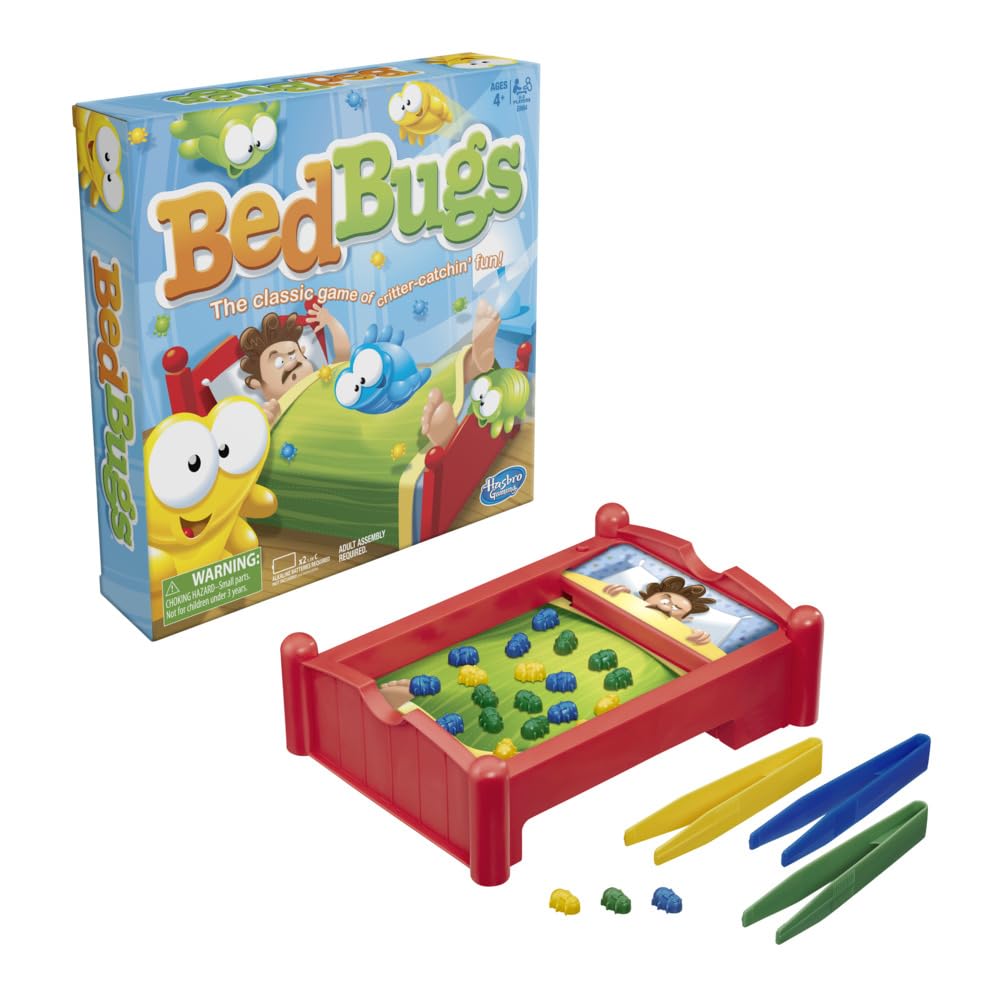
The vibrating bed game that turns catching plastic bugs into a speed challenge.
This Hasbro classic is all about action. A motorized gameboard “bed” vibrates, making 36 colorful plastic bugs bounce and hop all over the surface. Each player grabs a pair of tongs (blue, yellow, or green) and races to catch all the bugs of their matching color. The first one to clear their color out of the bed wins. It’s a game of hand-eye coordination, color matching, and a whole lot of giggling. The estimated playtime is around 20 minutes, making it perfect for a quick burst of fun.
Owners say this game is a hit with their kids, who love the chaotic energy of the bouncing bugs. It helps develop fine motor skills and hand-eye coordination in a very physical, engaging way. The setup is straightforward, and the bugs are durable enough to withstand rough play from 4 and 6 year olds. A few owners note the gameplay can feel a bit repetitive after a while, and the vibration mechanism can stop if pressed too hard. The size of the game is also noted as being compact, so manage expectations on how large the playing area is.
Core strengths
- Active, motor-skill-focused gameplay that gets kids moving
- Easy to understand and set up in minutes
- Great for building hand-eye coordination and color matching
Things to consider
- Gameplay can become repetitive after several rounds
- Only supports 2 to 3 players, so larger groups need another game
Best suited for: Kids who can’t sit still and need a game that lets them be hands-on and fast.
Not the best fit for: Quiet, thoughtful play or groups larger than three kids.
5. Hasbro Gaming Clue Junior Board Game

A two-in-one mystery game that teaches deduction without the stress.
Just like Monopoly Junior, this Clue game features a double-sided gameboard with two levels of play. Level 1, called the “Playground Mix-up,” is for ages 4 and up. In this cooperative game, everyone works together to figure out which item is missing from a character’s backpack by hunting for picture clues. Level 2, the “Science Lab Mystery,” is for ages 5 and up and introduces a competitive element where kids race to solve a “who, what, and where” mystery after a volcano erupts in the lab. It comes with a double-sided board, 9 playground tiles, 6 character pawns, 6 furniture tokens, and 7 color bases each of yellow, white, and blue, plus three dice.
What sets this apart is how it introduces logical deduction at a very young age. The cooperative first level means no one loses, making it perfect for nervous new gamers. The second level adds strategy and reading practice as they grow. Reviews highlight that a 4-year-old can grasp the Level 1 rules quickly, and the 15-20 minute playtime is just right. Some families find the directions can be a little unclear at first, but once understood, it becomes a favorite family night activity. The themes are cute and relatable for young kids.
What stands out
- Cooperative Level 1 removes the fear of losing for new players
- Double-sided board gives the game lasting value as kids age
- Teaches logical deduction and drawing conclusions from clues
Potential hiccup
- The instruction manual can be a bit confusing on the first read-through
Go for this if: You want to introduce your child to logic and mystery games in a gentle, collaborative way.
pass on it if: Your child prefers active, chaotic fun over sitting and thinking through a puzzle.
6. Hungry Hungry Hippos Kids Board Game

This marble-chomping frenzy has entertained generations of kids..
Hungry Hungry Hippos is a staple of childhood. The game’s simple lever mechanism creates fast, chaotic marble-chomping action.: four hippos sit around a central playing area, each attached to a lever. Players press down on their hippo’s tail to make it lunge forward and “chomp” down on the 20 plastic marbles that are released into the center. The player who eats the most marbles by the end of the round wins. The golden marble is the one to catch for victory. Cleanup is built-in, with storage for the marbles and hippos in the base.
This game offers pure, chaotic fun with no educational angle.. Owners love the nostalgia of playing it with their own kids, making it a cross-generational hit. It is incredibly easy to understand — press the tail, catch the marble. The gameplay is fast, chaotic, and always different due to the randomness of the bouncing marbles. The main point of discussion from buyers is the build quality. While many describe it as a classic they are happy to share, others note that the newer version uses thinner plastic and a cardstock box compared to the heavier boxes of decades past. For the price, it remains a very popular choice for a quick, loud, and happy game.
Why it endures
- Instantly recognizable and extremely easy for any age to pick up
- High-energy, short bursts of play keep kids engaged
- Excellent for developing hand-eye coordination and reflexes
A point of honesty
- The newer production models use thinner plastic compared to the vintage version, which some find disappointing
Best for: A loud, action-filled family game night where skill and chaos meet.
Think twice if: You prioritize build quality and a premium-feeling box over pure nostalgic fun.
7. National Geographic My First Safari Cooperative Board Game

A cooperative safari where everyone works together to beat the setting sun.
This is a game where no one loses. In My First Safari, players take on the roles of 5 safari explorers and work together to see all the animals before the sun token moves all the way across the board. It is entirely collaborative — you win or lose as a team. The game features three difficulty levels, so it can grow with your child’s skills. The included Learning Guide is packed with facts about the 21 animals featured, from elephants and cheetahs to gorillas and hippos, turning every play session into a mini-nature lesson.
Owners frequently praise how easy it is for 4-year-olds to learn and how it promotes a collaborative attitude rather than a competitive one. The animal facts are a big hit, keeping the game educational. The main piece of feedback is that the little character stands can be very hard to push into their bases, and a few have described the instructions as unclear. However, once set up, the gameplay is smooth and engaging, teaching strategic thinking and decision-making in a low-pressure environment. It’s a fantastic first board game for a child who is sensitive to competition.
What makes it a winner
- 100% cooperative, which removes any chance of hurt feelings over losing
- Three difficulty levels keep it interesting as kids improve
- Includes a detailed Learning Guide with real animal facts
Small frustrations
- Putting the small character pieces into their stands is fiddly and requires adult help
- The instruction sheet could be clearer
Reach for this if: Your child is empathetic and prefers playing as a team rather than head-to-head.
Look elsewhere if: You want a game that offers competitive play as an option — this one is purely cooperative.
8. Rainbow Unicorn Rescue Board Game

This unicorn adventure lets you choose between cooperative and competitive play..
Rainbow Unicorn Rescue is a game that offers two distinct ways to play: you can either work cooperatively with all players to save the unicorns. In a second mode, you can play head-to-head against each other to be the first to rescue one. This flexibility makes it a great choice for siblings with different play styles. The game revolves around moving through a magical world, and the “Rainbow Cards” are a standout feature — they prompt silly animal sounds and goofy actions, ensuring lots of laughter. A typical game lasts between 10 and 15 minutes, which is perfect for short attention spans.
Owners, especially those with 4 and 5 year olds, say this quickly becomes a favorite. The ease of play is a major selling point; kids can “read” the cards and understand the game without help. The board and pieces are well-made, with wood pieces adding a nice tactile feel. A minor issue some have encountered is a sticky spinner at the start, which is easily fixed with a bit of spray lubricant. The theme is a guaranteed hit with any child who loves unicorns, rainbows, or magical adventures.
What it does well
- Offers both cooperative and competitive modes, doubling the variety
- Rainbow Cards prompt silly sounds and motions for lots of giggles
- Very easy for a 4-year-old to understand and play independently
Minor detail
- The spinner can be sticky from the start and needs a little help to spin freely
Ideal for: Any child obsessed with unicorns, or families who want a flexible game that can be calm or competitive.
Not for: Kids who might be bored by a fantasy theme, or those looking for a skill-building game.
9. The Fidget Game SquishyLand in Rainbow Reef

This squishy phonics game makes learning to read feel like a reward..
SquishyLand is an educational board game designed to build early reading skills through a fun, multisensory experience. Developed by teachers and aligned with U.S. State and Canadian Provincial Standards, it helps children from Pre-K through 2nd grade with blending sounds, rhyming, decoding syllables, and understanding prefixes and suffixes. The game is inclusive and ability-friendly, designed for all learners, including those with autism, ADHD, or dyslexia. The secret weapon here is the tactile squishies — kids get to interact with them as they play, adding a sensory layer that boosts focus and reduces stress.
The biggest highlight from owners is how the game “sneakily” teaches reading skills. Customers note that their children repeatedly ask to play, and they don’t even realize they are practicing phonics. The game can level up with multiple card stacks. The board is large and vibrant, and the squishies are a genius addition. The main feedback is that the squishies can get dirty over time and are prone to a little paint wear from being pulled and squeezed. A few buyers also felt the value for money was a point of discussion, but most agree the quality and engagement it provides justify the purchase.
Standout features
- Multisensory play (sight, sound, touch) keeps kids engaged while learning
- Aligned with curriculum standards for real educational value
- Inclusive design supports kids with learning differences
Honest note
- The squishy pieces can get dirty and show paint wear from regular play
- Some parents question the price point, though most find it worth it
Best for: Parents who want a screen-free, research-backed way to teach their child to read.
it’s not for you if: You need a low-cost game or your child already has a very strong phonics foundation.
Understanding the Specs
Cooperative vs. Competitive Play
This is one of the biggest factors in how a game feels for a 4-year-old. Cooperative games (like My First Safari or Level 1 of Clue Junior) mean everyone plays together against the game itself. This removes the sting of losing and encourages teamwork, making it ideal for sensitive kids or first-time board gamers. Competitive games (like Monopoly Junior or Hungry Hungry Hippos) introduce the concept of winning and losing, which is a valuable lesson in sportsmanship but can be tough for some kids at first. Many of the best games, like Rainbow Unicorn Rescue, offer both modes.
Estimated Playtime
A 4-year-old’s attention span is notoriously short. You will want a game that promises a clear start and finish in a predictable time frame. Most of the games in this guide have playtimes between 10 and 20 minutes. This is a balance that allows for a complete game without boredom setting in. Games that run longer, even a junior version of Monopoly, might require a break or two before the winner is declared. Always check this spec before buying.
FAQ
What is the best first board game for a 4-year-old?
How many players do these games support?
How long does a typical game last for a 4-year-old?
Are there board games that teach reading and math for 4-year-olds?
What is the difference between a competitive and a cooperative board game?
Will a 7-year-old enjoy these games for 4-year-olds?
Are these board games safe for a 4-year-old?
What kind of skills do these board games teach?
Do I need batteries or electricity for these games?
How do I store these games and keep pieces from getting lost?
Final Thoughts: The Verdict
If you want one dependable pick, the best board games for kids 4 and up winner is the hand2mind Numberblocks Race to Pattern Palace! because it perfectly blends a beloved TV show with genuine educational value in a short, engaging playtime that kids ask for again and again. If you want a tried-and-true suspense game the whole family can enjoy, grab the TOMY Pop Up Pirate. And for building literacy skills in the most fun way possible, The Fidget Game SquishyLand is the creative standout to reach for.
How We Picked
We do not accept paid placement. Every pick is matched to a real buyer and a real use-case; we do not hands-on test units.
Sources & Methodology
Specifications: manufacturer listings and product documentation. Review insights: verified customer reviews, as of July 2026. Pricing: not shown on this page (it changes often); check the current price via the retailer link.
As an Amazon Associate, Gadgets Feed earns from qualifying purchases. This does not affect which products we feature.