
Our readers keep the lights on and my morning glass full of iced black tea. As an Amazon Associate, I earn from qualifying purchases.
Specs are compiled from manufacturer listings and verified buyer reviews and can change over time — please confirm the key details on the product page before buying.
The biggest mistake people make with Dolby Atmos is thinking any speaker pointed at the ceiling will do. The effect relies on a precise overhead sound bubble — and the wrong speaker turns helicopters into vague noise. This guide breaks down the ones that actually deliver the full-height, three-dimensional soundstage you are after, without the guesswork.
I’m Min — the founder and writer behind Gadgets Feed. This guide is built by comparing the manufacturers’ published specifications and the patterns across verified customer reviews, so you get each pick’s real strengths and trade-offs instead of marketing spin.
Whether you are building a 5.1.2 or a full 7.1.4 system, finding the right ceiling speakers for atmos depends on matching your room layout, amplifier power, and if you want a direct-firing or reflective design — here is what works best for each scenario.
Our Picks at a Glance
How To Choose The Best Ceiling Speakers For Atmos
Buying the right Atmos speaker is not about the brand name — it is about how the speaker fires sound into your room. Most people assume a standard in-ceiling driver works, but the angle and driver design are everything for a convincing overhead effect.
Direct-Firing vs Reflective Designs
A reflective speaker (like a traditional bookshelf placed high on a wall) relies on sound bouncing off your ceiling to reach your ears. This is hit-or-miss and depends heavily on ceiling height and material. A direct-firing speaker, either angled in the ceiling or mounted on the wall pointed at the listening position, delivers a far more reliable and rich Atmos bubble. The data backs this up — owners of direct-firing models report noticeably better overhead steering.
Woofer Angle and Tweeter Pivot
For in-ceiling models, the angle of the main woofer and the ability to pivot the tweeter matter tremendously. A fixed, downward-firing driver sends sound straight to the floor, not your ears. A speaker with a 15-degree angled woofer and a pivoting tweeter aims the sound directly at the seating area, creating that distinct overhead effect where a helicopter seems to fly right over your head.
Power Handling and Sensitivity
Atmos height speakers need to keep up with your main left, center, and right channels without distortion. Look for a power handling figure (like 175 watts) that matches your receiver’s output. Sensitivity ratings are less frequently advertised, but if your receiver is on the lower-powered end, a more efficient speaker will sound louder and clearer at the same volume level.
Quick Comparison
| Model | Best For | Design Type | Driver Size | Power Handling | Amazon |
|---|---|---|---|---|---|
| SVS Prime Elevation★ Best Overall | Direct-Firing Versatility | On-wall/ceiling angled | 4.5″ mid-woofer & 1″ tweeter | Undisclosed | Amazon |
| OSD ACE870 | In-Ceiling Stealth | 15° angled in-ceiling | 8″ woofer & 1″ tweeter | 175W | Amazon |
| MartinLogan Motion AFX | Reflective Bounce | Reflective (on-wall bounce) | 4″ woofer & 0.75″ tweeter | Undisclosed | Amazon |
| Klipsch RP-500SA II | Horn-Loaded Precision | On-wall elevation (switchable) | 5.25″ Cerametallic & 1″ LTS tweeter | Undisclosed | Amazon |
In‑Depth Reviews
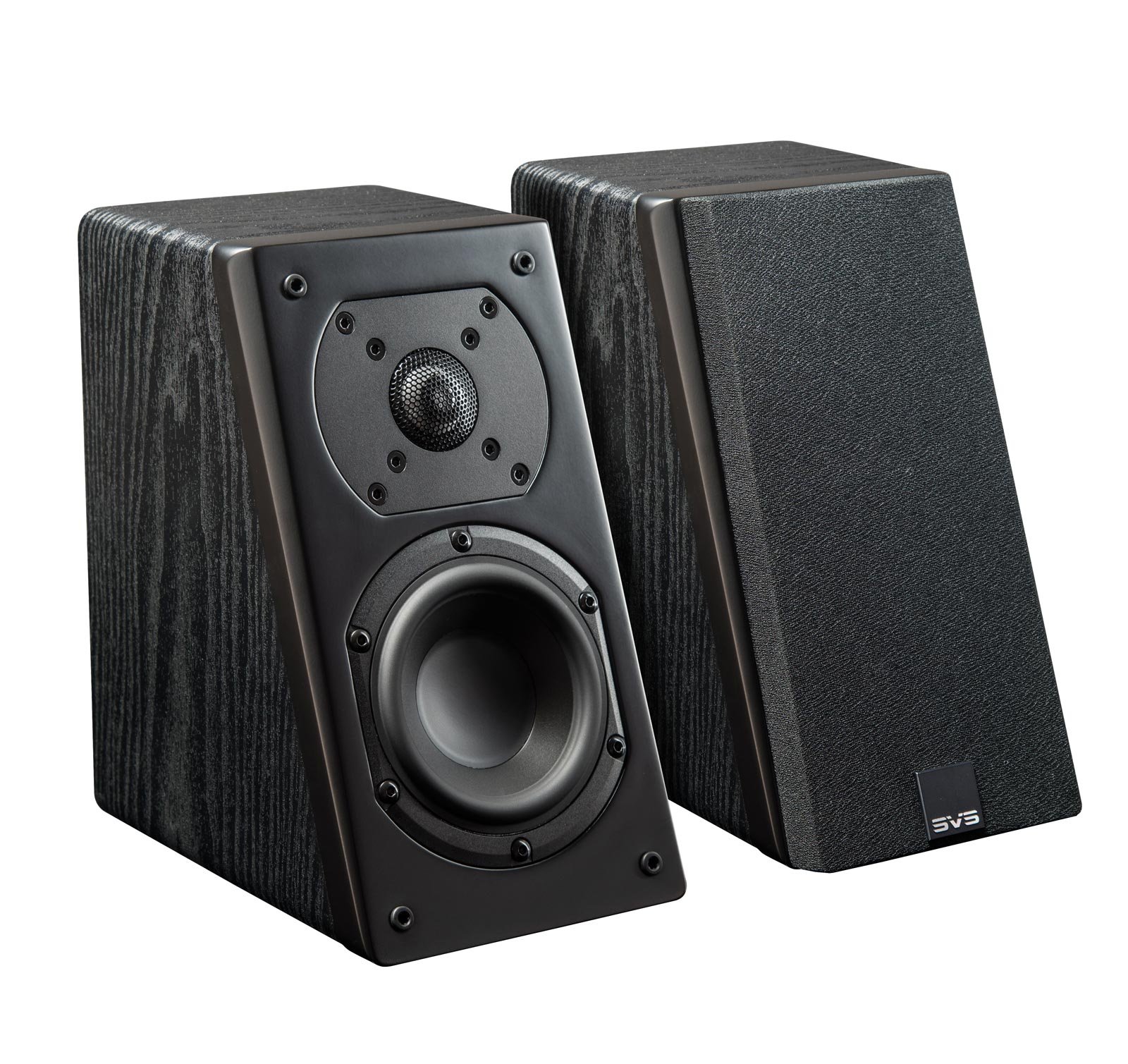
1. SVS Prime Elevation Speaker (Pair) – Premium Black Ash
Our pick — over 4.5★ from 400+ verified ratings; the strongest balance of quality and price.
The direct-firing specialist that demolishes the “ceiling bounce” limitation.
If you want a dedicated height effect that sounds like rain is actually falling above you — not bouncing vaguely off a surface — this is the one. The SVS Prime Elevation uses a 1-inch aluminum dome tweeter and a 4.5-inch mid-woofer inside an acoustically inert cabinet to project full-range sound straight at your ears. It completely sidesteps the frequency and room-condition problems that plague reflective “bounce” designs. Buyers report it integrates beautifully with advanced room correction software, making calibration straightforward.
The included multi-angle wall bracket (patent-pending) lets you mount it up-firing, down-firing, or directly overhead on the ceiling. This flexibility means you can fine-tune the aim for your exact seating position, which is a huge advantage over fixed in-ceiling drivers. A 20-degree angled baffle makes wall-mounting easy with standard drywall anchors. Do note that there are no banana plug inputs — the connectors accept bare wire from 10 to 12 gauge, which is secure but requires a small extra step during installation.
The crowd favorite among dedicated home theater enthusiasts — with over 400 ratings and a nearly perfect score. Buyers specifically call it out as excellent for a 7.1.4 system and say the build quality rivals more expensive brands. The consensus is that they “dramatically widen and heighten the soundstage,” which is exactly what you need for Atmos music and movie soundtracks.
SVS precision elevation
- Direct-firing design eliminates reflective ceiling dependency — works in rooms with higher or textured ceilings.
- Multi-angle bracket allows wall, ceiling, or overhead mounting with zero compromise on aim.
- Premium build quality that owners say matches Definitive Technology and B&W speakers.
wall alignment tricky
- No banana plug inputs — requires bare wire (10-12 gauge) connection.
- Mounting plate alignment takes a few practice runs before you settle on the perfect spot.
best for Atmos: you want the absolute best overhead effect and have the flexibility to mount speakers on a wall or directly on the ceiling — the SVS delivers a 10 out of 10 performance that owners call “too good to use only as height channels.”
skip if angled: you need a completely flush in-ceiling installation that disappears into the drywall — the Prime Elevation is an on-surface design and will be visible.
2. OSD 8″ Trimless Ceiling Speaker 175W LCR Home Theater Surround, Contour Switch, ACE870 (Single)

A stealthy in-ceiling solution that brings genuine overhead steering without the visual footprint.
Unlike the SVS which mounts on the surface, the OSD ACE870 is designed to disappear into your ceiling. The trimless grille sits flush against the drywall — held by powerful magnets — making it nearly invisible once installed. What makes this speaker tick for Atmos is the 15-degree angled woofer combined with a pivoting 1-inch aluminum dome tweeter. That angle is critical: it aims the sound directly at the listening position instead of straight down at the floor, creating the distinct overhead bubble that makes Atmos effects like rain and helicopters feel real.
The 8-inch carbon fiber composite cone woofer and 175-watt power handling give it serious output capability for a height channel. Owners mention that the sound is “clear, detailed with good panning” and that the 15-degree angle is crucial for the effect. It also has contour switches that let you tailor the bass and treble to your room acoustics — a nice touch when you are working with a ceiling installation that you cannot move after the fact. Note that each speaker is sold individually, so factor that into your budget for a 7.1.4 system.
The build quality is a step ahead of budget competitors. Owners specifically call out the solid construction compared to brands with known issues like broken mounting tabs or foam degradation. The trimless design and magnetic grille make it look clean and modern. The installation can be a little fiddly — the mounting cams do not always rotate smoothly on the first turn, requiring some jiggling to get them into position — but once they are in, the speaker feels very secure.
flush ceiling fit
- 15-degree angled woofer and pivoting tweeter provide pinpoint overhead aim.
- Trimless magnetic grille makes the speaker nearly invisible after installation.
- sturdy build quality that owners say beats Monoprice and Polk equivalents.
requires deep cavity
- Installation cams can be tricky to align — plan for some patience during mounting.
- Sold as a single speaker; a pair for left and right Atmos channels requires two units.
invisible install: you want a clean, flush-mount in-ceiling look that delivers authentic Atmos steering without seeing a speaker bracket — this is the best value for that specific goal.
skip shallow space: you are not comfortable with ceiling installation or need a simpler plug-and-play setup — the OSD requires cutting drywall and running wires.
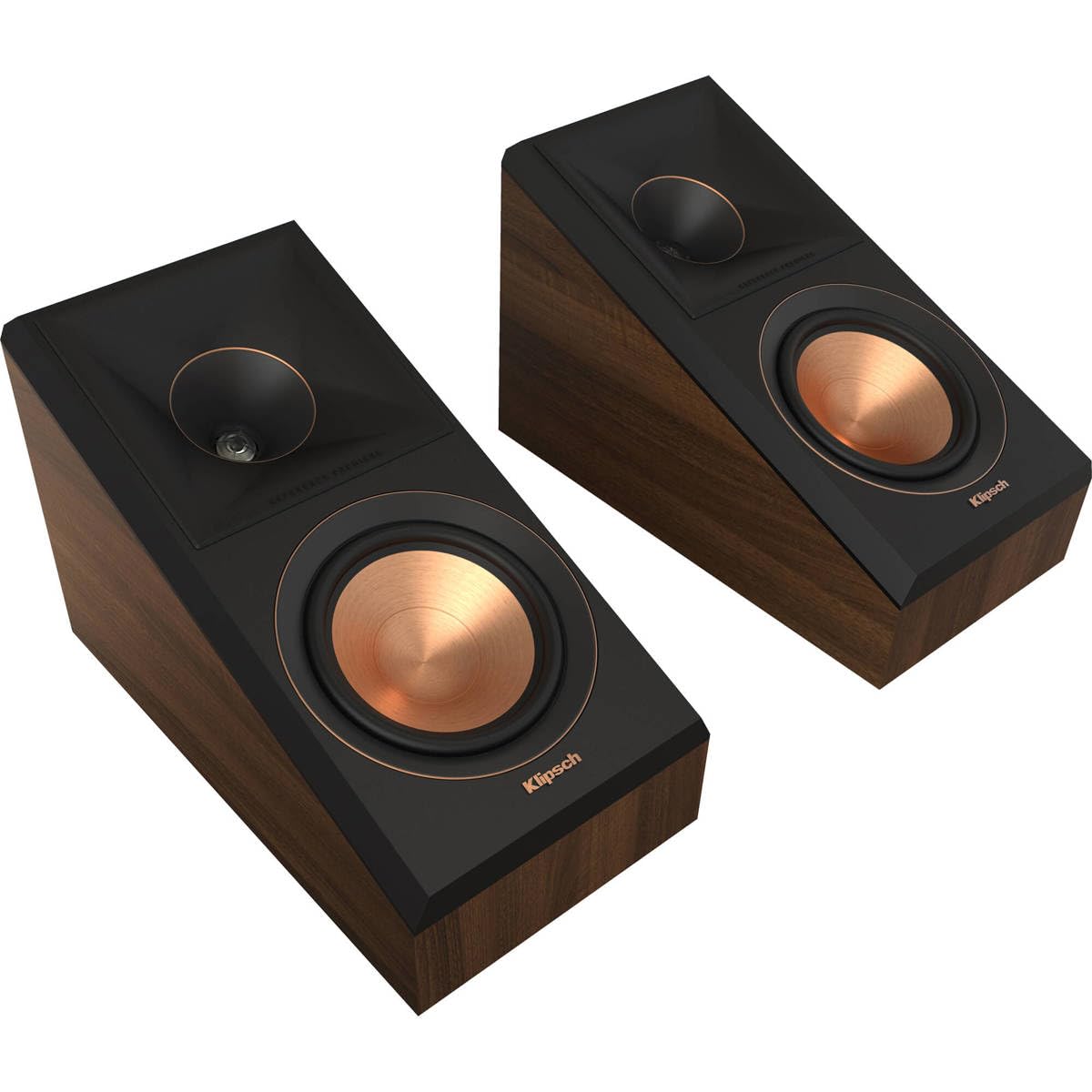
3. Klipsch Reference Premiere RP-500SA II Walnut Surround Sound Speakers
Horn-loaded precision that puts a laser focus on Atmos effects — perfect for matching Klipsch towers.
The Klipsch RP-500SA II uses a 90° x 90° silicone composite hybrid Tractrix horn paired with a 1-inch Linear Travel Suspension (LTS) titanium diaphragm tweeter. What that means in plain English is that the sound is directed with extreme accuracy, so a helicopter pan does not sound like a vague whoosh — you hear it move from front to back with clear placement. These are on-wall elevation speakers, designed to sit above your main left and right channels, not in the ceiling. The switchable crossover lets you toggle between Atmos mode and surround mode, giving you the flexibility to repurpose them as rear surrounds later if you change your mind.
The all-new Cerametallic 5.25-inch woofers deliver flawless sound reproduction with minimum distortion. Owners matched them with Klipsch RP-8000F towers and report that after recalibration, Atmos effects like jet flyovers and helicopter scenes were “clear and rich.” The new silicone composite horn is notably less harsh than some previous Klipsch designs — owners specifically note they do not sound overly bright. The furniture-grade wood finish and magnetic grille give them a premium appearance that looks like a dedicated showroom setup.
One thing to be aware of: these are larger than they look. At 5.25 inches, the driver and the horn assembly make them too big to sit comfortably on top of a bookshelf speaker like the R-50M. They work best with floorstanding speakers where you can wall-mount them above. And while the build quality is impressive across the board, a few owners mention the keyhole mounting system takes some careful measuring to get the aim right. The overall sentiment is that they provide a “subtle but worthwhile improvement” over the previous generation, especially for rich music from Blu-ray discs.
Klipsch horn clarity
- 90° x 90° Tractrix horn delivers pinpoint directional control for Atmos effects.
- Switchable crossover lets you repurpose the speaker from Atmos to surround mode.
- Furniture-grade wood finish looks premium and matches Klipsch RP floorstanders.
bulky for shelves
- Physically large — may not fit on top of bookshelf speakers; best paired with floorstanding towers.
- Requires wall-mounting for the best effect, which involves more planning than a simple shelf placement.
dynamic sound: you already own Klipsch floorstanding speakers and want a matching Atmos layer with horn-loaded precision — the clarity is a step up from typical in-ceiling drivers.
skip tight rooms: your ceiling is low or you need a flush, invisible installation — the RP-500SA II is an on-wall speaker that sits visibly above your mains.
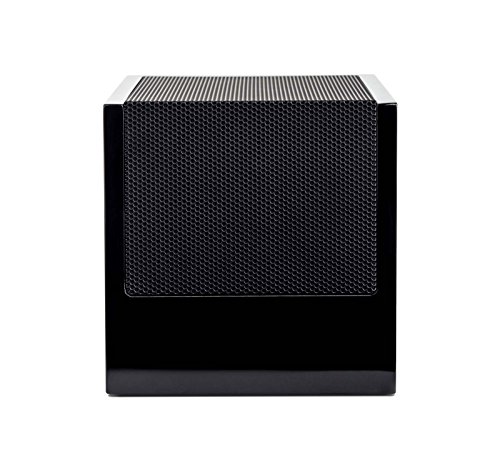
4. MartinLogan Motion AFX Speakers (Gloss Black)
A compact reflective speaker for those who want a minimalist Atmos add-on without cutting drywall.
The MartinLogan Motion AFX takes a different approach from the first three picks: it is designed to sit on top of your front left and right speakers and bounce sound off the ceiling to create the overhead effect. The speaker houses a 0.75-inch tweeter and a 4-inch woofer inside a wood enclosure finished in gloss black. Because it is a reflective design, it relies heavily on your ceiling being flat and at a reasonable height — ideally under nine feet. In rooms with standard 8-foot ceilings, some customers note a noticeable overhead effect when paired with larger floorstanding towers.
The packaging includes two speakers, which is convenient — no math needed for a stereo pair. However, the reflective approach is inherently less precise than direct-firing or angled in-ceiling designs. One owner with 8-foot 10-inch ceilings and a premium MartinLogan setup (Motion 60XTs, center channel, LX 16 rears) reported they “could not really tell a difference” even with the channel level at +12 dB. They noted the effect was faint and only sounded like it was near the ear rather than overhead. For rooms with flat, low ceilings and the right speaker placement, they can work well, but the margin for error is much narrower than a direct-firing alternative.
Build quality is typical MartinLogan — solid wood cabinets with a durable gloss finish that looks right at home next to their tower speakers. The custom 5-way tool-less binding posts make connecting speaker wire straightforward. This is a good option if you absolutely cannot cut into your ceiling or wall-mount speakers, but it requires the right room geometry to deliver the Atmos experience you are paying for.
MartinLogan dipole ease
- No ceiling cuts or wall mounting required — sits on top of existing front speakers.
- Sold as a pair, making stereo setup simple and cost-effective.
- Solid wood cabinets with a premium gloss finish match MartinLogan towers.
placement critical
- Reflective design requires a flat, low ceiling (ideally under 9 feet) to work effectively.
- Some owners with 8-foot 10-inch ceilings found the overhead effect indistinguishable from standard height channels.
no-drill solution: you own MartinLogan towers, have a flat ceiling under nine feet high, and want a zero-construction Atmos upgrade that keeps your living room looking clean.
skip small setups: you have a textured ceiling, high vaulted ceilings, or you expect the same pinpoint overhead effect that direct-firing designs deliver — the bounce approach has too many variables for consistent results.
Understanding the Specs
Direct-Firing vs Reflective
A direct-firing speaker (like the SVS Prime Elevation) aims sound straight at your ears. A reflective speaker (like the MartinLogan AFX) bounces sound off the ceiling. Direct-firing is far more predictable because it does not depend on your ceiling being perfectly flat or at the right height. For Atmos, direct-firing designs consistently produce a stronger and more rich overhead effect in typical home rooms.
Woofer Angle and Tweeter Pivot
For in-ceiling speakers, look for an angled woofer and a pivoting tweeter. A standard downward-firing driver sends sound to the floor, not your ears. A 15-degree angled woofer (like the OSD ACE870) aims the sound at your listening position. A pivoting tweeter lets you fine-tune the high-frequency detail for the exact seat you watch from. This combination is what creates the convincing overhead bubble that makes Atmos work.
FAQ
Can I use standard in-ceiling speakers for Dolby Atmos?
How many Atmos speakers do I need for a 5.1.2 system?
What is the difference between up-firing and in-ceiling Atmos speakers?
Do I need a special AV receiver for Atmos speakers?
Can I mount the SVS Prime Elevation directly on the ceiling?
Are the OSD ACE870 speakers sold as a pair?
What does the switchable crossover do on the Klipsch RP-500SA II?
Will reflective Atmos speakers work with a textured ceiling?
Final Thoughts: The Verdict
For most users building a dedicated home theater, the ceiling speakers for atmos winner is the SVS Prime Elevation because it delivers the most reliable and rich overhead effect through direct-firing design, backed by a nearly perfect score across hundreds of owners. If you need a flush in-ceiling installation that disappears into your room, grab the OSD ACE870 for its 15-degree angled woofer and exceptional value. And for a matching horn-loaded layer with your Klipsch floorstanders, the Klipsch RP-500SA II brings precision and furniture-grade looks that improve the entire setup.
How We Picked
We do not accept paid placement. Every pick is matched to a real buyer and a real use-case; we do not hands-on test units.
Sources & Methodology
Specifications: manufacturer listings and product documentation. Review insights: verified customer reviews, as of July 2026. Pricing: not shown on this page (it changes often); check the current price via the retailer link.
As an Amazon Associate, Gadgets Feed earns from qualifying purchases. This does not affect which products we feature.