
Our readers keep the lights on and my morning glass full of iced black tea. As an Amazon Associate, I earn from qualifying purchases.
Specs are compiled from manufacturer listings and verified buyer reviews and can change over time — please confirm the key details on the product page before buying.
Picking a radio today is less about finding one that works and more about finding one that actually works when you need it most — during a storm, at the campsite, or in a spot where the signal fades. The difference between a radio that pulls in a clear AM station thirty miles away and one that only delivers static often depends on a handful of specs you can check in seconds.
I’m Min — the founder and writer behind Gadgets Feed. This guide is built by comparing the manufacturers’ published specifications and the patterns across verified customer reviews, so you get each pick’s real strengths and trade-offs instead of marketing spin.
if you need an emergency lifeline or a simple tabletop companion, these are the models that earn their place as the am/fm radio worth your attention right now.
Our Picks at a Glance
How To Choose The Best AM/FM Radio
You might think all radios are the same, and you would be wrong in ways that matter when the power is out or you are deep in a valley. A few key decisions make or break your experience.
The Power Source Trio
Every radio on this list runs on one of three setups: disposable batteries (AA or C cells), a built-in rechargeable battery (measured in mAh), or a wall plug with battery backup. The best choice depends on your use case — emergency preparedness demands a radio with multiple ways to charge, while a kitchen table radio can live on AC power alone.
Reception: AM vs. FM
FM signals are line-of-sight and easier to pull in with a short antenna. AM signals travel farther at night but are harder to lock cleanly. A radio with a digital signal processor (DSP) will hold AM stations much better than an old analog circuit, especially if you live in a fringe reception area.
Extra Features That Actually Matter
NOAA weather alerts, flashlight beams, and USB charging ports turn a simple radio into a survival tool. Bluetooth streaming and auxiliary inputs make it a home audio device when you are not listening to the news. Think about if you need one role or several before you buy.
Quick Comparison
| Model | Best For | Battery Capacity | Speaker Size | Weight | Amazon |
|---|---|---|---|---|---|
| Mesqool Emergency Radio★ Best Overall | Storm/outdoor survival | 12000mAh | Not specified | 1.6 lb | Amazon |
| FosPower A1Best Value | Emergency preparedness kits | 7400mWh (2000mAh) | Not specified | 14.8 oz | Amazon |
| Jazmm Pocket RadioCompact Pick | On-the-go pocket carry | 1250mAh | 5W | Not specified | Amazon |
| Audiocrazy Portable | Kitchen/desktop with Bluetooth | 1800mAh | Not specified | 1.3 lb | Amazon |
| Panasonic RF-2400D | Senior-friendly daily use | 4x AA (not included) | Not specified | Not specified | Amazon |
| Yewrich Retro | Home/office big sound | Not specified | 5W | 2.5 lb | Amazon |
| LoopTone Vintage | Retro decor with Bluetooth | Plug-in (AC) | Not specified | 1.3 kg | Amazon |
| Sangean WR-15WL | Rich-sounding tabletop | Plug-in (AC) | Not specified | Not specified | Amazon |
| Sangean TB-100 TOUGHBOX | Rugged outdoor/garage | 4x C (not included) | 5.25″ | 7 lb | Amazon |
In‑Depth Reviews
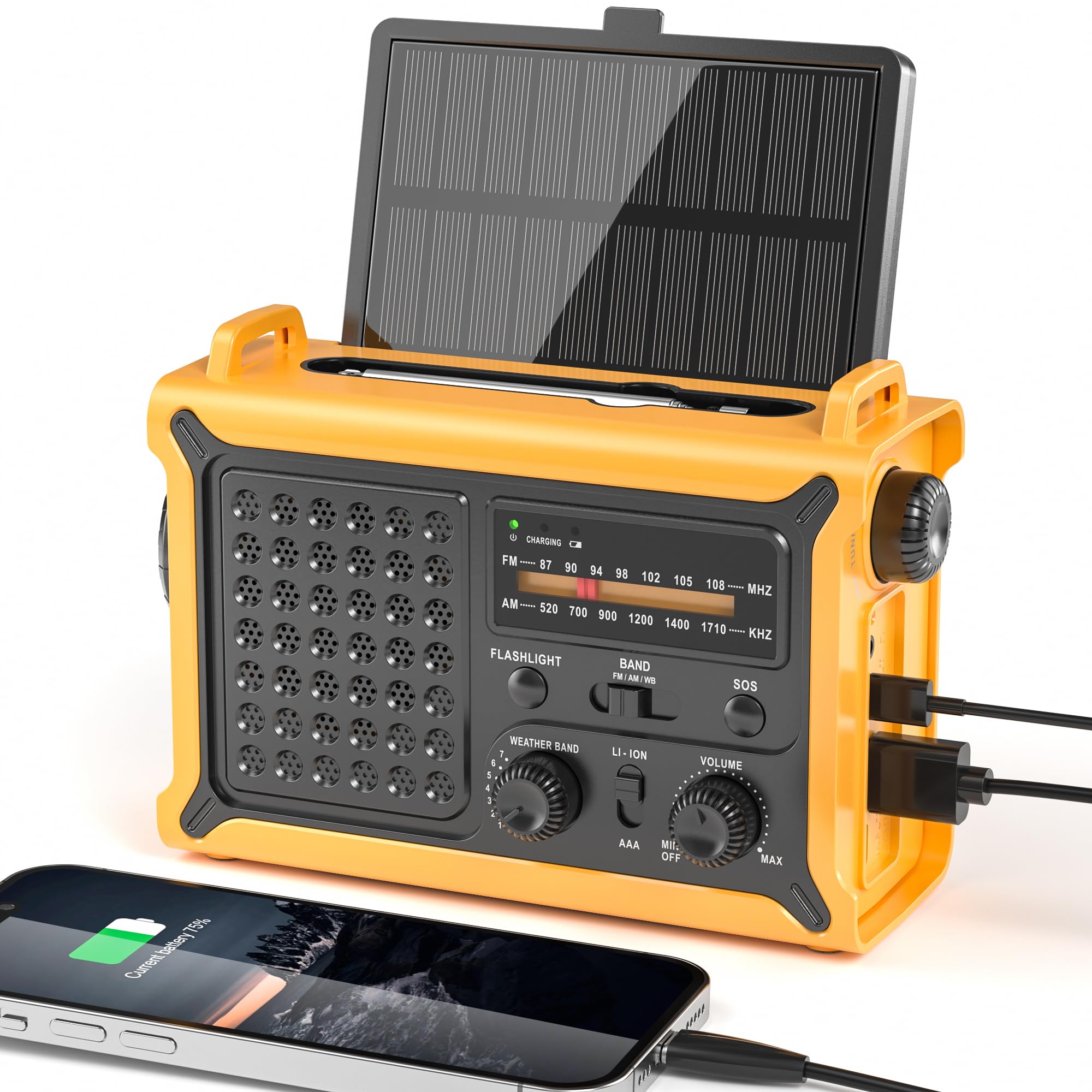
1. Mesqool Weather Radios Portable AM FM NOAA Alert (12000mAh)
Our pick — over 4.5★ from 950+ verified ratings; the strongest balance of quality and price.
The emergency station that keeps running when the grid doesn’t.
This is the radio you grab when the weather alert goes off — and you don’t want to think about battery life for days. It packs a genuine 12000mAh lithium battery, a 12000mAh capacity, far exceeding the 1250mAh in pocket-sized units. Buyers report using it on a 10-day camping trip where it played all night on low volume and was 99% solar charged. The solar panel is a large 8500mm² monocrystalline unit, so it actually charges in cloudy conditions.
Reception is handled by a high-sensitivity signal chip and noise-reduction circuitry that delivers clear NOAA, AM, and FM sound. The flashlight throws a focused beam up to 260 feet, and there is a frosted reading lamp for a softer glow. It weighs 1.6 pounds and measures 6.8 x 4.7 x 2.9 inches — substantial enough to feel solid but compact for a go-bag.
The crowd favorite — it holds a 4.7-star rating across nearly a thousand owners. What wins people over is the build quality and the sheer functionality: five power options (solar, hand crank, USB, AAA batteries, and AC), crisp reception, and a well-designed ergonomic grip. The only honest caveat is the lack of a battery level indicator — a few owners note they wished they could check remaining charge at a glance, though the solar panel keeps it topped off most of the time.
Why it leads the list
- Massive 12000mAh battery dwarfs every other radio here
- Large 8500mm² solar panel charges even in low light
- NOAA weather alerts plus AM/FM with noise reduction
- Flashlight reaches 260 feet with two brightness levels
The single trade-off
- No battery level indicator — you charge by habit, not by gauge
Reach for this if: you want one radio that survives a multi-day power outage or camping trip without hunting for outlets or batteries.
Look elsewhere if: you only listen at a desk plugged into the wall — the size and solar panel are overkill for that use.
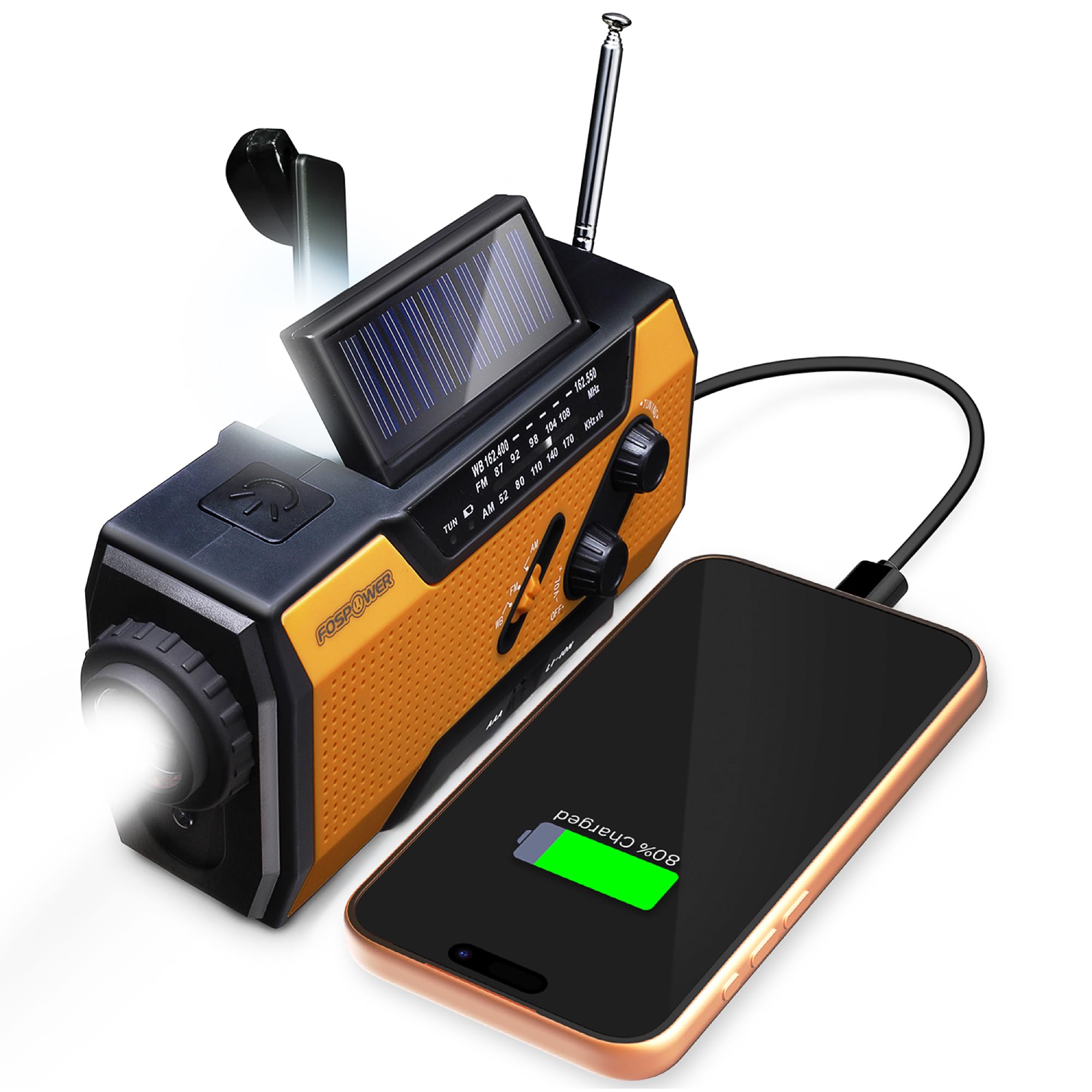
2. FosPower NOAA Emergency Weather Radio A1 (7400mWh)
The proven workhorse that tens of thousands of owners already trust.
With over thirty-seven thousand ratings and a 4.6-star average, this is the most-reviewed emergency radio on the list. It packs a 7400mWh (2000mAh) power bank that can charge a small tablet or phone in a pinch — a feature that makes the difference between a dead phone and a call for help. It runs on a hand crank, a solar panel, or three AAA batteries, so you always have a fallback.
The radio pulls in NOAA emergency broadcasts and AM/FM stations clearly. It also includes a 4-LED reading light and a 1W flashlight. At 14.8 ounces and 6.2 x 2.1 x 2.9 inches, it is compact enough to stash in a glovebox or emergency kit without thinking twice. The thing everyone raves about is the sheer reliability: owners leave AAA batteries inside for 9+ months and find it still works, and the hand crank revives the radio even when the flashlight is dim.
The honest trade-off? Charging is a common point of discussion — the solar panel is small and slow compared to the Mesqool above, so you will rely more on the hand crank or AAA backup. But at this price, the durability and confidence are tough to top.
Compact confidence: Small enough to toss in a bag, rugged enough to last years, and backed by a limited lifetime warranty — the definition of set-and-forget preparedness.
Best for: someone building an emergency kit on a budget who wants a proven radio with thousands of happy owners backing it up.
Skip if: you need all-day solar charging — the small panel here is more of a trickle charger than a primary power source.
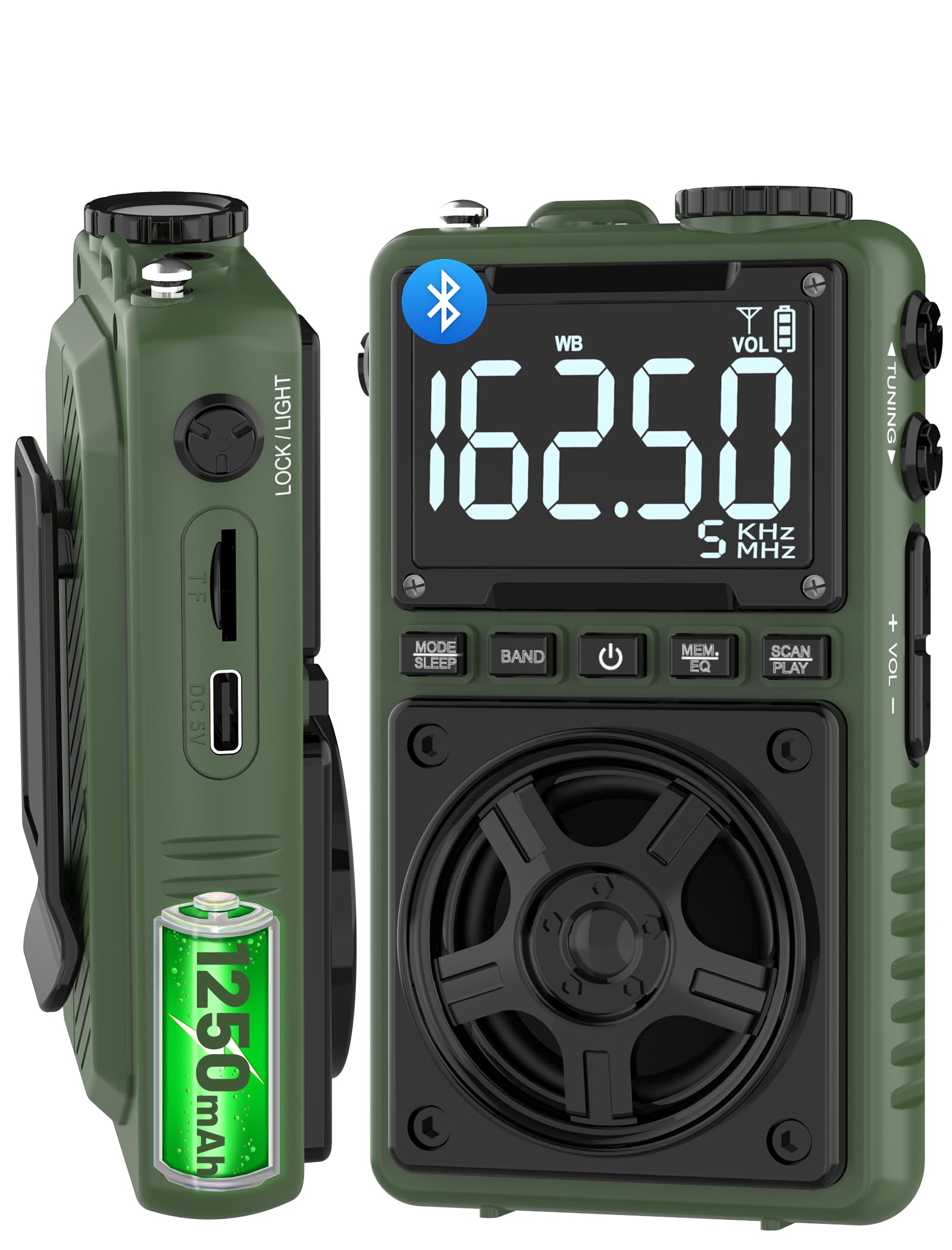
3. Jazmm Bluetooth AM FM Shortwave Radio (1250mAh)
A full-featured pocket radio that fits inside a shirt pocket.
At 2.3 x 4 x 1.3 inches, this radio is genuinely tiny — and yet it crams in AM/FM, shortwave, NOAA weather, a 5W speaker, Bluetooth, a flashlight, and a TF card slot. It is the only radio here that also plays MP3 files from a memory card, so you can load up audiobooks or a playlist for the trail. The built-in 1250mAh battery delivers 10 to 12 hours per charge via USB-C.
The digital tuner uses an advanced DSP chip that pulls in stations the old radios miss. What wins people over is the size category — it is the top-rated aspect by far. Owners slip it into a shirt pocket or clip it to a belt with the back clip and take it on walks, bike rides, and camping trips. The 5W speaker produces sound loud enough to fill a small room, yet the radio weighs almost nothing.
There are a couple of honest notes: AM and medium-wave reception is not the strongest due to internal noise from the compact design, and shortwave enthusiasts may want an external antenna for serious listening. But as a do-everything pocket companion, nothing else this small comes close.
Pocket-sized powerhouse
- Four bands: AM, FM, shortwave, and NOAA weather
- Bluetooth streaming plus TF card MP3 playback
- 5W speaker is unusually loud for its size
- Back clip and wrist strap for on-the-go carry
Reality check
- AM/MW reception is limited — expect stronger performance on FM and shortwave
- Shortwave users will want a longer external antenna for distant stations
Reach for this if: you want a music-streaming Bluetooth speaker that also pulls in shortwave and weather — all in a pocket-sized package.
Look elsewhere if: AM talk radio is your main use — the compact chassis limits AM sensitivity compared to larger radios.
4. Panasonic Portable AM/FM Radio (RF-2400D)

The analog radio that proves simple is still the best design.
Over thirty-three thousand ratings and a 4.5-star average speak to a radio that has been a trusted companion for years. This Panasonic is the definition of no-fuss: a large tuning dial with a fluorescent pointer you can read in the dark, a big volume wheel, and zero menus. It runs on four AA batteries or the included AC adapter, making it perfect for a kitchen counter or a bedside table.
The reception is excellent for FM — owners in fringe areas near mountains report clear sound with no interference. The AM side is more basic, lacking a tone adjustment, but for talk radio and news it gets the job done. A 3.5mm headphone jack gives you private listening. What wins people over is the ease of use: seniors, in particular, find the large knobs and simple dial far more approachable than digital radios. The build quality is classic Panasonic — sturdy plastic that feels like it will last a decade.
The honest trade-off is that the analog tuning scale is off by about 20 units on AM, so you tune by ear rather than by number. It is a minor nit for a radio that costs what it does and delivers such consistent performance.
Old-school dependability: No Bluetooth, no apps, no fuss — just a big dial, a clear speaker, and reception that beats radios twice its price.
Best for: anyone who wants a simple, reliable radio they never have to figure out — especially older family members or kids.
Skip if: you want to stream music from your phone or need NOAA weather alerts — this is strictly AM/FM with an aux input.
5. Sangean WR-15WL AM/FM Table Top Wooden Radio (Walnut)

A tabletop radio that sounds as good as it looks — rich bass from a small cabinet.
The Sangean WR-15WL is the radio that makes you stop and listen. It is housed in a solid MDF cabinet with a walnut veneer, and it weighs enough to feel premium. The ported speaker enclosure delivers bass that is genuinely surprising from a radio this size — owners say it sounds better than the Tivoli Pal it replaced. It has a smooth analog tuner with a green LED indicator, and the aux input lets you connect a Bluetooth receiver or MP3 player if you want to stream.
Reception is strong on FM, especially with the included F-type antenna terminal for connecting an external antenna if you are far from towers. What wins people over is the sound quality — the top aspect by a wide margin. The radio fills a room with warm, detailed audio that makes news, sports, and music all sound better. At 6 x 4.75 x 8 inches, it sits perfectly on a bookshelf or kitchen counter.
The catch? AM reception is not as strong as FM, and the AM dial can be off by about 50 points. Also, there is no built-in Bluetooth — you must use the aux port for wireless streaming. These are small concessions for a radio that sounds this rich.
Audio quality first
- Ported speaker enclosure delivers deep, rich bass
- Solid wood MDF cabinet that looks like furniture
- Aux input for external audio sources
- Smooth analog tuning with green LED indicator
Two notes to know
- No built-in Bluetooth — use the aux port with an adapter
- AM reception is weaker than FM; the dial scale is off by ~50 units
Reach for this if: you care about how your radio sounds — for music and talk alike, this is the best-sounding tabletop radio on the list.
Look elsewhere if: you need to carry it around or run it on batteries — this is a plug-in unit meant to stay put.
6. AudioCrazy Portable AM FM Rechargeable Bluetooth Radio
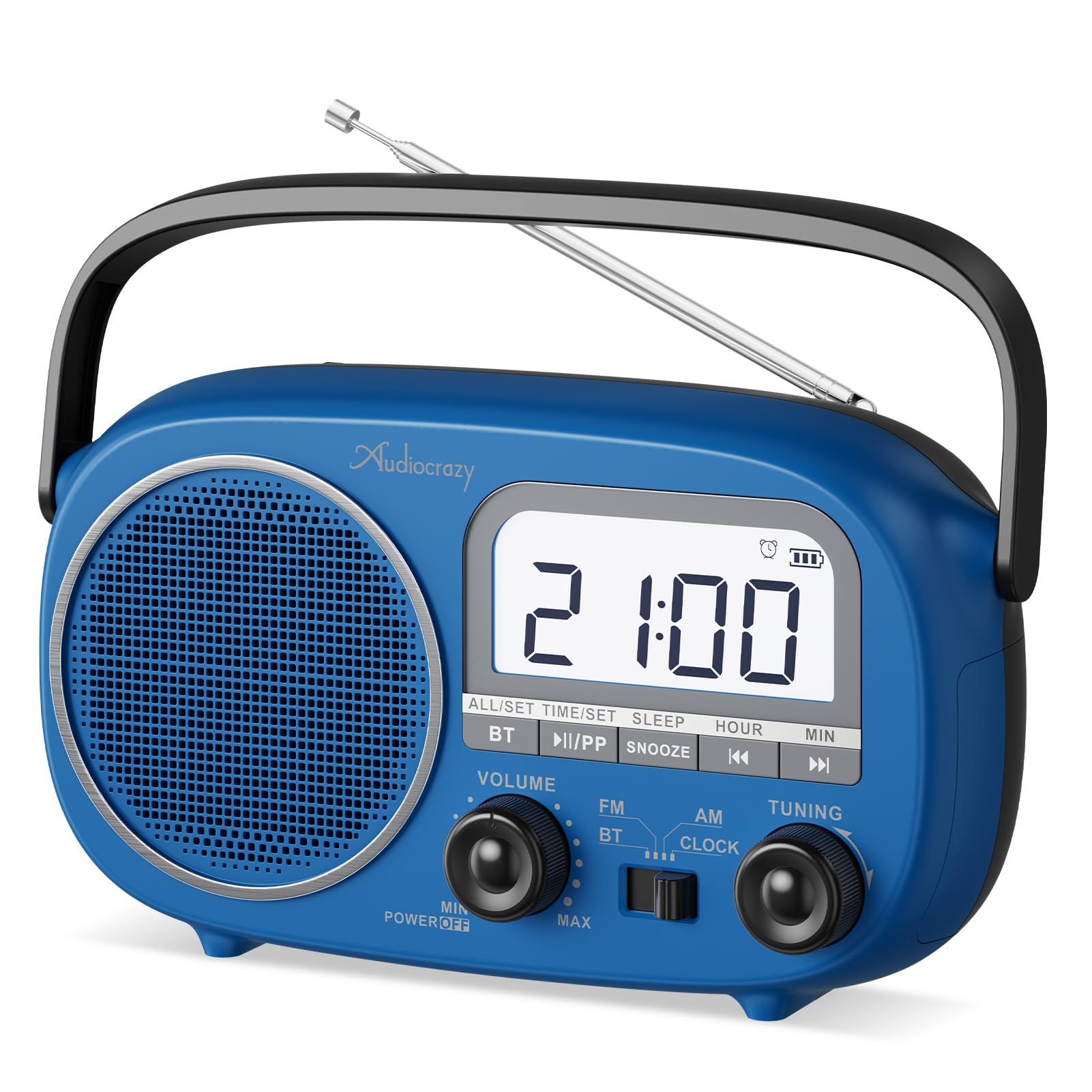
A bedside alarm clock that also streams Bluetooth and runs on three power sources.
This one is a genuine multi-tasker. It works as a plug-in wall radio at home, runs on a built-in 1800mAh rechargeable battery for up to 10 hours, or takes four AA batteries as a third option. That flexibility makes it equally useful on a nightstand, at a picnic table, or during a power outage. The large LCD display shows the station clearly with a backlight, and it includes a single alarm and a sleep timer (0-90 minutes).
The DSP-based tuner locks AM and FM stations reliably, and Bluetooth streaming lets you play podcasts and audiobooks from your phone. Owners praise the sound quality — the top-rated aspect — especially given the compact size and affordable price. At 1.3 pounds and 9.4 x 2.95 x 6.93 inches, it is light enough to move from room to room.
The most common note from owners is that the sound, while clear, lacks deep bass — it can sound a little “tinny” on music. For talk radio and news, it is perfectly fine. There is also no NOAA weather band, so this is not the radio to grab for storm warnings.
Every-scenario companion: Wall plug, rechargeable battery, or AA cells — this radio adapts to wherever you need it, with Bluetooth and a clock thrown in.
Best for: someone who wants a kitchen radio that doubles as an alarm clock and Bluetooth speaker — all without a separate charger.
Skip if: you need NOAA weather alerts or deep bass for music listening.
7. LoopTone Vintage AM FM Classic Retro Bluetooth Radio

Vintage looks with modern Bluetooth — a piece of furniture that plays music.
This radio is as much a decoration as it is a device. The wood cabinet and retro styling with rotary knobs make it a natural fit on a kitchen counter, bookshelf, or office desk. It includes treble and bass controls, so you can dial in the sound to your preference — a feature rare in this price range. Bluetooth pairs quickly with your phone for streaming, and the AM/FM tuner uses the classic analog dial.
What wins people over is the appearance — owners love the way it looks in their home. It is a conversation piece that happens to play music. However, this is the radio where you should know the trade-offs going in. Sound quality is mixed among owners: some find it loud and clear for talk radio, while others report a static-like noise and temperamental FM tuning that drifts and requires constant antenna adjustment. A small number of units have developed issues after a month of use.
The honest call here: buy this radio for the look, not for critical reception. If your main use is casual AM/FM listening in a strong signal area and you want a retro accent piece, it will be fine. If you need reliable reception in a fringe area, look at the Panasonic or Sangean above.
What makes it special
- Beautiful wood cabinet with vintage design
- Treble and bass controls for custom sound
- Easy Bluetooth pairing with phones and tablets
- Light enough to move room to room (1.3 kg)
Know before you buy
- FM reception can be temperamental — drift and static are reported
- A few owners cite reliability concerns after extended use
Reach for this if: you want a retro-looking radio that matches your decor and you are in a strong signal area where reception is not a struggle.
Look elsewhere if: reliable AM/FM reception in a weak signal zone is your priority — the Panasonic or Sangean are safer bets.
8. Sangean TB-100 TOUGHBOX FM/AM Ultra-Rugged Digital Rechargeable Radio

Built to survive rain, dust, and drops — the garage and job site champion.
This is not a radio you put on a shelf. It is rain-resistant to the JIS4 standard, dust-resistant, and wrapped in a rubber roll-cage design with shock blocks. The 5.25-inch water-resistant magnetically shielded speaker pumps out sound loud enough for outdoor use at distances up to 20 feet. It has 10 station memory presets (5 AM, 5 FM) and a digital PLL synthesized tuner that locks stations precisely.
It runs on the included 9-foot AC cord or four C batteries, which owners mention last all day on rechargeable cells. The rugged design means it handles exposure to weather and bumps without a problem — one owner bought a second unit after his original from 2016 survived years of outdoor use and rain. What wins people over is the sound quality: the largest aspect category by far is positive, with owners praising the clear, loud audio that works in a barn, garage, or construction site.
The honest trade-off is the antenna setup. The FM antenna is only about 6 inches long and the AM ferrite antenna is just 3 inches — an odd choice for a rugged radio. Some customers note distortion above 75% volume when on battery power (it is fine on AC). For a radio that otherwise hits every note, these feel like missed opportunities.
Built for the elements
- Rain, dust, and shock resistant — meets JIS4 standard
- 10 station presets (5 AM, 5 FM) with digital PLL tuning
- 5.25-inch speaker delivers loud, clear audio outdoors
- Long battery life on 4 C cells — lasts all day
Minor frustrations
- Short antennas (6-inch FM, 3-inch AM) limit fringe reception
- Distortion above 75% volume when running on battery power
Reach for this if: you need an indestructible radio for the garage, barn, or job site that handles weather and drops without skipping a beat.
Look elsewhere if: you want to pull in distant AM stations — the short antennas cap its reach compared to radios with full-length whips.
9. Yewrich Portable AM FM Radio Shortwave with Bluetooth

A full-featured radio with a long antenna that reaches stations others miss.
The Yewrich stands out for its 39.4-inch long antenna, which gives it an edge in pulling in weak FM signals — reviewers point out good reception at 50+ miles with the antenna extended. It covers four bands: AM, FM, shortwave 1, and shortwave 2. The 5W speaker produces room-filling sound, and the large tuning knobs make it easy to operate for seniors or anyone who dislikes tiny buttons.
Bluetooth streaming, USB playback, and TF card support mean it is not just a radio — it is a portable music system. At 2.5 pounds and 10.94 x 2.87 x 7.99 inches, it is larger than the pocket radios but still easy to carry by the built-in handle. The build quality feels solid for the price point.
The honest trade-off is that shortwave tuning can be fussy — it bleeds over between stations and requires a steady hand. The speaker, while loud, lacks bass depth and can sound flat on music. Reception is mixed among owners: while FM performance is strong, AM and shortwave are more variable depending on your location. For the price, it is a solid all-rounder, but serious shortwave enthusiasts will want a more refined tuner.
Best bang for your buck: A long antenna, big speaker, and multiple playback sources make this the most feature-dense radio in the budget tier.
Best for: someone who wants a single radio that does AM, FM, shortwave, and Bluetooth without spending much — and has room for a mid-sized unit.
Skip if: precise shortwave tuning or deep bass are deal-breakers — the Yewrich is a capable generalist, not a specialist.
Understanding the Specs
Battery Capacity (mAh vs. mWh)
Battery capacity tells you how long the radio runs between charges. mAh (milliamp-hours) is the standard measure — a 12000mAh battery holds ten times the energy of a 1250mAh one. mWh (milliwatt-hours) is another way to express the same thing; you can roughly divide by the voltage to compare. A radio with a larger battery is heavier but will stay on for days during a power outage, while a small battery keeps a pocket radio light for daily carry.
Digital Tuning (DSP) vs. Analog Dial
A digital signal processor (DSP) locks onto a station and holds it without drift, even in older AM/FM radios. An analog dial with a needle requires you to tune by ear and can drift as the radio warms up. For talk radio and news, DSP is better — it stays put. For the nostalgic feel of hunting for stations, analog is part of the charm. Many emergency radios now use DSP for reliability, while tabletop retro models keep the analog dial for looks.
NOAA Weather Band
The National Oceanic and Atmospheric Administration broadcasts continuous weather updates on seven specific FM frequencies (162.400 to 162.550 MHz). A radio with NOAA alert can automatically switch to a warning tone when a severe weather watch or warning is issued. This is a critical feature for anyone living in tornado, hurricane, or flood-prone areas, and it makes the difference between a casual radio and a genuine emergency tool.
Speaker Power (Watts)
Speaker wattage gives you a rough idea of maximum loudness, but it does not tell you about clarity or bass. A 5W speaker in a small pocket radio will sound different from a 5W speaker in a larger cabinet — the cabinet size and port design matter more for sound quality. For outdoor use, look for radios with higher wattage and a dedicated woofer or bass port. For indoor talk radio, even a 1W speaker is usually enough.
FAQ
Will an AM radio work in a basement or rural area?
Can I use a Bluetooth radio to stream music while also listening to AM/FM?
How long does a hand crank radio last when fully charged?
What is the difference between shortwave and AM/FM?
Do all emergency radios come with a built-in flashlight?
Can I charge my phone with an emergency radio?
Is a digital tuner always better than an analog dial?
What does it mean when a radio says “NOAA Weather Alert”?
Can I leave my radio plugged in all the time?
Final Thoughts: The Verdict
Across the board, the am/fm radio winner is the Mesqool Emergency Radio because no other model combines a genuine 12000mAh battery, a large solar panel, and five power sources in a well-reviewed package — it is the radio that keeps going when everything else stops. If you want pocket-friendly portability with Bluetooth and shortwave, grab the Jazmm Pocket Radio. And for a simple, no-compromise tabletop radio with beautiful sound that stays on a shelf, the Sangean WR-15WL is the one to reach for.
How We Picked
We do not accept paid placement. Every pick is matched to a real buyer and a real use-case; we do not hands-on test units.
Sources & Methodology
Specifications: manufacturer listings and product documentation. Review insights: verified customer reviews, as of July 2026. Pricing: not shown on this page (it changes often); check the current price via the retailer link.
As an Amazon Associate, Gadgets Feed earns from qualifying purchases. This does not affect which products we feature.