
Our readers keep the lights on and my morning glass full of iced black tea. As an Amazon Associate, I earn from qualifying purchases.
Specs are compiled from manufacturer listings and verified buyer reviews and can change over time — please confirm the key details on the product page before buying.
A bad night’s sleep can ruin a great camping trip. You know the feeling: tossing on hard ground, waking up sore, and dreading the next day. The single biggest upgrade you can make isn’t a fancier tent or a bigger stove — it’s the surface you sleep on. The right camp sleeping mat cradles your hips and shoulders, lifts you off the cold dirt, and lets you actually recover so you wake up ready for the trail.
I’m Min — the founder and writer behind Gadgets Feed. This guide is built by comparing the manufacturers’ published specifications and the patterns across verified customer reviews, so you get each pick’s real strengths and trade-offs instead of marketing spin.
We have sorted through memory foam slabs, ultralight air pads, and self-inflating hybrids to find the best camp sleeping mats that deliver real rest without breaking your back or your budget.
Our Picks at a Glance


How To Choose The Best Camp Sleeping Mats
Choosing a camp mat is about matching your sleep style, your camping environment, and how you carry your gear. A couple of key decisions will narrow down the dozens of options quickly.
Foam vs Air vs Self-Inflating: Which Construction Wins?
Entry-level options use plain air cells — they are light and pack small but can feel like a pool float and may leak. Memory foam pads like the CYMULA are heavy but supremely comfortable for car camping; you unroll them and lie down. Self-inflating pads, like the Hikenture, combine foam with an air valve — you open the valve and the foam expands, drawing air in. They are a strong middle ground for campers who want both support and convenience without needing a pump.
How Thick Should Your Mat Be?
Thickness is what keeps your hips off the ground. A 2-inch mat is fine for summer in a tent, but you will feel every rock and root. A 3-inch mat, like the CYMULA, starts to get comfortable for side-sleepers. At 4 inches or more (the Oramoose, Overmont, Hikenture, and Therm-a-Rest all hit this range), you get true suspension off the ground, so pressure points vanish even when you sleep on your side.
Why R-Value Matters (Especially in Cooler Weather)
The R-value measures how well a pad stops the cold ground from sucking your body heat away. A pad with an R-value of 7.2 (like the Trekology) or 9.5 (like the Wevelel and Hikenture) is built for freezing nights and snow camping. A basic air pad that is not insulated can leave you shivering in 40°F weather, no matter how good your sleeping bag is. Match your pad’s R-value to the lowest temperature you plan to camp in.
Quick Comparison
| Model | Best For | Type | Thickness | Weight | Amazon |
|---|---|---|---|---|---|
| CYMULA 3 Inch Memory Foam★ Best Overall | Car camping comfort | Memory foam roll-up | 3 in | 6.4 lbs | Amazon |
| Oramoose 4in UltralightBest Value | Budget backpacking | Inflatable | 4 in | 1.8 lbs | Amazon |
| Overmont 4.7″ Thick PadCompact Pick | Extra-wide comfort | Inflatable | 4.7 in | 1.98 lbs | Amazon |
| Amazon Basics Camping Pad | Entry-level value | Inflatable | 2 in | 1.4 lbs | Amazon |
| VALEHOWL Ultralight | Backpacking minimalists | Inflatable | 2.7 in | 1.8 lbs | Amazon |
| Wevelel Memory Sleeping Pad | Extreme insulation | Self-inflating foam | 3.1 in | 6.59 lbs | Amazon |
| TREKOLOGY UL R7 | Four-season insulated backpacking | Inflatable | 4 in | 2 lbs | Amazon |
| Hikenture Self-Inflating | Four-season car camping | Self-inflating foam | 4 in | — | Amazon |
| Therm-a-Rest MondoKing 3D | Luxury car camping | Self-inflating foam | 4.25 in | 5.5 lbs | Amazon |
In‑Depth Reviews
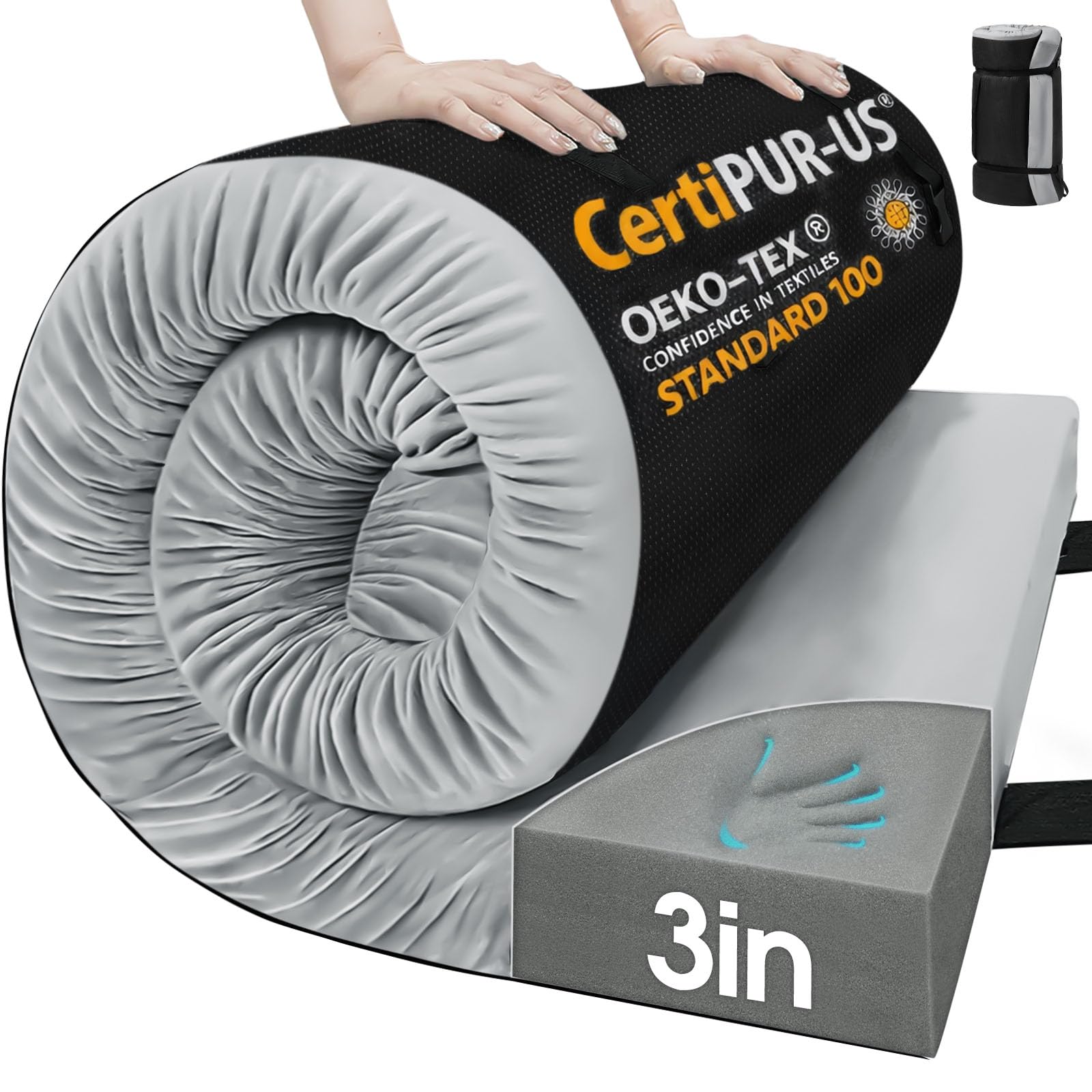
1. CYMULA 3 Inch Memory Foam Camping Pad
Our pick — 4.5★ from 850+ verified ratings; the strongest balance of quality and price.
A cushy memory foam slab that turns a tent floor into a real mattress.
This pad is 3 inches of carbon-fiber high-elasticity memory foam over a high-density base foam. That means your hips and shoulders sink into soft material rather than hitting hard ground. The cotton cover is removable and machine-washable, which matters when you drag it through a muddy campsite. It weighs 6.4 pounds though, so compared to air pads like the Amazon Basics at 1.4 pounds, the CYMULA is heavy — this is strictly for car camping or a cot, not backpacking.
Buyers report it delivered “superior comfort and warmth for cold-weather camping (30s°F) on cots/wooden platforms.” The waterproof bottom keeps dampness from seeping in, and the rubberized dots on the underside stop the pad from sliding around. Comfort is the aspect owners praise most, and the quality is the second most-praised. The softness does get mixed feedback — some find it plush, while others say it runs firm.
What wins people over
- True memory foam comfort — feels like a real bed, not a pool float.
- Removable, machine-washable cover keeps camp grime out of your sleep setup.
- Flat 3-inch profile lifts you off rocks and roots effectively.
The trade-offs
- Heavy at 6.4 lbs — only practical for car camping or guest use.
- Bulky when rolled; takes up significant trunk space.
Reach for this if: you drive to your campsite, value memory foam feel over pack size, and want a cover you can throw in the wash.
Look elsewhere if: you backpack to your site or need to keep your pack weight under 3 pounds.
2. Oramoose 4in Ultralight Camping Sleeping Pad
A 4-inch thick air pad that inflates in 30 seconds and packs water-bottle small.
The built-in foot pump is the standout feature: you simply step on it continuously to fill the pad in about 30 seconds. No mouth inflation, no separate pump. It holds up to 400 pounds, while the Amazon Basics pad supports 220 pounds.
Owners consistently mention that it solves “sore hips and back” and that it supports side-sleepers well, thanks to the V-shaped air cells that keep shoulders suspended. The comfort is the top praise by a wide margin, and ease of use runs second. A few people note the foot pump takes more effort than expected — one reviewer noted they “ended up blowing it up by mouth” because stepping took too long. The pad is 79 x 27.5 inches, giving you extra width compared to many ultralight mats, and the built-in pillow supports your neck.
Why it stands out
- 4-inch thickness and 400 lb capacity for a true suspension sleep.
- Built-in foot pump eliminates extra gear — inflate anywhere.
- Packs down to 9.4 x 4.3 inches, water-bottle sized for your pack.
The catch
- Foot pump requires consistent stepping; some find it slow.
- A few owners mention it deflates overnight, though the mixed air-retention feedback is not the majority.
Ideal for: budget-conscious backpackers or car campers who want 4 inches of cushion without the weight penalty of memory foam.
Not for you if: you need absolute air-tight reliability every night without re-inflating.
3. Overmont 4.7″ Extra Thick Inflatable Sleeping Pad
The thickest pad on our list — 4.7 inches — for true ground isolation.
At 4.7 inches tall, this pad beats even the 4-inch Oramoose and the Therm-a-Rest MondoKing in pure loft. That extra seven-tenths of an inch means your hips never touch the ground, even if you flip onto your side. It is 27.5 inches wide — the same width as the Oramoose — and uses ergonomic wave-shaped air cells to spread pressure across your back, neck, and hips.
The built-in foot pump inflates the pad in 30 to 60 seconds according to the maker, and the dual-layer anti-leak valve keeps the air locked in overnight. Customers note “no ground feel” and that it “stayed inflated” through multiple cold nights. Fabric is 75D polyester pongee with a multi-layer TPU coating, so it holds up on gravel and resists punctures better than thinner 40D pads. The weight is 1.98 pounds — still light enough for backpacking, though a few reviewers point out the fabric can feel slippery on sloped tent floors.
Strengths
- 4.7-inch thickness is the thickest here — side-sleepers will feel zero ground.
- Wide 27.5-inch surface gives room to spread out without sliding off.
- Built-in foot pump inflates fast with no separate bag.
Weaknesses
- Slippery top fabric can cause sliding on uneven tent floors — a sheet may be needed.
- Some owners find the actual thickness slightly under the claimed 4.7 inches.
Best for: side-sleepers and anyone who wants the thickest possible cushion without moving to a foam pad.
Consider something else if: you sleep on a steep slope and need a non-slip surface, or you need a pad that packs football-small.
4. Therm-a-Rest MondoKing 3D Self-Inflating Sleeping Pad

The gold standard for car campers who refuse to compromise on sleep quality.
At 4.25 inches thick with a 7.0 R-value, the MondoKing 3D uses StrataCore construction — alternating ridges of air and foam with a continuous thermal layer. That means it insulates in extreme cold while still packing down to 26 x 10.3 inches. This is the widest pad on the list at 30 inches and the longest at 80 inches, giving tall and broad sleepers full coverage.
The TwinLock valve system uses separate valves for inflation and deflation, so you don’t struggle with air escaping when you are still filling it. Owners consistently call it “like a real bed” and note that it eliminates any need for re-inflation overnight. The flip side? It weighs 5.5 pounds, making it a car-camp luxury item rather than a backpacking tool. A small number of shoppers say the nylon cover can tear from repeated use, though the brand backs it with a limited lifetime warranty.
What makes it great
- Superior 7.0 R-value keeps you warm in snow-level conditions.
- Self-inflates with a foam core — no pump, no blowing, just open the valve.
- 30-inch width is the widest here, preventing arm-slip for restless sleepers.
The reality check
- Expensive — costs more than several of the other picks combined.
- 5.5 pounds is too heavy for anything but car camping.
Go for it if: you car camp in cold weather, you are a large sleeper (30 x 80 inches), and you view a good night’s sleep as non-negotiable gear.
skip it if: you backpack to your site, need to save weight, or operate on a tight budget.
5. Wevelel Memory Sleeping Pad (3.1″ Self-Inflating)
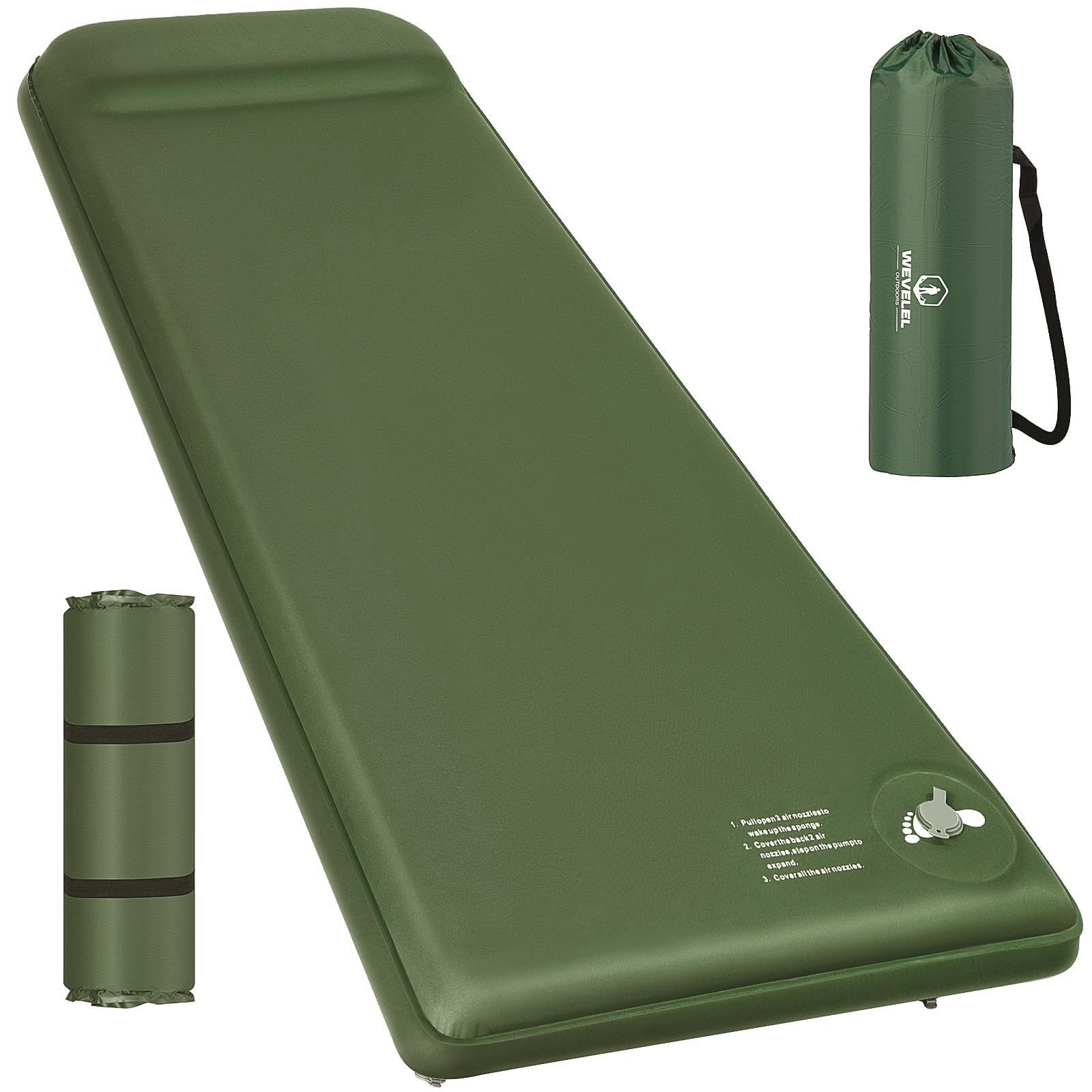
A self-inflating hybrid that wraps you in a 9.5 R-value cocoon for four-season camping.
This pad combines high-density 50D memory foam with an air chamber, giving you the softness of foam and the support of inflatable design. The R-value of 9.5 (industry-standard ASTM tested) is the highest on the list — it is purpose-built for winter camping when ground chill is relentless. It also supports up to 800 pounds, a figure that dwarfs the 400-pound capacity of the Oramoose or VALEHOWL pads.
The self-inflation process works by opening three valves, letting the foam expand for 10 seconds, then stepping on the front valve for 20 seconds to finish. Owners say it is “dry, comfortable, quick to inflate, and holds air throughout the night.” The 50D stretch knit fabric is quiet — no crinkling when you shift — and wicks moisture. The biggest trade-off is the 6.59-pound weight, making this a pure car-camping or guest-room mattress.
Why choose it
- Highest R-value (9.5) for true winter camping insulation.
- 800-pound capacity — durable enough for two smaller sleepers or one larger individual.
- Quiet, skin-friendly knit fabric doesn’t crinkle when you move.
The catch
- Heavy at 6.59 lbs — not suitable for backpacking or long carries.
- Deflation and rolling requires more effort than a pure air pad.
Designed for: winter car campers, cold-weather enthusiasts, and anyone who needs a high-insulation pad for a cot or tent base.
Not ideal for: backpackers or warm-weather only campers who don’t need the extra weight and R-value.
6. VALEHOWL 1.8Lbs Ultralight Camping Sleeping Pad (R3.0)
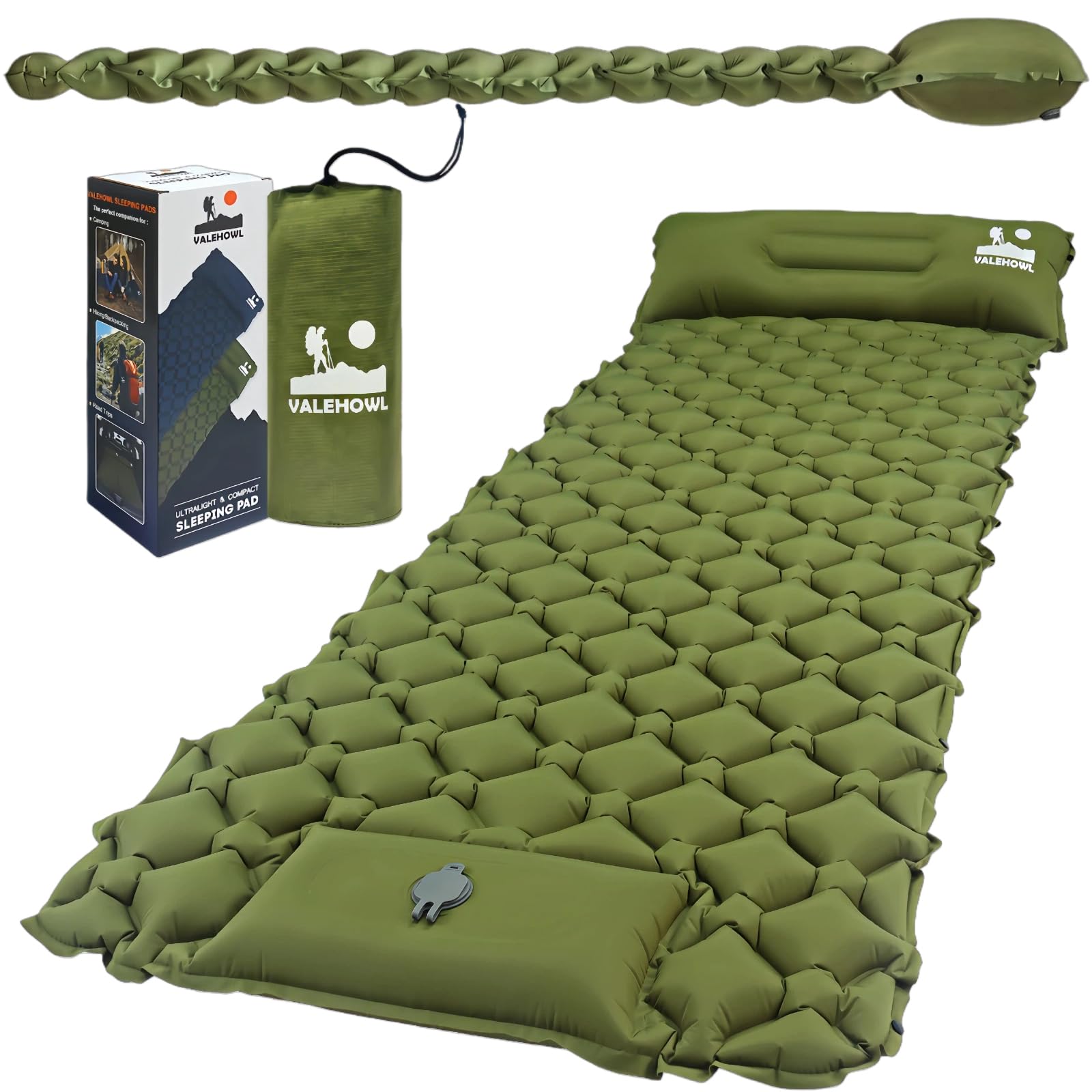
A 1.8-pound backpacker’s pad that inflates in 40 seconds and sits 2.7 inches off the ground.
This pad uses honeycomb air cells instead of vertical chambers to distribute weight evenly. It is 75 by 25 inches, fitting users up to 6’3″ and 400 pounds. A built-in foot pump fills it in 40 seconds — no separate pump bag needed. When deflated, it folds to 10 by 5 inches, small enough for a backpack side pocket. Unlike the 4-inch thick Oramoose, this pad is only 2.7 inches thick, so side-sleepers might feel the ground more on uneven terrain.
The pad is the lightest inflatable here alongside the Amazon Basics, but it draws mixed feedback on air retention. A common owner tip is to “ensure both plugs are seated closed with a clamp of your hands” after inflation, or the mattress can lose air unnoticeably. The built-in pillow also gets criticism for being in an awkward position for some sleepers. Comfort is the top positive aspect, and ease of use is second — the pad’s core job of providing a comfortable night for a lightweight hiker is solid.
Pros
- Lightweight at 1.8 lbs and packs tiny at 10 x 5 inches — ideal for backpacking.
- Built-in foot pump means no extra bag or mouth inflation.
- Honeycomb air cell design distributes weight evenly, reducing pressure points.
Cons
- 2.7-inch thickness is slim — side-sleepers will feel rocks on uneven ground.
- Air retention is a known issue if valves are not sealed meticulously.
Who it suits: weight-conscious backpackers who are careful with valve closure and sleep primarily on their back or stomach.
Who should pass: side-sleepers needing more cushion, or anyone who wants a leak-proof guarantee without checking seals.
7. TREKOLOGY UL R7 Insulated Sleeping Pad
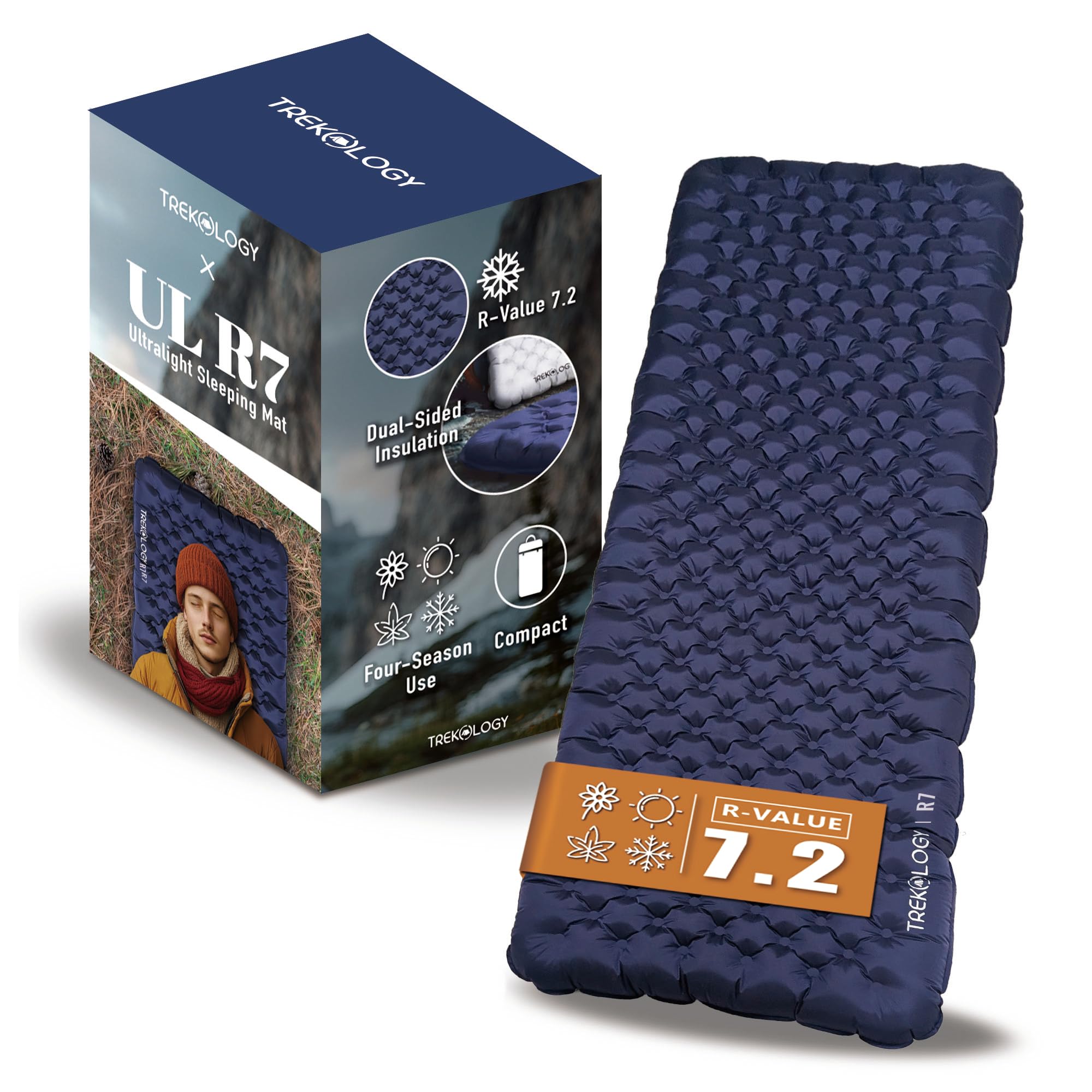
An insulated, 4-inch thick inflatable pad that stays warm in 22°F weather and packs small.
The TREKOLOGY UL R7 has an SGS-certified 7.2 R-value, meaning it is designed for three-season camping with the ability to handle freezing nights. At 4 inches thick and 24 inches wide, it provides solid ground separation without the weight of foam — it tips the scales at just 2 pounds. The pad uses 40D ripstop nylon with a TPU coating for tear and water resistance. The crowd favorite reports that in 22°F with a proper bag, they “slept warm all night.”
There is no built-in pump — the included stuff sack can be used as a pump bag, or you can inflate by mouth. This keeps weight down but means one extra step compared to the Oramoose or Overmont pads. A recurring owner insight is that the pad’s surface is slippery on sloped terrain; some owners lay a shelf liner underneath to stop sliding. Warmth is the second-most praised aspect after comfort, and value for money also gets strong positive feedback.
Highlights
- 7.2 R-value provides proven warmth below freezing — owners confirm 22°F performance.
- Lightweight at 2 lbs and packs water-bottle sized for backpacking.
- SGS-certified insulation rating adds credibility beyond marketing claims.
Limitations
- No built-in pump; requires separate pump bag or mouth inflation.
- Surface is slippery on sloped ground — a shelf liner or sheet may be needed.
Reach for this if: you backpack in three to four seasons, need a proven R-value for freezing nights, and prioritize weight over all-in-one convenience.
Look elsewhere if: you want a built-in foot pump or camp strictly in warm weather where the R-value is overkill.
8. Hikenture 4 Inch Thick Self Inflating Sleeping Pad (R9.5)

A spacious, 4-inch self-inflating foam pad with a 9.5 R-value for serious winter car camping.
The Hikenture is 80 inches long and 28 inches wide — roomier than the CYMULA and the TREKOLOGY — and uses memory foam with air construction for support. It has a 9.5 R-value, which is identical to the Wevelel’s rating, making it another top-tier option for insulating against snow and frozen ground. The self-inflating foam core does most of the work: open the patented two-way valve, let the foam expand, then add a few bags of air using the included pump sack.
Owners highlight how it “stays inflated” even after months of use, and the soft polyester surface is quiet at night. Comfort is the most-praised aspect by a wide margin, followed closely by quality. At 4 inches thick, it offers comparable loft to the Oramoose but with foam insulation. The pad is too heavy and bulky for backpacking, but for car camping, the easy setup and warm sleep surface are tough to top. Some owners mention the inflation process can seem slow the first time, and the 28-inch width may not fit all tent footprints.
Standout features
- Large 80 x 28-inch size fits tall sleepers and restless turners.
- Self-inflates with foam core and pump sack — no blowing or pumping.
- 9.5 R-value keeps you warm in extreme winter conditions.
Downsides
- Too heavy and large for backpacking — best for car camping and RVs.
- Initial setup requires a learning curve for the two-valve system.
Perfect for: car campers who camp in all four seasons, want a wide sleep surface, and value ease of setup.
pass on it if: you backpack to your campsite or have a small tent that can’t accommodate the 28-inch width.
9. Amazon Basics Camping Sleeping Pad

The lightest option on the list at 1.4 pounds, built around a quick-inflate foot pump.
Amazon Basics designed this pad to be simple: a built-in foot pump with Insta-Pump Technology that the brand says fills the pad in under 60 seconds. It measures 75 by 22 inches when inflated and packs down to 12 by 4 inches. However, it is only 2 inches thick, meaning you feel every root and stone compared to the 4-inch options in the list. The 220-pound capacity is also the lowest of any pick here.
Air retention is a mixed point among owners — some report it “holds air all night,” while others mention it stops holding air. The pump itself can be hit or miss; several buyers report the built-in pump is non-functional from the start but that manual inflation is easy. Portability and inflation are praised, as is the compact pack size. This is a fair-weather pick for a beginner camper who wants a cheap, ultra-light pad for occasional summer trips.
What works
- Only 1.4 lbs — the lightest pad on the list, ideal for ultralight backpacking.
- Built-in foot pump for no-mouth inflation, plus simple deflation.
- Affordable price point for a first-time camper or a backup pad.
What doesn’t
- 2.2-inch thickness is too thin for side-sleepers or rocky ground.
- 220 lb capacity and mixed air retention reports are limiting.
Good for: a beginner’s first pad, a hot-weather backup, or an ultralight hiker who sleeps on their back and hates carrying weight.
Not for you if: you are a side-sleeper, camp on rough terrain, or need reliable air retention for multi-night trips.
Understanding the Specs
R-Value: The Warmth Shield
Think of R-value as a number that tells you how well a pad stops cold ground from stealing your body heat. A pad with an R-value of 2 or less is a summer-only pad. A value of 4 to 5 works for three-season camping. Once you hit 7.0 or 9.5, you are ready for snow camping. The TREKOLOGY has a 7.2 R-value, and the Wevelel and Hikenture both have a 9.5 R-value. If you camp mostly in warm weather, the lower R-value of the VALEHOWL (3.0) is fine and saves weight.
Thickness: The Ground Gap
Thickness is measured in inches from the pad surface to the ground. A 2-inch pad is tolerable if you are a back-sleeper on soft soil. At 3 inches, most side-sleepers can get by. At 4 inches or above (the Oramoose, Overmont, Hikenture, and Therm-a-Rest), your body lifts off the ground completely, and rocks become invisible. The trade-off is that thicker pads usually weigh more and take longer to inflate or pack.
FAQ
Can I use a camp sleeping mat on a cot?
How thick does a camp sleeping mat need to be for side sleeping?
Will an inflatable sleeping pad fit in a backpack?
What does R-Value mean on a camping mat?
Can you connect two camp sleeping mats together?
How do you deflate and pack an inflatable camping pad?
Are camping sleeping mats waterproof?
How long do self-inflating camping pads last?
Is 1.8 pounds light enough for backpacking?
What is the difference between self-inflating and inflatable camping pads?
Final Thoughts: The Verdict
If you want one dependable pick, the best camp sleeping mat is the CYMULA 3 Inch Memory Foam Pad because it combines true memory foam comfort with a machine-washable cover at a price that beats foam pads from major outdoor brands. If you backpack and want a 4-inch thick pad with a built-in pump, grab the Oramoose 4in Ultralight. And for winter car campers who need the highest insulation and a self-inflating setup, the Wevelel Memory Sleeping Pad is the one to reach for.
How We Picked
We do not accept paid placement. Every pick is matched to a real buyer and a real use-case; we do not hands-on test units.
Sources & Methodology
Specifications: manufacturer listings and product documentation. Review insights: verified customer reviews, as of July 2026. Pricing: not shown on this page (it changes often); check the current price via the retailer link.
As an Amazon Associate, Gadgets Feed earns from qualifying purchases. This does not affect which products we feature.