
The moment the lights go out, a dead flashlight is worse than no flashlight at all. Battery-free designs—hand crank, solar, or a hybrid of both—eliminate that failure point, delivering light and communication when the power grid and your stash of AAs have both given up. Whether you are prepping for hurricane season, packing a bug-out bag, or just want a camp light that never leaves you fumbling in the dark, understanding the real-world output and charge time of these units separates a reliable tool from a frustrating toy.
I’m Min — the co-founder and writer behind Gadgets Feed. I spend my days dissecting emergency gear specs, comparing dynamo efficiency and solar panel wattage, so you know exactly what a crank-powered device can actually deliver during a blackout.
This guide covers seven of the most capable options on the market, from compact radios with NOAA alerts to high-lumen lanterns with hand-crank backups. Whether you need weather warnings, device charging, or just a dependable beam when the grid fails, the right battery-free flashlight keeps you powered without ever hunting for a spare cell.
How To Choose The Best Battery-Free Flashlight
Not all battery-free lights are created equal. A unit that relies solely on a tiny solar panel may leave you in the dark after a cloudy day, while one with a high-efficiency dynamo can keep your phone alive during a multi-day outage. Focus on three core areas to make the right call.
Charging Methods & Efficiency
The best options offer at least two ways to charge: a hand crank and a solar panel. Look for a crank with a reinforced gear and a comfortable handle—flimsy plastic cranks break under stress. For solar, monocrystalline panels (often 8500mm² or larger) charge 4–6 times faster than cheap polysilicon panels, even in overcast conditions. A unit that also accepts USB-C or AAA batteries as a fallback gives you maximum flexibility.
Battery Capacity & Real-World Output
Even though the device is “battery-free,” it still contains a rechargeable cell to store the energy you generate. A genuine 12000mAh battery can charge a modern smartphone 1.5 to 2 times and run an LED flashlight for 40–60 hours on a low setting. Be wary of inflated numbers—some brands list 74000mWh (which equals about 20000mAh) but ship with two smaller cells wired in series. Look for verified reviews that confirm the capacity test.
Extra Features That Matter in an Emergency
A flashlight alone is useful; a flashlight with AM/FM/NOAA weather alerts is a lifeline. Priority should go to models with automatic NOAA scanning—these wake you up with a loud siren when a tornado or hurricane warning hits. A built-in SOS strobe, a reading lamp for low-light tasks, and a USB output to charge your phone all add real value without adding much weight.
Quick Comparison
On smaller screens, swipe sideways to see the full table.
| Model | Category | Best For | Key Spec | Amazon |
|---|---|---|---|---|
| Mesqool 12000mAh | Hand Crank / Solar | All-in-one emergency kit | 8500mm² monocrystalline panel | Amazon |
| PPLEE 12000mAh CR1030 | Hand Crank / Solar | Stereo sound & long runtime | 57mm 5W speaker + 7 NOAA bands | Amazon |
| Raynic 12000mAh | Hand Crank / Solar | NOAA reliability & build | 5× larger monocrystalline panel | Amazon |
| Roxicosly CR1030 | Hand Crank / Solar | Verified 12000mAh power bank | 5W adjustable-beam flashlight | Amazon |
| QAUYYW 20000mAh | Hand Crank / Solar | Highest capacity for extended trips | 74000mWh / 20000mAh battery | Amazon |
| Vokida 37000mWh | Hand Crank / Solar | Compact weather radio | 6.5″L lightweight build | Amazon |
| JOYEKY 6400mAh Lantern | Hand Crank Only | Bright area lighting & portability | 1000 lumens, stepless dimming | Amazon |
In‑Depth Reviews
1. Mesqool 12000mAh Emergency Weather Radio
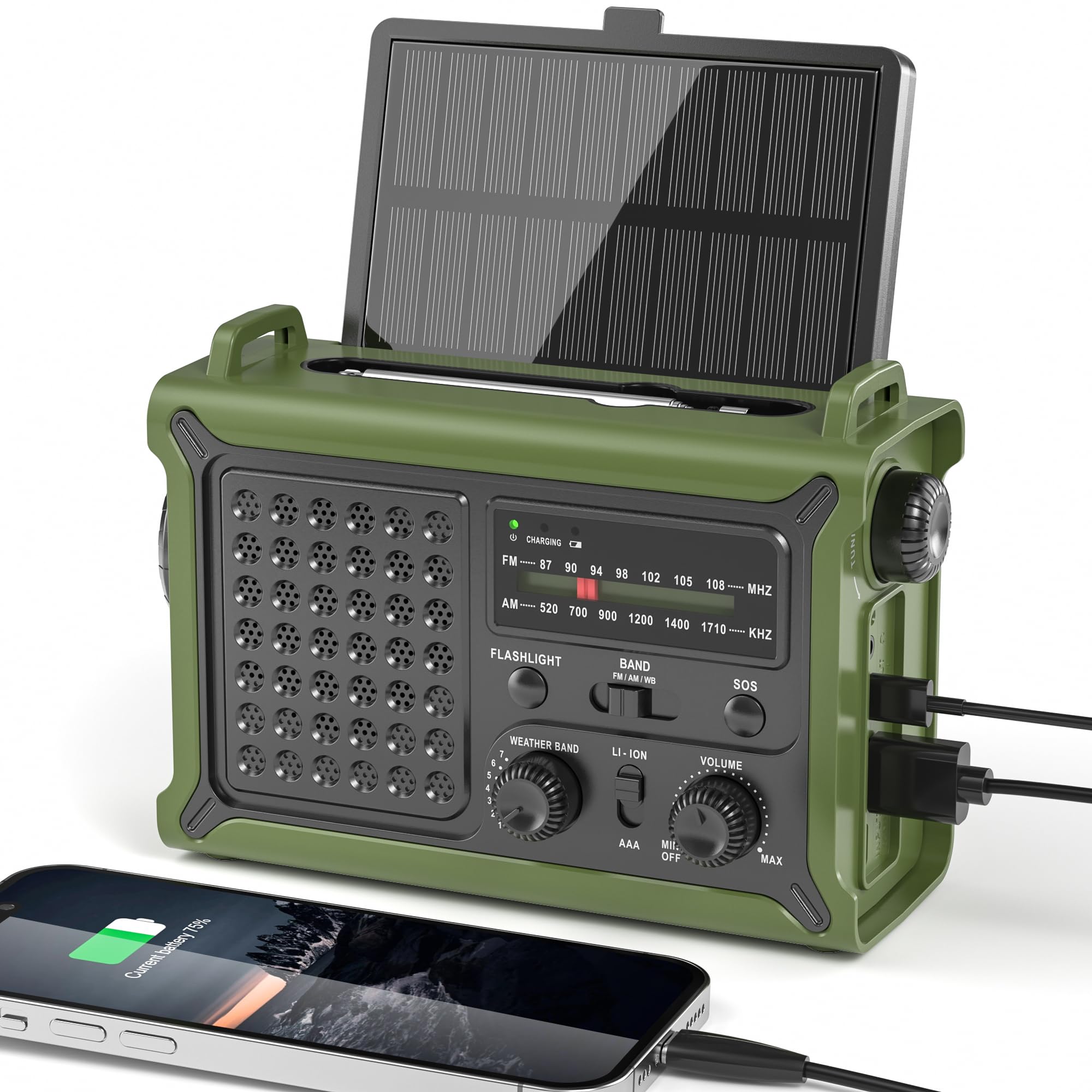
The Mesqool model sets the benchmark for a modern battery-free emergency radio. Its extra-large 8500mm² monocrystalline solar panel captures four times more sunlight than the tiny decorative panels found on budget units, delivering a measurable charge even under heavy cloud cover. The hand crank uses an upgraded internal generator with a larger copper coil and reinforced magnet, producing nearly double the charging efficiency of standard designs — three minutes of cranking can power a brief phone call or a substantial session of the 260-foot LED flashlight.
Beyond raw power generation, the Mesqool excels in reception and usability. The high-sensitivity chip and noise-reduction circuitry lock onto AM, FM, and all seven NOAA weather bands without the static that plagues lesser radios. The flashlight offers two brightness levels with a focused beam, and a separate frosted reading lamp provides a soft, eye-friendly glow for indoor tasks. Reviewers consistently note the brick-solid ABS build and the ergonomic grip, which makes it easy to operate even when your hands are cold or wet.
It also accepts three AAA batteries as a fallback, a welcome touch for those who keep a stash of alkalines. The 12000mAh lithium cell inside is a genuine capacity — verified by users who ran the lights and radio for over 18 hours continuously before needing a recharge. If you need one device to rule your emergency kit, this is it.
Why it’s great
- Genuine 12000mAh battery with reliable runtime
- Large monocrystalline solar panel charges in low light
- High-torque crank delivers useful power in 3 minutes
- Superb AM/FM/NOAA reception with clear audio
Good to know
- No battery level indicator — you have to guess remaining charge
- At 1.59 lbs, it is slightly heavier than some rivals
2. PPLEE 12000mAh CR1030 Emergency Radio
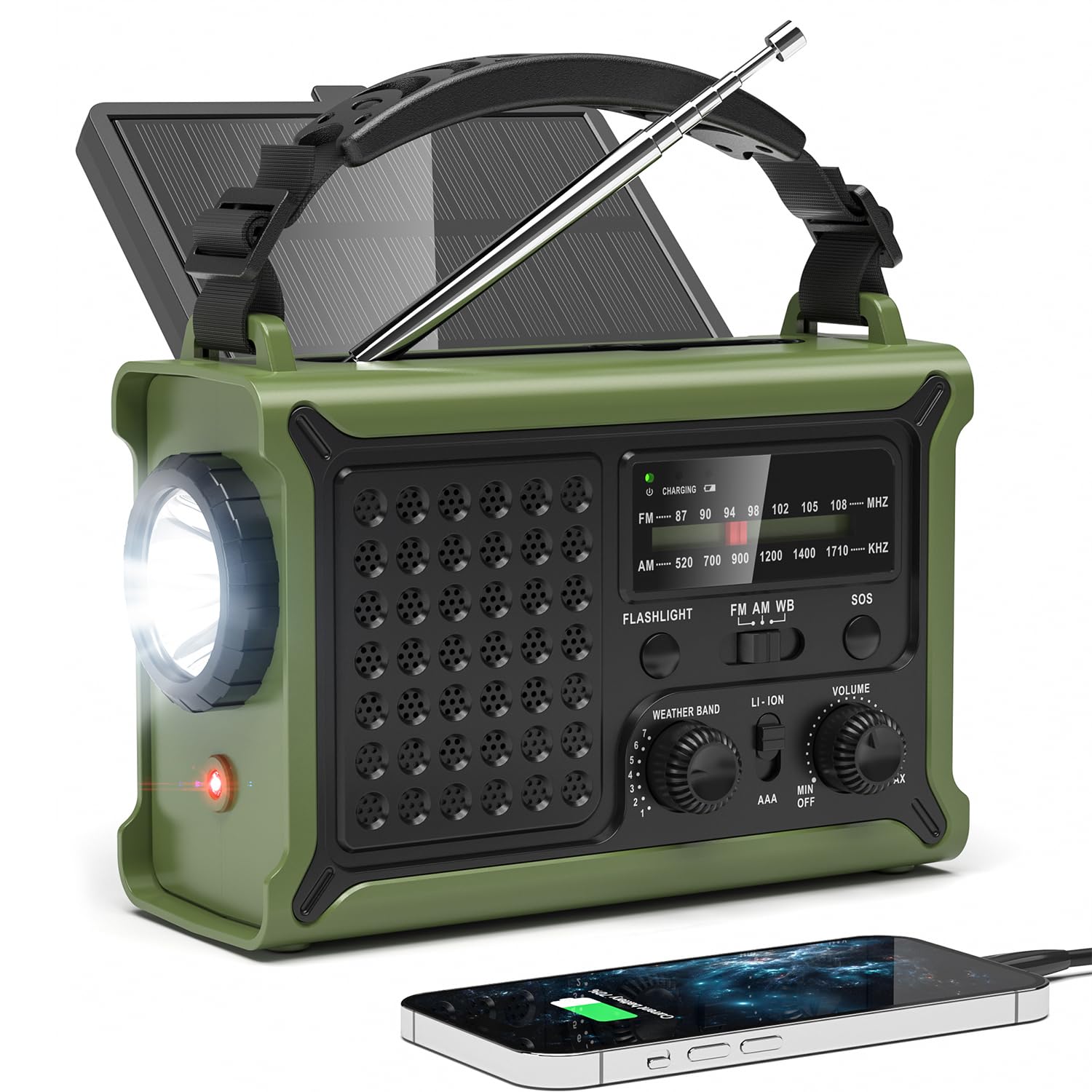
The PPLEE CR1030 is engineered for those who refuse to accept tinny, distorted audio during an emergency broadcast. Its 57mm full-range speaker is driven by a neodymium magnet and delivers tonal balance that makes AM talk radio, FM music, and NOAA alerts all sound clear and natural. The stereo output mode and included 3.5mm headphone jack let you listen privately without draining the speaker battery, a thoughtful detail for shelter scenarios with multiple people.
Charging versatility is a strong suit: hand crank (60 seconds of cranking provides about a day of normal radio use), an 8500mm² monocrystalline solar panel, AC input via USB-C, and even three AAA batteries as a fourth power source. The 12000mAh/44400mWh lithium pack is rated for roughly 60 hours of FM radio, 60 hours of flashlight or reading lamp use, and 30 hours of SOS siren. Users who tested the runtime confirmed that the capacity figures are honest, unlike the inflated claims on some competing units.
The NOAA weather scanning locks onto all seven preset channels (162.400 to 162.550 MHz) quickly, and the analog dial makes station selection intuitive even for elderly users. The dual lights — a 600-lumen flashlight and a softer reading lamp — each have two brightness settings. The only minor drawback is the plastic enclosure, which feels sturdy but not as impact-resistant as the ABS found on the Mesqool or Raynic.
Why it’s great
- Exceptional 57mm 5W speaker with clear, balanced audio
- Honest 12000mAh capacity with verified 60-hour radio runtime
- Four charging methods including AAA battery backup
- Fast NOAA weather band locking
Good to know
- Plastic housing, not as rugged as ABS competitors
- Solar panel is large but not removable for repositioning
3. Raynic 12000mAh Emergency Weather Radio
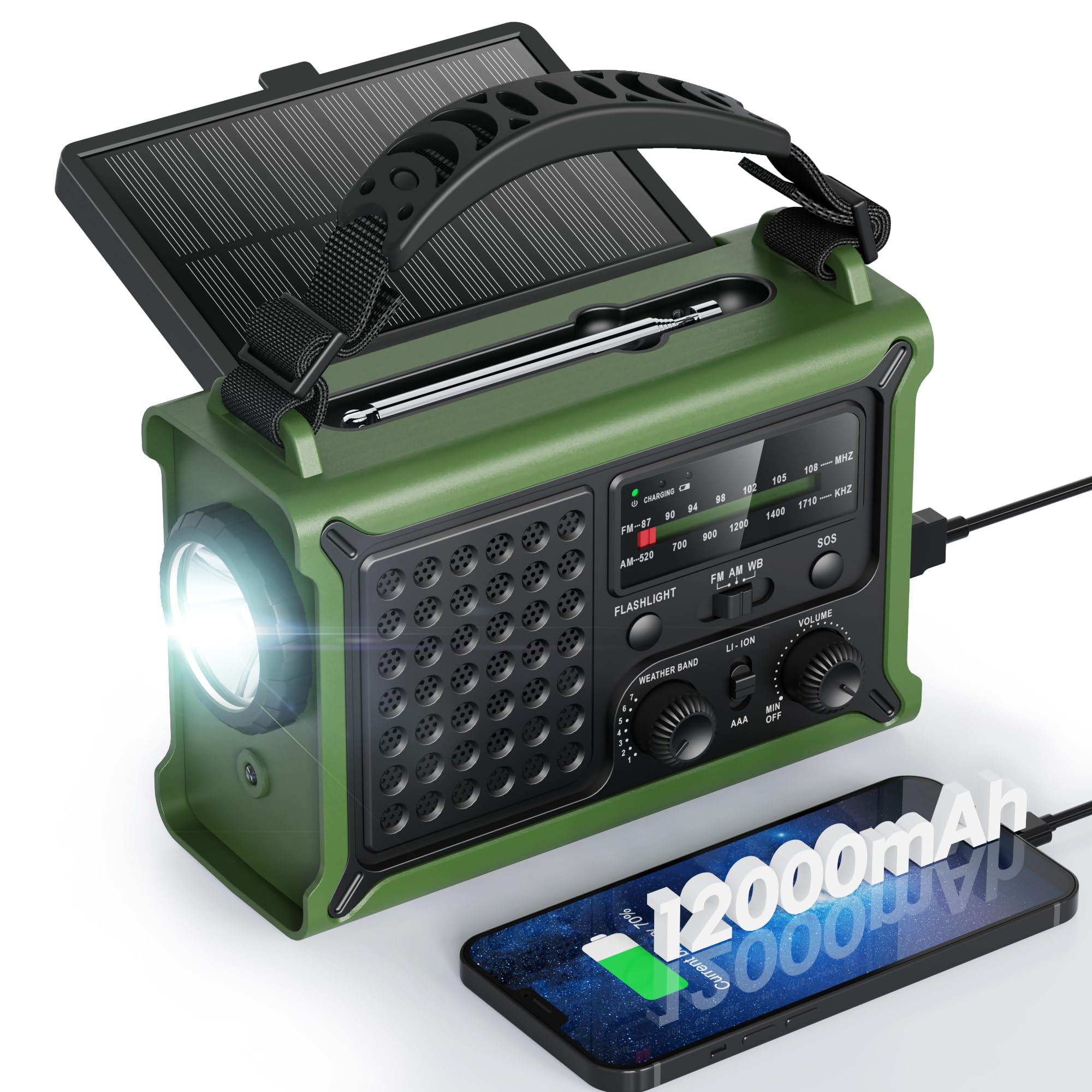
The Raynic 12000mAh radio brings NOAA-certified performance and a remarkably efficient solar charging system at a mid-range price point. Its monocrystalline panel is roughly five times larger than the decorative panels found on entry-level models, converting both direct and indirect sunlight into usable power much faster. The hand crank is also longer and smoother, requiring less effort to spin while delivering comparable output to the more expensive premium units.
Reception quality is excellent across AM, FM, and all seven NOAA weather bands. The 57mm full-range speaker produces richer bass and clearer highs than most radios in this class, making it genuinely pleasant to listen to during a long power outage. The 5W flashlight offers a bright, adjustable beam, and the reading lamp provides a softer spread for close-up tasks. The 120dB SOS siren is piercing enough to attract attention from a considerable distance, and the red flashing light adds a visual distress signal.
Build quality is a standout: the ABS enclosure, anti-slip knobs, and soft silicone carrying strap all suggest a device built for real-world abuse. The USB and USB-C output ports allow flexible device charging, and the 12000mAh cell has held up well in long-term user reports. The only real compromise is the lack of an automatic NOAA alert mode — you need to manually tune to a weather band to hear warnings, rather than having the radio wake you up with an alarm.
Why it’s great
- Large monocrystalline solar panel charges faster than most
- NOAA-certified with clear AM/FM/weather reception
- Durable ABS build with anti-slip grip
- 120dB SOS siren plus flashing red light
Good to know
- No automatic NOAA alert mode — must tune manually
- Battery level indicator is approximate, not precise
4. Roxicosly CR1030 Emergency Weather Radio
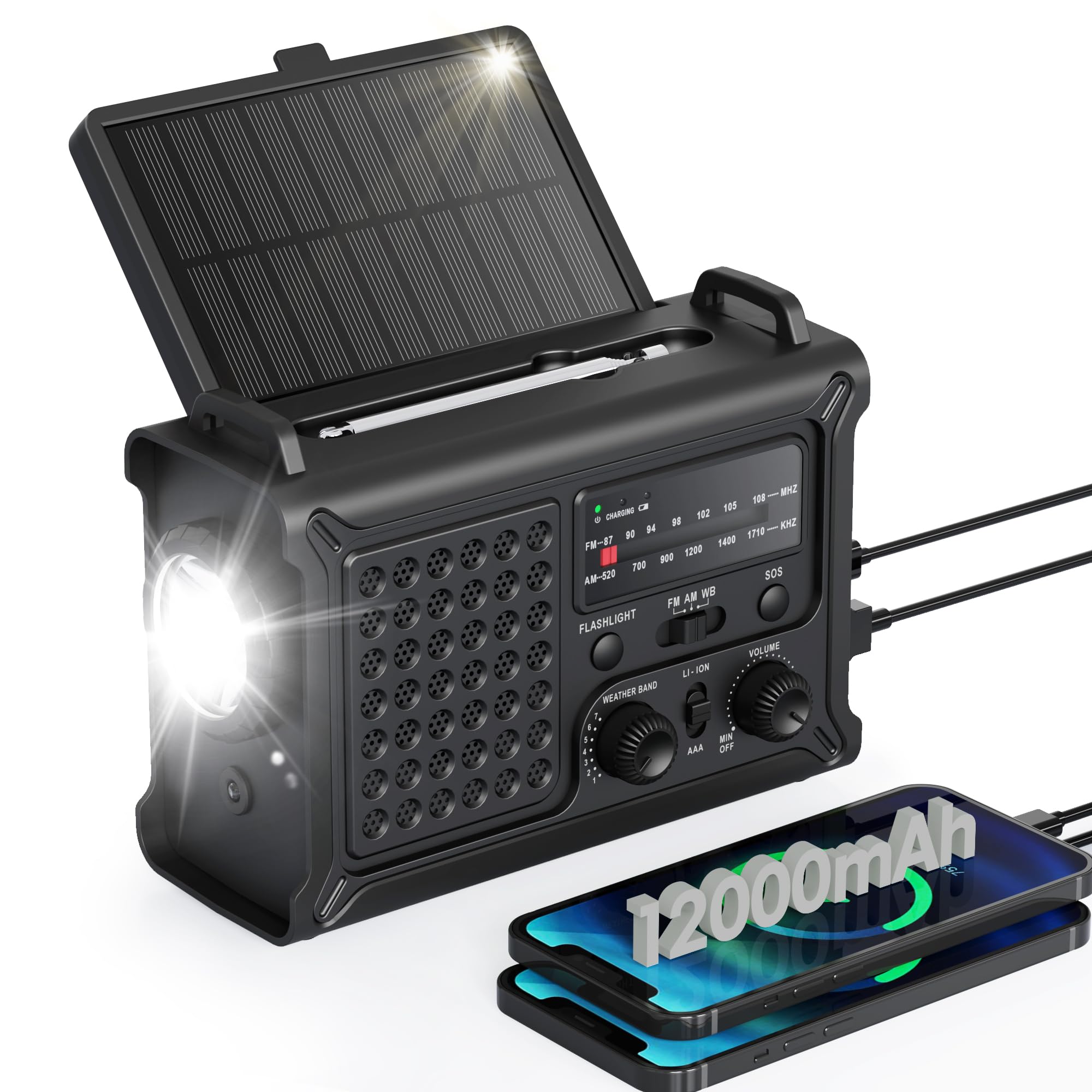
The Roxicosly CR1030 is purpose-built for hurricane season and extended grid-down scenarios. Its 8500mm² monocrystalline solar panel is the same size as the premium Mesqool, but the Roxicosly adds an automatic NOAA alert system that scans all seven weather bands and triggers a nine-second alarm when a warning is issued — a potentially life-saving feature during tornadoes or flash floods when every second counts.
The hand crank is reinforced and noticeably smoother than standard models, with a two-times-faster charging claim that user reviews support: one minute of cranking provides enough power for a short phone call or a solid chunk of flashlight runtime. The 5W adjustable-beam flashlight has multiple brightness levels, and the 12-LED reading lamp offers a soft, wide spread that is perfect for navigating a dark house or reading a map. The speaker delivers impressive sound clarity for both FM and AM broadcasts, though the average NOAA audio quality is typical for the format.
One unique advantage is the five-way power system: built-in 12000mAh lithium battery, Type-C cord, solar panel, hand crank, and AAA batteries. This redundancy makes it nearly impossible to find yourself without power. The IPX6 waterproof rating means it can handle rain and splashes without issue. The only frequent complaint is that the initial USB charge takes a long time — but once full, the solar panel easily maintains the charge during normal use.
Why it’s great
- Automatic NOAA alert with 9-second siren
- Genuine 12000mAh battery with five charging methods
- 5W adjustable flashlight with two brightness levels
- IPX6 waterproof and durable build
Good to know
- Initial USB charge is slow — plan ahead
- Tuner is less sensitive for distant AM stations
5. QAUYYW 74000mWh Hand Crank Radio
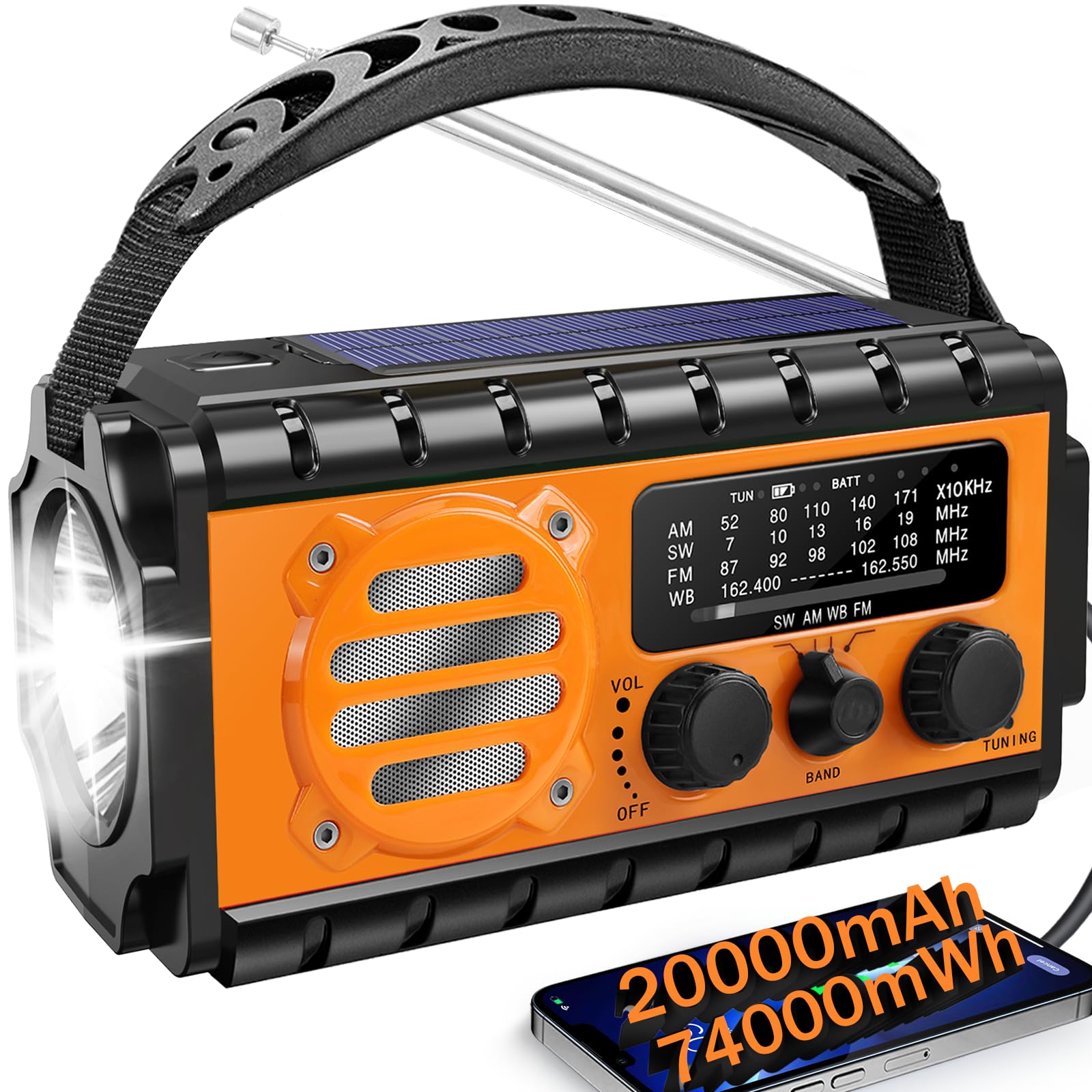
The QAUYYW radio stands apart for its enormous 74000mWh (roughly 20000mAh) internal battery — the largest capacity in this roundup. This translates to up to 35 hours of radio play at medium volume, 50 hours of reading lamp use, and the ability to charge a modern smartphone multiple times over without ever touching the crank or solar panel. It is a powerhouse for extended off-grid trips or multi-day power outages where recharging opportunities are limited.
Beyond the sheer battery size, the QAUYYW includes Short Wave (SW) reception in addition to AM, FM, and NOAA weather bands. The 52 cm extended antenna pulls in distant stations with surprising clarity, making it a strong choice for international news or remote-area communication. The three charging methods (hand crank, solar, and USB Type-C) are complemented by a large, easy-to-read analog dial and three dedicated control knobs for volume, band selection, and tuning — straightforward enough for any family member to operate under stress.
The IPX6 waterproof rating means it can handle rain and splashes, and the 3W flashlight and 3.5W reading lamp provide ample illumination for camp or shelter. The SOS alarm is loud, though not quite as piercing as the 120dB siren on the Mesqool or Raynic. Some users reported that the claimed 20000mAh capacity is closer to 18000mAh in real-world testing, but even that derated figure still leads the category. At just 0.68 pounds, it is remarkably lightweight for its battery size.
Why it’s great
- Largest battery capacity in class — 74000mWh / 20000mAh
- Short Wave band plus AM/FM/NOAA
- Lightweight at 0.68 lbs despite huge battery
- IPX6 waterproof and compact form factor
Good to know
- Real-world capacity slightly lower than advertised (reviewers report ~18000mAh)
- SOS siren not as loud as premium competitors
6. Vokida 37000mWh Emergency Radio
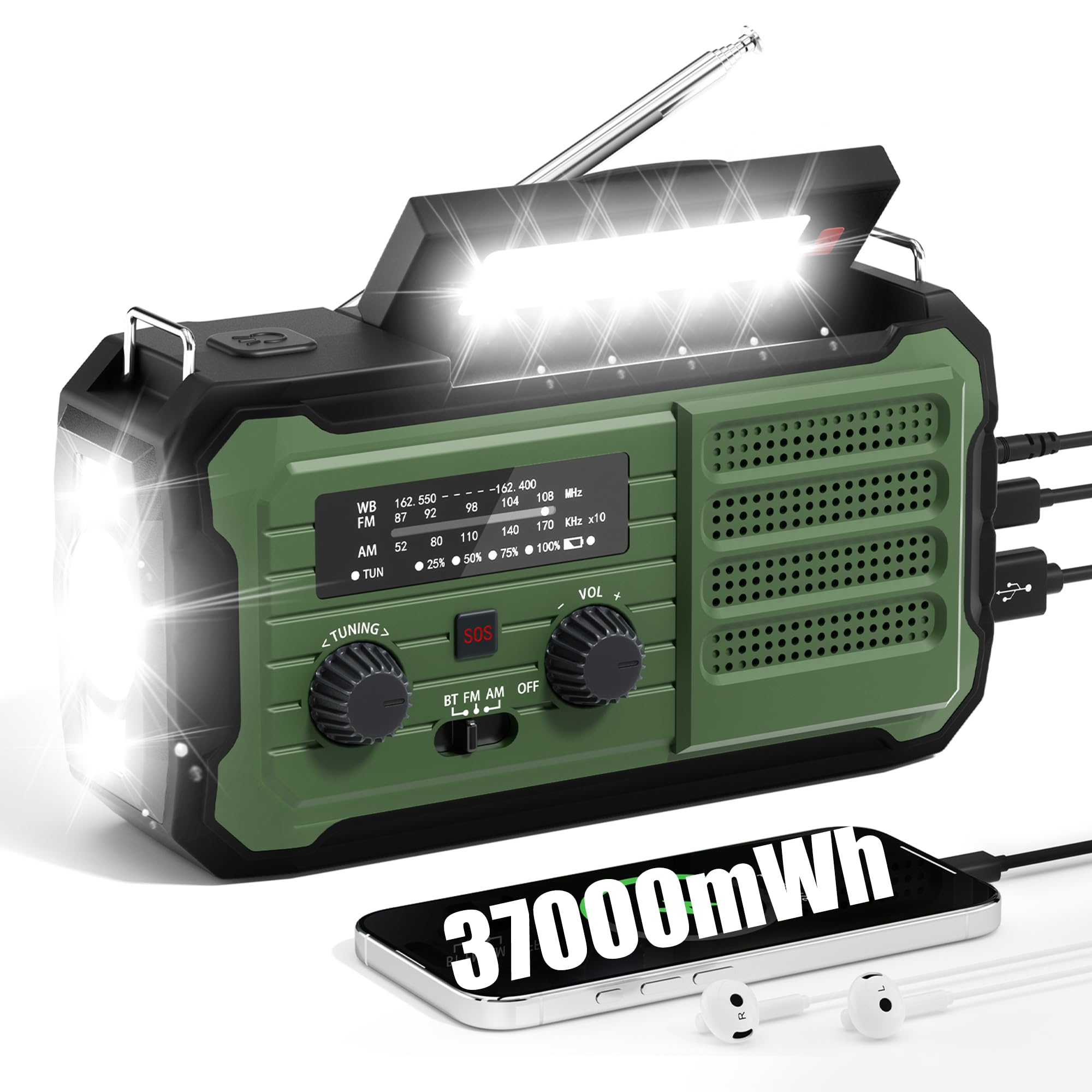
The Vokida is the most portable full-featured emergency radio in this lineup, measuring just 6.5 inches tall and weighing about 500 grams. It slips easily into a bug-out bag, glove compartment, or even a large coat pocket. Despite its small footprint, it packs a solid 37000mWh battery (roughly 10000mAh) and three charging methods: hand crank, solar panel, and USB-C input. The solar panel is smaller than the premium units, so charging under cloudy skies will be slower, but the hand crank is pleasantly smooth and efficient for a unit this size.
Radio performance punches above its weight: the AM/FM/NOAA reception is clear and stable, with users consistently noting strong signal locking even indoors. The built-in LED flashlight is surprisingly bright for a compact unit, and the SOS alarm with flashing red light adds an important safety layer. The USB output lets you charge a smartphone in a pinch — a 5-minute crank session can provide a few minutes of talk time, enough for a brief emergency call.
The Vokida also includes a headphone jack for private listening and a USB-A output for charging other devices. The build quality is decent for the price, though the plastic feels a bit thinner compared to the ABS used on the premium models. It lacks the automatic NOAA alert feature of the Roxicosly, so you must manually tune to a weather band. For those who prioritize portability and simplicity without needing a massive battery, the Vokida is a smart, affordable choice.
Why it’s great
- Ultra-portable size (6.5″ x 2.4″ x 3.5″) — fits any bag
- Clear AM/FM/NOAA reception in a small package
- USB output for emergency phone charging
- Smooth, low-effort hand crank
Good to know
- Smaller solar panel means slower charging in low light
- No automatic NOAA alert mode — manual tuning required
7. JOYEKY 6400mAh Hand-Crank Lantern

The JOYEKY lantern takes a different approach — instead of a radio, it is a dedicated 1000-lumen area light with a built-in hand crank. This makes it ideal for lighting up a tent, a room during a blackout, or a campsite rather than for communication. The stepless dimming feature lets you fine-tune brightness from a soft nightlight glow to full flood, and the four color modes (cool white, natural white, warm white, and SOS) give you flexibility for different moods and emergencies.
The 6400mAh lithium battery is advertised as a backup, but user teardowns revealed that the actual battery pack contains two 2600mAh cells wired in series for a total of 5200mAh, not 6400mAh. This is still enough to run the light for many hours on low, but it is worth noting the discrepancy. The hand crank is functional and will generate enough power for emergency lighting, though the output via cranking maxes out at around 500 lumens based on user measurements. The matte white finish and compact 4.87-inch height make it easy to pack or hang.
Purely as a battery-free flashlight and area lantern, the JOYEKY delivers good value. The USB charging port also allows it to double as a power bank for charging small devices like earbuds or a phone (slowly). However, it lacks the radio, NOAA alerts, and SOS siren of the combo units above, so it is best suited as a supplemental light source rather than a primary emergency device. The build quality is reasonable, and the six-month warranty provides basic peace of mind.
Why it’s great
- 1000-lumen output with smooth stepless dimming
- Four light modes including SOS for emergencies
- Lightweight at 0.65 lbs and compact
- Hand crank provides backup power without batteries
Good to know
- Advertised 6400mAh battery is actually 5200mAh (two 2600mAh cells)
- No radio, NOAA alerts, or SOS siren — light only
- Cranking output is lower than premium models
FAQ
How long does a hand crank flashlight last after one minute of cranking?
Can I use a battery-free flashlight without ever charging it from a wall outlet?
What is the difference between monocrystalline and polysilicon solar panels on these radios?
Do NOAA alerts work automatically, or do I have to tune the radio?
Final Thoughts: The Verdict
For most users, the battery-free flashlight winner is the Mesqool 12000mAh Emergency Weather Radio because it combines a genuinely large monocrystalline solar panel, a high-torque crank that delivers useful power fast, excellent AM/FM/NOAA reception, and a robust build — all at a price that undercuts the competition on features-per-dollar. If you want the best audio quality for long listening sessions during an outage, grab the PPLEE CR1030. And for the absolute highest battery capacity for extended off-grid trips, nothing beats the QAUYYW 74000mWh radio.