
Our readers keep the lights on and my morning glass full of iced black tea. As an Amazon Associate, I earn from qualifying purchases.
Specs are compiled from manufacturer listings and verified buyer reviews and can change over time — please confirm the key details on the product page before buying.
A circulation pump is the quiet heartbeat of any thriving aquarium. It stops that lifeless, still look and creates the subtle currents your fish, corals, and plants actually need to stay healthy. But not every pump can handle the job without rattling your nerves or pushing water where it does not belong — so this guide cuts through the spec-sheet noise to find the models that deliver real, reliable flow.
I’m Min — the founder and writer behind Gadgets Feed. This guide is built by comparing the manufacturers’ published specifications and the patterns across verified customer reviews, so you get each pick’s real strengths and trade-offs instead of marketing spin.
Whether you are setting up a reef, a planted freshwater tank, or just want less maintenance, this breakdown of the best aquarium circulation pump options covers every serious contender worth your time and money.
Our Picks at a Glance

How To Choose The Best Aquarium Circulation Pump
A circulation pump is not just a waterfall maker. It stirs up debris so your filter can catch it, adds oxygen at the surface, and gives your fish water that feels more like a river or reef than a bathtub. Here is what you need to check before you buy one.
Flow Rate (GPH) — Match It To Your Tank
The flow rate, measured in gallons per hour (GPH), tells you how much water the pump can move in an hour. A good rule is 5 to 10 times your tank volume in GPH for saltwater reefs and 3 to 5 times for freshwater planted tanks. Too little and you get dead spots where waste collects. Too much and you create a washing machine that stresses slow-moving fish.
AC vs DC Power — Noise and Control
AC (alternating current) pumps are the standard — simple and reliable, but often louder and with no speed control. DC (direct current) pumps run on lower voltage (like 24V), are noticeably quieter, and usually come with a controller that lets you adjust speed or even set wave patterns. If silence matters or you want a natural ebb-and-flow effect, a DC pump is worth the extra cost.
Mounting System — Magnet vs Suction Cup
A strong magnetic base holds the pump securely on glass up to about half an inch thick and makes repositioning easy. Suction cups can work on smooth surfaces but tend to lose grip over time, especially on acrylic tanks. For thick glass or a heavy pump, a magnet is the more reliable choice.
Adjustability — Where the Water Goes
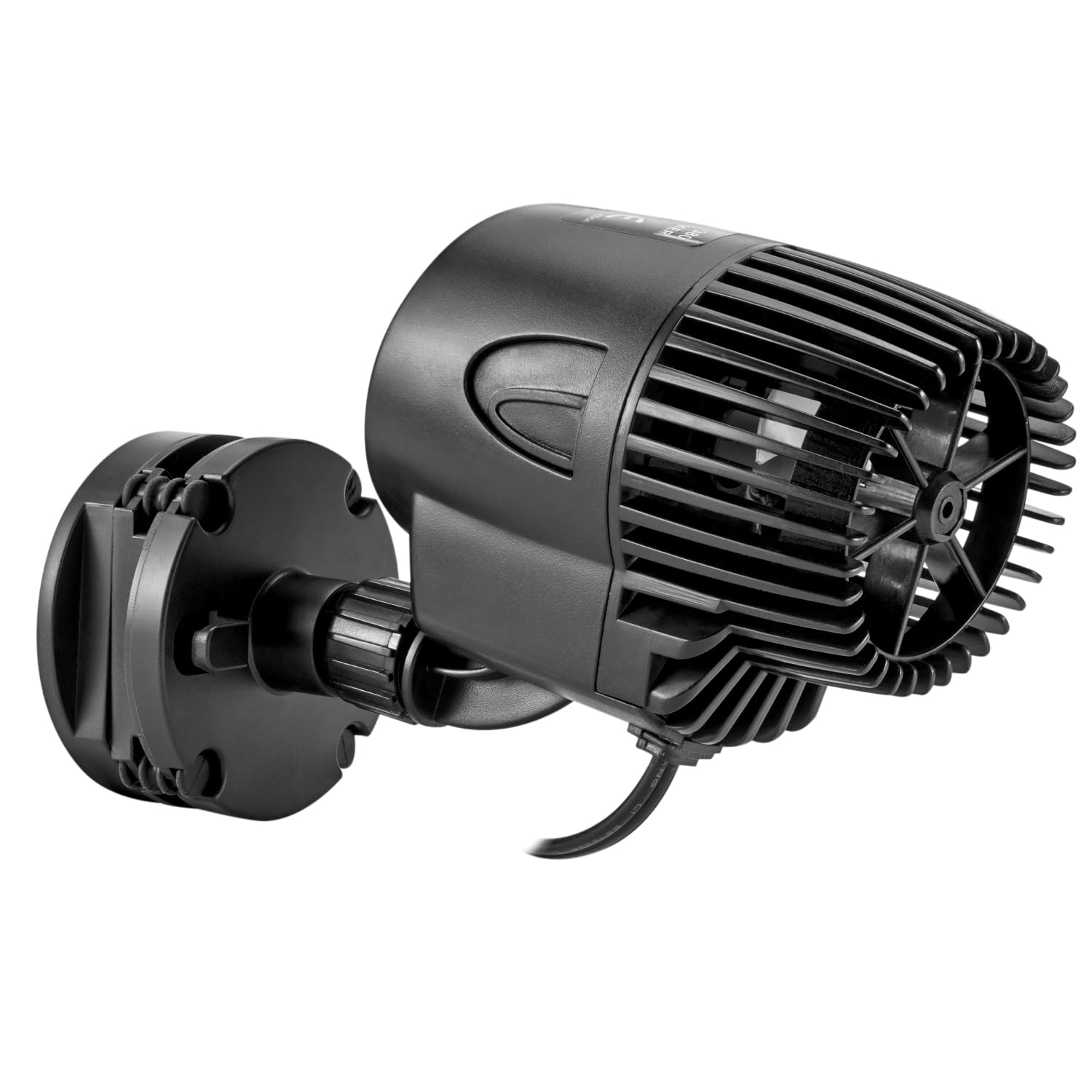
Look for a pump with at least 270 degrees of rotation on the output nozzle. A 360-degree head gives you full control to aim the stream exactly where you want it — up toward the surface for oxygen exchange or down along the substrate to roll debris toward the filter intake.
Quick Comparison
| Model | Best For | Flow Rate | Wattage | Mount Type | Amazon |
|---|---|---|---|---|---|
| AQQA 2100GPH★ Best Overall | Power and value | 2100 GPH | 15W | Magnet | Amazon |
| hygger 1320 GPHBest Value | Quiet reliability | 1320 GPH | 8W | Magnet | Amazon |
| YCTECH 1600GPHMost Adjustable | Flexible mounting | 1600 GPH | 8W | Magnet + Suction Cup | Amazon |
| Fluval Sea CP2 | Compact reefs | 1600 LPH (~422 GPH) | Low (undisclosed) | Suction cup | Amazon |
| Hydor Koralia 850 | Long-term reliability | 850 GPH | 5W | Magnet + Suction Cup | Amazon |
| Fluval Sea CP3 | Mid-sized reef flow | 2800 LPH (~740 GPH) | Low (undisclosed) | Suction cup | Amazon |
| Aqueon Circulation 500 GPH | Small tanks | 500 GPH | Low (undisclosed) | Suction cup | Amazon |
| Orlushy DC-4000 | Customizable DC control | 1050 GPH | 25W | Screws (in-line) | Amazon |
| hygger Cross Flow 18W | Advanced wave control | 1850 GPH | 18W | Magnet | Amazon |
In‑Depth Reviews
1. AQQA Wave Maker Pump, 2100GPH
Our pick — 4.5★ from 400+ verified ratings; the strongest balance of quality and price.
The torque monster that pushes a serious current without breaking your budget.
You get a massive 2100 GPH (gallons per hour) flow rate from just 15 watts — the AQQA moves 2100 GPH at 15W, compared to the hygger 1320 GPH at 8W and the YCTECH 1600 GPH at 8W, so water moves visibly in tanks from 50 up to 125 gallons. Buyers report it works as an inexpensive replacement for a broken gyre XF-150 (a type of wide-flow circulation pump), pushing similar water volume at a fraction of the cost. The full 360-degree rotating head lets you aim flow exactly where you need it, so you can eliminate dead spots wherever they form.
The crowd favorite feature is power — owners consistently point to it as the strongest aspect, followed closely by how well it moves water. The magnetic base is a major plus as well; it holds tight even on thick glass and keeps the pump quiet by reducing vibration. The trade-off mentioned by a few is that you get no speed control — it is a single-speed, full-flow pump. If that sounds like a lot, it is. The pump is quiet for its size, but it is not adjustable, so smaller tanks or fish that prefer calm water may find it overwhelming.
Why owners love it
- 2100 GPH at only 15W — one of the strongest flows for the wattage in this category.
- 360-degree adjustable head gives full control over flow direction.
- Strong magnetic mount holds securely on thick glass and cuts down noise.
A fair caveat
- No variable speed adjustment — what you get is full power all the time.
- Too powerful for tanks under 50 gallons or for fish that prefer gentle water movement.
Reach for this if: you have a 50 to 125 gallon tank and want maximum water turnover from a single pump without spending a premium.
Think twice if: your setup needs adjustable flow or your fish prefer a gentle current — this is a one-speed powerhouse.
2. hygger Aquarium Wave Maker, 1320 GPH
A solid workhorse that proves quiet reliability does not have to cost a lot.
This pump uses a ceramic shaft that resists wear and corrosion in both fresh and saltwater, and at just 8 watts it draws very little power compared to the 15W AQQA while still moving 1320 GPH. The 4.1-inch length means it takes up less space in the tank than the 6.3-inch AQQA, and owners mention it has been running for a year without trouble. The 360-degree rotating head gives you good control over where the water goes.
Reliability is what owners praise most, and the pump’s performance in a 75-gallon reef tank gets consistent positive notes for keeping corals and water quality on track. The catch? Noise gets mixed feedback — many say it is super quiet after a day or two, but some report a brief rattle on startup or a reverse-start issue after a power outage. The magnets also get mixed marks; some find them less grippy than expected on thicker glass.
What works
- Very compact footprint — 4.1 inches long means less clutter in the tank.
- Ceramic shaft is corrosion-resistant for long-term saltwater use.
- Low 8W power consumption keeps electricity costs down.
What to know
- Magnet hold is not as strong as some competitors — double-check fit on thick glass.
- Power outage may cause reverse startup with noise; a simple unplug/replug resolves it.
Best for: budget-conscious owners with 55 to 75 gallon tanks who want quiet, reliable circulation without the premium price tag.
Not for: setups where the pump cannot be easily accessed to restart after a power cut — the reverse noise can be unsettling.
3. YCTECH 1600GPH Wave Maker
The one that bends every which way to aim water into the tightest corners.
YCTECH offers a unique dual-axis rotation that lets you aim the flow 360 degrees horizontally and 270 degrees vertically — giving you more aiming options than many competitors. This is a huge advantage for eliminating stubborn dead spots behind rockwork or in tall, narrow tanks. It pumps 1600 GPH from only 8 watts, making it energy-efficient for the flow it delivers.
Buyers who use it in 55 to 75 gallon planted and reef tanks report it runs silently while creating a broad stream that reaches the tank floor. A few owners even bought multiple units for a 220-gallon setup, praising how easy it is to pull apart and clean the impeller. The honest caveat? Quality and durability are mixed. Some units stop working after a few months, and the plastic build can feel flimsy. The cord suction cup is near useless, and the flow does not push to the far end of a 6-foot tank.
The real deal: For the price and the massive adjustability, this is a great fit for medium tanks where you need to bend water around obstacles. Just know the long-term durability is not on the level of the Hydor or Fluval options.
Ideal for: aquarists who value precision aiming and want to cover every inch of a 55-75 gallon tank with a single pump.
skip it if: you expect a decade of service — the plastic construction and mixed reliability reports suggest a shorter useful life.
4. Fluval Sea CP2 Wave Maker

A tiny powerhouse that fits where bigger pumps simply cannot go.
The CP2 is built for aquariums up to 25 gallons, so it is one of the smallest pumps here. It uses a suction cup mount instead of a magnet — that works fine on clean glass, but some owners say the suction cup is hard to remove once set. The 270-degree adjustable nozzle lets you aim the flow, and owners of small reef tanks say it creates a clean, natural current their corals love.
Quality and flow are the highest-rated aspects, with owners appreciating both the build and the performance in tanks 15 to 25 gallons. The pump is near silent after an initial startup noise that typically subsides. However, reliability is the most-discussed aspect overall, and reviews point to a split: some units run for years, while others stop operating after six months. It is also not nearly powerful enough to be the main pump in a 75-gallon tank — that is simply beyond its design.
Bottom line: For nano and small reef tanks, the CP2 is a near-perfect fit. For anything larger or for anyone who needs a guaranteed long lifespan, it is a bigger gamble.
Pick this for: 10 to 25 gallon reef or planted nano setups where space is premium and flow needs to be gentle and steady.
Look elsewhere if: you have a 40+ gallon tank, or you want a mount that stays put on textured or uncleaned glass.
5. Hydor Koralia Evolution 850

The one that keeps running when others have already been replaced twice.
The Hydor Koralia Evolution 850 is the reliability king of this list. It uses a shaft-less impeller technology that eliminates the most common failure point in circulation pumps — no shaft means no shaft wear. With a flow of 850 GPH at only 5 watts, it is also energy-efficient. Its magnetic mounting system handles glass up to half an inch thick.
Buyers consistently use this pump in 50 to 125 gallon tanks and report years of dead-quiet operation. The sphere joint lets you angle the flow, and the cable protector adds a nice touch of durability. The top positive aspects are overwhelmingly reliability and quality, with noise level also earning strong praise. The only repeated note of caution is that some find 850 GPH too powerful for tanks under 50 gallons or for sensitive fish, and the intake screens can clog easily if detritus is high.
Why it stands out
- Italian-made shaft-less design practically eliminates impeller failure.
- 5W power draw is the most energy-efficient of the premium options here.
- Mounting system works on glass up to 1/2 inch thick without slipping.
The honest limits
- Single speed — no adjustment for different currents.
- No manual flow control; you get the full 850 GPH or nothing.
Your pick if: you want a set-and-forget pump that delivers consistent, quiet flow for years — the best long-term value for medium to large tanks.
Not the best fit if: you need adjustable flow or a pulsing wave effect — this is a steady current pump.
6. Fluval Sea CP3 Wave Maker

A step up in flow for tanks that the CP2 just cannot handle.
The CP3 is rated for aquariums up to 50 gallons and moves 2800 liters per hour (about 740 GPH). Like its smaller sibling, it has a 270-degree adjustable nozzle and a suction cup mount. Owners of 55-gallon cichlid and reef tanks report that it provides plenty of surface agitation without the need for air stones, and the increased oxygen exchange visibly improves fish activity.
Reliability and performance are the top-rated aspects, and reviews note the pump works great for cutting down fin nipping in angel fish by adding current. The catch is noise — it is the most-discussed aspect, and it is overwhelmingly negative. Many customers note a loud hum or vibration, especially compared to the silent CP2. A used CP3 was too loud for one owner, who returned it for a new CP2 instead. The suction mount also draws mixed feedback for holding power over time.
What to expect: Good water movement for a 50-gallon tank, decent build quality, but noise is a real gamble. It works for some and annoys others.
Reach for this if: you need the extra flow of the CP3 over the CP2 and are willing to tolerate some operational noise.
Skip if: silence is your top priority — the CP2 is the quieter choice, or consider a DC pump instead.
7. Aqueon Circulation Pump 500 GPH

The tiny pump that is perfect for small tanks where big flow is overkill.
This Aqueon pump is designed for 20 to 40 gallon aquariums, making it one of the lowest-flow picks at 500 GPH. Its ball-and-socket connection allows you to angle the flow direction, and the easy-lock suction cup makes installation and removal simple. Owners say it is a great behind-the-scenes powerhead that has lasted several years, and the rubber mount buffers make it very quiet during operation.
Performance and value for money are the aspects owners praise most. For a 20-gallon reef tank, it provides a gentle but steady current without blowing corals around. The main trade-off — and the most-discussed aspect — is mixed reliability. Some units stop working after 1.5 months, while others keep pumping for years. Noise is also somewhat polarizing; some find it silent, others a little noisy. And at this size, it is too powerful for a 10-gallon tank and not strong enough for anything above 40 gallons.
The honest read: For the price, it is a solid little pump for small tanks. Treat it as a good value buy with the understanding that long-term consistency is a roll of the dice.
Best for: budget nano-tank owners with 20-40 gallon setups who need a simple, quiet pump for basic water movement.
Watch out: mixed durability reports mean you might be replacing it sooner than a premium pump — but the low cost softens that blow.
8. Orlushy DC-4000 Silent Swirl Pump

The programmable pump that lets you dial in the exact flow you need.
This DC pump runs on a safe 24V low-voltage system and uses sine wave frequency conversion technology to operate near silently. With an external controller, you get 20 adjustable speed levels and three modes: Constant Flow, Wave Mode, and a Feed Mode that pauses the pump for 10 minutes. It flows 1050 GPH at 25 watts, making it more powerful than some AC pumps while being significantly quieter.
Owners praise the build quality and how easily it adapts to different roles — one buyer replaced a failed Fluval FX4 canister pump with this unit, noting it worked better than the original. The ceramic shaft core reduces friction, and the 4 rubber base feet absorb vibration. The honest downsides: the wave mode is nothing to rave about, the remote lacks a simple on/off button, and one of the plug fittings can fall out if not secured. But for sump return or as a dedicated circulation pump, the control it offers is class-leading at this level.
Why it matters: If you have been frustrated by single-speed pumps, this gives you real control over your water movement while staying affordable on high-end DC pumps.
Ideal for: aquarists who want to fine-tune flow speed, use a sump return, or need a quiet DC pump with multiple power options.
Skip if: you just want a simple plug-and-play pump — the learning curve on the controller is unnecessary for basic setups.
9. hygger Cross Flow Pump (18W)

The most advanced wave maker that actually mimics an ocean with different wave patterns.
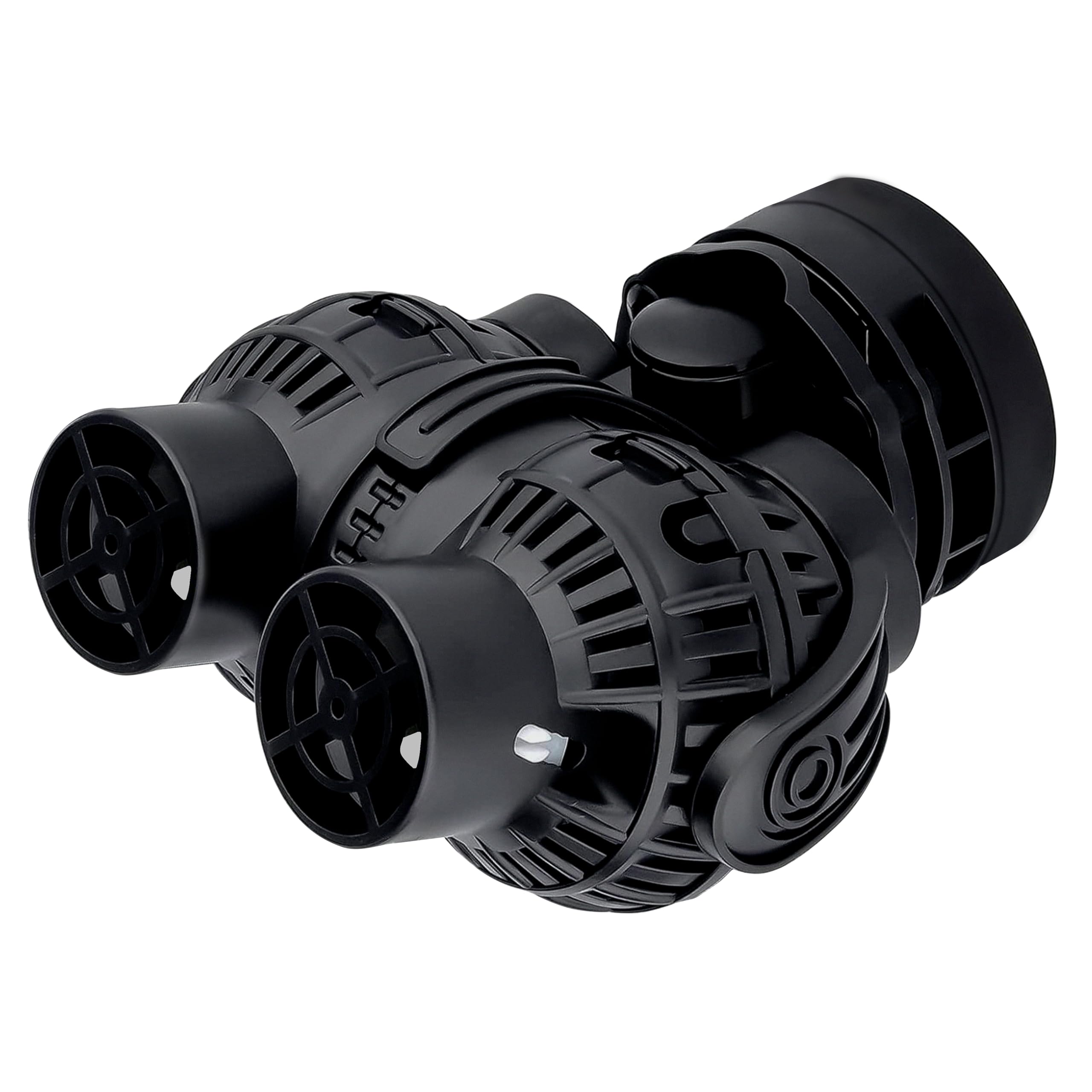
The hygger Cross Flow Pump uses unique cross flow technology to spread water 360 degrees, creating a much wider, gentler wave than a traditional directional pump. It is rated for tanks up to 135 gallons and pushes 1850 GPH at 18 watts. The real star is the LED controller: 5 wave modes (pulse, sine, constant, random, and cross flow), 30-100% flow rate levels, 30-100% frequency levels, plus feeding and night modes.
Owners of 65 to 100 gallon reef tanks love the natural wave motion, especially the M5 random wave mode. The pump is super silent at lower speeds, and the magnetic base holds securely on glass up to half an inch thick. Water flow is the most-praised aspect, followed by build quality and adjustability. The main note of caution is that at higher speeds, it generates a noticeable hum that some describe as a slight whistle — though changing modes usually resolves it. Noise level and reliability are the most-discussed aspects, and both get mixed feedback.
What makes it special
- 5 distinct wave modes create realistic ocean-like water movement.
- 1% fine-tune adjustability for both flow rate and frequency.
- 24V DC operation for safety and near-silent running at low speeds.
The trade-off
- Hum or whistle at higher speeds is a common owner note.
- Long-term reliability is yet unproven — mixed reports on how long it lasts.
Go for this one if: you want the most control over your tank’s water movement and enjoy dialing in the perfect wave for a reef or planted aquarium.
Look elsewhere if: you need dead silence at all speeds, or if you prefer a simple on/off pump without programming overhead.
Understanding the Specs
GPH — Gallons Per Hour
This is the most important number. It tells you how much water the pump moves in an hour. For a reef tank, you generally want 5 to 10 times your tank volume in GPH. For a freshwater planted tank, 3 to 5 times is usually enough. A pump rated 2100 GPH in a 50-gallon tank will create a strong current; in a 125-gallon tank, it will be much gentler. Always match the GPH to your specific tank volume and the type of fish or corals you keep.
Wattage and Energy Use
Wattage tells you how much electricity the pump draws. A lower wattage means lower operating costs. AC pumps often draw more watts than DC pumps for the same flow, so a 5W Hydor Koralia is very energy-efficient compared to a 15W AQQA moving less water. If the pump runs 24/7, the difference in wattage adds up over a year. DC pumps also run on low-voltage 24V power, which is safer in a wet environment.
Magnetic vs Suction Mount
A magnetic base uses a strong magnet inside the tank and a matching magnet outside the glass to hold the pump in place. This works on glass up to about half an inch thick. It is easy to reposition and rarely slips. A suction cup mount is simpler and cheaper, but it loses grip over time — especially on textured or dirty glass. For pumps over 1000 GPH, a magnetic mount is much more reliable.
Adjustable Nozzle and Flow Direction
A pump with a rotating head lets you aim the flow wherever you want. A 270-degree nozzle gives you a wide range of motion, while a full 360-degree head gives you total freedom. This matters because you want to aim the flow along the substrate to roll debris toward the filter, or toward the surface to increase oxygen exchange. Without adjustability, you get one fixed direction that may leave dead spots.
FAQ
How many circulation pumps do I need for my tank?
Can I use a freshwater circulation pump in a saltwater reef tank?
How do I clean a circulation pump without breaking it?
Why is my pump making a loud noise?
How deep should a submersible circulation pump be placed?
What is the difference between a wave maker and a circulation pump?
Will a circulation pump hurt my fish or corals?
How long do aquarium circulation pumps usually last?
Can I use a circulation pump as a return pump for a sump?
What does the GPH rating mean if I have a small tank?
Final Thoughts: The Verdict
Across the board, the best aquarium circulation pump winner is the AQQA 2100 GPH Wave Maker because it delivers the highest flow rate at a reasonable wattage, uses a strong magnetic mount, and has a 360-degree adjustable head — all at a price that undercuts most of the competition. If you want silent, adjustable DC control, grab the hygger Cross Flow Pump. And for long-term reliability without any gimmicks, the Hydor Koralia Evolution 850 is the one to reach for.
How We Picked
We do not accept paid placement. Every pick is matched to a real buyer and a real use-case; we do not hands-on test units.
Sources & Methodology
Specifications: manufacturer listings and product documentation. Review insights: verified customer reviews, as of July 2026. Pricing: not shown on this page (it changes often); check the current price via the retailer link.
As an Amazon Associate, Gadgets Feed earns from qualifying purchases. This does not affect which products we feature.