
Our readers keep the lights on and my morning glass full of iced black tea. As an Amazon Associate, I earn from qualifying purchases.
Specs are compiled from manufacturer listings and verified buyer reviews and can change over time — please confirm the key details on the product page before buying.
When you are living the full-time RV life or heading out on a long summer road trip, a rooftop air conditioner that struggles to keep the cabin cool, guzzles generator fuel, or rattles you awake at 3 a.m. turns a vacation into a chore. You need a unit that matches your rig’s power setup, fits the standard roof opening, and delivers consistent cold without a fuss. This guide compares the best AC RV units for every type of traveler — from the power-conscious boondocker to the big-rig owner who wants a quiet heat pump.
I’m Min — the founder and writer behind Gadgets Feed. This guide is built by comparing the manufacturers’ published specifications and the patterns across verified customer reviews, so you get each pick’s real strengths and trade-offs instead of marketing spin.
Whether you are replacing a worn-out Dometic, upgrading to an inverter-driven 12V unit for off-grid freedom, or picking a first-ever AC for your camper, this roundup of the best ac rv units highlights the key specs — from BTU cooling power and decibel ratings to annual energy consumption — so you know exactly what fits your rig and your lifestyle.
Our Picks at a Glance


How To Choose The Best AC RV Units
Picking the right rooftop AC for your recreational vehicle depends on three core trade-offs: the physical size of your living space and the outdoor temperatures you face (that’s the BTU number), how you power the unit (standard 120V shore power, a battery bank, or a generator — each with different amp draw limits), and your tolerance for noise. A heavy-duty 15,000 BTU unit with a heat pump is a great choice for a 30-foot fifth wheel in Texas heat, but it would be overkill and a huge drain on a small campervan with a 200Ah battery. Similarly, a low-profile 12V AC may not keep a large motorhome comfortable in direct sun. You also need to know whether your RV uses a ducted airflow system or relies on a non-ducted (free-blow) unit, because that determines which models fit without major ceiling modifications.
The following sections explain the three specs that separate a good match from a bad one: BTU cooling power, inverter versus fixed-speed compressors, and annual energy consumption, plus the important distinction between ducted and non-ducted configurations.
BTU Cooling Power and RV Size
BTU (British Thermal Unit) is the measure of how much heat an air conditioner can remove from your RV in one hour. A higher number means it can cool a larger space or fight hotter outside temperatures. A 13,500 BTU unit is the standard choice for many travel trailers and mid-size motorhomes, while a 15,000 BTU or 16,000 BTU unit is better for a 30- to 40-foot coach, especially in desert climates where daytime highs hit 100°F and above. If you go too low on BTU, the unit will run continuously and never catch up; if you go way too high, you may get short cycling and poor humidity removal. Match the unit to your rig’s square footage and typical sun exposure, not just the ceiling opening size.
Inverter Compressor vs Fixed-Speed Compressor
A fixed-speed compressor is the traditional design: it runs at full power until the thermostat is satisfied, then shuts off completely. Every restart creates a big amp spike (that’s often why generators struggle and why you might need a separate soft starter). An inverter compressor, by contrast, varies its speed continuously — it runs at low speed to maintain a set temperature, then ramps up only when needed. This makes inverter-driven AC units dramatically quieter, more energy-efficient (both for battery life and generator fuel), and gentler on your electrical system. They also tend to deliver more consistent temperatures without the on-off cycling that can feel drafty. If you camp off-grid or run on a smaller generator, an inverter unit is a serious upgrade.
Annual Energy Consumption and Low Amp Draw
This spec — measured in kilowatt hours per year (kWh/year) — tells you how much electricity the unit uses over a typical cooling season. A lower number means less strain on your RV’s batteries, your generator’s fuel tank, or your campground’s pedestal. Some units are specifically engineered for low amp draw, pulling around 11-13 amps while running rather than the 15-20 amps of older models. For boondockers running on solar and lithium batteries, this difference can mean the difference between a comfortable evening and a dead battery by midnight. The annual energy figure is a useful shorthand: all else equal, the unit with the lower kWh/year is the more efficient machine.
Ducted vs Non-Ducted Installation
Your RV’s ceiling determines if you need a ducted or non-ducted AC unit. A ducted system channels cooled air through a network of ducts that run inside the roof, feeding multiple vents in different rooms (bedroom, living area, etc.). A non-ducted (or free-blow) unit pushes air directly out of the AC’s ceiling assembly into the main living space without any ducts. Some units are made for ducted systems only, some for non-ducted only, and some (like many RecPro models) are compatible with both configurations. Check what your RV currently has before you buy. Installing a non-ducted unit into a ducted RV (or vice versa) requires significant ceiling modifications that most DIYers and even some pros want to avoid.
Quick Comparison
| Model | Best For | Cooling Power | Noise Level | Annual Energy Use | Amazon |
|---|---|---|---|---|---|
| RecPro 15K Quiet AC Heat Pump★ Best Overall | Best Overall — big rigs & no-duct flex | 15,000 BTU | 55.4 dB | 5,694 kWh/yr | Amazon |
| ASA Advent Air 13.5KBest Value | Budget-friendly replacement | 13,500 BTU | Not listed | Not listed | Amazon |
| Dometic FreshJet 3 13.5KSlim & Light | Lighter weight & quiet | 13,500 BTU | — | 12,264 kWh/yr | Amazon |
| Countrymod 12V 10K (Product 4) | Off-grid & solar setups | 10,000 BTU | 45–55 dB | Not listed | Amazon |
| Outequip 12V 10K (Product 5) | Van life & low-profile build | 10,000 BTU | ≈40 dB | Not listed | Amazon |
| RecPro 13.5K Non-Ducted (Product 6) | Quiet upgrade for ducted or free-blow | 13,500 BTU | 59.7 dB | 5,694 kWh/yr | Amazon |
| TURBRO 13.5K Inverter | Smart, thin rooftop AC with heat | 13,500 BTU | Not listed | 4,204.8 kWh/yr | Amazon |
| TOSOT 16K Heat Pump | Quietest big-bang cooling | 16,000 BTU | 43 dB | Not listed | Amazon |
| Furrion Chill Cube 18K | Power premium & variable speed | 18,000 BTU | Not listed | Not listed | Amazon |
| Coleman-Mach 15 15K | Trusted brand, straightforward swap | 15,000 BTU | Not listed | Not listed | Amazon |
In‑Depth Reviews
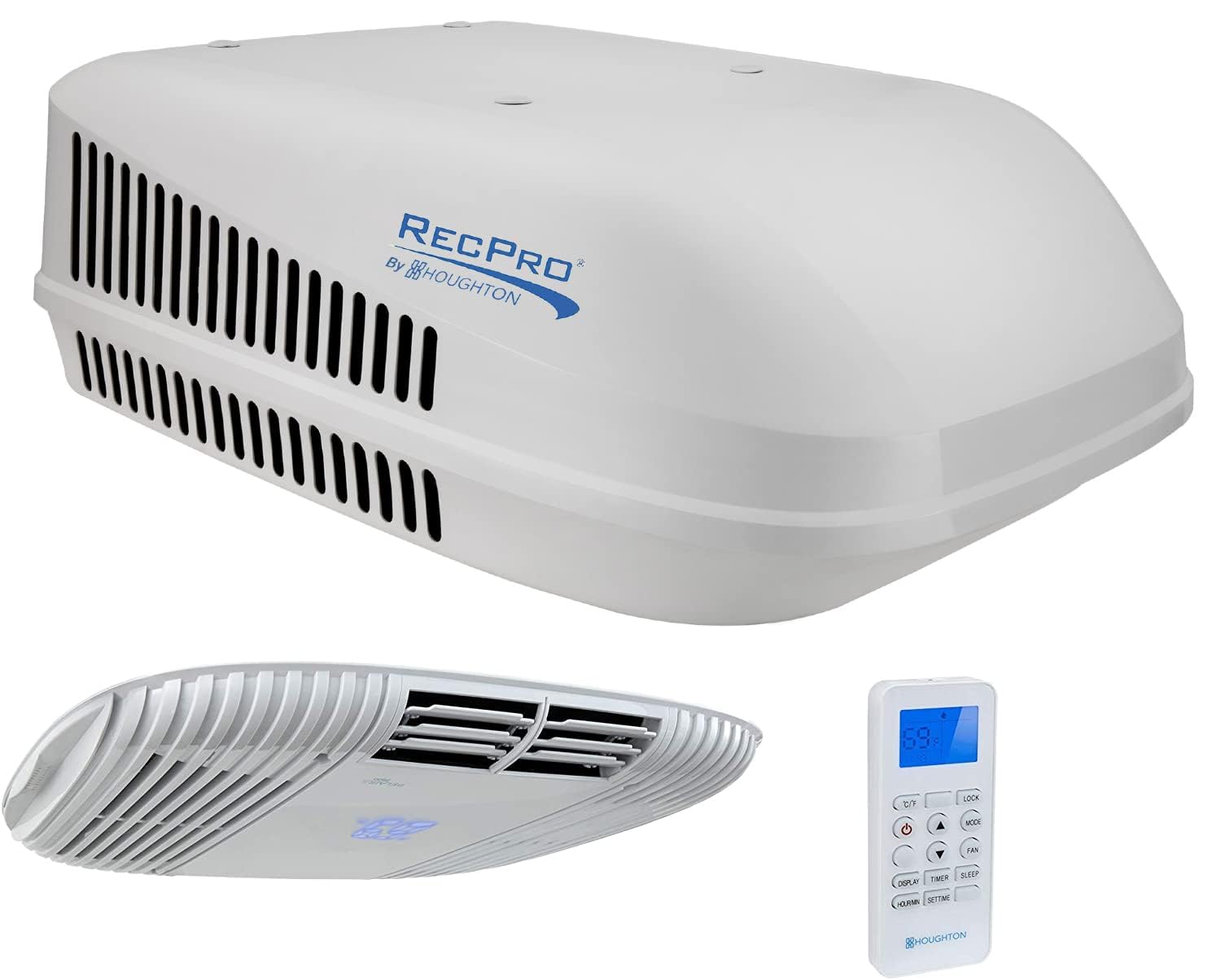
1. RecPro RV 15K Quiet AC Heat Pump Non-Ducted White 110-120V
Our pick — 4.5★ from 300+ verified ratings; the strongest balance of quality and price.
A 15,000 BTU workhorse that pairs a built-in heat pump with whisper-quiet 55.4 dB operation.
This RecPro unit solves two of the biggest RV AC headaches at once: noise and multi-rig compatibility. At just 55.4 decibels — about the sound of gentle rain — it won’t drown out conversation or your sleep. And because it works with both ducted and non-ducted ceiling systems, it fits the widest possible range of campers, fifth wheels, and motorhomes without you having to tear into the roof.
The integrated heat pump delivers supplemental warmth on chilly evenings, so you can stretch your camping season without relying entirely on your propane furnace. The annual energy consumption sits at 5,694 kWh per year. Owners consistently praise its performance (the most-discussed aspect) and installation, with many noting the complete kit — seal gasket, wireless remote, and touchscreen LED panel — means you rarely need extra trips to the hardware store. The rotary scroll compressor and UV-resistant plastic shell are built to handle road vibration and sun exposure.
Quiet 15K heat pump
- Low annual energy consumption (5,694 kWh/yr) — much easier on a generator or solar setup than the Dometic FreshJet 3 (12,264 kWh/yr)
- Engineered for low amp draw, so you can run other appliances without tripping a breaker
- Multi-function remote and touchscreen LED panel give you cool, dry, fan, sleep, and timer modes
Non-ducted installation
- Weighs over 100 lbs — definitely a two-person job to lift onto the roof
- A few owners had bolts that were too short for thick roofs and needed extensions
- Fan reliability gets mixed feedback, with some units running the fan continuously after the compressor cycles off
Reach for this if: you have a 30- to 40-foot RV, want a heat pump for four-season camping, and value quiet cooling that doesn’t drain your electrical budget.
Look elsewhere if: you are a solo installer with a heavy rig — the weight demands a helper, and the bolt length can be hit-or-miss on unusually thick roofs.
2. ASA Electronics ACM135 Advent Air 13,500 BTU Roof Top AC, White
An affordable, metal-pan 13.5K BTUs unit that buyer reports say “kept trailer cool in 115°F+ Arizona summer.”
This is the no-frills replacement for owners whose old Dometic or Coleman gave up after a few seasons, and the raw numbers back up the reputation. The rigid metal constructed base pan is a durability advantage over plastic-base units in extreme heat. A buyer who ran it continuously from May through October on a 3,500W generator in Arizona reports zero issues, calling it a “great unit at a great price.”
It only cools — there is no heat pump included, though an optional plug-in heat strip is available if you need it. The washable filter and three fan speeds give you basic control without app connectivity or digital display panels. Owners also warn that some units arrived missing ceiling assemblies or manuals, so check your package contents immediately upon arrival. But for a straightforward, metal-built roof AC that punches at the standard 13.5K BTU level without a premium price tag, this Advent Air is hard to argue with.
13.5K Advent Air
- Rigid metal base pan for durability in hot climates
- Acts as a direct replacement (plug-and-play) for older Dometic upper units
- Three fan speeds and a washable filter are simple to maintain
Basic control system
- Cooling performance gets mixed feedback — some units arrive with defects or produce minimal cold air
- No built-in heat pump for shoulder-season camping
- Install can be tricky because the supplied mounting screws may be too short for some roof builds
Best if: you want a proven 13.5K BTU replacement that’s painless to bolt onto your existing opening and don’t need a heat pump or smart features.
Think twice if: you rely on a single AC in a very large rig — the 13,500 BTU rating may struggle above 100°F compared to a 15K or 16K unit.
3. Dometic FreshJet 3 Series, 13.5K BTU RV Rooftop Air Conditioner, White
A 21 SEER-rated 13.5K BTU unit.
The Dometic FreshJet 3 is built for weight-conscious RVers and those who prioritize high-efficiency ratings. It boasts a 21 SEER (Seasonal Energy Efficiency Ratio), which is an excellent number for an RV rooftop AC and translates to less power draw while cooling. The lighter weight also makes it a more realistic DIY swap for one or two people. Buyers often mention it is “much quieter and lighter” than the Brisk Air 2 it replaced, with one owner reporting it brought their camper from 80°F to 64°F in 30-45 minutes.
However, there are two important caveats. The annual energy consumption sits at 12,264 kWh per year — a very high figure compared to the RecPro’s 5,694 kWh. That number likely reflects a different testing protocol, but it suggests this unit may use more power in real-world use. More critically, durability is the most-discussed negative aspect in the reviews: multiple buyers report units arriving with cracked shrouds or broken tabs, and at least one owner had it fail after only two months when a compressor wire burnt out. The performance and quietness are praised, but the build quality and shipping fragility are genuine concerns to weigh before purchasing.
FreshJet 13.5K
- High 21 SEER efficiency rating suggests excellent energy use per BTU
- Plug-and-play compatible with existing Dometic air boxes and competitor distribution boxes
- Very quiet and effective cooling — owners mention it can drop temps from 80°F to 64°F quickly
Premium price tag
- High annual energy consumption figure (12,264 kWh/yr) raises questions about actual efficiency
- Durability is a concern — multiple reports of cracked shrouds and compressors failing prematurely
- The high SEER rating and light weight come at a premium over more basic units
Ideal for: Dometic loyalists looking for a quieter, lighter upgrade that works with their existing ductwork and control system.
skip it if: you want a unit with a proven record of long-term durability or you’re on a tight budget and can’t risk a replacement in the first year.
4. 12V DC RV Air Conditioner 10000 BTU (Countrymod) with APP Remote
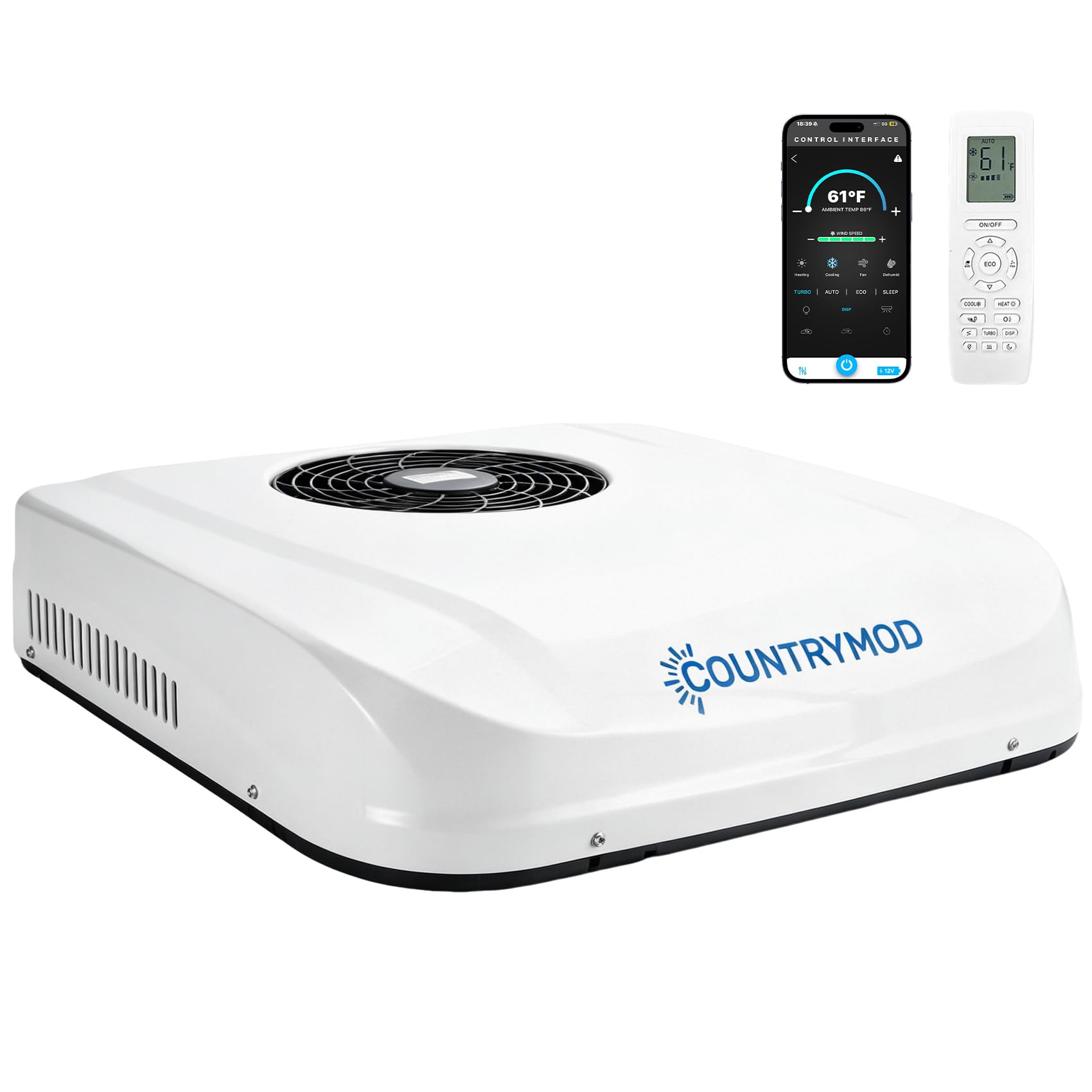
A 12V inverter-driven AC that sips just 0.3 kWh per hour for serious off-grid cooling.
This is the unit that changes the math for boondockers and van-lifers. It is a 10,000 BTU rooftop air conditioner that runs directly on 12V DC power — no inverter needed between your battery bank and the AC. The variable frequency inverter compressor adjusts its speed to match the cooling demand, which means it draws as little as 260 watts on ECO mode and tops out around 590 watts on TURBO. Owners who run this on a 300Ah lithium battery report 12 hours of runtime on ECO, and the unit uses less than 50 amps in operation. It fits a standard 14×14-inch roof vent opening, and the low-profile, ductless design makes it a natural fit for camper vans and small RVs.
The build quality is excellent, with a horizontal compressor that reduces vibration and a lower center of gravity. The noise level is impressively low at 45-55 dB in normal operation and 44 dB in sleep mode. The app and remote control give you full access to modes and scheduling. The only real snag: arched roofs need longer bolts than the included ones (8mm x 160mm), and owners note that the instructions are sometimes lacking — but customer service from a person named Tony is repeatedly praised as fast and helpful. If you live off-grid and need real air conditioning without a generator, this is the standout choice.
12V DC 10K with app
- Extremely low power consumption — consumes only 0.3 kWh per hour and uses less than 50 amps in operation
- Quiet operation at 45-55 dB (44 dB in sleep mode), with steady, inverter-driven cooling
- Multiple control options: keypad, remote, and app with scheduling
Limited cooling power
- 10,000 BTU is less powerful than standard 13.5K units — best for small to mid-size rigs
- Instructions are weak, and some roofs need longer bolts than the provided ones
- Not designed for ducted RV systems — ductless only
Reach for this if: you camp off-grid, have a sturdy battery and solar setup, and want a quiet AC that won’t drain your power bank overnight.
Look elsewhere if: you need to cool a large fifth wheel or motorhome — the 10,000 BTU output is better suited to vans, small trailers, or as a bedroom-only unit.
5. Outequip RV Air Conditioner, 12V 10000 BTU with Heat Pump
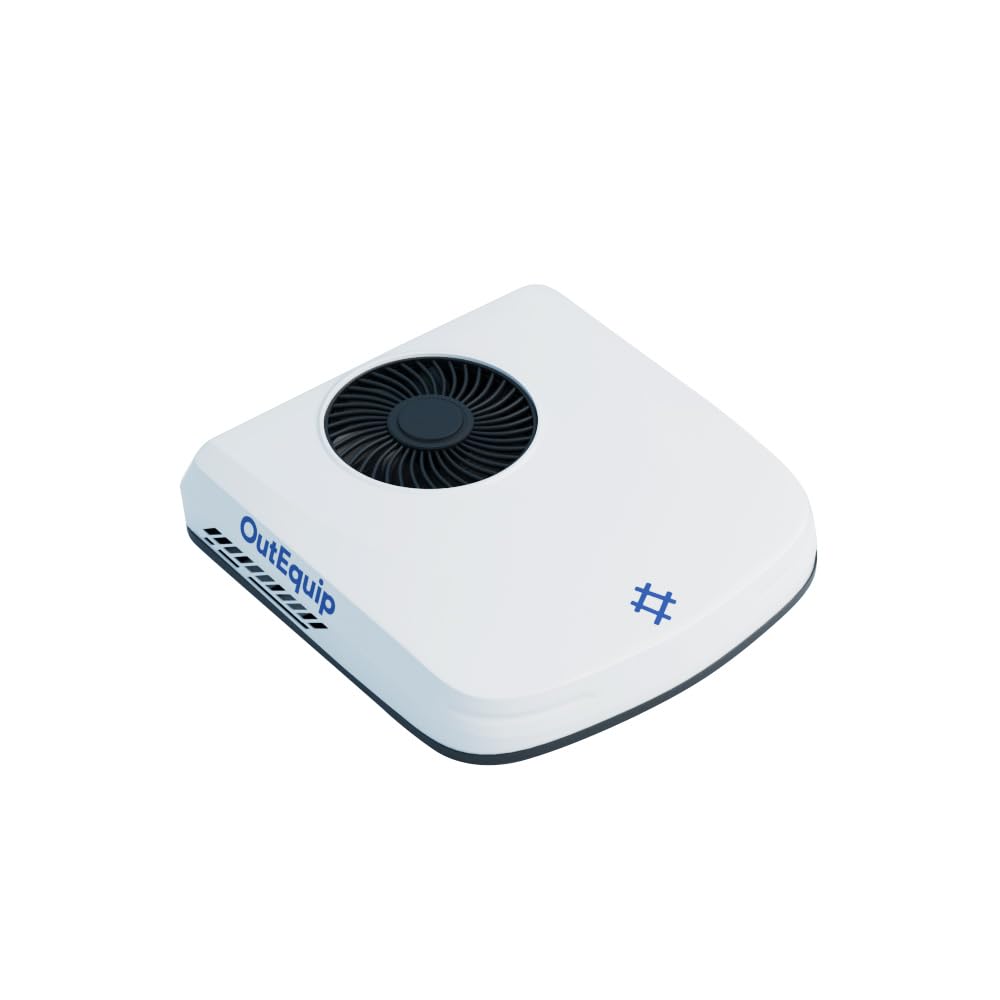
A low-profile 12V AC that keeps your roof clear for solar panels while delivering 10,000 BTU of cooling.
This Outequip unit is designed for the modern van or camper builder who wants to boost rooftop solar real estate. It stands roughly 6 inches tall, which is 2 to 3 inches lower than a traditional Dometic or RTX unit. That extra clearance on the roof can translate into one more panel or just cleaner aerodynamics and less wind noise while driving. The 10,000 BTU cooling capacity is paired with a 4,500 BTU PTC heater that takes the chill off on cool mornings — though it is not a primary heat source for extreme cold. Owners praise the fast cooling, with reports of it working well even in a full-sun Ram Promaster. The noise level is very low at around 40 dB, thanks to brushless copper motor fans and spring-supported mounts.
Installation is straightforward for a 12V unit, and the package includes 15 feet of 6 AWG wire and a fuse. The Bluetooth app is easy to set up for controlling modes (ECO, sleep, turbo) and monitoring temperature. The biggest praise from owners goes to the cooling performance and installation ease. One owner who switched from a 90-pound Coleman Mach 3 noted the new unit is roughly half the weight, making it a true one-person install. The only minor gripe: the lid screws can be hard to remove during installation, and the connectors feel a bit fragile.
12V 10K heat pump
- Low-profile design (about 6″ tall) frees up roof space for solar panels
- Very quiet operation at around 40 dB — comparable to a low hum
- Includes a 4,500 BTU PTC heater for shoulder-season warmth (not for extreme cold)
Compact output
- 10,000 BTU cooling means it is best for small to mid-size vans, not large RVs
- Install screws can be difficult to remove, and some connectors are prone to breaking
- Heat pump is supplemental only — not a substitute for a furnace in freezing temps
Best for: van-life builders who need a low-profile, off-grid AC that doesn’t eat into precious roof space for solar.
Not ideal for: large motorhomes or anyone who needs a primary heat source in sub-freezing temperatures — the 4,500 BTU heater is for mild chill only.
6. RecPro 13.5K Non-Ducted RV Air Conditioner, White, Cooling Only

A 13.5K BTU cooling-only unit that runs 20 dB quieter than the Furrion it replaces.
This RecPro is essentially the cooling-only sibling of the 15K heat pump model above, tuned for owners who already have a furnace and just need a cold-air upgrade. With 13,500 BTU of cooling power and a noise level of just 59.7 dB, . It works with both ducted and non-ducted configurations, giving you flexibility. The low amp draw also makes it a good match for smaller generators and solar setups — one owner runs it on a 2,200W generator with a SoftStart device. The installation is a straightforward four-bolt job; the whole process takes about two hours with help lifting the unit onto the roof.
Owners consistently praise the quiet operation and effective cooling. It uses the same UV-resistant plastic shell and touchscreen LED panel as its big brother. However, a significant minority of buyers in humid climates flag a specific issue: the fan runs continuously even after the compressor cycles off, which can dump moisture back into the RV — essentially acting as a “humidity generator.” This makes it a tricky choice for Gulf Coast or Florida campers. The remote is also limited to direct line-of-sight, which can be inconvenient from the driver’s seat or a bed.
13.5K non-ducted
- Very quiet at 59.7 dB — 20 dB quieter than older Furrion units
- Low amp draw works well with smaller generators and solar/off-grid setups
- Compatible with both ducted and non-ducted RV ceiling systems
Basic cooling only
- Cooling only — no heat pump or heater function
- Fan stays on after the compressor stops, which can reintroduce moisture in humid climates
- Remote needs direct line-of-sight to work, which some owners find limiting
Choose this if: you want a quiet, efficient 13.5K BTU unit for a dry climate and already have a separate furnace.
Pass if: you camp in the humid Southeast — the continuous fan could make the interior feel clammy.
7. TURBRO Inverter 13.5K BTU RV Air Conditioner with Heat Pump, WiFi & Remote

An inverter-driven 13.5K BTU unit with WiFi scheduling and an atmosphere lamp that is just 10 inches thick.
The TURBRO is one of the slimmest rooftop ACs on the market — just 10 inches thick. This cuts air resistance while driving and improves fuel economy. Inside, an inverter compressor delivers up to 30% greater efficiency than fixed-speed units, and it provides up to 13,500 BTU of both cooling and heating via a heat pump. The heat pump is rated to work in outside temperatures from 19.4°F to 109.4°F. The ceiling assembly includes a blue, yellow, or white atmosphere light — a small but welcome touch for nighttime ambiance.
WiFi scheduling via the smart app works well, and customers note the unit cools a 35-foot coach effectively in 90°F+ weather. However, the noise level is the most-mentioned aspect across all reviews, and it is marked as “mixed” — some buyers find it quieter than the old Penguin II they replaced, but others call it extremely loud at all fan speeds. A notable and recurring complaint is that the built-in thermostat reads about 12 degrees cooler than the actual room temperature, causing the compressor to ramp down too early or run continuously. This makes it a less reliable choice for precise temperature control, especially in a battery-sensitive off-grid setup.
Inverter 13.5K quiet
- Ultra-slim profile (10″ thick) reduces drag and improves fuel economy
- Inverter compressor delivers greater efficiency
- WiFi scheduling and app control for remote temperature adjustments
Newer brand
- Noise level is the top-discussed aspect and reviews are divided — some find it quiet, others very loud
- Built-in thermostat can be inaccurate (reading 10-12°F lower than actual room temp), affecting efficiency
- Some plastic clips and cover pieces feel cheap and may break during installation
Consider this if: you want a thin rooftop unit with smart features (WiFi, app, atmosphere light) and a heat pump for mild seasons.
Look elsewhere if: noise sensitivity is your top priority or you need a thermostat that reads the room accurately for battery management.
8. TOSOT 16000 BTU RV Air Conditioner, 43dB Ultra Quiet, White | Heat Pump

A powerful 16,000 BTU heat pump unit that runs at a whisper-quiet 43 dB — quieter than a normal conversation.
The TOSOT is the unit for RVers who need serious cooling power but refuse to sacrifice sleep quality. At 16,000 BTU, it is among the most powerful rooftop ACs on this list, yet its noise level is just 43 dB.. Owners consistently confirm this, with one calling it an “absolute lifesaver” in a Winnebago Revel Sprinter. It cools a 23-foot trailer to 70°F even when the outdoor temp hits 105°F. The heat pump delivers 12,500 BTU of warmth for shoulder-season camping, and the WiFi connectivity (via the Gree+ app) lets you turn it on remotely before you arrive at the campsite.
The unit works in ambient temperatures from 23°F to 115°F, so it covers almost every real-world camping scenario. Non-ducted design fits the standard 14.25 x 14.25-inch vent opening, and it ships in two packages that may arrive separately. The only recurring concern among owners is long-term reliability for a relatively new brand in the RV space — some wonder if replacement parts will be easy to find in five years. Energy use is also a factor: at high cooling, the unit draws about 800 watts, which is reasonable for a 16K BTU machine but means you need a decent battery bank or generator for off-grid use.
16K ultra quiet
- Extremely quiet operation at 43 dB — 32% quieter than typical RV ACs
- Powerful 16,000 BTU cooling and 12,500 BTU heat pump for year-round use
- WiFi connectivity allows pre-cooling your RV before you arrive
Large size
- Long-term parts availability for the TOSOT brand is unproven vs. legacy brands like Coleman or Dometic
- Draws about 800 watts on high cooling — requires a capable battery bank or generator
- Struggles with cooling above 95°F in very large RVs (31ft+), according to some owners
Ideal for: owners of 16- to 24-foot RVs who want the best possible combination of cooling power and quiet operation, plus a heat pump for three-season camping.
Not recommended if: you need a proven, long-term service network or you plan to cool a 35-foot+ motorhome with a single unit.
9. Furrion Chill Cube 18k BTU Variable Speed RV Rooftop Air Conditioner, Black

The most powerful unit on this list — 18,000 BTU with a variable-speed compressor and R32 refrigerant for efficiency.
The Furrion Chill Cube is for RV owners who refuse to compromise on cooling capacity. With 18,000 BTU, it provides over 1.5 tons of cooling and easily handles the largest fifth wheels and Class A motorhomes. The variable-speed compressor runs continuously, eliminating the abrupt starts, stops, and high amp draw that plague traditional fixed-speed ACs. It uses R32 refrigerant, which is more energy-efficient than older refrigerants and has a lower global warming potential. The unit weighs just 72.4 lbs — about 10% lighter than comparable high-BTU units — and its aerodynamic black shroud reduces drag during travel.
What wins people over is the combination of raw power and low energy draw. Reviewers point out it can drop the temperature inside an RV by 11 degrees in 14 minutes, and it runs on roughly 850 watts once it reaches set temp.. The noise level is another highlight, with many calling it “super quiet” even on Turbo Cool mode. However, this is the AC unit only — you must purchase the ADB (Air Distribution Box) separately, which is a critical extra cost and part. A handful of owners also report a loud compressor vibration that shakes the entire RV, though this appears to be a unit-specific defect rather than a design flaw.
18K variable speed
- Highest cooling capacity on the list at 18,000 BTU — suitable for large rigs
- Very power-efficient — draws around 850W once set temp is reached, about half of older units
- Lightweight for its class at 72.4 lbs and uses greener R32 refrigerant
Heavy unit
- Sold as AC unit only — the Air Distribution Box (ADB) is sold separately (B0F147CJCT) and is essential for installation
- A small number of units have a loud compressor vibration that resonates through the RV
- Black color may absorb more heat in direct sun than a white unit, though it matches some RV aesthetics
Best for: owners of large motorhomes or fifth wheels who want maximum cooling with variable-speed efficiency and are okay buying the separate ADB kit.
Skip if: you want a complete, install-ready package with all ceiling components included in one box.
10. Coleman-Mach 08-0080 Mach 15 48204 Series Air Conditioner Upper Unit, 15,000 BTU

The 15,000 BTU upper unit that has been the go-to replacement for RVers for years — simple, effective, and well-known.
The Coleman-Mach 15 is the replacement upper unit for the industry-standard Mach series. It delivers 15,000 BTU of cooling power using a scroll compressor and a 1/3 HP fan motor on 115V AC. For anyone who already owns the Mach lower assembly and control system, this is a direct mechanical swap — remove four bolts, disconnect the freeze sensor and electrical connector, lift the old unit off, and install the new one. The two-piece shroud is easier to handle than the older one-piece design. Shoppers say the new unit cools 15 to 20 degrees Fahrenheit below outdoor temp, which is a big jump over a worn-out unit that only dropped 4-5 degrees.
The reliability and installation aspects earn the most praise from owners — this is a product with a long, well-documented service history. The value for money is also strong. However, this is an upper unit only, meaning you need an existing (or separately purchased) lower control panel and mounting frame. It is not meaningfully quieter than the outgoing Mach 13.5K model, so it is not the choice for noise-sensitive sleepers. A few buyers received units damaged in transit due to flimsy packaging, and one owner reported the unit is far louder than the advertised 28 dB and tends to freeze up in humid conditions. Overall, it is a reliable workhorse, but not a technological leap forward.
Coleman 15K durable
- Proven, industry-standard design with tons of replacement parts and service knowledge available
- Easy to install if you already have the Mach lower assembly — a simple 4-bolt swap
- Cools effectively, with reports of a delta-T of 15-20°F below outdoor temperature
No heat pump
- Upper unit only — requires a separately purchased lower control panel and mounting frame for a full install
- Not significantly quieter than older Mach models, so it’s not ideal for noise-sensitive sleepers
- Packaging can be flimsy, leading to a higher chance of receiving a damaged unit in transit
Reach for this if: you already have a Coleman-Mach system and just need a reliable drop-in replacement with proven cooling performance.
Look elsewhere if: you want a quieter or more efficient inverter unit, or you need a complete AC system with a new control panel included.
Understanding the Specs
BTU: British Thermal Units
This is the standard measure of cooling power. One BTU is the amount of heat needed to raise one pound of water by one degree Fahrenheit. In an RV context, a higher BTU number means the air conditioner can remove heat faster from a larger space. A 13,500 BTU unit is the typical standard for a mid-size travel trailer or van, while a 15,000 or 16,000 BTU unit is better suited for a 30-to-40-foot motorhome or fifth wheel, especially in hot climates like the Southwest. If you undersize the BTU, the unit will run constantly and never satisfy the thermostat; if you oversize it significantly, you might get short cycling and poor humidity removal.
Inverter vs Fixed-Speed Compressor
A fixed-speed compressor runs at 100% power until the set temperature is reached, then shuts off completely. Every restart creates a large, brief amp draw (the “startup surge”) that can trip breakers or overload small generators. An inverter compressor varies its motor speed continuously — it runs at a low speed to maintain the temperature, ramps up when cooling is needed, and ramps down again. This makes inverter units significantly quieter, more energy-efficient, and gentler on your RV’s electrical system. They also provide a more consistent temperature without the on-off drafts of a fixed-speed unit.
Annual Energy Consumption (kWh/year)
This number tells you how many kilowatt-hours the unit will use over a typical cooling season. A lower figure means less strain on your generator’s fuel tank, your battery bank’s state of charge, or your campground’s electrical pedestal. For example, the RecPro 15K has an annual consumption of 5,694 kWh, while the Dometic FreshJet 3 shows 12,264 kWh. While these figures come from manufacturers’ specific test protocols and may not perfectly match real-world usage, they are a useful shorthand for comparing relative efficiency between two units.
dB: Decibel Levels
Decibels measure sound pressure. Because the scale is logarithmic, a 3 dB increase represents a doubling of sound energy. A 43 dB unit (like the TOSOT) is quieter, and the difference between 55 dB and 59 dB is perceptible but not enormous. For context: normal conversation is around 60 dB, gentle rainfall is about 50 dB, and a library is roughly 40 dB. If you are a light sleeper or camp in quiet natural settings, a unit that operates at or below 50 dB will make a meaningful difference.
FAQ
Will a 15,000 BTU unit fit the same roof opening as a 13,500 BTU unit?
Can I run a 15,000 BTU RV AC on a 30-amp service?
What is the difference between ducted and non-ducted RV AC units?
How long does a rooftop RV AC typically last?
Is a 12V AC unit better than a 120V unit for boondocking?
What does “low amp draw” mean for an RV AC?
Do I need a soft starter for an inverter RV AC?
Can an RV AC with a heat pump replace my furnace?
Final Thoughts: The Verdict
For most buyers, the best ac rv unit is the RecPro 15K Quiet AC Heat Pump because it delivers a strong balance of high BTU output, low noise, built-in heat pump, and very attractive annual energy consumption. If you need a true off-grid powerhouse that sips battery power, grab the Countrymod 12V 10K. And for the quietest, most powerful cooling in a single package, the TOSOT 16K is the one to reach for. One honest nudge: the RecPro’s strong 4.5-star crowd-sourced consensus, backed by hundreds of positive reviews, makes it the safest and most versatile bet for the widest range of RVers. Pick the one that matches your rig size and power setup, and you will stay cool all season long.
How We Picked
We do not accept paid placement. Every pick is matched to a real buyer and a real use-case; we do not hands-on test units.
Sources & Methodology
Specifications: manufacturer listings and product documentation. Review insights: verified customer reviews, as of July 2026. Pricing: not shown on this page (it changes often); check the current price via the retailer link.
As an Amazon Associate, Gadgets Feed earns from qualifying purchases. This does not affect which products we feature.