
Our readers keep the lights on and my morning glass full of iced black tea. As an Amazon Associate, I earn from qualifying purchases.
Specs are compiled from manufacturer listings and verified buyer reviews and can change over time — please confirm the key details on the product page before buying.
Picking a budget mini split means you want central-air comfort without the central-air price tag — but the wrong choice leaves you with a box that wheezes on the first hot day or bleeds your electric bill dry. You need an inverter-driven system that hits your room size hard, stays whisper-quiet, and actually heats when the mercury drops below freezing.
I’m Min — the founder and writer behind Gadgets Feed. This guide is built by comparing the manufacturers’ published specifications and the patterns across verified customer reviews, so you get each pick’s real strengths and trade-offs instead of marketing spin.
The crowd favorite — a 4.5-star system tested by hundreds of owners — anchors this list, but every model here was chosen because it earns its place in the budget mini split conversation with actual value, not just a low price tag.
Our Picks at a Glance


How To Choose The Best Budget Mini Split
Choosing the right mini split matters more than chasing the lowest price. Focus on capacity, efficiency, voltage, and heating range to ensure the system fits your space and climate.
Match BTU to Your Room Size
BTU (British Thermal Unit) is the raw measure of heating and cooling power. A 12,000 BTU unit handles roughly 450 to 750 square feet, while a 9,000 BTU system fits smaller rooms around 250 to 400 square feet. Oversizing leaves you with short cycles that never fully dehumidify; undersizing forces the compressor to run non-stop.
SEER2 and Energy Savings
SEER2 (Seasonal Energy Efficiency Ratio 2) tells you how efficiently the system converts electricity into cooling across a season. A higher SEER2 means lower monthly bills; 20 SEER2 and above is the balance for budget-friendly operation. Inverter compressors ramp up and down instead of cycling on and off, saving energy and keeping temperatures steady.
Voltage: 115V vs 230V
Most budget 12,000 BTU units run on a standard 115V outlet, so you can often skip the electrician. A 230V system typically pulls more power for faster temperature changes, especially in extreme climates. Check your panel capacity before buying — a 115V unit draws about 12 to 15 amps, while a 230V unit draws half that current.
Heating Range (Heat Pump)
If you plan to use the system for winter heating, look at the minimum operating temperature. Basic heat pumps work down to about 5°F, while higher-end models keep heating at -13°F. In cold climates, a model with a good low-temperature rating avoids the need for backup electric strips.
Quick Comparison
| Model | Best For | BTU / Square Feet | SEER2 / Voltage | Min Heating Temp | Amazon |
|---|---|---|---|---|---|
| Senville LETO★ Best Overall | Best Overall value & quiet operation | 12,000 BTU / 700 sq.ft | 19 SEER / 208-230V | 5°F | Amazon |
| TOSOT CosmoBest Cold Climate | Best cold-weather heating | 12,000 BTU / — | 22 SEER2 / 115V | -13°F | Amazon |
| DELLA VarioSmartest Pick | Best smart-home integration | 12,000 BTU / 550 sq.ft | 20.5 SEER2 / 115V | -4°F | Amazon |
| DELLA Serena | Best ultra-quiet operation | 12,000 BTU / 550 sq.ft | 22 SEER2 / 208-230V | 5°F | Amazon |
| COSTWAY Blast | Best warranty coverage | 12,000 BTU / 750 sq.ft | 20 SEER2 / 115V | — | Amazon |
| ROVSUN WiFi | Best energy-saving inverter | 12,000 BTU / 550 sq.ft | 20 SEER / 115V | — | Amazon |
| Garvee | Best precision temperature control | 12,000 BTU / 750 sq.ft | 22 SEER2 / 115V | — | Amazon |
| Mountman | Best easy DIY installation | 12,000 BTU / 750 sq.ft | 19 SEER2 / 110-120V | — | Amazon |
| Nexaro | Best eco-friendly refrigerant | 12,000 BTU / 750 sq.ft | 19 SEER2 / 115V | — | Amazon |
| YITAHOME | Best for extreme heat & cold | 12,000 BTU / 750 sq.ft | 20 SEER2 / 115V | 5°F | Amazon |
| ACiQ Essentials | Best compact 9000 BTU for small rooms | 9,000 BTU / 400 sq.ft | 20 SEER2 / 115V | 5°F | Amazon |
In‑Depth Reviews
1. Senville LETO Mini Split 12000 BTU
Our pick — 4.5★ from 450+ verified ratings; the strongest balance of quality and price.
A proven crowd-pleaser that balances value with real-world performance.
This 12,000 BTU, 19 SEER inverter unit is a 4-in-1 system — air conditioner, heat pump functional down to 5°F, dehumidifier, and fan — all in one wall-mounted package that covers 700 square feet. The DC inverter compressor ramps its speed up and down instead of cycling on and off, so you get steady temperatures without the energy spikes that drive up your bill. The included 16-foot line set is pre-loaded with refrigerant for runs up to 25 feet, meaning a professional installer won’t need to add coolant for standard setups.
What wins people over is what buyers call “super quiet” performance — the kind of silence that makes sense for a garage gym, a bedroom, or a sunroom. One owner installed theirs in a Pennsylvania basement and reports excellent heating and cooling through cold winters, with the Wi-Fi kit issue handled by Senville sending a free replacement immediately. The 5-year parts and compressor warranty adds confidence, though labor costs are not covered.
The Alexa and app controls let you set routines and tweak temperatures from anywhere. This is a 4.5-star unit tested by hundreds of owners — it is the pick that balances everything most buyers actually want.
Why it stands out: Performance is the top praise across the review pages — buyers consistently call out the strong cooling, quiet operation, and dependable heat pump. Installation is rated as straightforward for a pro, and the energy efficiency is a recurring positive note.
Room for improvement: Temperature control gets mixed feedback; some owners find the setpoint drifts a few degrees. The Wi-Fi module can sometimes require a replacement (though support handles it). Best suited for a space where you value silence over absolute temperature precision.
Your best match if: You want a proven, quiet, app-controlled system that covers most of a mid-sized home addition or garage — the most balanced performer in the budget tier.
Look elsewhere if: You need to cover more than 700 square feet with a single head, or you require heating below 5°F.
2. TOSOT Cosmo 12,000 BTU Mini-Split
The heat pump that refuses to quit when the thermometer plummets.
With a 22 SEER2 rating and an advanced rotary scroll compressor, this 12,000 BTU system from TOSOT is built by the same company behind the respected Gree brand. It cools in temperatures up to 122°F and — more importantly — keeps heating down to -13°F, making it one of the few budget units that can handle a northern winter without auxiliary heat strips. The noise range of 22 dB to 36 dB means it is effectively silent at low speeds, suitable for a bedroom or office where peace matters.
The Gree+ app and Alexa voice control give you full remote access, and owners highlight the fast shipping, easy install, and high efficiency cooling that pushes cool air more than 30 feet from the indoor unit. One RV owner used the heat pump exclusively for 1.5 years in single-digit temperatures, completely eliminating their propane furnace. The flip side is that the Wi-Fi app works reliably, but Alexa integration can be inconsistent — a point several owners mention. The unit ships in multiple packages that may arrive on different days, so plan your install timeline accordingly.
At 4.5 stars with a strong base of reviews, this is the premium-budget balance for anyone who needs year-round performance in a climate that sees real winter.
Its defining strength: The -13°F heating floor is extraordinary at this price point — no other budget pick here keeps pumping heat that low. Build quality and quiet operation are consistently praised.
Its one real compromise: The floor area claim of 1,500 square feet is optimistic for 12,000 BTU; expect real-world coverage closer to 750 square feet for effective cooling. The app-to-Alexa handoff can be finicky.
Reach for this if: Your winters drop below zero and you want a single system that handles both cooling and heating without backup strips — no other budget mini split goes as cold.
Skip it for: A small room under 400 square feet where a 9,000 BTU unit would cycle more efficiently.
3. DELLA Vario Series 12000 BTU Mini Split
The smart-home heavy lifter that talks to your phone, not just your thermostat.
This 12,000 BTU, 20.5 SEER2 system runs on a standard 115V outlet and covers up to 550 square feet with its DC inverter compressor. The standout feature is the I Feel mode — the remote control senses the temperature right where you are sitting, not at the indoor unit on the wall, and adjusts the airflow accordingly. That means the unit targets your actual comfort zone instead of guessing from across the room. The 4D air flow (up-down and left-right vanes) and a range of 60°F to 90°F give you fine-grained control.
After six months of use, buyers report the unit is “very quiet” inside and out, with the phone app updated to show room temperature and custom programming. One buyer installed it in a 462-square-foot insulated garage and found it handled 90°F summer days and teens°F winter nights without breaking a sweat. The wireless connectivity does have a quirk — it can occasionally disconnect, requiring a breaker reset to reconnect. The included refrigerant line tape is also described as inadequate; you will want to buy separate line-set cover for a clean install. Reliability is the most common praise in the data, with installation and cooling performance following close behind.
At 4.4 stars, this is the strongest pick for anyone who wants app-based temperature management and a system that knows where you are in the room.
Why it wins the smart category: The I Feel sensor is genuinely useful — it solves the “cold at my desk, warm at the wall” problem. The updated app is better than most budget brands.
Where it stumbles: The wireless can drop out and need a power cycle. The install manual lacks detail (wiring pinout, tool sizes), so plan on YouTube guides if you are DIY-ing. Best for a tech-comfortable owner who values smart controls.
Your pick if: You want to control the climate from your phone and prefer a system that senses your spot in the room rather than the wall temperature.
Not the one if: You need silent confidence from the wireless connection — occasional drops may frustrate you.
4. DELLA Serena 12000 BTU Mini Split

The quietest bedroom companion for light sleepers.
At just 22 dBa in mute mode, this 12,000 BTU unit is quieter than a library — it is the most silent system on this list. It runs on 208-230V and delivers a 22 SEER2 rating, which translates to significant energy savings. The PureClean technology prevents dust buildup on the indoor coil, and a bottom heating element in the outdoor unit prevents ice buildup during winter operation, keeping defrosting efficient down to 5°F. The 4D air flow, I Feel mode, and the DELLA app with Alexa/Google Home integration round out a feature set that rivals units costing significantly more.
One rental property owner who bought this system called it “very, very quiet” and praised the two-day delivery with everything included for a simple install. A tiny home owner in Alabama reports it works “fantastic” in summer heat. However, the 22 dBa rating applies only to mute mode — at normal fan speeds and compressor start, the outdoor unit can sound like an idling car, which a few owners note. The app and remote also do not always sync; the remote overrides the app, which can confuse smart-home routines. The 16.4-foot installation kit is standard, and professional installation is mandatory to maintain the warranty.
This DELLA Serena is an Energy Star certified unit, making it eligible for government rebates in some areas — a nice bonus if you are looking to offset the upfront cost of 230V installation.
Noise performance: The 22 dBa mute mode is leagues ahead of the competition for sleep spaces. The indoor unit is genuinely whisper-level.
App quirk: The remote overrides app settings, so if you build automations, they may not stick. The outdoor unit’s compressor start noise is more noticeable than the indoor whisper. Best paired with a quiet outdoor mounting location.
Perfect for: A bedroom or nursery where every decibel counts — the mute mode is genuinely sleep-friendly.
Think twice if: You plan heavy smart-home automation; the app-remote conflict may frustrate you.
5. COSTWAY Blast Series 12000BTU Mini Split

The garage hero with a warranty that outlasts the install.
COSTWAY backs this 12,000 BTU, 20 SEER2 system with 5 years on parts and 8 years on the compressor — the strongest warranty in this roundup. It runs on 115V, covers up to 750 square feet, and includes five operating modes (auto, cool, dry, heat, fan) with four fan speeds. The self-cleaning function heats the indoor coil to 134.6°F to prevent mold and bacteria buildup, while the auto-defrost on the outdoor unit protects against ice damage in winter. The remote control’s display turns off after 10 seconds of inactivity so it does not disturb sleep, a small but thoughtful detail.
One owner who installed this in an Ohio shop reports excellent heating down to 3°F — the unit kept two rooms at 70°F through brutal cold snaps. Another used it in a trailer shop running on inverter and lithium batteries, finding the cooling effective in 85°F weather and the heating “powerful.” The recurring sentiment is that this unit delivers 75% of the performance of a Mitsubishi at a fraction of the cost. The catch is that there are no onboard controls — you need the remote for everything, and the manual is essentially useless, so YouTube is your friend. Temperature fluctuations of ±3°F are common as the output steps between 25%, 60%, and 100% capacity rather than ramping infinitely.
At 4.4 stars across over 800 ratings, this is the most-reviewed budget mini split on this list — proof of its reliability at scale.
Warranty leadership: No other budget pick matches 8 years on the compressor. For a long-term install, this matters.
Stepped output: The three-step power modulation means temperature swings of a few degrees — fine for a garage or shop, less ideal for a nursery. No Wi-Fi or app control, so if you want smart-home integration, look at the DELLA Vario.
Best for: A workshop, garage, or rental property where the 8-year compressor warranty justifies the investment and you do not need app control.
Not for: A primary bedroom where you need ±1°F precision and quiet ramp-up.
6. ROVSUN 12000 BTU Wifi Mini Split

The inverter wizard that slashes your electric bill without sacrificing power.
With an advanced inverter that delivers a 20 SEER rating, this 12,000 BTU system claims up to 35% energy savings through intelligent frequency adjustment — the compressor speed adapts automatically to indoor temperature changes instead of cycling on and off. It covers 550 square feet, runs on 115V, and offers an ultra-quiet 28 dB in mute mode. The included 16.4-foot copper line set and signal cord cover standard installations, and the app works with Alexa and Google Assistant for hands-free adjustments.
An HVAC professional who bought this unit for his Arizona garage says the build quality matches or exceeds competitors, and the “super” mode provides powerful cooling that runs 24/7 without issues. Another owner notes it runs on a standard 110V circuit without tripping a 20A breaker, making it ideal for retrofit installations where running new 230V wiring would be expensive. The noise level is described as “very quiet” across the board. The Wi-Fi works but requires a 2.4 GHz network, and the app setup can be slightly fiddly — one owner called the Wi-Fi “useless.” Durability gets mixed feedback, with a few owners noting the compressor can be less consistent on older units. The 4.4-star rating across 255 reviews reflects strong overall satisfaction.
This is the pick if energy efficiency is your top priority and you want the flexibility of smart-home voice control.
Energy story: The 35% savings claim is the highest in this budget category, and owners confirm their electric bills did not increase after running it 24/7 in a hot climate.
Wi-Fi caveat: The app works fine once connected, but some units arrive with a finicky module. The 2.4 GHz requirement is standard for budget IoT devices. Best if you prioritize energy savings over dead-simple smart setup.
Grab this if: Reducing your electric bill is the number one goal, and you already have a 2.4 GHz network for the smart features.
Skip it for: A large, poorly insulated space — the 550 sq ft coverage is smaller than most 12K systems.
7. Garvee 12000 BTU Mini Split

Holds room temperature to within a tenth of a degree.
Garvee’s 12,000 BTU unit is the spec-sheet standout in this budget roundup. It boasts a 22 SEER2 rating, an AI-driven vector inverter that holds the setpoint to ±0.1°C (0.18°F), and a 30-second turbo cool that blasts 12,000 BTU in half a minute. The 60-second turbo heat delivers 12,300 BTU, and the dual-layer acoustic insulation keeps noise between 41 dB in Turbo mode and a mere 23 dB in Sleep mode. The outdoor unit is compact, which helps if you have tight balcony or rooftop space. It covers 750 square feet and runs on 115V.
Early owners (4.7 stars from 38 ratings) report “very cold” output — one measured 45.5°F at the vent with 70°F inlet and 90°F outside. Installation is described as easy if you have a vacuum pump and know the fittings, and the app connection works well. The temperature hold precision is genuinely impressive at this price tier, rivaling mid-range Mitsubishi units. The gripes are minor: the remote shows temperature in Celsius only (no Fahrenheit option), and the packaging can arrive a bit banged up even though the unit itself is fine. The 5-year warranty covers shipping damage, normal part failures, and functional defects.
This is the most technologically advanced budget mini split here — ideal if you want tight temperature control and very low noise.
Precision advantage: The ±0.18°F setpoint hold is class-leading in this price bracket — most competitors allow ±2-3°F swings. The 30-second cool burst is genuinely fast.
Celsius-only remote: The display shows Celsius, which is a non-issue for scientific users but a minor friction for those used to Fahrenheit. Also a newer product with fewer long-term reviews (38 ratings), so the durability track record is shorter.
Reach for this if: You are a temperature-sensitive sleeper or have a home server room that needs stable temps — the precision here is category-leading.
Hold off if: You prefer a longer, proven track record over cutting-edge features.
8. Mountman 12000 BTU Mini Split
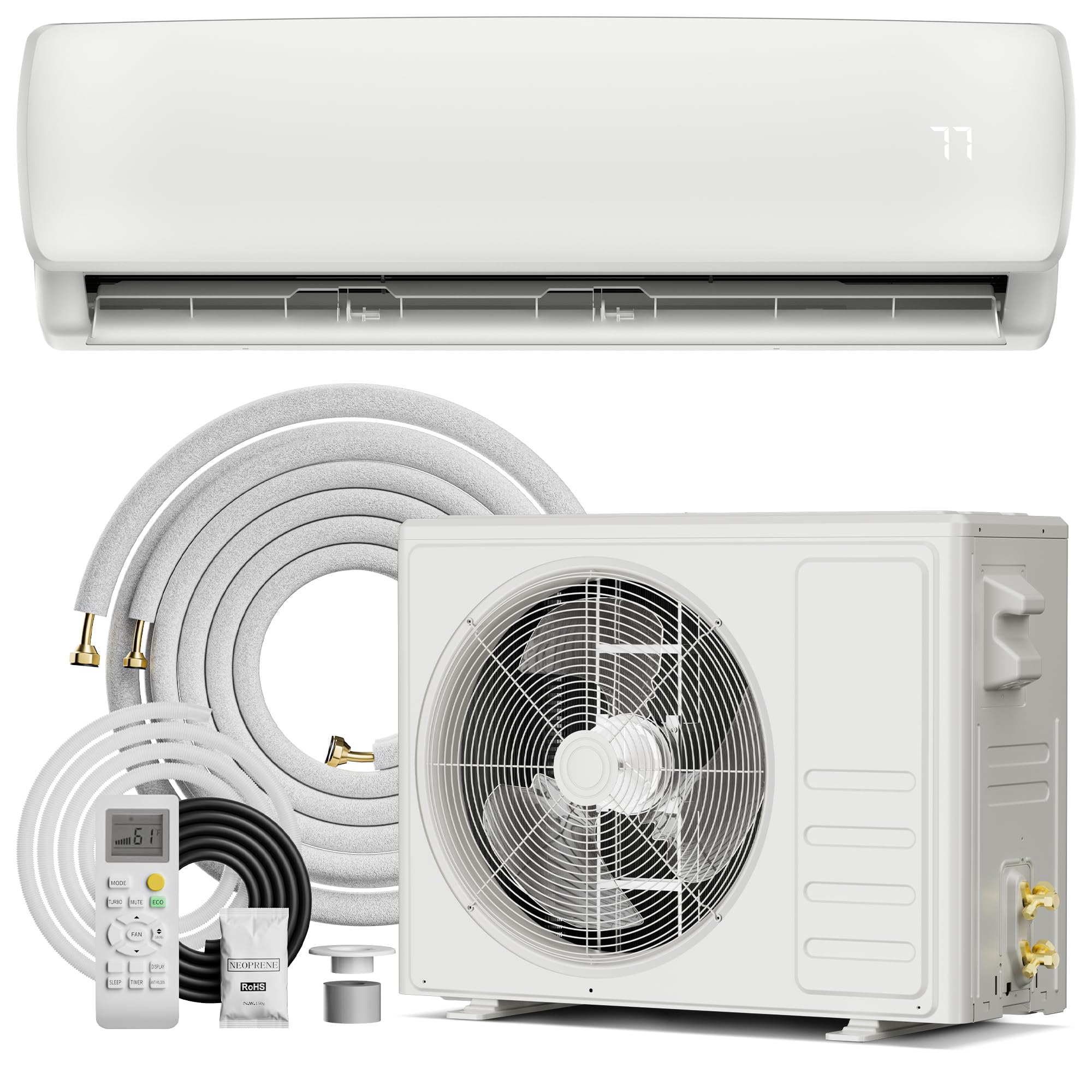
The one that actually guides a first-timer through installation.
Mountman’s 12,000 BTU, 19 SEER2 system is designed with the DIY installer in mind. The included mounting template makes positioning the indoor unit straightforward, and the manual walks through each step — several owners completed the install in about an hour. The rotary scroll compressor runs on 110-120V and pulls a maximum of 12 amps, so most existing circuits can handle it without an electrician. Features include 4 fan speeds, Sleep Mode at ultra-quiet 26 dB, ECO Mode, and Turbo Boost for rapid cooling. The self-cleaning function and automatic defrost reduce maintenance.
One owner installed it in a 30×20 insulated shop and reports it keeps the space “cozy all year round.” Another used a temporary window setup with the unit during a renovation and found flawless performance over three months. The outdoor component is described as barely audible. However, the instructions lack charging information, and customer service can be slow to respond. The wall plate bracket uses 12-inch centers, which may not match standard stud spacing without modification. Several owners recommend buying foam sealer and blue tape for the line wrap. At 4.4 stars across 362 reviews, the consensus is clear: great value with a slight learning curve on the manual.
This is the best option if you are handy and want to save on professional installation costs.
Install focus: The mounting template and detailed manual earn consistent praise — owners call it “easy install” and “whisper quiet.” The side knockout for line routing is a smart design touch.
Missing info: No charging specs in the manual, and support response can lag. The 12-inch bracket centers may need stud modification. Best for a confident DIYer who knows how to bleed lines with a vacuum pump.
Your buy if: You are handy, want to install it yourself, and appreciate a thoughtful mounting template — the install experience here is the smoothest in this list.
Not for: Anyone who wants plug-and-play support or a manual with every detail.
9. Nexaro 12000BTU Mini Split (R32)

An eco-conscious choice that uses low-GWP R32 refrigerant.
This 12,000 BTU, 19 SEER2 system uses R32 refrigerant, which has a lower global warming potential (GWP) than R410A — a meaningful choice if environmental impact factors into your purchase. It covers 750 square feet, runs on 115V, and offers 5 modes (cool, heat, auto, fan, dry) plus 4 fan speeds, Sleep Mode, Eco Mode, Turbo Boost, and a 24-hour timer. The anti-mildew function cleans the internal components automatically, and the automatic defrost prevents ice buildup in cold weather. The indoor unit dimensions are 32.32 inches wide by 11.91 inches tall, which is compact enough for most wall spaces.
One owner replaced a 24K BTU R22 unit with this 18K BTU version and reports it is “flawless after months” of running 18 hours a day in heat mode — no icing, proper drainage, and powerful heating. A non-HVAC owner says the install was “very DIY” and took time following the manual. The build quality impresses owners for the price. However, some units have arrived with cosmetic damage or in poor condition, and the instructions are sparse — you will likely need YouTube guidance for the vacuum pump step. The 4.3-star average from 84 ratings reflects high satisfaction among those who got a clean unit.
This is the pick if you want the lower environmental footprint of R32 refrigerant and do not mind a slightly reduced feature set compared to the higher-SEER2 competitors.
Eco profile: R32 is the future of residential refrigerants — lower GWP and higher energy efficiency than R410A. This unit is ahead of the curve in the budget segment.
Condition concerns: A small percentage of units arrive with dents or damage — inspect thoroughly on delivery. No Wi-Fi or voice control, so if smart features matter, look at Garvee or ROVSUN.
Choose this if: You want the most environmentally responsible refrigerant available, and a compact, reliable 12K unit for a medium-sized room.
Pass on it if: You need smart-home integration or can’t risk receiving a damaged unit from shipping.
10. YITAHOME 20 SEER2 12000BTU Mini Split
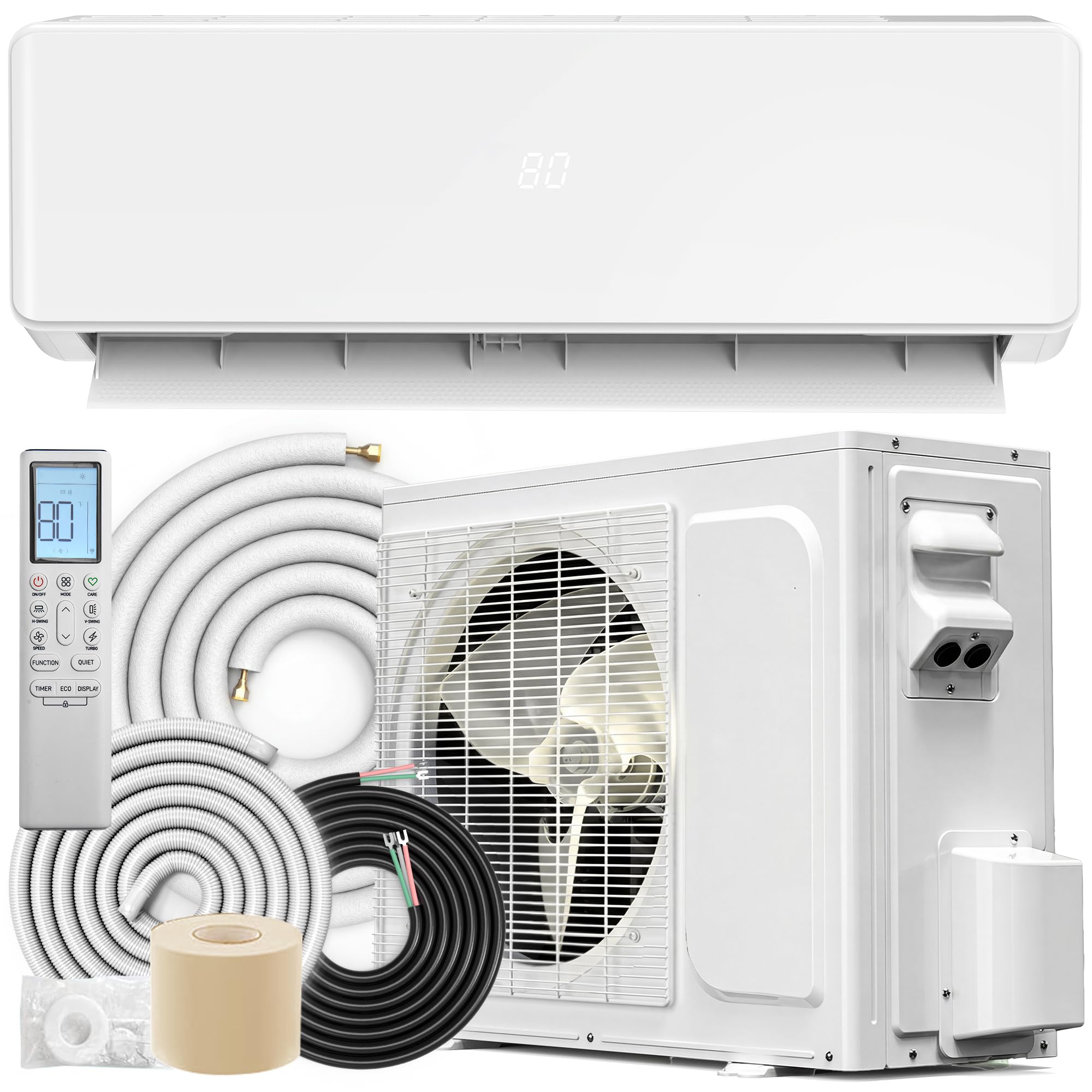
The 115V bruiser that laughs at triple-digit heat and sub-zero cold.
YITAHOME’s 12,000 BTU, 20 SEER2 system is engineered for extremes — it operates in temperatures from 5°F up to 118°F, making it one of the widest operating ranges in this budget class. It covers 750 square feet on a standard 115V circuit and delivers a maximum airflow distance of 50 feet. The five modes (auto, cool, dry, heat, fan) are joined by iFEEL mode, which adjusts the temperature based on the remote’s sensor, and “HEALTH” mode that uses negative ions for electrostatic dust removal and PM2.5 filtration (an unusual bonus at this price). The noise level stays below 41 decibels.
A Chicago-area owner reports it cools about 600 square feet well in 110°F+ heat and heats effectively in negative temperatures — the kind of year-round performance that matters in the Midwest. The ECO mode maintains temperature efficiently, drawing less than 300 watts in some setups. Owners appreciate the easy wiring and straightforward install, though the WiFi connectivity gets mixed reviews (some units connect easily, others are finicky). The biggest caveat is that a small number of units arrive with a non-functional compressor — two owners in the review data received units that only blew warm air. It is a risk at this price point, but the majority of the 398 reviews rate it positively at 4.1 stars.
This is the cheapest 20 SEER2 unit in the list — ideal for budget-first buyers in extreme climates, with the understanding that quality control is a bit more variable.
Climate range: The 5°F to 118°F operating window is genuinely wide, and owners confirm it handles both extremes well. The 50-foot airflow distance is impressive.
Compressor variability: A small fraction of units arrive with compressor issues — the data shows positive performance (86 mentions) vastly outweighs negative, but it is a real consideration. The WiFi is hit-or-miss. Best purchased with a returns-friendly plan.
Pick this if: Your budget is tight and you live in a climate with both scorching summers and freezing winters — this unit handles the spread better than most at its price.
Skip if: You cannot risk a potential early defect or you rely heavily on WiFi controls.
11. ACiQ Essentials 9000 BTU Mini Split
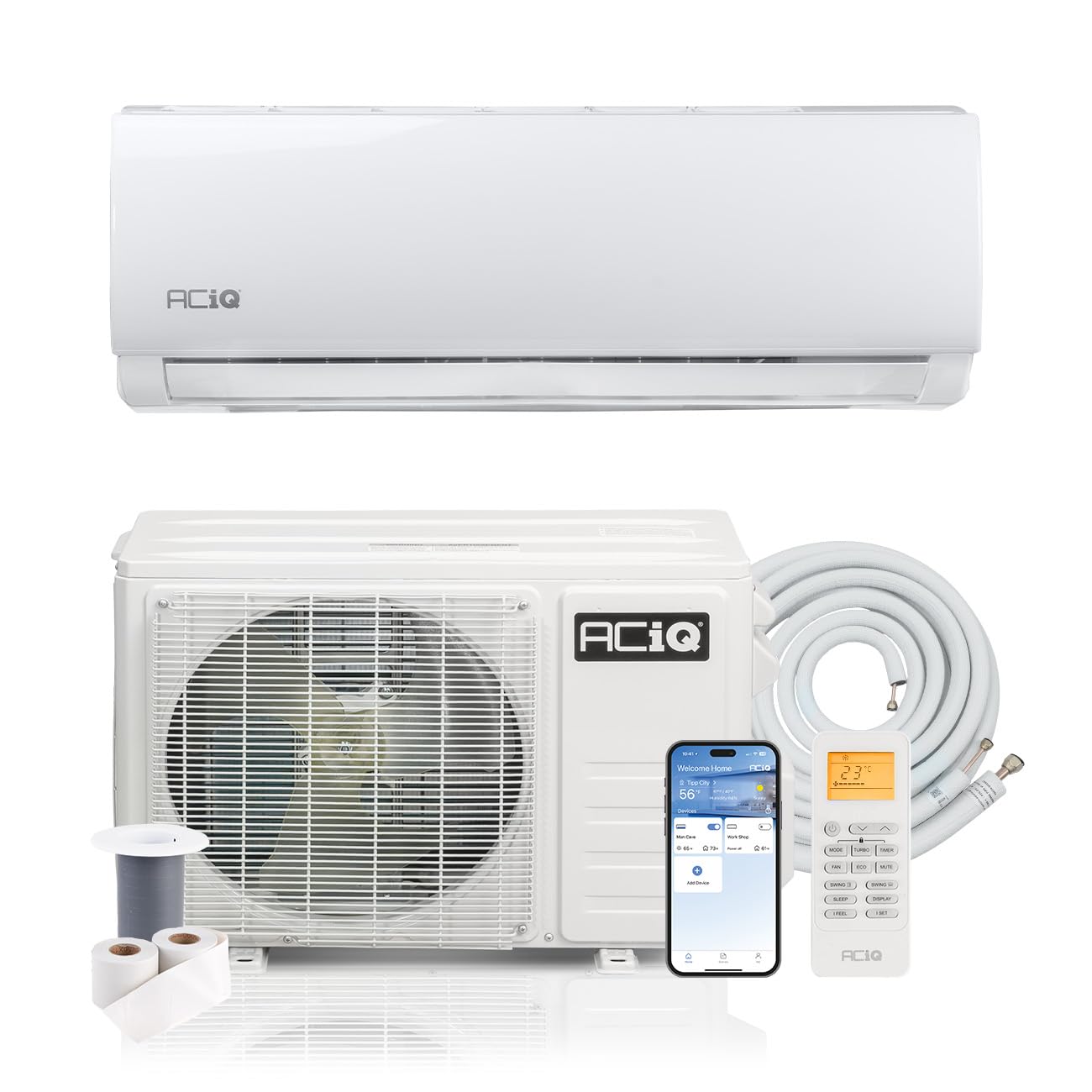
The perfect size for that awkward medium room no standard unit fits.
At 9,000 BTU, this ACiQ Essentials system fills a specific gap — rooms between 250 and 400 square feet where a 12,000 BTU unit would short-cycle and waste energy. It runs on 115V, delivers a 20 SEER2 and 9.5 HSPF2 rating, and uses R32 refrigerant pre-charged for the included 16-foot line set without needing additional refrigerant. The inverter compressor operates at whisper-quiet sound levels while self-adjusting capacity up to 9K BTU output. It also works with the SmartLife-SmartHome app for iOS and Android, and ships with a full accessory kit including the mounting plate, rubber feet, drain elbow, and hardware.
One owner mounted the indoor unit 12 feet high and describes it as “silent” operation with air that reaches the floor — a common challenge with higher-mounted units. The condensing unit is also near-silent. The unit works fine even in 20°F weather, according to another reviewer. Build quality impresses those who have installed it. The catch is that the instructions are vague, and the indoor air handler materials feel a bit flimsy compared to the 12K units in this list. The minimum set temperature is 60°F, which may be too warm for some garage applications where you want it cooler for storage. The 4-year parts and 6-year compressor warranty (when registered) is solid for a 9K system.
This is the best pick for a small, well-insulated space where a 12K unit would be overkill.
Size advantage: 9,000 BTU is the just-right zone for bedrooms, offices, and small workshops — it cycles properly and dehumidifies effectively in a 400 sq ft space.
Hands-on note: The indoor unit’s plastic feels less substantial than the outdoor unit’s build. The 60°F minimum temperature is worth checking if you want a cooler garage. Professional installation is strongly recommended.
Grab this for: A small bedroom, office, or shed where a 12K unit would be too powerful — the 9K size is perfect for efficient dehumidification and temperature control.
skip it if: You need to cool more than 400 square feet or want the sturdier build feel of a 12K system.
Understanding the Specs
SEER2 and Inverter Technology
SEER2 (Seasonal Energy Efficiency Ratio 2) is the current standard for measuring how efficiently a mini split converts electricity into cooling over an entire season. A higher number means lower monthly bills — 19 SEER2 is the floor for decent efficiency, while 22 SEER2 is excellent in the budget tier. Inverter compressors are what deliver these gains. Unlike a traditional compressor that clunks on at full power and off again, an inverter varies its speed continuously, matching the cooling output to the exact demand in the room. This keeps temperatures steady, reduces wear, and eliminates the on-offwasting energy. In real terms, an inverter system uses roughly 25–30% less electricity than a fixed-speed unit of the same BTU rating.
BTU, Square Footage, and Heat Pump Range
BTU (British Thermal Unit) measures the raw heating or cooling power of the system. A 12,000 BTU unit is generally rated for 450 to 750 square feet, but real-world coverage depends on insulation, ceiling height, and local climate. A heat pump reverses the refrigerant cycle to provide warmth in winter — the key spec is the minimum outdoor temperature at which it can still extract heat. Basic budget heat pumps stop working around 5°F, while advanced models like the TOSOT Cosmo keep heating down to -13°F. If you live in a cold climate, a low minimum heating temperature is critical to avoid needing expensive backup electric resistance strips.
FAQ
Can I install a budget mini split myself to save money?
What tools do I need for a DIY mini split installation?
How long do budget mini splits typically last?
Do I need a dedicated circuit for a 115V mini split?
Is R32 refrigerant better than R410A for budget mini splits?
How do I decide between 115V and 230V for my mini split?
What does “pre-charged” mean and do I need to add refrigerant?
How quiet are these budget mini splits in practice?
Can a budget mini split really heat a room in freezing weather?
What is the biggest mistake people make when buying a budget mini split?
Final Thoughts: The Verdict
Across the board, the budget mini split winner is the Senville LETO because it combines a proven 4.5-star track record, whisper-quiet operation, and a 5-year warranty at a price that undercuts most name-brand competitors without cutting corners on performance. If you want class-leading cold-weather heating, the TOSOT Cosmo is the one to reach for — its -13°F operating floor is the best in this list. And for the budget-obsessed buyer who does not flinch at a slightly higher quality-control risk, the YITAHOME packs the widest climate range into the lowest price. No matter which you choose, invest in a professional install — or a proper vacuum pump and a Saturday morning — and these systems will deliver central-air comfort for years.
How We Picked
We do not accept paid placement. Every pick is matched to a real buyer and a real use-case; we do not hands-on test units.
Sources & Methodology
Specifications: manufacturer listings and product documentation. Review insights: verified customer reviews, as of July 2026. Pricing: not shown on this page (it changes often); check the current price via the retailer link.
As an Amazon Associate, Gadgets Feed earns from qualifying purchases. This does not affect which products we feature.