
Our readers keep the lights on and my morning glass full of iced black tea. As an Amazon Associate, I earn from qualifying purchases.
Specs are compiled from manufacturer listings and verified buyer reviews and can change over time — please confirm the key details on the product page before buying.
Shooting in dim light is where most camcorders fall apart. Grain floods the frame, autofocus hunts, and everything turns into a muddy mess. But a handful of camcorders are built for exactly this problem — they pack bigger sensors, faster lenses, or clever processing that keeps your footage clean when the sun goes down. This guide breaks down the six camcorders that actually deliver in low light, from pocket-sized travel companions to professional cinema rigs.
I’m Min — the founder and writer behind Gadgets Feed. This guide is built by comparing the manufacturers’ published specifications and the patterns across verified customer reviews, so you get each pick’s real strengths and trade-offs instead of marketing spin.
You will find the right camcorder in low light by understanding what sensor size, aperture, and stabilization really mean for your footage, and by seeing which model matches your shooting style and budget.
Our Picks at a Glance

How To Choose The Best Camcorder In Low Light
Picking a low-light camcorder feels technical, but the deciding factors are straightforward once you know what to look for. Sensor size, aperture, and stabilization are the three pillars — each one directly determines how your footage will look when the lights go down.
Sensor Size — The Bigger, The Better
The physical size of a camcorder’s imaging sensor determines how much light it can capture in a single frame. A 1-inch sensor, like the one found in the DJI Osmo Pocket 3 or Canon XA70 Pro, gathers significantly more light than the smaller 1/2.3-inch or 1/2.5-inch sensors in many consumer models. This translates directly to less grain (what camera owners call noise) and cleaner detail in dim environments. For true low-light mastery, look for camcorders with at least a 1-inch sensor or, at the professional level, a Super 35 sensor like the one in the Blackmagic Design Pocket Cinema Camera 6K Pro. The Super 35 sensor is roughly the same size as a frame of 35mm movie film and, with its 13 stops of dynamic range, retains detail in both shadows and highlights.
Aperture and Light Gathering
Aperture refers to how wide the lens opens to let in light, measured in f-stops — a lower number means a wider opening. A lens with an f/1.8 aperture lets in roughly four times more light than one at f/3.5. In practical terms, that wider opening lets you shoot indoors, at dusk, or under cloudy skies without cranking up the ISO (the sensor’s sensitivity, which adds grain when pushed high). Most of the camcorders on this list work with interchangeable lenses or have fast built-in zooms, so check the lens’s maximum aperture (the lowest f-number) before you buy.
Image Stabilization and Steady Shots
Low-light shooting often forces you to use slower shutter speeds, which makes any camera shake more visible. That is why good image stabilization (a system of gyroscopes and motors that counteract your hand’s movement) becomes critical. Optical stabilization inside the lens or a mechanical gimbal (like the DJI Osmo Pocket 3’s 3-axis gimbal) physically steadies the image, keeping your footage sharp without adding electronic artifacts. A camcorder with strong stabilization lets you shoot handheld in a dimly lit room and still get usable, smooth footage.
Dual Gain ISO and Noise Control
Dual gain ISO is a feature found on more advanced camcorders like the Blackmagic Design Pocket Cinema Camera 6K Pro. It means the sensor has two native circuits for handling sensitivity — one for bright scenes and one for dark scenes — so when you switch to the high-ISO circuit, you get much less noise (grain) than you would on a standard camcorder at the same setting. The Blackmagic 6K Pro boasts a dual gain ISO up to 25,600, which is exceptionally clean for a camera at its price point. If you shoot a lot of events, weddings, or performances in variable light, dual-gain or dual-native ISO is a huge advantage.
Quick Comparison
| Model | Best For | Sensor Size | Max Video Resolution | Zoom | Amazon |
|---|---|---|---|---|---|
| Blackmagic Pocket Cinema Camera 6K Pro★ Best Overall | Cinematic productions | Super 35 | 6144 x 3456 (6K) | Lens mount (EF) | Amazon |
| DJI Osmo Pocket 3Best Value | Vlogging & travel | 1-inch CMOS | 3840 x 2160 (4K) | 4x Digital | Amazon |
| Sony FDR-AX43 Handycam | Family events & church | 1/2.5-inch Exmor R | 3840 x 2160 (4K) | 20x Optical | Amazon |
| Canon VIXIA HF G70 | Hobbyist videography | 1/2.3-inch CMOS | 2160p (4K UHD) | 20x Optical | Amazon |
| Canon XA70 Pro | Professional event work | 1-inch CMOS | 3840 x 2160 (4K) | 15x Optical | Amazon |
| Panasonic HC-X2 | ENG & news gathering | 1.0-inch MOS | 3840 x 2160 (4K) | 20x Optical | Amazon |
In‑Depth Reviews
1. Blackmagic Design Pocket Cinema Camera 6K Pro
Our pick — over 4.5★ from 200+ verified ratings; the strongest balance of quality and price.
A cinema-grade sensor that sees clearly when the venue goes dark
The Blackmagic 6K Pro is the undisputed champion for low-light work among these picks, and it is not close. Its Super 35 image sensor delivers a native resolution of 6144 x 3456 pixels — at 6144 pixels versus the DJI Osmo Pocket 3’s 3840 pixels, giving you enormous cropping and reframing freedom in post-production. More importantly for dim conditions, it offers 13 stops of dynamic range and a dual gain ISO that reaches up to 25600, meaning you can shoot in a candlelit room or a stage performance and still see smooth, grain-free skin tones and texture. Built-in 2, 4, and 6 stop ND filters (neutral density filters that act like sunglasses for the lens) let you keep the aperture wide open in bright light without overexposing, then dial them back when the sun drops.
What buyers praise most is the image quality — it is the number one thing owners single out. One owner who shot live opera and classical masterclasses in 6K noted that the high resolution let them “use digital zoom during editing without losing quality,” which is a real advantage for event videographers who cannot reposition mid-show. The body is lightweight carbon fiber polycarbonate composite, and the large 5-inch HDR tilt screen eliminates the need for an external monitor. Recording options are flexible: you can write to SD/UHS-II or CFast 2.0 cards, or plug in an external SSD via USB-C. Buyers also report that it “runs all day without overheating” and records to a 2TB SSD, which is critical for long ceremonies or shoots.
The catch is the auto-exposure system, which lacks dedicated ISO control in auto mode. Some owners note that the camera makes harsh jumps in shutter and aperture when lighting changes, and there is no spot metering. That means you will want to shoot in full manual or manual exposure for predictable low-light results. It also requires a bit of post-production polish — the included DaVinci Resolve Studio activation key covers that, but it is not a point-and-shoot experience. This camcorder is for someone who wants cinema-quality low-light footage and is ready to invest the time in manual control and color grading.
cinema 6K dynamic: The Super 35 sensor and dual gain ISO up to 25600 mean you can shoot in extremely dim conditions without the grain that plagues smaller sensors.
battery hungry: Auto-exposure lacks smooth transitions, so plan to shoot manual for professional results. The crowd favorite — 4.6 stars across 200+ owners — backs up the consensus.
cinematic power: you shoot events, performances, or narrative work where holding detail in near-darkness is non-negotiable.
charge heavy: you want a grab-and-go camcorder with fully automatic settings for family videos.
2. DJI Osmo Pocket 3
A pocket camera that punches far above its size in dim light
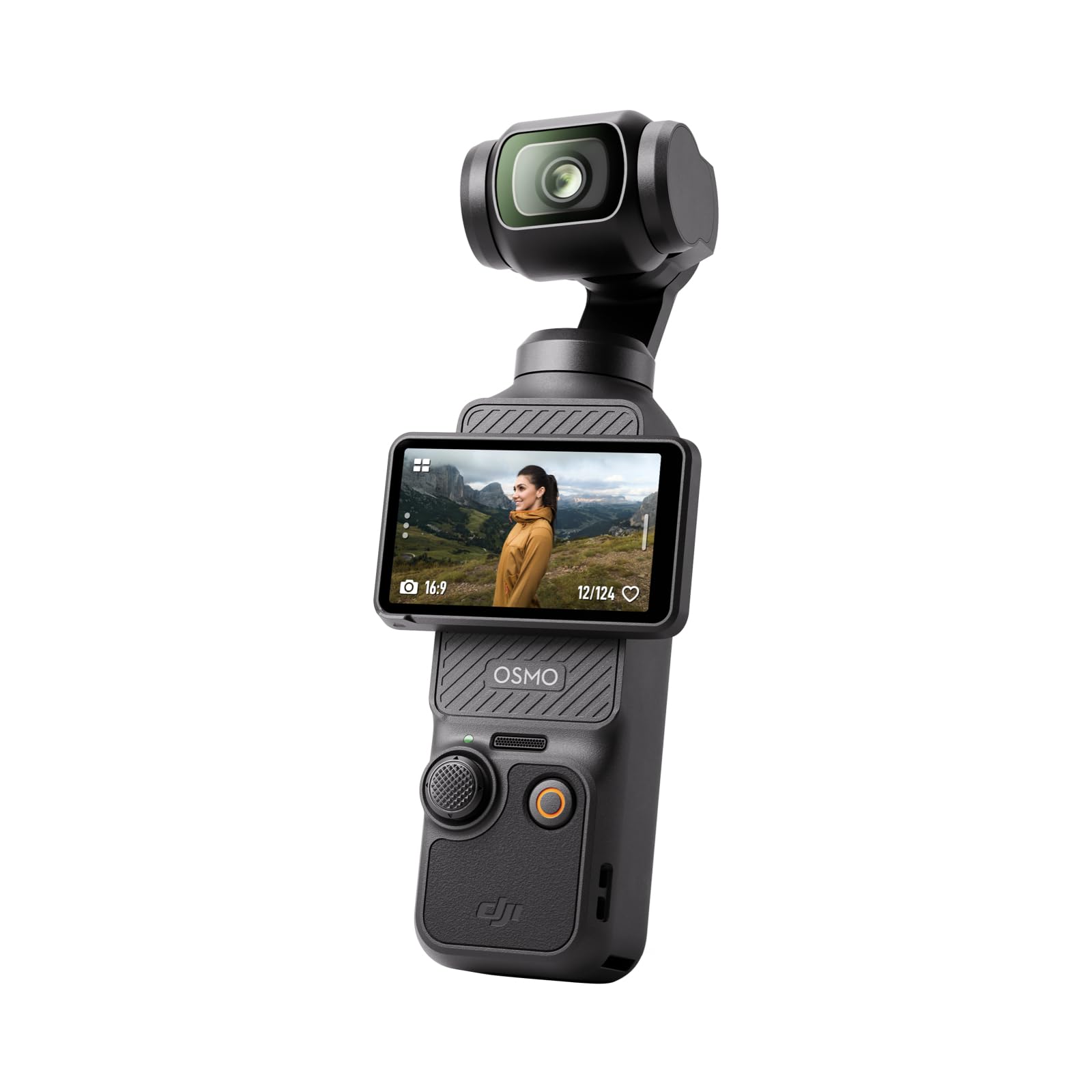
The DJI Osmo Pocket 3 proves that you do not need a shoulder-mounted rig to get clean low-light footage. Its 1-inch CMOS sensor (the same physical size used in many premium compact stills cameras) captures 4K video at up to 120fps (frames per second), and the 3-axis mechanical gimbal keeps every frame utterly smooth even when you are walking, dancing, or chasing a pet. For a camcorder that fits in a jeans pocket, the low-light capability is remarkable — reviewers consistently praise the “good low-light” performance and how the 1-inch sensor handles dusk and indoor scenes without breaking into heavy noise.
The Pocket 3 captures 4K resolution at 3840 pixels, which is a familiar balance for YouTube and social media, and the D-Log M color profile with 10-bit color depth (that is over a billion colors) gives you plenty of latitude in post-production. The 2-inch rotating touchscreen flips for horizontal or vertical shooting, making it a natural fit for TikTok and Instagram Reels. Quality is the aspect buyers praise most — the #1 mentioned attribute — followed closely by video quality. One owner described it as having “excellent image quality from 1″ CMOS sensor, 4K/120fps, outstanding stabilization, fast autofocus, face/object tracking.” The ActiveTrack 6.0 keeps you center-frame even on a tripod, and the new OsmoAudio feature connects directly to two DJI Mic 2 or Mic Mini transmitters for pro-level audio without extra cables.
The trade-off is battery life, which earns mixed feedback. The rated 166 minutes is decent, but heavy 4K recording at 120fps drains it faster, and the battery is not user-swappable without a charger sold separately (DJI recommends the 30W USB-C charger). The digital zoom is only 4x, so you cannot reach distant subjects without quality loss, and the body is not waterproof. It is also fragile — treat it carefully. This camcorder is best for vloggers, travelers, and content creators who want a tiny, stabilized, genuinely capable low-light camera that they can pull out at sunset or in a dim restaurant without pulling out a full cinema rig.
pocket gimbal pro: The 1-inch sensor and bright lens deliver footage that rivals much larger camcorders in dim conditions.
fixed lens: Battery life is adequate but not generous for all-day shoots, and the digital zoom is weak at range.
vlog king: you vlog, travel light, or need a second camera that fits in your pocket and shoots cleanly at dusk.
zoom limited: you need long optical zoom for events or sports in low light — this is a wide-to-normal focal length tool.
3. Sony FDR-AX43 UHD 4K Handycam

Optical zoom that keeps focusing when the church lights go dim
The Sony FDR-AX43 is built around a 1/2.5-inch Exmor R CMOS sensor, which Sony tune specifically for low-light sensitivity. While the sensor is physically smaller than a 1-inch type, the Exmor R back-illuminated design helps it gather more light than older sensor technologies. The headline feature here is the 20x optical zoom (with Clear Image Zoom that extends to 30x for 4K and 40x for HD), paired with Balanced Optical SteadyShot image stabilization. At the telephoto end, that stabilization is essential — without it, a 536mm-equivalent zoom would be unusable handheld in dim light.
Buyers consistently praise the construction and picture quality — the #1 and #2 most-mentioned aspects are quality and image quality. One owner who uses it for church events noted it is “very easy to operate, and very sturdy without being too heavy.” Another called the color “True Color 4K” with a “clean crisp zoom, no pixelation.” The Fast Intelligent AF tracks focus on moving subjects, which is helpful for recitals or sports. Connectivity includes NFC and Wi-Fi for remote control via your smartphone, and the lens flange accepts standard 67mm filters. It also has a mic input, which is a welcome addition for better audio in quiet, echoing spaces like a sanctuary or classroom.
The downsides are practical. The battery protrudes from the back, which owners note makes it harder to mount on a selfie stick or a compact gimbal. The camcorder has no internal memory — you must supply an SD card. And while the Exmor R sensor does a decent job in dim light, it cannot match the noise performance of larger-sensor camcorders like the Canon XA70 or the Blackmagic 6K Pro. The AX43 is a strong point-and-shoot zoom camcorder for family events, school plays, and indoor gatherings where the light is low but not extreme.
long zoom king: The 20x optical zoom with Balanced Optical SteadyShot lets you shoot from the back of a dark room and still come home with usable footage.
small sensor: The smaller Exmor R sensor helps, but it is not as clean at high ISO as the 1-inch or Super 35 options.
reach master: you need zoom power in a traditional camcorder shape for recitals, church services, or sports in a dim gym.
low light weak: your priority is the absolute cleanest image in near-darkness — step up to a 1-inch sensor model.
4. Canon VIXIA HF G70

A sharp 4K sensor with an honest low-light limit you should know
The Canon VIXIA HF G70 packs a 1/2.3-inch 4K UHD CMOS sensor and a DIGIC DV6 processor that produces crisp, detailed footage in good light. The 20x optical zoom is paired with 5-axis Dynamic IS image stabilization (a system that corrects for five different types of camera shake), which keeps shots steady when you are walking or panning. The Hybrid AF system with face detection locks on quickly, and the 8-blade aperture creates cinema-style rounded bokeh (the soft, out-of-focus background blur) in your highlights. It shoots at 2160p (4K UHD) and supports UVC livestreaming — plug it into a PC or Mac via USB-C and stream HD video directly without a capture card.
Image quality is the aspect buyers praise most, followed by video quality. Owners say it delivers “outstanding video quality” and call it “easy to use” with “excellent zoom.” The On-Screen Display Time Stamp recording embeds date, time, and timecode right into the original file, which is useful for event videographers who need to log footage. The screen features customizable function buttons, and the exposure compensation knob is a nice physical touch for quick adjustments.
However, low-light performance is the most-discussed trade-off here. Buyers report that “poor low-light performance” is real — once the gain (the electronic amplification of the sensor’s signal) goes over 4, the image softens noticeably, and at gain 10 it becomes “mush.” Manual focus is recommended to avoid background jitter in dim conditions, and the face detection box is hard to see in the viewfinder. If your primary use case is shooting in consistently dim conditions, this camcorder will frustrate you. But for mixed-light outdoor scenes and daytime events, where the stabilization and sharp zoom shine, it remains a strong choice at this price.
daylight sharp: In good to moderate light, the sharp 4K output, smooth zoom, and reliable stabilization produce excellent results.
night blur: Gain beyond 4 causes visible softening, so keep this camcorder for lit interiors or outdoor scenes.
sun shooter: you shoot mostly in daylight or well-lit indoor spaces and want a reliable, easy-to-use 4K camcorder.
dusk fails: your work regularly takes you into bars, dim halls, or evening outdoor events — the grain will be noticeable.
5. Canon XA70 Pro Camcorder

Professional 4K with a 1-inch sensor that sees what others miss
The Canon XA70 Pro is a professional-grade camcorder built around a 1-inch CMOS sensor paired with the DIGIC DV6 processor. That 1-inch sensor is the key spec for low-light work — it gathers significantly more light than the 1/2.3-inch sensor in the VIXIA HF G70, producing noticeably cleaner footage in dim conditions. The 15x optical zoom lens (with up to 600x digital zoom, though you will rarely want to push beyond the optical range) is wide enough for interiors and long enough for stage shots. The XA70 records in 4K UHD at 3840 pixels and supports both XF-AVC and MP4 formats, with simultaneous recording to dual SD card slots for backup in the field.
The professional audio setup is a differentiator — the detachable handle includes 2 XLR terminals with 4-channel linear PCM recording, so you can connect professional microphones for interviews, sermons, or panel discussions without an external mixer. The 3.5-inch touchscreen LCD and tiltable OLED electronic viewfinder (EVF) give you framing options in bright and dark environments. USB Type-C and UVC support enable HD live streaming directly to a PC or Mac, and the infrared and optical image stabilization keeps footage steady when you are moving in low light. Buyers who understand manual controls love it — one owner called it a “GREAT camera if you’re going to use manual settings,” and another replaced an overheating Nikon Z30 with this camcorder specifically for reliable rink-side hockey recording.
The drawbacks are two-fold. First, the monitor’s resolution is not the highest, making it hard to judge fine focus and noise levels on the built-in screen — you will want an external monitor for critical low-light work. Second, a few owners reported that the built-in ND filters did not seem to have a visible effect. And at this price, it demands the operator knows what they are doing; it is not a low-maintenance camcorder. The XA70 is the right tool for event videographers, interview shooters, and live-stream producers who need pro-level low-light quality with professional audio inputs.
1-inch sensor: The larger sensor delivers a meaningful jump in low-light cleanliness over the VIXIA HF G70, especially in challenging indoor venues.
manual focus: Best results come from manual settings — treat it as a professional tool, not a family camcorder.
pro control: you shoot interviews, live events, or streaming content and need XLR audio plus a 1-inch sensor in a compact pro body.
auto tricky: you rely on full auto mode or do not have the budget for external monitoring and extra batteries.
6. Panasonic HC-X2

A broadcast-ready body with a massive sensor for challenging light
The Panasonic HC-X2 is a professional camcorder designed for news, event, and interview work, and its 1.0-inch MOS sensor (with 15.03 effective megapixels) is the star of the show for low-light performance. This sensor, combined with the 24.5mm wide-angle lens and 20x optical zoom (with i.ZOOM extending to 24x in UHD and 32x in FHD), means you can shoot from the back of a dim lecture hall and still come home with clean, detailed footage. The HC-X2 records 4K 60p and supports the HEVC codec (an efficient video compression standard), and its 13-stop V-Log gamma mode gives color graders significant flexibility to pull detail out of shadows without introducing noise.
Professional connectivity is extensive: you get simultaneous HDMI and 3G-SDI outputs (the standard connector for broadcast equipment), Ethernet for direct wired streaming, dual XLR inputs, and Wi-Fi. The 5-Axis HYBRID O.I.S image stabilization keeps your handheld shots stable, and Face Detection AF/AE ensures faces stay in focus and properly exposed. The triple manual ring (focus, zoom, iris) gives you full physical control, which is critical when you are adjusting exposure on the fly in falling light. Buyers praise the “excellent 4K 59fps image quality” and note the zoom is “clear, high-quality,” with one owner calling the “detailed image” and “amazing image stabilization” the highlights. It is also praised for “impressive battery life.”
The weak point reported by owners is audio reliability. One reviewer noted that both the internal microphone and the external XLR inputs produced unusable audio with a noticeable hiss, even after a repair that took four weeks. That owner said the issue was so persistent they would “not buy Panasonic again.” It is important to note that this appears to be a quality-control issue rather than a design flaw — other owners do not flag the same problem — but it is worth testing audio thoroughly upon arrival. The HC-X2 is for professional videographers and news crews who need a rugged, full-featured camcorder with a large sensor, broadcast connectivity, and the ability to livestream directly via Ethernet.
broadcast ready: The 1.0-inch sensor and 13-stop V-Log give you a professional’s latitude in challenging lighting scenarios.
audio basic: A few owners mention XLR hiss issues — check your unit thoroughly before relying on it for a paid shoot.
studio choice: you shoot ENG work, live events, or need simultaneous SDI/HDMI output with a large sensor in a traditional camcorder body.
mic needed: you are a solo shooter who cannot afford a backup unit during a potential repair wait.
Understanding the Specs
Sensor Size and Low-Light Performance
The single most important spec for low-light video is the physical size of the image sensor. Sensor sizes are usually listed as fractions (1/2.3-inch is tiny, 1-inch is large) or as a format name like Super 35. A larger sensor has bigger individual pixels (photosites) that capture more light, which means less noise (grain) at the same ISO setting. For example, a 1-inch sensor gathers roughly 4 times the light area of a 1/2.3-inch sensor. That translates directly to cleaner footage in a dimly lit room. Camcorders with a 1-inch sensor or larger — like the Canon XA70 or the Panasonic HC-X2 — are your best bet for serious low-light work. The Blackmagic 6K Pro’s Super 35 sensor is even larger, which is why it tops this list.
Optical Zoom vs Digital Zoom in Dim Light
Optical zoom uses the lens’s glass elements to magnify the image without losing quality. It maintains the same light-gathering ability. Digital zoom, by contrast, crops into the image and enlarges the pixels — it magnifies both the subject and the noise (grain) already in the frame. In low light, digital zoom makes a noisy image look much worse. Always prioritize a camcorder with strong optical zoom (20x is generous; 15x is solid) for low-light shooting. The Sony FDR-AX43 offers 20x optical zoom and a 250x digital zoom, but you will want to stop at the optical limit. The Panasonic HC-X2 gives you 20x optical with i.ZOOM extending to 32x in FHD, which uses a blend of optical and cropping that is sharper than pure digital.
Image Stabilization for Low-Light Handheld Shooting
In low light, you often need a slower shutter speed to let in more light — and a slower shutter makes every wobble visible. Image stabilization counters that by physically moving the lens element or the sensor to counteract your hand’s movement. The DJI Osmo Pocket 3 uses a full 3-axis mechanical gimbal, so it physically floats the camera for buttery-smooth footage. Sony’s Balanced Optical SteadyShot uses a floating lens element. Canon’s 5-Axis Dynamic IS corrects for five types of shake. Whatever the system, good stabilization is what turns a shaky, unusable low-light clip into something you can watch the whole way through. Without it, a tripod or monopod becomes essential.
Frame Rate and Bit Depth for Low-Light Video
Frame rate (fps — frames per second) and bit depth (measured in bits) affect how smooth your motion looks and how much color information the sensor captures. 4K 60p (60 progressive frames per second) gives you smooth motion for fast action like sports or dancing. A 10-bit depth (like the DJI Osmo Pocket 3 offers in D-Log M) captures over a billion colors, which is critical for color grading without seeing banding in smooth gradients like a sunset sky. A higher bit depth also helps retain shadow detail when you brighten a dark scene in post. Many pro camcorders, including the Blackmagic 6K Pro and Panasonic HC-X2, support 10-bit or 12-bit recording. For low-light work, a camcorder that records 10-bit or higher gives you much more flexibility to salvage underexposed shadows.
FAQ
What sensor size is best for a low-light camcorder?
Can the DJI Osmo Pocket 3 really shoot well in low light?
Is optical zoom better than digital zoom for low light?
Does the Canon VIXIA HF G70 handle low-light events well?
How does dual gain ISO help in low light?
Why is image stabilization so important for low-light camcorders?
Can I use any camcorder for low-light live streaming?
What does 10-bit color depth do for low-light video?
Which camcorder has the best audio inputs for low-light event work?
Is 4K 120fps useful in low light?
Final Thoughts: The Verdict
For the majority of shoppers, the camcorder in low light winner is the Blackmagic Design Pocket Cinema Camera 6K Pro because its Super 35 sensor, dual gain ISO up to 25600, and 13 stops of dynamic range produce the cleanest low-light footage in this lineup. If you want a pocket-sized camcorder that still delivers surprisingly good dim-light results, grab the DJI Osmo Pocket 3. And for professional event work where you need XLR audio, a 1-inch sensor, and broadcast connectivity, the Canon XA70 Pro is the one to reach for.
How We Picked
We do not accept paid placement. Every pick is matched to a real buyer and a real use-case; we do not hands-on test units.
Sources & Methodology
Specifications: manufacturer listings and product documentation. Review insights: verified customer reviews, as of July 2026. Pricing: not shown on this page (it changes often); check the current price via the retailer link.
As an Amazon Associate, Gadgets Feed earns from qualifying purchases. This does not affect which products we feature.