
An AC/DC welder is the only machine that lets you weld steel, stainless, and aluminum from the same power source. The real challenge isn’t choosing between AC and DC — it’s finding a machine that gives you a stable, clean arc on both without burning through thin sheet or leaving a messy puddle on thicker plate.
I’m Min — the co-founder and writer behind Gadgets Feed. I’ve spent years digging into inverter topologies, duty-cycle ratings, and real-world feedback on AC balance and pulse functionality to separate the welders that actually deliver on their spec sheets from the ones that frustrate..
Whether you’re tackling an aluminum boat repair or laying clean beads on chromoly tubing, the right machine balances amperage range, duty cycle, and waveform control. This guide walks through the best ac/dc welder options for every budget and skill level.
How To Choose The Best AC/DC Welder
Selecting an AC/DC welder means balancing your material thickness, available power, and how much control you want over the arc. A machine that shines on 1/8-inch steel may struggle to deliver a stable puddle on thin aluminum without pulse and AC balance adjustments.
AC Balance and Frequency Control
AC balance lets you adjust how much time the waveform spends cleaning the aluminum oxide versus penetrating the base metal. More cleaning action (higher EN) removes oxidation faster but can overheat thin material. AC frequency, measured in Hz, tightens or widens the arc cone — higher frequencies narrow the arc for precise corners and tight joints. If you plan to weld aluminum thicker than 1/8 inch, look for adjustable balance (typically 30–70% EN) and frequency range (40–200 Hz).
Pulse TIG and Duty Cycle
Pulse TIG alternates between a high peak current and a low base current, allowing the weld puddle to cool slightly between pulses. This reduces heat input and distortion on thin sheet. A pulse frequency range of 0.5 to 200 Hz gives you control from slow, deliberate beads to fast stitching. Duty cycle, usually rated at 200A, tells you how many minutes out of a 10-minute cycle the machine can weld before overheating — 35% at 200A means 3.5 minutes of welding followed by 6.5 minutes of cooling.
Power Input and Portability
Most AC/DC TIG welders run on either 120V or 240V. Dual-voltage machines offer flexibility for home garages with standard outlets and shop floors with dedicated 240V circuits. Pay attention to the actual amperage draw at full output — some machines need a 50-amp breaker on 240V to hit their rated 200A welding output. The weight of the unit (typically 25 to 60 pounds) affects how easily you can move it between workbenches or job sites.
Quick Comparison
On smaller screens, swipe sideways to see the full table.
| Model | Category | Best For | Key Spec | Amazon |
|---|---|---|---|---|
| Weldpro 200A | Premium | Stainless exhaust & aluminum fabrication | 200A, 40% duty cycle, 5-in-1 | Amazon |
| Everlast PowerTIG 200DV | Premium | Professional-grade precision on mixed metals | 200A, dual voltage, 5A DC start | Amazon |
| AHP Alpha-TIG 225Xi | Mid-Range | Thicker aluminum and steel with stable arc | 225A, 0.5-200 Hz pulse | Amazon |
| Weldpro Digital TIG 250GD | Premium | Heavy-duty fabrication with water cooling option | 250A, memory function, CK torch | Amazon |
| LOTOS TIG200ACDC | Mid-Range | Learning AC TIG on aluminum up to 3/8″ | 200A, square wave, 110V/220V | Amazon |
| HITBOX 200A | Value | Budget-friendly aluminum with pulse TIG | 200A, 6-in-1, 19.36 lbs | Amazon |
| ARCCAPTAIN MIG200 | Value | Multi-process versatility for home DIY | 200A, 6-in-1, LED synergic | Amazon |
| Forney 271 Easy Weld | Entry-Level | 120V-only MIG and DC TIG for farm & ranch | 140A, 3-in-1, 25.8 lbs | Amazon |
| Lincoln Electric Power MIG 211i | Premium | Professional MIG with dual-voltage portability | 211A, 30% at 175A, 41 lbs | Amazon |
In‑Depth Reviews
1. Weldpro 200A AC/DC TIG Welder with Pulse
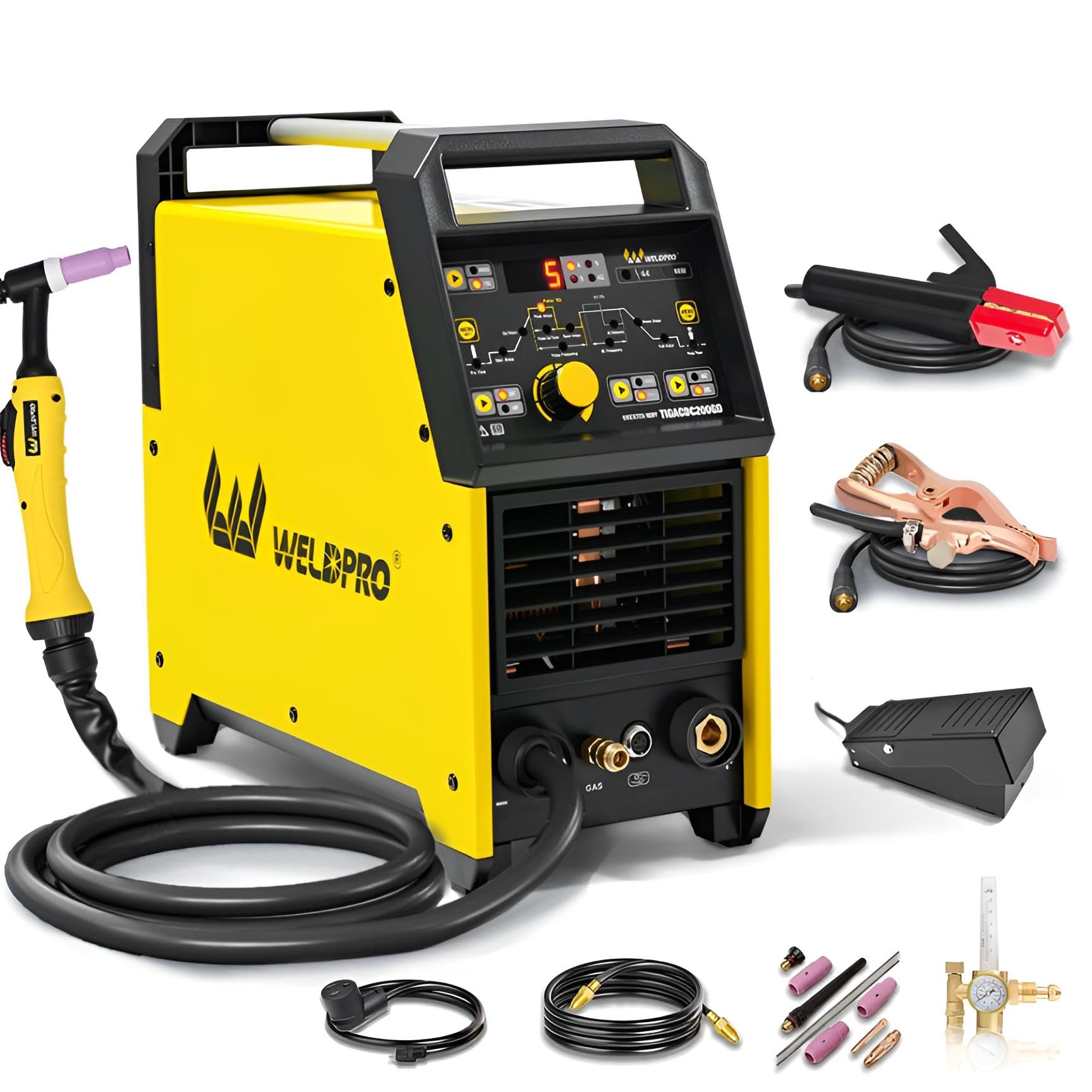
The Weldpro 200A delivers a stable HF start and a clean arc on both AC and DC, with fully adjustable pulse parameters that make thin-gauge stainless and aluminum work surprisingly manageable. Experienced fabricators have noted the included CK17 flex torch is a premium touch usually reserved for machines at nearly double the price, and the rocker-style foot pedal gives smooth amperage control for intricate welds. The 40% duty cycle at 200A is realistic for hobbyist and light professional use, and the dual-voltage input means it runs on standard household 110V without a transformer.
Users report excellent results with 16- and 18-gauge stainless exhaust work, citing the easy arc starts and responsive upslope/downslope settings. The AC balance and frequency adjustments allow dialing in the cleaning action for aluminum, while the pulse TIG mode helps manage heat input on thin sheet. A few owners noted the gas-cooled torch heats up during extended beads, but that is typical for air-cooled torches at this amperage.
The Weldpro stands out because it bundles serious pro-level features — HF start, adjustable pulse, 2T/4T modes, and a quality foot pedal — into a package that competes with machines costing twice as much. The auto-sensing dual voltage is a genuine convenience for moving between garage and job site, and the large LED display makes parameter tweaking clear through a welding helmet.
Why it’s great
- High-frequency start ensures non-contact arc ignition
- Adjustable pulse frequency from 0.5 to 200 Hz
- CK17 flex torch and rocker foot pedal included
Good to know
- Gas-cooled torch runs hot on long continuous beads
- Ground clamp spring is stiff and opens less than 1 inch
2. Everlast PowerTIG 200DV

The PowerTIG 200DV from Everlast builds on a decade of refinement, offering a low 5-amp DC start for precise work on thin stainless and a 20-amp AC start for aluminum. The dual-voltage input (120V and 240V) is fully automatic, so the machine detects the incoming power and adjusts without a switch or pigtail. The IGBT inverter delivers a stable arc at low amperages, which is critical for small-diameter filler rods and thin-gauge sheet metal. The fan-on-demand feature keeps noise down when the machine isn’t working hard.
Long-term owners report consistent performance over years of use, with many praising the unit’s ability to handle racecar fabrication and shop repairs. The pulse function is adjustable from low frequency for heat-sensitive materials up to 200 Hz for faster travel speeds. A few users have noted that the manual is sparse on setup details, but online resources and the Everlast support team fill the gaps. The lift-start function provides an alternative to high-frequency start when working around sensitive electronics.
The PowerTIG 200DV is the right choice for someone who wants a dedicated TIG machine with a proven track record and professional-level features like pre- and post-flow control and arc force adjustment. Its build quality and consistent arc performance make it a reliable workhorse for the serious hobbyist or small shop.
Why it’s great
- Low 5-amp DC start for precise thin-gauge TIG
- Automatic dual-voltage detection with no manual switching
- Fan-on-demand keeps the shop quiet during light use
Good to know
- Manual lacks detailed setup instructions
- Some users report repair wait times if issues arise
3. AHP Alpha-TIG 225Xi

The Alpha-TIG 225Xi pushes the amperage envelope to 225A, giving it extra headroom for thicker aluminum and steel compared to typical 200A units. It delivers 150A on 120V and the full 225A on 240V, making it genuinely functional on a standard household circuit for lighter work. The pulse frequency ranges from 0.5 to 200 Hz, and the pre-flow and post-flow adjust from 0 to 10 seconds, giving solid control over gas coverage and heat input. The 2T/4T trigger modes help reduce hand fatigue on long weld passes.
Users consistently praise the machine’s stable arc on aluminum, steel, and stainless after dialing in the basic controls. A few experienced welders note that the Nova 26 torch uses non-standard consumables, making stubby kits harder to find, and recommend upgrading the torch for better consumable availability. The fan runs only on demand, which keeps noise levels low during intermittent welding. Customer support via Facebook is responsive, and the machine has a reputation for reliability over several years of regular use.
The 225Xi fills a sweet spot for the buyer who needs more than 200A for occasional thicker plate work but isn’t ready to jump to a 250A+ class machine. Its dual-voltage capability and pulse function make it a strong contender for the home shop or light fabrication environment where flexibility matters.
Why it’s great
- 225A max output for thicker metals on 240V
- Pulse frequency adjustable from 0.5 to 200 Hz
- On-demand fan reduces shop noise
Good to know
- NOVA 26 torch uses less common consumable parts
- Shipping may take over a month in some regions
4. LOTOS TIG200ACDC

The LOTOS TIG200ACDC is a square-wave inverter machine that ships with a foot pedal and argon regulator, which is uncommon at its price tier. The AC TIG capability is geared specifically for aluminum up to 3/8 inch, while DC TIG and stick modes handle steel and stainless without drama. The dual-voltage input (110V/220V) is automatic, and the 200A output is enough for light to medium fabrication work. The interface uses simple knobs rather than a digital menu, which some welders prefer for quick adjustments.
Owners report solid performance on AC TIG aluminum after learning to interpret the slightly mislabeled controls — the “Clearance Effect” knob essentially controls AC balance. The stick mode runs 7018 rods up to 5/16 inch well, and the duty cycle on 220V is sufficient for shop use. Several users note that the foot pedal cord is excessively long and that the amp dial numbers don’t perfectly match the digital display, but the arc quality is consistently described as good for the price. The 30-day money-back guarantee and 3-year limited warranty add purchase confidence.
The TIG200ACDC is ideal for the hobbyist who wants to learn AC TIG on aluminum without a huge investment. It includes the essential accessories to start welding out of the box, and the square-wave output delivers a respectable cleaning action on oxide layers. If you’re comfortable learning through testing rather than a detailed manual, this unit offers strong performance per dollar.
Why it’s great
- Includes foot pedal and argon regulator in the box
- 3-year limited warranty for long-term coverage
- Square-wave inverter for clean aluminum AC TIG
Good to know
- Controls are mislabeled; requires trial and error to learn
- Must power cycle to switch between TIG and stick modes
5. HITBOX 200A AC/DC TIG Welder 6-in-1
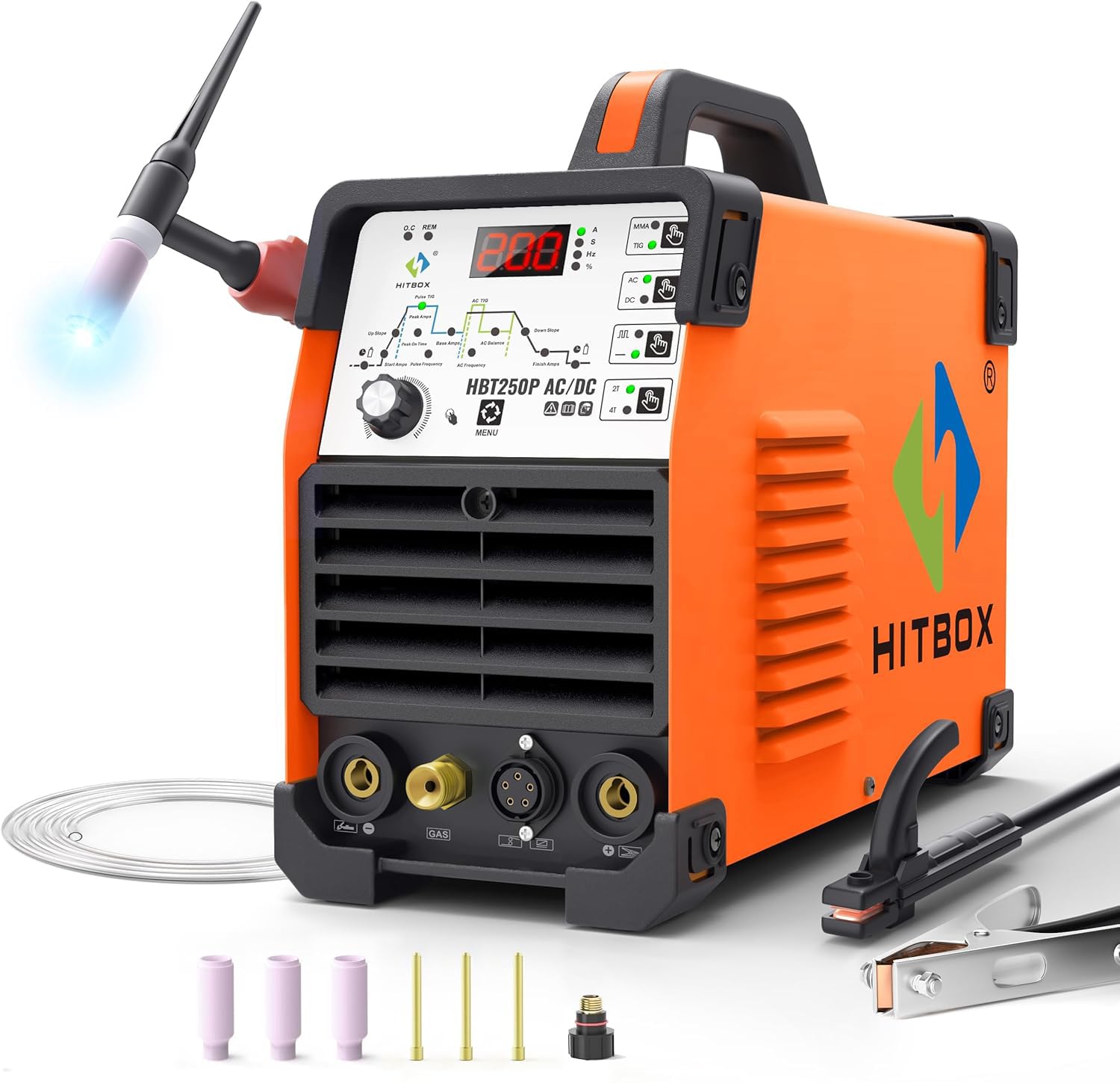
The HITBOX HBT250P packs AC TIG, DC TIG, pulse TIG, and stick welding into a compact 19.36-pound package, making it one of the lightest AC/DC machines with pulse on the market. The HF start enables non-contact arc ignition on both AC and DC, and the adjustable AC frequency (40–200 Hz) and AC balance give real control over aluminum cleaning action. Pulse frequency ranges from 0.5 to 200 Hz with adjustable base amps (5–95%), which helps manage heat on thin aluminum without burn-through. The machine runs on 220V single-phase only.
User feedback highlights the machine’s strong arc quality for budget aluminum welding, with several owners successfully welding 1/4-inch aluminum after adjusting the balance and frequency settings. The 2T/4T modes reduce hand fatigue on long seams. Common complaints include a finicky gas hose fitting and a cheap stinger/ground clamp that many users replace. A small number of units have arrived with defects, though the 2-year warranty provides a safety net. The dual-fan cooling system keeps the inverter from overheating during extended sessions.
For the budget-conscious welder who needs AC TIG with pulse for aluminum, the HITBOX delivers the essential waveform controls at a fraction of the weight and cost of larger units. You may need to upgrade the torch and ground clamp, but the core inverter and pulse board offer respectable performance for light fabrication and repair work.
Why it’s great
- Very lightweight at 19.36 lbs for easy transport
- Adjustable AC frequency, balance, and pulse base amps
- 2-year quality guarantee for peace of mind
Good to know
- 220V-only input, not dual voltage
- Gas hose fitting is non-standard; stinger and clamp feel cheap
6. ARCCAPTAIN MIG200 6-in-1
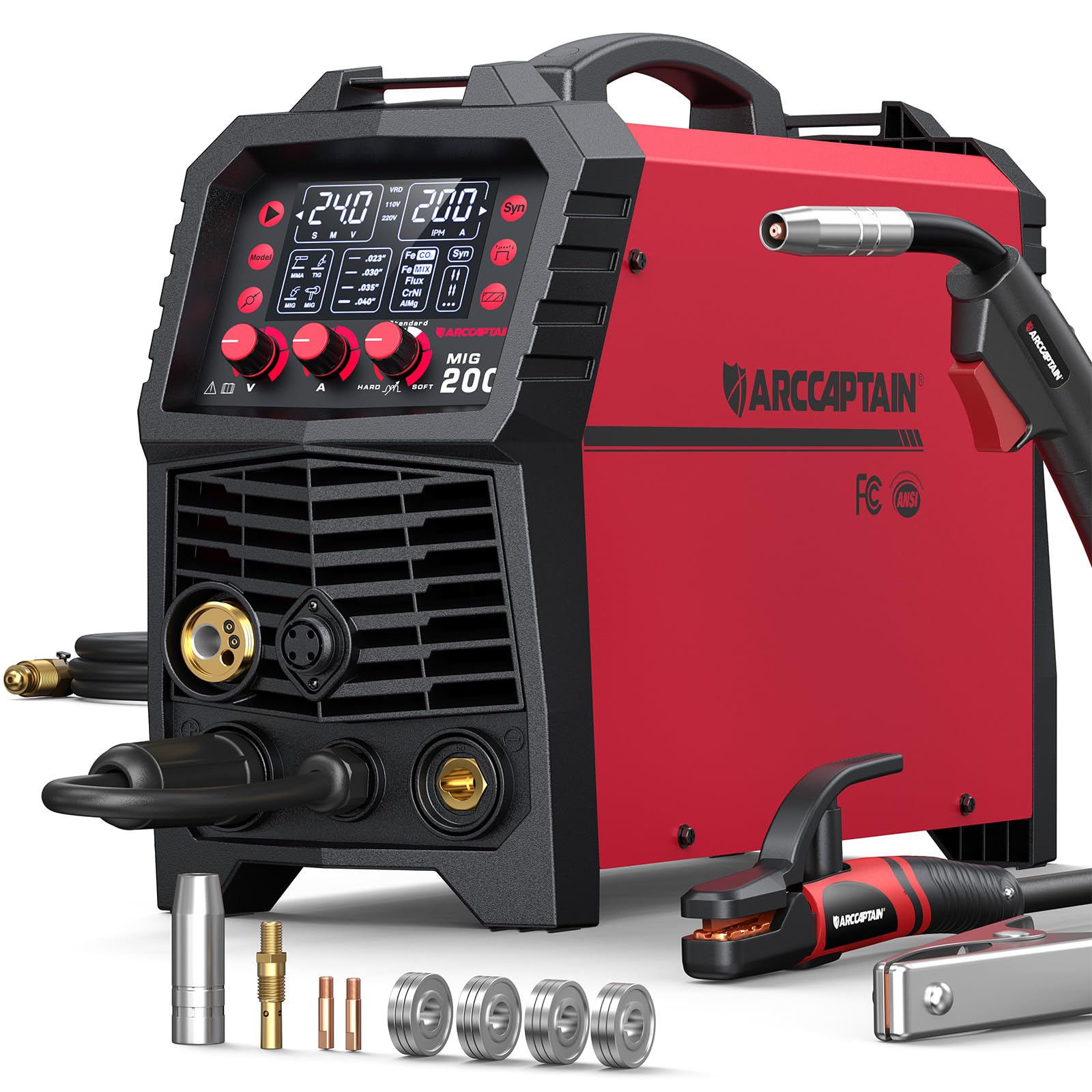
The ARCCAPTAIN MIG200 covers gas MIG, flux-core MIG, stick, lift TIG, spot welding, and spool-gun compatibility, making it the most process-diverse machine in this lineup. The synergic mode automatically matches wire feed speed to amperage when you select wire diameter and material, which simplifies setup for beginners. The large LED display shows welding parameters clearly, and 10 preset memory slots let you save settings for repeat jobs. The 110V/220V dual-voltage input widens its usable locations.
Users praise the MIG200 as a great upgrade from basic 120V-only units, noting solid weld quality on car frames, exhaust systems, and brackets. The burn-back adjustment and adaptive crater fill add polish to MIG welds. Some owners report the 110V-to-220V adapter is poorly designed and recommend running the machine on 220V for consistent performance. The missing 0.035-inch drive rolls in the box is a small but frustrating omission. Customer support is responsive for troubleshooting.
This machine is best suited for the home DIYer or farm user who needs one machine to handle MIG, flux-core, stick, and occasional lift TIG without buying separate units. The synergic control flattens the learning curve, and the spot-weld mode is handy for sheet metal work. If TIG is your primary focus, a dedicated AC/DC TIG machine will serve you better — but for multi-process flexibility, the MIG200 is hard to beat.
Why it’s great
- Synergic MIG simplifies wire speed and voltage setup
- 10 preset memory slots for repeatable weld parameters
- Lightweight and portable with included shoulder strap
Good to know
- No setup chart sticker on the machine
- Missing 0.035-inch drive rolls in the box
7. Weldpro Digital TIG 250GD

The Weldpro Digital TIG 250GD steps up to 250 amps with a memory function that stores multiple weld parameter sets, so you can switch between material types without re-dialing everything. The machine is equipped with a CK Worldwide torch option (air-cooled or water-cooled), a high-quality SSC rocker foot pedal, and a rear receptacle for an optional liquid cooler — pro features that scale with your workload. The digital control panel shows start and end amps, upslope, downslope, AC balance, AC frequency, and pulse settings clearly.
Experienced fabricators report the 250GD produces welds that compete directly with Miller and Lincoln machines at a lower entry point. The CK flex torch and smooth pedal give excellent control on stainless exhaust work and thicker aluminum. Some users note the gas-cooled torch runs hot on long beads, and the work clamp spring is overly stiff. The AC balance scale is reversed compared to Miller convention, which takes a short adjustment period. The optional water-cooled torch and separate water cooler are worth considering for production work.
The 250GD is the right choice for the serious fabricator who regularly welds thick aluminum or steel and needs the additional amperage headroom and memory presets. The ability to add a water cooler later makes it a scalable platform that can grow with your shop’s demands without buying a whole new machine.
Why it’s great
- 250-amp output for thicker materials and heavier duty cycles
- Memory function stores multiple weld parameter profiles
- Compatible with CK Worldwide water-cooled torch option
Good to know
- Gas-cooled torch heats up on extended runs
- Work clamp spring is very stiff and hard to open
8. Forney 271 Easy Weld 140 MP

The Forney 271 is a 120V-only multi-process welder that covers MIG, DC TIG, and stick welding, making it an accessible starter machine for home garages and farm use. The 3-position switch lets you toggle between processes, and infinite voltage and wire feed speed adjustments give you fine control over bead appearance. At 25.8 pounds with an all-metal case, it’s built tougher than many plastic-bodied competitors. The included accessory set — MIG gun, electrode holder, ground clamp, and adapter — gets you started immediately.
First-time welders report impressive results with 6013 rods on 1/8-inch steel and find the learning curve much gentler than older transformer-based machines. The metal wire drive system feeds smoothly, and the arc is stable with low spatter on MIG. Some users note the included MIG gun feels flimsy and that the 20A household breaker can trip with Lincoln 6011 rods. The lack of a 240V option limits its ceiling for thicker materials, but for basic repair and hobby work, the 140 MP delivers reliable performance.
The Forney 271 is the best entry point for someone who needs a simple, rugged machine that runs on standard household power and can do three processes. DC TIG on the 140 MP is lift-start only and works best on thin stainless and steel — it won’t handle aluminum. If your primary need is AC TIG aluminum, look at the dedicated AC/DC units above, but for general-purpose stick and MIG with occasional DC TIG, this is a solid value.
Why it’s great
- All-metal case is durable for shop and transport
- Simple 3-position switch for process selection
- Runs on standard 120V household outlet
Good to know
- DC TIG only — no AC TIG for aluminum
- Included MIG gun feels less durable than the machine itself
9. Lincoln Electric Power MIG 211i

The Lincoln Power MIG 211i is a dual-voltage machine that auto-senses 120V or 230V input without adapters, delivering up to 211A of output. It handles steel, stainless, and aluminum up to 3/8 inch thick, and the cast-aluminum drive system feeds wire sizes from 0.025 to 0.045 inch smoothly. The digital controls with a seven-segment display and easy-turn knobs allow fast setup, and the presets for wire diameter and material thickness automatically set voltage and wire feed speed — you can still fine-tune from there. The Magnum PRO 100L gun features an over-molded handle and flexible cable to reduce hand fatigue.
Users transitioning from stick welding find the auto-set feature transformative, producing clean MIG welds without manual voltage guessing. The 30% duty cycle at 175A is realistic for job-site work, and the 41-pound weight makes it easy to lift onto a truck bed. The spool-gun compatibility is a plus for soft aluminum wire. Some experienced welders note occasional fine-tuning is needed beyond the presets for specific joint configurations. The build quality is consistent with Lincoln’s reputation for durability.
The Power MIG 211i is the choice for the professional or serious enthusiast who needs a portable, dual-voltage MIG machine with reliable arc characteristics. If your primary welding process is MIG rather than TIG, and you value brand support, auto-sensing voltage, and a smooth wire feed, this Lincoln delivers a premium experience. It does not offer AC/DC TIG — it is a MIG-focused machine with a spool-gun option for aluminum.
Why it’s great
- Auto-sensing dual voltage eliminates adapter cables
- Preset parameters for wire diameter and material thickness
- Lightweight at 41 lbs for a 211A machine
Good to know
- MIG-focused; no AC/DC TIG capability
- Premium price reflects the brand and build quality
FAQ
What is the difference between AC and DC TIG welding?
Do I need pulse TIG for aluminum welding?
Can I weld aluminum with a DC-only TIG welder?
What does high-frequency start do?
Final Thoughts: The Verdict
For most users, the best AC/DC welder winner is the Weldpro 200A because it combines a premium CK17 torch, full pulse control, and dual-voltage convenience at a price that undercuts the big-name brands. If you want professional-grade precision with a proven track record, grab the Everlast PowerTIG 200DV. And for budget-friendly aluminum welding with pulse, nothing beats the HITBOX 200A for its lightweight design and waveform adjustments.