
Our readers keep the lights on and my morning glass full of iced black tea. As an Amazon Associate, I earn from qualifying purchases.
Specs are compiled from manufacturer listings and verified buyer reviews and can change over time — please confirm the key details on the product page before buying.
Pressing a stopwatch button is never fast enough — human reaction time adds a few hundredths to every 40-yard dash, and those hundredths are what scouts compare on their draft board. A proper 40 yard dash timer replaces that guesswork with a laser gate that starts and stops the clock the instant your body breaks the infrared beam. You get a number that is real and repeatable, not a thumb-tap estimate. This guide picks the five best, from wearable wrist sensors to pro-level gate systems, so you can choose the one that fits your training setup.
I’m Min — the founder and writer behind Gadgets Feed. This guide is built by comparing the manufacturers’ published specifications and the patterns across verified customer reviews, so you get each pick’s real strengths and trade-offs instead of marketing spin.
A coach building a combine-style protocol, a parent timing drills in the backyard, or a serious athlete chasing every millisecond — the right 40 yard dash timer cuts out inconsistency and gives you a fair, accurate read on every rep.
Our Picks at a Glance


How To Choose The Best 40 Yard Dash Timer
Every timer on this list gives you a faster, more accurate time than a stopwatch. But the right one depends on where you train, how many athletes you time, and how deep you want the data to go. Here is what to keep in mind.
Laser Gates vs. Wearable Sensors
A laser gate setup uses two tripod-mounted units at start and finish. When the runner breaks the first beam, the clock starts; breaking the second beam stops it. This is the gold standard for the 40-yard dash because it measures true speed from point A to point B. Wearable sensors, like the JAWKU Speed, strap to your wrist and use an accelerometer (a sensor that detects motion) to measure movement. They are more portable and do not need tripods. But they measure motion processing, not a precise beam break, so purists and scouts tend to trust laser gates more.
Wired vs. Wireless Connections
Wired laser timers, like the Indoor Wired Laser Timer, are simpler and often cheaper. But the cable between start and finish sensors limits placement. Wireless systems use radio signals — the Single Training Version Wireless Laser Timer claims a 500m wireless distance — so you can set up on a full track without tripping over cords.
Battery Life and Power Options
A timer that dies mid-session is worse than no timer at all. The YZ Laser Timer runs for 10 hours on a single charge. The Wireless Laser Timer requires a power bank (a portable USB battery pack) for each unit. If you time a full team for hours, look for built-in rechargeable batteries. If you only run a few sprints a day, USB power banks work fine.
Data Logging and Connectivity
Most basic laser timers just show the time on the display — no logs, no Bluetooth. The ArenaGear system streams times to phones and Apple Watches. The JAWKU sensor logs everything to an app, which requires a monthly subscription. If you want to track progress over weeks or share leaderboards instantly, connectivity is a must. If you just need a clean number, a standalone display works perfectly.
Quick Comparison
| Model | Best For | Screen Size | Battery / Power | Accuracy | Amazon |
|---|---|---|---|---|---|
| Single Training Version Wireless Laser Timer★ Best Overall | Simple, standalone wireless timing | 2.25 inches | Power bank (not included) | 0.01 sec (laser gate) | Amazon |
| JAWKU Speed WearableTop Performer | Portable, app-connected training | Wristband (no display) | 65 mAh rechargeable | 0.01 sec (sensor) | Amazon |
| Indoor Wired Laser Timer | Budget-friendly indoor use | 5 inches | 8 hrs rechargeable | 0.001 sec (laser gate) | Amazon |
| YZ Laser Timer | Portable kit for outdoor sprints | 3.5 inches | 10 hrs rechargeable | 0.001 sec (laser gate) | Amazon |
| ArenaGear Sports Timer | Pro-level analytics & streaming | 18 inches | Rechargeable (long life) | 0.001 sec (laser gate) | Amazon |
In‑Depth Reviews
1. Single Training Version Wireless Laser Timer
Our pick — over 4★ from 60+ verified ratings; the strongest balance of quality and price.
A wireless laser timer with a 500-meter communication range — set the display in the end zone while sensors sit on the field.
If your training space demands distance — a full football field or a long straightaway — this SPEED TECH unit gives you a 500m wireless connection between the laser sensor and the display. Setup is simple: plug each unit into a power bank (a portable USB battery pack), press reset for one second, and you are timing. Owners describe it as easy to use and note that athletes can run consecutively without resetting the timer — a huge time-saver during team sessions.
The screen is 2.25 inches — noticeably smaller than the 5-inch display on the Indoor Wired Laser Timer. That is a difference of 2.25 inches versus 5 inches, so you need to be closer to read the time at a glance. But the wireless freedom means you place the display wherever is convenient. The effective laser distance is 0-8 meters, so the sensor pair must be reasonably close to the start and finish lines. The included foam case protects everything during transport. A development ski team reported it works reliably even in mid-20s°F temperatures.
The main downsides: you need three separate power banks (one for each laser unit and one for the display), which are not included. The stock tripods sit at ankle height, causing missed beam triggers. Owners strongly recommend buying four taller tripods, adding extra cost. There are no logs, splits, or Bluetooth — you write times down by hand. But for pure, simple, wire-free laser timing, this is the best of the bunch.
Standout spec: the 500m wireless communication distance lets you run the timer from a sideline table while sensors sit at start and finish.
The catch: the 2.25-inch display is small for outdoor use, and power banks are extra. Budget for four taller tripods to get reliable beam breaks.
Ideal for: a coach or club that sets up across a long track and values wire-free flexibility above all else.
Not for: someone who wants a large, easy-to-read display from 30 feet away or a self-contained battery system.
2. JAWKU Speed – Wearable Sprint Sensor
A wearable sensor that replaces timing gates with your smartphone — no tripods required.
If you want pro-level timing without carrying tripods, the JAWKU Speed is the only wearable on this list. It syncs wirelessly with your iOS or Android phone and measures 40-yard dashes, cone drills, and reaction time. Owners who compared it head-to-head against a pro-grade Fusion timing system report an average difference of just 0.01 seconds across 10 tests. That is essentially identical for any practical training purpose.
In real use, athletes run through normal drills while the sensor logs speed, agility, and distance. The app builds a performance picture over time. It reliably tracks the 40-yard dash — the core combine test. One owner summed it up: “accurate as pro equipment, user-friendly, affordable.” It replaced the inconsistency of a hand-held stopwatch and motivated players to improve.
The catch: about one in ten owners reports a defective unit or serial-number pairing issue. The app requires a monthly subscription after a short trial. Customer support is mixed — some get quick replacements, others hit a wall. The 65 mAh battery (milliamp-hours, a measure of battery capacity) is tiny, so charging it every session becomes a habit. But for an athlete or small team who wants the portability of a wristband and the data depth of a phone app, this is the most forward-looking pick here.
Why this works: It packs the accuracy of multi-thousand-dollar timing systems into a wrist-worn sensor. The app handles the data lifting, tracking 40-yard times, cone drills, and reaction times with 0.01-second precision.
Know before you buy: The monthly subscription is not optional after the trial. The sensor has a higher than average defect rate — buy from a seller with a solid return policy.
Reach for this if: you train solo or with a small group and want data logging without setting up laser gates at every session.
Look elsewhere if: you need dead-simple reliability for 30-plus athletes or you refuse to pay a monthly fee for the app.
3. YZ Laser Timer for Sprints
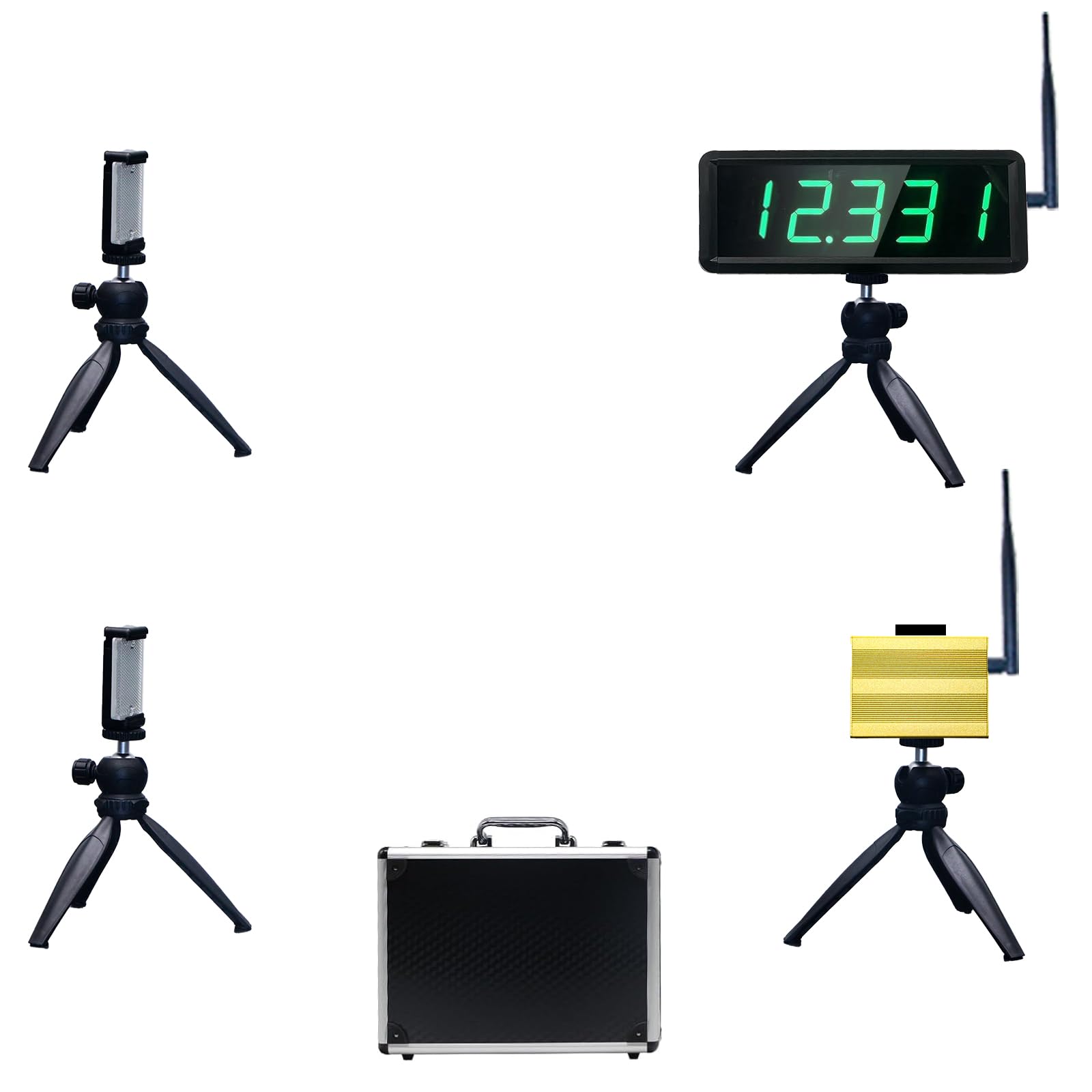
A battery-powered laser timer that charges for 4 hours and runs for 10 — no power bank clutter.
The YZ Laser Timer is the closest thing to a grab-and-go pro system at a mid-range price. It uses a five-digit display accurate to 0.001 seconds (one-thousandth of a second), with the maker claiming a timing error of less than 0.001 seconds in one hour. That precision works for the 40-yard dash, 60-yard dash, and longer sprints. A sports chiropractor uses it for mile splits, the T-Test, the Pro Agility, and 100-meter tests. The portable toolbox packaging keeps the timer, laser, two reflectors, stands, and chargers organized.
Owners consistently praise the battery life, noting it lasts through 1.5-hour-plus sessions without issue. However, reliability feedback is mixed. Some buyers report scratched displays on arrival. The bigger issue: the supplied stands are too short, causing missed beam triggers. Owners mention the fix is simple — the manufacturer now sells 13-inch adjustable tripod stands separately, or you can use wooden blocks. The unit itself survived multiple falls from 3 feet, so the electronics build is solid.
Biggest praise: The five-digit display with 0.001-second resolution and the built-in rechargeable battery that eliminates power bank clutter.
Honest trade-off: The stock tripods are too short for reliable beam placement at 40 yards. Factor in the cost of taller tripods from the manufacturer when budgeting.
Grab this for: a coach who runs frequent outdoor sprint tests and wants battery independence without a power bank tether.
Pass if: you need a complete out-of-box system with no extra purchases — the stock stands will frustrate you.
4. Indoor Wired Laser Timer (GAN XIN)

A compact wired laser timer with a 5-inch display readable from 30 feet — the most affordable laser gate on the list.
For indoor training — a basketball court, field house, or basement setup — this GAN XIN timer is the cheapest laser gate here. The 5-inch red LED display is easy to read from 30 feet (10 meters) away. That is a big upgrade over the 2.25-inch screen on the wireless timer above. A built-in rechargeable battery gives you 8 hours of use on a 3-hour charge, so a full practice session is no problem.
The wired laser sensor runs on a 2-meter cable, meaning start and finish gates must stay close to the display unit. The effective laser distance is 0-20 meters, giving you enough room for a full 40-yard dash in a typical indoor facility. You can adjust the sensing distance with a screw on the sensor. The laser trigger interval is adjustable from 0 to 9999 milliseconds (thousandths of a second). It supports two timing modes: C1 (a simple start-to-finish laser trigger time) and C2 (each individual lap time). It can store up to 30 laps, which is handy for repeated drills.
The honest downside is durability. A verified buyer reported it “did not withstand trial period” due to a bad plug. The tripods are noted as too short. The outdoor visual range drops to less than 30 feet in sunlight, so this is strictly an indoor tool. For a school gym or indoor facility on a budget, it works well. For outdoor combine prep in the sun, skip it.
What wins people over: the large 5-inch display at this price point is tough to top. The adjustable sensing distance gives you flexibility for different lane lengths.
One real limitation: the 2-meter cable between sensor and timer restricts placement. The display is unreadable outdoors in sunlight.
Best for: an indoor training facility or garage setup where you control the lighting and need a large, readable timer on a tight budget.
skip it if: your 40-yard dash testing happens outdoors, even partly — sunlight kills the display visibility.
5. ArenaGear Sports Timer

A professional timing system that streams times to phones during the drill — no manual entry needed.
The ArenaGear system is the most advanced unit here. It uses an 18-inch display — massive compared to every other option — and streams times wirelessly to phones, Apple Watches, and iPads. Times log to a cloud console and create instant leaderboards before the athlete slows down. One pro sprinter and hurdler called it “the best timing system I’ve ever used at practice,” particularly for getting flying 30-yard times.
The system uses two laser gates and supports up to 23 settings, giving you control over distance, splits, and timing modes. The included hard case protects everything during transport. Owners praise the build quality and customer service, and one user rates the equipment 10/10. The app sharing feature lets trainees see their own times on their phones without the coach calling them out — which is great for competitive groups.
The main friction points are real. The tripods are too high for 40-yard dash timing — the beam focuses on the runner’s hand instead of the body, causing missed or inconsistent triggers. Starting in the beam with multiple runners becomes cumbersome. The phone dependency is a genuine risk: if the phone battery dies or the app stops working in the background, you lose data. After a year, some customers note intermittent connectivity issues. This is a powerful system, but it demands tech patience.
Standout feature: automatic cloud logging and instant leaderboard generation — no clipboard, no manual transcription.
Honest trade-off: the tripod height is wrong for 40-yard dashes from the start, requiring adjustment. The phone app dependency means a dead phone equals no data.
Pull the trigger if: you run a serious program with multiple athletes and want data-logging, leaderboards, and phone streaming without manual entry.
Hold off if: you prefer a simple, reliable display that just works without an app or the risk of connectivity dropouts mid-session.
Understanding the Specs
Accuracy (0.01 vs 0.001 seconds)
A timer that reads to 0.001 seconds (one-thousandth of a second) is theoretically more precise. But for a 40-yard dash — where top college prospects run in the 4.2 to 4.5-second range — a display showing 0.01 seconds (one-hundredth) is plenty accurate for training. The 0.001-second precision matters more for scientific testing or comparing athletes separated by just hundredths. The YZ Laser Timer and ArenaGear both offer 0.001-second resolution. The JAWKU and Wireless Laser Timer stick with 0.01-second reads.
Battery Type and Runtime
There are two power philosophies here. Some timers, like the YZ and the Indoor Wired Timer, have built-in rechargeable batteries. The YZ gives you 10 hours on a 4-hour charge; the Indoor Wired Timer gives 8 hours on a 3-hour charge. Others, like the Single Training Version Wireless Laser Timer, require external power banks — you need three separate USB power packs (one per laser unit and one for the display). This is less convenient but lets you swap fresh power banks mid-session. The JAWKU sensor uses a tiny 65 mAh battery that needs charging after every workout.
FAQ
Can I use a 40-yard dash timer for longer distances like 60 or 100 meters?
Do I need a separate tripod for the laser sensors?
How does a wearable sprint sensor compare to a laser gate?
Does the JAWKU Speed require a monthly subscription?
What is the difference between C1 and C2 timing modes?
Can I use a 40-yard dash timer outdoors in direct sunlight?
How many power banks do I need for the wireless laser timer?
Can I export times from the ArenaGear system for my spreadsheet?
How long does the YZ Laser Timer battery last on a single charge?
Will these timers work for barrel racing or motorcycle training?
Final Thoughts: The Verdict
Across the board, the 40 yard dash timer that ticks every box is the Single Training Version Wireless Laser Timer. It offers genuine wireless freedom with a 500-meter range and simple, reliable operation for team sessions. If you want data logging without tripods, the JAWKU Speed brings pro-level accuracy to a wearable. For a coach running a serious program on a budget, the YZ Laser Timer delivers 10-hour battery life and 0.001-second precision at a mid-range price. Any of these picks eliminates the inconsistency of a hand-held stopwatch.
How We Picked
We do not accept paid placement. Every pick is matched to a real buyer and a real use-case; we do not hands-on test units.
Sources & Methodology
Specifications: manufacturer listings and product documentation. Review insights: verified customer reviews, as of July 2026. Pricing: not shown on this page (it changes often); check the current price via the retailer link.
As an Amazon Associate, Gadgets Feed earns from qualifying purchases. This does not affect which products we feature.