
Our readers keep the lights on and my morning glass full of iced black tea. As an Amazon Associate, I earn from qualifying purchases.
Specs are compiled from manufacturer listings and verified buyer reviews and can change over time — please confirm the key details on the product page before buying.
The biggest headache with a bathroom fan is the noise — that rattling turbine that turns your morning shower into a roaring event. A 120 CFM (cubic feet per minute — the volume of air the fan moves each minute) fan moves enough air to clear steam from a standard bathroom, but not all of them do it quietly. The trade-off between airflow and sound is what separates a fan you forget about from one you dread turning on.
I’m Min — the founder and writer behind Gadgets Feed. This guide is built by comparing the manufacturers’ published specifications and the patterns across verified customer reviews, so you get each pick’s real strengths and trade-offs instead of marketing spin.
After digging through hundreds of owner experiences, these three picks stand apart for their balance of power and peace. Here is the definitive look at the 120 cfm bathroom fan market — who each one fits, and where the compromises live.
Our Picks at a Glance

How To Choose The Best 120 CFM Bathroom Fan
A bathroom fan is a simple appliance with a single job — pull humid air out and exhaust it outside. But the difference between a great one and a frustrating one depends on three things: how much air it actually moves, how loud it is while doing it, and whether you can install it without tearing open your ceiling. Here is what to focus on.
Noise — The Sone Scale Is Your Real Guide
Manufacturers advertise airflow in CFM, but the number that determines whether you will use the fan is the sone rating (a unit of perceived loudness — how loud a sound feels to a person). A fan at 1.0 sones is about as loud as a quiet refrigerator humming in the next room. A fan at 0.3 sones is barely audible — you would feel the air moving before you hear it. At 1.2 sones and above, the fan becomes a noticeable background presence. If the fan runs during a conversation or while you are winding down, the lower the sone number, the less you will think about it.
Installation — The Attic Access Question
Some fans require you to reach the housing from above — meaning you need attic space above the bathroom ceiling. Others are designed with a compact housing and spring-loaded grille that lets you install everything from below, through the ceiling opening itself. If you are replacing an existing fan in a finished ceiling without attic access, the no-attic design saves hours of drywall work. If you are building new or have easy attic access, the attic-required fans often offer better sound insulation and more flexible duct routing.
Real-World Airflow vs The Sticker
A fan’s advertised CFM is measured in a lab with no back pressure. In a real ceiling, a long duct run, a restrictive grille, or a kinked hose can cut effective airflow by 30-50 percent. That is why a 120 CFM fan in a 100-square-foot bathroom can still leave the mirror foggy if the installation is poor. The most reliable clue is not the spec sheet — it is the owner consensus on whether the mirror stays clear after a hot shower. Look for that pattern in the reviews rather than trusting the number alone.
Quick Comparison
| Model | Best For | Noise Rating | Duct Size | Housing Depth | Amazon |
|---|---|---|---|---|---|
| KAZE APPLIANCE SEP120★ Best Overall | Near-silent operation | 0.3 sones | 6 inch | 7.63 inch | Amazon |
| Gopper Ultra Quiet with Light | Built-in LED light + value | 1.0 sones | 4 inch | 6.7 inch | Amazon |
| Nalle Style B | No-attic installation | 1.2 sones | 4 inch | 5.2 inch | Amazon |
In‑Depth Reviews
1. KAZE APPLIANCE SEP120 | 120 CFM | 0.3 Sone Ultra Quiet
Our pick — over 4★ from 200+ verified ratings; the strongest balance of quality and price.
The whisper-quiet contender that actually clears the steam before you notice it.
The KAZE SEP120 is built for the buyer whose top priority is silence. It runs at a claimed 0.3 sones — a rating so low that, in practice, you will feel the airflow before you hear the motor. Owners consistently report that the mirror stays completely fog-free after a shower. That real-world steam removal matches the spec, which is not something every fan can claim. The fan uses a 6-inch duct (wider than the 4-inch on the Gopper and Nalle, which reduces resistance and keeps airflow stronger over longer duct runs) with a removable back-draft damper (a flap that closes when the fan is off, preventing cold air from blowing back inside). A 6-to-4-inch duct reducer is included if your existing ductwork is smaller.
The trade-off is installation — this unit requires attic access. The housing is 7.63 inches deep and needs a ceiling opening of 11.38 by 10.5 inches. If you are replacing a fan with a different footprint, you will need to resize the opening. The sliding hanger bars span up to 24 inches and work with any common framing, so the housing positioning is flexible once you are up there. Several owners note that the instructions could be clearer on the duct bracket placement, but overall the install is straightforward for anyone comfortable working in an attic.
The noise debate is the one point worth flagging. About half of the owners find it impossibly quiet, while a vocal minority rate the actual sound at roughly 1.0 sones — quieter than most fans but louder than the 0.3 claim. Even the critics, however, say it is a meaningful upgrade over their old fan. Reliability is a strong suit: owners mention running it daily for nearly a year with zero issues, and the positive feedback on durability outpaces every other aspect. The value-for-money opinion is mixed, which makes sense at its higher price point, but the crowd that values near-silent airflow finds it worth every cent.
Where it excels
- Holds the lowest noise-floor of any fan here — owners call it barely audible even at full speed
- Strong suction: one buyer tested it by holding cardboard against the grille and it did not drop
- Reliability is the most-praised aspect; buyers report trouble-free use approaching a year
What to know
- Attic access is mandatory — this is not a no-attic retrofit design
- Ceiling opening is non-standard at 11 3/8 x 10 1/2 inches; expect to cut drywall
- Some owners peg the real noise at 1.0 sones, not the advertised 0.3
Your quietest option if you have attic access: The KAZE SEP120 is the best pick for anyone who wants the fan to disappear from their sensory awareness — it is the only 0.3-sone-rated fan in this lineup, and real-world results confirm the mirror stays clear.
Think twice if you need a no-attic install or a built-in light: This unit requires you to reach the housing from above, and there is no integrated LED — it is a pure ventilation fan, nothing more.
2. Gopper Ultra Quiet Bathroom Exhaust Fan with Light, 120 CFM, 1.0 Sones
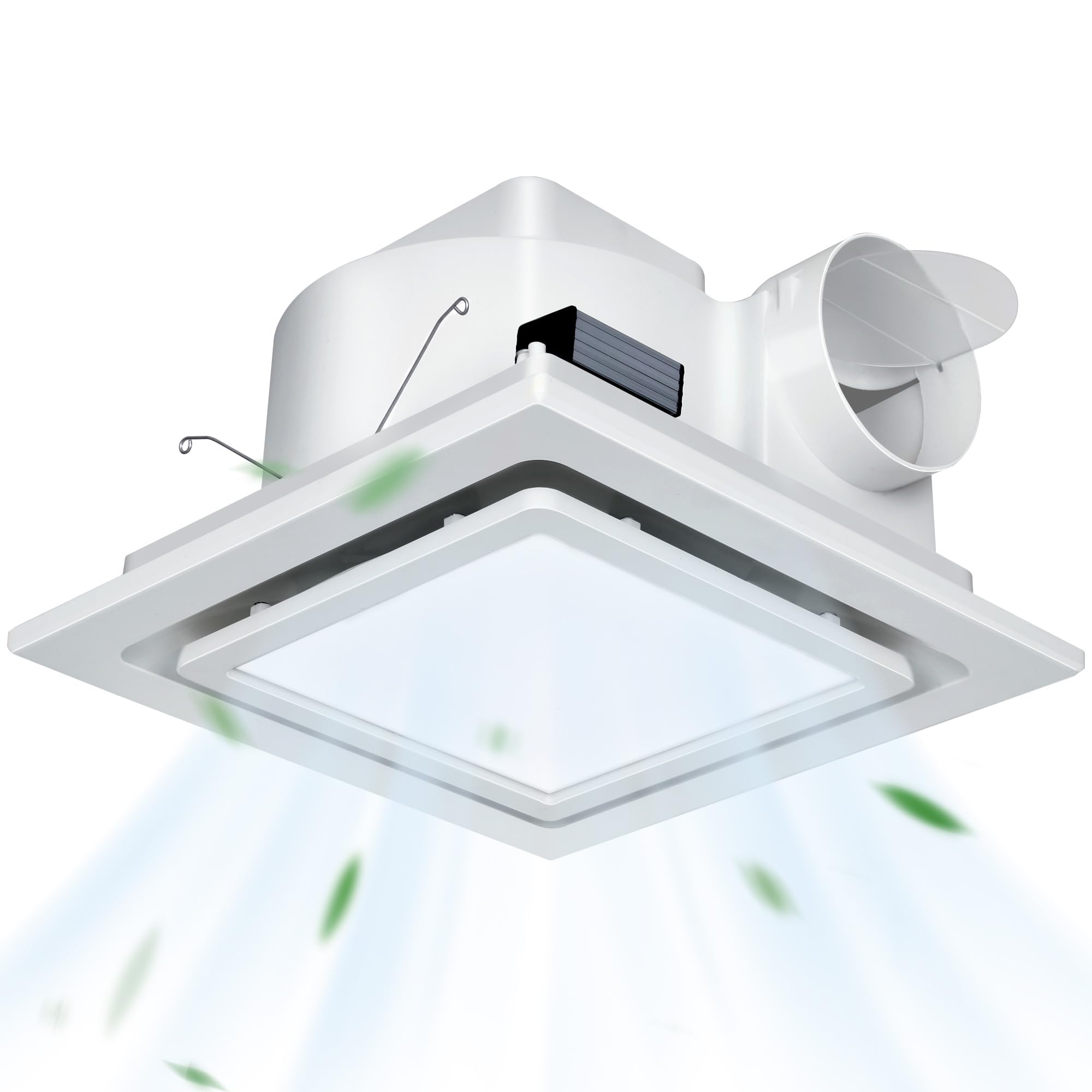
A combined fan-and-light unit that gives you two functions for the price of one.
The Gopper packs a 120 CFM fan and a 1000-lumen LED light (a lumen is a measure of brightness — 1000 lumens is about as bright as a 60-watt incandescent bulb) into a single ceiling-mounted housing. The fan runs at 1.0 sones — noticeably quieter than a standard builder-grade fan, though not as hushed as the KAZE above. Owners describe it as a quiet background hum that does not interfere with conversation. The LED light is rated at daylight white (roughly 5000K), which some buyers find a touch cool for a bathroom. The light is non-dimmable and produces a single color temperature, so if you prefer a warmer glow, this is not adjustable.
Installation is manageable if you have basic electrical experience. The fan housing measures 12 by 12 by 6.7 inches and requires a 9.8 by 9.8-inch ceiling opening. It uses a 4-inch duct, which is the standard size for many retrofit situations. Owners note that a wood frame may be needed to support the unit if your joist spacing does not align perfectly. The included back-draft prevention dampers (flaps that stop cold air from coming back in when the fan is off) work well, though one owner warns that overtightening a hose clamp can jam the flap open — a small detail to watch during install. Unlike the KAZE, this fan lacks a 6-inch duct option, so it may lose more airflow on long or twisted duct runs.
The main honesty flag from the review data is the light reliability. A handful of owners mention the LED failing within the first few months of use. The manufacturer appears to stand behind the product — the same owners mention receiving a replacement light and a prompt refund after raising the issue. Beyond that, the fan itself earns praise for clearing mirror condensation and delivering solid airflow. The overall sentiment is strongly positive, with owners calling it a stylish, quiet upgrade for a small to medium bathroom.
Why it makes the list
- Two-in-one design saves ceiling space and eliminates the need for a separate light fixture
- Quiet enough at 1.0 sones to run during a shower without being intrusive
- Customers note it is affordable for what it delivers — a fan and light together is a strong value
The honest downsides
- Light quality is a caveat — some owners find the daylight-white color too sterile for a bathroom
- A small number of owners had the LED fail within three months; the company replaces it, but it is an extra step
- Airflow gets mixed reactions in reviews — it works for standard bathrooms but may struggle in larger spaces or through long ducts
Your best bet if you want a two-in-one remodel in a single box: The Gopper gives you a built-in 1000-lumen LED and a 1.0-sone fan, meaning one ceiling fixture and one rough-in job. The fan is quieter than the Nalle Style B (1.0 sones vs 1.2) and adds light, but it is not as silent as the KAZE (0.3 sones) and skips the warm-light option entirely.
Steer clear if near-silence or a warm, dimmable light is non-negotiable: At 1.0 sones it is a background hum, not invisible, and the fixed daylight-white LED cannot be dimmed or warmed.
3. Nalle Ventilation Fan (Style B), 120 CFM, 1.2 Sones

The fan that slides into your ceiling without ever setting foot in an attic.
The Nalle Style B is the only fan here designed specifically for no-attic installation. The housing is just 5.2 inches deep — shallow enough to fit between standard ceiling joists without needing access from above. The grille mounts to the housing using torsion springs (wire coils that snap the grille into place), which means you push it into place and it locks. No screws, no tools. If you are replacing an old fan in a finished ceiling without attic space, this alone saves hours of work compared to the KAZE or Gopper.
The fan is rated at 120 CFM and 1.2 sones. Owners consistently describe it as quiet — flat cover, minimal vibration, no rattling. At 1.2 sones it is louder than the Gopper (1.0) and noticeably louder than the KAZE (0.3), but still quieter than the builders-grade fans most people are replacing. The 4-inch polymeric duct (a flexible plastic tube, unlike metal ducting) is detachable and includes a back-draft damper.
The real-world airflow is where the honest caveat lives. A number of reviewers point out that the fan does not seem to move the full 120 CFM in practice. One buyer used a rough measurement and estimated the actual output closer to 40 CFM — enough to supplement an existing fan, but not enough to clear a steamy bathroom on its own. Shoppers say airflow is a mixed point, not a positive one. For a small half-bath or as a secondary fan, this is fine. For a master bathroom where you expect the mirror to stay fog-free, it may fall short.
What owners love
- Installation is genuinely easy — no attic required, torsion-spring grille goes on in seconds
- Quiet operation for the price; owners say it is barely noticeable during a shower
- Very affordable entry point — the lowest-priced fan in this lineup
Where it underdelivers
- Real-world airflow is the main complaint — several owners find it far below the 120 CFM rating
- At 1.2 sones it is the loudest of the three; not intrusive, but you will hear it
- The 4-inch duct is standard, but a 6-inch duct (like the KAZE uses) moves air more efficiently over longer runs
Pick this one if your bathroom has no attic access and you need a quiet fan at a low cost: The Nalle Style B solves the installation problem that stops many DIYers — 5.2-inch deep housing and spring-loaded grille mean no attic work. It is simpler to install than the Gopper or KAZE, both of which require attic access.
This is the right choice for a small half-bath where you must avoid ceiling work, but the airflow caveat is real: Several owners say the mirror still fogs up, so pair it with a secondary fan or use it only in a small space.
Understanding the Specs
Sones — The Loudness You Actually Hear
A sone is a unit of perceived sound — it is not a decibel measurement but a human-centric scale of how loud something feels. Every time the sone number doubles, the perceived loudness roughly doubles. A fan at 0.3 sones is the quietest end of the spectrum — you would have to stand directly under it to confirm it is running. A fan at 1.0 sones is comparable to a quiet conversation or a refrigerator hum. At 2.0 sones, the fan becomes a noticeable presence in the room. The jump from 0.3 to 1.2 sones represents a change in perceived loudness — that is the difference between forgetting the fan is on and hearing it during a shower.
CFM — Airflow on Paper vs in Your Ceiling
CFM stands for cubic feet per minute — the volume of air the fan can move at its maximum speed. A 120 CFM fan is generally recommended for bathrooms up to 100 to 120 square feet. But that lab measurement assumes zero resistance from the duct, grille, or back-draft damper. In reality, every bend in the duct and every foot of length reduces effective CFM. A 6-inch duct moves air with less resistance than a 4-inch duct, which is why the KAZE uses a 6-inch connection while the Gopper and Nalle use 4-inch. If your bathroom is on the larger end or your duct runs through an attic with multiple turns, the 6-inch duct becomes a meaningful advantage.
FAQ
What does 120 CFM mean for my bathroom size?
Can I install a fan without attic access?
What is a good noise level (sone) for a bathroom fan?
Do I need a fan with a built-in light?
Why does my fan sound louder than the spec says?
Is a 4-inch duct enough for a 120 CFM fan?
How long should a bathroom fan last?
What size ceiling opening do I need for a standard 120 CFM fan?
Can I wire a fan-and-light combo to separate switches?
What does Energy Star certification mean for a bathroom fan?
Final Thoughts: The Verdict
If you want one dependable pick, the best 120 cfm bathroom fan is the KAZE APPLIANCE SEP120 because it delivers the quietest operation at 0.3 sones while reliably clearing steam from the room — reviewers back the near-silent performance and solid airflow. If you want a two-in-one solution with a built-in LED light at a reasonable price, grab the Gopper Ultra Quiet with Light. And if you need to install a fan without attic access on a tight budget, the Nalle Style B is the one to reach for — just keep your expectations realistic about real-world airflow.
How We Picked
We do not accept paid placement. Every pick is matched to a real buyer and a real use-case; we do not hands-on test units.
Sources & Methodology
Specifications: manufacturer listings and product documentation. Review insights: verified customer reviews, as of July 2026. Pricing: not shown on this page (it changes often); check the current price via the retailer link.
As an Amazon Associate, Gadgets Feed earns from qualifying purchases. This does not affect which products we feature.