
Our readers keep the lights on and my morning glass full of iced black tea. As an Amazon Associate, I earn from qualifying purchases.
Specs are compiled from manufacturer listings and verified buyer reviews and can change over time — please confirm the key details on the product page before buying.
A 4-inch midrange speaker handles the critical vocals, guitar riffs, and snare hits that make your music feel alive. It handles the critical vocals, guitar riffs, and snare hits that make your music feel alive. The wrong 4-inch driver turns those details into mud or distortion at higher volumes. This guide cuts through the spec sheets to find which 4-inch driver delivers clean, present sound without requiring a full system re-engineer.
I’m Min — the founder and writer behind Gadgets Feed. This guide is built by comparing the manufacturers’ published specifications and the patterns across verified customer reviews, so you get each pick’s real strengths and trade-offs instead of marketing spin.
Whether you are replacing factory coaxials or building a dedicated midrange stage from scratch, the right 4 inch midrange speaker transforms how your system sounds — giving vocals body and instruments space.
Our Picks at a Glance


How To Choose The Best 4 Inch Midrange Speaker
Not every 4-inch driver is built for the same job. Some are full-range coaxials that include a tweeter, others are pure midrange drivers meant to work with a separate crossover and subwoofer. Knowing which type fits your system is the first step toward an upgrade that sounds better, not just louder.
Coaxial vs. Dedicated Midrange
A coaxial 2-way speaker combines a midrange driver with a small tweeter mounted on top, giving you a single-unit solution for full-range sound. Dedicated midrange speakers, on the other hand, play only the middle frequencies and need a crossover to send highs to a separate tweeter and lows to a subwoofer. If you are keeping your factory head unit without adding an amp, a coaxial is easier to install. If you already have a subwoofer and external crossover, a pure midrange delivers cleaner output in its band.
Sensitivity and Power Handling
Sensitivity (measured in dB) tells you how loud the speaker will play from a single watt of power. A rating of 91 dB or higher means the speaker produces solid volume even from a low-power head unit. The power handling numbers that matter most are RMS (continuous power) and impedance in ohms. A 4-ohm speaker is the standard for most car systems. Matching the RMS rating of the speaker with your amplifier prevents distortion and protects the driver from damage.
Mounting Depth and Fit
A 4-inch speaker is defined by its cutout diameter, but the mounting depth (how far the magnet extends behind the mounting surface) varies widely — from about 1.7 inches to over 3 inches. A deep magnet assembly can hit a window track or wiring harness in a shallow door or dash. Measure your available depth before buying, and keep an eye out for sealed-back designs that protect the speaker from debris in open-mount applications.
Quick Comparison
| Model | Best For | Power Handling | Sensitivity | Type | Amazon |
|---|---|---|---|---|---|
| DS18 ZXI-44★ Best Overall | Best Overall | 150W | — | Coaxial 2-Way | Amazon |
| PRV AUDIO 4MR60-4High Efficiency | High Efficiency | 60W Program | — | Dedicated Midrange | Amazon |
| Hifonics Zeus ZS4CXBudget Champion | Budget Value | 175W | — | Coaxial 2-Way | Amazon |
| GRTSKY MX40P1 | Clarity at Low Power | 120W | 88dB | Dedicated Midrange | Amazon |
| Power Acoustik XPS-104 | Budget Single | 300W | 92dB | Dedicated Midrange | Amazon |
| P Acoustik 2X Sealed Back | Sealed-Back Install | 600W (pair) | 92dB | Dedicated Midrange | Amazon |
| Mobiator MB-M404 | Maximum Volume | 400W | 90dB | Dedicated Midrange | Amazon |
| WDiYA 4-Inch | Premium Glass-Fiber | 600W | — | Dedicated Midrange | Amazon |
| Audison AP 4 Prima | High-End Upgrade | 120W | 91dB | Dedicated Midrange | Amazon |
In‑Depth Reviews
1. DS18 ZXI-44 4″ Car Audio Coaxial Speaker
Our pick — 4.5★ from 450+ verified ratings; the strongest balance of quality and price.
The coaxial that replaces expensive aftermarket speakers and still sounds better.
The DS18 ZXI-44 is a 4-inch, 4-ohm coaxial speaker that handles 50W RMS and 150W peak power. It is a two-way design — meaning the midrange driver has a built-in tweeter — so it gives you full-range frequency coverage from a single drop-in unit. What wins people over is the sound quality: with 44 mentions as a positive aspect, owners consistently say these drivers produce crisp, clear vocals and nice subtle treble. One owner who swapped out Focal speakers reported these DS18s “blow them away hands down.”
The ZXI-44 is part of DS18’s broader ZXi ecosystem, so you can match it with the brand’s amplifiers and subwoofers for a cohesive look. Installation is straightforward for the most part, though the mounting holes on some vehicles require an adapter to fit properly. A very small number of units arrived with cosmetic damage to the tweeter or grill, but that was rare and did not affect sound.
Where the DS18 truly stands out is in raw output compared to the Hifonics Zeus ZS4CX — the DS18 handles 150W peak versus the Hifonics’ 175W peak. While the Hifonics leads slightly on paper, owners who have heard both pick the DS18 for its clarity at high volume. Match these with your subwoofer and they fill the stage perfectly.
Why owners pick this
- Crisp, clear sound that outperforms higher-priced competitors
- Coaxial 2-way gives full-range output without extra tweeters
- Strong build quality and sleek appearance
Who should measure twice
- Mounting holes are slightly larger than some dash openings — check fitment first
- Rare cosmetic damage on delivery reported
Grab these if: you want a straightforward coaxial upgrade that delivers clean, loud vocals without needing to add separate tweeters.
Hold off if: you have a super shallow dash — the DS18’s magnet depth requires measuring your opening first.
2. PRV AUDIO 4MR60-4 4 Inch Midrange Speaker
The tiny driver that delivers big, clear sound without a huge power draw.
The PRV AUDIO 4MR60-4 is a pro-audio-grade midrange driver with a 4-ohm impedance, 60 watts program power, and a frequency response that extends up to 8 kHz. Its woven fiberglass cone and rubber surround are designed for low distortion even at high output. Owners praise the sound quality — with 34 positive mentions — calling it a “loud little banger” that punches far above its compact size.
This is a pure midrange driver, not a full-range coaxial. It does not have a built-in tweeter, so you will need a crossover and separate tweeters for a complete system. That said, its flat midrange response makes it ideal for line array systems, home theater surrounds, or as a mid-bass replacement in cars where space is tight. One owner used the PRV to replace the center channel in a BMW 7 Series Logic 7 system and noted the impressive build quality for a mid-range cost, though the higher sensitivity caused that channel to overpower the front speakers — the fix was to swap them into the doors.
Compared with the DS18 ZXI-44 above, the PRV is a dedicated midrange and costs less, but it lacks the built-in tweeter. If you already have a tweeter setup, the PRV gives you cleaner midrange detail at a lower price point.
Who this fits best: The PRV is for the DIY enthusiast building a component system with separate tweeters and a subwoofer. skip it if you want a simple one-speaker swap.
The honest trade-off: Because it is so efficient, it may overpower your other speakers if you do not adjust your crossover points.
3. Hifonics Zeus ZS4CX 4 Inch 2 Way 175W Coaxial Speakers
The entry-level coaxial that punches far above its price tag.
The Hifonics Zeus ZS4CX is a pair of 4-inch, 4-ohm coaxial speakers rated for 175W peak power handling. It features a neo-mylar soft dome tweeter, a moisture-resistant rubber surround, and a passive Butterworth crossover that smoothly hands frequencies from the midrange to the tweeter. Sound quality earns 23 positive mentions from owners, who describe it as having decent clarity with minimal distortion for the cost.
This is firmly an entry-level speaker, and owners are honest about that. The bass is naturally limited by the 4-inch cone size, so expect weak low-end — you will need a subwoofer for full-range sound. The mids and highs are described as decent but not exceptional; one owner noted they are “definitely not a replacement for tweeters” and recommended a good equalizer to get the best performance. That said, the value proposition is strong: several owners call it “best bang for your buck” and appreciate how loud they get with proper power (one fed them 125 watts and got more clarity than their old Rockford Fosgates).
The Hifonics handles 175W peak, which is a noticeable step above the 150W peak of the DS18 ZXI-44. But the DS18 wins on pure clarity and build quality by owner consensus. If your budget is tight, the Hifonics is a solid starter set.
Bottom line: The Hifonics Zeus ZS4CX is the right pick for someone building their first aftermarket system on a tight budget. If you are looking for rich, detailed highs and deep midrange, the DS18 ZXI-44 is a more rewarding upgrade for a bit more investment.
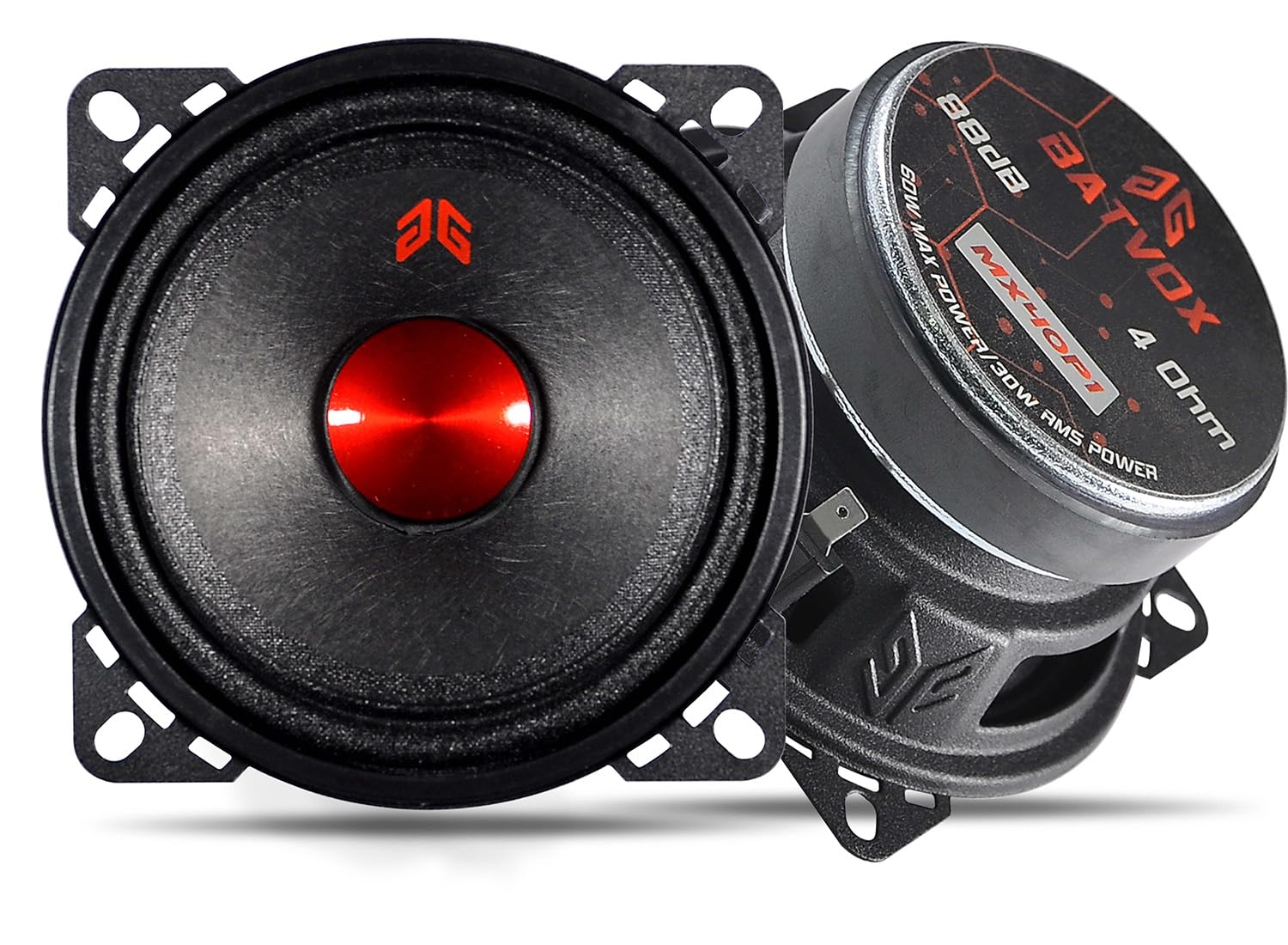
4. GRTSKY MX40P1 4 Inch Midrange Loudspeaker
The 4-inch speaker that owners say outperforms bigger brands on clarity.
The GRTSKY MX40P1 is a dedicated 4-inch midrange driver rated for 30W RMS, 60W max, and 120W peak power at 4 ohms with a sensitivity of 88dB and a frequency response of 100Hz to 10kHz. Its distinguishing feature is the striking red dust cap, but what matters more is the owner feedback: several who compared it directly to PRV and SKAR speakers found it delivered “crisp sound” and was “at least twice as loud” as a new SKAR 2-way.
This is a pure midrange. It does not have a built-in tweeter, so it needs a crossover and separate tweeters for full-range output. Buyers report pairing it with coaxial speakers of the same size in a sealed box, getting great projection and mid-bass. One caveat is that it does not come with a protective grill, so it is vulnerable to debris in an open-mount installation. The compact dimensions — 5.5 inches wide and just 1.81 inches deep — make it easy to fit in shallow dash and door locations.
A note on the list: This list uses flexible matching for 4-inch midrange speakers. The GRTSKY MX40P1 is a 4-inch driver, but its 30W RMS rating is lower than some competing options. It is included here because owners mention it sounds louder and clearer than many higher-wattage alternatives.
Reach for this if: you want a shallow-mount midrange that delivers exceptional clarity on limited power. It is perfect for a component system where space is tight.
Look elsewhere if: you need a built-in tweeter or a protective grill included in the package.
5. Power Acoustik XPS-104 4″ Midrange 300W Speaker

The affordable single driver that makes a great midrange in a 3-way setup.
The Power Acoustik XPS-104 is a single 4-inch, 4-ohm midrange speaker rated for 300W peak power with a 92dB sensitivity and a 0.75-inch voice coil. Despite the ambitious peak number, owners consistently emphasize that its real strength is clear sound rather than earth-shaking output. With 32 positive mentions for sound quality, the consensus is that it delivers “good sound quality” and “impressive highs” for a budget price.
Multiple owners used the XPS-104 as a midrange replacement in 3-way car audio systems, pairing it with an Alpine amp and a high-pass crossover at 400Hz. One owner found the clear sound perfect for replacing a blown midrange in a home speaker box. The primary catch is that this is a single speaker — the listing wording confused some buyers into expecting a pair. Additionally, it is not a full-range speaker, so do not expect bass output; it needs a subwoofer and a proper crossover to shine.
Compared to the Hifonics Zeus ZS4CX (175W peak) at a similar price, the Power Acoustik has a higher peak wattage (300W versus 175W), but the Hifonics is a coaxial with a built-in tweeter. For pure midrange, the XPS-104 is a fine budget choice, but for a complete speaker, the Hifonics gives you tweeter coverage.
Pick this if: you need a single budget midrange driver to fill a specific band in a 3-way active system. Check the product description carefully — it is one speaker, not a pair.
6. P Acoustik 2X Sealed Back 4″ 600W Mid Range Speaker XPS-104

The sealed-back design means cleaner installs in open panels and doors.
The Power Acoustik XPS-104 (this version is a 2-pack) is a pair of 4-inch, 4-ohm sealed-back midrange speakers with a 600W peak power rating for the pair. Each speaker features a 0.75-inch voice coil, a 15 oz magnet, 92dB sensitivity, and a frequency response spanning 450Hz to 10kHz. The sealed back is the key feature here — it protects the speaker from debris and rear-wave interference when mounted in an open panel or door without a separate enclosure.
Owners describe these as “very good for the money” and recommend using a good crossover to get the best results. One buyer used them as a midrange replacement for DJ speakers and reported they “sound great.” The mounting depth is a shallow 1.75 inches, making them easy to fit in tight spaces. A few owners noted that the edges of the basket arrived bent despite the packaging, though it did not affect the sound. Expect crisp, clear vocals rather than bass — these need a proper subwoofer and crossover to perform at their best.
The price difference between the single Power Acoustik XPS-104 and this 2-pack is minimal, making the pair the better value if you need two drivers. The sealed-back design is a genuine advantage over open-back budget options if you are mounting in a door without a baffle.
Reach for this pair if: you are building a 3-way system and need slim, sealed-back midrange drivers for door or dash locations. The shallow 1.75-inch depth fits almost anywhere.
Hold off if: you need a coaxial with a built-in tweeter — this is pure midrange only.
7. Mobiator MB-M404 Midrange Loudspeaker 4” 400W Max

The dedicated midrange that fills a warehouse with clear audio.
The Mobiator MB-M404 is a 4-inch, 4-ohm dedicated midrange speaker with 80W RMS power handling and 400W peak, a sensitivity of 90dB, and a frequency range of 100Hz to 6000Hz. It features a 2-layer voice coil and large-gauge wire for durability under continuous use. Sound quality is the top positive aspect with 20 mentions, and owners describe the midrange as “crisp.”
The standout real-world story comes from an owner who built a custom portable speaker and supplied 160 watts each to these drivers. The result was loud enough to be heard “clear as day on the other side of the warehouse over 400 feet away.” Another owner running them on a Boss head unit (without an external amp) already noticed a significant improvement over stock. The build quality earns 12 positive mentions, and the 1-year warranty adds confidence.
Compared with the PRV AUDIO 4MR60-4, the Mobiator offers much higher power handling (400W vs 60W program). However, the PRV extends its frequency response up to 8kHz, while the Mobiator rolls off at 6000Hz. For high-SPL installations where volume is the priority, the Mobiator is the better choice.
Why volume seekers choose this
- Very high 400W peak gives headroom for loud systems
- Solid build quality noted by owners
- Noticeable improvement over stock speakers even without an amp
One thing to note
- Frequency response stops at 6000Hz, so it needs a good tweeter for high-frequency detail
Reach for the Mobiator if: volume and mid-bass impact are your priorities and you already have a dedicated tweeter setup. It handles serious power without strain.
pass on it if: you need extended high-frequency response from a single driver — the PRV goes higher.
8. WDiYA 4 Inch Car Speakers 600W Peak Power

The glass-fiber cone that delivers surprising bass output from a 4-inch driver.
The WDiYA 4-inch speakers are a pair of dedicated midrange drivers rated for 600W peak power at 4 ohms, with glass fiber cones designed for reduced resonance and accurate sound reproduction up to 20kHz. The glass fiber cone is the defining feature here — it provides greater rigidity than standard paper or polypropylene cones, which means cleaner midrange and less distortion at high volumes.
Owners rave about the sound quality, with 27 positive mentions. One audiophile owner used them as a stock replacement in a 2010 Prius, amplified with a 6-channel amp and crossed at 300Hz-20kHz on a -6dB slope, calling the result “amazing.” Another owner running them off a 5-channel Memphis amp found them good enough to order a second set for the rear. Build quality also gets 18 positive mentions, with buyers calling the speakers “very well-made.” The only real complaint is the lack of included grills, leaving the cones exposed if you mount them in an open location.
Compared to the Mobiator MB-M404, the WDiYA has a wider frequency response (up to 20kHz vs 6000Hz) and is better suited for a full-range application even as a pure midrange. The glass fiber cone is a tangible upgrade over the Mobiator’s standard materials if clean articulation matters more than raw SPL.
Best for: the audio enthusiast who wants a well-built midrange with a premium cone material and surprising bass depth. Great for a component system with a proper amplifier.
One thing missing: no protective grills — plan to mount them behind a factory grille or add aftermarket ones.
9. Audison AP 4 Prima Series 4″ (100mm) Midrange Speakers (Pair)

The prestigious Italian midrange that reveals details budget speakers miss.
The Audison AP 4 Prima is a pair of 4-inch (100mm) dedicated midrange speakers from the renowned Italian audio house. They handle 120W peak power at 4 ohms, with a sensitivity of 91dB and a frequency response spanning 80Hz to 7.5kHz. The construction uses an aluminum basket, paper cone, and foam surround — classic materials chosen for their acoustic properties rather than cost. Audison does not publish RMS specs, but the 120W peak figure gives a solid reference for system planning.
Owner feedback reveals a speaker that sounds “awesome” and outperforms older speakers from top-line brands like Focal K2. One buyer who compared these directly to their previous Focal K2 speakers noted the Audison sounded “a little less warm” but still excellent. Another buyer using a different language called them “muy buena calidad” with crisp midrange and high notes. The caveat is that there is no dedicated crossover included, so you will need to supply your own for optimal performance in a component system.
At the premium end of the list, the Audison AP 4 sits above every other pick here in brand prestige and materials quality. The woven fiberglass cone of the PRV 4MR60-4 is also premium for its price, but the Audison’s paper/foam/aluminum construction targets a different kind of natural, musical sound. It holds a strong 4.4 out of 5 stars across over 100 ratings, which speaks to its consistent quality.
Reach for these if: you are building a high-end component system and value a neutral, natural midrange from a brand with serious car audio heritage. They reward a good amplifier and careful crossover tuning.
Look elsewhere if: you want a coaxial for a simple factory replacement or need the highest possible power handling — the Mobiator and WDiYA handle more wattage.
Understanding the Specs
Sensitivity (dB)
Sensitivity tells you how efficiently a speaker converts power into volume. A rating of 90dB or higher means the speaker will play loudly with a modest amount of amplifier power — great for systems using a factory head unit. Lower sensitivity figures (below 88dB) typically require a separate amplifier to reach satisfying volume levels. For a 4-inch midrange, look for at least 88dB if you are not using an external amp, and 90dB+ for maximum output.
Impedance (Ohms)
Impedance is the electrical resistance the speaker presents to the amplifier, measured in ohms. Most car audio systems are designed for 4-ohm speakers. A 2-ohm speaker will draw more power from the same amplifier, which can be louder, but it also puts more strain on the amp and may cause it to overheat if it is not rated for 2-ohm loads. Stick with 4-ohm drivers unless you know your amplifier can handle a lower load.
Frequency Response (Hz to kHz)
This spec shows the range of audio frequencies the speaker can reproduce. A 4-inch midrange typically covers between 80Hz (low bass edge) and 8kHz (upper treble edge). A wider frequency response means the speaker can handle more of the audio spectrum on its own. Coaxial speakers with a tweeter often extend to 20kHz, while pure midrange drivers roll off around 6-8kHz because they assume you will add a separate tweeter for the highest frequencies.
Coaxial vs. Dedicated Midrange
A coaxial speaker combines a midrange driver and a tweeter in a single unit, making it a drop-in replacement for a factory speaker. A dedicated midrange plays only the middle band and needs a crossover and separate tweeter to produce full-range sound. If you are upgrading without adding extra components, go coaxial. If you are building a multi-amp component system, dedicated midranges give you more control over the sound stage.
FAQ
Can I use a 4-inch midrange speaker without an amplifier?
What is the difference between RMS and peak power?
Do I need a crossover for a dedicated midrange speaker?
Will a 4-inch midrange speaker fit in my car’s factory location?
How many 4-inch midrange speakers do I need for a car system?
Can I use 4-inch midrange speakers for home audio?
Is a coaxial 2-way speaker better than a pure midrange?
Why does my 4-inch midrange speaker sound distorted at high volume?
Final Thoughts: The Verdict
For the majority of shoppers, the 4 inch midrange speaker winner is the DS18 ZXI-44 because it combines crisp coaxial sound with straightforward installation and high owner satisfaction. If you want high efficiency and already have a tweeter setup, the PRV AUDIO 4MR60-4 is a bargain midrange driver that punches well above its size. And for maximum volume while staying affordable, the Mobiator MB-M404 handles serious power and fills even large spaces with clean audio. The top pick edges out the competition by offering the most rewarding balance of clarity, output, and ease of use for the widest range of buyers.
How We Picked
We do not accept paid placement. Every pick is matched to a real buyer and a real use-case; we do not hands-on test units.
Sources & Methodology
Specifications: manufacturer listings and product documentation. Review insights: verified customer reviews, as of July 2026. Pricing: not shown on this page (it changes often); check the current price via the retailer link.
As an Amazon Associate, Gadgets Feed earns from qualifying purchases. This does not affect which products we feature.