
Our readers keep the lights on and my morning glass full of iced black tea. As an Amazon Associate, I earn from qualifying purchases.
Specs are compiled from manufacturer listings and verified buyer reviews and can change over time — please confirm the key details on the product page before buying.
Hot dashboard, sticky seats, a drive that feels like a convection oven. The factory A/C in an older vehicle often just recirculates warm air, and a portable cooler barely takes the edge off. A proper 12-volt car air conditioner bolts or mounts into your existing cabin and delivers cold that makes you forget the shimmering asphalt outside. This guide cuts through mixed specs and fitment questions to pick units that actually work for every rig, from classic pickup to full-time van conversion.
I’m Min — the founder and writer behind Gadgets Feed. This guide is built by comparing the manufacturers’ published specifications and the patterns across verified customer reviews, so you get each pick’s real strengths and trade-offs instead of marketing spin.
Whether you are building a camper van, restoring a vintage truck, or cooling a long-haul semi, these picks cover the landscape — including one rooftop unit owners call “a standout” with 4.9 stars and unbelievable cooling speed. Welcome to hands-on, data-backed research on the best car air conditioner for your ride.
Our Picks at a Glance
How To Choose The Best Car Air Conditioner
The right 12-volt air conditioner depends on your vehicle, battery bank, and how much installation work you want to do. Here are the three biggest factors that separate a successful install from a frustrating one.
Rooftop vs. Under-Dash
A rooftop unit mounts into a standard 14″ x 14″ roof vent cutout, which makes it a natural fit for RVs, vans, and campers. It keeps the noisy compressor and condenser outside, so the cabin stays quieter. An under-dash kit sits inside the cab and is far more practical for trucks, classic cars, and vehicles without a flat roof. The trade-off is that the compressor and condenser also mount under the hood or chassis, which can mean more hoses and a tighter fit.
BTU Rating and Battery Math
Most 12-volt units cluster around 10,000 BTUs (British Thermal Units, the standard measure of cooling power). That is enough to cool a medium-sized van cab or a small RV bedroom. The spec that matters more to off-grid buyers is the amp draw. A unit that pulls 40-60A while running needs a healthy battery bank — buyers report that a 400 to 600 amp-hour battery delivers 8 to 10 hours of runtime. Inverter models (variable-speed compressors) draw much less on eco mode, often around 300-400W, which is a major advantage for solar-powered setups.
Fitment: Roof Thickness and Cab Dimensions
A rooftop unit typically works with roof thicknesses between 1.5″ and 3.5″. If your van has an arched or unusually thick roof, you may need longer bolts (some owners buy aftermarket 8mm threaded rod). Under-dash units have their own constraint — the evaporator box (often about 15.9″ x 13.6″ x 6.1″) must fit somewhere under the dashboard or behind a seat. Measure twice before clicking “buy”.
Quick Comparison
| Model | Best For | Type | Cooling Power | Weight | Amazon |
|---|---|---|---|---|---|
| Outequip 12V Rooftop (White)★ Best Overall | RV off-grid reliability | Rooftop | 10,000 BTU | 45 lbs | Amazon |
| Outequip 12V (Black)Also Great | First-time van builders | Rooftop | 10,000 BTU | ~45 lbs | Amazon |
| Countrymod 12V DCOff-Grid Master | Low-power boondocking | Rooftop | 10,000 BTU | — | Amazon |
| OutEquip 12V (White w/ Heat) | Year-round van living | Rooftop | 10,000 BTU | 43 lbs | Amazon |
| Gidrox 12V Rooftop | Quick 3-minute cool-down | Rooftop | 10,000 BTU | 52 lbs | Amazon |
| Aspligo 12V Split | Truck and semi cabs | Split System | 10,500 BTU | — | Amazon |
| Aspligo Under-Dash | Budget van cool-down | Under-Dash | 10,000 BTU | — | Amazon |
| Coldmaster Kit | Classic car restorations | Under-Dash Kit | 12,700 BTU / 359 CFM | — | Amazon |
| Universal 12V Under-Dash | Budget heating and cooling | Under-Dash | 10,000 BTU | — | Amazon |
In‑Depth Reviews
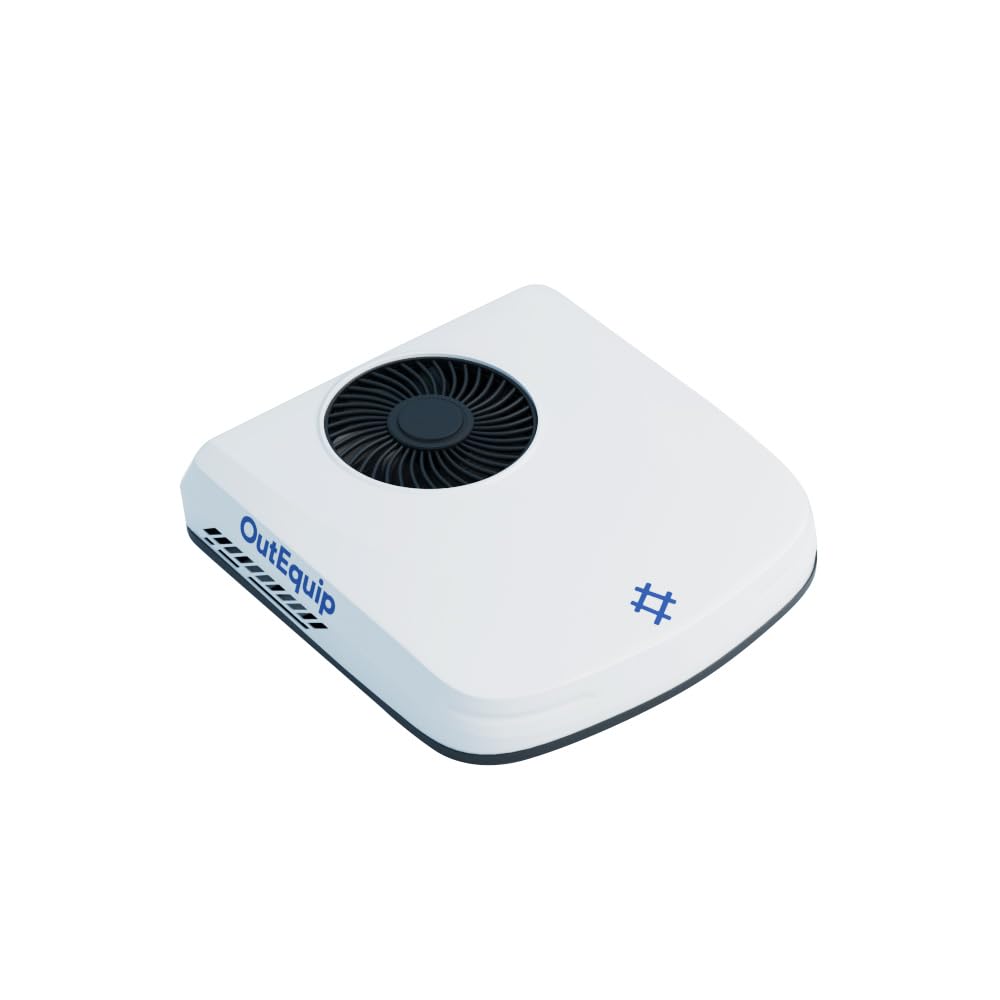
1. Outequip 12V Rooftop Air Conditioner (White) — No Heater
Our pick — over 4.5★ from 80+ verified ratings; the strongest balance of quality and price.
The crowd favorite — installation is the most-praised aspect by a clear margin.
This white rooftop unit shares the same cooling DNA as the black version (10,000 BTU, 43 lbs, 15-minute cool-down) but skips the heater, which makes it lighter and simpler. The sheer volume of positive reviews puts it in a different league for buyer confidence. Installation is the most-discussed positive, with owners calling the process straightforward and the instructions clear. The second-most-praised aspect is cooling performance — one owner measured 55-degree air coming from the vents.
It runs on 12V DC power. According to the specs, it can deliver 8 hours of cooling when paired with a 480Ah battery bank, and 10 hours with a 600Ah bank. The quiet operation is a recurring theme; owners describe the brushless copper motor fans as extremely quiet, even in a pop-up camper. One owner installed it on a VW Westfalia bus and reports that on eco mode the power draw is “surprisingly low.”
The only caution from the feedback is to avoid overtightening the mounting screws — the threaded inserts can pop out. Customer support is mentioned as responsive, with one owner having a replacement control unit sent out quickly.
What stands out
- Installation is the most-praised aspect — “lightweight (43 lbs), easy one-person install in 2 days”
- Cooling performance praised by dozens; blows 55-degree air
- Low noise on eco mode; owners say it is “extremely quiet” even in small campers
- Energy efficiency (17 positive mentions) makes it ideal for solar/battery setups
The trade-off
- No heater — this is cooling only
- Overtightening screws can damage the threaded inserts; gentle install required
- Some owners wished the manual had more photos
The verdict: If all you need is cold air and the simplest install, this white Outequip is the most-bought, most-praised rooftop unit in the group for good reason.
skip it if: You want heating capability or have a very thick roof that may need longer bolts — but that is a rare situation.
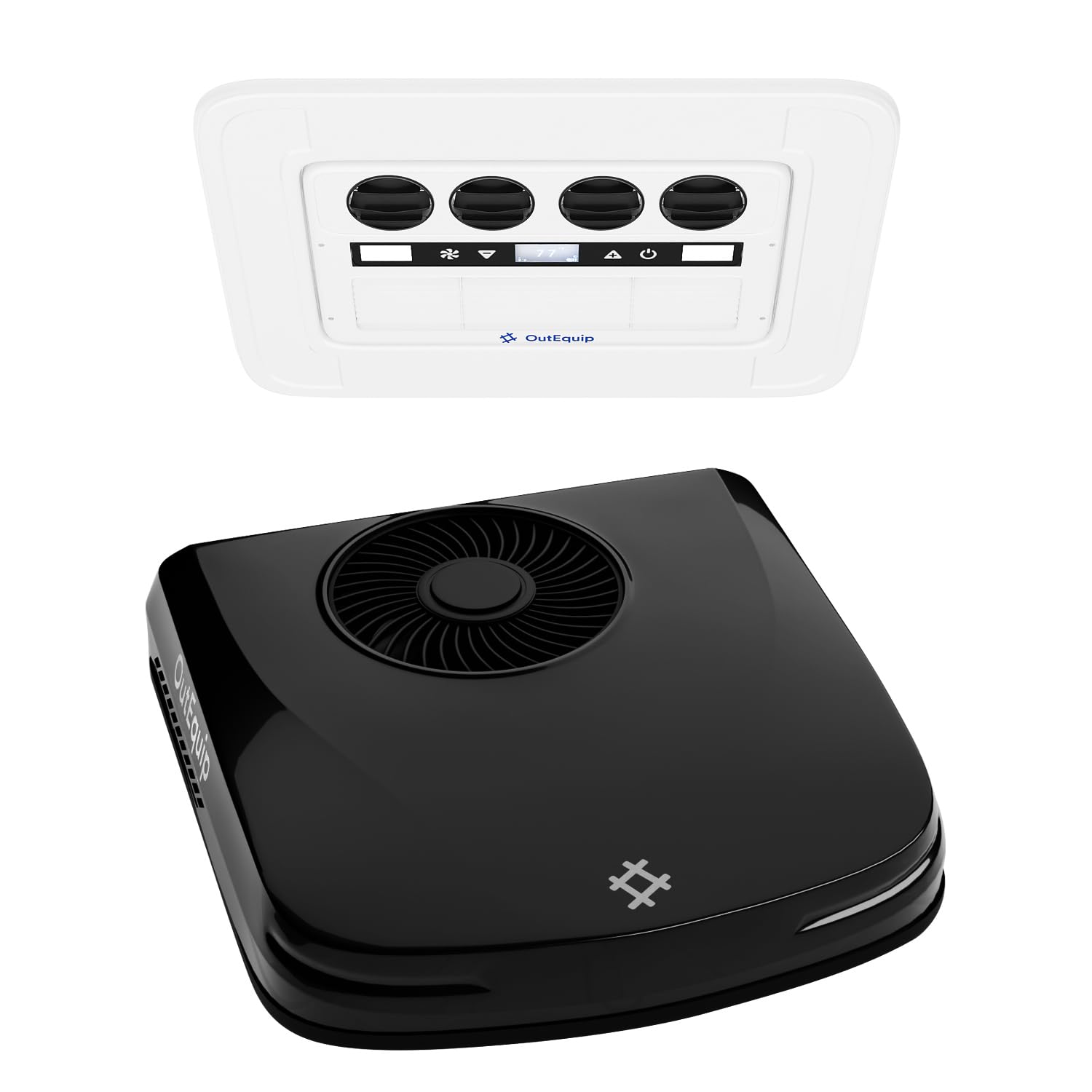
2. Outequip 12V RV Rooftop Air Conditioner (Black)
The one that silences “too good to be true” critics with a 4.9-star reception.
This 10,000 BTU rooftop unit from Outequip gets the nod at the top because it does almost everything right — and the crowd that bought it agrees without hesitation. It cools an RV cabin in 15 minutes, runs on a standard 12V system, and stays quiet enough that owners describe it as “exceptionally quiet” compared to Dometic or Velit units. The quality is the most-praised aspect, with cooling performance and value for money right behind it.
The built-in heater offers 4,500 BTU of PTC warmth, which owners say works for mild mornings but isn’t a primary heat source in extreme cold. One owner in Arizona says it keeps up with that punishing heat and cools quickly. At around 45 pounds and a low-profile black housing, it sits lower on the roof than many Dometic units, leaving room for solar panels.
The only real fitment friction: installation can be tricky on a non-flat roof. Several owners needed extra 8mm threaded rod. And the heater is noticeably louder than the cooling fan — a few note the remote beeps on every button press. But the professional installer quoted in one review praised the build quality, and customer support is described as responsive.
What wins people over
- Quality is the most-discussed positive — the build feels solid compared to big-brand alternatives
- Cools a van in 15 minutes; 10,000 BTU is plenty for a camper-size space
- Quieter than Dometic; “exceptionally quiet” in multiple owner reports
- Smart modes (Eco, Sleep, Turbo) with a digital display and remote control
Who should think twice
- Heater is noisy and only adequate for mild cold (not a winter solution)
- Installation on arched or very thick roofs requires aftermarket bolts
- No built-in Bluetooth (a separate temp gauge may be needed for monitoring)
Reach for this if: You are building out a van, truck topper, or camper and want a rooftop unit that works the first time, cools fast, and earns near-perfect owner scores.
Look elsewhere if: You absolutely need app-based Bluetooth monitoring or a primary heat source for sub-freezing winters — this unit does not have an app and the 4,500 BTU heater is supplementary.
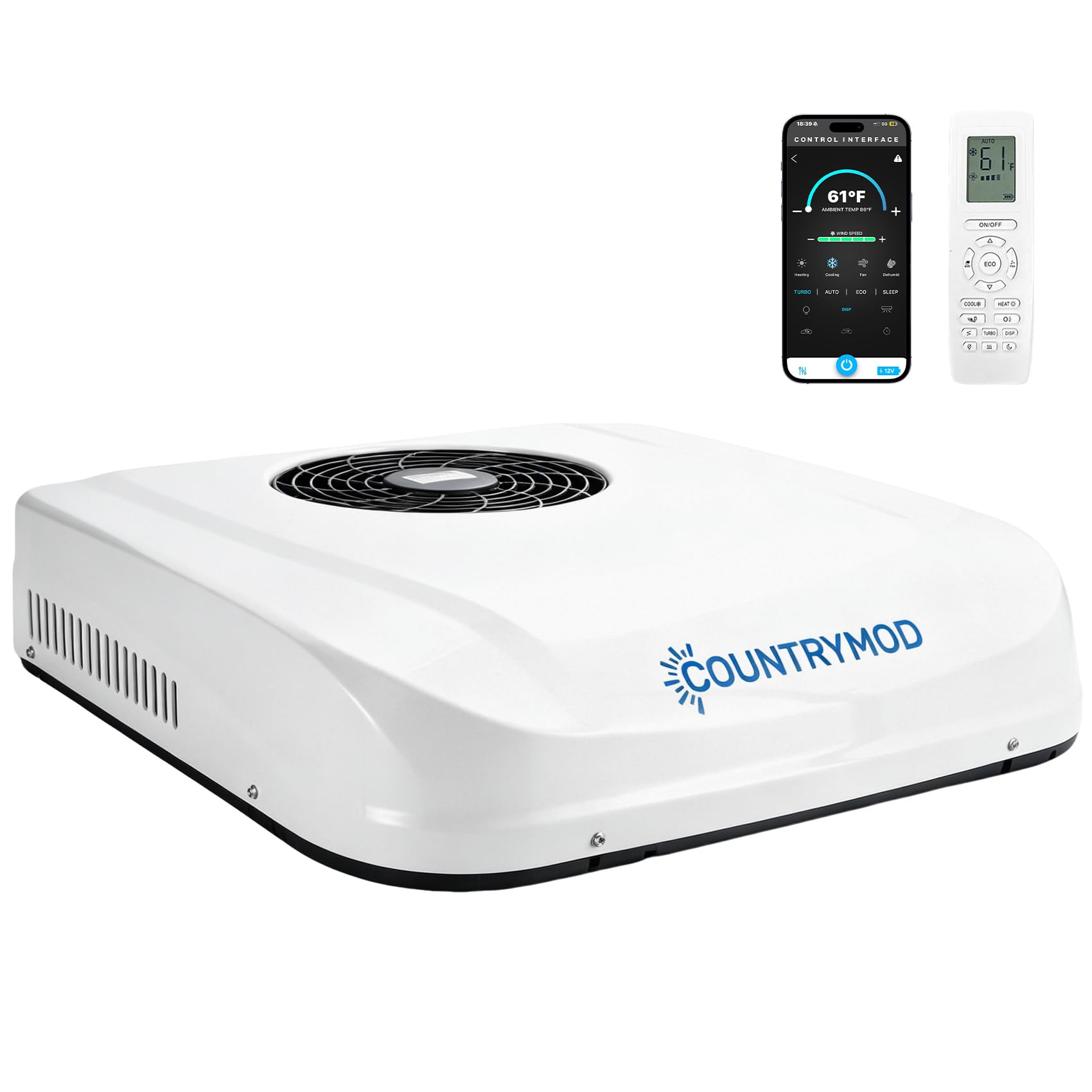
3. Countrymod 12V DC RV Air Conditioner
The inverter-driven unit that barely sips power on eco — 260W is the owner-reported figure.
If battery life is your obsession, the Countrymod is the unit that owners call a “standout for boondocking.” Its variable-frequency inverter compressor adjusts the cooling output on demand, which means on ECO mode it pulls around 260 watts (owners mention as low as 260W in ECO and 590W in TURBO). Noise is another standout: sleep mode operates at around 44 dB, which is barely louder than a refrigerator.
Installation is the most-praised aspect here too, though the instructions are called “subpar” by some. Multiple owners ended up buying longer 8mm x 160mm bolts for arched roofs. The Countrymod uses a horizontal compressor that owners say reduces vibration and lowers the center of gravity. One owner installed it in a 36-foot motorhome in the Nevada desert where temps hit 113°F, and it kept the bedroom at 80°F during the day and 72°F at night. The unit fits a standard 14″ x 14″ roof vent and is ductless, so it works best in RVs without built-in ductwork.
Customer service is praised — a specific rep named Tony is mentioned by several owners as responsive. The only recurring friction is that the instructions are lacking for some details, and the power wire (30 ft of 4 AWG is recommended for long runs) needs to be sized correctly for the amperage.
Why battery-builders love it
- Inverter compressor pulls 260W on ECO (owner-measured)
- Sleep mode at ~44 dB; owners call it “very quiet”
- Cools a 100 sq ft bedroom in extreme desert heat
- Quality and installation both praised by 22 owners each
The catch
- Instructions are “subpar” — you will figure it out, but the manual lacks detail
- Arched roofs need longer 8mm bolts (160mm)
- Requires >11V at the unit; battery voltage drop can cause shutdown on long wire runs
Reach for this if: You live off-grid with lithium batteries and want the most efficient, quietest 12V rooftop AC that stretches your amp-hours.
Think twice if: Your roof is arched or very thick — the install is doable but you will be buying aftermarket bolts. Also, it is ductless, so it is not ideal for RVs that rely on ceiling ducts.
4. OutEquip 12V Rooftop Air Conditioner with Heater (White)
The most-reviewed unit in this lineup — 143 owners have weighed in, and the vast majority call it a win.
This is essentially the same platform as the white non-heater version above, but with a built-in 4,500 BTU PTC heater. That makes it a true year-round option for van life and small RV spaces. Customers say installation is the most-praised aspect — 52 owners call it straightforward. Cooling performance follows at 46 positive mentions, with one owner noting it can reach temperatures as low as 25 degrees. Power consumption is also a highlight: multiple owners confirm it runs all night on battery and does not strain the electrical system.
The key difference from the budget-friendly pick is the heater, but owners are clear that the 4,500 BTU heat pump is only for “mild temperatures and small spaces.” Several say it “takes the chill off” but is not a primary heat source for extreme cold. At 43 pounds and 6 inches tall, it sits lower on the roof than many Dometic units — one owner points out this enables more solar panel space. The included 15-foot 6 AWG wire and fuse kept voltage drop to only 0.03V in one install. The app-based Bluetooth control also gets consistent praise for simplicity.
The drawbacks are minor: lid screws can be hard to remove, and some connectors felt fragile during installation. Most owners advise patience and spare connectors if you are a DIY installer. Noise on turbo mode is moderate, but on low or eco it is genuinely quiet.
What the numbers say
- 52 owners praise installation — “simple installation with accurate instructions”
- Cools in 15 minutes; “as low as 25 degrees” vent temperature reported
- Low power draw (~16A on Eco) enables all-night cooling on battery
- 143 total ratings — the most in this comparison
The fine print
- 4,500 BTU heater is supplemental only — not enough for freezing temps
- Lid screws can be difficult to remove; fragile connectors need care
- Turbo mode is moderately noisy
The verdict: The most-reviewed and most-trusted rooftop unit in the list, with the versatility of heating and cooling. Ideal for van lifers who want one unit that handles spring through fall.
pass on it if: You live in a place where winter means single-digit temperatures — this heat pump is not enough for that. You would need a separate diesel or propane heater.
5. Gidrox 12V RV Rooftop Air Conditioner
Three minutes to comfortable — the claim that actually holds up in owner reports.
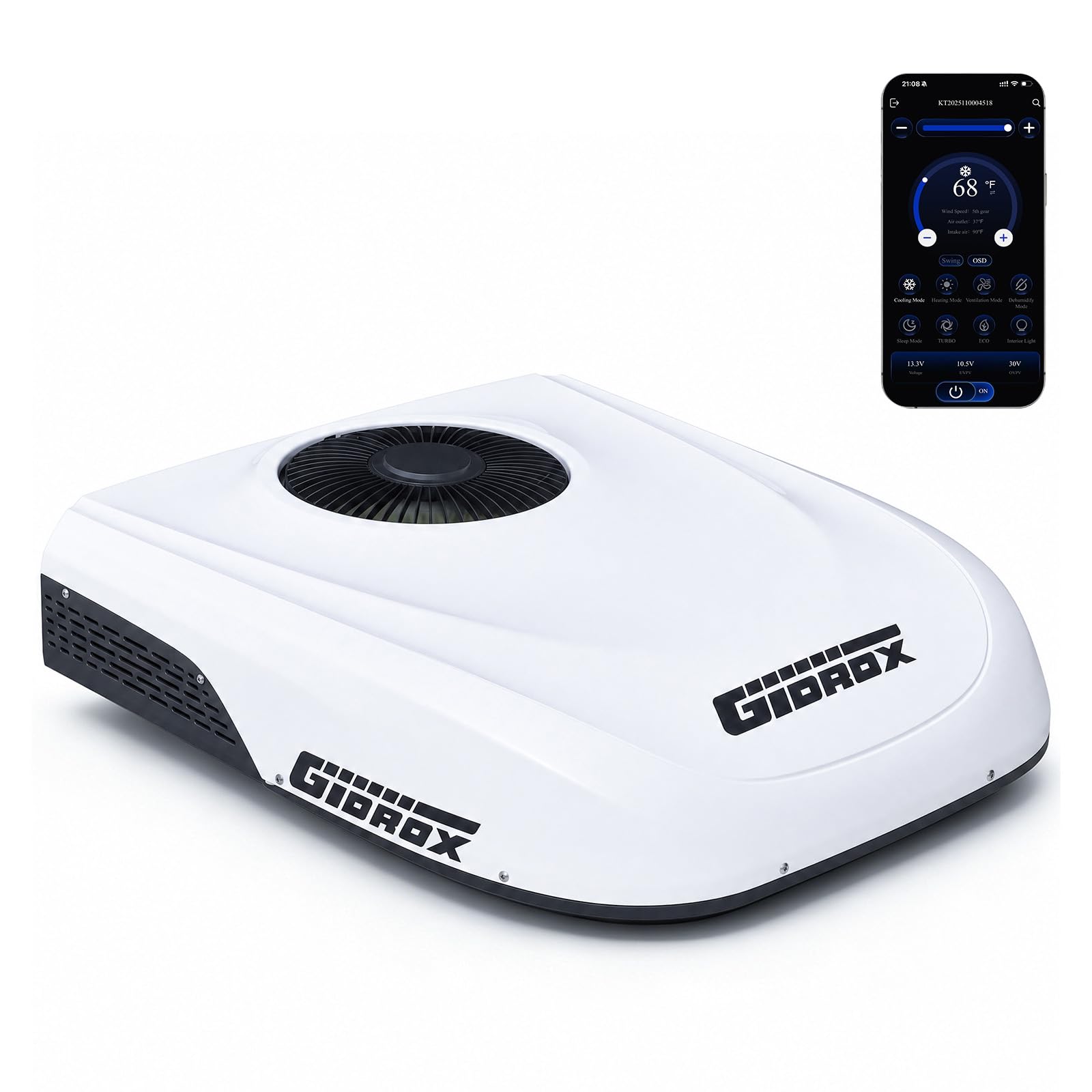
The Gidrox promises a 3-minute cool-down and owners confirm it delivers. It includes a PTC heater for warmth too, making it another all-season contender. The standout spec is the low power consumption: on sleep mode it operates at around 40 dB and uses roughly 300-350W on eco (owner-measured). The unit weighs 52 pounds and stands 7 inches tall, which is slightly larger than the Outequip units but still within the range of a solo install.
It has three control methods — smartphone app via Bluetooth, infrared remote, and physical buttons on the unit. The app lets you set temperature, timers, and switch between °C and °F. Another notes that customer service replaced a damaged board quickly. The mounting hardware works with roof thicknesses between 1.5″ and 3.5″ and includes a 19.7 ft power cable.
The mixed feedback centers on functionality — some units arrive with the compressor not engaging. One owner reported an error code H2 and fans that blow for 1-2 minutes then stop, with no customer service response after a week. That is a small minority, but it is note for risk tolerance.
What clicks
- 3-minute cool down — one of the fastest claims verified by owners
- Eco mode uses 300-350W (owner-measured); 40dB on sleep is library-quiet
- Three ways to control it: app, remote, and on-unit buttons
- Includes heater for transitional weather
The risk
- Functionality is mixed — a minority of units have compressor issues
- Mounting hardware may be too short for thick roofs; need aftermarket all-thread
- Installation is mixed (some find it easy, others struggle with hardware fit)
Reach for this if: You want the fastest cool-down in the lineup and control via smartphone app, and you have a moderately thick roof (1.5-3.5″).
Think twice if: You have zero tolerance for a potential defective unit — the mixed functionality feedback means a small chance of a dud. Buy from a seller with a solid return policy.
6. Aspligo 12V Split System Air Conditioner (10,500 BTU)
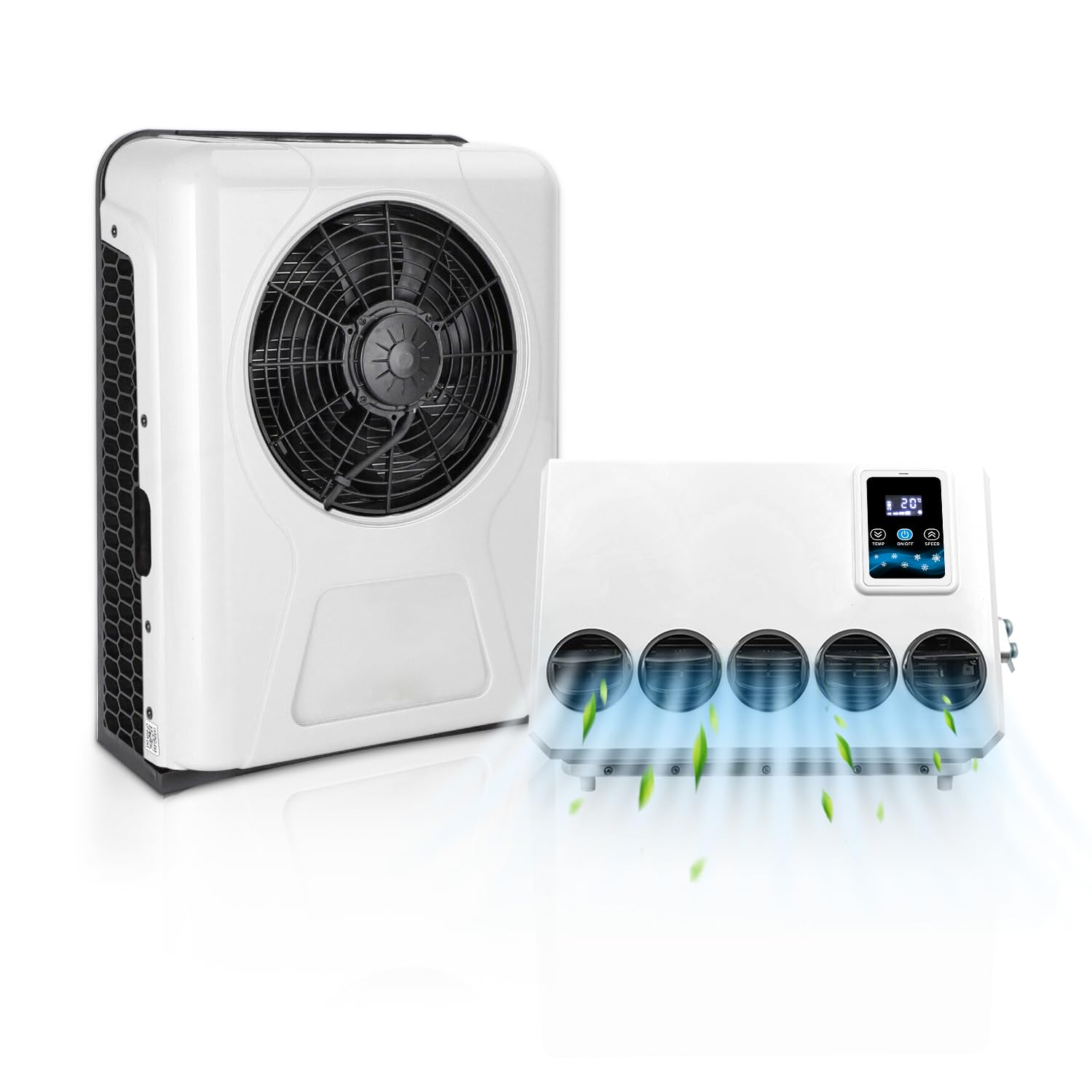
45°F vent air on the lowest setting — and the owner had to turn it off while driving because it got too cold.
This split-system unit is different from the rest because the compressor sits outside the cabin in a separate housing, connected by refrigerant lines. That makes it a better fit for semi trucks, tractors, and vehicles where a rooftop unit is impractical. One owner says it “blows hard, I actually had to turn it off while driving.”
The split design means you have more flexibility in mounting the evaporator inside the cab. It includes low-voltage protection to prevent excessive battery drain and a 12mm² pure copper wire core for better conductivity. An inverter compressor is built in, so the unit varies its speed based on cooling demand. Owners consistently report it is “very quiet” and works well in truck applications without discharging batteries during night work.
The drawbacks: the unit runs on R134a refrigerant, which is an older gas, and one owner mentioned the expansion valve was misadjusted from the start. The indoor fan is fine, but some vibration from the back wall can be an issue depending on mounting. The instructions are self-explanatory for mechanically inclined owners but may be lacking for first-timers.
The strong points
- 10,500 BTU — slightly more cooling power than any other unit in this list at 10,500 BTU versus the 10,000 BTU of other models
- Blows 45°F air on lowest setting; owners say it is “very cold”
- Split system design works where rooftop units do not (semi cabs, tractors, box trucks)
- Inverter compressor; owners say it is quiet and “high quality components”
The honest notes
- Works with R134a only (older refrigerant; not the newer eco-friendly gas)
- Expansion valve may need adjustment; some units arrive mis-set
- Installation requires mechanical expertise — not a plug-and-play for everyone
Reach for this if: You drive a semi, tractor, or box truck and want a split system that delivers serious cold air without taking up roof space.
it’s not for you if: You want a simple rooftop install or are not comfortable troubleshooting a potentially misadjusted valve — this is for the mechanically experienced.
7. Aspligo 12V Under-Dash AC Kit (10,000 BTU)

A 20-cc electric scroll compressor in a compact under-dash package that a novice can install.
This under-dash kit from Aspligo uses a 20cc electric scroll compressor for cooling and is designed for cars, trucks, RVs, and boats. It offers both heating and cooling, with the heating function warming engine coolant. At 10000 BTU, it delivers the same cooling power as the rooftop units but in a smaller form factor that fits under the dashboard. Owners say the installation is “easy” for experienced mechanics, and one novice reported success on a 2005 Savana skoolie. The compressor comes pre-oiled with 20 oz of POE68 oil, which saves a step.
It includes low-voltage protection and is battery-powered so it can run while the vehicle is off. The kit ships in two separate packages (internal unit and external unit), which may arrive at different times. Owners consistently mention customer service responsiveness — under 24 hours in one case.
The mixed feedback: a few units arrive with damage or broken components, and some owners found the basic instructions lacking. One owner says “poor quality and all broken, customer not helpful,” though that was a minority experience. The fitment is the biggest variable — the internal unit measures 15.89″ x 13.58″ x 6.12″, so measure your dash space carefully. An RV, van, or large truck cab is the natural home for this.
Why it earns a spot
- 20cc electric scroll compressor — stronger cooling capacity for its size
- Heating and cooling in one under-dash package
- Low-voltage protection extends battery life
- Owners call it a “bargain price” for the quality
The fitment reality
- Measure twice — the box is 15.89 x 13.58 x 6.12 inches and needs real under-dash space
- Instructions are “basic”; experienced mechanics will find it easier
- A few units arrived broken; check return policy
Reach for this if: You have a van, truck, or skoolie and want a competent under-dash unit with both cool and heat for less than the premium rooftop options.
Look elsewhere if: You are not handy with basic auto HVAC wiring or you have a very small car cabin with zero under-dash space.
8. Coldmaster Universal Under-Dash A/C Kit (12,700 BTU)

A true 12,700 BTU output with 359 CFM of airflow — the most raw cooling power in the list.
This kit from Coldmaster is designed for vintage cars and special vehicles where a modern compressor system will not fit. It includes an SD 508 Sanden-type compressor (2A groove, 12V), a parallel flow condenser (14×20 inches), and a 120W pusher fan. The under-dash evaporator has a 30-pass, 4-way aluminum coil with a 1.5-ton expansion valve, a thermostat, and a 3-speed blower switch. The total BTU rating of 12,700 is the highest in this lineup, and the airflow is rated at 359 CFM (cubic feet per minute, a measure of how much air the fan moves).
The complete electrical harness is designed as a plug-and-play system, making it easier to connect all components. The kit was successfully installed on a 1980 International Scout and a 1952 Pontiac — both owners say it worked “perfectly” with clear instructions that are easy to follow. The airflow out of the head unit is described as “great.” It includes mounting brackets, a drain hose, and a drier with a pressure switch.
Not all installs are smooth: one owner on a 1975 K10 found the hoses too short and the unit too deep for the dash. Another described a loud fan that sounds “like something is dragging.” The compressor mounting bracket is not included, which can be an issue for non-standard engine bays. The fan noise registers at 69 dB, which is the loudest rating in this list — important if cabin noise matters to you.
Where it dominates
- 12,700 BTU and 359 CFM — the highest raw cooling power and airflow in the list
- Works perfectly for classic cars (1952 Pontiac, 1980 International Scout) per owners
- “Complete electrical harness” is plug-and-play for easier wiring
- Includes quality components: SD 508 Sanden compressor, 120W pusher fan, parallel flow condenser
The fitment reality
- Hoses may be too short for some truck dashes; no compressor bracket included
- Fan noise is 69 dB — noticeably louder than rooftop units
- One owner calls the fan quality “poor” and recommends buying a better system
Reach for this if: You are restoring a classic car or working on a vehicle with no existing A/C and want the strongest possible cooling from an under-dash kit.
Think twice if: Cabin noise is a deal-breaker (69 dB fan) or you own a tight truck cab where hoses and depth are an issue. Also verify if your engine bay has space for a compressor bracket.
9. Universal 12V Under-Dash AC Kit (10,000 BTU)
A heating-and-cooling under-dash kit that, when it works, puts out “good air speed and pretty cold air.”
This is the most budget-friendly entry in the list, and it covers both heating and cooling in a single under-dash unit. The rated power draw is 550-600W at 40-60A, and it uses R134a refrigerant (500-550g charge, not included). It is designed to fit most cars, trucks, RVs, campers, and boats — the internal unit measures 15.89″ x 13.58″ x 6.12″. The heating function works by warming the engine coolant, so it requires the engine to be running to produce heat.
The one positive review mentions “good air speed and pretty cold air” and notes the seller provided helpful shipping updates and emailed instructions. That same owner says “time will be the test” for durability. The updated design combines the receiver dryer, condenser fan, and condenser into one integrated unit, which the maker claims reduces leakage points and improves efficiency.
The honest picture: this kit has by far the most mixed feedback in the list. Multiple customers note it stopped working after an hour, a broken evaporator temperature regulator, wrong hose fittings, and incorrect wiring plugs. One buyer’s quote sums up the risk: “the unit worked for an hour then it stopped, now the compressor blinks but won’t work any more and the shipment was extremely late, don’t waste the money.” The instructions are also described as unclear. This is a budget gamble — it can work well, but a significant minority of units have defects.
When it works
- Both heating and cooling in one under-dash unit
- Good air speed and cold air when functioning correctly
- Seller communication is praised by the positive reviews
- Integrated design reduces potential leak points
The honest trade-off
- Several reviewers point out units failing after an hour of use
- Wrong hose fittings and wiring plug issues are common complaints
- Instructions are “so dumb” and “not clear at all” per owners
- Two-package shipping means parts may arrive at different times
Reach for this if: Your budget is tight and you are comfortable potentially dealing with a defective unit or returning it. It works for some owners.
Strictly avoid if: You need reliable cooling that works the first time without troubleshooting. The failure rate in the reviews is too high for a primary vehicle AC. Invest in one of the higher-rated picks above.
Understanding the Specs
BTU (British Thermal Unit)
This is the standard unit for measuring cooling power. One BTU is roughly the energy needed to cool one pound of water by one degree Fahrenheit. In a vehicle context, 10,000 BTU is sufficient for a medium-sized van or small RV. A higher BTU number means faster cooling in a larger space, but it also means a higher electrical load. The units in this list cluster around 10,000 BTU, with one hitting 12,700 BTU for larger cabs. Think of BTU as the size of the engine — bigger is not always better if your battery can not sustain it.
12V DC Power and Battery Draw
A 12-volt DC air conditioner connects directly to your vehicle battery — no inverter needed. The real-world spec to watch is the amp draw (current in amperes). Most units pull 40 to 60 amps while running. That matters because a typical car battery will drain quickly at that rate. Off-grid van owners pair these units with a 400-600 amp-hour house battery bank to get 8-10 hours of runtime. Inverter units with variable-speed compressors can pull as little as 260W on eco mode, which is the gold standard for solar-powered setups.
Inverter vs. Fixed Compressor
An inverter compressor (also called a variable-speed or variable-frequency compressor) adjusts its speed to match the cooling demand. Instead of cycling on/off at full power, it runs continuously at a lower speed when the cabin is already cool. That cuts power consumption dramatically — often by 50-60% compared to a fixed-speed unit. Fixed-speed compressors are simpler and cheaper but draw full power every time they kick on. For battery-dependent van life, an inverter compressor is a major advantage.
Noise Level (dB)
Sound level is measured in decibels (dB). For reference, a quiet library is about 40 dB and a normal conversation is about 60 dB. Rooftop units in this list typically claim 40-55 dB depending on mode (sleep vs. turbo). An under-dash kit like the Coldmaster is rated at 69 dB, which is closer to a loud conversation. If you plan to sleep in the vehicle with the AC running, prioritize a unit that owners explicitly call “quiet” or that reports sleep-mode decibel values below 45 dB.
FAQ
Can I install a 12V car air conditioner in a regular sedan?
How long will a 12V car AC run on my battery?
What is the difference between a split system and a rooftop unit?
Can a 12V car AC run while the engine is off?
What does “low voltage protection” mean on a car AC unit?
Is R134a refrigerant still available, or do I need a different gas?
Do I need a special compressor bracket for my engine bay?
How heavy is a rooftop car AC unit, and can I install it alone?
Can I use a 24V or 48V battery with a 12V car AC?
Final Thoughts: The Verdict
For most van and RV owners, the best car air conditioner is the Outequip 12V RV Rooftop Air Conditioner (Black). It combines a 4.9-star owner score, a proven 15-minute cool-down, solid build quality, and a low-profile black housing that fits most standard roof vents. If your main goal is energy efficiency and you run lithium batteries, the Countrymod 12V DC unit with its inverter compressor is the smarter long-term bet — buyers report 260W on eco and 12-hour runs on a 300Ah bank. And if you are driving a semi truck or classic car where a rooftop unit is not an option, the Aspligo 12V Split System delivers 10,500 BTU of cooling with vent temperatures as low as 45°F. Pick the one that matches your vehicle and battery setup, and the next time the asphalt is shimmering, you will be the one reaching for the temperature dial instead of a bottle of water.
How We Picked
We do not accept paid placement. Every pick is matched to a real buyer and a real use-case; we do not hands-on test units.
Sources & Methodology
Specifications: manufacturer listings and product documentation. Review insights: verified customer reviews, as of July 2026. Pricing: not shown on this page (it changes often); check the current price via the retailer link.
As an Amazon Associate, Gadgets Feed earns from qualifying purchases. This does not affect which products we feature.