
Our readers keep the lights on and my morning glass full of iced black tea. As an Amazon Associate, I earn from qualifying purchases.
Specs are compiled from manufacturer listings and verified buyer reviews and can change over time — please confirm the key details on the product page before buying.
You want doors and windows secured without a monthly contract or drilling holes through your trim. A wireless contact sensor sits flush on the frame and sounds off the moment a gap appears. That deters an intruder, warns you about a wandering toddler, or simply chimes when the back door opens. But peel-and-stick units vary wildly in loudness, alignment tolerance, and build quality. Some are barely audible from the next room. Others will wake the whole block. This guide finds the one that fits your frame, stays stuck, and hits the decibel level you need.
I’m Min — the founder and writer behind Gadgets Feed. This guide is built by comparing the manufacturers’ published specifications and the patterns across verified customer reviews, so you get each pick’s real strengths and trade-offs instead of marketing spin.
The crowd favorite works inside a popular smart-home ecosystem and earns the top spot here. The real choice depends on how loud you need it and if you want a connected app or just a standalone scream. These are the best alarm window sensors for every real-world scenario, from a rental apartment to a multi-window family home.
Our Picks at a Glance


How To Choose The Best Alarm Window Sensors
A magnetic contact sensor is simple: two plastic halves that trigger an alarm when they separate. The specs that separate a good one from a dud are the decibel output, the allowable gap between the halves, and the battery life. Here are the three things to check before you stick one on your window.
Loudness: The Decibel (db) Reality
Most sensors fall between 90 db and 125 db. A 90 db alarm is loud enough for a single room, but probably won’t wake someone two floors up. A 120 db alarm is genuinely painful up close and will be heard through walls. The trade-off is that at 120 db, you risk startling yourself or triggering a false-alarm panic. Pick your level based on if you want a gentle chime for a busy front door or an ear-splitting deterrent for a ground-floor window.
Alignment Tolerance: The Gap That Matters
The alarm triggers when the magnet moves away from the sensor. If the gap required is too tight — say, 10 mm (about 0.39 inches) — an old, drafty window that’s slightly warped might never stay aligned. A sensor with a 0.78-inch gap tolerance (about 20 mm) is far more forgiving. Check your window frame before buying: if it’s uneven or painted shut, a wider tolerance sensor will save you frustration.
Standalone vs Smart-Home Hub
Standalone sensors (like most picks here) are battery-powered, don’t need Wi-Fi, and cost nothing monthly. They beep or chime locally. Smart-home sensors (like the Ring pick) connect to a base station and push alerts to your phone, but they typically require a subscription for cloud recording and advanced features. If you just need an audible warning, go standalone. If you want a notification when you are away, go smart.
Quick Comparison
| Model | Best For | Loudness | Gap Tolerance | Power | Amazon |
|---|---|---|---|---|---|
| Ring Alarm Contact Sensor (2nd Gen)★ Best Overall | Smart-home integration | Audible alert (no db listed) | ~1 inch | 2x CR2032 (3-year life) | Amazon |
| TECKNET Door Alarms (3 Pack)Budget Champion | Multi-point budget coverage | 65 db | 0.78 inches | 4x LR44 | Amazon |
| UltraPro Personal Security (2 Pack)Best Siren Volume | Extreme loudness on a budget | 120 db | 0.5 inches | 4x LR44 (included) | Amazon |
| WimuPath Window Alarm (bulk pack) | Senior care / memory care | 92 db | 10 mm | 4x AAA (not included) | Amazon |
| METAK Window/Door Alarm (2 Pack + Remote) | Remote-control convenience | 90 db / 120 db | Not specified | 2x AAA (not included) | Amazon |
| Philips Personal Security (4 Pack) | Family safety / classroom | 120 db | 0.5 inches | 4x LR44 (included) | Amazon |
| Xuhal Window Alarm (24 Pack) | Bulk installation / property | 90 db | 10 mm | 2x AAA (not included) | Amazon |
| SanJie Door Window Alarm (5 Pack) | Adjustable volume for versatility | 100 db / 125 db | Not specified | 3x LR44 (13-month life) | Amazon |
| Rinetiy Window Alarm (8 Pack) | Highest value per sensor | 120 db | 0.4 inches | AG13 (LR44) button cell | Amazon |
In‑Depth Reviews
1. Ring Alarm Contact Sensor — 2nd Gen
Our pick — over 4.5★ from 29,000+ verified ratings; the strongest balance of quality and price.
The smart-home champ that pushes notifications straight to your phone.
If you already own a Ring Alarm Base Station, this second-gen sensor is a no-brainer. It sends an instant mobile alert the moment a door or window opens. The “Easy DIY install (peel-and-stick or screws)” is exactly what buyers report — no tools required. The slim form fits tight window frames. The 3-year battery life (a pair of CR2032 cells) means you low-maintenance for years.
The catch is that this sensor cannot do anything without the Ring Base Station. If you don’t have one, the standalone options below will serve you better. It also requires a subscription for advanced features like video recording. But as a core component inside the Ring ecosystem, the sensor earns its reputation. It was a massive improvement over the first generation. The battery protectors add tamper resistance. It is the crowd favorite at 4.7 stars across 29,000+ owners, and for good reason.
Unlike the smaller UltraPro sensors which rely on a loud 120 db siren, the Ring works silently and notifies you silently. That makes it perfect for when you are away and want a log of every opening.
What wins people over
- Super simple setup — peel and stick in under two minutes.
- 3-year battery life means no frequent replacements.
- Compact design slips into narrow window gaps.
The trade-off
- Requires Ring Base Station — no standalone use.
- Gap tolerance up to ~1 inch — needs a very flat mounting surface.
Grab it for: anyone inside the Ring ecosystem who wants instant phone alerts, not just a siren.
Think twice if: you don’t have a Ring base and just want a loud, standalone sensor.
2. TECKNET Door Alarms (3 Pack)
Three sensors for the price of one, with volume control and a proven track record.
The TECKNET pack is the sensible choice if you need to cover several doors or windows on a budget. It delivers a 65 db alarm — modest compared to the 120 db screamers in this list. The big advantage is three levels of volume control and two different alarm sounds (a doorbell chime and a continuous alarm). As owners mention, it is “easy to install, good price, loud beeping, still attached and working over a year later.” That durability is rare at this price point.
The sensor gap tolerance is 0.78 inches, which is forgiving enough for most standard frames. The unit itself is the largest by footprint at 4.96″L x 4.33″W x 0.79″H — noticeably bigger than the UltraPro. It runs on 4 LR44 batteries (included). What wins people over most is the loudness; even at the low setting, it’s audible across the house.
The main limit? The sound is not ear-splitting. If you need a siren that deters an intruder by sheer volume (120 db), you’ll want the UltraPro below. But for monitoring kids, pool doors, and giving a clear chime, this pack is the value king.
Best for multi-point coverage: three sensors, three volume settings, and a 36-month warranty make this the longest-lasting budget pick.
Reach for it when: you need three spots covered without spending more than a single premium sensor.
skip it if: you require a genuinely intimidating siren volume.
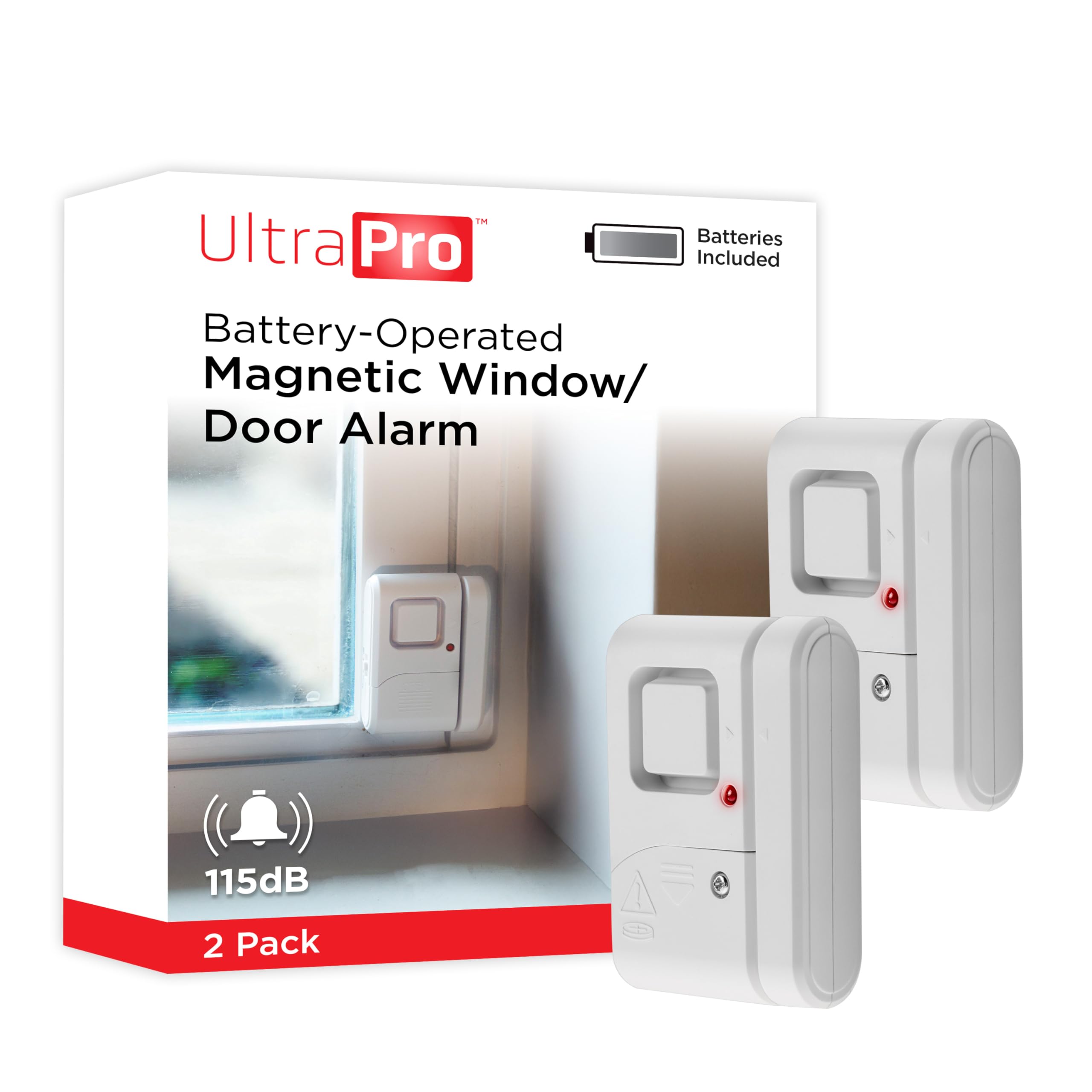
3. UltraPro Personal Security (2 Pack)
A 120 db siren in a package smaller than a deck of cards.
The UltraPro is the loudest of the standalone sensors on this list. It is capable of a 120 db siren that “is loud enough to alert everyone in the house if a door or window is opened,” as customers note. It is also the most compact at 2.3″L x 0.6″W x 2.3″H. That makes it just 0.6 inches wide, more than two inches thinner than the TECKNET. This tiny profile lets it fit on narrow window frames where bigger units won’t sit.
It runs on four included LR44 batteries. You have a choice between a chime and the full siren. The adhesive pads make installation a 30-second job, though the 0.5-inch alignment gap is tighter than the TECKNET’s 0.78 inches. The most discussed aspect among owners is volume, but it is a mixed note: the siren is genuinely painful up close, and some find it too aggressive for a simple window chime. You can just switch it to chime mode and avoid the blast.
It hits a balance: extreme volume in a tiny package, no hub, no fees. If you want a sensor that physically hurts to ignore, this is it.
The real-world trade-off: that bone-rattling 120 db siren will wake the whole house — perfect for security, but set it to chime mode if you just want a door alert.
Grab it for: ground-floor windows, garages, or any spot where a loud siren is a must.
Think twice if: you need a gentle alert — the chime is fine, but the siren is overwhelming.
4. WimuPath Window Alarm (Bulk 15 Pack)

A bulk pack of simple 92 db sensors ideal for institutional or senior care settings.
The WimuPath alarm is a straightforward magnetic sensor that hits 92 db — a middle-ground volume that is loud but not piercing. The real-world feedback is telling: one buyer installed these on windows in a memory care unit at a senior living facility and found them to work great as an additional security alert system. Another owner used them to alert dogs to open doors. The value here is the sheer quantity — you get 15 units for the price of two premium sensors.
The downsides are the common budget issues: the adhesive pads failed on a few units, requiring a separate glue, and the alarm requires 4 AAA batteries that are not included. The gap tolerance of 10 mm (about 0.39 inches) is the tightest on this list, so an uneven window frame may cause problems.
If you are equipping an entire floor of windows, a rental property, or a care facility, the low per-unit cost makes the trade-offs worth it.
Who it fits best: facility managers and caregivers who need a large number of functional, loud sensors at a very low per-unit cost.
Reach for it if: you are covering 10+ windows and need a simple, loud siren on a budget.
pass on it if: you need a tight fit on old, warped windows — the 10 mm gap is unforgiving.
5. METAK Window/Door Alarm (2 Pack + Remote)

A two-pack with a remote that arms and disarms from across the house.
The METAK alarm is the only pick here that includes a remote control — two of them, actually — with a 600-foot range. That means you can disarm the sensor from your bed without getting up. It also offers two volume settings: 90 db for a discreet chime and 120 db for the full deterrent siren. The installation uses strong 3M adhesive, so it sticks to most frames without drilling.
The loudness is the biggest win among owners — reviewers point out it is loud enough that a neighbor once heard it and thought it was a car alarm. The remote is easy to use and convenient for arming and disarming as you come and go. One review noted that the tape requires firm pressure to stay attached, and occasional false alarms can happen in windy conditions. It runs on 2 AAA batteries (not included).
If you want the convenience of a remote to turn sensors on and off without touching the device itself, the METAK is the clear winner in this list.
Why this stands out: the included remote is genuinely useful for downstairs doors and windows you want to disarm from the kitchen.
Grab it for: sliding doors and entry points where you want to arm or disarm without walking to the sensor.
6. Philips Personal Security (4 Pack)
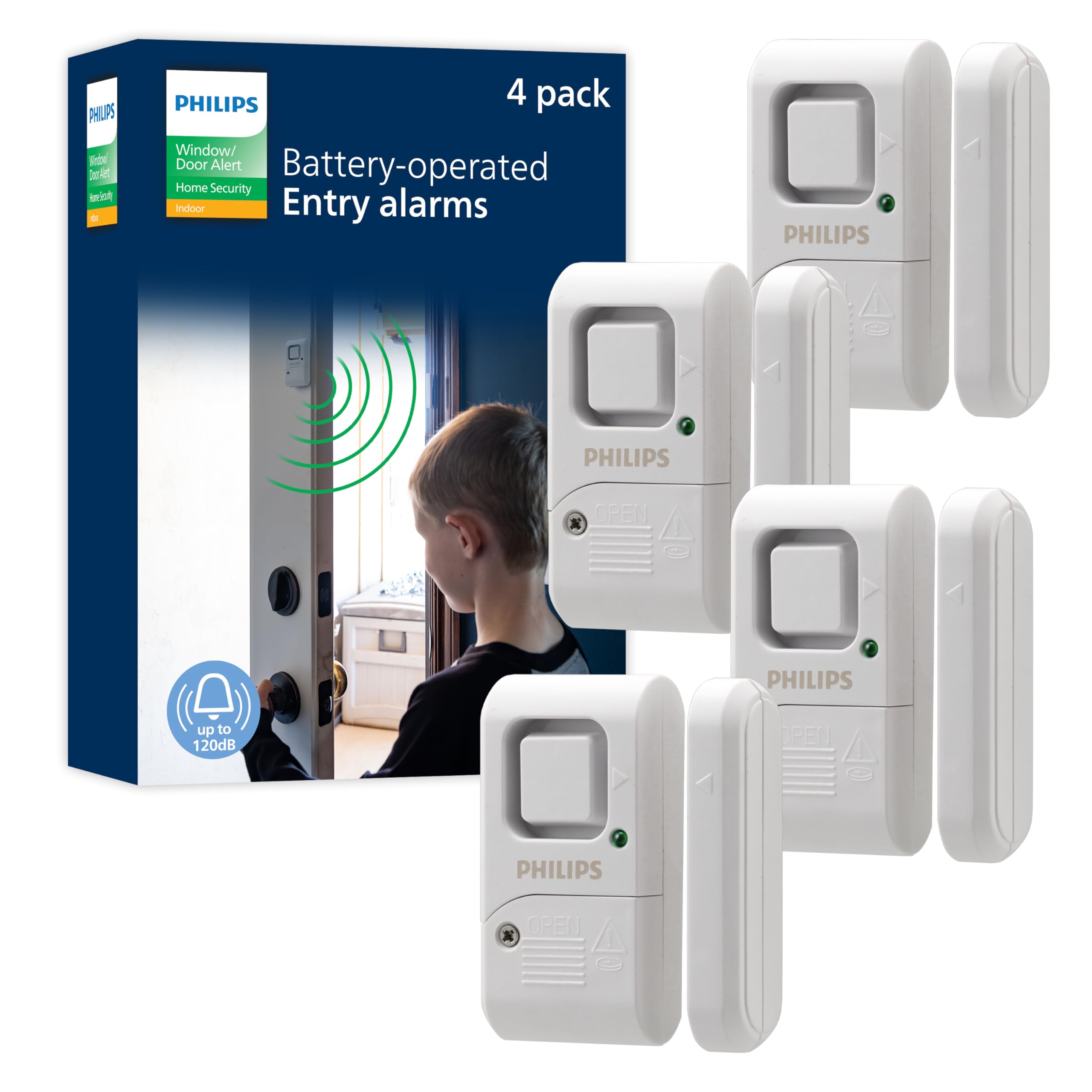
Four powerful 120 db alarms from a trusted brand, each with batteries included.
The Philips pack provides four sensors at a 120 db output — identical volume to the UltraPro, but with a larger, more sturdy housing. The installation is dead simple with the included double-sided tape, and each unit comes with its own set of four LR44 batteries, so you are ready to stick and go. The side switch gives you three modes: off, chime, and alarm.
What owners love most is the sheer loudness and the brand reliability. One buyer installed these for deaf parents with dementia and found the dinger “audible from across the house.” Another teacher uses them in a classroom to monitor door openings. The biggest complaint is that the adhesive tape is not the strongest; some shoppers say the sensor falls off over time. A common fix suggested by buyers is to use a stronger adhesive like Gorilla Glue putty.
At four units with batteries in the box, it is the most complete starter kit among the standalone sensors.
Best for family safety: the loud siren is ideal for dementia or child safety, and the 1-year warranty adds confidence.
Reach for it if: you want a reliable brand, a full four-pack, and batteries included.
it’s not for you if: you have tricky surfaces — the adhesive may need reinforcement.
7. Xuhal Window Alarm (24 Pack)

Twenty-four sensors for the price of two — the ultimate bulk option.
If you need to equip an entire building — every window, every door, every cabinet — the Xuhal 24-pack is your cheapest route. You get a 90 db alarm and a simple magnetic contact system with a 10 mm (about 0.39 inches) gap tolerance. The installation is the same peel-and-stick process, using 2 AAA batteries (not included).
The loudness is sufficient for a single room, but at 90 db it won’t match the 120 db screamers. The quality is the most-discussed aspect among owners, and it is a mixed bag: some find the build “cheap,” while others call it “great for the price point,” noting that it works well on doors, windows, cabinets, and drawers. The adhesive is reportedly fine, but alignment is critical — both halves must lay flat and match up closely, which is tough on warped frames.
This is the sensor you buy when you care about quantity over premium feel. For a single window or door, the TECKNET or UltraPro is better. For a 24-window storefront or workshop, the Xuhal is the obvious pick.
The honest take: you are getting basic function with no frills. Expect to reinforce the tape on some units.
Reach for it if: you need bulk coverage for a property with many windows.
look elsewhere if: you want a satisfying, solid feel and loud siren per unit.
8. SanJie Door Window Alarm (5 Pack)

Five sensors with adjustable 100 db and 125 db modes — the volume balance.
The SanJie pack gives you five sensors that you can set to either a 100 db chime or a 125 db siren. That flexibility is rare: you get a gentle alert for the front door and a window-rattling siren for the back windows, all from the same unit. The alarm sounds for 31 seconds and only stops when the door or window is closed. The battery life is rated at 13 months on 3 LR44 cells that are supplied.
One owner with an autistic child who wanders found these sensors to be “super effective” and gave the family confidence. The loudness is the most-discussed feature, but it is mixed: some find the volume perfect, while others report random false alarms. The installation is the standard peel-and-stick with 3M tape. The silver color blends with most window frames.
The SanJie is a strong middle ground if you want a volume dial rather than a fixed scream. The lifelong warranty from the manufacturer adds an unusual safety net.
The smart trick: use the 100 db chime for entry doors and the 125 db siren for vulnerable windows — all from one pack of five.
Grab it for: families wanting adjustable volume per opening without buying separate packs.
9. Rinetiy Window Alarm (8 Pack)

Eight powerful 120 db sensors that can be heard from 800 feet away.
The Rinetiy pack delivers the best per-loudness value on this list: eight sensors each capable of 120 db, rated as “audible at over 800 feet.” That is the longest range claim here. It uses the familiar AG13 (LR44) button cell batteries built into each alarm, and users can switch between a chime mode and an alarm mode.
The installation is peel-and-stick, with a note to keep the gap between the alarm and magnet within 0.4 inches — a slightly tighter tolerance than the TECKNET’s 0.78 inches. Owners praise the loudness and ease of installation. One reviewer noted that the adhesive is strong enough to hold, but repositioning a unit can break the plastic casing, so place it correctly the first time.
If you want to cover eight windows with maximum volume and zero monthly fees, this is the cheapest way to get there.
Best for multi-window properties: eight high-decibel alarms that cover every ground-floor opening while staying affordable.
Reach for it if: you need eight loud sensors at once — the per-unit cost is unbeatable for the 120 db output.
Understanding the Specs
Decibel (db) — How Loud is Loud?
The decibel scale is logarithmic, meaning 120 db is not just twice as loud as 60 db — it is roughly 16 times more intense. A 90 db sensor is about as loud as a lawnmower from close range; it will wake someone in the same room. A 120 db siren is as loud as a rock concert or a jet engine at 100 feet — it will wake the whole house and may cause discomfort if you are standing next to it. For a bedroom window, 90 db is enough. For a ground-floor entry point, 120 db is a serious deterrent.
Alignment Gap (mm / inches)
This is the distance the magnet and the sensor can move apart before the alarm triggers. A tighter gap (10 mm or 0.4 inches) means the two halves must be nearly touching — good for tight, modern frames, but bad for old, sagging windows where the gap can shift with temperature. A wider tolerance (0.78 inches) forgives a slightly warped frame. Always measure the gap between your window sash and the frame before buying.
FAQ
Do these sensors work with a smart-home hub like Alexa or Ring?
How do I install a peel-and-stick window sensor?
What batteries do these sensors need, and are they included?
Can I use these sensors on a sliding glass door?
How long does the battery last in these alarms?
What happens if the adhesive fails and the sensor falls off?
Are these sensors waterproof for outdoor use?
What is the difference between “alarm” mode and “chime” mode?
Can I arm or disarm these sensors remotely?
Final Thoughts: The Verdict
Across the board, the best alarm window sensors pick is the Ring Alarm Contact Sensor (2nd Gen) because it integrates flawlessly into a smart-home ecosystem and sends phone alerts with a 3-year battery life. If you want maximum siren volume at the lowest price per sensor, grab the UltraPro Personal Security (2 Pack). And for covering a whole house on a budget without sacrificing quality, the TECKNET 3-Pack is the one to reach for.
How We Picked
We do not accept paid placement. Every pick is matched to a real buyer and a real use-case; we do not hands-on test units.
Sources & Methodology
Specifications: manufacturer listings and product documentation. Review insights: verified customer reviews, as of July 2026. Pricing: not shown on this page (it changes often); check the current price via the retailer link.
As an Amazon Associate, Gadgets Feed earns from qualifying purchases. This does not affect which products we feature.