
If you maintain a lawn tractor, snowblower, generator, or RV, you know the ritual of lifting a full five-gallon gas can to chest height and hoping the stream hits the funnel. That balancing act strains your back, invites spills, and leaves gasoline fumes soaked into your clothes. A battery operated transfer pump eliminates the lift entirely: you place the intake in the supply can, aim the nozzle into the receiving tank, and press a button—the pump does the work while you stand upright.
I’m Min — the co-founder and writer behind Gadgets Feed. I spend my days comparing flow rates, battery options, and material specs across dozens of utility pumps to identify the designs that actually survive repeated use with gasoline and diesel. (And Homer 🐱 supervised from the garage shelf, one paw raised as if directing traffic around the hoses.)
These cordless, spill-resistant tools range from compact AA-powered models to units that run on high-capacity power tool batteries. Every pump in this roundup has been evaluated for flow speed, auto-stop reliability, adapter fit, and real-world build quality. This guide ranks the best options to help you choose the right battery operated transfer pump for your equipment and your back.
How To Choose The Best Battery Operated Transfer Pump
Not every pump that fits a gas can spout delivers the same experience. Some struggle to prime, others leave half a gallon at the bottom of the jug, and a few rely on adapters that rattle loose mid-stream. Understanding the specs below will help you pick a model that works consistently and lasts.
Flow Rate: How Fast Do You Want The Fuel To Move?
Flow rate is measured in gallons per minute (GPM). A 3.2 GPM pump empties a typical five-gallon can in about 94 seconds, while a 3.8 GPM unit cuts that to roughly 79 seconds. For most homeowners maintaining a small fleet of lawn tools, 3.2 GPM feels satisfyingly fast without causing splash-back at the nozzle opening. Premium models that accept 20V power tool batteries often hit 5 GPM, which fills a tractor tank in under a minute but demands a firm grip on the nozzle to avoid overshoot.
Power Source: AA Batteries vs. USB vs. Tool Batteries
The power delivery system dictates where and how long you can pump. Entry-level and mid-range units run on 4 AA batteries, which offer true portability but require periodic swaps if you move many gallons weekly. USB Type-C backup power—common on mid-range models—lets you plug into a power bank or car charger when the AAs run low, adding flexibility without extra bulk. At the high end, pumps that accept 18V or 20V power tool batteries deliver sustained high flow but add weight and raise the initial investment since batteries are sold separately.
Auto-Stop Sensor and Siphon Prevention
The auto-stop sensor is the difference between walking away while a pump runs and standing by with a rag. A good sensor cuts power the moment liquid reaches the nozzle tip, stopping the flow before any spill. Some pumps also eliminate the siphon effect, which otherwise lets fuel continue draining even after the pump shuts off if the supply can sits higher than the receiving tank. Patented siphon-break mechanisms allow air into the line so the flow stops instantly when the motor stops.
Adapter Compatibility and Hose Length
North American fuel cans use several neck sizes, so a pump that ships with four adapters (typically 2.0, 2.1, 2.75, and 3.75 inches) covers most standard jugs. A 51-inch discharge hose provides reach for awkward fill ports on tractors and boat tanks. Check whether the adapters require removing the can’s internal mesh filter—some pumps do, which is a one-time step that most users find acceptable.
Quick Comparison
On smaller screens, swipe sideways to see the full table.
| Model | Category | Best For | Key Spec | Amazon |
|---|---|---|---|---|
| Keimi 5 GPM (Bare Tool) | Premium Cordless | High-volume farm & tractor use | 5 GPM / Hand trigger nozzle / Dewalt & Milwaukee | Amazon |
| PETASOON Patented Pump | Mid-Range Smart | Spill-free operation with siphon break | 3.8 GPM / 10W motor / PP+EVA hose | Amazon |
| MISFANS 3.8 GPM | Mid-Range Fast | Quick fueling with USB backup | 3.8 GPM / Type-C backup / 51″ hose | Amazon |
| FEEDRON Auto-Stop | Mid-Range Reliable | Safety-focused with beeper alarm | 3.8 GPM / USB + AA / Beeper alarm | Amazon |
| Keimi 3.2 GPM | Mid-Range Compact | Compact travel-ready refueling | 3.2 GPM / Dual power / 51″ hose | Amazon |
| SKYJDM Portable Pump | Entry-Level All-in-One | Budget-friendly basic fueling | 3.2 GPM / 4 AA / 51″ hose | Amazon |
| FORDWALT Stick Pump | Water/Utility | Draining pools, barrels & flooded areas | 720 GPH / Brushless motor / 26 ft head | Amazon |
In‑Depth Reviews
1. Keimi 5 GPM Cordless Fuel Transfer Pump (Bare Tool)
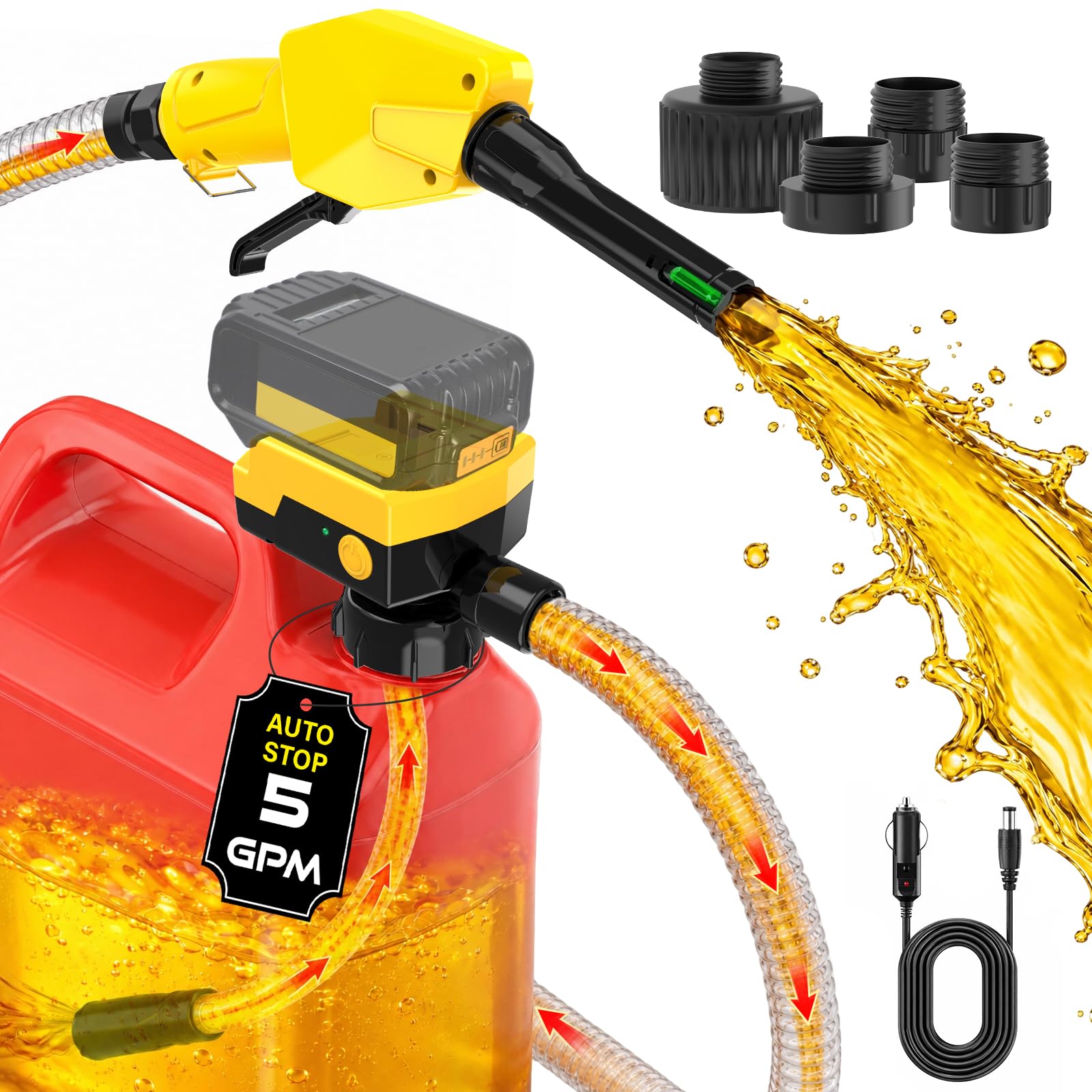
This is the fastest pump in the roundup by a wide margin. The Keimi 5 GPM model accepts DeWalt 20V and Milwaukee 18V batteries, turning a power tool battery into a fuel-moving workhorse. In tests, it transferred five gallons of diesel in roughly 90 seconds at full speed, and the hand trigger nozzle gives you precise control over the stream—useful when filling a tractor or generator tank without splash-back. The kit includes four adapters covering 2.0 to 3.75 inches, plus a 51-inch reinforced hose that reaches awkward fill ports on trucks and boats.
The auto-stop nozzle shuts off flow when the receiving tank is full, which works reliably in practice. A 12V cigarette lighter cable is included as a backup power source, so even if your power tool battery dies, you can draw from a vehicle. The pump body feels robust thanks to the ABS housing, though the included hoses have a flexible, lightweight feel that some users describe as less durable than the motor itself.
One caveat: this is a bare tool, meaning you must already own a DeWalt or Milwaukee battery and charger or buy them separately. The pump also leaves roughly half a gallon in the supply jug due to the pickup tube design—a common trait among high-flow models. For anyone already invested in a 20V or 18V platform who needs maximum speed, this is the clear choice.
Why it’s great
- Industry-leading 5 GPM flow reduces refuel time dramatically
- Accepts popular DeWalt 20V and Milwaukee 18V batteries
- Hand trigger nozzle gives manual flow control alongside auto-stop
- 12V cigarette lighter backup expands field use
Good to know
- Bare tool — batteries and charger not included
- Pickup tube leaves about 0.5 gallon residual in supply jug
- Hose material feels less premium than the pump motor
2. PETASOON Patented Fuel Transfer Pump
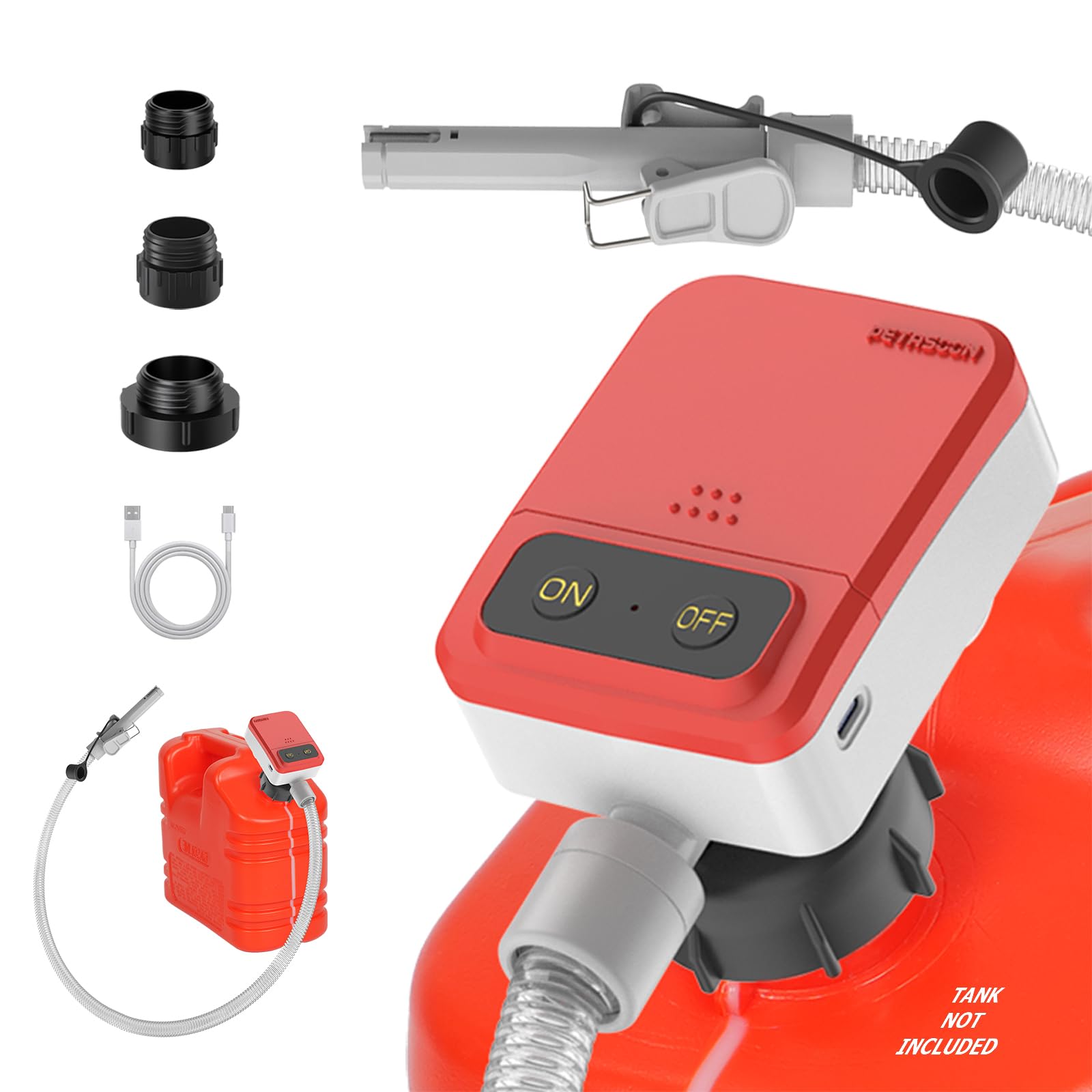
The PETASOON stands out because of its patented anti-siphon mechanism. On most pumps, if the supply can sits higher than the receiving tank, fuel continues flowing by gravity even after you turn the motor off—a frustrating and messy situation. PETASOON solves this by letting air enter the line, killing the siphon instantly. The auto-stop sensor has also been repositioned for better detection accuracy, and users report it triggers reliably before any overflow.
The 10W motor pushes up to 3.8 GPM via USB power, hitting about 79 seconds for a five-gallon can. The hose material is a PP+EVA composite that resists cracking at temperatures as low as -50°F, a meaningful upgrade for users in cold climates. Three power modes are available: 4 AA batteries for full-speed work, 2 AA batteries for slower emergency use, and USB Type-C for continuous power from a bank or adapter.
The stainless steel nozzle clamp holds securely to the receiving tank opening, and the redesigned hose clip includes an O-ring seal that prevents drips at the connection point. At just over one pound, it is light enough to carry anywhere. Some users note that the cap adapters feel slightly less substantial than the pump body, but the pump has held up well over months of repeated gasoline and diesel transfers.
Why it’s great
- Patented siphon-break stops flow instantly when motor is off
- Upgraded PP+EVA hose resists cracking at extreme cold
- Three power modes — 4 AA, 2 AA, or USB Type-C
- Lightweight design (1 lb) with stainless steel nozzle clamp
Good to know
- Adapter fit can be loose on some non-standard fuel cans
- Full 3.8 GPM requires USB power, not 2 AA batteries
3. MISFANS 3.8 GPM Fuel Transfer Pump
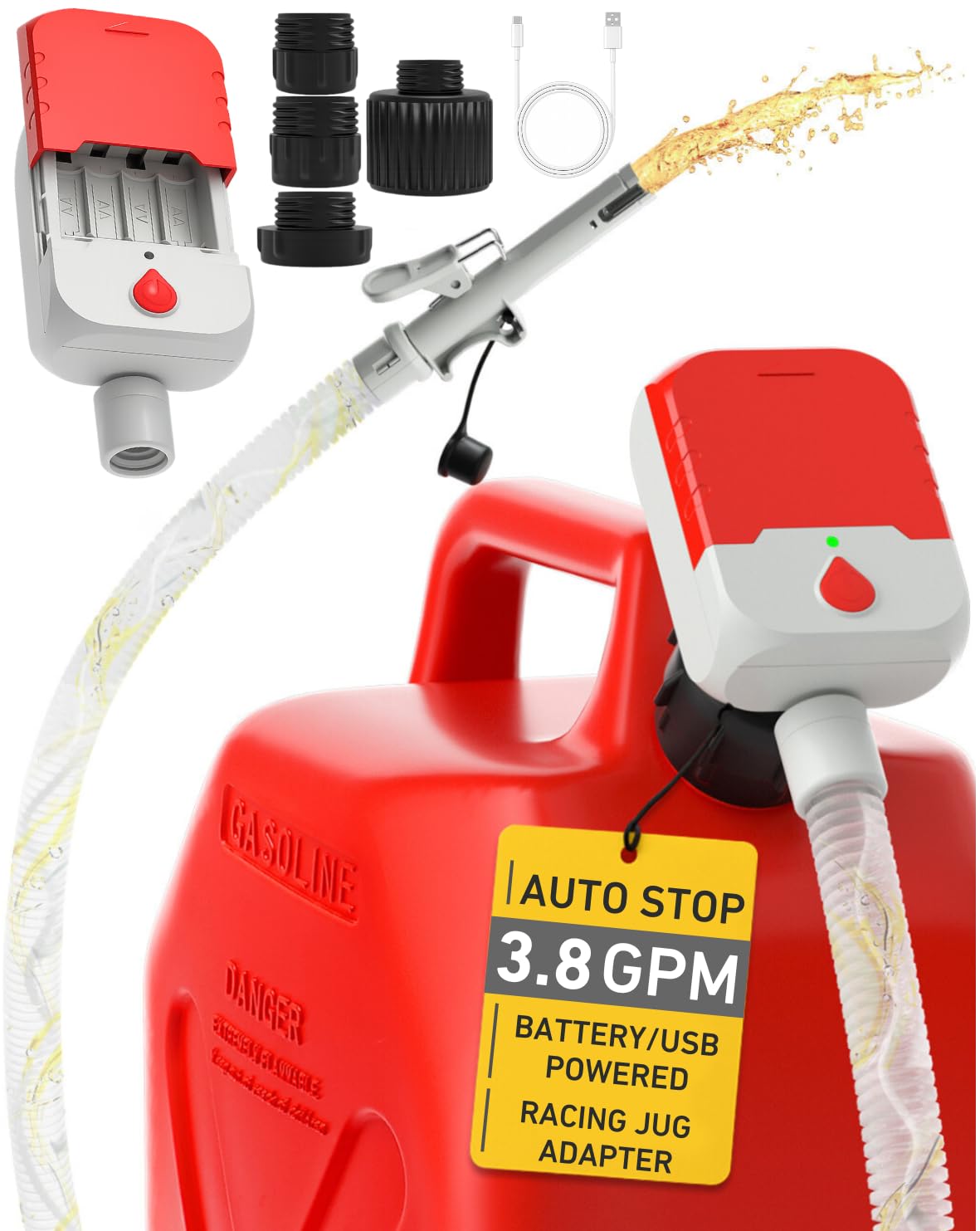
The MISFANS pump prioritizes speed with an upgraded motor that pushes 3.8 GPM—roughly 20 percent faster than the 3.2 GPM baseline. A five-gallon can empties in about 79 seconds on battery power, making it a solid pick for anyone who transfers fuel weekly and wants to minimize time spent standing at the tank. The transparent PE hose lets you verify flow visually, and the 51-inch discharge hose paired with a 19-inch intake hose covers most reach scenarios around tractors, ATVs, and boat fill ports.
The independent button design avoids the confusing multi-function switches found on some pumps: one press starts the flow, another press stops it. The auto-stop sensor uses a high-sensitivity tip that shuts down the motor the instant the nozzle contacts fuel. Users report the sensor works every time, though a small amount of fuel in the nozzle before detection is common across all auto-stop models.
Dual power comes from 4 AA batteries (recommended for daily use) or a USB Type-C connection to a power bank or car charger. The high-impact ABS shell has survived drops from tailgate height without cracking, and the included drawstring storage bag keeps everything organized. A few users reported that the USB charge function did not work on their unit, suggesting occasional quality variation at the charging port.
Why it’s great
- 3.8 GPM flow is 20% faster than standard 3.2 GPM pumps
- Simple one-button operation with clear on/off logic
- Transparent hose allows visual monitoring of fuel flow
- Includes drawstring bag and nozzle clip for clean storage
Good to know
- USB charging port quality varies between units
- Auto-stop sensor leaves a small fuel residue in nozzle tip
4. FEEDRON Automatic Fuel Transfer Pump

The FEEDRON adds an audible beeper alarm that sounds when the auto-stop sensor triggers, giving you a clear audio cue that the tank is full. This is particularly useful if you are working in a noisy environment like a garage with a running generator or a farm yard with tractor engines idling. The 3.8 GPM flow rate matches the faster mid-range pumps, and the soft rubber start/stop button is easy to operate with gloves on.
Dual power comes from 4 AA batteries or a USB Type-C port, with an LED indicator showing the current status. The 51-inch hose and four adapters (2.0, 2.1, 2.75, and 3.75 inches) cover standard North American fuel cans. The ABS shell and reinforced polyethylene hose feel sturdy, and the included drawstring bag makes toting the pump between vehicles straightforward.
Users consistently mention the pump’s ability to handle gasoline, diesel, kerosene, and DEF without issues. The beeper alarm was praised for preventing overfills during inattentive moments. One minor tradeoff: the nozzle clip that attaches to the gas cap ring can be finicky to position on certain cans, requiring a small adjustment before it clicks into place securely.
Why it’s great
- Audible beeper alarm sounds when auto-stop triggers
- Compatible with gasoline, diesel, kerosene, and DEF
- Soft rubber button easy to use with work gloves
- LED indicator shows pump and power status clearly
Good to know
- Nozzle positioning clip can be fiddly on some gas caps
- Batteries not included, and USB-C requires external adapter
5. Keimi 3.2 GPM Portable Fuel Transfer Pump
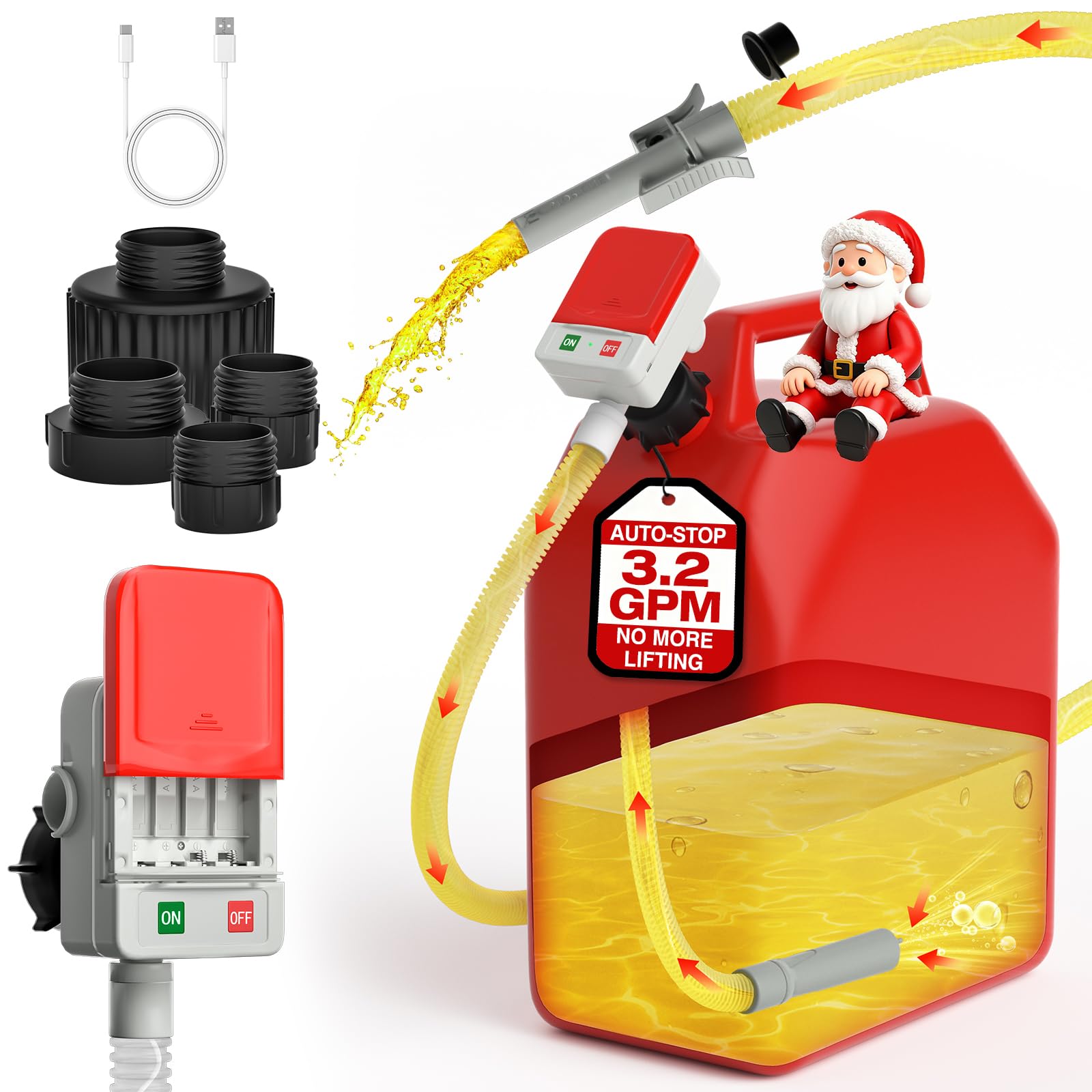
This Keimi model trades the top-end speed of its 5 GPM sibling for a more compact, dual-power-friendly design that fits easily into a travel bag. The 3.2 GPM flow rate empties a five-gallon can in about 94 seconds—fast enough for most residential tasks without the urgency that can lead to splashing. It uses 4 AA batteries as the primary power source and includes a USB Type-C cable for backup from a power bank, car charger, or wall adapter.
The kit includes the same four-adapter set (2.0, 2.1, 2.75, and 3.75 inches) and a 51-inch hose found on more expensive models. The auto-stop nozzle works consistently across gasoline, diesel, and kerosene, and users running the pump off a 12V power bank report no noticeable slowdown. The pump body is lightweight enough to keep in a truck toolbox or RV compartment without worrying about space.
Where this pump shines is simplicity. There are no complex switches or battery platform commitments; you grab it, drop in AAs or plug a USB cable, and start transferring. The primary limitation is that 3.2 GPM is noticeably slower than the 3.8 or 5 GPM options if you are refueling large tractor tanks or multiple pieces of equipment in one session. The hoses, while functional, feel less substantial than the upgraded materials on the PETASOON.
Why it’s great
- Compact, travel-ready design fits in truck bins and RV compartments
- USB Type-C backup power expands field flexibility
- Four adapters cover most standard North American fuel cans
- Simple operation with no complex switch modes
Good to know
- 3.2 GPM is slower than premium pumps for high-volume jobs
- Hose material is functional but not as durable as upgraded composites
6. SKYJDM Portable Fuel Transfer Pump

The SKYJDM is the entry-level workhorse that proves you do not need to spend heavily to eliminate manual lifting. Running on 4 AA batteries (2 AA works in emergencies but at reduced speed), it delivers 3.2 GPM—enough to drain a five-gallon can in a few minutes. The auto-stop sensor shuts off flow when the nozzle detects liquid, and users report it functions consistently, though the plastic nozzle clip feels less durable than metal-reinforced alternatives.
The 51-inch hose provides the same reach as pricier competitors, and the four included adapters (2.0, 2.1, 2.75, and 3.75 inches) fit typical fuel cans from Home Depot, Lowes, and Walmart. One notable limitation: the adapters do not work with Scepter SmartControl cans without modification. The pump body is entirely plastic, which keeps weight very low but means it cannot survive a drop from waist height onto concrete without potential damage.
Customer experiences highlight strong durability over a year of use with VP Racing fuel jugs, with one reviewer noting the pump still works after 12 months of regular lawn mower and snow blower refueling. The main tradeoff is the lack of a USB backup option—you are entirely dependent on AA batteries. For occasional users who want a simple, no-frills way to stop lifting gas cans, this pump hits the mark at a very accessible price point.
Why it’s great
- Lowest entry cost for a functional auto-stop fuel transfer pump
- Four adapters cover the majority of standard North American fuel cans
- Proven durability over a year of regular use reported by multiple users
- Reduces back strain without requiring platform-specific batteries
Good to know
- Not compatible with Scepter SmartControl gas cans without modification
- No USB backup power; completely dependent on AA batteries
- Fully plastic construction is less drop-resistant than ABS-shell models
7. FORDWALT Brushless Stick Water Transfer Pump
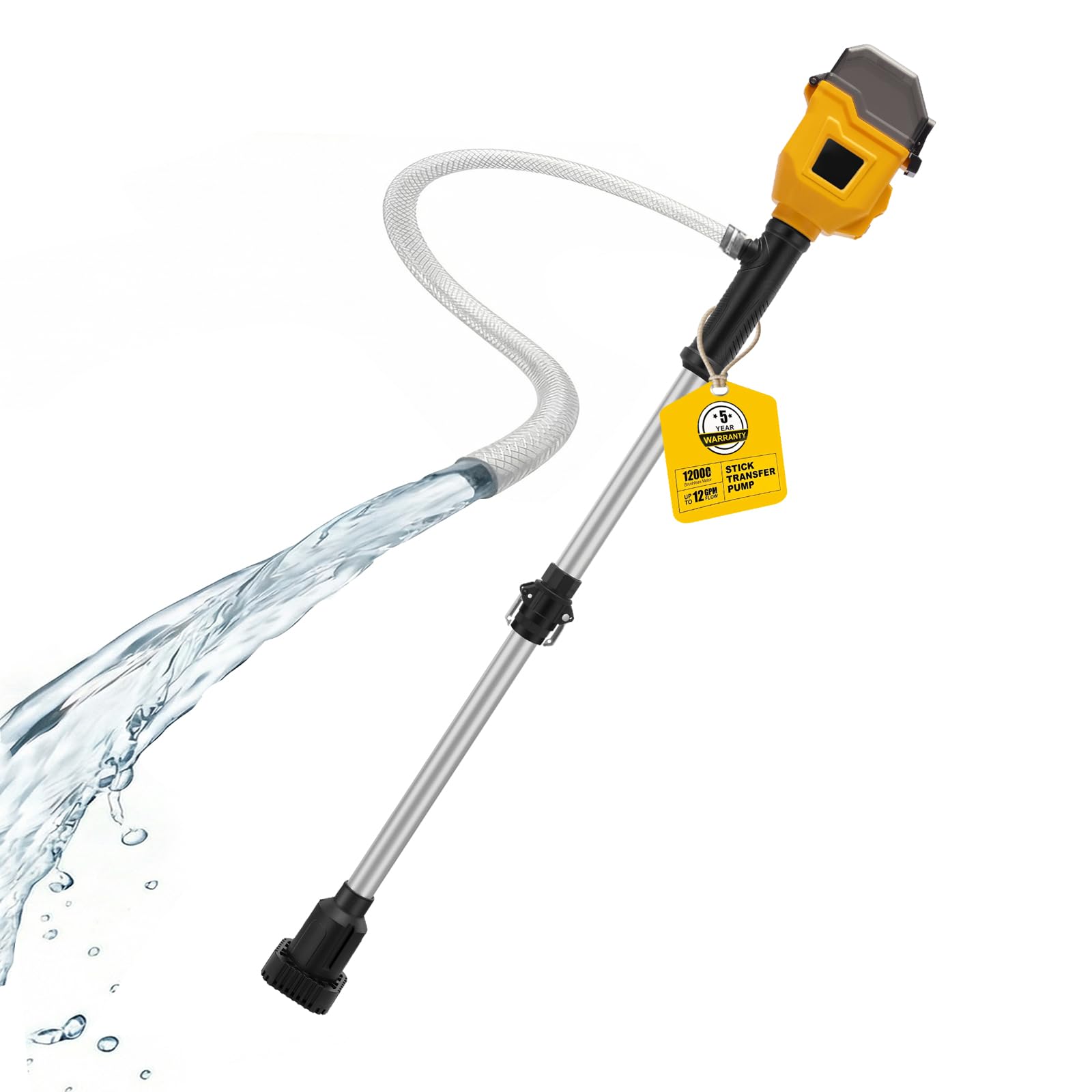
Note that this pump is designed for water transfer only—it is not intended for gasoline, diesel, or any flammable liquid. The FORDWALT stick pump connects to your existing Dewalt 20V battery platform and delivers up to 720 gallons per hour (12 GPM) through a brushless motor that runs at 12,000 RPM. The 36-inch submersible aluminum barrel reaches into rain barrels, flooded basements, inflatable pools, and duck ponds, and three-speed settings (720, 600, and 480 GPH) let you match flow to the task.
The 3/4-inch outlet connects directly to a standard garden hose, and the detachable sediment filter keeps debris from clogging the line. Users report draining a large inflatable pool that previously took over an hour down to 15 minutes. The brushless motor eliminates brush wear, and five smart protections (dry-run, low-voltage, overload, over-current, overheat) safeguard both the pump and your battery.
The pump weighs 2.65 kilograms (about 5.8 pounds) with the battery attached, making it heavier than fuel transfer pumps but still portable for carrying from a garage to a pool or pond. The one-piece internal wiring reduces failure points, and the 5-year warranty is the longest in this roundup. One quirk: the pump auto-switches off 10 seconds after the first power-on, requiring you to toggle it back on to run continuously—a minor annoyance until you learn the startup sequence.
Why it’s great
- Massive 720 GPH flow rate drains pools and barrels in minutes
- Brushless motor with 12,000 RPM delivers maintenance-free performance
- Three speed settings match flow to task requirements
- 5-year warranty is the best coverage of any pump listed
Good to know
- For water only — cannot be used with gasoline or diesel
- Auto-off feature 10 seconds after first power-up requires re-toggle
- Heavier than fuel transfer pumps at 5.8 lbs with battery
FAQ
Can I use a battery operated transfer pump for water as well as gasoline?
How long do 4 AA batteries last in a fuel transfer pump?
Final Thoughts: The Verdict
For most users, the battery operated transfer pump winner is the PETASOON Patented Pump because it combines a 3.8 GPM flow rate with a siphon-breaking mechanism that no other mid-range pump offers, plus three power modes for total flexibility. If you want the absolute fastest transfer speed and already own DeWalt or Milwaukee batteries, grab the Keimi 5 GPM. And for draining pools, flooded basements, and rain barrels without dragging extension cords across wet ground, the FORDWALT brushless stick pump is the only choice that belongs in that niche.