
Our readers keep the lights on and my morning glass full of iced black tea. As an Amazon Associate, I earn from qualifying purchases.
Specs are compiled from manufacturer listings and verified buyer reviews and can change over time — please confirm the key details on the product page before buying.
You want to see exactly which birds are visiting your feeder, without needing to sit at the window all day. The right camera-equipped birdhouse captures crisp video day and night, identifies species, and saves clips for sharing. The challenge is sorting through resolution claims, subscription catches, and build-quality promises — every model looks good in listing photos.
I’m Min — the founder and writer behind Gadgets Feed. This guide is built by comparing the manufacturers’ published specifications and the patterns across verified customer reviews, so you get each pick’s real strengths and trade-offs instead of marketing spin.
Your backyard can become a live nature channel with the right birdhouse with camera, and this guide breaks down the nine models that deliver on the promise — from solar-powered 2K workhorses to no-subscription 4K stunners — so you can pick the one that actually fits how you watch.
Our Picks at a Glance
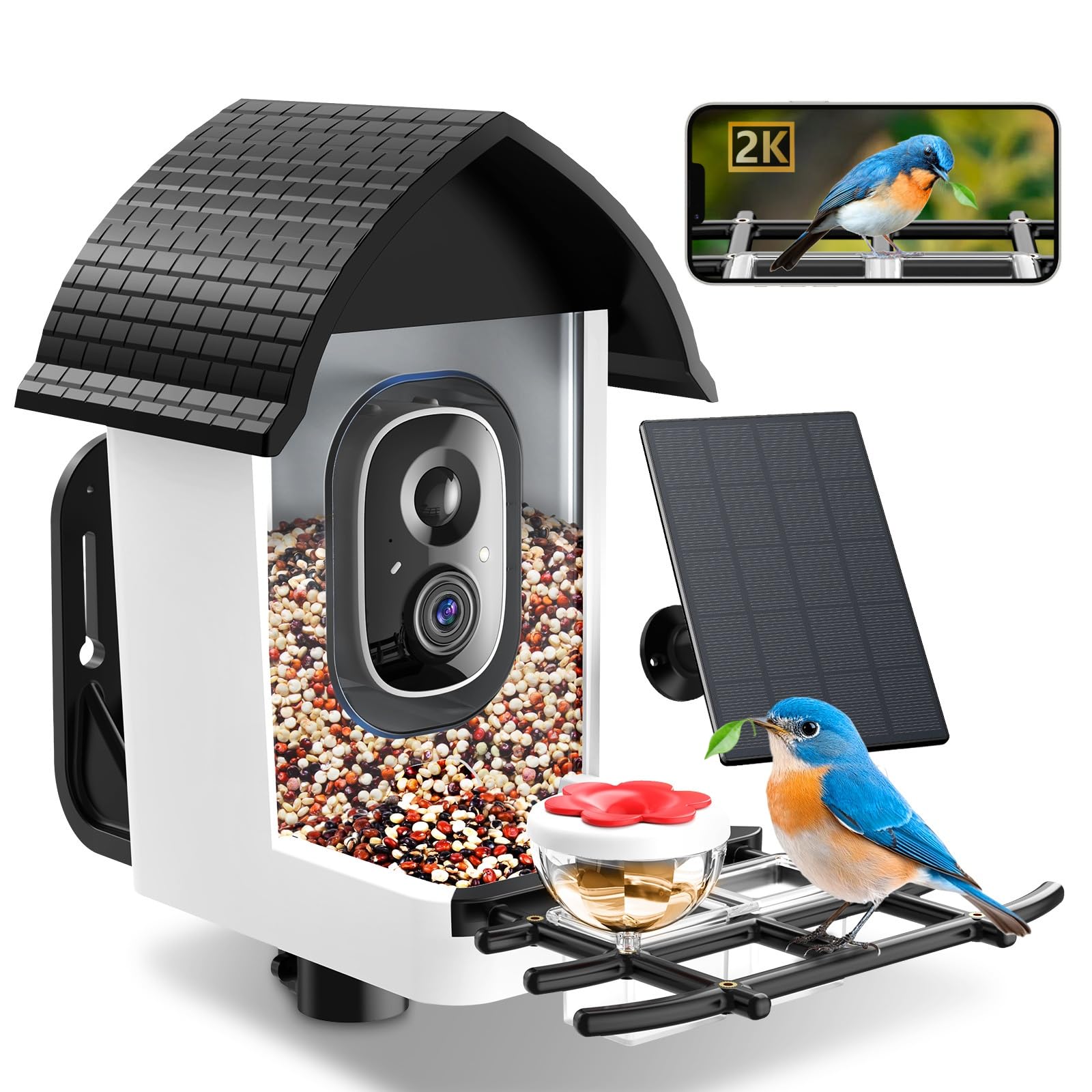
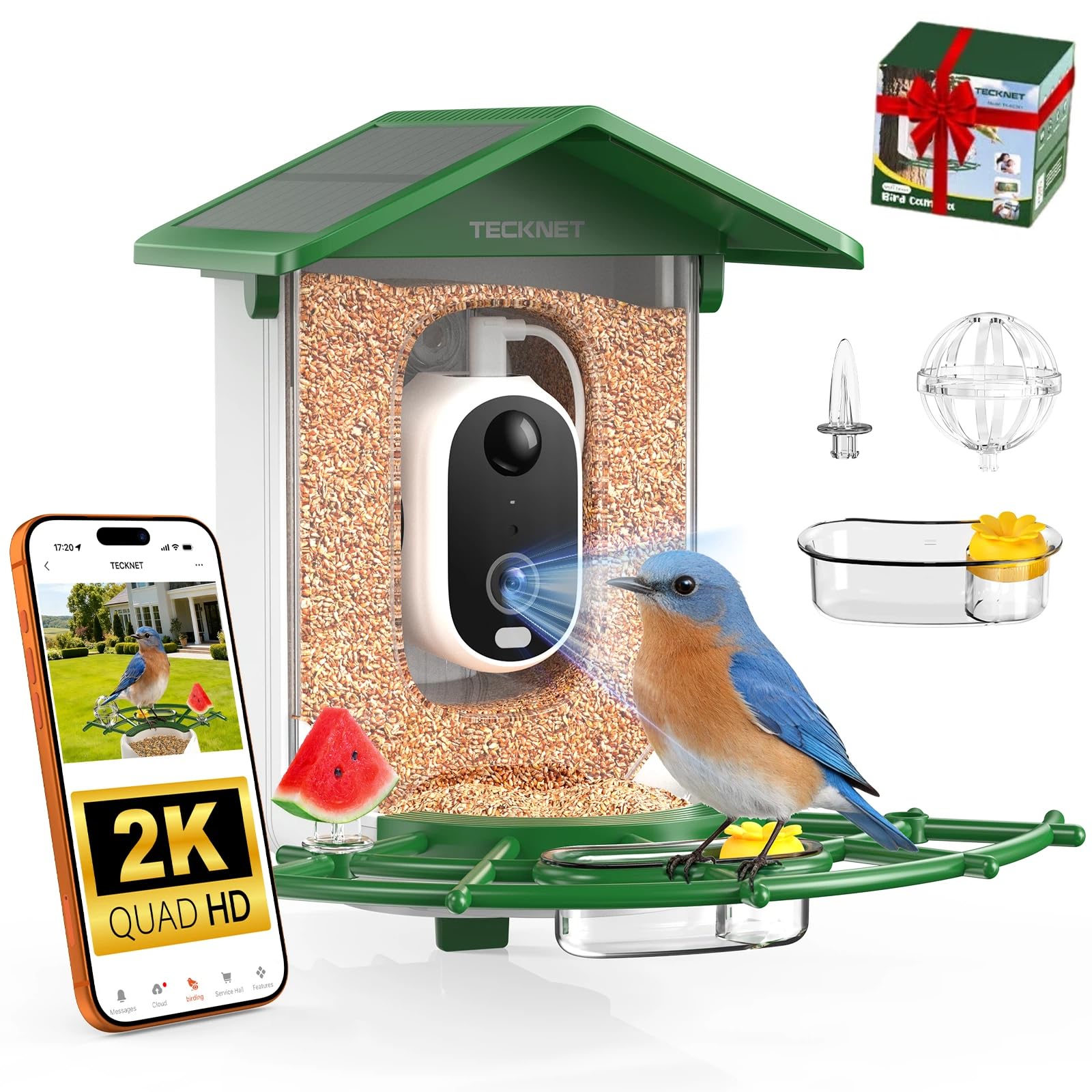
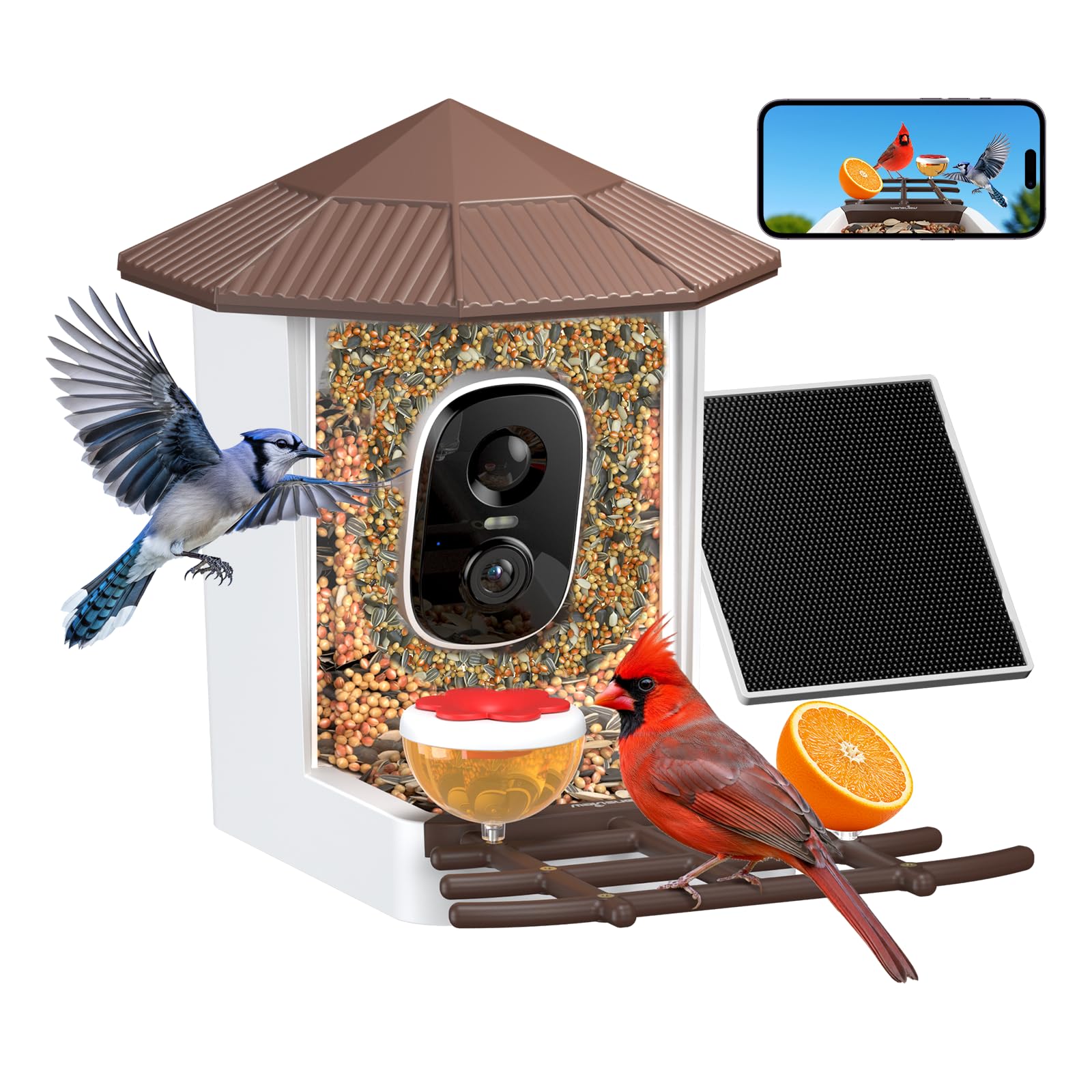
How To Choose The Best Birdhouse With Camera
Buying a camera-equipped feeder is different from a standard birdhouse. You are choosing a piece of outdoor smart-home tech that needs to survive rain, freezing nights, and direct sun while keeping a WiFi signal and a battery alive. Focus on a few key areas to get the most enjoyment without frustration.
Video Quality: Clarity Matters
The camera resolution decides whether you can tell a house finch from a purple finch at a glance — or just see a blurry blob. 2K (roughly 2560×1440) is the baseline for good detail these days, while 4K (3840×2160) captures individual feather textures and crisp images even when you zoom in. Resolution also affects how well the image holds up at night, so if you want to watch activity after dark, prioritize models with higher resolution and dedicated infrared or color night vision.
Power and Charging: Solar vs. Battery
Nobody wants to climb a ladder every few days to swap a battery. Most modern birdhouse cameras use a built-in rechargeable battery paired with a solar panel — typically a 2W to 3W panel and a battery between 5000mAh and 5200mAh. A larger battery capacity means the feeder can run longer during stretches of cloudy weather. If your mounting spot is shaded for much of the day, look for a model with a separate (adjustable) solar panel so you can place the panel in the sun while the feeder stays in the shade.
AI Bird Identification and Subscriptions
Automatic species identification is among the most fun features, but not every model handles it the same way. Some brands require a monthly or yearly subscription (around /month or /year) to open up AI species ID, cloud storage, or both. Others offer lifetime free AI ID and basic local storage on an SD card. Decide upfront if you want a one-time purchase or are comfortable with ongoing costs — the sticker price difference between subscription-free and subscription-dependent models can be surprisingly small when you add in a year or two of fees.
Build Material and Weatherproofing
Your chosen feeder will live outdoors through rain, snow, heat, and wind. Plastic (usually ABS or PC) is lightweight and affordable, but metal construction handles harsh weather and persistent squirrels far better over time. Look for an IP65 weatherproof rating as the minimum — anything less risks water damage in a heavy storm. The latch, roof overhang, and the camera seal itself are also common failure points worth checking in owner experiences.
Quick Comparison
| Model | Best For | Video Resolution | Battery (mAh) | Material | Amazon |
|---|---|---|---|---|---|
| Faddial Smart Feeder★ Best Overall | Budget-friendly starter | 2K | 5000 | Plastic | Amazon |
| TECKNET Smart FeederTop Performer | Large SD card support | 2K | 5200 | ABS | Amazon |
| wansview F1Quality Pick | Excellence in quality & setup | 2K | Built-in + solar panel | ABS + PC | Amazon |
| birdsnap APS Metal | Durable metal build | 2K | 5200 | Metal | Amazon |
| PeckCam Smart Feeder | Dual solar panels | 2K | Built-in + solar | ABS + PC | Amazon |
| NETVUE by Birdfy | Large community & no subscription | 1080p | Solar powered | ABS + PC | Amazon |
| Kiwibit 4K AI Camera | High-res 4K on a budget | 4K | 5200 | ABS + PC + Metal Mount | Amazon |
| Humbirdy SH66 | Best no-subscription 4K | 4K | Built-in + solar | Metal | Amazon |
| Kiwibit BW512 | Premium solar roof design | 4K | 5200 | ABS + PC | Amazon |
In‑Depth Reviews
1. Faddial Smart Bird Feeder with Camera
Our pick — over 4.5★ from 300+ verified ratings; the strongest balance of quality and price.
The complete package that starts your backyard smart-feeder journey without sticker shock.
This model wraps the essentials — 2K video, a 3W solar panel, and a 5000mAh battery — into an IP65 weatherproof shell that keeps running through heavy rain and snow without ever needing you to take it down for charging. The 5000mAh cell is only a touch smaller than the 5200mAh found in pricier competitors, yet it still powers year-round operation with the solar panel topping it off daily. The VicoHome app sends instant arrival alerts and identifies over 10,000 bird species using AI, and you get free rolling 3-day cloud storage with no monthly commitment for the first stretch.
Setup takes minutes via Bluetooth pairing with your 2.4GHz WiFi, and the mounting kit works on a wall, tree, or pole. The AI identification includes a 30-day free trial, which is long enough to decide if the subscription is worth it for you — and the feedback from owners is that the camera quality and solar reliability are the real highlights.
The honest trade-off here is the plastic build. It feels sturdy enough but won’t survive a direct impact from a falling branch the way a metal body would. Owners praise the quality (81 mentions) and ease of setup (58 mentions) above all else. Also, the 16oz capacity means slightly more frequent refills during peak season, but the clear video and reliable solar charging make that a minor chore.
Solar runner: The 5000mAh battery and 3W panel deliver non-stop power through all seasons — owners confirm it “keeps the battery fully charged” even in variable weather.
Mind the app: A few owners note the app has a minor learning curve, and the video defaults to SD until you adjust the settings; a quick tweak gets you full 2K quality.
Best for: Anyone wanting the most balanced mix of features, video quality, and price without over-committing to a premium budget.
Think twice if: You need a metal-bodied feeder for squirrel-war zones or prefer a no-subscription AI identification plan.
2. TECKNET Smart Bird Feeder with Camera
A weather-defying 2K feeder that survived typhoon winds and still streams crisp footage.
TECKNET comes loaded with a 3W solar panel and a 5200mAh battery (5200mAh versus the Faddial’s 5000mAh) so it holds a charge a bit longer during overcast stretches. What really separates it is the ability to accept a microSD card up to 256GB, which is double the 128GB limit of most competitors. That means significantly more stored footage before you need to offload clips. The 2K camera records in crisp detail, and the real-time alerts arrive with snapshots so you see who just landed without opening the app.
The AI identifies over 10,000 species after a 30-day free trial, and owners praise the easy assembly and durable ABS build. One reviewer even confirmed that this unit “survived typhoon winds in Hong Kong” without issue. The app also includes a tap-to-scare feature that triggers a siren or alarm sound to deter squirrels, which owners find genuinely useful.
The catch is that the companion app tends to push cloud subscriptions aggressively, though you can bypass this entirely by using a microSD card. Some owners also note the app is a shared framework with other devices and isn’t the most intuitive on first use. At 8.86 x 8.86 x 9.25 inches, it is more compact than the Faddial, which helps it fit on smaller branches or balconies.
Durability champ: The ABS plastic and rainproof, snow-resistant design have real-world proof — buyers report it works continuously through storms and extreme temperatures.
Smaller footprint: At 8.86 inches square, it fits in tighter spaces than most 9-inch-plus feeders, and the included accessories (suet ball holder, water trough, fruit fork) attract more species from day one.
Grab it for: Maximum local storage (256GB) and the confidence that comes from a feeder that weathers heavy storms without flinching.
Consider the competition if: App simplicity is your top priority — the shared platform takes a bit of patience to learn.
3. wansview F1 Bird Feeder with Camera
The setup speed champ that gets birds on camera within minutes — not hours.
Of all the models here, the wansview F1 earns the highest praise for its remarkably simple startup. Owners call out the easy setup (127 mentions) and overall quality (132 mentions) more than any other aspects, and the voice-prompted barcode pairing system is a standout. Once set up, the 2K camera with a 135-degree wide-angle lens and two LED lights delivers vibrant color night vision — so you see a blue jay’s true colors even at midnight, not just a grayscale silhouette.
The IP65 weatherproof body and included accessories (jelly box, suet feeder, honey feeder) cover a broader range of attractants than most competitors. The solar panel keeps things charged with just an hour of sun per day, and the battery backup provides roughly a week of runtime during cloudy spells. The app offers a siren function and two-way talk, both of which owners actually use to manage squirrels and raccoons. The 3.7-pound weight makes it one of the lighter metal-and-plastic hybrids.
The primary limitation is that without an SD card, the unit only captures still photos on motion alerts — video recording requires a card (up to 128GB, not included). Some advanced features like cloud storage and the squirrel-defense mode also require a subscription. Owners love the overall quality and camera clarity, but note that the AI bird plan subscription is necessary to open up species facts.
Bright at night: The color night vision mode uses two LED lights to preserve feather hues in the dark — a rare find at this price tier.
Subscription reality: AI bird identification and cloud storage require the wansview AI Bird Plan subscription; the siren and two-way talk are free.
Reach for this if: You value a straightforward, voice-guided setup and want accurate color night vision to watch nocturnal visitors.
Look elsewhere if: You are unwilling to pay for a subscription to open up the full AI species identification experience.
4. birdsnap APS Metal Bird Feeder with Camera
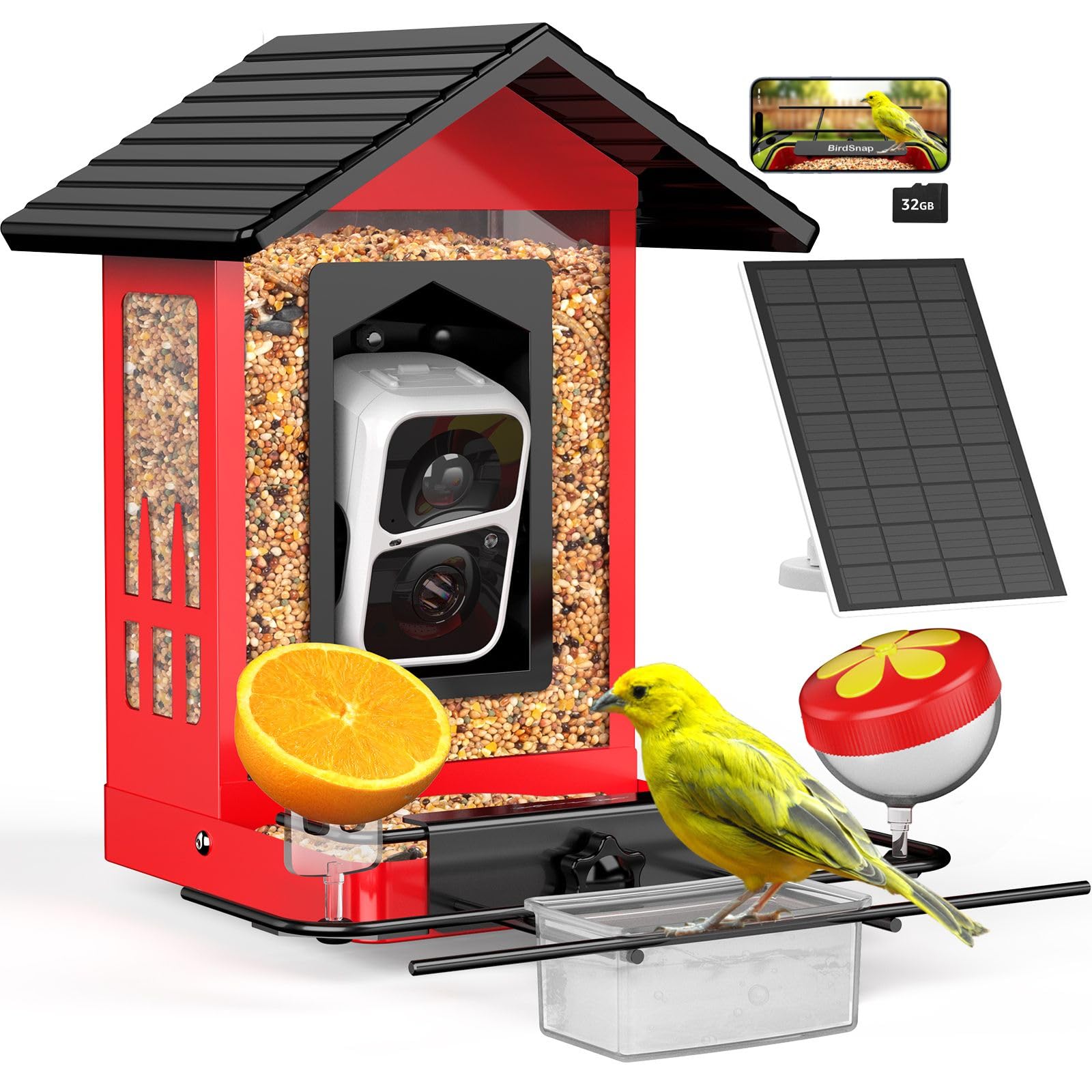
The metal tank that comes with a 32GB card right in the box — no separate purchase needed.
This is the only model in this lineup that includes a memory card out of the gate. The 32GB card stores over 20,000 ten-second clips, and the metal casing gives you the kind of durability that plastic bodies simply cannot match. If a branch falls or a squirrel decides to test the latch, the birdsnap holds up. The 2K camera with a 160-degree ultra-wide lens captures a noticeably broader field of view than the 132-to-135-degree lenses on other models, meaning you see birds approaching from the side, not just when they are already on the perch.
The 5200mAh battery matches the TECKNET’s capacity but pairs with an adjustable solar panel that you can tilt toward the sun as the seasons change — a practical detail owners appreciate for maintaining charge during short winter days. The 5dB external antenna improves WiFi signal stability, and the VicoHome app integrates with other cameras you may already own. The feeder supports up to four users sharing the same feed, making it easy for family members to check in from different phones. At 4.2 pounds, it is the heaviest of the 2K models, a trade-off for the solid metal construction.
Owners mention it survived a harsh winter without any degradation, and the separate solar panel (not built into the roof) means you can mount the feeder in a shaded spot while the panel sits in full sun — a huge advantage for covered patios. The only downside is that the AI species identification and cloud storage still require a subscription after a trial; the included SD card handles local recording natively.
Why owners love it
- Included 32GB memory card saves you an extra purchase — stores 20,000+ clips
- 160-degree ultra-wide lens captures the widest feeding area of any 2K feeder here
- Adjustable solar panel lets you chase the sun for optimal charging year-round
The honest trade-offs
- Some units shipped without the roof hanger for hanging mounts (check contents)
- Paid bird ID and cloud history subscription needed for full smart features
Who this suits: Buyers who want a metal body, widest camera angle, and the convenience of storage included in the box.
Pass it up if: A built-in solar panel (rather than a separate one) fits your setup better, or you want subscription-free AI ID.
5. PeckCam Smart Bird Feeder with Camera
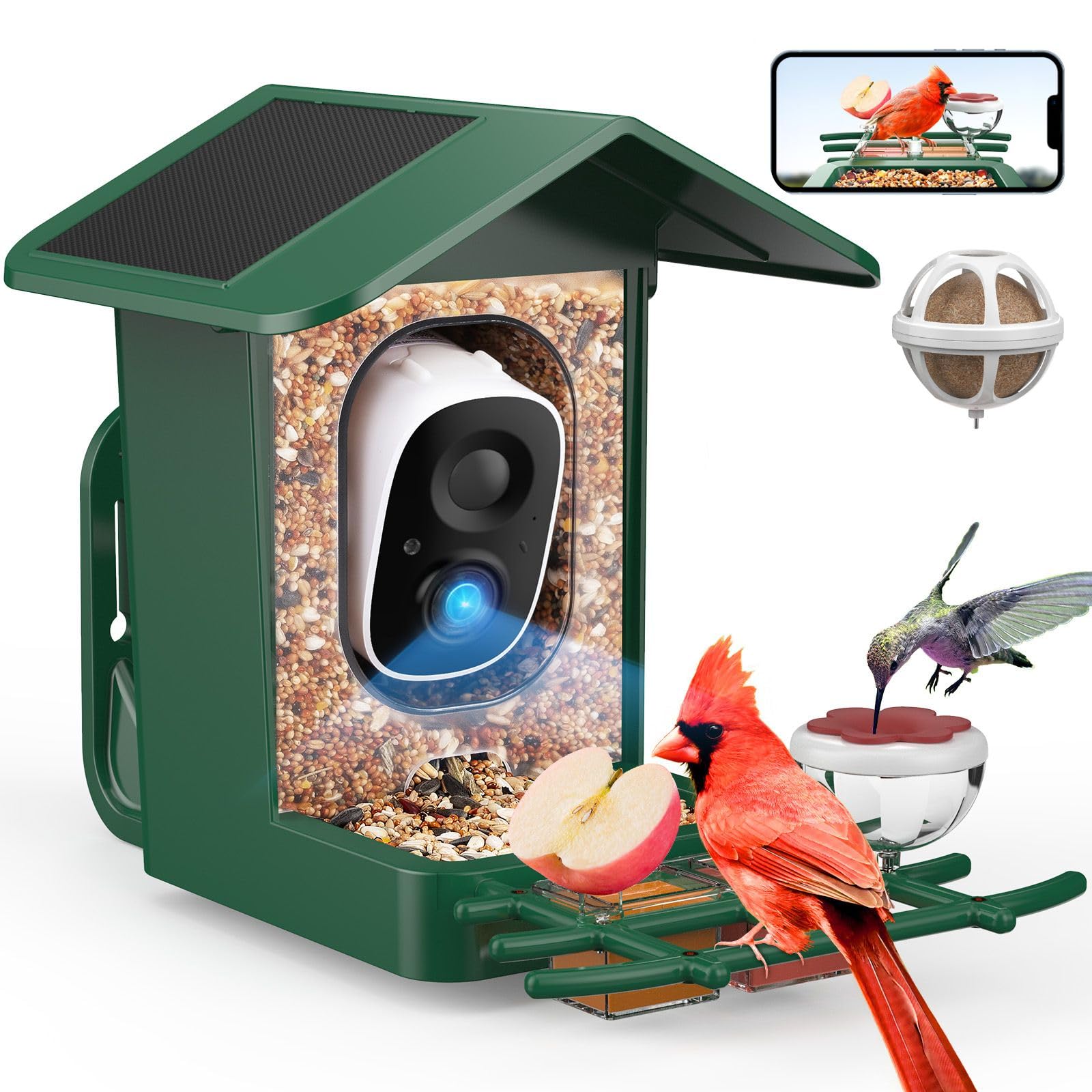
Two solar panels and a built-in siren give this mid-priced feeder a surprising edge.
While most birdhouse cameras use a single solar panel, the PeckCam packs dual 2W panels into the roof — doubling the surface area for catching sunlight. In practice, this means the feeder stays topped up even in partially shaded yards, and the battery drains more slowly during overcast days. The 2K camera includes full-color night vision and sends instant alerts via the VicoHome app, which supports up to four users watching simultaneously. The 3.5-pound weight keeps it light enough for pole or tree mounting without extra support.
The feeder ships with a full set of DIY add-ons: a suet ball holder, honey feeder, fruit fork, and water feeder. That variety attracts hummingbirds, orioles, and woodpeckers — not just seed-eaters. Owners praise the clear picture quality and the easy assembly, and many mention the dual panels eliminated their charging concerns entirely. The siren function works well for scaring off squirrels without harming them.
The biggest sticking point is the subscription. While the basic live view and alerts are free, full AI species identification requires a /month subscription, which some owners find frustrating given the purchase price. The bird identification feature itself gets mixed owner feedback — plenty of correct IDs, but a notable number of missed detections. Also, the kit’s solar panels work best in direct sun; deep shade will still drain the battery over several days.
Dual-panel advantage: Two 2W solar panels capture more light in variable conditions than any single-panel model at this price level, reducing manual charging frequency.
Subscription surprise: The price is competitive, but the ongoing monthly cost for AI ID catches some buyers off guard — factor it into your long-term budget.
Ideal for: Birders with partially shaded yards who want the best solar capture and a wide variety of attractant options.
Not ideal if: You want free, lifetime AI bird identification — the subscription is mandatory for that feature.
6. NETVUE by Birdfy Smart Bird Feeder

The feeder that built a community of 650,000+ owners — and never asks for a subscription fee.
NETVUE takes a different approach than most: lifetime free AI bird species identification with no monthly bill. While most competitors push a paid subscription after a free trial, this feeder identifies birds and saves 3 months of cloud clips at no extra cost. The trade-off is a 1080p camera instead of 2K or 4K, which means slightly less sharp detail on distant birds, but for feeders placed within 6 to 10 feet of a window, the clarity is still excellent. The 5dBi wireless antenna provides better range than many built-in antennas, keeping the connection stable even in larger yards.
The Birdfy app automatically generates recap highlight videos, and the shared community (over 650,000 users) makes it easy to compare sightings and tips. The solar panel keeps the battery charged reliably, as owners confirm, and the mounting system works with third-party poles and baffles. The design is taller at 11 inches, giving a more traditional birdhouse silhouette that looks at home in any garden.
Honest negatives: the AI misidentifies some species — customers note it struggles with less common birds and occasionally mislabels visitors. Also, the roof lacks a sufficient overhang, so seed in the tray can get waterlogged during rain. A few owners warn the WiFi signal is weaker than expected even at moderate distances. For a premium-priced unit, the lack of 2K or 4K resolution is the most common reason buyers look elsewhere.
What keeps it popular
- Lifetime free AI bird ID — no monthly subscription, ever
- Free 3-month cloud storage for all video clips
- Very large user community (650k+) for sharing and support
Where it falls short
- 1080p resolution is behind the 2K/4K competition in sharpness
- Roof overhang is too small — rain can reach the feeding tray
- AI identification accuracy is mixed, especially with rare species
Verdict: The subscription-free model that works perfectly for close-range birders who prioritize no recurring costs over maximum resolution.
Think twice if: You need 2K or 4K detail for identifying smaller birds at a distance, or your feeder is exposed to heavy diagonal rain.
7. Kiwibit 4K AI Camera Bird Feeder
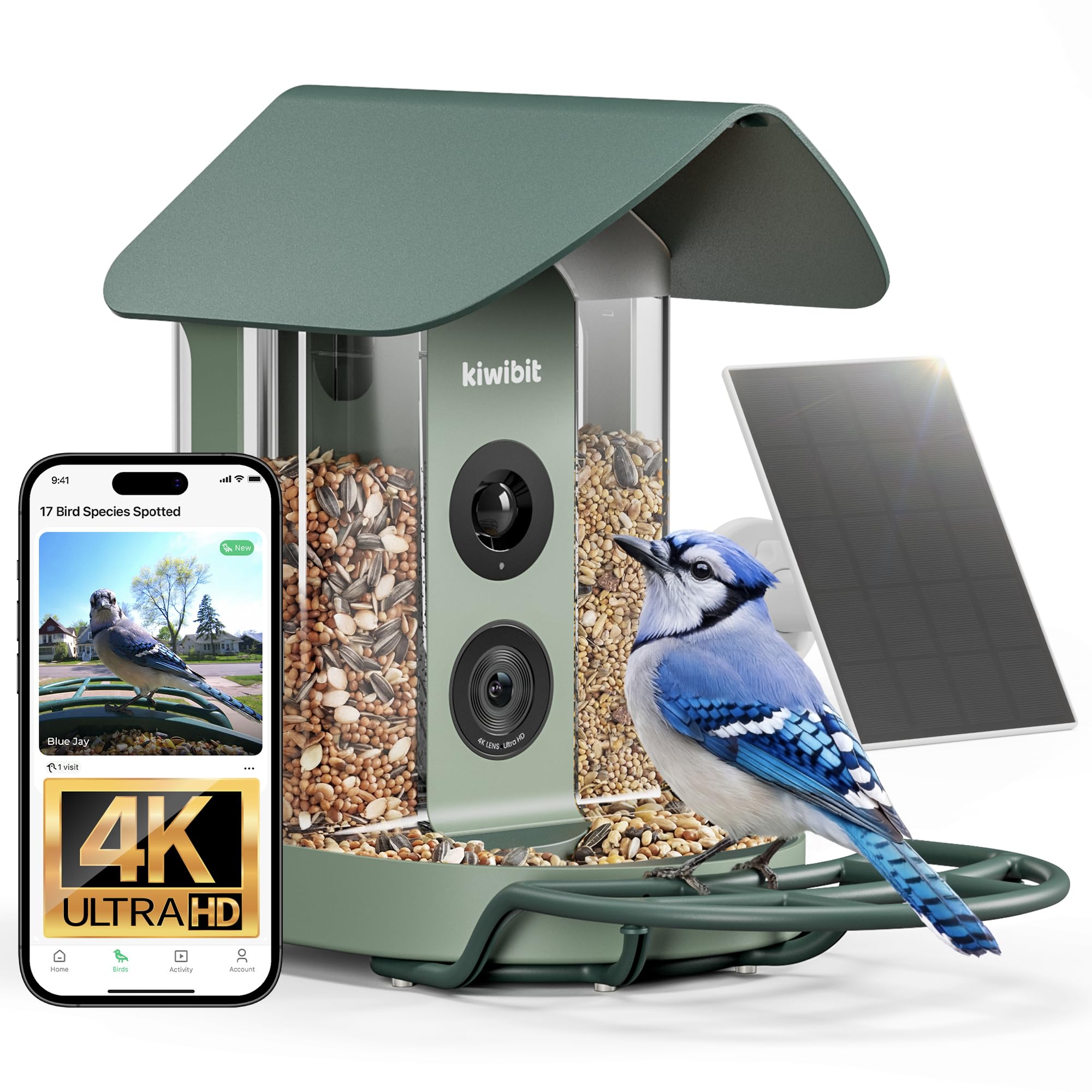
A 4K lens and modular design that beats feeders costing twice as much on resolution alone.
Stepping up to 4K makes a real difference. The Kiwibit captures 4K video and 8MP photos through a 132-degree lens with HDR and enhanced night vision, so you get crisp, detailed footage even in low light. The 5200mAh battery matches the top capacity available, and the 3W adjustable solar panel can be tilted to follow the sun. The feeder uses a 1.5-liter dual-compartment hopper that reduces refilling frequency and makes cleaning simpler — you detach the hopper and rinse it out without touching the camera. The build quality earns high marks (114 mentions) and ease of setup (87 mentions) from owners.
A standout design detail: the body acts as a modular platform. You can add an optional hummingbird kit or a squirrel-proof baffle from Kiwibit without replacing the whole unit. The app supports streaming to up to three users simultaneously and sharing playback with up to 20 family members. The AI identifies over 10,000 species, and a 30-day free trial of Kiwibit Plus gives you time to test the full feature set before deciding on a subscription.
Battery life is the most mixed aspect — reviewers point out decent longevity with solar assist, but heavy alert activity drains it faster than expected. Also, no SD card is included (support up to 512GB), and the cloud storage starts at a free 1-day rolling history, which may be too short for casual check-ins. Some owners also wish the sensitivity trigger was adjustable to cut down on false alerts from blowing leaves.
4K at a mid-range price: This is the most affordable way to get true 4K resolution in a smart feeder designed for easy maintenance with a detachable seed hopper.
Battery watch: Owners rate the battery life as mixed (47 mentions) — expect to charge sparingly with solar but more often during long overcast stretches.
Reach for this if: 4K video clarity is your priority and you want a feeder that can grow with add-on accessories without needing a full replacement.
Consider alternatives if: Budget battery life is a deal-breaker, or you want full app features without a subscription trial.
8. Humbirdy SH66 Bird Feeder with Camera
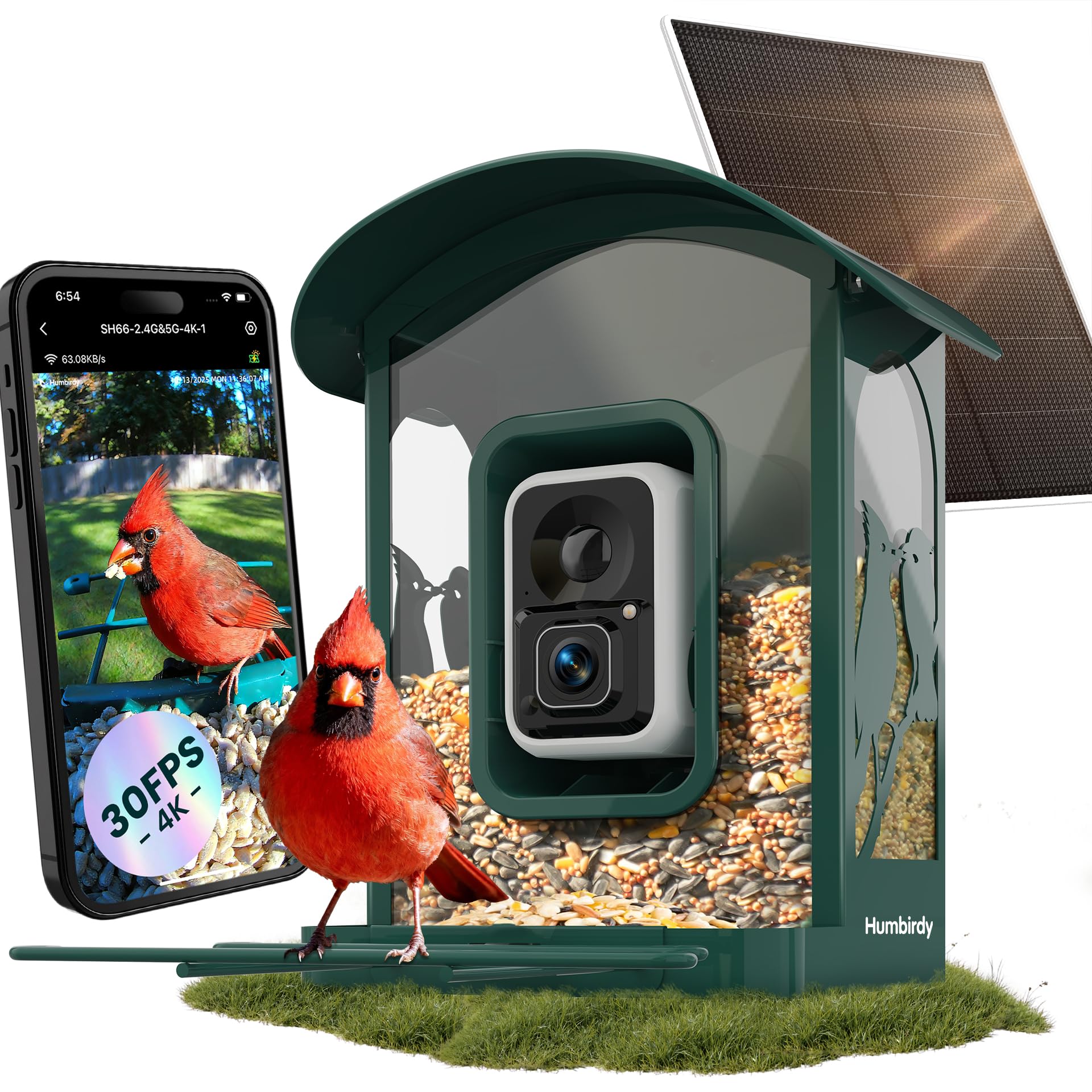
True 4K, slow-motion playback, and zero subscription fees — the sharpest trade-off in the list.
The Humbirdy SH66 is the only model here that combines true 4K resolution at 30fps with 1080p slow-motion capture at 120fps, letting you replay a hummingbird’s wingbeats in detail. The 8MP HDR photos are crisp enough to identify birds by subtle feather patterns, and the all-metal construction (IP66-rated) means it survives extreme conditions — one owner ran it through a -20°F Alaskan winter with no issues. The dual-band WiFi works on both 2.4GHz and 5GHz, a rare flexibility that avoids the 2.4GHz-only limitation of virtually every other feeder here.
There are no subscription costs. The AI bird identification (10,000+ species) is free for life, and the built-in 32GB storage saves footage locally without needing a cloud plan or a separate SD card purchase. The detachable wireless camera lifts out for easy indoor charging and cleaning, while the feeder body stays mounted. The M-Guard design keeps birds outside the seed container, preventing them from getting trapped inside. The triple-sensor system filters out false alerts from wind and branches, so you only get notifications when an actual bird arrives.
The main compromises: the 32GB internal storage fills up quickly with high-traffic feeders — there is no microSD slot to expand it. The field of view is narrower than some competitors, so birds feeding at the edges of the tray may not appear in the frame. A small number of owners also report the solar panel struggles to maintain full charge during long periods of heavy overcast skies.
Slow-motion standout: This is the only feeder in the entire guide that records 1080p 120fps video, turning rapid feeding moments into slo-mo clips you can edit and share.
Internal storage limit: The 32GB is generous for a built-in, but with no expansion slot, frequent birders may need to offload clips every few days during peak season.
Best for: Birders who want top-tier video quality, durable metal construction, and hate recurring subscription fees with a passion.
skip it if: You need expandable storage for weeks of unattended recording or expect the widest possible camera angle.
9. Kiwibit BW512 Solar Smart Bird Feeder
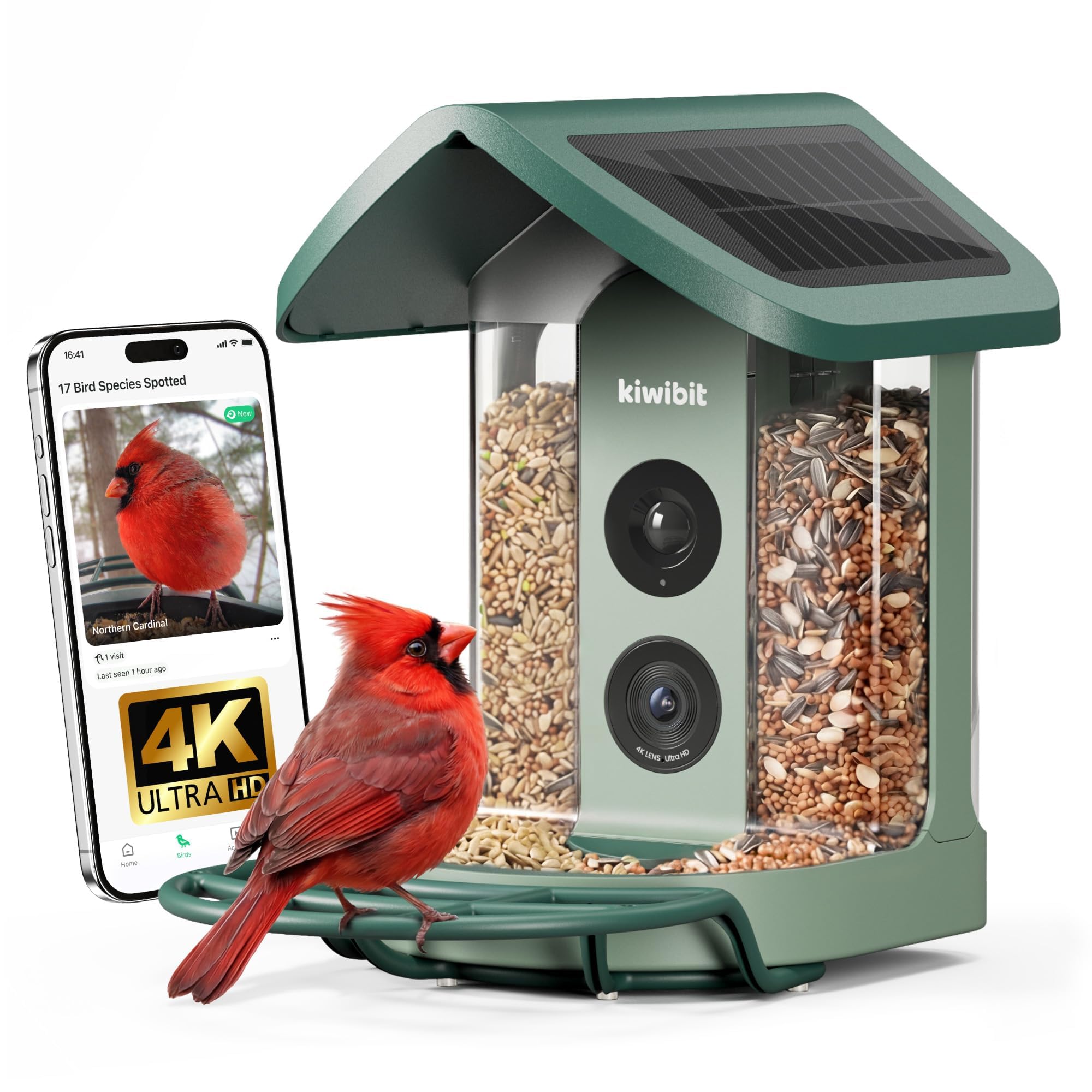
The integrated solar roof and removable battery make this the most turnkey premium feeder.
Kiwibit’s flagship model integrates the solar panel directly into the roof — no separate panel to mount and aim. The dual solar panels and 5200mAh battery work together to keep the feeder running with minimal maintenance, and the battery module is removable so you can swap a fresh one in seconds without taking the whole thing down. The 4K camera with a 132-degree wide-angle lens and 8MP HDR photos delivers the same sharpness as the Kiwibit 4K above, so owners consistently praise the video quality (80 mentions) and overall quality (88 mentions).
The dual-compartment 1.5-liter seed hopper is the most thoughtful design on this list: you can fill each side with a different seed type, attracting both finches and cardinals simultaneously. The detachable hopper and tray rinse easily under a tap, and the IP65 build handles rain, snow, and sun without issue. Up to 20 family members can access the live feed, and you can stream the camera through Alexa to your TV with bird song audio — a feature owners specifically call out as the highlight of their setup. The Perch Extender accommodates larger birds, and the 6.3-pound weight gives it the most substantial feel of any feeder here.
The downsides are real: the hard plastic construction is sturdy but not as dent-proof as the all-metal Humbirdy. Battery life under heavy bird traffic (hundreds of clips per day) drops to 2 to 4 days rather than the two weeks some owners expected, and the 1.5-liter hopper still needs refilling once or twice daily when multiple species visit. The AI species detection, while generally praised, still makes errors with less common birds, and the AI features require a Kiwibit Premium subscription after the 30-day trial.
Why it stands out
- Integrated solar roof design looks cleaner and eliminates an extra mounting step
- Removable battery module allows instant swaps without unmounting the feeder
- Dual-compartment hopper lets you offer two seed blends simultaneously
Honest caveats
- Battery life can drop to 2-4 days with heavy visitor traffic despite the sizable 5200mAh cell
- Premium subscription needed for full AI features after the free trial expires
Who this fits: Buyers who want the most refined, all-in-one design with a built-in solar roof, removable battery, and multi-family sharing.
Who should pass: Anyone wanting metal construction, unlimited battery endurance, or AI identification without a recurring subscription.
Understanding the Specs
Video Resolution: 2K vs 4K
This is the single biggest differentiator in how much feather detail you can see, especially when you zoom into a photo later. 2K (roughly 2560×1440 pixels) is a solid baseline — it captures enough detail to identify most common garden birds. 4K (3840×2160 pixels) has nearly twice the horizontal resolution, which means you can clearly see individual barbs on a wing feather or read a subtle color gradient on a warbler’s chest. At night, higher resolution paired with infrared or color LEDs makes the difference between a recognizable bird and a grainy shadow. If you have a smartphone with a 1080p screen, you can still see the improvement from 4K footage because the extra pixels give better zoom-in ability and less pixelation on tricky patterns.
Battery Capacity and Solar Integration
Every birdhouse camera here uses a rechargeable lithium battery measured in milliampere-hours (mAh). The mostly commonly seen figures are 5000mAh and 5200mAh — a 4% difference that translates to roughly an extra hour or two of continuous runtime on a full charge. The real-world charging frequency depends on two things: how many visitors trigger recordings per day, and how much sun the solar panel receives. A 3W solar panel in full sun can recharge the battery completely during a 6-hour day. In heavy shade or winter overcast, the battery depletes faster than the panel can replenish it. Models with separate (detachable) solar panels let you place the panel in a sunny spot while the feeder stays in a shaded or covered location — a major practical advantage if your mounting spot gets less daylight.
FAQ
Will the birdhouse camera work with my home WiFi?
Can I use the feeder without a subscription?
How long does the battery last on a single charge?
Is the camera weatherproof enough for snow and rain?
What size memory card do I need?
Does the camera record at night?
Can I share the live feed with other family members?
How do I mount the birdhouse camera?
Final Thoughts: The Verdict
For most people, the birdhouse with camera that hits the broadest balance is the Faddial Smart Bird Feeder — it combines 2K clarity, a long-lasting 5000mAh battery with reliable solar charging, and a price that leaves room for a memory card or extra seed. If your top priority is subscription-free operation with crisp detail, the Humbirdy SH66 delivers true 4K video and slow-motion capture with zero ongoing fees in a metal body that laughs at winter storms. And for the best balance of all-metal durability and out-of-the-box storage, the birdsnap APS Metal Feeder includes a 32GB card and a wide 160-degree lens that catches every side visitor.
How We Picked
We do not accept paid placement. Every pick is matched to a real buyer and a real use-case; we do not hands-on test units.
Sources & Methodology
Specifications: manufacturer listings and product documentation. Review insights: verified customer reviews, as of July 2026. Pricing: not shown on this page (it changes often); check the current price via the retailer link.
As an Amazon Associate, Gadgets Feed earns from qualifying purchases. This does not affect which products we feature.