
Our readers keep the lights on and my morning glass full of iced black tea. As an Amazon Associate, I earn from qualifying purchases.
Specs are compiled from manufacturer listings and verified buyer reviews and can change over time — please confirm the key details on the product page before buying.
Dropping a monthly fee just to keep an eye on your front door feels like paying rent on a house you already bought. The whole point of going wireless is freedom — freedom from drilling holes, from running cables, and especially from a subscription that quietly nibbles at your wallet every month. The best budget wireless security camera system requires no monthly fee, records clear clips, and stores them locally.
I’m Min — the founder and writer behind Gadgets Feed. This guide is built by comparing the manufacturers’ published specifications and the patterns across verified customer reviews, so you get each pick’s real strengths and trade-offs instead of marketing spin.
Whether you are covering the backyard, the driveway, or a dark side alley, finding the best budget wireless security camera system means knowing which ones deliver clear night vision and reliable motion alerts without locking you into a monthly plan.
Our Picks at a Glance


How To Choose The Best Budget Wireless Security Camera System
Three key features determine whether a camera stays reliable or becomes a frustration over time. Here is the short version before we dive into the picks.
Local Storage or No Storage
Local storage — on a built-in chip, memory card, or hub — is the single biggest factor in long-term cost. Every model that forces you into a cloud subscription to see or save recordings will cost you more over 12 months than the camera itself. Look for “no subscription required” or “built-in storage” in the product specs.
Battery Life and the Solar Safety Net
A truly wireless camera is battery-powered. Battery life ranges from a few months to a year, depending on daily motion events. Cameras with a solar panel can stay charged indefinitely, eliminating the need for manual recharging.
Resolution That Actually Helps Identify a Face
Most budget cameras offer 2K (3MP–4MP), enough to read a license plate or identify a visitor. 4K offers sharper detail but consumes more bandwidth and storage. The real key is night-vision quality — a 2K camera with good color night vision and a spotlight will show you more detail in the dark than a grainy 4K camera with infrared only.
Quick Comparison
| Model | Best For | Resolution | Storage | Power | Amazon |
|---|---|---|---|---|---|
| aosu 2-Cam Kit★ Best Overall | Overall value / small homes | 2K QHD | 32GB built-in | Battery (18.72 Wh) | Amazon |
| GMK 4 PackValue Pack | Multi-camera coverage on a budget | 2K 3MP | SD card / Cloud | Battery (1-6 months) | Amazon |
| Cinnado S1 4PackSolar Ready | No-hassle solar power | 2K 3MP | TF card / Cloud | Solar (integrated) | Amazon |
| Safemo 4K + Solar | Highest detail for under | 4K 3840×2160 | 32GB built-in (expandable) | Battery + 5W solar panel | Amazon |
| Arlo Essential 2K (3rd Gen) | Smart alerts / brand ecosystem | 2K 1440p | Cloud (subscription optional) | Battery | Amazon |
| Blink Outdoor 4 (2-Cam) | Alexa households / mass-market ease | 1080p HD | Cloud (subscription optional) | AA lithium batteries | Amazon |
| Vivideye 4MP + 360° PTZ | Pan/tilt control on a budget | 4MP | 128GB built-in hub | Solar panel | Amazon |
| SEHMUA 4-Cam Solar | Full home 360° coverage | 4MP | 64GB hub (expandable) | Solar panel | Amazon |
In‑Depth Reviews
1. Aosu 2K QHD Battery System (2-Cam Kit)
Our pick — over 4★ from 2,500+ verified ratings; the strongest balance of quality and price.
The crowd-pleasing starter that keeps recording long after the monthly-bill cameras have run out of credit.
This is the system that nails the trifecta: sharp 2K video that improves on 1080p by a claimed 60%, a 166° wide-angle lens that practically eliminates blind spots, and 32GB of built-in local storage so you never see a subscription prompt. The battery is the real star here — at 18.72 watt-hours, it is 1.37 times larger than competing units, and lab testing with 40 events per day at 10 seconds each projects a 240-day stretch between charges. In heavy real-world use, buyers report getting more than two months out of a single charge, which is excellent for a battery-powered outdoor cam.
Motion alerts come with a still preview image so you can decide if the notification is worth your attention before opening the app. The camera-to-camera track and sync feature groups clips from multiple cameras by time period, which makes reviewing a sequence much less tedious than hopping between feeds. You can add up to four cameras to the same base station and control them all with one tap in the app when you leave or return home. The minor trade-off is the phone-only app — there is no desktop interface — and one owner noted the included Ethernet cable is short at 2 feet. As buyers put it: “high quality, affordable, durable, easy install, long battery life (2+ months heavy use), no monthly fee.”
Why it wins: The combination of a large built-in battery, generous local storage (32GB), and a genuinely useful 166° field of view makes this the most complete two-camera package for anyone who wants simple, subscription-free security.
Grab it for: Reliable 2K coverage of a small to medium home, driveway, or front porch without ever paying a monthly fee.
Think twice if: You need to cover a large property — the two-camera limit on the hub (expandable to four with additional units) might feel tight.
2. GMK 4 Pack Camera System
Four cameras for the price of one or two — a bargain that does not skimp on the sharpness of its 2K image.
Quality is the aspect buyers praise most here, and it is easy to see why. Each camera delivers 2K at 3MP with a 3.3mm lens that gives a wide view of your front door, garage, or chicken coop (yes, one owner uses them for chickens). The color night vision switches between infrared and full-color modes, so you get vivid detail even in complete darkness. Motion detection is handled by a smart PIR sensor and AI cloud analysis, which the crowd says catches movement instantly without the delay that plagues many budget cameras.
Installation is genuinely fast — multiple owners mention getting all four cameras mounted and connected in about an hour. The VicoHome app manages all four feeds on one screen, and you can choose between SD card storage or an encrypted cloud service (new users get a 7-day trial). The 2.4GHz-only WiFi limitation is worth noting: if your router is strictly 5GHz, these cameras will not connect. The IP65 weatherproofing means rain, snow, and heat are not a concern. With 66 buyers calling out the battery life positively, this pack earns its “Value Pack” badge without reservation.
Four-cam advantage: This is the most affordable way to cover a full perimeter — front door, back gate, garage, and driveway — with clear 2K footage and no ongoing fees beyond an optional cloud upgrade.
Buy this for: Maximum coverage on a strict budget — four cameras that deliver solid 2K video, responsive motion alerts, and easy setup.
Skip if: Your home network is 5GHz-only; these cameras require a 2.4GHz WiFi band to pair and run.
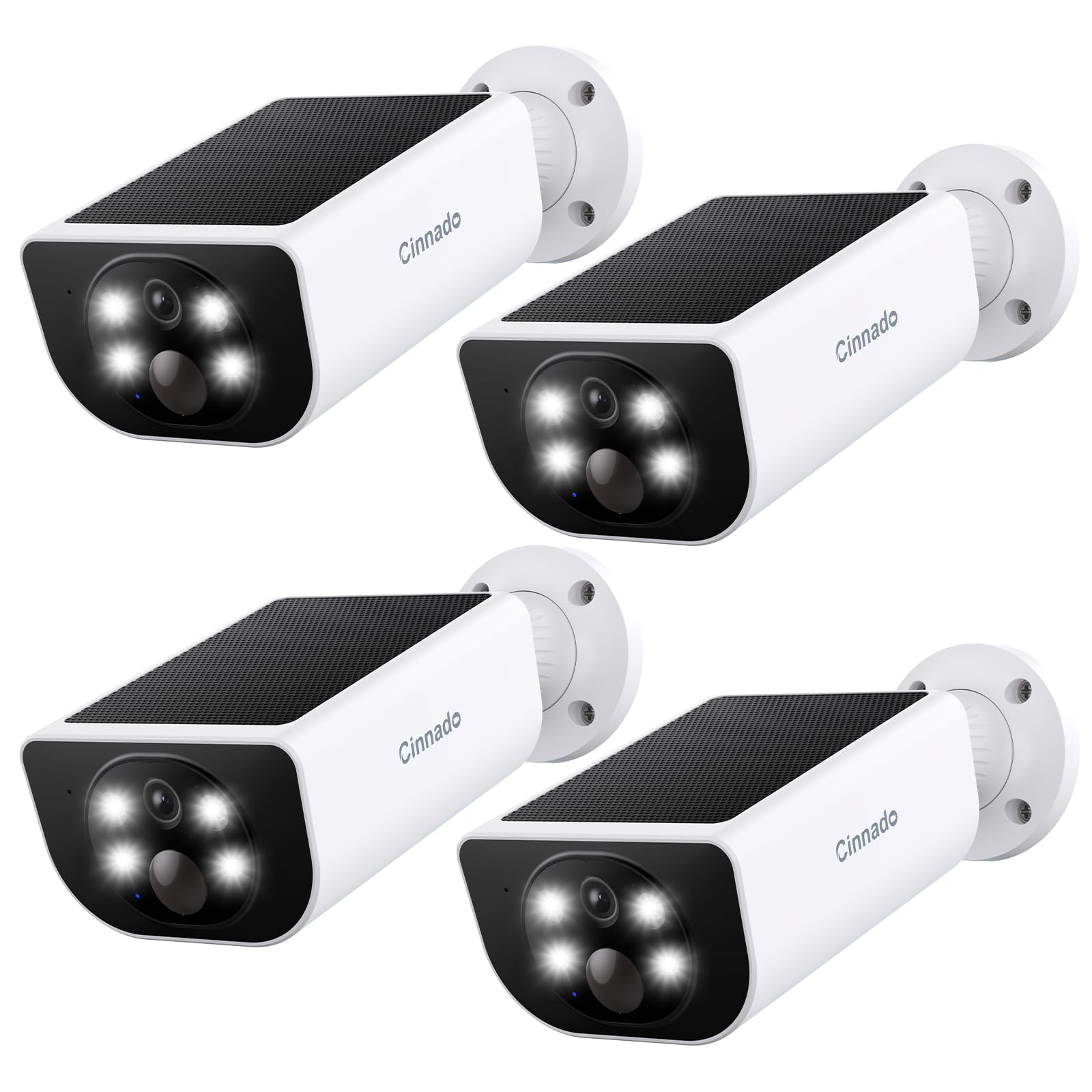
3. Cinnado S1 4Pack Solar Security Cameras
A four-pack with built-in solar panels that eliminate the chore of recharging each camera by hand.
The standout feature here is the integrated solar panel on every camera. You mount it in a spot that gets direct sun, connect to 2.4GHz WiFi via the app, and the camera keeps itself charged indefinitely. Owners confirm that even after cloudy days, the battery stays full through the night. Picture quality is the aspect mentioned most — 52 buyers single it out — and the 2K 3MP footage is described as “crisp.” The PIR motion sensor is paired with AI that filters out false alarms from pets and moving branches, and you can set the cameras to trigger a spotlight and siren automatically when a real threat is detected.
Storage is flexible: you can use a TF card (FAT 32, not included) for local recordings or subscribe to a cloud plan that keeps up to 30 days of history. The 4.49 x 2.24 x 3.58-inch form factor is compact enough to tuck under eaves without being obtrusive. The IP65 rating covers dust and rain, so these cameras handle a British drizzle or a desert dust storm the same way. The obvious catch is that integrated solar panels mean the camera cannot be placed in a fully shaded location — it needs a few hours of daily light to keep running.
Solar simplicity: A true set-and-forget system — mount it in the sun, and the built-in panels keep every camera topped up, freeing you from the recharge schedule of battery-only units.
Reach for this if: You want a multi-camera system that never asks you to take a camera down and plug it in — the integrated solar panels handle daily charging automatically.
Look elsewhere if: Every camera location is under a deep, shaded overhang with zero direct sunlight; the built-in panels need a few hours of daily sun to stay topped up.
4. Safemo 4K Wireless Security Cameras + 5W Solar Panel

True 4K clarity at a budget-friendly price point, backed by AI that actually cuts down on false alerts.
At 3840 x 2160 resolution, this is the highest-resolution camera in the roundup by a clear margin. The f/1.6 lens lets in plenty of light, and the 140° wide-angle view covers most of a driveway or yard in a single frame. The 8x digital zoom lets you read a license plate or identify a face without getting close, and the full-color night vision reaches up to 40 feet — far enough to cover a standard front garden. The 5W solar panel keeps the battery topped up with a few hours of daily sunlight, which reviewers in snowy northeastern US winters confirm works year-round.
Privacy is a central pitch here: SafeRTC encryption and local processing keep data off the cloud unless you choose to upload it. The 32GB of built-in storage holds about six months of clips, and you can expand it up to 4TB via an SSD. AI motion detection recognizes people, pets, vehicles, and packages, and the Safemo App sends real-time notifications only for what you select. The build quality and reliability earn consistent praise — 25 owners call out quality specifically, and 15 mention video quality as a standout. A handful of customers note the base station needs an Ethernet connection for remote viewing, so it is not 100% wire-free if your router is far from the hub.
4K edge: The highest resolution in this lineup — 4K at 3840×2160 with a fast f/1.6 lens and 40-foot color night vision — plus a 5W solar panel and expandable local storage that holds up to 4TB.
Pick this if: You want the sharpest possible footage (4K) with a solar assist and the freedom to store clips on a huge local drive rather than the cloud.
Pass if: You need a truly wire-free hub — the base station requires an Ethernet cable to the router for remote access, which might limit placement.
5. Arlo Essential 2K (3rd Gen) – 3-Pack
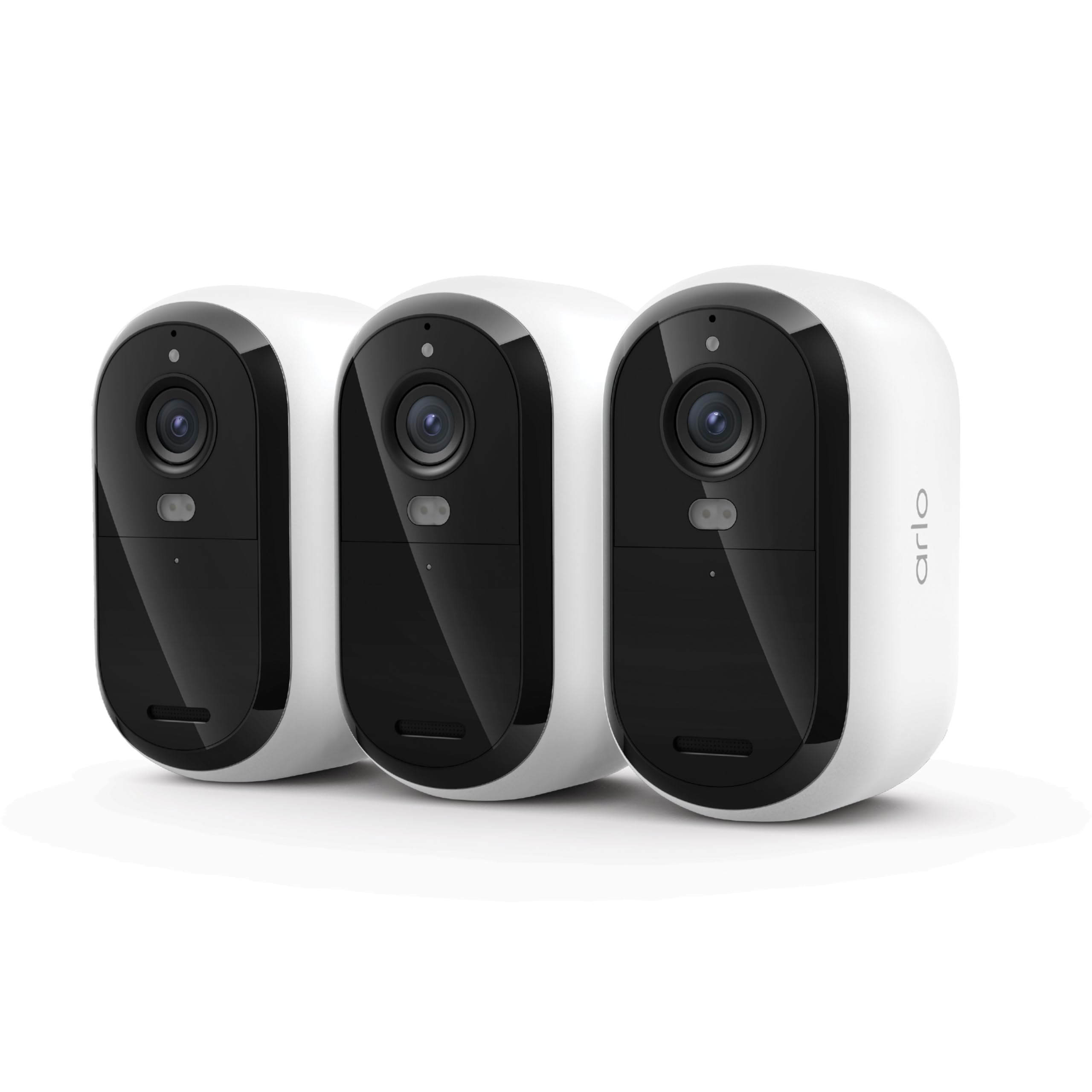
The brand-name choice with the most sophisticated detection categories — person, package, vehicle, and animal.
Arlo is a well-known name in the wireless security space, and the third-generation Essential 2K camera brings the resolution up to 1440p with a 130° field of view. The real differentiator is the detection intelligence: the camera distinguishes between people, vehicles, packages, and animals, so you get a push notification that says “vehicle detected” rather than just “motion.” The Arlo Secure subscription open up 60-day video history and AI-powered detection, but basic live streaming and motion alerts work without paying. Setup is famously fast — reviewers point out a 10-minute install straight from the start, with dual-band WiFi ensuring a strong connection whether your router is 2.4GHz or 5GHz.
The build quality gets consistent praise (46 buyers mention it positively), and the 12x zoom lets you inspect details without walking outside. The color night vision, spotlight, and built-in siren give you a full deterrent toolkit. The biggest trade-off is battery life — reliability and battery both land as “MIXED” in the review data, with some owners experiencing shorter spans than expected. A solar panel (sold separately) is a sensible add-on to avoid frequent charging. At three cameras, this pack covers the front door, back yard, and garage without leaving gaps.
Detection detail: The only camera in this lineup that independently identifies people, packages, vehicles, and animals — plus a 12x zoom and 130° FOV for a clear view of what triggered the alert.
Reach for this if: You want the most nuanced motion alerts — person, vehicle, package, and animal detection in a clean 2K feed — and you do not mind pairing it with a solar panel for low-maintenance power.
Consider a different pick if: You want subscription-free local storage; Arlo’s advanced features and cloud storage require a monthly plan after the first month.
6. Blink Outdoor 4 (2-Camera System)

The most affordable smart-camera ecosystem with a two-year battery claim and deep Alexa integration.
Blink Outdoor 4 is the lowest entry point into a well-established smart-home ecosystem. The headline feature is the two-year battery life — the camera runs on two AA Energizer lithium batteries, and the claim holds up well for moderate motion activity. At 1080p HD, the video resolution is lower than the 2K and 4K picks above, but the infrared night vision and two-way audio are solid for the price. The new Sync Module Core handles the wireless connection, and the camera supports enhanced dual-zone motion detection that alerts faster than the previous generation.
Person detection is available through an optional Blink Subscription Plan, and the free 30-day trial gives you a taste of cloud storage. Without a subscription, you cannot save clips locally to the Sync Module Core — you would need to buy a Sync Module XR with a MicroSD card or a Sync Module 2 with a USB drive. The Alexa integration is excellent: you can view the live feed, arm and disarm the system, and trigger routines using voice commands. The reliability category has the highest raw mention count at 2,200, but Amazon marks it as MIXED, meaning some owners experience connectivity dropouts. Occasional firmware updates have caused cameras to go offline temporarily.
Alexa-first design: Deep integration with Alexa for voice control and routines, plus up to two years on two AA lithium batteries and a well-polished mobile app.
Perfect for: An Alexa-heavy household that wants a dead-simple, budget-friendly two-camera setup with the longest possible battery life.
Look elsewhere if: You refuse any subscription — local storage requires buying an additional Sync Module XR or 2, and the base bundle does not include it.
7. Vivideye 4MP Solar Powered PTZ (2-Cam Kit)
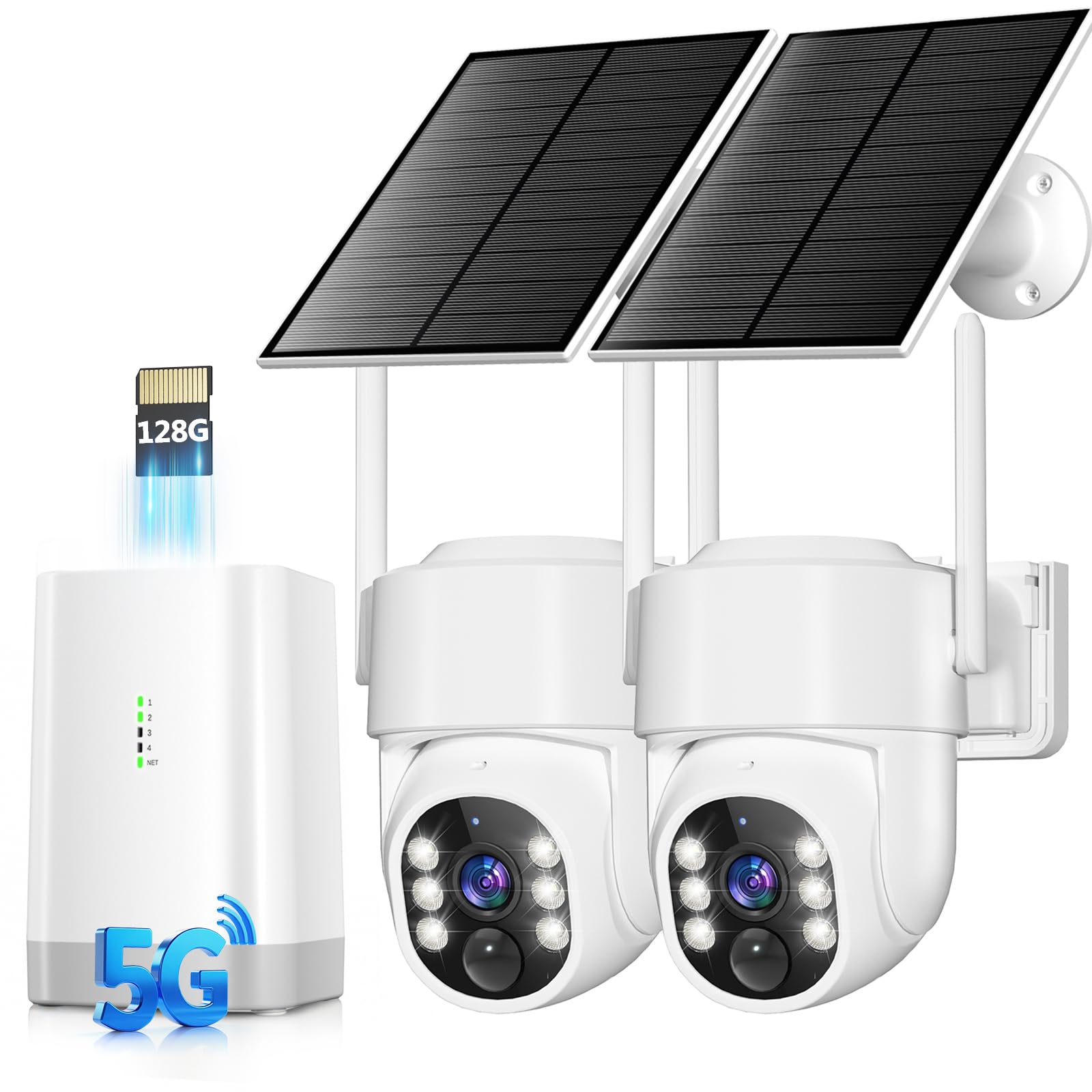
The only camera in this lineup with motorized pan and tilt — plus a massive 128GB of built-in storage in the hub.
Remote pan and tilt (350° pan, 90° tilt) is the defining feature here, letting you sweep the camera across your yard without physically moving it. The video comes in at 4MP, which is slightly sharper than standard 2K, and the color night vision reaches 65 feet — bright enough to identify someone at the far end of a long driveway. The home hub comes with 128GB of built-in storage (expandable by adding more), which holds roughly three months of loop recordings without any subscription. The camera connects over 2.4GHz or 5GHz WiFi, and the built-in solar panel keeps the battery charged year-round.
Image quality earns the most mentions from owners — nine call it excellent, and one buyer specifically says the cameras capture “natural-looking color.” The magnetic mount makes installation simple, and the app interface is straightforward. The Pan/Tilt control lets you digitally zoom in on specific areas, which is useful for checking package deliveries or spotting wildlife. The catch is that the system currently only supports one phone at a time for full control — family members cannot all independently pan and tilt from their own devices. A few buyers also ran into WiFi connection hurdles, and the app store ratings are on the lower side.
Motorized view: Full 350° pan and 90° tilt via the app, 4MP color night vision out to 65 feet, and a 128GB local hub — all powered by solar, with no subscription.
Reach for this if: You want a camera that can follow movement across the yard remotely, with generous built-in storage and solar power — all in one kit.
Think twice if: Multiple family members need independent pan/tilt control from their own phones; the current single-phone limitation is a reported constraint.
8. SEHMUA 4-Cam Solar System with 360° PTZ
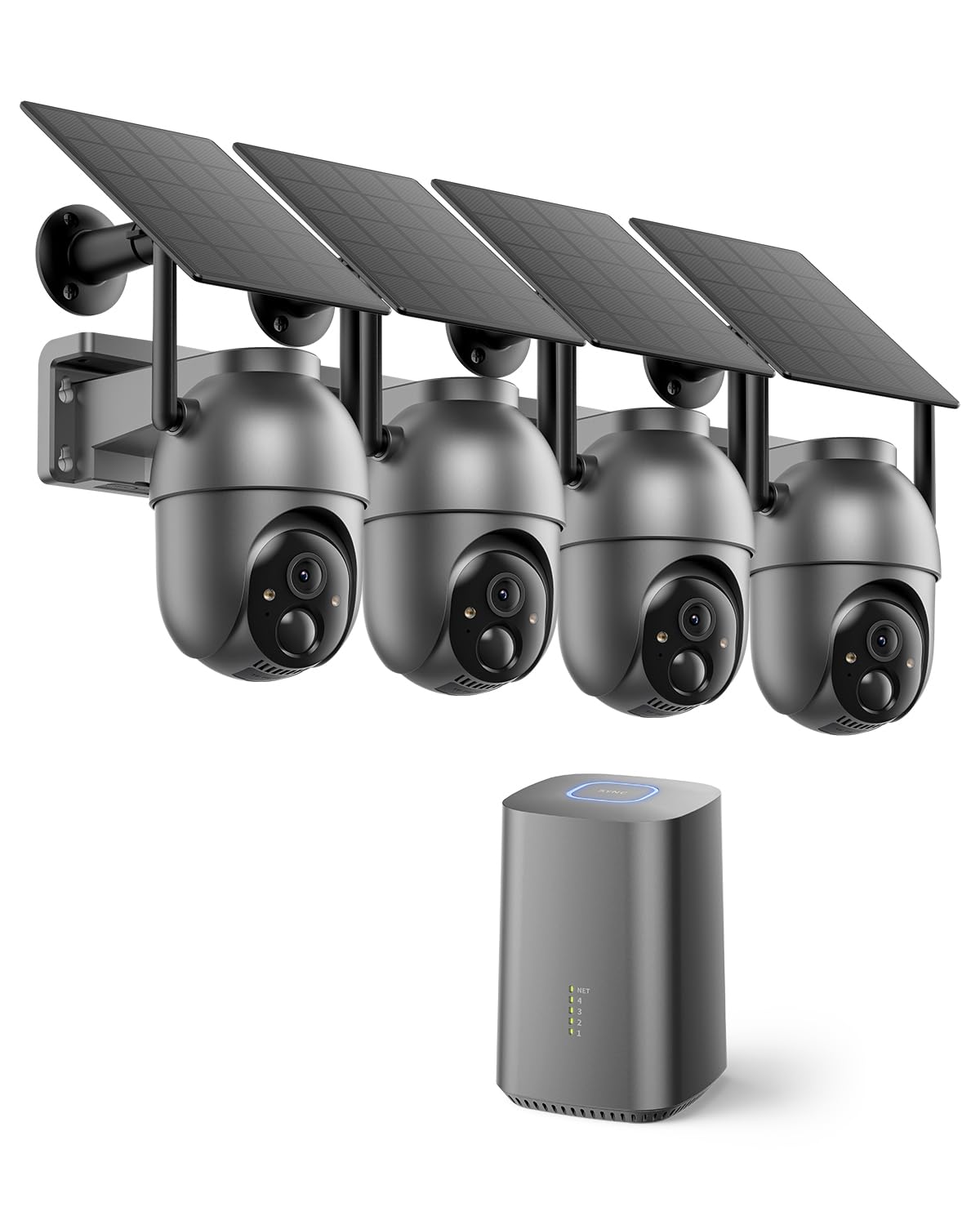
A four-camera, fully solar-powered system with a PTZ lens on each unit and a hub that stores 4 months of clips.
SEHMUA covers every angle quite literally — each of the four cameras offers 350° pan and 90° tilt, and combined they cover the driveway, porch, swimming pool, and back gate with almost no blind spots. The video is 4MP, and the built-in LED spotlight delivers vivid color night vision out to about 65 feet. The 3W solar panels need roughly three hours of direct sunlight per day to keep the camera charged indefinitely, which owners in mild climates confirm works perfectly. The 64GB hub (expandable to 256GB) stores around four months of local recordings, so there is no cloud fee and no SD card to manage per camera.
The “One-Touch Sync” feature pairs all four cameras to the hub automatically, and the custom detection zone lets you mark specific areas for priority monitoring. Human-only detection with PIR sensors cuts down on false alerts from leaves and passing cars, and the app pushes instant notifications when something triggers a camera. The Eseecloud app allows you to view all four feeds on a single screen at once. Ease of setup is the most-cited positive (69 owners), and video quality earns 49 positive mentions. The connectivity score is marked MIXED — a few users report that cameras must stay within WiFi range of the base station, so large properties may need a range extender.
Full perimeter: Four solar-powered cameras, each with 350° pan and 90° tilt, storing up to 4 months of local clips in the hub — all with no monthly bill.
Buy this for: Complete outdoor coverage with four PTZ solar cameras, a central hub with generous local storage, and zero subscriptions.
Consider a different option if: Your property is very large and the cameras cannot maintain a strong WiFi signal to the base station — a mesh extender may be needed.
Understanding the Specs
Resolution: 1080p vs 2K vs 4K
Resolution determines how much detail you can see when you zoom in on a face or a license plate. 1080p (1920×1080) is the standard HD baseline — clear enough for a front-door view, but it gets blocky at 8x zoom. 2K (around 2560×1440 or 3MP to 4MP) is the balance for a budget system: it gives you significantly more detail than 1080p without eating up storage space as fast as 4K. 4K (3840×2160) is the sharpest option and is great for identifying someone from across a yard, but it creates larger video files and may need a faster memory card or more cloud storage.
No Monthly Fees vs Subscription
This is the single biggest long-term cost factor. Some cameras store clips on a built-in memory chip (like the 32GB inside the aosu) or on an SD card you insert into the hub or camera. These systems never charge you, even if you store months of footage. Other cameras, like the Arlo Essential and Blink Outdoor 4, offer basic live viewing and alerts for free, but require a monthly subscription (typically -15/month) to save recordings to the cloud, access video history for more than a few days, or use advanced detection features like person recognition. Over two years, a subscription can easily cost more than the camera itself.
FAQ
Will any of these cameras work with Amazon Alexa or Google Assistant?
How long do the rechargeable batteries actually last before I need to recharge?
Can I add more cameras later to any of these systems?
Do any of these cameras record continuously, or only on motion?
What does IP65 or IP66 waterproof rating actually mean for outdoor cameras?
Which WiFi band do I need — 2.4GHz or 5GHz?
Can I view the cameras on my desktop computer, or is it phone-only?
How do solar-powered cameras handle cloudy or winter days?
Which system gives me the most local storage without paying any subscription?
What is the field of view, and why does it matter for my driveway?
Final Thoughts: The Verdict
Across the board, the budget wireless security camera system that ticks every box is the aosu 2-Cam Kit because it delivers sharp 2K QHD video, a genuinely useful 166° field of view, and 32GB of built-in local storage — all without charging a monthly fee. If you want four cameras to cover the full perimeter for a similar price, the GMK 4 Pack offers solid 2K footage, instant motion alerts, and quick setup. And for those who want to skip the recharge cycle entirely, the Cinnado S1 4Pack integrates solar panels directly into each camera so you can set them up, connect to WiFi, and never think about power again.
How We Picked
We do not accept paid placement. Every pick is matched to a real buyer and a real use-case; we do not hands-on test units.
Sources & Methodology
Specifications: manufacturer listings and product documentation. Review insights: verified customer reviews, as of July 2026. Pricing: not shown on this page (it changes often); check the current price via the retailer link.
As an Amazon Associate, Gadgets Feed earns from qualifying purchases. This does not affect which products we feature.