
Our readers keep the lights on and my morning glass full of iced black tea. As an Amazon Associate, I earn from qualifying purchases.
Specs are compiled from manufacturer listings and verified buyer reviews and can change over time — please confirm the key details on the product page before buying.
A teenager’s first serious camera is a big step. It needs to be simple enough for a 13-year-old to figure out without a manual, yet powerful enough to keep them interested for years. The wrong pick frustrates them or limits what they can shoot. This guide focuses only on beginner-teenager models that deliver sharp photos, easy controls, and room to grow.
I’m Min — the founder and writer behind Gadgets Feed. This guide is built by comparing the manufacturers’ published specifications and the patterns across verified customer reviews, so you get each pick’s real strengths and trade-offs instead of marketing spin.
Whether your teen wants to vlog, capture sports, or beat a phone camera, you’ll find the right match here. The best camera for beginner teenager balances strong image quality, straightforward controls, and a price that makes sense for a first real investment.
Our Picks at a Glance
How To Choose The Best Camera For Beginner Teenager
Buying a camera for a teenager comes with a unique set of questions. You want something that feels like a step up from a phone without being so complex it ends up in a drawer. The major factors to weigh are image quality, ease of use, and features that match how teenagers actually create and share content.
Image Quality and Sensor Size
The sensor is the heart of the camera. A larger sensor (like the APS-C sensor in a DSLR) captures more light, which means better photos in low light and more control over background blur. Smaller sensors in compact point-and-shoot cameras are perfectly fine for well-lit daytime photos, which is how most teenagers start.
Autofocus Performance
Nothing frustrates a new photographer more than blurry pictures. A fast and accurate autofocus system makes the difference between a keeper and a throwaway. Look for cameras with reliable face detection or phase-detection autofocus — these systems lock onto a subject instantly, which is crucial for capturing quick moments like a pet or a friend mid-laugh.
Zoom Capability: Optical vs. Digital
This is a significant difference. Optical zoom uses the lens to magnify the image without losing quality, making it ideal for wildlife, sports, or concerts from a distance. Digital zoom simply crops and enlarges the image, which often results in a grainy, low-quality photo. A teen interested in distant subjects needs genuine optical zoom.
Video and Vlogging Features
Most teenagers are as interested in video as they are in photos. A camera with a flip screen lets them frame themselves for vlogging or selfies. Built-in Wi-Fi is also a big deal — it allows them to transfer photos to their phone instantly for editing and posting on social media, avoiding the hassle of cables and computers.
Size and Portability
A camera that is too bulky or heavy will be left at home. A lightweight, compact body that fits easily into a backpack or small bag is far more likely to be carried everywhere. The best camera for a teenager is the one they actually carry.
Quick Comparison
| Model | Best For | Sensor Resolution | Zoom Power | Screen & Wi-Fi | Amazon |
|---|---|---|---|---|---|
| Canon EOS Rebel T7★ Best Overall | Future photographers | 24.1MP | Optical (lens) | 3.0″ LCD, Wi-Fi | Amazon |
| Tecglem 8K 88MP CameraBest Value | Best value bundle | 88MP | 16X Digital | 3.2″ Touch, Wi-Fi | Amazon |
| AUREAPIX 8K 96MP CameraVlogger’s Pick | Budget vlogging | 96MP | 20X Digital | 3.5″ Flip, Wi-Fi | Amazon |
| LIYTIFOR 5K 80MP Camera | Selfie creators | 80MP | 18X Digital | 3.5″ + 2″ Dual, No Wi-Fi | Amazon |
| SMARTKLIK 5K 75MP Camera | Young beginners (Pink) | 75MP | 16X Digital | 3.0″ Flip, Wi-Fi | Amazon |
| LOUM 8K 88MP Camera | Touchscreen fans | 88MP | 16X Digital | 2.8″ Touch, Wi-Fi | Amazon |
| Xoieod 1080P Camcorder | Night vision video | 36MP (still) | 16X Digital | 3.0″ 270° Rotating, No Wi-Fi | Amazon |
| KODAK FZ45 | Budget-friendly classic | 16MP | 4X Optical | 2.7″ LCD, No Wi-Fi | Amazon |
| KODAK AZ528 | Wildlife & sports zoom | 16MP | 52X Optical | 3.0″ LCD, Wi-Fi | Amazon |
In‑Depth Reviews
1. Canon EOS Rebel T7 DSLR Camera with 18-55mm Lens Bundle
Our pick — over 4.5★ from 400+ verified ratings; the strongest balance of quality and price.
The real-deal DSLR that teaches photography, not just picture-taking.
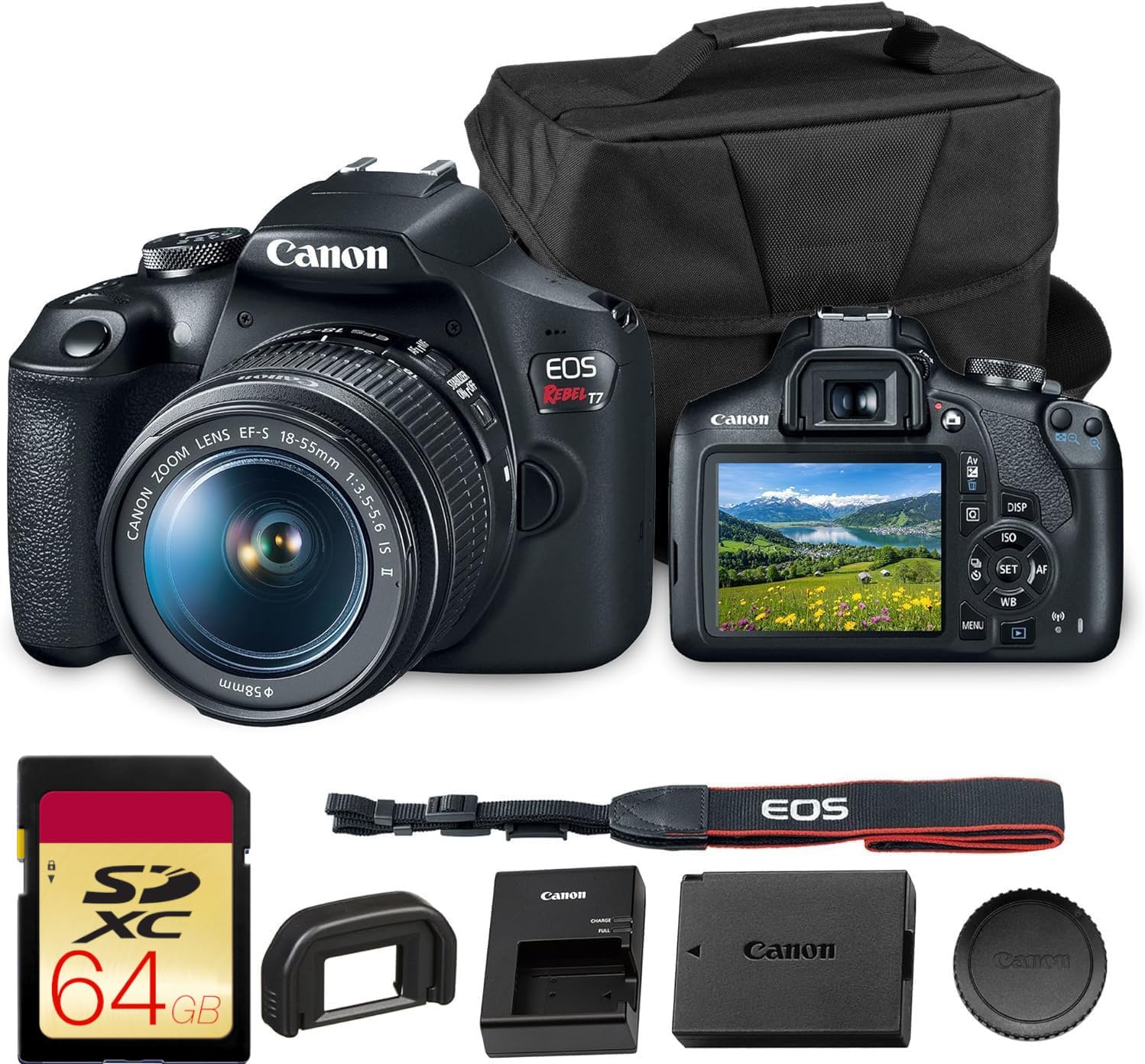
You get true-to-life photos with the Canon Rebel T7, thanks to its 24.1MP APS-C CMOS sensor (a larger sensor that captures more light and detail than compact cameras). It handles low light beautifully—think indoor birthday parties or evening sports—and the included 18-55mm lens covers everything from group shots to portraits. The crowd favorite across thousands of owners, it scores a dominant 4.7 stars out of 5, a rare achievement that underlines its beginner-friendly nature. The quality and picture quality are what win people over, scoring the top two positive aspects by a wide margin. Buyers report it is “very easy to use on auto focus, lightweight, got the job done as I shot photos for my son’s high school track team.” Its battery is a 45-gram Canon LP-E10 unit, versus a 21-gram battery found in smaller point-and-shoots, which means longer run time for a full day of shooting.
Wi-Fi and NFC are built in, so transferring photos to a phone for social media is easy. It also bundles a 64GB memory card and a shoulder bag, making it a true start-to-shoot kit. The included battery supports extended photo sessions, and the body itself is lightweight enough for a teen to carry on a hike or to school. Those who mention it most praise its quality (62 mentions) and picture quality (30 mentions), with ease of use also scoring highly (24 mentions).
The trade-off is a learning curve. The autofocus system is simple—9 points—which is fantastic for learning composition but means the camera does less automatic work than a phone. It records 1080p video, not 4K. For a teen interested in photography as a craft, this is the gold standard; for a TikTok point-and-shooter, a simpler compact is better.
What Makes It a Winner
- Superior image quality from a large 24.1MP APS-C sensor — photos look professional even in low light
- Full compatibility with Canon EF and EF-S lenses, so learning and upgrading are built in
- Built-in Wi-Fi and NFC make sharing to a smartphone instant and cable-free
The Realistic Picture
- Heavier and bulkier than any compact — it demands a bag, not a pocket
- Video is capped at 1080p Full HD, not 4K, which matters if vlogging is the priority
- Simple 9-point autofocus is excellent for learning but slower than modern mirrorless systems
Reach for this if: your teen shows a real spark for photography and you want a tool that will teach them the fundamentals for years without needing an upgrade.
Think twice if: they just want a lightweight camera for quick selfies and TikTok videos — the size and price are overkill for casual use.
2. Tecglem 8K 88MP Digital Camera
An absurdly good bundle that delivers crisp 8K video for the price of a video game.
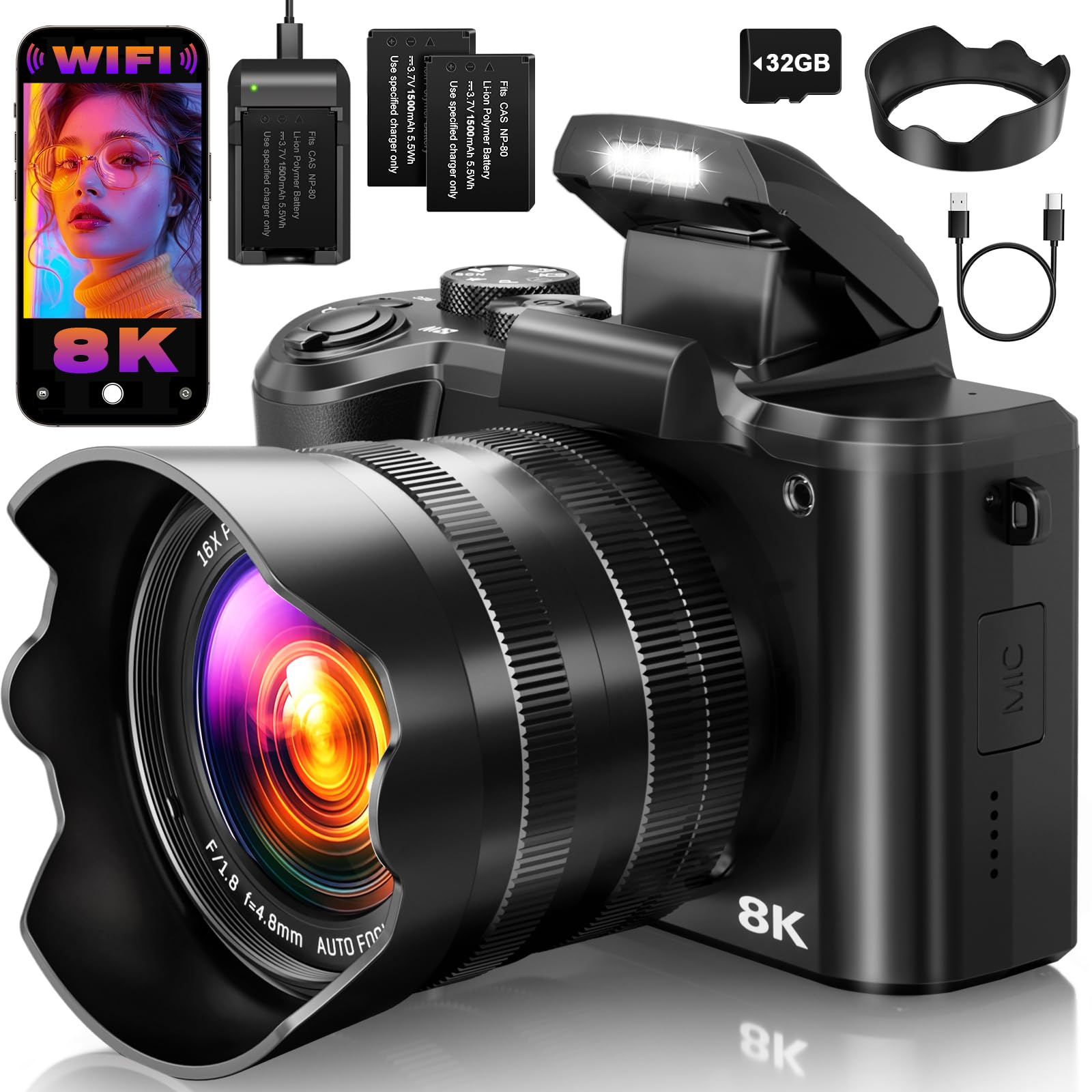
You get 8K video and 88MP stills from this camera, a spec combination that makes it a strong contender for any teen interested in high-resolution content creation. The package is genuinely complete: it includes two batteries, a charging stand, a 32GB SD card, a lens hood, a lens cap, and a camera bag. The image quality and ease of use are the top positive aspects, with 71 and 51 mentions respectively, and buyers consistently describe the pictures as “sharp and vibrant.” The autofocus system uses Phase Detection and Face Detection (two methods that lock onto moving subjects) to keep subjects sharp, even in motion.
The 3.2-inch IPS touchscreen is intuitive, allowing a teen to tap to focus and shoot. Wi-Fi transfer through the “iSmart DV2” app is quick. The 6-axis stabilization helps reduce blur from shaky hands, a common issue when learning to hold a camera steady. For a teen wanting to film YouTube videos or take high-res travel photos, this is hard to argue against.
The catch is the 16X digital zoom. It works fine for getting closer, but it is digital, so zooming in heavily reduces image quality. It also uses an f/2.2 aperture, which is good for a compact camera but not as light-hungry as a DSLR’s kit lens. For the money, the value is undeniable — this is the set to grab for a content-hungry beginner on a stricter budget.
High-res starter: Excellent 8K video and a full kit that leaves nothing to buy later. The digital zoom is the trade-off, but for the price, the image quality more than makes up for it.
Best for: a teen who wants to make high-quality YouTube videos and share them immediately, without needing to buy any extra accessories.
skip it if: they need genuine optical zoom for wildlife or sports — this camera’s zoom is only digital.
3. AUREAPIX 8K 96MP Digital Camera
The vlogging-first camera with a flattering f/1.8 aperture and Wi-Fi sharing.
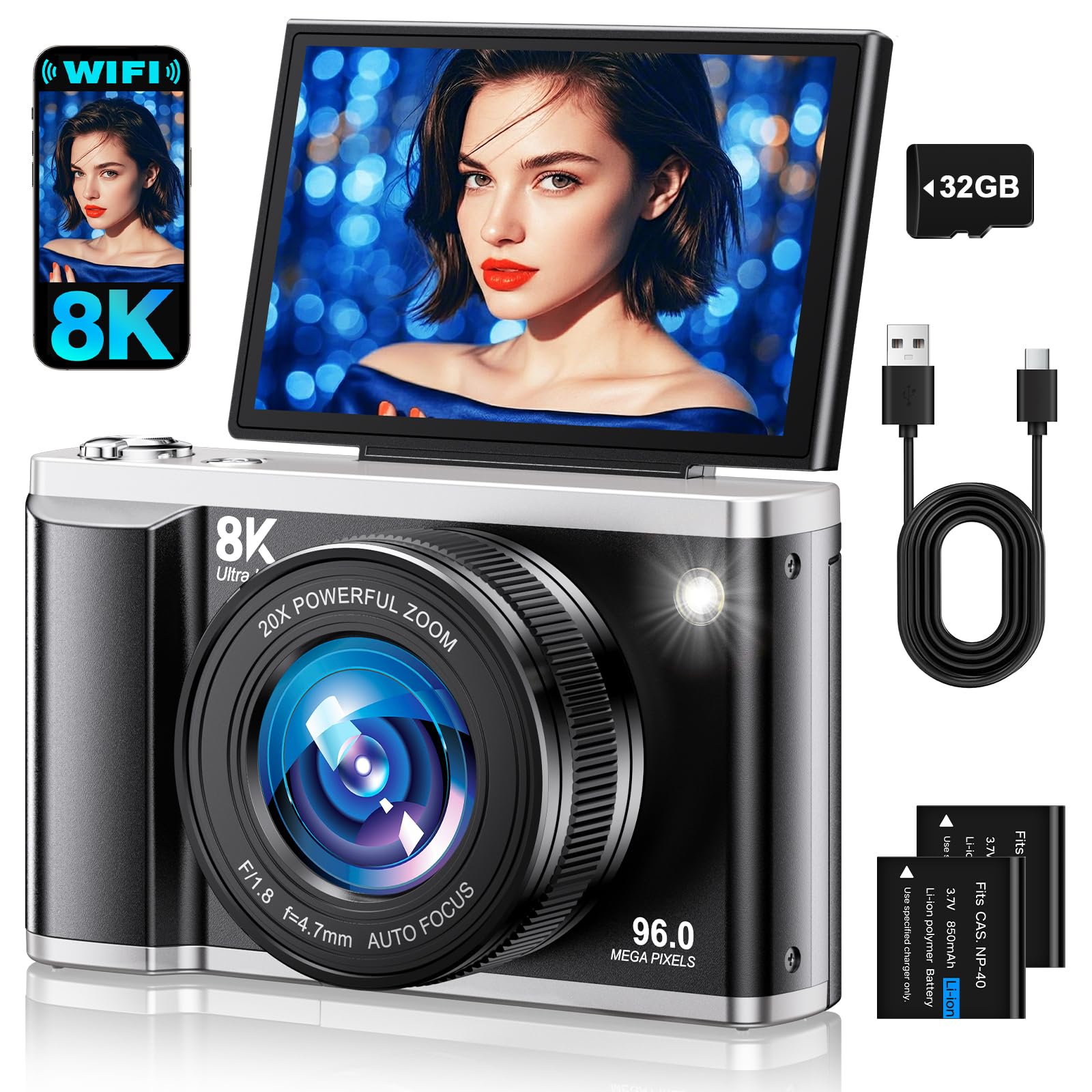
This camera is built for the creator mindset. It records 8K video and captures 96MP stills, and its f/1.8 aperture lets in significantly more light than most compact cameras, which means better selfies and vlogs in indoor or evening settings. The 3.5-inch 180-degree flip screen is excellent for framing yourself while filming, making it a natural fit for a teen starting a YouTube channel. The image quality (54 mentions) and ease of use (45 mentions) are the top praised aspects, and the suitability for beginners scores well (27 mentions).
Wi-Fi transfer is handled through the “Viipulse” app for quick social media posts. It also comes with a 32GB SD card and two batteries, so a teen can shoot all day without charging. The 20X digital zoom offers more reach than many competitors — at 20X versus the 18X zoom found on similar models. Its 4.7mm focal length is equivalent to a standard wide-angle view, and the battery weight is just 21 grams, making the whole setup very portable.
The primary limitation is the 20X digital zoom. Unlike the KODAK AZ528’s 52X optical zoom, this is digital, so maximum zoom will degrade image quality. Also, while it claims 8K video, this is interpolated, and a teen shooting fast action might encounter some softness. For planned vlogs and static shots, it is a superb value.
Creator’s tool: The f/1.8 lens and flip screen are perfect for indoor vlogging. The digital zoom is not for long-range wildlife, but for selfies and daily content, it excels.
Grab this for: a teen who loves making TikTok and YouTube videos and wants a camera that makes them look good instantly with a wide, bright lens.
Look elsewhere if: they are into birdwatching or sports photography — the digital zoom falls apart at max range.
4. LIYTIFOR 5K 80MP Digital Camera
The only camera here with a front-facing selfie screen for perfect framing every time.
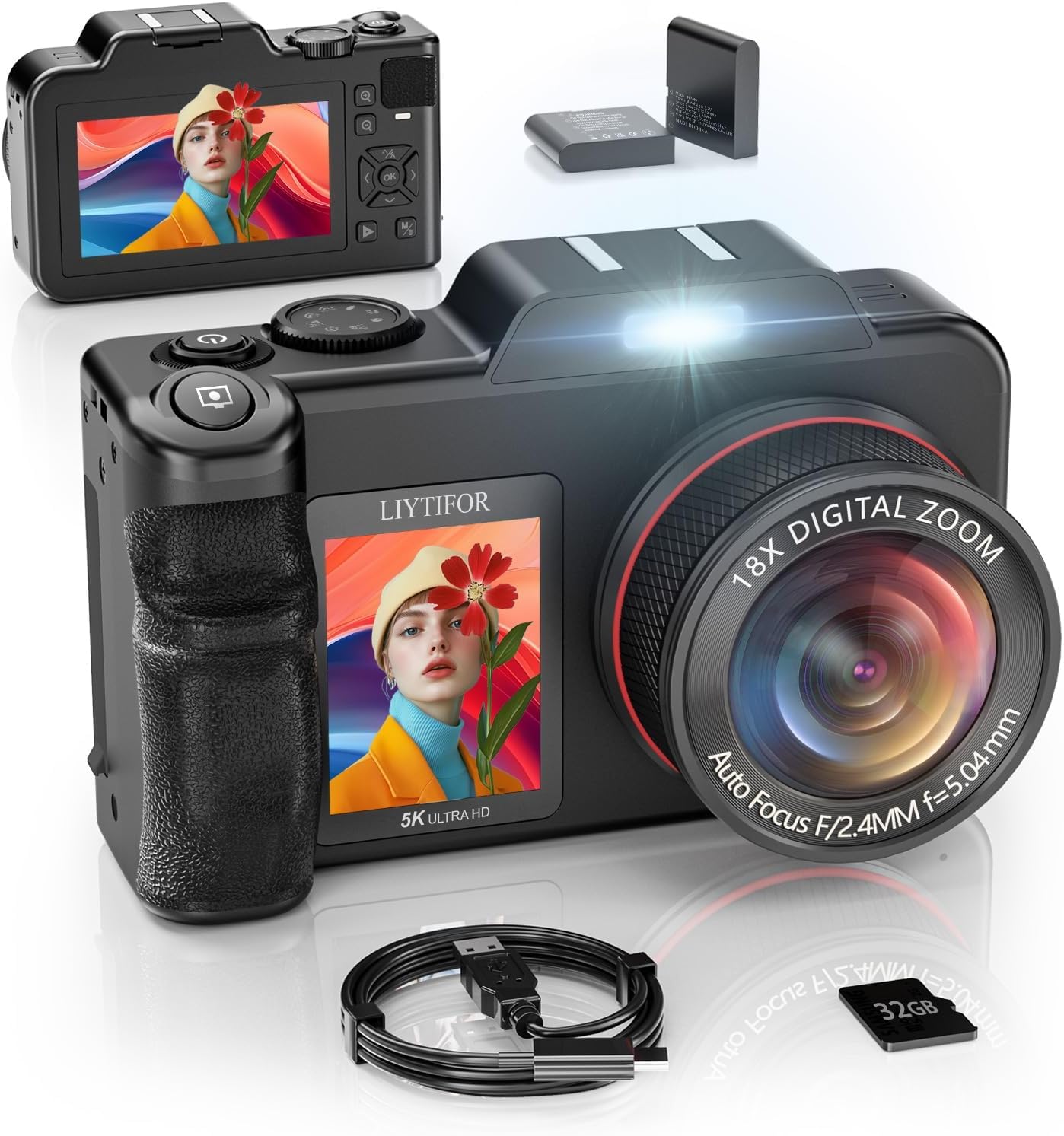
This camera solves a specific problem: how to frame a selfie or solo vlog without guessing. It has a large 3.5-inch HD main screen and a dedicated 2-inch front-facing screen, allowing a teen to see exactly what the lens sees while recording. It shoots 5K video and captures 80MP photos, and the quality (51 mentions) and picture quality (31 mentions) are the top aspects, making it a solid entry-level performer. The 18X digital zoom is a step above the 16X common in this price range.
The single USB-C cable is a clever design — it can charge via power bank, transfer files, or turn the camera into a 5K webcam for streaming. Two 1500mAh batteries provide over 300 minutes of shooting time. The 360-degree rotating filter dial gives quick access to 8 color filters and scene modes like Portrait and Night Scene, a fun way for a beginner to experiment creatively. As reviewers put it: “great beginners camera. Perfect for the teenager showing interest in photography without the big price tag.”
The biggest missing feature is Wi-Fi. This camera uses a USB cable for transfers, so a teen cannot instantly share photos to a phone without a physical connection. The zoom is also fully digital. For those who value a dedicated selfie screen and don’t mind cable transfers, the dual-screen setup is a wonderful feature for content creation.
Dual-screen advantage: The front-facing screen is a win for solo vloggers, and the 300-minute battery life is a full-day guarantee. No Wi-Fi means cable-only photo sharing.
Perfect for: a teen who vlogs alone and wants to see their framing in real time without a phone app.
Not for: a teen who expects to wirelessly beam photos to their phone every few minutes.
5. LOUM 8K 88MP Digital Camera
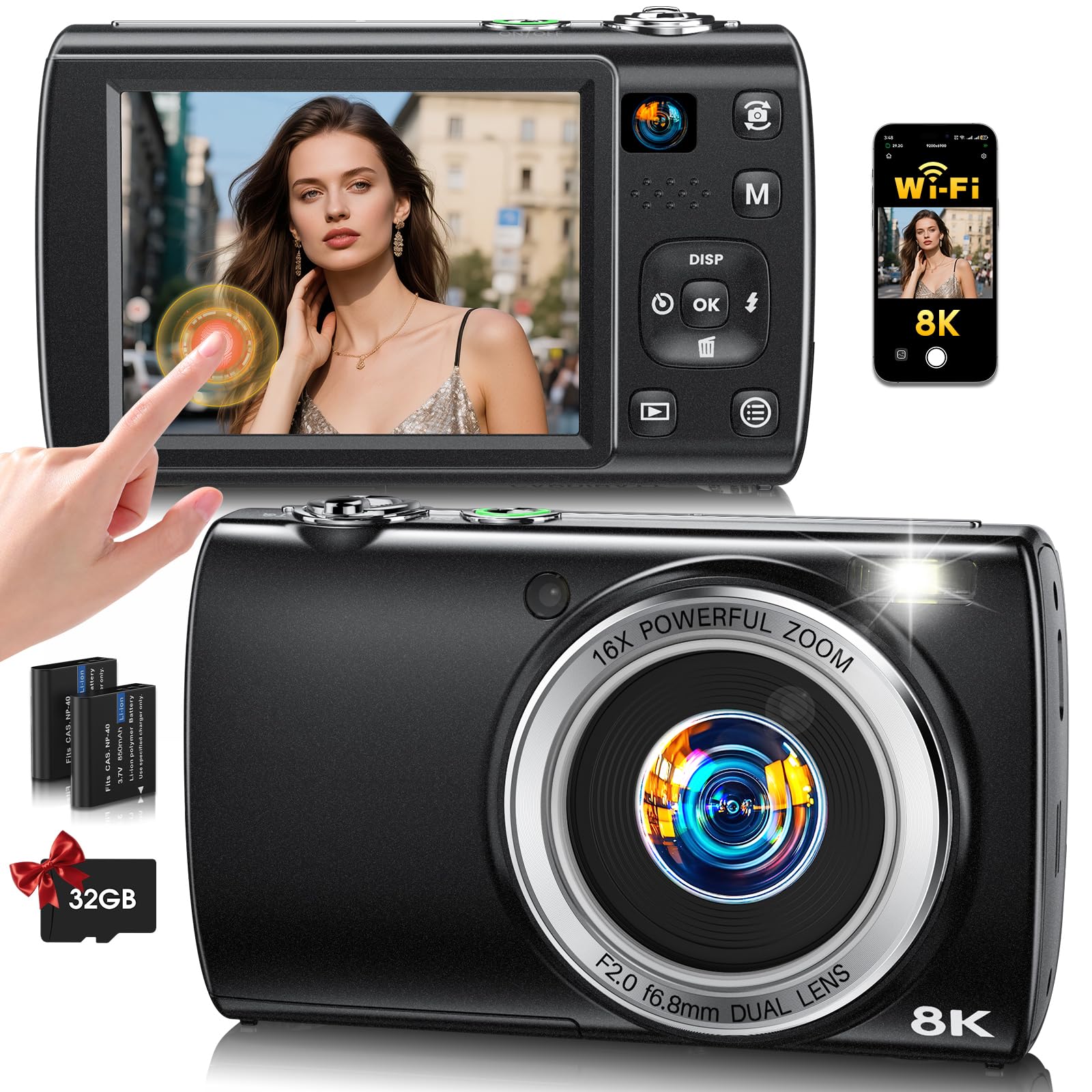
A responsive touchscreen that makes navigating menus feel as natural as a phone.
For a teen raised on smartphones, a touchscreen is a non-negotiable comfort. This LOUM camera features a 2.8-inch IPS HD touchscreen that is bright and responsive, making it easy to tap to focus, swipe through menus, and review photos. It records 8K video and captures 88MP stills, and the image quality (130 mentions) and quality (77 mentions) are the most-discussed aspects by a huge margin, with ease of use at 74 mentions. The 5-axis anti-shake stabilization is a genuine help for beginners prone to camera shake.
Wi-Fi is built in, and the kit includes a 32GB memory card and two rechargeable batteries. The dual-camera design (front and rear) allows for selfies without needing to flip a screen around. The electronic 5-axis stabilization produces steady clips even when walking, and the 16X digital zoom is adequate for everyday framing. The compact size also scores well at 41 mentions, confirming it is very pocketable.
The battery weight is just 11 grams, which is the lightest battery in this entire list. While this helps keep the camera light, some owners note the battery life is solid but not class-leading. The 8K video is interpolated, so the true resolution is lower. For a teen who values a modern, phone-like interface and sharp 8K video, this is a compelling choice.
Touch-native interface: The responsive touchscreen and 5-axis anti-shake are standout features. The 88MP photos are crisp, and the Wi-Fi sharing is fast.
Ideal for: a teen who prefers a touch interface over buttons and wants smooth, stabilized video straight from the start.
Consider if: they plan on mostly static or slow-paced shots — the 16X digital zoom isn’t great for distant subjects.
6. Xoieod 1080P Video Camera Camcorder
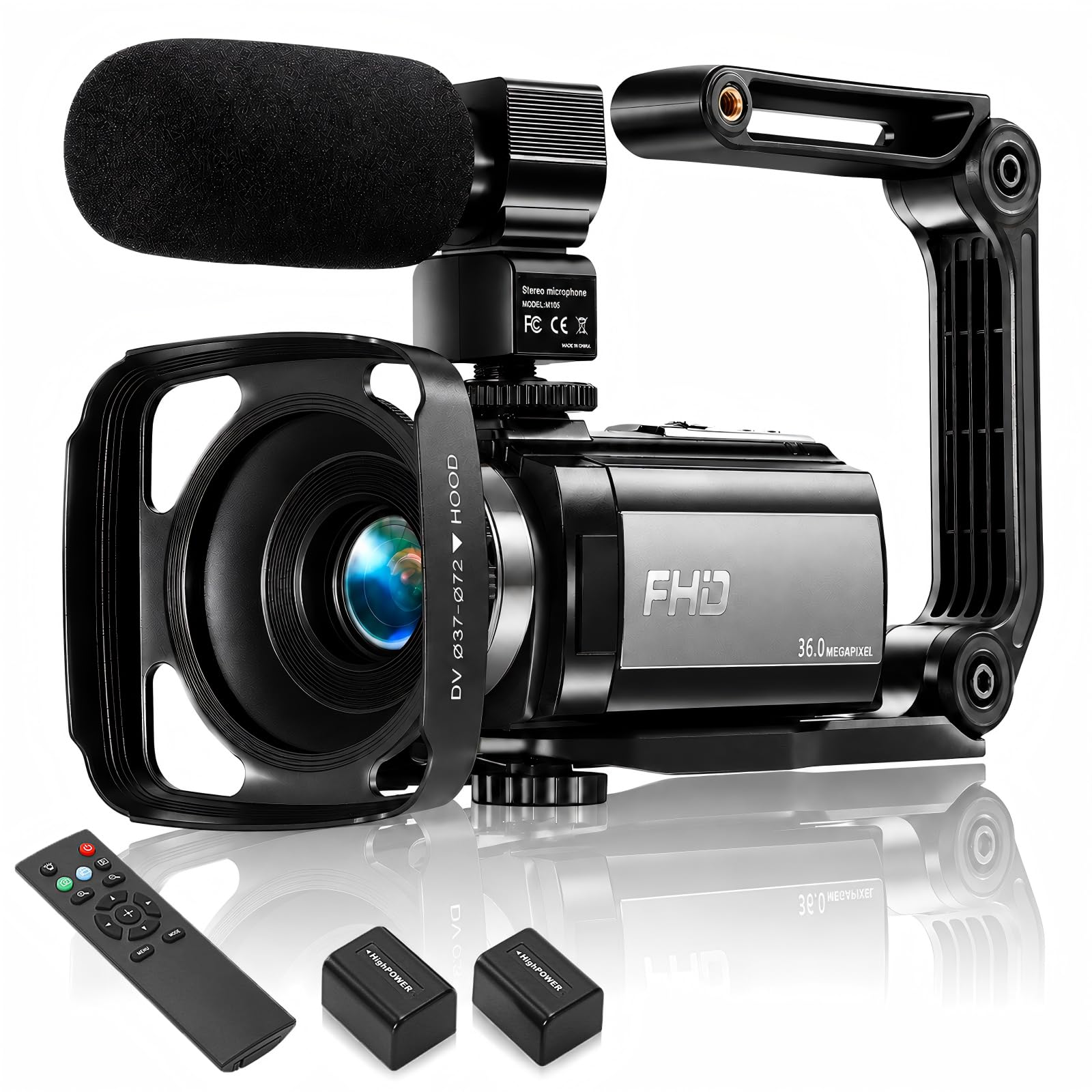
The dedicated camcorder with infrared night vision for spooky or low-light explorations.
This is not a stills camera — it is a camcorder first, built for video. It records 1080p Full HD video and captures 36MP still photos. Its defining feature is the built-in infrared night vision mode (a sensor that sees in total darkness), which can record clear footage in complete darkness, an unusual and fun feature for a teen interested in outdoor night hikes, ghost hunting, or just messing around in the dark. The quality (15 mentions) and compact size (8 mentions) are the top praised aspects.
The kit is ridiculously generous. It includes two batteries, an external X-Y stereo microphone, a remote control, a lens hood, a charging stand, and a carrying bag. The 3.0-inch 270-degree rotating screen allows for vlogging and overhead shots. The remote works up to 16 feet away, which is a solid feature for solo creators who need to start and stop recording from a distance. The 16X digital zoom and image stabilization help reduce blur during active shooting.
The main downside is the lack of a memory card included, and a few owners note the menu can lag and the zoom is step-based rather than smooth. 1080p video is perfectly adequate for YouTube and social media but lacks the resolution of the 4K and 8K models in this list. For a teen whose primary passion is video — especially in creative low-light scenarios — this is a unique and capable tool.
Video-first tool: The night vision and wireless remote are unique for this price point. The audio from the external mic is surprisingly clear and rich.
Buy for: a teen who wants to make films in unusual settings, especially at night, and values good audio for interviews or storytelling.
Skip if: they want high-resolution photos — this is a video camera through and through.
7. SMARTKLIK 5K 75MP Digital Camera
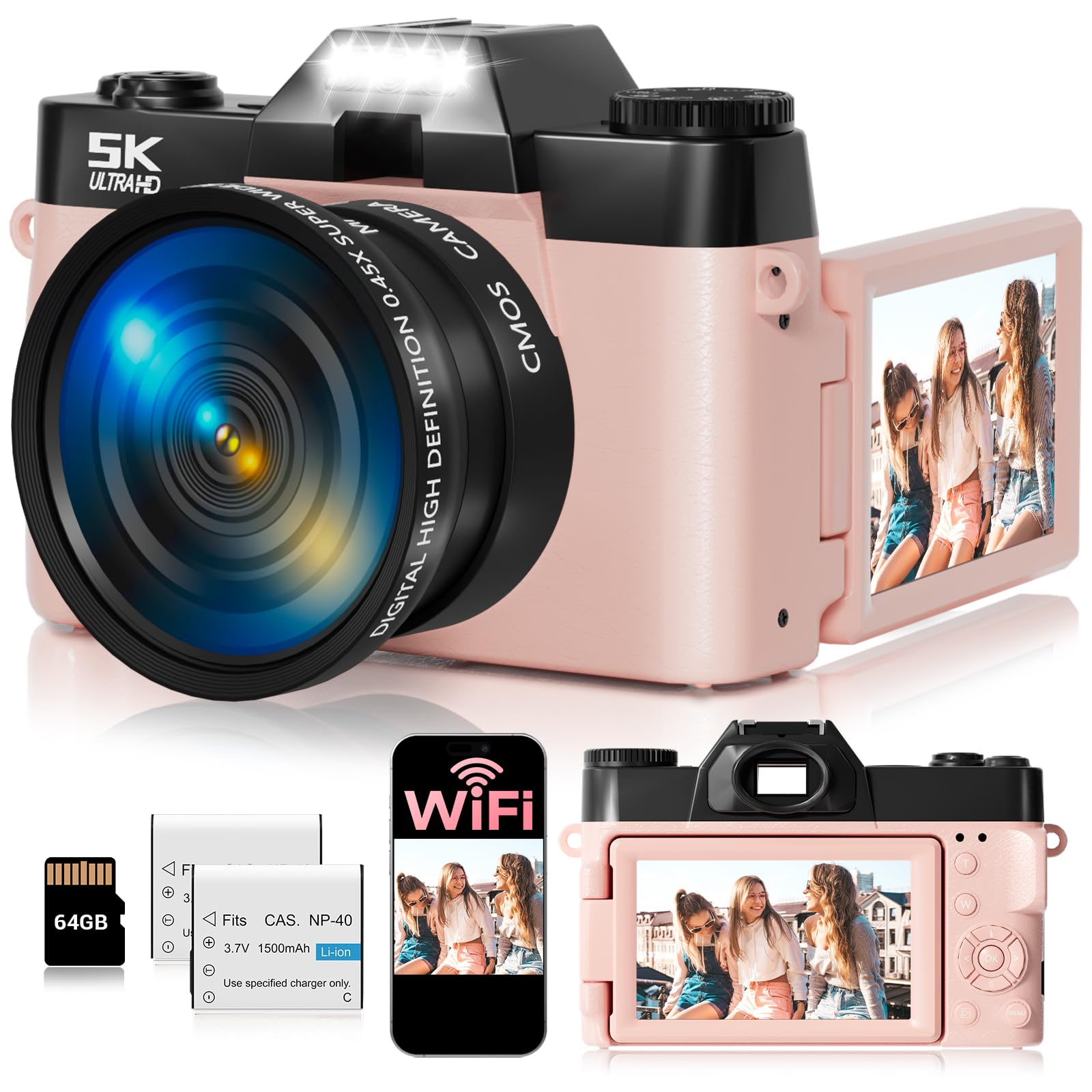
A cute, pink, easy-to-use starter camera that comes with a wide and macro lens.
This camera is designed to be approachable. It is available in a pink finish that many young users love, and the picture quality (29 mentions) and quality (29 mentions) are the top positive aspects, tied for first place. It records 5K video and captures 75MP photos, which is more than enough for a beginner. The 180-degree flip screen and 360-degree rotating dial make it simple to switch between photo, video, time-lapse, and slow-motion modes. It is specifically listed as being for kids, teens, and beginners.
The kit includes a 64GB memory card and two batteries, plus a separate wide/macro angle lens that clips on. This is a rare addition at this price and lets a teen experiment with close-up shots of insects or flowers, or capture a wider field for landscapes. The Wi-Fi transfer works well for sharing photos. The anti-shake technology keeps things steady during handheld shots.
A few owners have noted video quality can feel softer than the 5K claim suggests, especially in low light. The build is plastic, which keeps it lightweight but less durable than a metal-bodied camera. For a younger teen looking for a fun, colorful camera to learn on, this is a gentle and capable entry point.
Cute and capable: The pink color and included wide/macro lens make it stand out. The 180-degree flip screen is great for selfies, but the video quality has its limits.
Great for: a younger teen (10-14) who wants a colorful camera that is super easy to use and includes a bonus macro lens for fun close-ups.
Not for: a teen who wants professional-level video quality or a camera that feels like serious gear.
8. KODAK PIXPRO FZ45 16MP Digital Camera

The familiar-name camera with real optical zoom that runs on standard AA batteries.
The KODAK brand carries weight with parents. The FZ45 is a true point-and-shoot with a 16MP sensor and, crucially, a 4X optical zoom lens. This is real zoom — it brings distant subjects closer without losing detail, unlike the digital zooms on many competitors. The 27mm wide-angle lens is good for group shots and landscapes. It records 1080p Full HD video and is powered by two AA alkaline batteries (the camera includes two in the box). The quality (438 mentions) and picture quality (291 mentions) are the top positive aspects, with over 6000 ratings making it the most-reviewed camera on this list.
It is incredibly simple to use. There is no complex menu system for autofocus; it is a contrast detection system with 9 points that works well in good light. The 2.7-inch LCD screen is small but bright. A few buyers find the picture quality comparable to much more expensive cameras like the Canon G7X. It accepts SD, SDHC, and SDXC cards up to 512GB, which is plenty of room.
The downside is reliability. The 342 mentions of reliability are negative, with reports of units failing after a few months. The included AA batteries are very low quality and die quickly; most owners recommend buying high-quality rechargeable AA batteries immediately. There is no Wi-Fi or flip screen, so it lacks the modern features a teen might expect for instant sharing and vlogging.
Classic optical zoom: The 4X optical zoom is a genuine advantage over digital-only cameras, producing sharp, zoomed-in photos. The AA battery system is convenient but requires fresh, quality cells.
Pick this if: your budget is tight and you want a no-frills camera from a known brand that takes clean, optically-zoomed photos during the day.
pass on it if: reliability is your top concern, or if your teen needs Wi-Fi sharing or a flip screen for vlogging.
9. KODAK PIXPRO AZ528 16MP Bridge Camera

An astonishing 52X optical zoom camera that puts wildlife and sports within reach.
This is the only camera on this list that can zoom in on a bird at a hundred yards and produce a clear, recognizable photo. The 52X optical zoom is the headline feature, backed by a 24mm wide-angle lens for landscapes and a 16MP BSI CMOS sensor with Optical Image Stabilization. The OIS is critical — it actively compensates for hand shake even at maximum zoom, making telephoto shots usable without a tripod. The camera quality (51 mentions) and ease of use (29 mentions) are the top positive aspects.
It also shoots 1080p Full HD video, has a 3-inch LCD screen, and offers a burst mode of 6 frames per second for capturing fast action. Built-in Wi-Fi allows sharing from the field. The rechargeable Li-Ion battery and support for SD cards up to 512GB make it ready for a full day of photography. For a teen interested in birdwatching, nature, or sports photography, this is an incredibly powerful tool for the price.
The picture quality is mixed (46 mentions, marked Mixed). Some shots are sharp and vibrant, while others, especially at high zoom, can be blurry if the subject is moving or the camera is not perfectly steady. The autofocus is a contrast detection system with 25 points, which is okay for stationary subjects but slow for action. The body is also relatively large and heavy for a teenager. For the zoom enthusiast, this is a unique and powerful camera; for general everyday use, it is over-specialized.
Unrivaled reach: With 52X optical zoom, this camera does what no other camera in this guide can — bring distant wildlife into clear, sharp view. The OIS (optical image stabilization, which steadies the lens) is essential for handheld use at full zoom.
Ideal for: a teen who loves nature, birdwatching, or sports and wants the most zoom power available without buying a lens.
Not for: everyday selfies, vlogging, or indoor photography — this is a specialized tool for getting close to distant subjects.
Understanding the Specs
Megapixels (MP) and Sensor Size
Megapixels determine how much detail a camera can capture. A 24.1MP APS-C sensor, like in the Canon Rebel T7, delivers significantly better low-light performance and more control over background blur than the 16MP sensors found in many compact cameras. Higher megapixel numbers (like 88MP or 96MP) often sound better, but these are frequently achieved through interpolation (digital enlargement) rather than a physically larger sensor. For photos meant to be shared on social media or printed at standard sizes, a 16MP or 24.1MP sensor is more than enough. The real quality comes from sensor size and the quality of the camera’s lens.
Optical Zoom vs. Digital Zoom
This is the most important zoom distinction you can learn. Optical zoom uses the camera’s lens to physically magnify the image, preserving full resolution and sharpness at any zoom level. Digital zoom simply crops into the center of the picture and enlarges the pixels, which results in a lower-resolution, grainy image — especially at higher zoom levels. For sharp pictures of distant subjects like wildlife or sports players, optical zoom is a must. Digital zoom is a convenience feature for casual framing adjustments, not a tool for serious distance photography.
FAQ
What is the best first DSLR camera for a teenage beginner?
How many megapixels does a teenager need in a camera?
Is optical zoom better than digital zoom for a beginner?
What does “interpolated” mean in camera specs?
Do I need to buy a separate memory card for a beginner camera?
Can a teenager use a vlogging camera as a webcam for online classes?
What is the importance of a flip screen for a beginner teenager?
What type of batteries do these beginner cameras use?
Will a camera be a better investment than using a smartphone?
What is “anti-shake” or “image stabilization” in a camera?
Final Thoughts: The Verdict
If you want one dependable pick, the camera for beginner teenager winner is the Canon EOS Rebel T7 because it provides a true, learnable photography experience with superior image quality and room to grow. If you want a compact, all-in-one kit with 8K video and instant Wi-Fi sharing for content creation, grab the Tecglem 8K 88MP Camera. And for the teen obsessed with capturing distant birds or sports action, the KODAK PIXPRO AZ528 with its 52X optical zoom is the one to reach for. Each pick serves a specific passion, so matching the tool to how your teen actually wants to shoot is the secret to a camera that gets used every day, not left in a drawer.
How We Picked
We do not accept paid placement. Every pick is matched to a real buyer and a real use-case; we do not hands-on test units.
Sources & Methodology
Specifications: manufacturer listings and product documentation. Review insights: verified customer reviews, as of July 2026. Pricing: not shown on this page (it changes often); check the current price via the retailer link.
As an Amazon Associate, Gadgets Feed earns from qualifying purchases. This does not affect which products we feature.