
Our readers keep the lights on and my morning glass full of iced black tea. As an Amazon Associate, I earn from qualifying purchases.
Specs are compiled from manufacturer listings and verified buyer reviews and can change over time — please confirm the key details on the product page before buying.
If your music sounds muddy at volume, or your factory stereo flattens bass, an amp with built-in digital signal processing (DSP — a tiny computer that shapes the sound) fixes it. Unlike a plain amplifier, it doesn’t just get louder; it corrects the flaws in your current setup, so words become clear and instruments separate. This guide compares nine models for cars, home theaters, and live sound, focusing on channels, power, and how easy the tuning is to use.
I’m Min — the founder and writer behind Gadgets Feed. This guide is built by comparing the manufacturers’ published specifications and the patterns across verified customer reviews, so you get each pick’s real strengths and trade-offs instead of marketing spin.
Understanding channel counts and DSP tuning tools is key to fixing muddy car audio or weak home theater bass. Here is how to choose the right amp with dsp for your system and your skill level.
Our Picks at a Glance

How To Choose The Best Amp With DSP
Before you shop, decide where this amp will live. If your car’s factory stereo sounds muddy, a car audio DSP amp (a digital signal processor that cleans up the audio signal) fixes those flaws. If you’re powering PA speakers and subwoofers, a pro audio unit is the better fit. Your use case tells you if you need auto-tuning or deep manual control.
Match the channel count to your speakers
Every speaker you want to power individually needs its own channel. A 4-channel amp runs a standard front-and-rear door speaker setup, while an 8-channel unit lets you run a fully active system where tweeters, mids, and a subwoofer each get dedicated processing. For a simple subwoofer, a single-channel plate amp is all you need.
Decide how much tuning you want to do
Some amps measure your car and tune themselves in minutes with a microphone. Others give you a massive equalizer and expect you to know what you’re doing. If you want plug-and-play, an auto-tuning amp saves hours. If you love fiddling, look for 30-band EQs and parametric filters. Be honest about your patience — the strongest DSP is wasted if you never learn to use it.
Quick Comparison
| Model | Best For | Channels | Output Power | Weight | Amazon |
|---|---|---|---|---|---|
| Kicker 47KEY2004★ Best Overall | Auto-tuned car upgrades | 4 | 200 watts | 2.2 lbs | Amazon |
| Dayton Audio SPA250DSPBest Value | Subwoofer replacement amps | 1 | 250 watts | 3.6 lbs | Amazon |
| JBL DSP4086Most Channels | Full-range active systems | 8 | 100 watts | — | Amazon |
| Crown XLS1002 | Lightweight pro sub driving | 2 | 350 watts | 8.6 lbs | Amazon |
| Behringer NX6000D | High-power home subs | 2 | 2 x 3000 watts | 13.2 lbs | Amazon |
| AudioControl D-4.800 | Flexible OEM car builds | 4 | 800 watts | 5 lbs | Amazon |
| Yamaha PX3 | Reliable live performance | 2 | 2x 500W | 19.6 lbs | Amazon |
| Crown XLS2502 | Clean high-power pro audio | 2 | 775 watts | 10.8 lbs | Amazon |
| AudioControl D-6.1200 | Ultimate 6-channel car builds | 6 | 1200 watts | 5 lbs | Amazon |
In-Depth Reviews
1. Kicker 47KEY2004 Key 4-Channel DSP Smart Amplifier
Our pick — over 4.5★ from 200+ verified ratings; the strongest balance of quality and price.
This Kicker tunes your car’s acoustics automatically, so a non-expert can fix muddled factory sound.
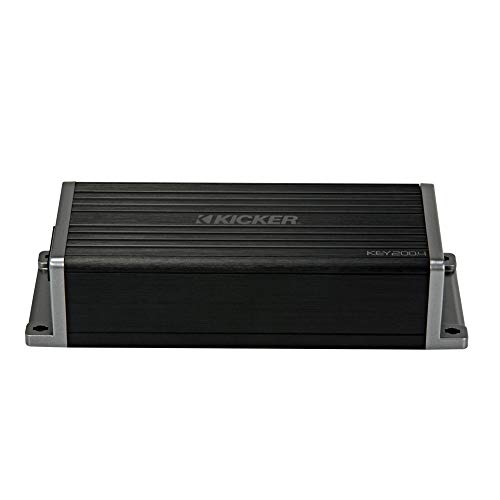
The Kicker 47KEY2004 is the crowd favorite — 4.6 stars across 200+ ratings — because it takes the hardest part of adding DSP and makes it automatic. Press a button and the amp’s internal microphone measures your vehicle, then its computer sets a massive 40-band equalizer and a 24dB crossover to clarify each speaker. What a professional might spend hours tuning happens in minutes, which is why clarity is the thing owners praise most.
This amp fits in tight spots like a glovebox, thanks to its 2.2-pound weight and 10.75 x 8.5 x 2.75-inch size. Buyers report a dramatic upgrade in a 2025 Ford F150, noting it is “very clear at higher volume,” and another fitted it into a 2025 Kia K5 GT and could suddenly “hear the words at a decent volume.” It’s a 4-channel amp delivering 200 watts of output, and its color-coded wires make installation approachable for a DIYer.
The smart auto-turn-on can occasionally fail, and one owner had to wire a remote turn-on lead instead. The tuning works best with quality speakers, so budget for upgraded drivers if your factory set is weak.
The Auto-Tune Appeal
- Microphone-driven setup does the DSP work for you
- 40-band EQ refines tonality far beyond a basic amp
- Tiny 2.2 lb footprint slides into cramped dashboards
The Honest Trade-Offs
- Auto-sensing turn-on may need a manual remote wire
- Benefits are clearest with upgraded aftermarket speakers
The smart pick: If you want a big factory-stereo upgrade without learning pro tuning, this auto-calibrating Kicker is the simplest path to genuinely better sound.
Reach for a manual DSP: If you love tweaking every frequency yourself, this unit’s automation feels limiting.
2. Dayton Audio SPA250DSP 250W Subwoofer Plate Amplifier with DSP
A 250-watt plate amp that slots into your subwoofer cabinet and brings a full suite of DSP tuning.
For anyone with a dead subwoofer amp or a DIY cabinet, this Dayton Audio SPA250DSP is a high-value fix. It’s a 1-channel plate amplifier — meaning it mounts directly into a hole in your enclosure — and its 250-watt output breathes new life into a passive sub. One owner used it to revive a 15-inch Monoprice sub, summing up the experience as “works great.”
The real strength here is the tuning depth. You get 7 parametric EQ bands (PEQ), a low-pass filter, phase control, a subsonic filter, a limiter, and mains delay, all adjustable through a single-knob interface with a high-contrast LCD. A free PC-based GUI app open up full control, and buyers found that laptop tuning transformed a shallow-box sub’s output. At 3.6 pounds, it’s heavier and substantially larger than the Kicker above — 16 x 11 x 8 inches — but that bulk houses the plate amp’s power supply and connections.
The included USB cable works only with the specific software, not generic printer cables, and the transformer and inductor run warm during heavy use. Tuning flexibility is excellent, but beginners should expect a learning curve with the software.
The pragmatic fix: For replacing a dead sub amp on a budget, this Dayton packs parametric EQ and crossover control that makes an old sub sound better than it did originally.
3. JBL DSP4086 8-Channel Class D Amplifier with DSP
This renewed JBL packs 8 channels of DSP into a small footprint for full active audio systems.
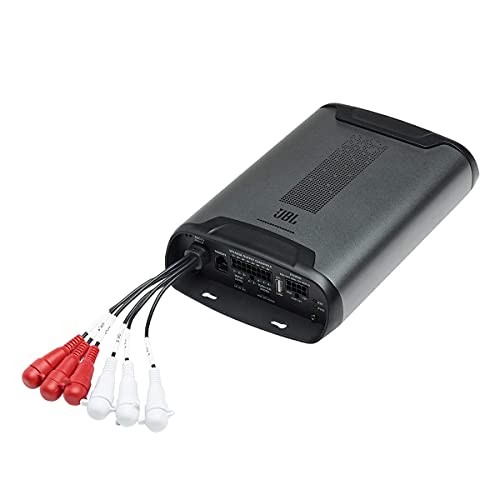
The JBL DSP4086 is for the serious builder who wants to process every speaker separately. Its 8-channel count represents a huge gap over the Dayton’s single channel — 8x the routing possibilities — letting you run a fully active setup where tweeters, mids, and a subwoofer each get their own EQ and crossover. The compact all-in-one design mounts in tight spaces, which suited one owner who hid it in a 2014 Ford Explorer while replacing the factory Sony amp.
Tuning power is the headline: 32 parametric EQ bands per channel (each band lets you adjust a specific frequency range), plus crossovers and time alignment to stage the sound perfectly. A wired remote control gives quick bass adjustment from -30 to +6dB right from the driver’s seat. Owners mention fixing terrible factory equalizers — one installed it in a 2022 Toyota Venza and called the result “absolute perfection.” Balanced differential inputs reject noise and accept RCA or speaker-level signals, so it works in almost any system.
This is a renewed unit with a 90-day warranty, and its 100-watt output is modest — it won’t go louder than a stock system. The USB port and startup order can be finicky, and the PC app has a learning curve.
The active-system enabler: If you are running individual tweeters, mids, and subs with dedicated tuning, this 8-channel JBL gives you the routing depth of a much pricier processor.
4. Crown XLS1002 2-Channel DriveCore Power Amplifier with DSP

A 350-watt pro amp that brings studio-grade DSP to home subwoofers and live rigs alike.
The Crown XLS1002 is a 2-channel professional amplifier beloved for driving subwoofers. It pumps 350W at 4 Ohms per channel, and customers note it handles four 10-inch subs without strain. Housed in a standard rack-mount chassis at 8.6 pounds, it’s a featherweight next to older iron — the switching power supply keeps it cool and efficient for home theater or PA duty.
Its DSP is built around speaker protection and control. The Peakx Limiters boost output while guarding your drivers, and the PureBand Crossover System handles frequency splitting. Selectable input sensitivity (1.4VRMS or.775VRMS) lets you match it to nearly any source. With its balanced XLR, quarter-inch TRS, and RCA inputs, this amp slots into both consumer and pro setups.
The internal cooling fan draws mixed feedback — some owners find it quiet, others notice it. One owner notes it may need a preamp line driver with AVR receivers to get sufficient bass, so gains need proper setting to avoid clipping.
The flexible pro option: This Crown bridges home and live audio with lightweight Class D power, configurable crossovers, and limiter protection that makes it a top choice for sub duty.
5. Behringer NX6000D Power Amplifier
Serious wattage — 2 x 3000 watts — plus deep DSP for multiple large home theater subwoofers.
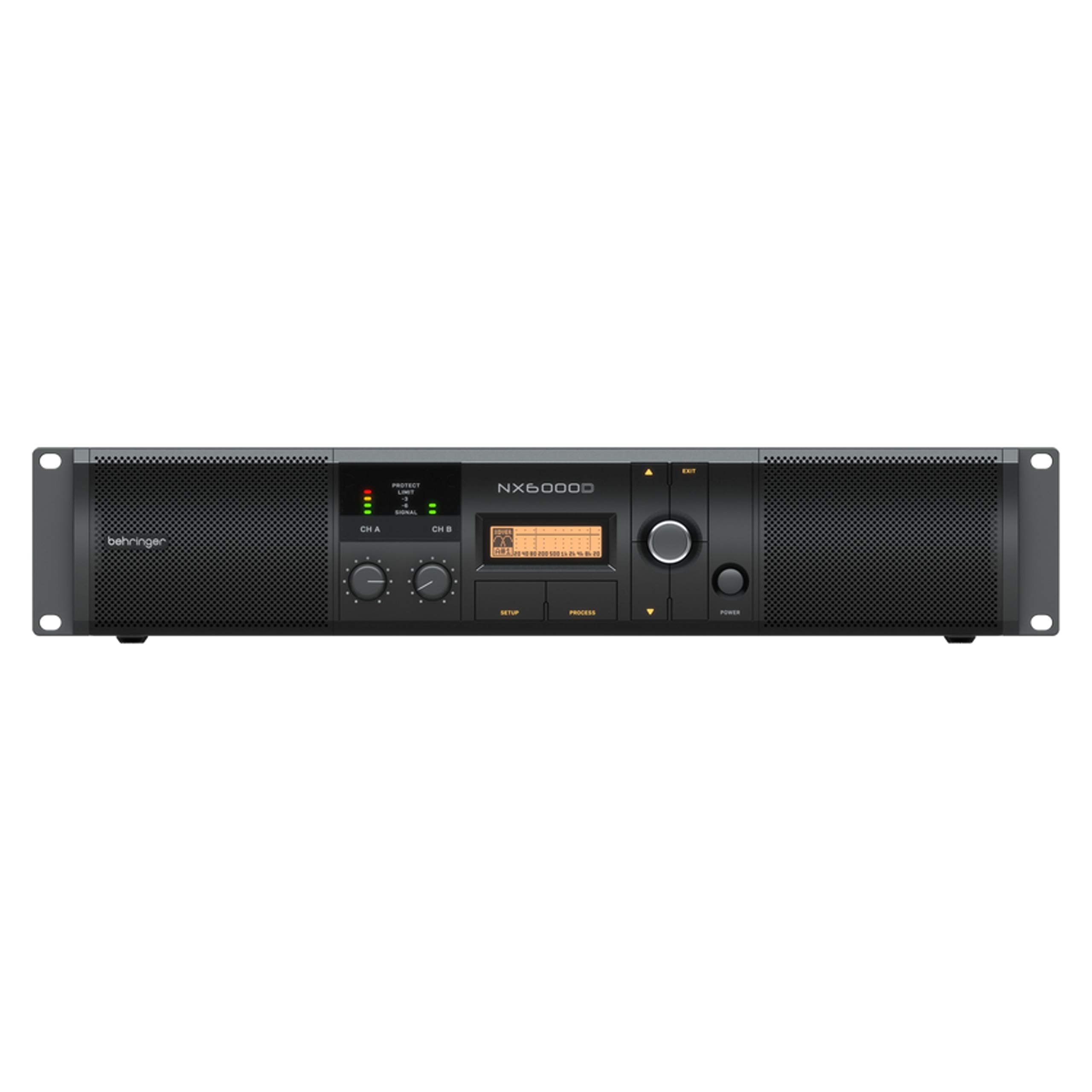
For those chasing extreme headroom, the Behringer NX6000D is a staple in DIY subwoofer builds. It’s rated at 2 x 3000 watts into 4 ohms, and while that’s peak power, owners find it easily runs multiple large home theater subs. Despite the massive output, it weighs less than 13.2 lbs thanks to high-density Class-D technology.
Its 24-bit/96 kHz DSP converters handle sophisticated processing: delay, crossover with three filter types up to 48 dB per octave, eight parametric EQ bands, two dynamic EQs, and lockable settings. The 2-channel design works for mains-and-monitors splits, and the SmartSense auto-detects 8 or 4-ohm loads. Reviewers point out it delivers “the most volts per dollar,” making it a favorite for single-gig and home theater applications.
Reliability gets mixed feedback — one unit arrived dead on arrival and went into protection mode, though other shoppers say years of trouble-free service across multiple amps. The always-on fan is audible, though typically masked by subwoofer output.
The power play: If you need to move serious air and want DSP protection, this cheap-per-watt Behringer is a proven DIY subwoofer workhorse with a caveat about quality control.
6. AudioControl D-4.800 Matrix DSP 4-Channel Amplifier
AccuBASS restores factory-sapped low end while 30 bands of EQ give you surgical tuning control.
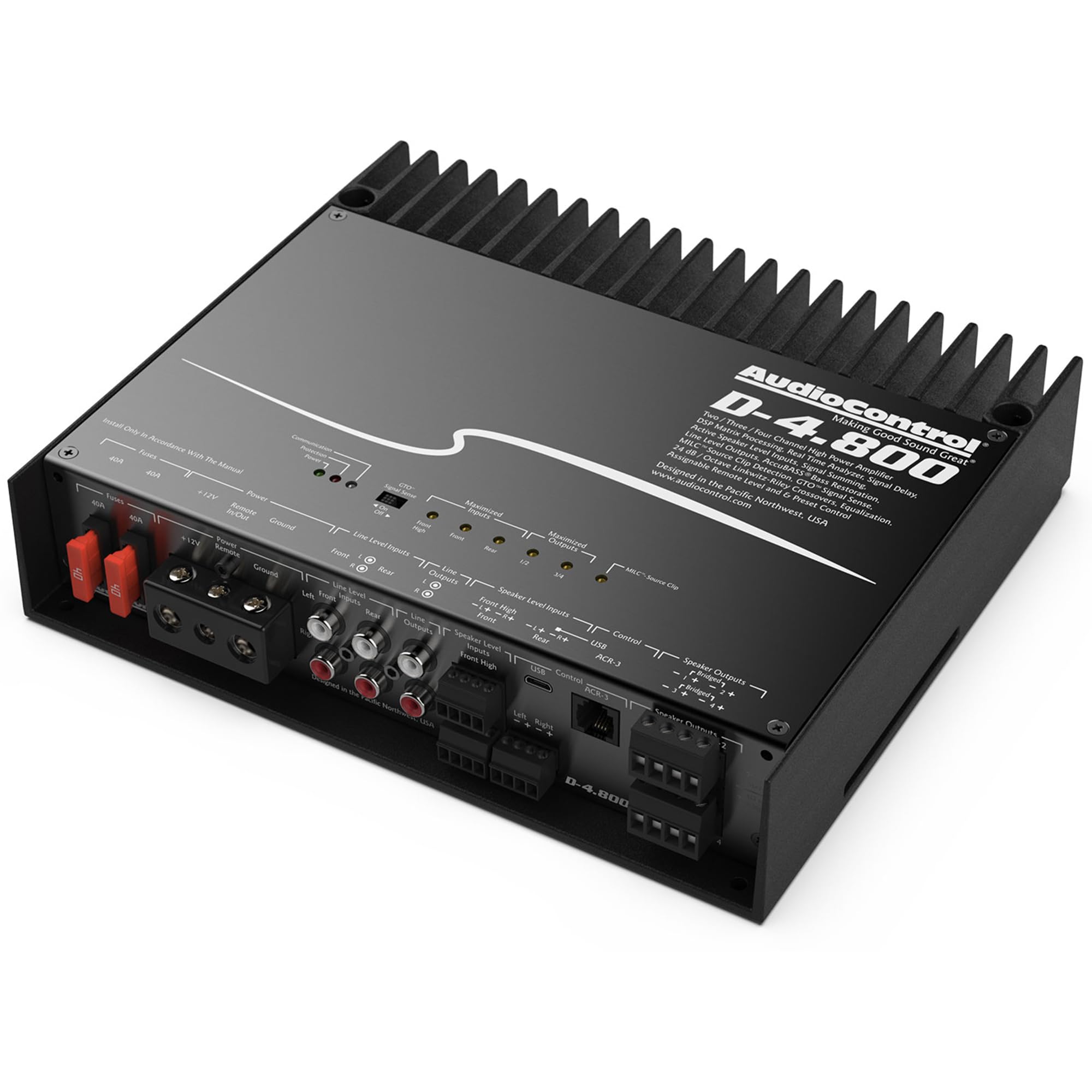
The AudioControl D-4.800 is for the OEM integration purist. Its signature AccuBASS feature corrects bass roll-off caused by factory head-unit processing — the reason stock stereos sound weaker as volume climbs. Built around an 800-watt Class D design (4 x 125W at 4 Ohms), this 4-channel amp configures down to 3 or 2 channels for flexible system layouts, and at 5 pounds it’s a manageable install.
Input flexibility is a standout: 6 speaker-level inputs plus 4 balanced RCA preamp inputs let it sum factory signals cleanly. The DM Smart App provides the tuning interface, backed by a 30-band graphic EQ and a 10-band parametric EQ per output channel. Crossovers run at 12, 18, or 24 dB per octave so you can dial in exactly which frequencies reach which speaker.
The programming side demands a laptop, and the app’s file-saving logic frustrated more than one owner despite the amp’s otherwise stellar reputation. Built-in diagnostic codes help troubleshoot, and GTO signal sensing wakes the amp automatically when audio plays.
The factory-sound fixer: If your stock head unit crushes the bass, this AudioControl’s AccuBASS restores it while giving you pro-level EQ control.
7. Yamaha PX3 2x500W Lightweight Power Amplifier with DSP

A 2x500W Yamaha that pairs easily with branded speakers and sounds clean doing it.
The Yamaha PX3 is a 2-channel amp built for reliability and straightforward operation. It delivers 2 x 500W at 4 Ohms, and while Yamaha touts it as 50% lighter than previous P-Series amps, at 19.6 pounds it’s still a solid piece of pro gear. Its onboard DSP includes D-Contour processing and a Config Wizard that walks you through setup.
Owners running it with Yamaha CBR15 speakers and a MG10UX mixer report easy configuration thanks to pre-registered speaker profiles. The unit handles karaoke, gaming, and home theater fronts with equal composure. For a home theater receiver, the amp drives L/R channels with complete clarity — one buyer used the DSP’s gain boost and equalizer in ADVANCED mode to hit rated RMS power.
The 2U rack design features Panel Lock to prevent accidental changes, Event Logging for diagnostics, and USB stick profile saving. Buyers consistently describe it as “solid reliable performance” from a well-supported brand.
The set-and-forget option: If you want dependable pro power with easy DSP presets and aren’t chasing extreme wattage, this Yamaha is a confident choice.
8. Crown XLS2502 2-Channel DriveCore Power Amplifier with DSP

775 watts of ultra-clean power that’s famously quiet while driving demanding 4-ohm speakers.
The Crown XLS2502 improve the XLS line with more headroom: 775W at 4 Ohms per channel, and it can bridge to a massive 2500W for subwoofer duty. It’s a proven workhorse for high-end home theaters — one owner runs five Crown XLS amps across Martin Logan speakers and praises how cool and quiet the units stay, noting they “handle 4-ohm easily” in hot climates. The 10.8-pound weight keeps it rack-friendly.
DSP control goes deeper than the XLS1002, with a band-pass filter per channel. Selectable input sensitivity (1.4V or.775V) plus Peakx Limiters give you precision and protection. The PureBand Crossover System tune frequency splitting, and the forced-air fans only spin up in short bursts — buyers calling it “so quiet that I have no idea what is going on inside it.”
While the sound is “clean and quiet with better controlled bass and no hiss,” some owners find the bright standby lights distracting since they can’t be disabled. Power draw sits around 46W at idle.
The clean-power specialist: If you’re driving power-hungry 4-ohm home theater speakers, this Crown combines serious wattage with genuinely silent operation.
9. AudioControl D-6.1200 Matrix DSP 6-Channel Amplifier
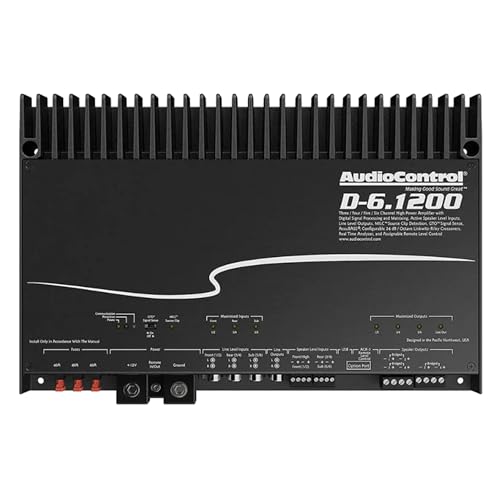
A 6-channel, 1200-watt DSP amplifier that powers and processes an entire vehicle’s audio system.
The AudioControl D-6.1200 is the flagship for complete car audio builds. Its 6-channel design (6 x 125W at 4 Ohms) configures down to 5, 4, or 3 channels, and it can power a full front stage plus a subwoofer in one compact aluminum chassis. Despite the 1200-watt capability, it stays at 5 pounds and fits in a 12 x 8 x 2.1-inch footprint — short enough for under-seat mounting.
Inputs are extensive: 8 speaker-level inputs and 6 balanced RCA preamp inputs, all with input/output RTA analysis to identify and sum factory signals. The 30-band graphic EQ plus a 10-band parametric EQ per output channel is the same tuning depth as its 4-channel sibling, and AccuBASS restores factory bass roll-off. The DM Smart App handles programming, and GTO signal sensing means no remote wire is needed.
The tuning is deep, and that’s the catch — the owner consensus is that it’s “not for a novice,” needing roughly six hours and an external RTA microphone for best results. Owners who invest the time report “exceptional sound quality” that outshines other top brands, though some question the price.
The enthusiast’s endgame: If you’re building a serious multi-speaker system and enjoy deep tuning, this AudioControl delivers flagship DSP flexibility plus real power.
Look elsewhere, though, if: you want plug-and-play — this unit demands time and patience to reach its potential.
Understanding the Specs
Channel Count
Each speaker you need to power and tune individually takes one channel. A 4-channel amp covers standard front-and-rear door speakers. An 8-channel amp allows a fully active setup where tweeters, mids, and subwoofers are each processed separately. For a standalone subwoofer, a single channel is enough.
Output Power (Watts)
This tells you how loud the amp can drive your speakers. More watts usually means cleaner output at higher volumes, but matching power to your speakers is more important than chasing the biggest number. For subwoofers, power matters most; for OEM car upgrades, DSP correction matters more than raw wattage.
FAQ
What does DSP actually do in an amplifier?
Will an amp with DSP fit my car’s factory stereo?
Do I need a 4-channel or 8-channel DSP amp?
How hard is it to tune a DSP amplifier?
Can I use a pro audio DSP amp at home?
What is a plate amplifier?
How many watts do I need for a subwoofer amp with DSP?
What is the difference between a graphic EQ and a parametric EQ?
Final Thoughts: The Verdict
Across the board, the amp with dsp winner is the Kicker 47KEY2004 because auto-tuning makes professional-grade sound correction accessible to anyone. If you want to revive a dead subwoofer with deep tuning power, grab the Dayton Audio SPA250DSP. And for the enthusiast building a complete multi-channel system, the AudioControl D-6.1200 is the flagship to reach for. The Kicker holds the highest owner satisfaction among the car audio picks, making it the safest starting point for a major factory stereo upgrade.
How We Picked
We do not accept paid placement. Every pick is matched to a real buyer and a real use-case; we do not hands-on test units.
Sources & Methodology
Specifications: manufacturer listings and product documentation. Review insights: verified customer reviews, as of July 2026. Pricing: not shown on this page (it changes often); check the current price via the retailer link.
As an Amazon Associate, Gadgets Feed earns from qualifying purchases. This does not affect which products we feature.