
Our readers keep the lights on and my morning glass full of iced black tea. As an Amazon Associate, I earn from qualifying purchases.
Specs are compiled from manufacturer listings and verified buyer reviews and can change over time — please confirm the key details on the product page before buying.
You want a bathroom fan that clears steam fast without sounding like a jet engine. The 150 CFM rating (cubic feet per minute, or how much air it moves) tells you the airflow, but the “sones” rating (a measure of loudness) tells you what your ears will experience. This guide compares four top-rated units by their published specs and the patterns across verified owner reviews, so you can match the right fan to your bathroom size, ceiling setup, and tolerance for hum.
I’m Min — the founder and writer behind Gadgets Feed. This guide is built by comparing the manufacturers’ published specifications and the patterns across verified customer reviews, so you get each pick’s real strengths and trade-offs instead of marketing spin.
The quietest models use ECM motors and insulated housings to push air without the drone of older fans. For most homes, the 150 cfm bathroom fan that hits the best balance of low noise, easy installation, and proven reliability will serve you for a decade or more.
Our Picks at a Glance

How To Choose The Best 150 CFM Bathroom Fan
Choosing a bathroom fan means balancing airflow (CFM), loudness (sones), and ceiling fit. A 150 CFM rating suits large bathrooms, but the sone rating determines whether you’ll tolerate it running while brushing your teeth.
Read the sone rating, not just the CFM
Sones measure perceived loudness. A fan rated at 0.5 sones is whisper-quiet, while a 1.4-sone fan is noticeable but still far quieter than the 4.6-sone units older homes often have. If you hate fan noise, prioritize the lowest sone number you can find; if the fan runs in a rarely used guest bath, a slightly louder unit is fine.
Match the ceiling opening to your existing hole
Every fan has a housing size that must fit between your ceiling joists. Some units use collapsible frames that flex around obstructions, while others need a specific opening dimension. Measure your current cutout before buying; the biggest installation headaches come from a fan that is slightly too large for the hole you already have.
Know whether you have attic access
Some fans let you wire and duct everything from below the ceiling, which is a lifesaver for upper-floor bathrooms. Others require you to climb into the attic to connect the duct and electrical. Check the manufacturer’s installation notes so you do not buy a fan you cannot physically install.
Quick Comparison
| Model | Best For | Noise (Sones) | Airflow Options | Housing Depth | Amazon |
|---|---|---|---|---|---|
| Panasonic WhisperChoice★ Best Overall | Quiet plus lighting | 0.8 sones | 130 / 150 CFM | 7-3/8 in. | Amazon |
| KAZE APPLIANCE SEP150 | Near-silent airflow | 0.5 sones | 150 CFM | 7-3/8 in. | Amazon |
| Broan-NuTone QTXE150 | Continuous operation | 1.4 sones | 150 CFM | 2×8 in. framing | Amazon |
| Panasonic FV-1115VQ1 | Adjustable speed | <0.3 sones | 110 / 130 / 150 CFM | 7-3/8 in. | Amazon |
In-Depth Reviews
1. Panasonic WhisperChoice 0.8-Sone 150-CFM White Bathroom Fan
Our pick — over 4.5★ from 100+ verified ratings; the strongest balance of quality and price.
The do-it-all fan that pairs serious airflow with a built-in dimmable light.
This Panasonic is the rare fan that solves two problems at once: it clears steam and lights the room. The built-in 10W dimmable LED panel runs at 3000 Kelvin (warm white), and a separate LED night light draws less than 0.1W — perfect for middle-of-the-night trips. At 150 CFM it produces 0.8 sones, which owners describe as extremely quiet while still knocking out moisture fast.
The install works for most standard ceilings. The housing fits joists sized 2 in. x 8 in. or larger with a 7-3/8 in. depth, and the collapsible frame gets positive mentions for making the job easier. You can also dial it down to 130 CFM for slightly quieter operation in smaller rooms from 130 to 150 sq ft. One note: the night light must be wired separately, and buyers suggest having an insulated 6-inch duct ready.
Reliability is a strong suit here, with the fan UL Listed for tub and shower use on GFCI circuits. The fan is UL Listed for use over a tub or shower enclosure when it is on a GFCI-protected circuit, so it is safe for the most humid spot in the house. The quality build shows, with owners most often praising the quiet noise level.
What wins people over
- Dimmable LED light plus a low-power night light
- Quiet 0.8-sone operation at full 150 CFM
- Collapsible frame eases installation
- UL Listed for tub or shower use on a GFCI circuit
Watch out for
- Night light needs separate wiring
- Unit must sit flush below the drywall
- 6-inch duct has no 4-inch adapter included
Reach for this if: you want one fixture that both ventilates a large bathroom and lights it with a dimmable warm LED.
Look elsewhere if: your bathroom has a tight 4-inch duct run, because this fan expects a 6-inch duct.
2. KAZE APPLIANCE SEP150 150 CFM 0.5 Sone Ultra Quiet Fan

The near-silent 0.5-sone powerhouse that is 2.8x quieter than the Broan below.
If quiet is your absolute top priority, this KAZE is the pick. It runs at just 0.5 sones — the quietest rating on this list, a 2.8x gap versus the 1.4-sone Broan — while still pushing a full 150 CFM of air for bathrooms up to 150 sq ft. Owners swapping out 20-year-old fans report humidity dropping roughly 75% after switching.
Installation is designed for accuracy. Sliding hanger bars span up to 24 inches to position the housing between any framing type, and the package includes a 6-inch duct adapter plus a ceiling template to cut the hole. The removable 6-inch duct has a back draft prevention damper, so cold attic air does not seep back in when the fan is off.
The catch is access. This unit must be installed from the attic, and it expects a ceiling opening of 11 3/8 x 10 1/2 inches — if your existing hole differs, you will need to resize it. One owner summed up the experience as a quiet upgrade from a 20-year-old unit that is well-built with easy wiring, though the 6-inch duct may need a reducer for older homes.
Quiet by design: a 0.5-sone rating that makes it the peace-and-quiet champion here, backed by sliding hanger bars for precise positioning.
Plan the install: attic access is required, the opening must be 11 3/8 x 10 1/2 inches, and wire nuts are not included.
Best suited for: anyone who will tolerate attic work to get the quietest 150 CFM airflow possible.
Not for: first-floor bathrooms with no attic hatch, since the housing must be reached from above.
3. Broan-NuTone QTXE150 Ultra-Silent Ventilation Fan
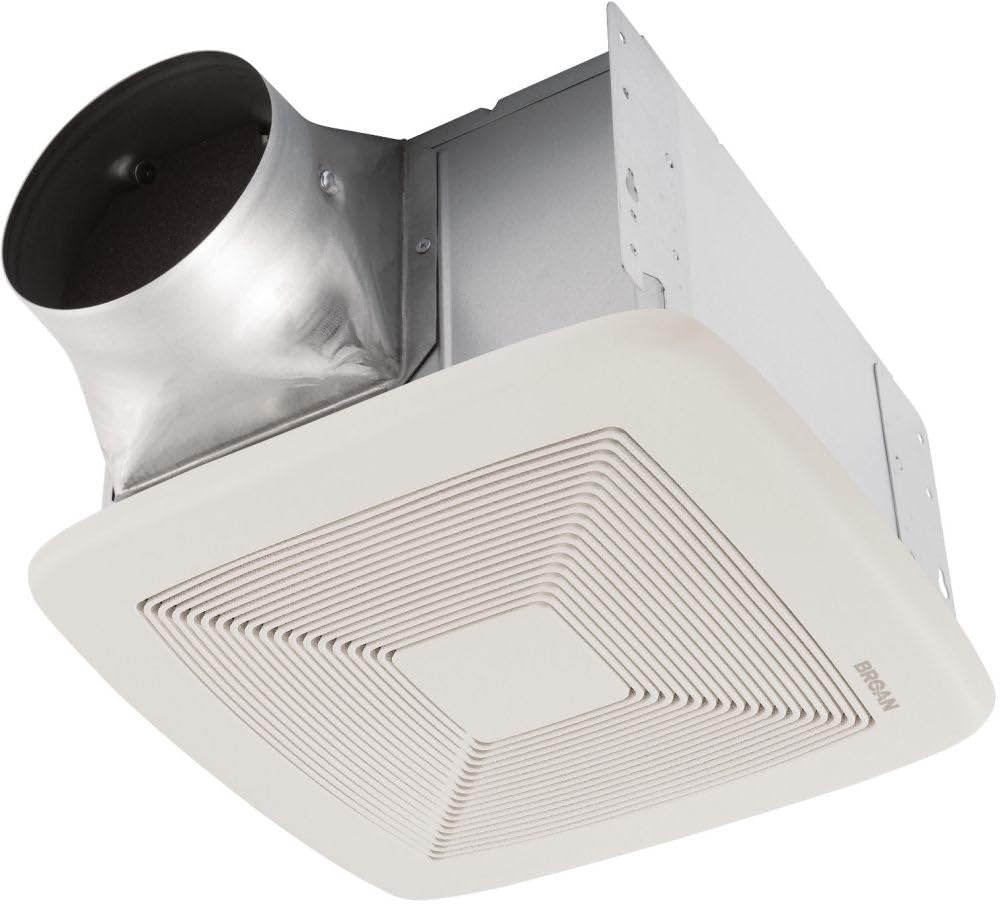
A continuous-duty workhorse with paintable grilles and a no-frills approach.
The Broan is built for one thing: constant, dependable ventilation. Its motor is engineered for continuous operation, meaning you can leave it running far longer than a standard fan without worrying about wear. At 150 CFM and 1.4 sones, it is noticeably louder on paper than the KAZE’s 0.5 sones, but owners still call it near-silent compared to the old 4.6-sone units it typically replaces.
It handles rooms up to 140 sq ft and takes aim at humidity, tobacco smoke, and cooking odors. The paintable polymeric grilles are a thoughtful touch — you can spray them to match your ceiling exactly. Installation is straightforward in 2-inch by 8-inch construction with the included hanger bars and 6-inch ducting, and it is UL listed for tub or shower use on a GFCI circuit.
The trade-off is the retro-fit experience. Buyers report that squeezing this into an existing opening can be tricky when ceiling clearance is low, and one backflow flap arrived broken. But the consensus is clear: it is quiet, it is effective, and after a month of daily showers, the humidity cloud is gone.
Continuous-duty muscle: a motor built to run nonstop, making it ideal for homes that need constant fresh air, not just post-shower venting.
Fit note: retrofitting into an old ceiling hole can be difficult, and the 6-inch vent requires adequate clearance above.
Pick this for: homeowners who want a dependable, energy-efficient fan and do not mind 1.4 sones of gentle background noise.
Think twice if: you are replacing a fan in a cramped ceiling cavity, because the retrofit is the most common complaint.
4. Panasonic FV-1115VQ1 WhisperCeiling DC Fan

The ultra-efficient DC-motor fan that is nearly inaudible at any speed.
This Panasonic uses a DC (electronically commutated) motor, which is the same efficient technology found in premium appliances. The result is a fan rated below 0.3 sones at every speed setting — so quiet that owners say they forget it is on and sometimes mistake it for water running in the pipes. The Pick-A-Flow selector lets you choose 110, 130, or 150 CFM, so one fan adapts to your room size now and later.
Installation is genuinely different from the others. The Flex-Z fast bracket is designed to be wired and ducted entirely from below the ceiling, which means no attic access is required. The included 6-inch duct adapter pairs with a 7-3/8 inch housing depth, and the kit even comes with self-drilling screws and a template for cutting the hole.
Reliability is a family trait here, with owners reporting previous Panasonic units lasting seven-plus years. Owners mention previous Panasonic units lasting seven-plus years without issue, and one replaced a 20-year-old Broan with this fan to eliminate moisture on the ceiling after showers. The larger footprint and oversized grille are note, but the flush mount means the cutout template fits perfectly.
Why owners love it
- Below 0.3 sones at any of the three speeds
- Flex-Z bracket installs completely from below the ceiling
- Pick-A-Flow selector adjusts from 110 to 150 CFM
- ECM motor for energy efficiency
Keep in mind
- Larger housing and grille than standard fans
- So quiet you may forget to switch it off
Grab this if: you have no attic access and want a fan you can wire and duct from a ladder inside the bathroom.
The single caveat: its generous footprint means you need a ceiling area that can take a larger housing.
Understanding the Specs
Sones vs CFM
CFM (cubic feet per minute) measures how much air the fan moves, which tells you if it can handle your room size. Sones measure perceived loudness on a scale where each whole number is roughly twice as loud as the one before. A 0.5-sone fan is a whisper; a 1.4-sone fan is noticeable but gentle; a 4.6-sone fan is the noisy drone many old homes have. Always check both numbers before buying.
Ceiling Opening and Housing Depth
The housing depth is the vertical space the fan body needs inside your ceiling cavity, usually measured in inches. The ceiling opening is the width of the cutout you need to make. If your existing hole is smaller than the new fan requires, you will have to cut drywall to enlarge it. Fans with sliding hanger bars can adapt to different joist spacings, but the opening size is fixed — measure it before you buy.
FAQ
Will a 150 CFM fan fit in my existing ceiling opening?
Do I need attic access to install a 150 CFM bathroom fan?
What is the difference between 0.5 sones and 1.4 sones?
Can these fans be installed over a bathtub or in a shower enclosure?
What size duct does a 150 CFM fan need?
What size bathroom does a 150 CFM fan handle?
Can I adjust the airflow speed on a 150 CFM fan?
How long will a quiet bathroom fan last?
Final Thoughts: The Verdict
For most households, the top 150 cfm bathroom fan is the Panasonic WhisperChoice because it pairs a quiet 0.8-sone motor (about as loud as a whisper) with a dimmable LED light, so you get ventilation and lighting in one fixture. If silence is everything and your home has attic access, the KAZE SEP150 delivers 0.5-sone performance, which is even quieter. For a dependable workhorse that can run continuously, the Broan-NuTone QTXE150 is a solid value, and the Panasonic FV-1115VQ1 is the best pick when you cannot reach the attic at all. The crowd favorite holds 4.6 stars across over 100 ratings, winning owners over by clearing steam quietly without drawing attention.
How We Picked
We do not accept paid placement. Every pick is matched to a real buyer and a real use-case; we do not hands-on test units.
Sources & Methodology
Specifications: manufacturer listings and product documentation. Review insights: verified customer reviews, as of August 2026. Pricing: not shown on this page (it changes often); check the current price via the retailer link.
As an Amazon Associate, Gadgets Feed earns from qualifying purchases. This does not affect which products we feature.