
Our readers keep the lights on and my morning glass full of iced black tea. As an Amazon Associate, I earn from qualifying purchases.
Specs are compiled from manufacturer listings and verified buyer reviews and can change over time — please confirm the key details on the product page before buying.
The ground is unforgiving, and the cold creeps up on you after midnight. A camping pad for backpacking is the difference between waking up refreshed and waking up stiff, cold, and counting the hours until sunrise. The two big questions are simple: do you want guaranteed durability or maximum comfort, and how much warmth do you actually need for the seasons you hike?
I’m Min — the founder and writer behind Gadgets Feed. This guide is built by comparing the manufacturers’ published specifications and the patterns across verified customer reviews, so you get each pick’s real strengths and trade-offs instead of marketing spin.
The best way to choose the right camping pad for backpacking is to match its weight and insulation to the coldest nights you plan to face on the trail.
Our Picks at a Glance

How To Choose The Best Camping Pad For Backpacking
Backpacking pads are a trade-off game. Every ounce you carry on your back is an ounce you feel on every uphill mile, so the pad that feels amazing in the store might feel awful on day three of a trip. The key is knowing which spec matters most for the kind of nights you actually spend outside.
Decide between foam and air first
Closed-cell foam pads are bombproof — they never puncture, never deflate, and double as a sit pad or a dog bed on the trail. Air pads win on comfort and packed size, but they demand care: a sharp rock or a stray branch can end your night unless you carry a repair patch.
Match the R-Value to your season
R-Value measures how well the pad blocks ground cold. A summer pad with an R-Value around 1.5 keeps you warm in mild weather, a 3-season pad lands in the 3 to 5 range, and a true all-season pad pushes past 6. If you camp in the shoulder seasons, this number matters more than any other spec on the page.
Quick Comparison
| Model | Best For | Type | R-Value | Weight | Amazon |
|---|---|---|---|---|---|
| NEMO Switchback★ Best Overall | Bulletproof durability | Foam | 2 | 0.42 kg | Amazon |
| Klymit Static VSmart Value | Budget-friendly comfort | Air | — | 13.5 oz | Amazon |
| Elegear 4″ CumbreXArctic Grade | Extreme cold | Air | 9 | 2.2 lbs | Amazon |
| Hikenture | Value all-season warmth | Air | 6.2 | 1.53 lb | Amazon |
| Big Agnes Divide | Warm-weather comfort | Air | 1.5 | 19 oz | Amazon |
| Sea to Summit Ultralight | Minimal pack weight | Air | 1.1 | 0.89 pounds | Amazon |
| Big Agnes Rapide SL | 3-season warmth | Air | 4.8 | — | Amazon |
| Therm-a-Rest NeoAir Xlite NXT | Ultralight all-season | Air | 4.5 | 11.5 oz | Amazon |
| NEMO Tensor All-Season | Quiet luxury nights | Air | — | 590 g | Amazon |
In‑Depth Reviews
1. NEMO Equipment Switchback Foam Sleeping Pad
Our pick — over 4.5★ from 650+ verified ratings; the strongest balance of quality and price.
The featherweight that never lets you down, because it has no air to lose
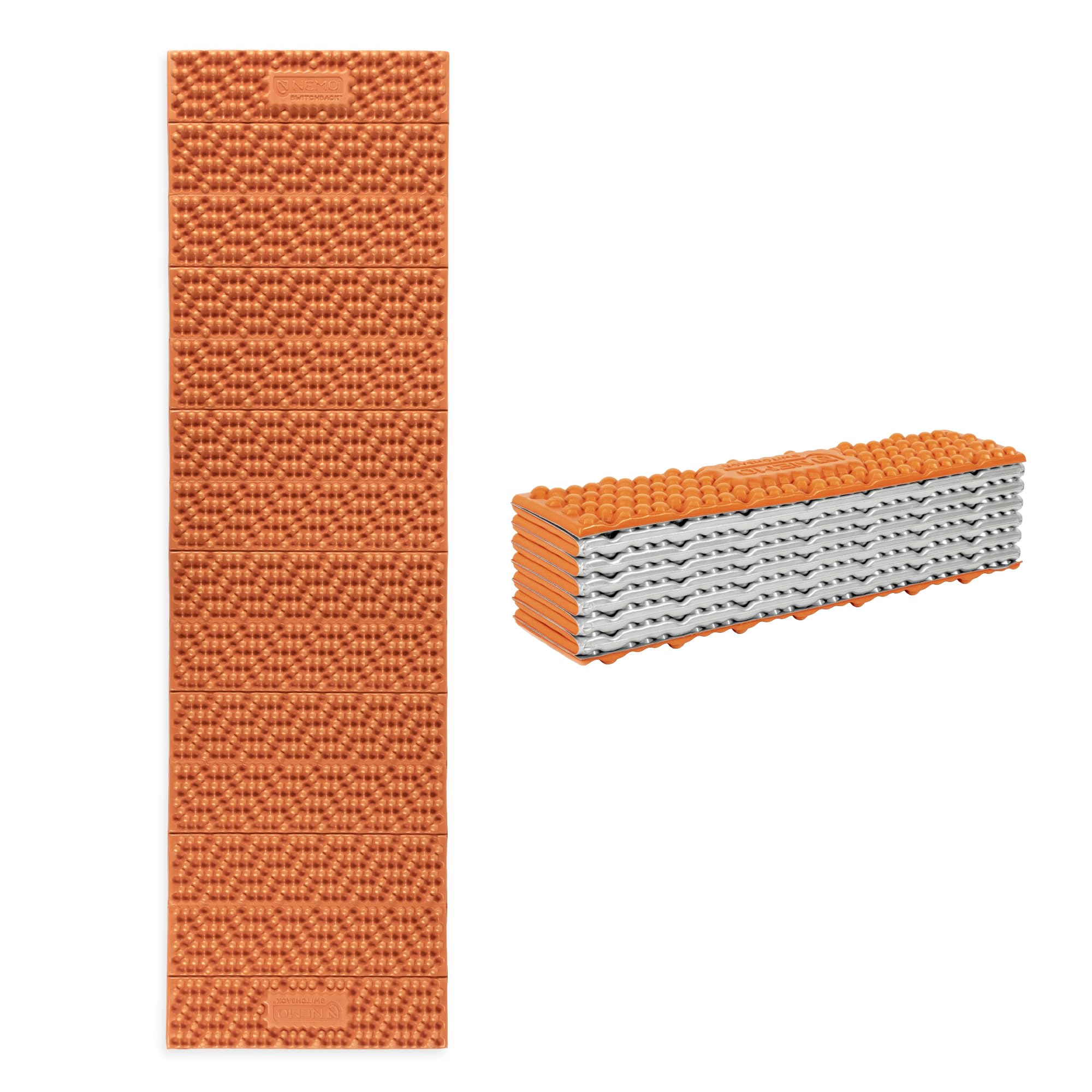
This pad flips the usual backpacking worry on its head: there is no bladder to puncture, no valve to fuss with, no midnight hiss. The closed-cell foam construction means a sharp rock or a stray branch simply cannot end your night, which is why durability is the thing owners talk about most. Its hexagonal nesting pattern carves out room for taller, wider nodes, so you get noticeably more plushness than the foam pads of a few years ago.
You stay warm because a metallized thermal reflective film bounces your body heat back, and the dual-density Axiotomic foam (a foam with a soft top layer and a firmer base) supports you without sagging. The trade-off is a modest R-Value of 2 (a measure of insulation; higher means warmer), so this is a three-season pad at best — owners pair it with an inflatable pad beneath when the mercury heads toward the teens, and they report that combo feels bed-like. Many people cut the full-size pad down and get three separate pieces out of it: a torso pad, a sitting pad, and a dog bed.
At 0.42 kg, it is not the lightest option here, and foam pads never pack as small as air pads. But buyers report it holds up where others fail, even surviving a scrape with barbed wire that gouged the surface without hurting function. If your trips lean toward dry climates and you want total confidence, this is the pad that will outlast every air bladder in your gear closet.
Built to Outlast
- Foam cannot puncture or deflate
- Reflective film adds warmth without weight
- Doubles as a sit pad and a gear mat
Fair Trade-Offs
- R-Value 2 limits deep-winter use
- Bulkier rolled than an air pad
- Firmer feel than inflatable rivals
Reach for this if: you want bombproof reliability and a pad that earns its place as a camp seat, dog bed, and sleep surface all in one.
Look elsewhere if: your nights fall below freezing and you want thick, cushioned loft without adding a second pad.
2. Klymit Static V Sleeping Pad
A comfort-first air pad that deflates to the size of a soda can
This is the pad for the hiker who refuses to accept a sore hip after a long day. The signature V-shaped chamber limits air movement so you do not roll off in the night, and the inflated dimensions of 50.4 inches long, 23 inches wide, and 2.5 inches thick give you room to shift without spilling onto the tent floor. It compresses down to 3 by 8 inches when deflated, which is why portability is among the most-praised traits in the reviews.
At 13.5 oz it is genuinely light, and the dynamic side rails keep you centered all night — no small thing for side sleepers who toss. The polyester construction feels durable in hand, and inflation is straightforward through the separate valves. It is a compact fit, though; shorter adults and kids will find it roomy, while taller men may find themselves running out of length.
The catch is air retention, which comes up repeatedly in owner feedback. Most users enjoy a full night of support, but a small number report the pad losing pressure within a couple of hours of use. Keep the included patch kit close and lay down a ground cloth to protect the fabric, and this becomes a remarkably comfortable value pick for ounce-counting hikers.
Why owners pick it: the size-to-comfort ratio has no equal near this tier — it disappears into a pack and still cradles you at the end of the day.
The honest watch-out: a minority of pads lose air over a few hours, so test yours at home before you trust a long trail night to it.
3. Elegear 4″ Thick Sleeping Pad with 9 R-Value
The warmest pad here, rated to shrug off -40°C ground chill
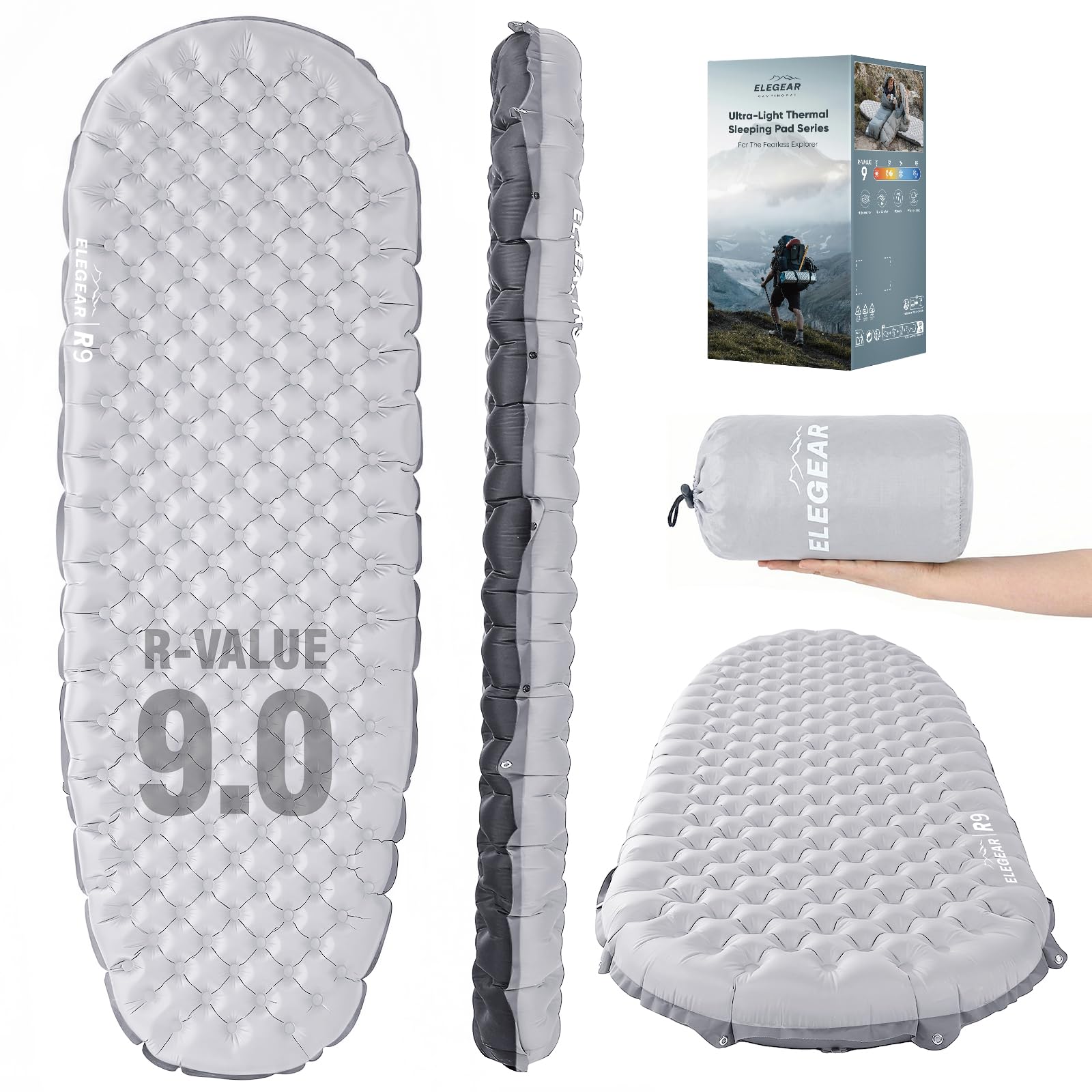
If you plan to camp where frost bites hard, this is the pad that keeps the cold at bay. Its 9 R-Value is an enormous insulation figure — compare that to the NEMO Switchback’s 2, and you are looking at a roughly 4.5x gap in ground-cold protection. The 4-inch thickness also beats the standard 3.2-inch camp mat, so your hips and shoulders stay cushioned even on uneven, rocky terrain where thinner pads bottom out.
Heavier hikers have nothing to fear here: owners mention that at 278 lbs, there is no bottoming out on the hip, even for side sleepers. The 20D tear-resistant nylon with a reinforced TPU layer shrugs off abrasion and moisture, and the mummy shape keeps the packed size sensible. Inflation is fast and tool-free — the included pump sack fills it in just 4 to 6 pumps.
The honest trade-off is weight. At 2.2 lbs, this is the heaviest pad in this lineup, so ultralight purists chasing a sub-pound pack will pass. But for car campers, winter trips, and hikers who prioritize a genuinely warm night over a few saved ounces, the comfort payoff is what the reviews keep circling back to. One owner took it up Mt Rainier to Camp Muir during a summit attempt and called it very warm and comfortable, highlighting its alpine reliability..
Warmth That Works
- 4-inch loft cushions hips and shoulders
- Pump sack inflates in 4–6 pumps
- 4-season insulation for cold camps
What It Costs You
- Heavier than every other pad here at 2.2 lbs
- Some owners note a crinkly, plastic-like feel
- Mummy shape gives less sprawl room
Best for: three-season-plus campers and bigger-bodied sleepers who would rather carry a few extra ounces than shiver at 20°F.
Not for: fast-and-light hikers counting every gram on a multi-day ascent.
4. Hikenture Camping Sleeping Pad with 6.2 R-Value
Four-season warmth that undercuts pads costing twice as much
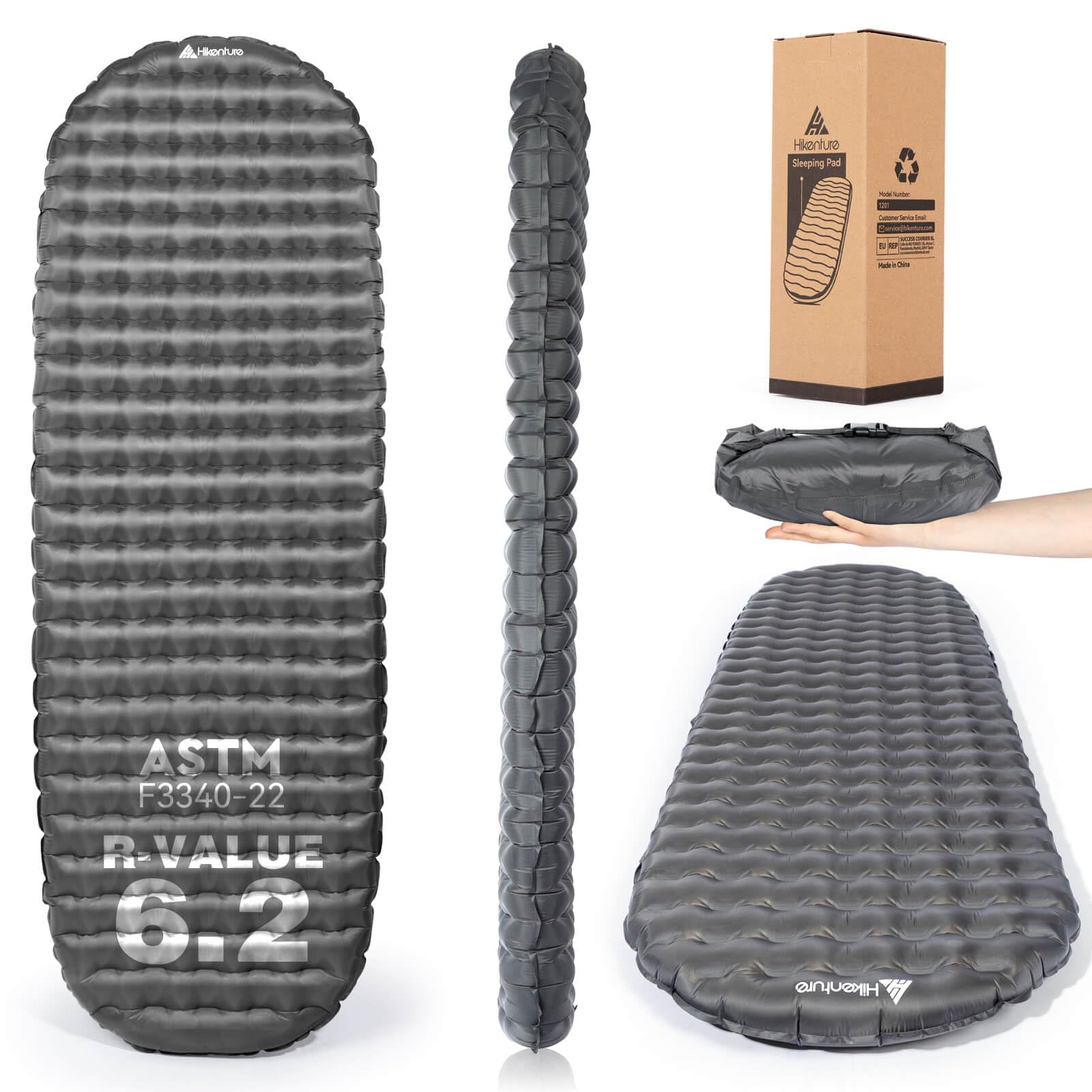
This pad threads a needle most brands miss: serious winter-grade insulation without the premium price tag. Its 6.2 R-Value (a measure of insulation; higher means warmer), tested to ASTM F3340-22 standards (a standard method for measuring sleeping pad insulation), comes from an aluminum film layer that reflects body heat, and the 3.2-inch thickness distributes your weight across an airbag structure so you do not bottom out sitting or lying down. One owner ran it through six months of hard use with a dog on board and reported it still looked new with no leaks, underscoring its durability..
At 1.53 lb, it splits the difference between ultralight and cushioned. The clever 2-in-1 storage bag doubles as a 40L pump sack, so you inflate the whole pad with about 3 pumps — no separate pump to pack or lose. Two repair patches come in the box for the inevitable trail mishap, and the TPU liner is an eco-minded choice. Buyers also praise the generous size, noting the extra length and width are a genuine upgrade over narrower rivals.
The recurring theme in owner feedback is a crinkly noise from the inner reflective liner when you shift at night — a minor annoyance, but real. Warmth is solid for mild and cool conditions, though some find cold legs a factor if feet slip outside the bag. For the hiker who wants real all-season capability without a flagship price, this is the value king of the list.
Why It Shines
- R-Value 6.2 covers three and four seasons
- Pump sack doubles as a 40L stuff bag
- Durable enough to survive 6 months of abuse
The Fine Print
- Reflective liner crinkles when you move
- Top-ups needed on colder second nights for some
- Not the quietest pad in a shared tent
Grab this for: budget-conscious backpackers who hit the trails across multiple seasons and want one pad to do it all.
skip it if: you are a light sleeper who cannot tolerate any crinkle noise from your pad at 2 a.m.
5. Big Agnes Divide Air Chamber Sleeping Pad

Like bringing a bed with you, minus the cold-weather bulk
This pad is built for the warm months, full stop, and it does that job beautifully. The proprietary I-Beam construction keeps the 3.25-inch profile stable and consistent, while the outer chambers run 3.5 inches larger to cradle you in the middle instead of letting you roll off the edge. Owners describe it as being wide enough to roll over comfortably — a luxury on the trail — and one called it “like bringing a bed with me.”
At an R-Value of 1.5, this is a dedicated summer pad, so do not bring it to a winter camp. The high-volume valve with micro-adjustments makes fine-tuning firmness easy, and the included inflation sack saves your breath. The regular 20-by-72-inch size weighs just 19 oz and packs down to 4 by 7 inches, which slots neatly into the bottom of any backpack. Recycled nylon ripstop with aviation-grade TPU lamination gives the weld strength you expect from Big Agnes.
Feedback splits on weight: some call it super lightweight, others find it a touch heavy for ultralight standards, and a few note the material rustles against a nylon tent floor. Stack a closed-cell foam pad underneath in colder weather — the brand’s own advice — and this becomes a versatile warm-season companion with a lifetime warranty behind it.
The comfort verdict: the thick, quiet, roll-over-friendly surface is the stand-out feature, and the wide outer chambers keep you centered all night.
Who should pass: cold-sleeping hikers and deep-winter campers who need more than a 1.5 R-Value between them and the frozen ground.
6. Sea to Summit Ultralight Backpacking Air Mattress

Sub-pound luxury for hikers who count every single gram
At 0.89 pounds with a packed size of just 3 by 6.5 inches, this is the pad that disappears into your pack and makes you forget you are carrying it. The Air Sprung Cell construction mimics a spring mattress, keeping more of your body in contact with the pad and spreading pressure evenly — owners consistently rank the comfort higher than self-inflating rivals. The regular size measures 72 by 21.5 by 2 inches, roomy enough for a normal adult to stretch out.
Inflation is the hidden win here. The multi-function valve works with the integrated Airstream Pumpsack (a stuff sack that doubles as an air pump), so you can fill it in just a few breaths or about 30 seconds with the sack — no moisture from your breath inside the pad, which is kinder to the materials over time. One-way deflation makes pack-up fast, and the non-slip 30D/40D nylon face (a durable, quiet fabric) is both durable and quiet. The single-layer cell design is what keeps the weight and packed size this low, while a 2-inch thickness still lifts you off the cold floor.
The catch is the R-Value of 1.1, which makes this strictly a warm-season pad — owners say summer use only and steer cold sleepers toward an insulated version. One traveler ran it for a month straight in the Congo rainforest and never lost air overnight, proving its airtight reliability in humid conditions., and the included field repair kit covers the occasional puncture. For hot sleepers and ounce-counters chasing fast-and-light trips, this is the comfort-to-weight champion.
Fast and Light
- Weighs just 0.89 pounds
- Pumps up in about 30 seconds with the sack
- Quiet, durable, non-slip face fabric
Know Before You Go
- R-Value 1.1 limits it to warm weather
- 2-inch loft feels firm to some side sleepers
- Premium price for a single-season pad
Choose it when: summer mileage and minimal pack weight matter more to you than all-season insulation.
pass on it if: you tend to run cold at night or camp anywhere the mercury drops below about 50°F.
7. Big Agnes Rapide SL Insulated Sleeping Pad

The three-season all-rounder that feels like a hotel mattress in a tent
There is a reason owners call this “the best pad ever made” — the Rapide SL pairs serious insulation with serious comfort. Two layers of heat-reflective film deliver an R-Value up to 4.8, making this a genuine three-season pad that holds warmth as temperatures drop. The quilted top creates a cushioned, pillowy surface, and the offset I-Beam construction at 3.5 inches thick with 4.25-inch outer chambers cradles you without the air mattress bounce that wakes you on every turn.
Setup is genuinely fast thanks to the Pumphouse inflation sack — owners say it inflates in seconds without introducing moisture, which is easier on the pad and easier on your lungs at altitude. The high-volume valve with micro-adjustment dials in your preferred firmness, and the superlight double ripstop nylon with aviation-grade TPU lamination keeps the weight down while holding strong welds. One owner carried it on a week-long Grand Canyon trip and called it light, packable, and comfortable, confirming its trail-ready portability..
The recurring note is that the sew-line construction leaves some room for wear after prolonged rocky-backcountry use — One long-term owner got 3 months of hard use before concerns crept in, noting seam stress on rocky terrain.. Every pad is individually inflated and tested at the factory, backed by a lifetime warranty against manufacturing and material defects. For the hiker who wants one pad that handles spring, summer, and fall without complaint, this is the balance.
The Comfort Case
- R-Value 4.8 with two reflective film layers
- Quilted pillowy top, no air mattress bounce
- Pumphouse sack inflates in seconds
Fair Warning
- Prolonged rough-terrain use can stress the seams
- Premium price lands it in the higher tier
- Pair with foam for extreme cold
Best suited to: three-season backpackers who want hotel-grade comfort without carrying a mummy-sized brick.
Think twice if: your trips are mostly ultralight summer jaunts where an R-Value near 1.5 saves you a pound.
8. Therm-a-Rest NeoAir Xlite NXT Ultralight Sleeping Pad

An 11.5-ounce pad that somehow delivers a 4.5 R-Value
This is the pad that set the ultralight standard, and the NXT version refines the formula. At 11.5 oz with a 3-inch thick profile, it delivers the best weight-to-warmth ratio in this lineup — the Reflective ThermaCapture technology (a film that traps radiant heat) works with the Triangular Core Matrix construction (a structure that stops convective heat loss) to earn a 4.5 R-Value (a measure of insulation; higher means warmer) that carries you across three seasons and into light winter. One owner tested it down to 35°F and stayed warm all night, confirming its three-season warmth..
The WingLock valve is a joy after a long day: it inflates easily and deflates with lightning speed when you are breaking camp. The 30D ripstop nylon cover feels premium, and owners who upgraded from earlier models were delighted to find the NXT is quiet — the old crinkly reputation is gone. Holds air for 48+ hours, per multiple reports, with an anti-roll shape that keeps you centered and a regular-small size of 20 by 66 inches for the ultralight crowd.
There is a quality-control asterisk: a few buyers experienced a defective valve or shipping issues, which is frustrating at this price point. The baffled structure is also firm, so side sleepers who prefer deep cushioning may want to test the feel first. For thru-hikers and fast-and-light adventurers who refuse to sacrifice warmth for weight, the Xlite NXT remains the benchmark.
The Benchmark
- 11.5 oz with a 4.5 R-Value
- Quiet NXT fabric fixes the old crinkle
- WingLock valve for fast in and out
What Gives
- Premium price for the ultralight spec
- Firm feel, less plush for side sleepers
- Occasional quality-control issues reported
Reach for it if: you measure your pack in ounces and want three-season warmth that vanishes into your bag.
Pass on it if: you are a side sleeper who needs deep plush cushioning; this pad is firm by design.
9. NEMO Equipment Tensor All-Season Sleeping Pad
Statement-worthy silence and warmth crammed into a 590-gram frame
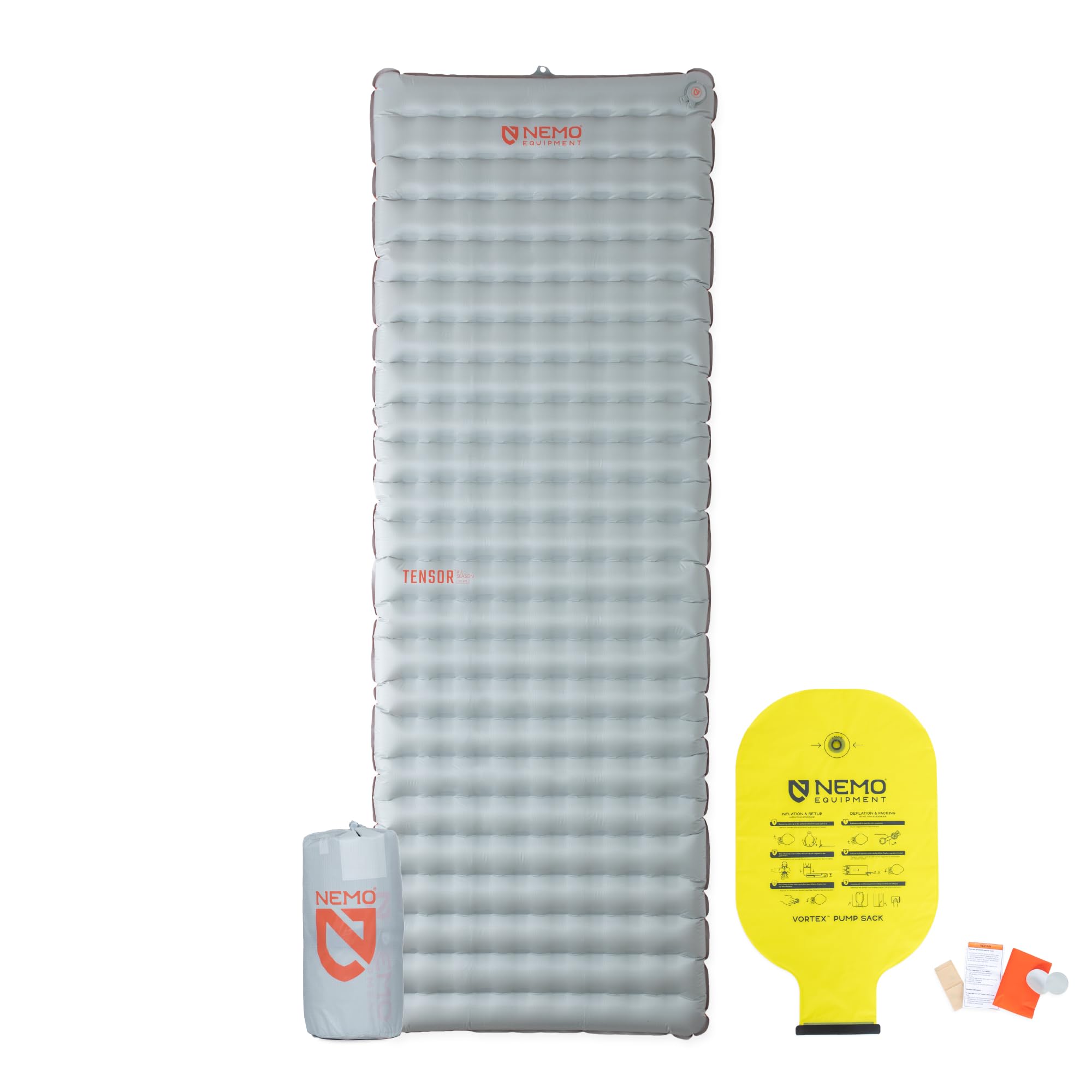
The Tensor All-Season is the pad for the hiker who has tried everything and now demands both peace and warmth. Two layers of floating Thermal Mirror metallized film deliver quiet insulation with a remarkable weight-to-warmth ratio, and the Spaceframe baffles use low-stretch, die-cut trusses to eliminate the springy, bouncy feel of lesser air pads. At 3.5 inches of cushioned loft, customers note it feels stable, not bouncy, and stays comfortable all night.
Warmth is the headline. The all-season build held up at 18°F in a hammock tent under a 190-lb sleeper with no cold spots, proving its winter-grade insulation., and a 5’10” hiker praised both the size and the fact that it held air all night on a fall trip. It also impressed on rocky ground, staying inflated for two full days, and the quiet fabric means no crinkle every time you shift — a real gift for anyone sharing a tent. The included Vortex Pump Sack (a stuff sack that doubles as an air pump) makes inflation quick and moisture-free.
The premium price is the main barrier, and it is a real one. A few buyers received opened boxes missing the repair patches, which points to fulfillment slips rather than product flaws. The 25-inch width is generous for sprawlers, and the bluesign-approved premium nylon shaves grams while resisting punctures and tears. If a silent, warm, genuinely comfortable night ranks above budget on your priority list, this is the gear investment that pays off every single trip.
What wins people over: the rare combination of real warmth, a quiet fabric, and a 3.5-inch loft that does not bottom out on rock — all in a 590-gram package.
The honest asterisk: it is the most expensive pad in this lineup, and occasional shipping mix-ups mean you should check the contents of your box on arrival.
Understanding the Specs
R-Value Explained
R-Value is the pad’s insulation rating — how well it blocks the cold from rising off the ground into your sleeping bag. A value around 1.5 is a summer pad, 3 to 5 handles three seasons, and anything above 6 is built for serious cold. Match it to the coldest night you plan to face, not the average one.
Weight vs Packed Size
Backpacking pads live and die by the ounces you carry. Air pads deflate to fit in a corner of your pack, while foam pads strap to the outside or back. Weigh your tolerance for inflation effort against your need for a smaller, lighter load — the trade-off drives every choice on this list.
FAQ
What R-Value do I need for three-season backpacking?
Is a foam pad or an air pad better for backpacking?
How do I inflate an air pad without getting breath moisture inside?
Will a sleeping pad keep me warm if my sleeping bag is not warm enough?
How do I fix a puncture in an inflatable sleeping pad?
What is the difference between an uninsulated and an insulated sleeping pad?
How heavy is too heavy for a backpacking sleeping pad?
Can I use a backpacking pad for car camping too?
Final Thoughts: The Verdict
Across the board, the camping pad for backpacking winner is the Big Agnes Rapide SL because it delivers the ideal blend of warmth, comfort, and packability for three-season trips. If you want an ultralight, durable foam pad that never fails you, grab the NEMO Switchback. And for budget-minded hikers who need real cold-weather insulation without the premium price, the Hikenture is the one to reach for.
How We Picked
We do not accept paid placement. Every pick is matched to a real buyer and a real use-case; we do not hands-on test units.
Sources & Methodology
Specifications: manufacturer listings and product documentation. Review insights: verified customer reviews, as of August 2026. Pricing: not shown on this page (it changes often); check the current price via the retailer link.
As an Amazon Associate, Gadgets Feed earns from qualifying purchases. This does not affect which products we feature.