
Our readers keep the lights on and my morning glass full of iced black tea. As an Amazon Associate, I earn from qualifying purchases.
Specs are compiled from manufacturer listings and verified buyer reviews and can change over time — please confirm the key details on the product page before buying.
An aquarium monitoring system is the difference between finding your tank perfectly stable and discovering a silent pH crash that stressed every fish inside it.. The best systems watch your water around the clock, send an alert to your phone the moment something drifts, and save you from the guesswork of daily test kits.. This guide breaks down the multi-parameter monitors, controllers, and smart power strips that actually earn their spot above your tank..
I’m Min — the founder and writer behind Gadgets Feed. This guide is built by comparing the manufacturers’ published specifications and the patterns across verified customer reviews, so you get each pick’s real strengths and trade-offs instead of marketing spin.
Whether you keep a planted freshwater tank or a reef full of sensitive corals, the right aquarium monitoring system tells you what is happening in the water before your fish show signs of trouble.
Our Picks at a Glance
How To Choose The Best Aquarium Monitoring System
Your aquarium’s water quality is the difference between thriving fish and a tank that slowly fails.. The right monitoring system depends on your setup: CO2 injection, saltwater, or a simple freshwater tank each need different levels of oversight..
Decide what you actually need to track
A basic system watches pH and temperature, which covers most freshwater planted tanks.. Saltwater and reef keepers need more, because salinity, specific gravity, and ORP all become critical when you have corals and invertebrates.. The more parameters a unit measures, the more probes and calibration it brings with it — so match the sensor count to your tank type, not to the biggest number on the box.
Monitor only, or monitor and control
Some systems simply display readings and push alerts to your phone. Others, like pH controllers and smart power strips, actually switch equipment on and off when a reading crosses your set limit. If you run pressurized CO2 or a heater that needs to react to conditions, a controller that can shut things down automatically is worth far more than one that only beeps at you.
Quick Comparison
| Model | Best For | Parameters Measured | WiFi / App | Control Output | Amazon |
|---|---|---|---|---|---|
| Milwaukee MC122US★ Best Overall | CO2 Reactor Control | pH Only | No | Hi/Low Relay (12 VDC) | Amazon |
| LANDTEK 6-in-1Best Value | Budget Multi-Parameter | pH, EC, TDS, Salinity, SG, Temp | Yes | App Alerts Only | Amazon |
| DANOPLUS Smart TesterSaltwater Pick | Saltwater pH & Salinity | pH, EC, TDS, Salinity, SG, Temp | Yes | App Alerts Only | Amazon |
| Gain Express WQM-242 | Rechargeable Continuous Read | pH, EC, CF, TDS, Temp | No | None | Amazon |
| AC Infinity Outlet AI | Environment Control | Temp, Humidity (dual zone) | Yes | 4 Smart Plugs | Amazon |
| Kactoily 7-in-1 WiFi | Reef All-in-One | pH, ORP, Salt, SG, TDS, EC, Temp | Yes | App Alerts Only | Amazon |
| Kactoily 7-Parameter Pro | Compact 7-in-1 | pH, ORP, EC, TDS, Salinity, SG, Temp | Yes | App Alerts Only | Amazon |
| Bluelab Guardian Monitor | Prosumer Hydroponics | pH, Conductivity, Temp | Yes | App Alerts Only | Amazon |
In‑Depth Reviews
1. Milwaukee Instruments MC122US pH Controller
Our pick — 4.5★ from 90+ verified ratings; the strongest balance of quality and price.
The hands-on controller that keeps your CO2 reactor honest, not just informative.
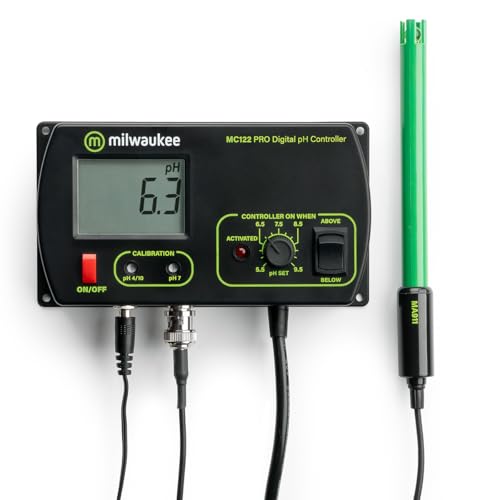
The MC122US earns the top spot because it does more than watch your pH — it acts on it. You set a user-selectable high or low set point, and when the reading crosses your line, the unit switches a power plug that is supplied specifically for CO2 dosing. That means your CO2 bubbles stop the moment your pH hits your target, so you never gas your fish and shrimp overnight.
Buyers report running two of these units to control pH in 30+ gallon hydro reservoirs for six months straight, with probes holding calibration and control staying stable the whole time. It reads a wide 0.0 to 14.0 pH range and uses a manual two-point calibration, which is simple and dependable. The visual LED alarm gives you an at-a-glance warning right on the unit, and it ships with a 12 VDC adapter and mounting kit so you can hang it where you can see it.
One recurring note from owners is that the included AC/DC adapter measured 19.78V on a multimeter instead of the labeled 12V, though Amazon resolved it quickly. If you run pressurized CO2 and want automatic shutoff rather than just a phone alert, this is the pick that keeps your livestock safe.
Why it wins
- Controls CO2 flow automatically at your set pH point
- Stable control with probes that hold calibration for months
- Visual LED alarm plus a dedicated CO2 dosing plug
The trade-off
- No WiFi or app — it is a controller, not a remote monitor
- One owner found the included adapter outputting 19.78V instead of 12V
Grab it if: you run pressurized CO2 and want an automatic safety shutoff when pH drifts out of range.
Look elsewhere if: you need to check readings from your phone while away from the tank.
2. Smart Water Quality Tester 6-in-1
A six-parameter dashboard that turns your phone into a full aquarium readout.
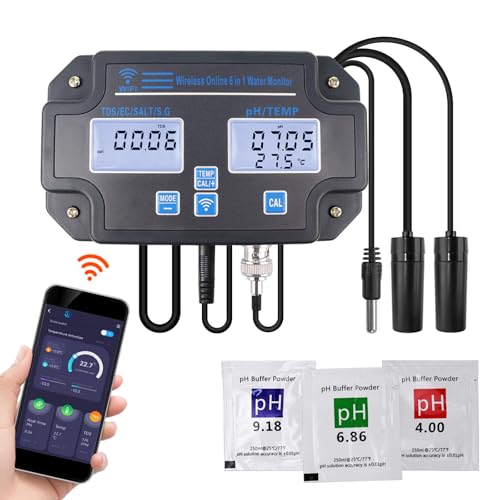
This LANDTEK unit is the budget pick that punches above its weight by measuring pH, EC, TDS, salinity, specific gravity, and temperature all in one probe. It pushes real-time data to your phone through the app, and you can scroll back through a 30-day history curve for any parameter to spot slow trends that a single glance would miss.
At 2.07 pounds it is noticeably heavier than the similar DANOPLUS unit at 1.39 pounds, which tells you the build is more substantial. Owners describe it as light and wall-mountable with tape, and they praise the one-touch calibration that does not require a tiny screwdriver like some meters do. The app includes an alarm function, so you can set a security range for each parameter and get a push notification when a reading goes above or below your limit.
Accuracy is the honest catch here. While some owners mention readings that match their expectations, others describe the pH probe becoming inaccurate even after repeated calibration, with one unit failing past the 30-day return window. This is a strong value pick if you want broad parameter coverage at a low entry cost, but it asks you to stay on top of calibration.
Where it shines: the 30-day data curve in the app is a genuinely useful tool for spotting slow changes in your tank before they become problems.
Know before buying: probe accuracy gets mixed reports, so budget for regular calibration checks.
3. Smart Water Quality Tester 24hrs Wireless
A minimalist six-in-one that reef keepers rate for pH and salinity at a friendly price.
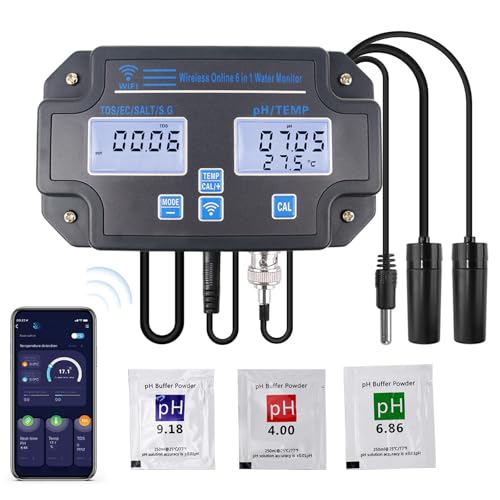
This DANOPLUS unit targets the same six parameters as the LANDTEK above — pH, TDS, EC, salinity, specific gravity, and temperature — but at 1.39 pounds it is the lighter, more portable of the two. Its claim to fame is a clean, minimalist design that does not distract from the look of your tank, paired with a straightforward display that is easy to read at a glance.
The app lets you view a data curve for each parameter going back 30 days, and you can set a security range per parameter to get notifications when readings cross your limits. Owners who run saltwater tanks call it the best of three similar monitors they tried, praising easy calibration and a clear display for reef use. One reef keeper got it running after solving a WiFi connection issue by manually adding the device as a “sensor other” in the app.
The durability picture is the honest trade-off. Several customers note the pH probe failing after roughly four months, with one unit reading pH 11 that would not recalibrate below 9.18. Calibration gets mixed feedback — some find it easy, others call it tricky. This is a fine entry-level saltwater monitor if you accept that the probe may need replacing sooner than you would like.
Its strength: saltwater hobbyists consistently rate its pH and salinity tracking as dependable for daily use.
Its limit: probe lifespan shows up as the main frustration across longer-term owners.
4. Gain Express 5-in-1 Water Quality Meter
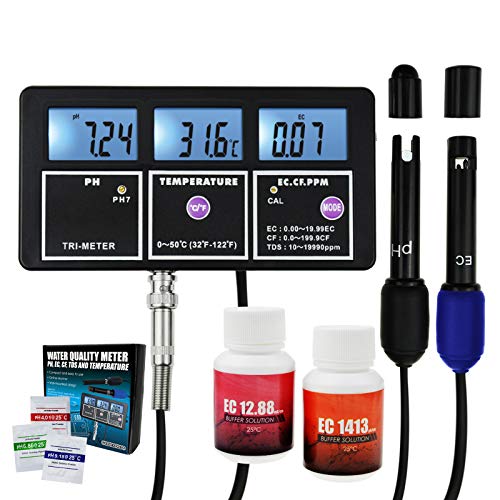
A wall-mounted dashboard with a backlit screen that keeps your water stats always visible.
Unlike the app-based units above, the Gain Express WQM-242 is a self-contained continuous monitor with a large-screen triple display and backlight, so you get instant readings without pulling out your phone. It measures five parameters — pH, EC, CF, TDS, and temperature — across ranges including pH 0.00 to 14.00 and TDS 10 to 19990 ppm. It runs on a rechargeable battery built into the main unit, or you can plug in the included adapter for long-term monitoring.
Owners call it a dashboard for the fish tank, with one saying its pH, thermometer, and TDS readings match multiple other meters they compared. The kit arrives pre-calibrated and includes both pH calibration powders and EC calibration solution, plus a removable BNC electrode and auto temperature compensation so readings stay consistent as water warms or cools.
The catch is design-related rather than accuracy-related. One owner found that when both probes sit in the same liquid, the EC reading goes out of range and pH drifts — they suspect electrical leakage between the two probes, and recommend keeping them in separate containers. Another owner warns against putting it inside a grow tent because the bright LED screen throws unwanted light. As a standalone continuous readout, it is a reliable workhorse, but it is not a remote monitor.
What owners love
- Backlit triple display is easy to read from across the room
- Rechargeable battery or included adapter for nonstop use
- Calibration solutions and powders ship in the box
What to watch
- Both probes together in one liquid can throw off EC and pH readings
- No WiFi or app — this is local display only
Pick this if: you want an always-on wall display you can glance at without opening an app.
Choose differently if: you need remote alerts while away from your tank for days at a time.
5. AC Infinity Outlet AI Controller
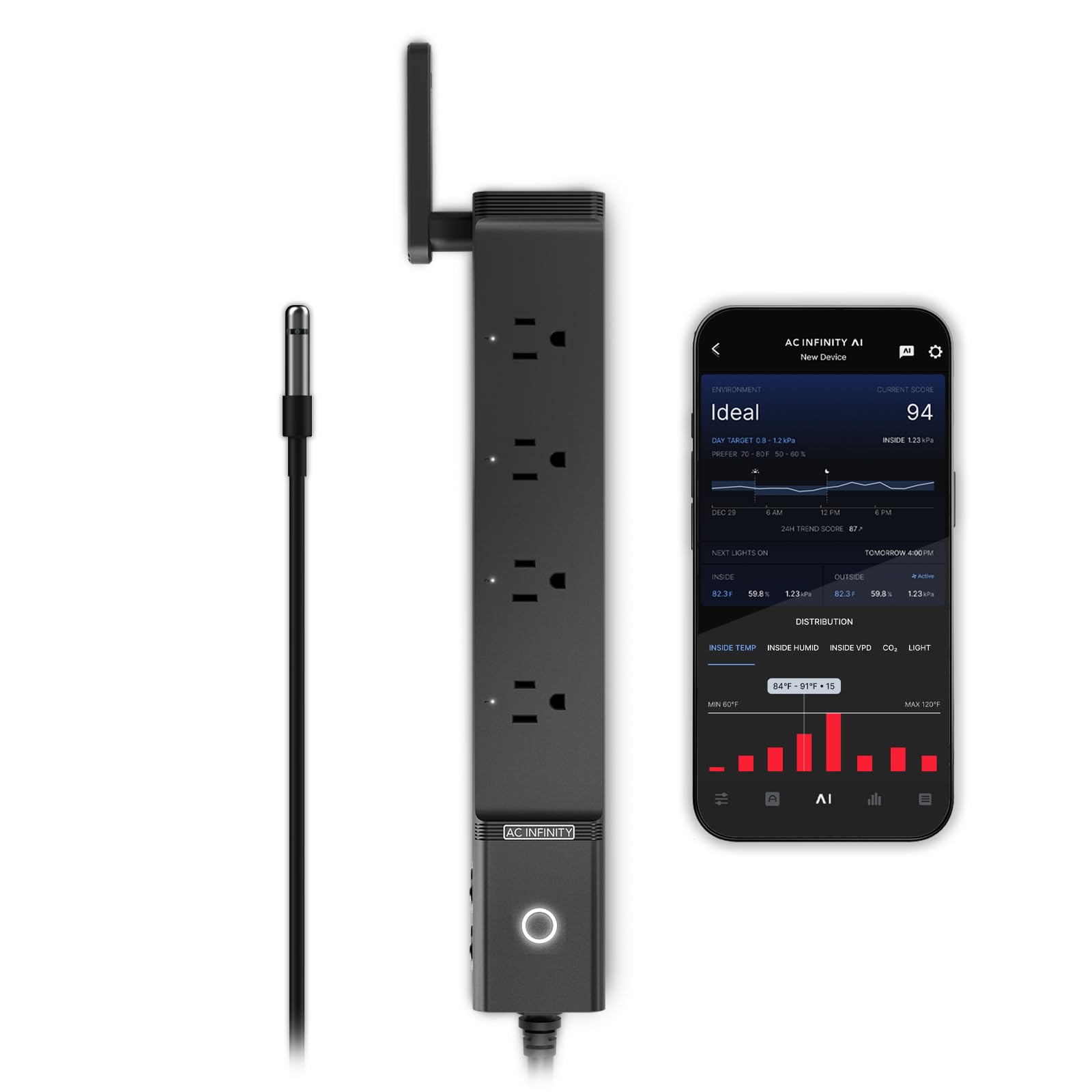
A smart power strip that turns your heater, lights, and pumps into one coordinated climate brain.
The AC Infinity Outlet AI is a different kind of aquarium monitoring system — instead of measuring water chemistry, it watches the environment around your tank and switches your equipment to match. It tracks dual-zone temperature and humidity with VPD calculation, and its four individually controlled outlets can run heaters, lights, fans, CO2 systems, and water pumps on schedules or climate triggers. The 1800W max capacity with built-in surge protection covers serious setups.
Unlike the chemistry monitors above, this unit uses AI targeting to control your environment. You can program each outlet with climate triggers, timers, or schedules, or let the AI sync multiple devices toward one goal. The app provides real-time alerts, data charts, and AI insights, and owners say it works with anything that plugs in. Reptile keepers rate it as probably the best cage climate control available, using remote temperature and humidity monitoring with manual fan and lamp control.
The honest friction is setup. It requires a 2.4GHz WiFi network, which means temporarily switching your router band, and owners note the manual is thin and the app navigation takes time to learn. You also cannot combine two parameters in one trigger — for example, a temperature trigger with a time limit at the same time. For full water chemistry you pair this with a separate monitor; for environment control, it is the standout.
Why it stands out
- Four independent smart outlets with individual scheduling
- Dual-zone temperature and humidity tracking with VPD
- 1800W capacity with surge protection for big gear
Setup friction
- Needs 2.4GHz WiFi, often a temporary router switch
- App navigation has a learning curve and thin documentation
Reach for this if: you want automated climate control that runs heaters, fans, and lights based on real conditions.
Look elsewhere if: your priority is measuring pH or chemistry — this strip does not read water.
6. Kactoily 7-in-1 Smart Aquarium Monitor WiFi

Seven parameters including ORP in one WiFi probe, aimed squarely at reef keepers.
The Kactoily 7-in-1 brings a seriously useful parameter to the table that most affordable monitors skip: ORP. That oxidation-reduction potential is the inverse of ammonia and nitrite, so a higher ORP reading generally means lower ammonia and nitrite — exactly the early-warning signal a reef keeper wants before a cycle goes wrong. It also measures pH, TDS, EC, specific gravity, salinity, and temperature through the Tuya Smart app, with customizable min and max values that trigger notifications by app, phone, or SMS.
Owners call it a standout for daily water monitoring., with one saying “to have history to see how the quality is changing over time. You know when you need to adjust the water.” The kit includes two packs each of pH 4.01, 6.86, and 9.18 powders for three-point calibration, plus two packs of 256 mV ORP powder — but EC calibration solution is not included and must be bought separately due to shipping limits.
The realistic catch is out-of-the-box accuracy. Some reviewers point out pH readings consistently double the actual value until recalibrated, and others note the unit arrives needing calibration before it is usable. Salinity instability was fixed in one case by moving the probe to a low-flow area away from protein separators. If you want broad parameter coverage including ORP without spending premium dollars, this is a compelling mid-range option — just plan for a calibration session on day one.
Its edge: ORP monitoring at this price point is rare, and the SMS alert option beats app-only rivals.
Its friction: expect to calibrate thoroughly from the start, and buy your EC solution separately.
7. Kactoily 7-Parameter Smart Aquarium Monitor
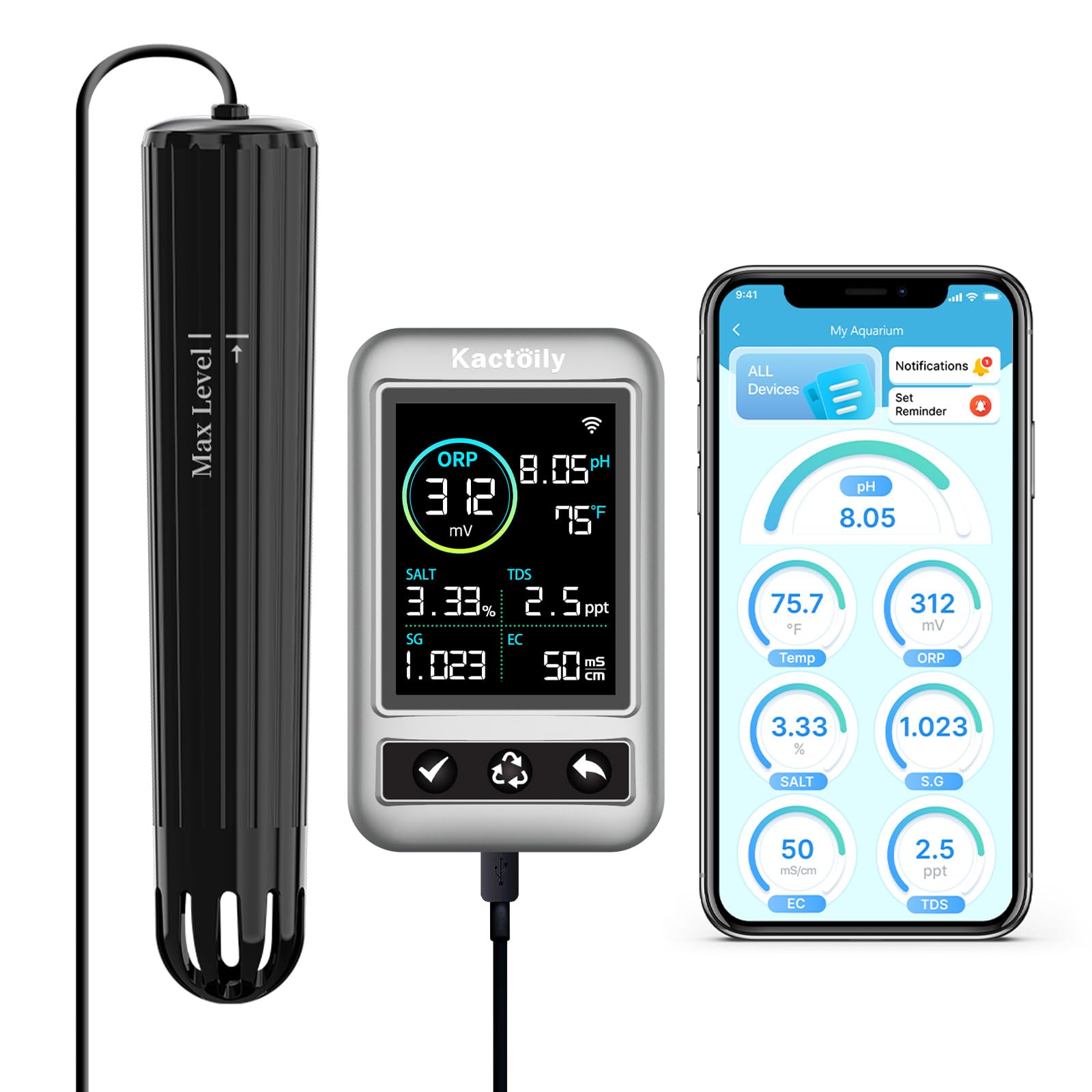
A sleek floating seven-parameter monitor built for larger saltwater and planted tanks.
This second Kactoily unit is the floating, compact sibling to the 7-in-1 above, measuring the same core parameters — pH, ORP, EC, TDS, salinity, specific gravity, and temperature — but in a glossy black and metal gray design that suits a premium tank. It uses high-stability industrial sensors that owners describe as durable, with long-range WiFi that connects reliably and an app that handles alerts simply and effectively.
At 4.8 ounces it is featherlight, and owners say the bright display and multi-parameter readings in one device speed up their daily checks considerably. It is a good fit for tropical, betta, shrimp, and planted tanks, with one owner calling it great value and another noting it is reliable for hobbyists who want seven parameters without juggling separate meters.
The big caveat is size and scope. It is a large floating unit that owners say is unsuitable for tanks under 40 gallons, and it does not measure nitrate, nitrite, or ammonia — so it is best for saltwater salinity monitoring on a 50+ gallon system. App connection hiccups appear in a few reviews, with one owner unable to pair it for remote monitoring and returning it for a replacement. The floating form factor also needs surface area, so match it to a big tank.
What impresses: the single-probe design simplifies seven-parameter tracking into one floating device with a clear display.
Who it is not for: nano tanks under 40 gallons, or anyone needing nitrogen compound readings.
8. Bluelab Guardian Monitor Wi-Fi
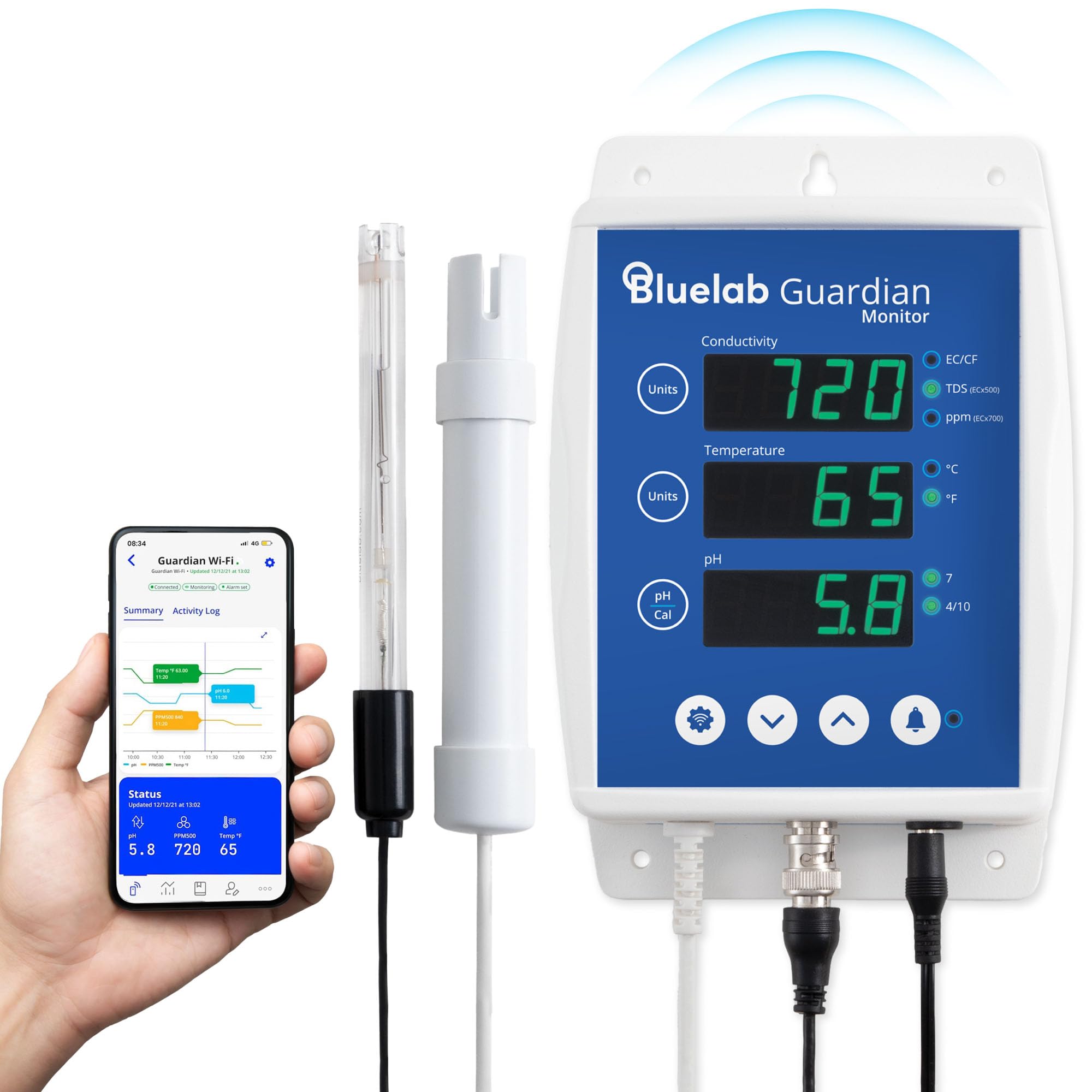
The prosumer standard for hydroponics, with a replaceable probe and rock-steady readings.
The Bluelab Guardian Monitor Wi-Fi is the premium choice for serious hydroponic and indoor grow setups, tracking pH, conductivity, and temperature in real time through the Edenic by Bluelab app. It reads conductivity in EC/CF, TDS ppm 500, and ppm 700 scales, and temperature in °C or °F, so it adapts to whatever unit system you already use. High and low alerts for all three parameters push straight to your smartphone, and non-volatile memory keeps your settings intact even through a power loss.
Owners praise its precision, describing steady pH and PPM readings that do not jump around, with one unit remaining accurate across different water temperatures. The double-junction, replaceable Bluelab pH Probe connects via BNC and uses a simple two-point calibration, and one owner who received a defective probe had Bluelab send a replacement quickly. The plant-safe green LEDs with adjustable display brightness are a thoughtful touch for grow rooms where stray light matters, and the 2 metre (6.6 foot) probe cables give you placement flexibility.
The honest friction is the app. Some shoppers say the app failing to load or cycling endlessly, with one returning the unit because remote monitoring — the key selling point — would not connect. Others note that pairing requires entering PROVISION mode first, and once you do, it works flawlessly. It also lacks a dosing model sensor, so if you want automated nutrient dosing you need additional gear. This is a precision instrument for the grower who wants lab-grade confidence and is willing to pay for it.
What justifies the premium
- Replaceable double-junction pH probe with BNC connection
- Reads TDS in ppm 500 and ppm 700 plus EC/CF scales
- Plant-safe green LEDs with adjustable brightness
Where it stumbles
- App reliability gets mixed reports, including endless loading loops
- No built-in dosing control in this model
Choose this if: you want a precision workhorse for a hydro reservoir with a probe you can replace instead of the whole unit.
Pass if: you need tight app reliability — test the pairing in PROVISION mode before committing.
Understanding the Specs
pH Range and Calibration
A pH probe measures acidity on a 0.0 to 14.0 scale, and its accuracy depends entirely on calibration. Most monitors use a two-point or three-point calibration, where you dip the probe in buffer solutions with known pH values — commonly 4.01, 6.86, and 9.18 — and the device adjusts itself to match. The more points you calibrate, the wider the accurate range, which matters if your tank runs acidic for CO2 or alkaline for African cichlids. Expect to recalibrate every few weeks; a probe that drifts despite repeated calibration is the most common failure across every monitor in this list.
ORP and Why It Matters
ORP, or oxidation-reduction potential, measures the water’s ability to break down waste. A higher ORP value generally means lower ammonia and nitrite, because the oxidation process is working efficiently — the values are inversely proportional. Reef keepers watch ORP as an early-stress signal before fish show physical symptoms. Only a few monitors in this guide include ORP, which is why the units that do (like the Kactoily 7-in-1) stand out for saltwater use.
FAQ
How often do I need to calibrate my aquarium pH probe?
What is the difference between a monitor and a controller?
Can one system track both freshwater and saltwater tanks?
Why does my ORP reading matter for reef health?
Do these systems measure ammonia or nitrate?
Will a WiFi monitor work with my home network?
Where should I place the probe in my tank for accurate readings?
Is a wall-mounted or floating monitor better for my tank?
Final Thoughts: The Verdict
Across the board, the aquarium monitoring system winner is the Milwaukee MC122US because it does the one job that matters most for CO2 tanks — shutting off the gas automatically when pH hits your limit. If you want remote multi-parameter tracking from your phone, the LANDTEK 6-in-1 delivers six readings with a 30-day history curve at a friendly price. And for the grower who wants lab-grade precision with a replaceable probe, the Bluelab Guardian Monitor Wi-Fi is the premium standard — the crowd favorite holding a 4.5-star average, which is the highest score in this lineup, is the Milwaukee, and that consistency is exactly why it takes the top spot.
How We Picked
We do not accept paid placement. Every pick is matched to a real buyer and a real use-case; we do not hands-on test units.
Sources & Methodology
Specifications: manufacturer listings and product documentation. Review insights: verified customer reviews, as of August 2026. Pricing: not shown on this page (it changes often); check the current price via the retailer link.
As an Amazon Associate, Gadgets Feed earns from qualifying purchases. This does not affect which products we feature.