
Our readers keep the lights on and my morning glass full of iced black tea. As an Amazon Associate, I earn from qualifying purchases.
Specs are compiled from manufacturer listings and verified buyer reviews and can change over time — please confirm the key details on the product page before buying.
Peeling vinyl planks on a wood subfloor are among the most frustrating DIY failures — the edges curl, the seams catch, and within months you are right back where you started. The right adhesive for vinyl flooring on wood locks planks down through temperature swings and foot traffic, not just a quick stick. You have three proven options here, so you can match one to your project size, your subfloor prep, and your patience for drying time.
I’m Min — the founder and writer behind Gadgets Feed. This guide is built by comparing the manufacturers’ published specifications and the patterns across verified customer reviews, so you get each pick’s real strengths and trade-offs instead of marketing spin.
From solvent-free formulas to heavy-duty gallons, these picks cover the real-world scenarios of laying adhesive for vinyl flooring on wood. Each pick earns its spot through verified performance and honest owner feedback, not hype.
Our Picks at a Glance

How To Choose The Best Adhesive For Vinyl Flooring On Wood
Matching the glue to your flooring type and subfloor condition matters more than brand name. The three products here each solve a slightly different problem, so start by identifying what you are actually installing.
Match the adhesive to your flooring type
Luxury vinyl tile (LVT), luxury vinyl plank (LVP), and vinyl composition tile (VCT) all bond differently. Some adhesives list specific compatibility — like the ROBERTS formula that handles LVT, LVP, VCT, vinyl sheet goods, and vinyl-backed carpet tile — which gives you flexibility for mixed projects. Always check that your exact flooring type appears on the label before committing.
Understand working time and drying time
Working time is your window to position a plank after applying glue; drying time is how long until the bond reaches full strength. A short working time of 30 minutes to an hour (like the Lucida option) suits fast, experienced installers, while a longer window gives beginners breathing room to adjust. Drying time varies wildly — some adhesives need 24 hours, others claim much less.
Check the subfloor compatibility
Not every adhesive bonds to every wood surface. Plywood rated for flooring is the standard for many formulas, but you should also verify whether your subfloor has existing vinyl, radiant heating, or moisture issues. The ROBERTS adhesive, for example, bonds to properly prepared plywood but has a maximum surface temperature of 85 degrees Fahrenheit for radiant heated floors.
Quick Comparison
| Model | Best For | Container Size | Weight | Drying Time | Amazon |
|---|---|---|---|---|---|
| ROBERTS Universal Resilient★ Best Overall | Large multi-room projects | 1 Gal (3.78 L) | 8.4 pounds | 24 hours | Amazon |
| Lucida Surfaces CoreBond | Small repairs & motorhomes | 1 Quart | 2 pounds | 1 hour | Amazon |
| HENRY 12098 GAL #430 | Budget-friendly full rooms | 1 Gal | 8 pounds | 18 hours | Amazon |
In‑Depth Reviews
1. ROBERTS Universal Resilient Flooring & Vinyl-Backed Carpet Tile Adhesive
Our pick — 4.5★ from 400+ verified ratings; the strongest balance of quality and price.
The heavy-duty gallon that shrugs off snow, mud, and 115-degree heat without a single lifted corner.
This is the workhorse for anyone tackling multiple rooms or demanding conditions. The 1-gallon pail weighs 8.4 pounds — a full 4.2x heavier than the Lucida quart — and that mass translates into serious coverage for whole-house projects. The acrylic latex formula is pressure-sensitive, meaning it grabs with high initial strength the moment you set a plank, yet it stays solvent-free for a friendlier indoor footprint.
Owner experiences back up the toughness. Buyers report using it on rubber flooring in a motorcycle trailer that lived through six-plus months of snow, mud, rain, and sand with zero lifting — a brutal real-world test for any adhesive. Another owner carpeted a camper’s walls and ceiling and watched it hold through 115°F+ Southwest US summer heat without bubbling. Clean spills and tools with water immediately, because once dry, even lacquer thinner struggles to remove it.
One honest caveat: drying time gets mixed feedback. Some owners mention it dries clear and fast, while others note the full 24-hour dry time before the bond reaches its final strength. Plan your project so you can keep weight on the flooring overnight.
Why It Wins
- Handles LVT, LVP, VCT, vinyl sheet, and vinyl-backed carpet tile
- Bonds to plywood, concrete, steel, marble, and terrazzo
- Microban protection fights stain-causing growth
The Trade-off
- 24-hour dry time demands overnight patience
- Drying speed varies between owners
Reach for this if: you have a large residential or commercial project and want one adhesive that covers every vinyl type in one pail.
Look elsewhere if: you need a quick-curing bond and cannot wait a full day for the glue to set.
2. Lucida Surfaces CoreBond Pro-Grade Solvent Free Vinyl Flooring Pressure Sensitive Adhesive
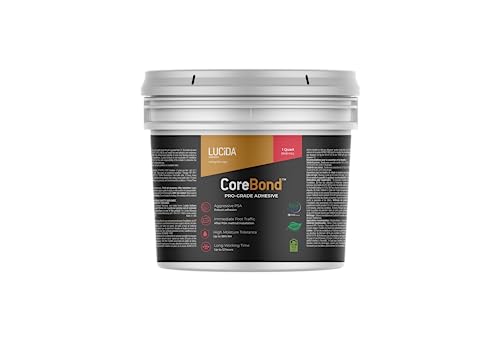
The lightweight quart that fixed a motorhome floor in minutes and wipes clean without a fight.
When your project is a single room or a tight space like a motorhome, lugging an 8-pound pail around is overkill. At just 2 pounds, this quart-size can is the nimble option, and its 40 sqft approximate coverage fits perfectly into small repairs or a single RV floor. The solvent-free, waterproof formula installs on both porous and non-porous surfaces, which makes it flexible across different subfloor situations you might encounter inside a vehicle.
Owners consistently call the application easy. Customers note replacing vinyl tile in a motorhome and finding it “easy to use and easy to wipe up excess” — a genuine win when you are working in tight quarters. Another owner laid vinyl tile on a concrete slab and was very happy with the hold. The working time of roughly 30 minutes to an hour gives you a decent window to position each piece before the pressure-sensitive bond locks in.
One thing to note: this adhesive is rated for LVT (luxury vinyl tile, a rigid vinyl plank), vinyl plank without attached backing, PVC (polyvinyl chloride, a common plastic), carpet tile, VCT (vinyl composition tile, a type of commercial floor tile), quartz tile, and fiberglass-backed sheet flooring — so check that your vinyl has no attached cushion backing before you commit.
Small-job standout: the quick 1-hour full cure time (per the manufacturer) means you can finish a repair and use the floor the same day, unlike the 24-hour wait on the ROBERTS option above.
Pick this for: motorhomes, RVs, single rooms, or touch-ups where portability and fast cure beat raw volume.
skip it if: you are covering a whole house — the quart size will run out fast and you would be better served by the gallon.
3. HENRY 12098 GAL #430 Vinyl Adhesive
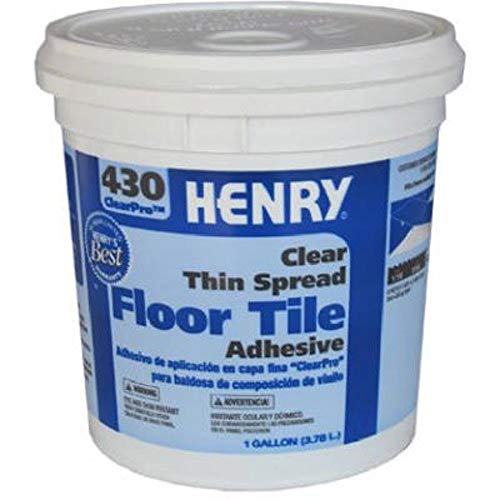
A dependable budget gallon that covers four rooms with a thin layer and dries crisp.
For cost-conscious full-room installations, this clear-drying adhesive from the American manufacturer HENRY delivers dependable value in an 8-pound pail. Owners who laid flooring across four rooms found that a thin application went a long way — one used a putty knife instead of a trowel and reported the adhesion was great and dried quickly. The clear finish is a bonus for tricky cuts where you might see the glue line.
The catch with this one is consistency in setting. The makers state the set time is 18 hours, but one owner reported it still had not set five days later — a clear reminder that proper ventilation and surface prep matter with this formula. A distinct smell also sent one owner out of the house during application, though they planned to reorder for the kitchen anyway, which says something about the performance despite the odor.
Use it sparingly and follow the directions, as owners stress that letting the adhesive dry for the specified minutes before laying the laminate is key to a strong bond.
Value play: the most budget-friendly gallon here, and the thin-application trick means one pail can genuinely cover four rooms.
Choose this if: price is the priority and you are comfortable with a longer set time and a strong odor during application.
Think twice if: you need fast curing or a low-smell adhesive for an occupied home — the Lucida quart or ROBERTS gallon serve those needs better.
Understanding the Specs
Pressure-Sensitive vs. Standard Adhesive
A pressure-sensitive adhesive stays slightly tacky after it dries, so it bonds when you press the plank down with weight. This is forgiving for DIYers because you get some repositioning time, and it creates high initial grip the moment the flooring touches the glue. Standard adhesives, by contrast, cure into a rigid bond and give you almost no adjustment window.
Working Time and Full Cure Time
Working time is the minutes you have to set and adjust a plank before the glue becomes too tacky to move — the Lucida option offers roughly 30 minutes to an hour. Full cure time is when the bond reaches maximum strength; the ROBERTS gallon lists 24 hours while the Lucida claims just 1 hour. Longer working time helps beginners; shorter cure time gets you walking on the floor sooner.
FAQ
Can I use these adhesives on a plywood subfloor?
What is the difference between LVT, LVP, and VCT flooring?
How long does vinyl flooring adhesive take to dry?
Does solvent-free adhesive really matter for indoor use?
How much coverage do I get from a quart versus a gallon?
Can I use these adhesives on concrete subfloors too?
What is a pressure-sensitive adhesive and why does it matter?
How do I clean up excess adhesive during installation?
Final Thoughts: The Verdict
For most people, the best adhesive for vinyl flooring on wood is the ROBERTS Universal because its versatility across every vinyl type and brutal real-world durability make it the safest investment for serious projects. If you want a fast-curing, portable option for a small space, grab the Lucida CoreBond quart. And for a budget-friendly full-room install where you can tolerate a longer set time, the HENRY 12098 is the one to reach for.
How We Picked
We do not accept paid placement. Every pick is matched to a real buyer and a real use-case; we do not hands-on test units.
Sources & Methodology
Specifications: manufacturer listings and product documentation. Review insights: verified customer reviews, as of August 2026. Pricing: not shown on this page (it changes often); check the current price via the retailer link.
As an Amazon Associate, Gadgets Feed earns from qualifying purchases. This does not affect which products we feature.