
Our readers keep the lights on and my morning glass full of iced black tea. As an Amazon Associate, I earn from qualifying purchases.
Specs are compiled from manufacturer listings and verified buyer reviews and can change over time — please confirm the key details on the product page before buying.
A sudden blackout can wipe out hours of unsaved work in seconds. A UPS (uninterruptible power supply) bridges the gap between the outage and your safe shutdown. Here are the top UPS models that give you enough runtime to save and shut down cleanly.
I’m Min — the founder and writer behind Gadgets Feed. This guide is built by comparing the manufacturers’ published specifications and the patterns across verified customer reviews, so you get each pick’s real strengths and trade-offs instead of marketing spin.
We focus on real-world runtime, outlet count, and voltage smoothing to find the battery backup for computer that actually protects your setup during an outage.
Our Picks at a Glance


How To Choose The Best Battery Backup For Computer
To keep your computer running when the power cuts out, you need a UPS (uninterruptible power supply — a battery backup that kicks in automatically). The key is matching its capacity to what you plug in. Focus on two numbers: VA (volt-ampere, a measure of electrical capacity) and watts (the actual power your devices consume).
Match the Wattage to Your Load
Add up the wattage of your computer tower and monitor. A typical desktop with a modern power supply might pull 300-500W under load, while a basic home office PC runs much lower. Your UPS needs a wattage rating above that total, or it will overload and shut down right when you need it most.
Count the Outlets You Actually Need
You want enough battery-backup outlets for your PC, monitor, and router, plus a few surge-only outlets for printers and speakers. Surge-only outlets protect against spikes but won’t keep devices running during an outage, so know which is which before you plug in.
Quick Comparison
| Model | Best For | Capacity | Outlets | Battery Type | Amazon |
|---|---|---|---|---|---|
| CyberPower ST900U★ Best Overall | Value and reliability | 900VA / 500W | 12 | Lead Acid | Amazon |
| SKE 600VABudget Champion | Budget home office | 600VA / 360W | 6 | Lead Acid | Amazon |
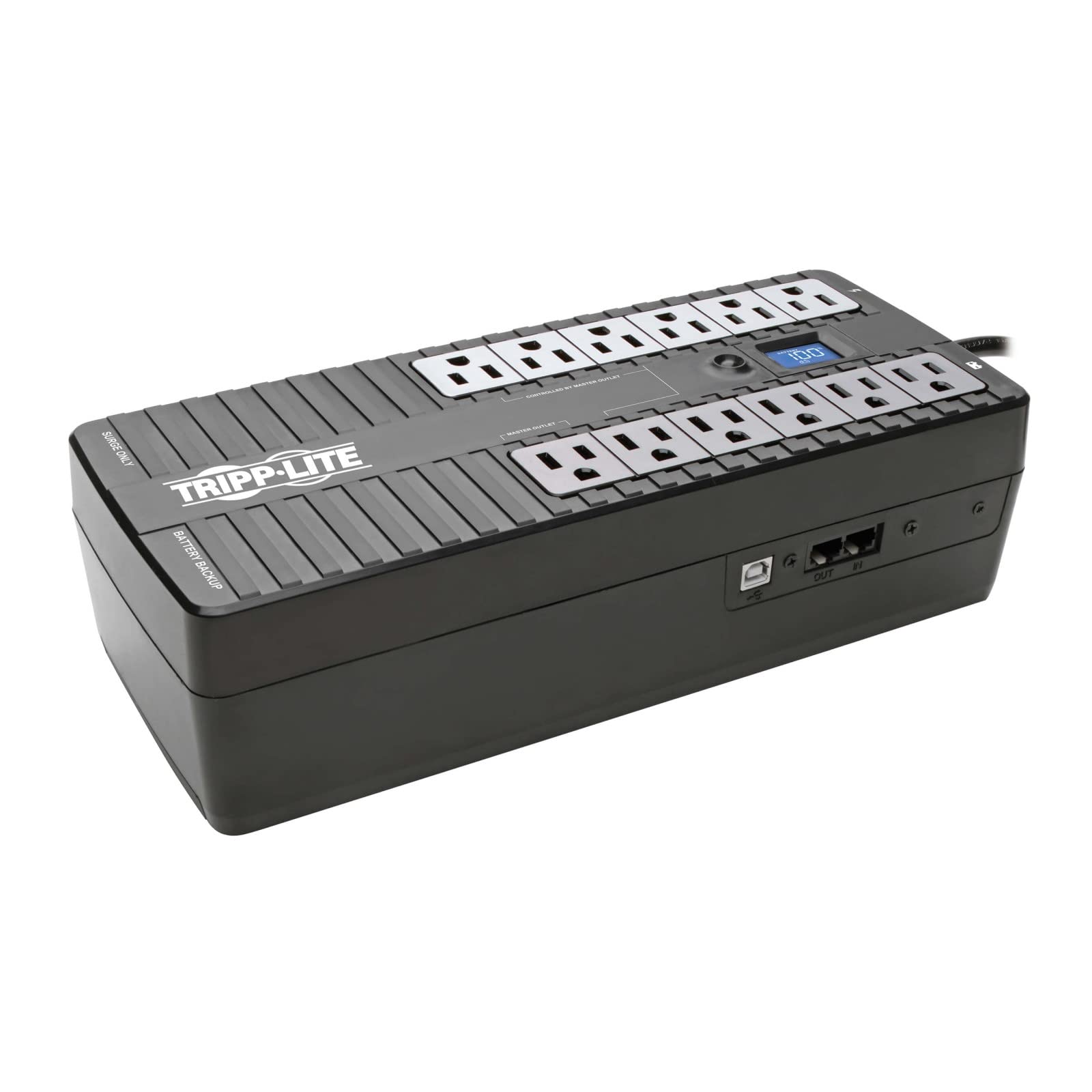
| Eaton Tripp Lite ECO850LCDEco Pick | Energy efficiency | 850VA / 425W | 12 | Lead Acid | Amazon |
| CyberPower AVRG900LCD | Voltage fluctuation | 900VA / 480W | 12 | Lead Acid | Amazon |
| APC BX850M | Reliable brand trust | 850VA / 510W | 8 | Lead Acid | Amazon |
| Amazon Basics 1500VA | Whole office setups | 1500VA / 900W | 10 | Lead Acid | Amazon |
| GOLDENMATE 1000VA | Long-term lithium value | 1000VA / 600W | 8 | LiFePO4 | Amazon |
| APC BR1350MS | Pure sine wave power | 1350VA / 810W | 10 | Lead Acid | Amazon |
| Eaton Tripp Lite OMNI1500LCDT | High capacity protection | 1500VA / 810W | 10 | Lead Acid | Amazon |
In‑Depth Reviews
1. CyberPower ST900U Standby UPS
Our pick — over 4.5★ from 850+ verified ratings; the strongest balance of quality and price.
A 900VA/500W standby UPS with 12 outlets that balances price and protection.
What wins people over is the rock-solid power reliability that keeps their machines alive through outages. At 900VA/500W, it handles a gaming PC, home theater, TV, and even a crock pot, with buyers reporting their software shows real-time usage between 80-180W. That headroom means your critical gear has room to breathe.
You get 12 NEMA 5-15R outlets: six with battery backup and surge protection, plus six surge-only. Four outlets are widely spaced to fit large adapter bricks, which is a lifesaver for awkward power supplies. The right-angle 45-degree input plug helps it sit flush against the wall.
The catch is the battery runtime. Under a heavy load, owners see roughly 10-20 minutes of backup, and the alarm beep can get annoying (though it is disableable). It is built for a safe shutdown, not for powering your setup through an extended blackout.
What Owners Love
- Proven power reliability during outages
- Plenty of outlets for mixed setups
- Quiet operation and clean design
What to Know
- Alarm can be annoying until disabled
- Battery runtime is modest under load
Reach for this if: you want a dependable, well-reviewed unit that protects a full home office without fuss.
Look elsewhere if: you need extended runtime for long outages, since it is built for shutdown, not endurance.
2. SKE 600VA/360W UPS
A compact tower that bridges the gap during short generator switchovers.
This entry-level pick shines in a specific scenario: keeping your computer alive for the 15 seconds it takes a backup generator to kick in. One owner sums up the experience perfectly — “Have had it about a year so far so good” — and notes it carries the PC fine through those transition moments.
The intelligent LCD screen shows input voltage, output voltage, battery capacity, and load capacity in real time. It can auto-extinguish the screen 30 seconds after boot, then wake the backlight with a touch, which keeps a bedroom or office dark at night. The cooling fan handles higher power demands without overheating.
Be aware that the outlet spacing is tight. If your modem or router uses an oversized adapter, the bottom plug can protrude awkwardly. Some owners also report the USB connection can be finicky with the bundled software, though the hardware itself earns praise after months of use.
Solid value pick: the reliability for the price is the main draw, and the real-time monitoring adds genuine utility.
Mind the fit: check your adapter sizes before buying, since the tight outlet layout is the most common complaint.
3. Eaton Tripp Lite ECO850LCD 850VA
An ENERGY STAR-certified 850VA/425W UPS with ECO outlets that cut phantom power draw.
Reliability is the trait that stands out most — over a hundred owners single it out, praising its consistent power quality. This ENERGY STAR-certified unit runs at >98% efficiency, so it saves on electricity costs while providing a 40-minute runtime at a 70-80W load. That is a full work session of protection.
The smart ECO mode is the standout feature: four ECO outlets automatically turn off when the master outlet device powers down or sleeps. This stops your peripherals from draining phantom power. AVR (automatic voltage regulation) corrects voltages as low as 95V and as high as 145V back to 120V without touching the battery, preserving your runtime for real blackouts.
The honest trade-off is the noise. When running on battery, the unit emits a loud buzz, and the surge rating sits at 316 joules (though one owner lists 420 joules), which is modest for heavy storm areas. It is best for a standard desktop setup, not a high-wattage gaming rig.
Efficiency wins: the ECO outlets and >98% efficiency make it a smart long-term money saver.
Keep it simple: ideal for basic computer setups, but loud on battery and light on surge capacity for serious protection needs.
4. CyberPower AVRG900LCD 900VA
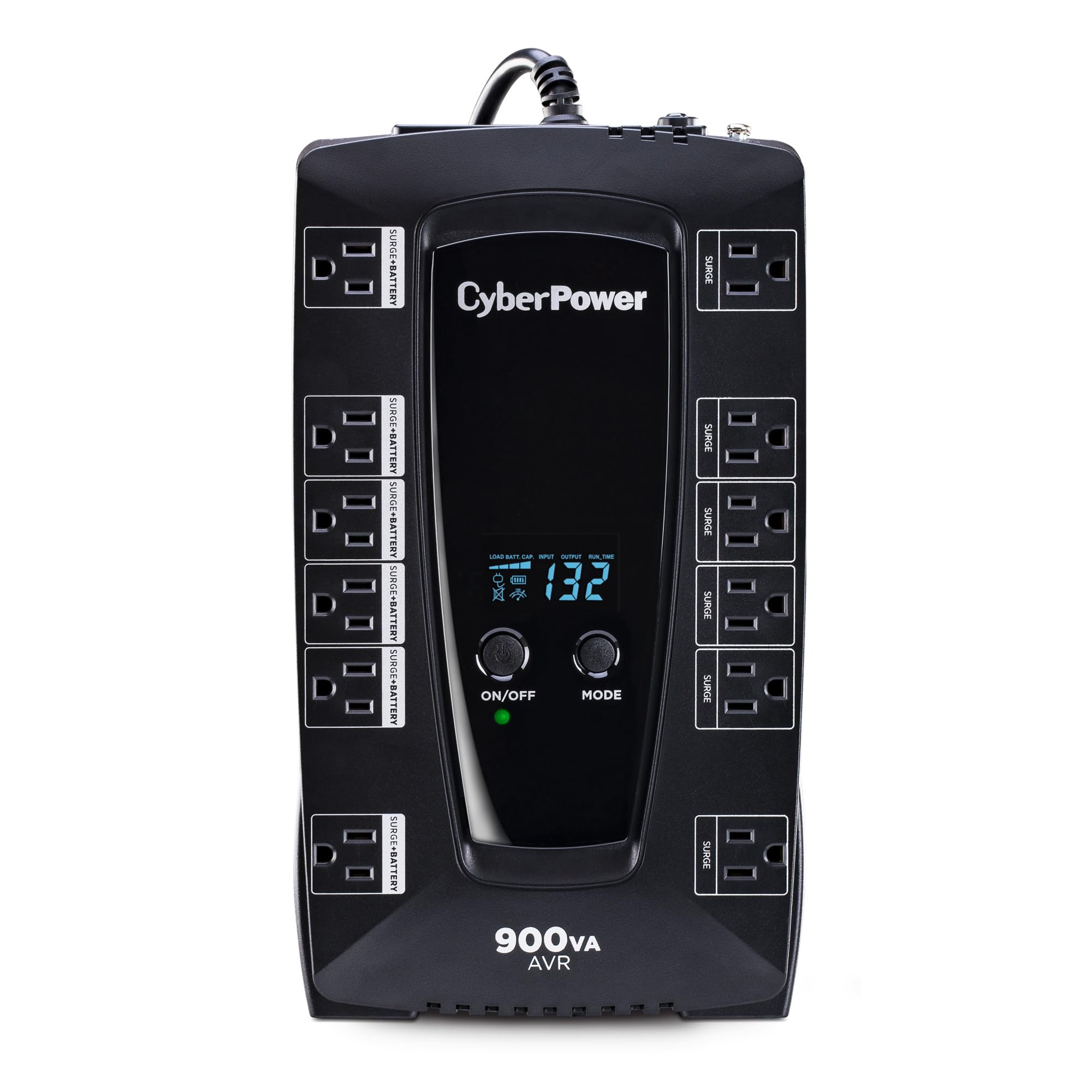
A 900VA/480W UPS with AVR that corrects brownouts without draining the battery.
Power supply is what owners praise most, and this unit’s AVR (automatic voltage regulation) corrects minor fluctuations without ever switching to battery. That extends your battery life and protects against the slow damage brownouts cause. For island dwellers with only one power line, it has been a lifeline — giving enough time to safely shut down a 100TB NAS without data loss.
With 12 NEMA 5-15R outlets, six battery-backed and six surge-only, you can cover a full workstation plus peripherals. The intelligent LCD gives real-time status, and the free PowerPanel software enables unattended shutdown. At a 72W load, owners see a 62-minute runtime, which is generous for a 900VA unit.
Setup has a learning curve. The mode button is difficult to navigate, so download the free software first. Also, some units beep relentlessly — the fix is to plug devices in before connecting the UPS to the wall outlet. Reliability opinions are genuinely divided; some units work flawlessly for years while others fail to power on.
Why It Wins Fans
- Strong AVR for voltage fluctuation
- Long runtime at low loads
- Ample outlet count
Setup Quirks
- Mode button is confusing
- Beeping issues if plugged in wrong order
Choose this for: brownout-prone areas where voltage sags threaten your hardware.
Think twice if: you want a truly plug-and-play experience, since the setup demands patience.
5. APC 850VA/510W Pro BX850M

An 850VA/510W UPS from APC with AVR and Active PFC compatibility for modern PSUs.
This unit’s battery backup is its standout feature — it provides over 29 minutes of runtime at a 100W load, so you can keep your PC, monitor, and router alive while you save your work and shut down. One owner reports their system survived a lightning strike three houses away that fried their modem and router via coax; the PC stayed fully protected.
The AVR corrects low-voltage brownouts from 88V+ and trims surges of +/-13%, keeping your gear at stable 120V without draining the battery. It is Active PFC compatible, meaning it works cleanly with modern gaming PC power supplies that draw power in a non-linear way. The LCD display gives real-time battery charge, load capacity, and estimated runtime.
The main drawback is the mixed reliability picture. Some units arrive with defective batteries or fail after the first blackout, and APC’s support process has been described as agonizing by a few owners. The bundled software is bare-bones but functional, and works quietly in the background on Windows 11.
Trustworthy protection: the brand’s reputation for saving equipment during spikes and strikes is well-earned.
Watch for duds: occasional units fail early, so test it soon after arrival and confirm your return window.
6. Amazon Basics 1500VA/900W UPS

A 1500VA/900W line-interactive UPS with 10 outlets for whole-office protection.
Value for money is what owners highlight most, and the math is simple: 900W of real power at a budget-friendly price. At half load (750VA/450W), it provides approximately 10 minutes of backup, while a full 1500VA/900W load gives about 1.5 minutes. This is designed for a graceful shutdown, not extended work sessions.
The line-interactive design with AVR smooths out voltage fluctuations before they reach your hardware. You get 10 outlets total: five surge-protected and five surge-protected with battery backup, letting you split your critical gear from your peripherals. The mini tower shape with a 6-foot cord fits neatly under a desk.
The weak link is the software and long-term reliability. The bundled browser-based monitoring software is sketchy — it needs Windows 11 exceptions and has certificate issues. Some buyers report units stopping work after about 10 months, and one found runtime fell far short of the software’s prediction (1h17m predicted, 25 minutes actual).
The Upside
- High 900W capacity for whole setups
- Easy setup and clear outlet split
- Compact tower design
The Downside
- Monitoring software is problematic
- Mixed long-term reliability reports
Great for: budget buyers who need lots of wattage and treat the software as an afterthought.
Not for: those who want precise runtime predictions or rely on advanced monitoring features.
7. GOLDENMATE 1000VA/600W Lithium UPS

The featherweight that trades lead-acid bulk for a decade of lithium longevity.
Power quality is what wins people over here, backed by a 153.6 Wh LiFePO4 (lithium iron phosphate) battery that delivers a lifespan of over 10 years and more than 5000 charge cycles. Compared to traditional lead-acid batteries, the maker claims a total cost of ownership more than 40% lower — meaning you likely never buy a replacement battery.
The pure sine wave output mimics utility electricity, which is gentler on sensitive components like gaming PCs and network equipment. At just 4.8 kg, it is far lighter than comparable lead-acid units, and the compact design leaves a large area to install plugs. The intelligent LCD shows real-time battery and power conditions, with an automatic safety mechanism that halts charging if limits are exceeded.
The trade-offs are real. The user manual is missing entirely, and the cooling fan operates below 50 dB but activates audibly under heavy battery use. Power duration gets mixed feedback — some report hours of backup, while others say the unit completely died after 7 months. It is not ideal for server closets or high-heat enclosed areas.
Modern investment: the lithium battery and pure sine wave make it a futuristic choice that saves money over a decade.
Check the manual online: no printed guide is included, and an occasional unit fails early, so verify your warranty support.
8. APC 1350VA/810W Pure Sine Wave BR1350MS
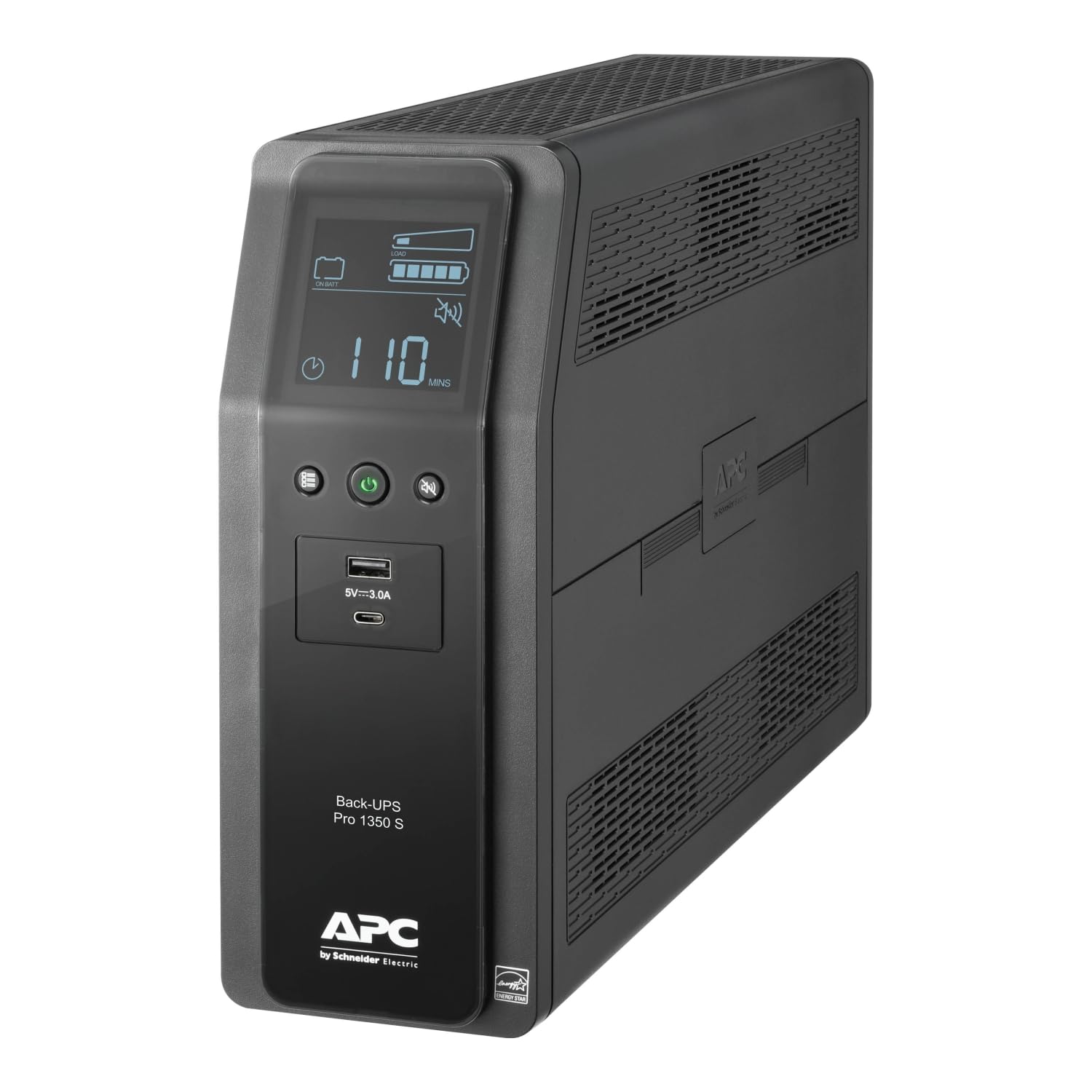
Clean utility-grade power that keeps expensive hardware running cooler and longer.
Power capacity is the top praise, and the 1350VA/810W rating delivers up to 54 minutes of backup runtime at a 100W load. The pure sine wave output mimics utility electricity, ensuring sensitive components — like Active PFC gaming power supplies — run cooler and last longer. It is the right pick for a computer worth over a grand.
The ten protected outlets split into six battery-backup and four surge-only, with built-in coaxial and Ethernet surge protection. A bonus many owners love: built-in USB-C and USB-A ports (5V/3A shared) for fast phone and tablet charging without an extra adapter. The angled LCD display shows remaining runtime and wattage load at a glance from your seat.
The honest complaint is battery longevity and an occasional odor. Some owners mention 45-60 minutes of runtime for office tasks, but others received units with defective batteries or saw failures after a few months of power surges. The lead-acid battery is user-replaceable, which extends the unit’s life, but the metal enclosure and 16-hour charge time are worth noting.
For high-value rigs: the pure sine wave and USB-C ports justify the premium for serious setups.
Verify early: test the battery soon after arrival, since a few units arrive with defects and support can be slow.
9. Eaton Tripp Lite OMNI1500LCDT 1500VA

A long-haul champion that ran a modem, NAS, and switch for hours on a five-year-old battery.
Quality is the trait owners praise most, and the longevity story is remarkable: one unit bought in September 2020 powered a modem, NAS, and switch for hours during a January 2026 outage — on the original battery. That is the kind of durability that makes a UPS a once-a-decade purchase.
The 1500VA/810W rating with 10 outlets handles a full desktop, gaming console, workstation, and network devices. AVR corrects brownouts between 92V and 150V back to 120V without touching the battery, and the 650 joules of surge protection guards against spikes. The LCD screen displays runtime, wattage load, overload, AVR status, and input voltage clearly.
The bundled software is the weak point — owners describe it as terrible, with device-discovery failures and registry errors, though it uninstalls cleanly. Some units arrive with a strong electronics smell and a partial charge (75% from the start). The bright display can even act as a night light, which some love and others find intrusive.
Built to Last
- Proven multi-year battery endurance
- High 1500VA capacity
- User-replaceable battery
Minor Gripes
- Terrible bundled software
- Initial strong smell and partial charge
Grab it for: a high-capacity setup where long-term durability matters more than slick software.
skip it if: you need integrated monitoring, since the software experience is genuinely frustrating.
Understanding the Specs
VA and Wattage
VA (volt-ampere) measures the electrical capacity, while watts measure the actual power your devices consume. A 900VA unit with 500W output handles a typical desktop, but a gaming PC with a high-end GPU can pull 600W or more. Always match the wattage rating to your real load — a UPS that overloads will shut down exactly when you need it.
Runtime and Battery Type
Runtime is how long the battery keeps your gear alive during an outage, and it shrinks dramatically as load increases. A 100W load might run for 54 minutes, while the same unit at 900W lasts under two minutes. Lead-acid batteries are affordable but age in 3-5 years; lithium iron phosphate (LiFePO4) units cost more upfront but can last over a decade.
FAQ
How many watts do I need for my computer setup?
What is the difference between battery backup and surge-only outlets?
How long will a UPS keep my computer running?
What does AVR do and why does it matter?
What is the difference between simulated sine wave and pure sine wave?
How often do I need to replace the battery?
Can a UPS protect my modem and router during an outage?
Why does my UPS beep and can I turn it off?
Final Thoughts: The Verdict
If you want one dependable pick, the battery backup for computer winner is the CyberPower ST900U because it combines dependable power reliability with 12 outlets at a fair price. If you want clean pure sine wave power for a high-end gaming rig, grab the APC BR1350MS. And for a lithium battery that outlasts the decade, the GOLDENMATE 1000VA is the one to reach for.
How We Picked
We do not accept paid placement. Every pick is matched to a real buyer and a real use-case; we do not hands-on test units.
Sources & Methodology
Specifications: manufacturer listings and product documentation. Review insights: verified customer reviews, as of August 2026. Pricing: not shown on this page (it changes often); check the current price via the retailer link.
As an Amazon Associate, Gadgets Feed earns from qualifying purchases. This does not affect which products we feature.