
Our readers keep the lights on and my morning glass full of iced black tea. As an Amazon Associate, I earn from qualifying purchases.
Specs are compiled from manufacturer listings and verified buyer reviews and can change over time — please confirm the key details on the product page before buying.
You might think you’ve contained your bamboo, but the real escape happens underground. Rhizomes (the horizontal stems that spread the plant) can tunnel 20 feet past your fence line before you ever see a shoot. A bamboo barrier — a buried sheet of thick plastic — stops that sideways march cold. The best barrier for you depends on three numbers: depth in inches, thickness in mils, and length in feet.
I’m Min — the founder and writer behind Gadgets Feed. This guide is built by comparing the manufacturers’ published specifications and the patterns across verified customer reviews, so you get each pick’s real strengths and trade-offs instead of marketing spin.
Everything you need to know about choosing bamboo barrier material is here: the three best HDPE barriers, real digging advice, and which thickness actually stops rhizomes.
Our Picks at a Glance

How To Choose The Best Bamboo Barrier Material
Think of a bamboo barrier as an underground fence. You bury a tall, thick sheet of high-density polyethylene (HDPE — a tough, rigid plastic) in a trench around the bamboo. The rhizomes hit the wall and turn downward instead of escaping sideways across your yard.
Thickness: why 60 mil is the floor
Thickness is measured in mils, where one mil equals 0.001 inches. Barriers thinner than 60 mil have failed in bamboo containment tests. At 60 mil, the sheet is stiff enough to stand on its own in the trench. Thicker options, like 80 mil, add puncture resistance for stronger rhizome pressure.
Depth: match it to your climate
Bamboo rhizomes run shallower in cold climates and deeper in warm ones. The depth you bury matters because a rhizome that goes under the barrier edge is an escape artist. Cold climates use a 24-inch depth; warm climates use 30 inches; tropical climates use 36 inches.
Length: measure your perimeter, then overshoot
Count the total feet of bamboo edge you need to contain, then add a little extra so the barrier ends overlap. A longer roll means fewer seams, and every seam is a potential weak point where a rhizome could push through.
Quick Comparison
| Model | Best For | Thickness | Depth | Length | Amazon |
|---|---|---|---|---|---|
| Bamboo Shield 60 mil★ Best Overall | Cold-climate containment | 60 mil | 24 inches | 25 feet | Amazon |
| Joewuzun Tree Root Barrier | Driveway and walkway protection | 60 mil | 18 inches | 20 feet | Amazon |
| Sidewalk Shield 80 mil | Large-scale perimeter jobs | 80 mil | 18 inches | 100 feet | Amazon |
In‑Depth Reviews
1. Bamboo Shield 25 ft x 24 in x 60 mil
Our pick — over 4.5★ from 600+ verified ratings; the strongest balance of quality and price.
The 24-inch-deep sheet that matches the exact depth cold climates need.
This is the one buyers describe as feeling like “a thick plastic board” rather than a flimsy tarp. It’s made in the USA from high-density polyethylene (HDPE — a tough, rigid plastic), and At 60 mil, it’s the proven minimum thickness for holding bamboo.
What wins people over is the build quality — owners consistently call it sturdy and durable, noting it will last many years. The 24-inch depth suits cold climates, where rhizomes run shallower than in warm or tropical zones.
The trade-off is the installation workout. Buyers report: “Very sturdy. Digging the trench for this was rough. Probably should have rented a machine for that part.” Plan for real labor or a rented trencher, and expect to work to unroll the stiff sheet.
What owners rave about
- Thick, board-like stiffness that stands up in the trench
- Effective at stopping rhizome spread
- Made in the USA from HDPE
What to expect at install
- Digging the trench is genuinely hard work
- Unrolling the stiff sheet takes effort
Grab this for: a cold-climate bamboo containment job where you want a proven 60-mil wall at the recommended 24-inch depth.
Think twice if: your yard is in a warm or tropical climate — the manufacturer recommends a deeper 30- or 36-inch barrier there.
2. Joewuzun Tree Root Barrier 18in x 20ft x 60mil
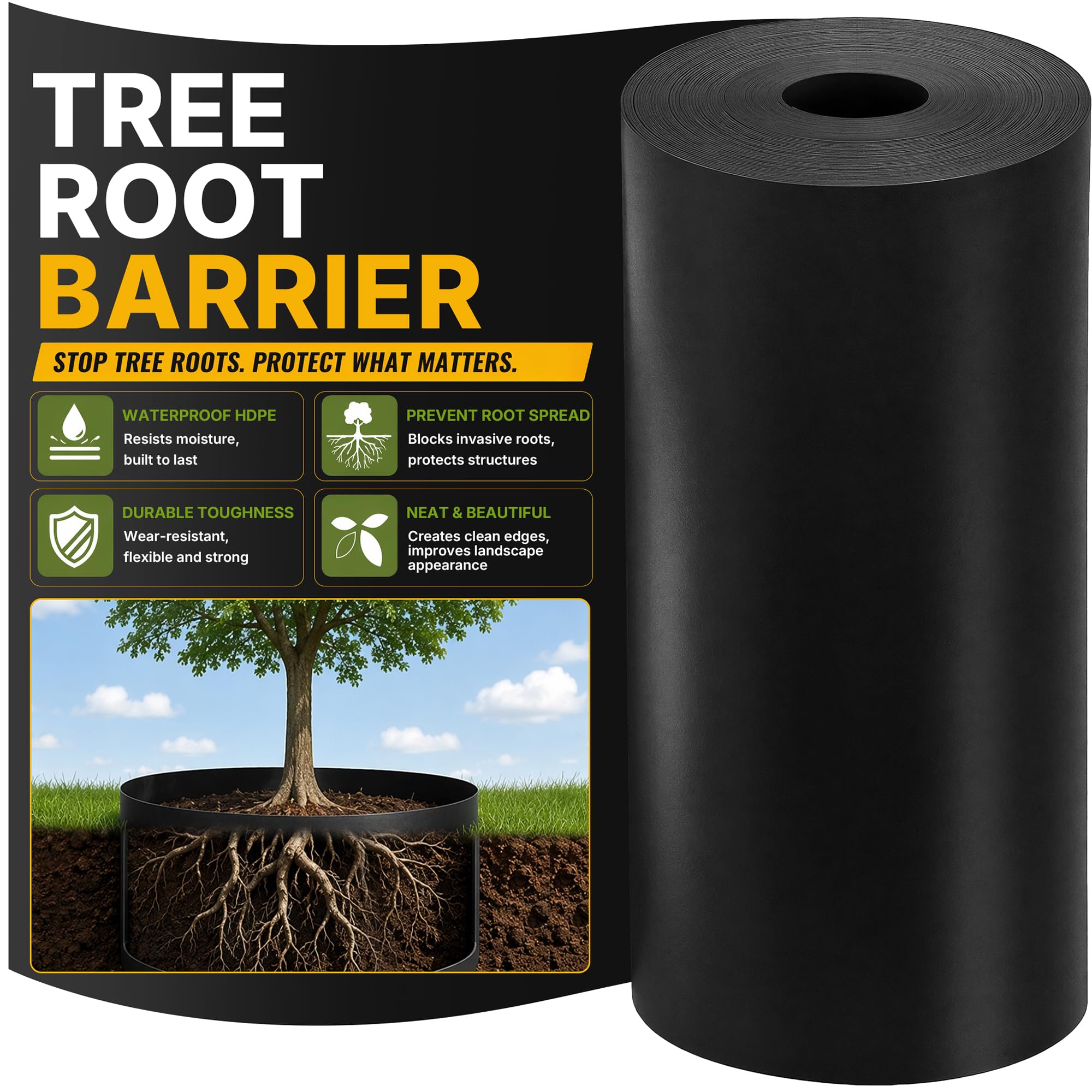
The shorter 20-foot run that’s easy to cut and trim by hand.
If your bamboo line is short, this roll keeps the job manageable. At 20 feet long and 18 inches deep, compared to the Sidewalk Shield’s 100-foot length, and its 60-mil thickness still meets the minimum for holding bamboo.
This one is designed for multi-duty use — owners use it to protect driveways and walkways from lifting roots, not just for bamboo. It’s made of the same high-density polyethylene, and owners mention it’s easy to install and easily trimmed to fit tight spots.
The honest caveat is the measurements. Customers note the advertised 18-inch height actually measures 17.25 inches, and the roll arrives stiff — the fix is to lay it in the sun with weights to straighten it before burying.
Real-world verdict: this is the value pick for a modest perimeter — same 60-mil plastic as the premium option, at a shorter length that’s easier to haul and handle.
The known quirk: check the actual depth when it arrives, since the cut runs slightly shy of the label.
3. Sidewalk Shield Tree Root Barrier 100 ft x 18 in

A 100-foot, 80-mil wall that stops bamboo and protects sidewalks in one pass.
This is the big-job specialist. Its 100-foot length covers 100 feet, compared to the Joewuzun’s 20 feet, and at 80 mil it steps up the thickness beyond the 60-mil minimum — thick enough that owners say roots can’t grow through it.
The thickness pays off in puncture resistance: This barrier offers 155 lbs of puncture resistance per ASTM D 4833 testing. That’s a real number from the maker’s published specs, and it’s why buyers trust it to divert water and stop tree roots from uplifting sidewalks.
Reviewers point out the sheet is sturdy enough to stand on its own without framing, which simplifies trench installation. The recurring advice is to unroll it in the sun first to remove the coil memory, and The standard-duty 80-mil sheet is rated for small to medium trees.
Where it shines: the longest run here, with the thicker 80-mil wall and the lab-tested puncture number to back it up.
The honest note: some buyers feel the price is steep “for a film of plastic,” so this one is about buying coverage and thickness in bulk, not the cheapest per-foot deal.
Understanding the Specs
Mil Thickness
A mil is one-thousandth of an inch. The 60-mil figure you see on most bamboo barriers means the sheet is 0.06 inches thick — enough to feel stiff like a board, not floppy like a tarp. Treat 60 mil as your minimum—thinner sheets have failed to contain bamboo.
Depth in Inches
This is how deep the barrier goes into the ground, and it must match your climate. Cold climates use 24-inch depth, warm climates use 30-inch, and tropical climates use 36-inch. If the barrier is too shallow, rhizomes can dive under the bottom edge and escape.
FAQ
How thick should a bamboo barrier be in mils?
How deep should I bury the bamboo barrier?
Can this barrier also protect my driveway or sidewalk?
Why is the roll so stiff when it arrives?
How much trench digging work should I expect?
Is a 20-foot roll enough for my yard?
Does the barrier need to stand up on its own in the trench?
Will the advertised depth always match the real measurement?
Final Thoughts: The Verdict
If you want one dependable pick, the bamboo barrier material winner is the Bamboo Shield 25 ft x 24 in x 60 mil because it pairs the proven 60-mil thickness with the 24-inch depth recommended for cold climates. If your job is protecting a driveway or walkway with a shorter run, grab the Joewuzun 18in x 20ft x 60mil for its easy-to-trim 20-foot length. For a long perimeter that needs serious puncture resistance, the Sidewalk Shield 100 ft delivers 80-mil thickness and 155 lbs of puncture resistance across 100 feet.
How We Picked
We do not accept paid placement. Every pick is matched to a real buyer and a real use-case; we do not hands-on test units.
Sources & Methodology
Specifications: manufacturer listings and product documentation. Review insights: verified customer reviews, as of August 2026. Pricing: not shown on this page (it changes often); check the current price via the retailer link.
As an Amazon Associate, Gadgets Feed earns from qualifying purchases. This does not affect which products we feature.