
Our readers keep the lights on and my morning glass full of iced black tea. As an Amazon Associate, I earn from qualifying purchases.
Specs are compiled from manufacturer listings and verified buyer reviews and can change over time — please confirm the key details on the product page before buying.
A 3-inch loudspeaker solves a very specific problem: delivering real, room-filling sound from a space where a traditional bookshelf speaker simply won’t fit. The catch is that “3-inch” covers a surprisingly wide range of designs—from bare driver units for DIY builders to fully powered, amplifier-included desktop sets. That flexibility is exactly why this guide separates the raw components from the ready-to-play systems, so you can match the product to your actual setup rather than just the size of the cone.
I’m Min — the founder and writer behind Gadgets Feed. This guide is built by comparing the manufacturers’ published specifications and the patterns across verified customer reviews, so you get each pick’s real strengths and trade-offs instead of marketing spin.
Every option below nails the compact form factor, but they diverge wildly on power, connectivity, and build. By the end of this guide, you’ll know precisely which 3 inch loudspeaker fits your desk, your turntable, or your next DIY project.
Our Picks at a Glance


How To Choose The Best 3 Inch Loudspeaker
Before you worry about sound quality, decide how much setup you want. You can pick a powered speaker that plays as soon as you plug it in, or a passive one that needs a separate amplifier. That one choice narrows your options by half right away.
Passive vs. Powered: The Amp Question
Passive speakers (like the Micca and raw Dayton drivers) have no built-in amplifier. They need a separate receiver or amp to make sound. Powered speakers (like the RIOWOIS, Electrohome, and Edifier) have everything built in—just plug them into power and connect your device. This is the single biggest fork in the road for 3-inch buyers.
Full-Range vs. Two-Way: Who Handles the Highs
A full-range driver tries to cover the entire audio spectrum with one cone. A two-way design splits the work: a woofer for lows and mids, plus a separate tweeter for highs. Two-way designs generally deliver cleaner treble, but a well-engineered full-range driver like the Dayton PC83-4 can surprise you with its smooth response.
Quick Comparison
| Model | Best For | Type | Woofer Setup | Connectivity | Amazon |
|---|---|---|---|---|---|
| Micca OoO Slim★ Best Overall | Hi-Fi Desktop Surround | Passive (Pair) | Dual 3-Inch | Binding Posts | Amazon |
| Edifier MR3Top Performer | Studio Monitoring | Powered (Pair) | 3.5-Inch + 1-Inch | BT 5.4, TRS, RCA, AUX | Amazon |
| RIOWOIS PoweredMost Versatile | Record Players | Powered (Pair) | Single 2.75-Inch | BT 5.3, AUX, Optical, ARC | Amazon |
| Dayton Audio PC83-4 | DIY Projects | Raw Driver | Single 3-Inch | Solder Terminals | Amazon |
| Herdio Marine | Boats & Hot Tubs | Passive (Pair) | Single 3-Inch | Bare Wire | Amazon |
| Dayton Audio PS95-8 | Car Dash Upgrades | Raw Driver | Single 3.5-Inch | Solder Terminals | Amazon |
| Electrohome Huntley | Turntable & TV | Powered (Pair) | Single 3-Inch | BT 5, RCA, AUX | Amazon |
| LONPOO 30W | Desktop & Gaming | Powered (Pair) | Single 3-Inch | BT 5.3, AUX, USB | Amazon |
In-Depth Reviews
1. Micca OoO Slim Passive Bookshelf Speakers
Our pick — over 4.5★ from 700+ verified ratings; the strongest balance of quality and price.
The slim surround-sound specialist that packs two woofers into a 4-inch-wide frame
What wins people over here is the sound quality—well over 160 owners single it out as the defining trait. The secret is the dual 3-inch square frame woofers working together inside a ported enclosure, which pushes usable bass down to 60Hz without needing a subwoofer for casual listening. Its 0.75-inch silk dome tweeter handles the top end, and buyers report warm mids with “clean highs” that make a room feel full.
This is a passive speaker, so you’ll need an amplifier to drive it. Owners often pair it with a compact desktop amp like the SMSL AD18 and report the total setup stays well under while sounding far richer than the price suggests. The slim profile means you can lay it flat as a center channel for a 5.1 gaming rig or stand it vertically on a desk—the removable grill and quality binding posts make either placement feel intentional.
The trade-off is the bass ceiling. Even with dual woofers, owners mention that heavy low-end needs a subwoofer for real punch, especially in larger rooms. For desktop use, small-room stereo, or surround duty where dialog clarity matters more than thumping bass, this is the pick that consistently outperforms its compact size.
What Owners Love
- Warm mids and clean highs praised more than any other trait
- Dual woofers reach 60Hz bass—impressive for the footprint
- Fits horizontally or vertically for flexible placement
Consider This First
- Requires a separate amplifier or receiver
- Heavy bass needs a subwoofer for full impact
The desk-and-dialog winner: It is the strongest passive choice for desktop stereo, gaming surround, or center-channel duty where space is tight and clarity is king.
Who needs more: If your listening room is on the larger side or you crave floor-shaking bass without adding a sub, look toward bigger drivers instead.
2. Edifier MR3 Powered Studio Monitor Speakers
The studio-grade monitor that brings flat, honest sound to a desktop footprint
This is the pick for anyone who wants to hear exactly what’s in the recording rather than a flattering version of it. The Hi-Res Audio certification and flat 52Hz-to-40kHz response make it a top pick for audio production and video editing. Its 18W*2 RMS output and 92.5dB peak SPL deliver genuinely loud, distortion-free sound—a point buyers emphasize repeatedly.
What makes it feel premium is the connectivity. You get balanced TRS inputs for pro gear, plus RCA and AUX for everyday sources, and Bluetooth 5.4 with multi-point connection so two devices can stay paired. The MDF cabinet keeps the enclosure dead-silent, and the Edifier ConneX app lets you switch between Music, Monitor, and Custom EQ modes to tailor the response.
The recurring theme on the review pages is “clean, neutral, and detailed”—but that honesty cuts both ways. Some buyers found the mids a touch recessed from the start and needed EQ tweaks to bring vocals forward. It’s also not plug-and-play in the strictest sense; serious listeners often add a subwoofer like the Edifier T5s for deeper low-end. If you want a precise, tunable near-field monitor rather than a consumer-tuned party speaker, this is where your money goes furthest.
Accuracy first: The flat 52Hz-to-40kHz response makes it a genuine monitoring tool, not just a pretty desktop set.
The honest catch: Expect to spend time with the EQ app or add a sub if you want a warmer, bass-forward consumer sound.
Reach for this if: You edit audio, produce music, or just appreciate hearing every layer of a track with zero coloration.
Look elsewhere if: You want a one-plug, zero-configuration speaker that sounds “notable” right from the start—this one rewards a little tuning.
3. RIOWOIS Powered Bookshelf Speakers
The amp-free, turntable-ready set with TV-ARC control in a wood-grain shell
You won’t need a receiver or amplifier with this pick—it’s fully powered, so you plug it in and connect your phone or stereo directly. That ease of use is a big reason nearly 200 owners praise its sound, especially the clear vocals and crisp highs. Inside, a 2.75-inch woofer and a silk dome horn tweeter (a small driver that spreads high notes widely) give you a full, room-filling sound from a speaker that fits in your palm.
Where this set stands apart from the RIOWOIS’s peers is the connection panel. You get Bluetooth 5.3, AUX, Optical, and TV-ARC support, which means you can use your existing TV remote to control volume directly through the ARC connection. That makes it a legitimate soundbar alternative for a bedroom TV or a living-room setup where you also want to play vinyl from a turntable with a Bluetooth transmitter.
The classic wood-grain MDF cabinet keeps crackling at bay, and the included remote adds quick input switching and three sound-effect presets. Customers note the setup takes under 15 minutes and pairs instantly, though a few reported reliability hiccups after a few months of use, so it’s best treated as a solid mid-range value rather than a forever investment.
The one-box fix: No amp, no receiver, no confusion—just connect, pair, and play from your phone, TV, or turntable.
Who it fits best: Living-room listeners who want TV sound plus music streaming without a separate receiver cluttering the shelf.
Best for: The all-in-one buyer who wants vinyl, TV, and Bluetooth from a single powered pair with remote control.
Not for: Audiophiles chasing reference-grade accuracy—this prioritizes easy, enjoyable listening over clinical precision.
4. LONPOO 30 Watts RMS Computer Speakers
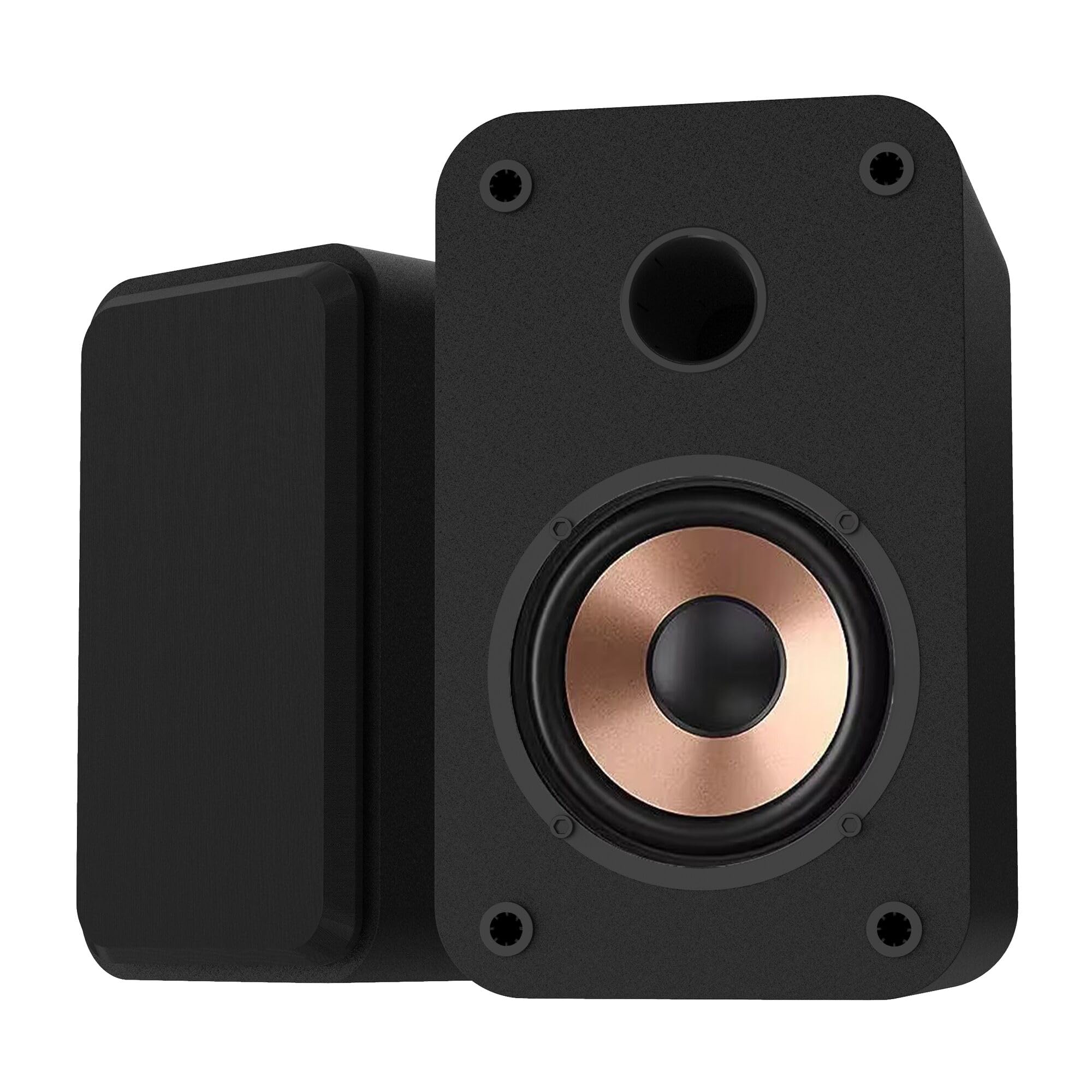
The 30-watt desktop powerhouse with aluminum drivers that beat a pair of Bose
The defining spec is 30W RMS (50W peak) from a high-efficiency Class-D amp driving dual 3-inch aluminum cones. In plain terms, this is genuinely loud for a desk setup, and reviewers point out it produces a “pretty decent level of bass” for its size, which is what most desktop listeners are really chasing. The wooden cabinet adds resonance control that plastic alternatives lack.
Connectivity covers Bluetooth 5.3 for wireless streaming, plus AUX and USB inputs for wired desktop use, and a 3.5mm headphone jack for private listening. Each speaker measures roughly the size of a smartphone, so they tuck neatly beside a monitor without taking over your workspace. Setup takes under two minutes: plug in the power, connect, and play.
One owner swapped out a pair of Bose speakers for these and found the LONPOO set sounded better—praise that carries weight. The caveat is that Bluetooth pairing has been hit-or-miss for some, with a few buyers unable to connect their iPhones or iPads. If you plan to use the AUX or USB input primarily, that hassle vanishes entirely.
The spec that sells it: 30W RMS from a Class-D amp in a wooden cabinet is rare at this level, and it shows in the bass response.
One honest flaw: Wireless pairing is the weak link—wired inputs are rock solid, but Bluetooth can be temperamental on some Apple devices.
Reach for this if: You want a compact, loud desktop pair with real bass and don’t mind plugging in via AUX or USB.
Look elsewhere if: Wireless streaming is your primary mode—the Bluetooth inconsistency makes it a gamble for those users.
5. Electrohome Huntley Powered Bookshelf Speakers

The retro-styled 3-inch powered pair that pairs instantly with a turntable
What gets the most consistent praise here is the build quality—buyers call it attractive, compact, and well-made, with a classic wood finish that looks far more expensive than the price suggests. The handcrafted acoustically tuned wood cabinets use a rear ported design to enhance bass response, and the 3-inch drivers deliver what most owners describe as warm, natural sound that “turns skeptics into believers.”
Connectivity is the other headline feature. You get Bluetooth 5 for wireless music streaming, plus RCA and Aux-In for turntables, TVs, and PCs. Shoppers say instant pairing and easy setup, which is why connectivity ranks as the second-most-praised aspect. The rear port means you’ll want a little space behind the speakers for the bass to breathe, but on a desk or console, the compact footprint fits neatly.
The honest trade-off is that sound quality gets mixed reviews as a category—many love it, but some report occasional popping noises and a general need for external EQ to dial in bass and treble to taste. These are powered speakers, so there’s no separate amp to tweak; you’re relying on the built-in amplifier, which includes a 1-year manufacturer’s warranty and lifetime customer support.
The Strong Suits
- Build quality and classic wood appearance praised most often
- Instant Bluetooth pairing with easy, beginner-friendly setup
- RCA, AUX, and Bluetooth cover turntable, TV, and phone
Keep In Mind
- Sound signature is warm but not reference-grade
- Some units report popping noises; bass often needs EQ help
Best for: The casual listener who wants an attractive, simple powered pair for a turntable or TV, prioritizing ease and looks over audiophile tweaking.
skip it if: You’re a critical listener who expects flat, detailed sound without needing to adjust EQ curves.
6. Dayton Audio PC83-4 3″ Full-Range Poly Cone Driver

The raw driver that one builder called “perhaps the finest 3-inch speaker I have ever heard”
This is a component, not a finished speaker—a bare 3-inch driver built for DIY enthusiasts who want to design their own cabinets or upgrade an existing build. The poly damped woven glass fiber cone controls break-up and rolls off smoothly, so highs stay clean at higher volumes. A copper cap tames inductance and extends high-frequency response for true full-range output from a single driver.
Reviewers report the sound quality is genuinely excellent for a 3-inch driver, with clean mids and highs and no distortion at high volumes. Some say bass is slightly lacking compared to larger drivers, but for a single full-range cone, the output is impressive. The high-energy ferrite magnet boosts efficiency, and buyers report how surprisingly large it is relative to the driver’s size.
One crucial detail: this is not a plug-and-play product. You’ll need to solder it to an amp or build a cabinet. Owners use it in everything from smart speakers to chip-amp DIY builds and MTM bookshelves. If you’re comfortable with a soldering iron, this is the best raw-value driver at the price, with a big following among hobbyists who swear by its performance.
Built For Builders
- True full-range response with smooth, non-fatiguing highs
- Surprisingly powerful magnet for high efficiency output
- Heat-tested in smart speakers at 25W with zero distortion
Know Before You Buy
- Requires soldering and a cabinet—not for casual listeners
- Bass is limited, as expected from a 3-inch driver
Reach for this if: You’re building your own speakers, upgrading a car audio setup, or want a component-grade driver to experiment with.
Look elsewhere if: You want to plug speakers in and play—this is raw material, not a finished product.
7. Dayton Audio PS95-8 3-1/2″ Point Source Full Range Driver

The 3.5-inch point-source driver that upgrades Ford dashboards with crisp, clear imaging
This driver’s defining feature is the copper-anodized phase plug in the center of the cone, which spreads dispersion and avoids resonance buildup. The low-mass voice coil and paper cone deliver detailed, non-fatiguing sound, while the non-resonant cast frame enhances clarity. Buyers consistently report the sound quality as the strongest trait, with one noting “excellent imaging” and another calling it a “huge upgrade over OE” factory speakers.
The most striking review pattern is how this 8-ohm driver has become a go-to for truck owners—specifically 2018 Ram 1500 dash swaps and 2021+ F150 center channel upgrades. The 8-ohm impedance tames overpowering center channels in Ford’s B&O systems, adding clarity and a crisper front stage. It’s also popular in DIY 3D-printed pods and line arrays where its wide high-frequency dispersion works well off-axis.
One honest constraint: bass is limited, which is expected at this size. Buyers describe the upper mids and highs as excellent but note the low end needs a subwoofer or larger drivers alongside it. And like the PC83-4, this is a raw driver—you’ll be soldering and mounting it yourself. The 3.5-inch cone is slightly larger than other picks here, which gives it a bit more presence in vehicle installations.
What Shines
- Clear, detailed upper mids and highs with wide dispersion
- 8-ohm impedance ideal for Ford and Ram dash upgrades
- Cast frame and phase plug enhance clarity and dynamics
The Limits
- Minimal bass output—pairs best with a subwoofer
- Mounting holes don’t always align with factory slots
Best for: Truck owners upgrading dash speakers and DIY builders who want a clean, natural-sounding full-range driver with wide dispersion.
Think twice if: You expect full-range bass from a single 3.5-inch driver—pair it with a sub or larger woofers for real low-end.
8. Herdio 3 Inch Waterproof Marine Speakers

The rugged, splash-proof 140W pair built for boats, UTVs, and hot tubs
This is the only pick in the lineup with a true outdoor mission. The IP44 splash-proof rating means every material—from the polypropylene cone with rubber edge to the molded ABS plastic basket—is designed to resist the corrosion present in humid, salty environments. With max power handling of 140W per pair and a frequency response of 120Hz to 20kHz, these are built to be loud in open-air settings where sound disperses quickly.
Setup is simpler than any other passive speaker in this guide. With a 3.94-inch total diameter and 2.95-inch mounting holes, it drops easily into boats, ATVs, UTVs, golf carts, motorcycles, or hot tubs. The box includes 6.5-foot speaker wires and mounting screws, so you won’t need extra parts. Owners mention it sounds better than factory-installed hot tub speakers, and the cover hides the mounting screws for a tidy finish.
The durability conversation is honest and split. Some owners have run these in hot tubs and reported they “worn out within one year,” while others bought two pairs and had no complaints. The manufacturer explicitly lists SPA and Hot tub as compatible environments, but the harshest installations seem to test the limits of even splash-proof gear. For boat decks, patios, or covered outdoor areas, they deliver “loud for a small speaker” performance at a price that makes replacements painless.
The Outdoor Credentials
- IP44 splash-proof build resists humid and salty environments
- 140W max power with 80dB sensitivity for open-air volume
- Tool-free mounting with all hardware included
Reality Check
- Continuous submersion in hot tubs can wear them out within a year
- Passive design requires an external amplifier to drive them
Best for: Outdoor enthusiasts adding sound to boats, ATVs, golf carts, or covered patios where water resistance matters more than audiophile refinement.
Not for: Fully submerged or extreme environments—treat splash-proof as a shield, not a license for constant soaking.
Understanding the Specs
Passive vs. Powered: The Amp Rule
Passive speakers and raw drivers need an external amplifier or receiver to produce sound. Powered speakers have the amplifier built in, so you just connect your source and plug into wall power. This is the first filter: if you don’t own an amp and don’t want to buy one, you need powered speakers. If you already have a receiver or want to build your own system, passive gives you more control over the sound signature.
Why Woofer Count and Tweeter Type Matter
A two-way design splits the audio workload: a woofer handles lows and mids while a tweeter delivers highs. Full-range drivers try to cover everything with a single cone. At 3 inches, dual woofers can push bass lower, and a silk tweeter generally produces smoother highs than a metal dome. For critical listening, a two-way with a quality tweeter tends to sound more refined; for simplicity, a well-engineered full-range driver can be remarkably good.
FAQ
Do I need an amplifier for a 3-inch passive speaker?
Will a 3-inch speaker provide enough bass without a subwoofer?
Can I connect a 3-inch speaker to my TV?
What is the difference between a full-range driver and a two-way speaker?
Are 3-inch speakers loud enough for a large room?
Can I use a Bluetooth 3-inch speaker with a record player?
Are waterproof 3-inch speakers suitable for a hot tub?
Which 3-inch speaker is best for a car dashboard upgrade?
Final Thoughts: The Verdict
If you want one dependable pick, the 3 inch loudspeaker winner is the Micca OoO Slim because it delivers genuine hi-fi sound with dual woofers and a silk tweeter in a footprint smaller than most competitors. If you want a fully powered, amp-free setup with TV-ARC remote control, grab the RIOWOIS Powered pair. And for studio-grade accuracy with balanced TRS inputs, the Edifier MR3 is the one to reach for. Whichever you choose, read the design type carefully—passive, powered, or raw driver—so your purchase matches the setup you already have.
How We Picked
We do not accept paid placement. Every pick is matched to a real buyer and a real use-case; we do not hands-on test units.
Sources & Methodology
Specifications: manufacturer listings and product documentation. Review insights: verified customer reviews, as of August 2026. Pricing: not shown on this page (it changes often); check the current price via the retailer link.
As an Amazon Associate, Gadgets Feed earns from qualifying purchases. This does not affect which products we feature.