
Our readers keep the lights on and my morning glass full of iced black tea. As an Amazon Associate, I earn from qualifying purchases.
Specs are compiled from manufacturer listings and verified buyer reviews and can change over time — please confirm the key details on the product page before buying.
If you are shopping for a 21700 battery charger, the single most important thing to know is that not every charger with that number in the title actually fits the battery. A 21700 cell is fatter and longer than the older 18650, so a slot made for a slimmer cell will reject it. This guide cuts through the listing confusion and ranks the chargers that genuinely accept the longer 75 mm slot size, based on the manufacturer specs and the real patterns across thousands of owner experiences.
I’m Min — the founder and writer behind Gadgets Feed. This guide is built by comparing the manufacturers’ published specifications and the patterns across verified customer reviews, so you get each pick’s real strengths and trade-offs instead of marketing spin.
Whether you are feeding a high-drain vape mod, a powerful flashlight, or a DIY power bank, the right 21700 battery charger needs a long enough slot, smart current detection, and a charging speed that matches your daily routine.
Our Picks at a Glance


How To Choose The Best 21700 Battery Charger
Before you buy a charger, check three things: the slot must physically fit a 21700 battery (a 21 mm by 70 mm cylindrical cell), the charge speed must match your patience, and it must handle different battery chemistries safely. Nail those three, and the rest is just convenience.
Check the Slot Length First
A 21700 battery is about 75 mm long with the positive terminal. If a charger lists a 75 mm slot, it can take a 21700, a 20700, and most 26650 cells too. If the listing only mentions 18650, assume the slot is too short and the 21700 will not seat properly, no matter what the marketing says.
Match the Charging Amps to Your Patience
Charging speed is measured in amps. A 0.5A rate is gentle and slow, good for small cells like a 14500. A 2A or 3A rate fills a big 21700 in about an hour or two. Most smart chargers let you switch between rates, so you can choose speed for a quick top-up or a slower rate to baby a cell.
Confirm It Handles Both Major Chemistries
You likely own a mix of lithium-ion cells (the 3.7V type, like 18650 and 21700) and nickel-metal hydride AA or AAA batteries. A smart charger detects which chemistry is inserted and applies the correct voltage automatically, so you can charge an 18650 and an AA side by side without fiddling with settings.
Quick Comparison
| Model | Best For | Charging Current | Charging Bays | Power Input | Amazon |
|---|---|---|---|---|---|
| IMREN 4-Bay★ Best Overall | Multi-size flexibility at a low price | 0.5 / 1 / 2A | 4 | USB-C | Amazon |
| EdisonBright are-D1Compact Pick | Ultra-portable single-cell travel | 0.5 – 2A | 1 | USB | Amazon |
| Nitecore UMS2Top Performer | Fast dual-slot charging with organizer | Up to 3A (single slot) | 2 | USB-C | Amazon |
| VCYWE 2-Slot | Budget 2-slot simplicity | Up to 2A | 2 | Micro-USB | Amazon |
| SUNLYTOUR 4-Slot | Big-capacity four-cell charging | 0.5 / 1A | 4 | USB | Amazon |
| WANGDAJIEDIAN 4-Bay | Informative LCD per-slot readouts | Up to 2A | 4 | USB-C | Amazon |
| XTAR VC4SL | Capacity testing & storage modes | Up to 3A (single slot) | 4 | USB-C | Amazon |
| FENIX are-A4 | Home and car AC/DC versatility | 0.6A | 2 | AC / DC jack | Amazon |
| Nitecore UMS4 | Four-slot power with included adapter | Up to 3A (single slot) | 4 | USB / QC3.0 | Amazon |
In‑Depth Reviews
1. IMREN 4-Bay 18650 / 21700 Charger
Our pick — over 4.5★ from 950+ verified ratings; the strongest balance of quality and price.
The four-bay workhorse that swallows nearly every cell you own without blinking.
The headline feature here is the 75 mm slot, which is what lets this 4-bay unit comfortably seat a 21700, a 20700, or even a chunky 26650 with a button top. Most budget chargers stop at the shorter 18650 length, so this one immediately covers more of your battery drawer than the average pick.
It runs on USB-C power and offers three selectable current rates — 0.5A, 1A, and 2A — toggled with a middle button. Drop in a single cell and it will charge on its own without needing a pair, which is a genuine time-saver if you only have one battery to top up. The smart detection reads whether you inserted a lithium-ion or a Ni-MH cell and adjusts the charge separately for each bay.
Owner experience backs up the versatility, with reports of it reviving flashlight cells that older chargers left under-filled. On a 12V RV setup it charges two 18650s in roughly 30 minutes, and the 2A fast mode is the reason. The trade-off is a missing instruction manual — some buyers had to figure out the button sequence by trial and error, and button-top cells can pop out if the unit gets jostled mid-charge.
What wins people over
- 75 mm slot fits 21700, 20700, and 26650 cells
- Charges any number of batteries, not just pairs
- 0.5 / 1 / 2A selectable fast charging
The honest friction
- No printed manual included with the unit
- Button-top cells can unseat if the charger is bumped
Reach for this if: you charge a mixed fleet of 18650, 21700, and 26650 cells and want one USB-C charger to rule them all.
Look elsewhere if: you need a printed guide in the box or you plan to charge while the unit gets carried around loose.
2. EdisonBright Fenix are-D1
A single-slot pocket charger that doubles as a spare power bank when you are on the road.
If your daily carry is one flashlight and one spare 21700, the are-D1 is the most honest size for the job. It is a single charging bay, but it works with 26650, 21700, 18650, 16340, 14500, 10440, AA, AAA, and C cells, and the whole thing is light enough to ride in an EDC pack without weighing you down. The bundle even throws in the EdisonBright BBX5 battery carry case.
It outputs up to 2A, which roughly halves the charge time compared to the 0.5–1A rivals, and the display cycles through voltage, amp draw, and amp-hours so you can watch the charge progress live. Owners clock a 3400mAh cell at about 1.5 hours when fed by a proper adapter.
The catch is the power source — it needs a 5V/2A adapter to reach a full 4.20V charge. Plug it into a plain computer USB port and it undercharges to around 3.29V, which is not enough for a full cell. It also still uses micro-USB instead of the newer USB-C standard, so travelers will want to carry the right cable.
Best as a travel buddy: pair it with a 2A wall adapter and it beats the slow multi-bay chargers for sheer portability, with a power-bank trick for emergency phone top-ups.
Grab it for: a minimalist loadout where one battery at a time is plenty and pocket weight matters more than bay count.
Skip it for: charging a whole drawer of cells at once — that is a job for a 4-bay unit.
3. Nitecore UMS2 Dual-Slot
The dual-bay speed demon that finishes a 21700 while the old charger is still warming up.
Nitecore built the UMS2 for people who are tired of waiting. With a 9V QC2.0+ power source, it pushes a maximum 3000mA into a single slot — that is the highest single-cell rate on this list — and up to 4000mA total across both bays. On a standard 5V/2A source it drops to a 1000mA per slot, which is still respectable.
The LCD reports battery health, charging status, and the active charging mode in real time, and the intelligent charging logic auto-selects the right current and voltage for each cell to protect its lifespan. It handles li-ion, IMR, LiFePO4, Ni-Cd, and Ni-MH chemistries across a wide size range that includes protected 21700 cells, and the bundle adds an organizer pouch for travel.
Long-time owners upgraded from older chargers and cut their charge time from 2–3 hours down to 1.5–2 hours on the same batteries. The recurring gripe is reliability — a few units have had power-up failures or an occasional electrical squeal, which is exactly the kind of thing a brand with Nitecore’s reputation should not be shipping. The USB-C port is a plus, though you have to supply the wall plug yourself.
Speed-first design: nothing else at this size fills a single 21700 faster, but a spotty quality record means checking the unit early in the return window.
Choose this for: vapers and flashlight fans who rotate two cells and want the fastest single-slot charge available.
Think twice if: you want a brand with a long, proven history, or you need four slots instead of two.
4. XTAR VC4SL 4-Bay

The lab-grade four-bay charger that tests your cells’ true capacity, not just fills them.
The XTAR VC4SL is the upgrade of the popular VC4S, and its a neat extra is a real capacity test. Long-press the Mode button into “Grad.” mode and it runs a charge-discharge-charge cycle to reveal whether a battery’s advertised rating is honest. That is a genuinely useful feature if you buy cells in bulk and want to verify them before trusting them in a device.
It charges via a USB-C port with QC3.0 fast input, hitting a maximum of 3A for a single slot, and you can manually adjust the current through five steps from 0.25A up to 3A. The 170° view-angle VA LCD shows real-time status for all four bays, and it safely handles protected 21700 batteries, which is a requirement many cheaper chargers fail.
There is also a storage mode that charges or discharges a cell to its rated voltage for long-term keeping, plus a revive feature for over-discharged batteries. The honest trade-offs: the display drew mixed feedback for readability, and the reliability record is spotty enough that some owners had to work with XTAR support to get a replacement power block. It is also picky about its power brick — a cheap adapter can cause resets.
Built for the curious: the capacity test and storage mode make it the only pick on this list that doubles as a diagnostic tool for your battery collection.
Pick this up if: you want to verify cell capacity and store batteries properly during long downtime.
Pass it by if: you just want to plug in and charge without thinking about modes or power-brick quality.
5. VCYWE 2-Slot Charger
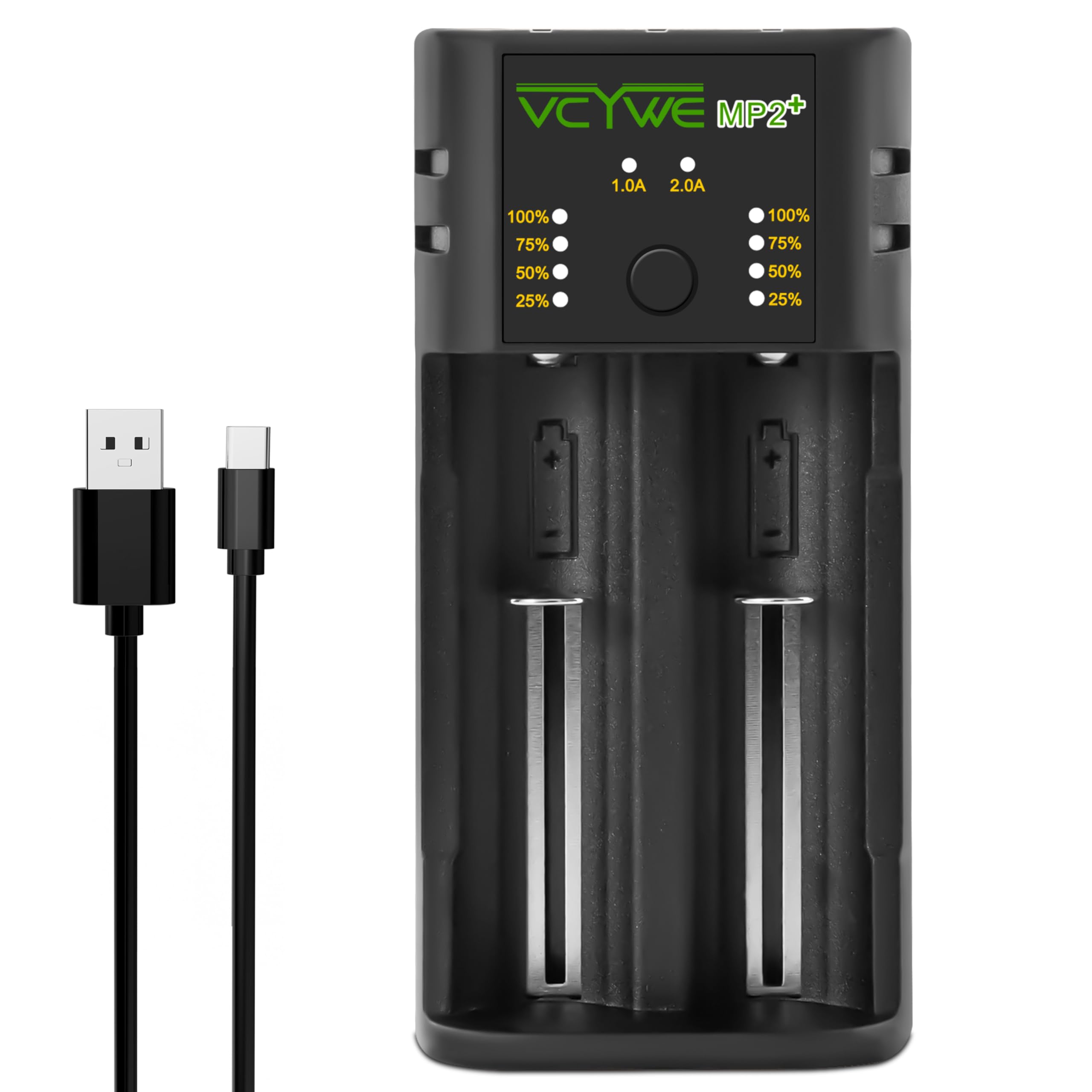
A no-frills two-slot charger with one clever emergency trick up its sleeve.
The VCYWE keeps things refreshingly simple: two independent slots, up to 2A per slot, and auto-detection that picks either a 1A or 2A rate depending on the cell. It covers the full 3.7V Li-ion range (10400 through 21700 up to 26650) plus 1.2V Ni-MH and Ni-Cd in AAAA/AAA/AA/A/SC/C/F6 sizes, so it is a legitimately wide compatibility list for the money.
What sets this budget pick apart is the emergency output mode. Drop an 18650 (a 18 mm by 65 mm cylindrical cell) into the right slot, and the charger can power a USB device like your phone in a pinch — a genuinely useful fallback when the power goes out or you are away from a wall outlet. The LED display shows charging progress at 25%, 50%, 75%, and 100% stages, so you always know how much juice is left.
Compatibility is the aspect owners praise most, and the fast charging speed gets consistent shout-outs — one buyer specifically needed a charger for 2/3 AAA batteries and found this one charged them quickly. The trade-off is connectivity: it uses Micro-USB instead of USB-C, so keep the included cable close, and the two-slot limit constrains large battery rotations.
Smart money move: the emergency phone-charging output and wide size support make this the most useful thing at its price point, even if the Micro-USB port feels dated.
Best for: a first-time rechargeable user with a couple of 21700s and AA batteries who wants USB-C convenience without the steep learning curve.
Not for: heavy multi-cell households that would outgrow two slots in the first week.
6. WANGDAJIEDIAN 4-Bay LCD Charger
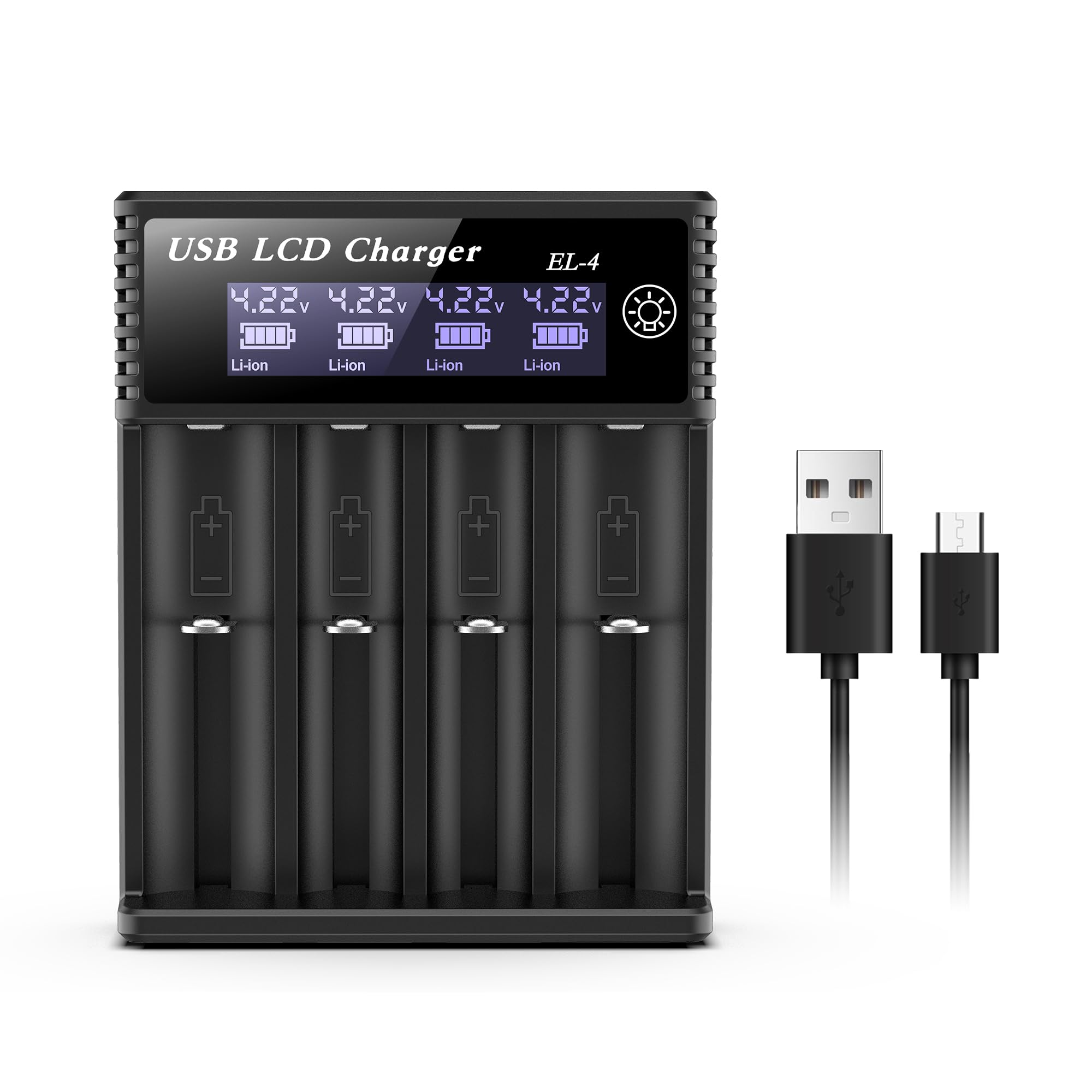
A four-bay charger that shows you voltage, current, and battery type for every slot at once.
The WANGDAJIEDIAN earns its place on this list with a proper LCD that reports each bay independently — voltage, current, charge level, and battery type all readable on one screen. Touch the screen switch to adjust brightness, and it dims after 30 seconds of inactivity to save power. The flame-retardant PC shell with good heat dissipation is a thoughtful safety touch for a device that handles lithium cells.
It is a true 4-bay design where each slot charges independently without interfering with its neighbors, and it delivers up to 2A for lithium-ion cells. For AA/AAA Ni-MH or Ni-Cd batteries it tops out at a gentler 300mA rate, which is exactly what those cells prefer. The slot range of 29mm to 70mm covers everything from a 10440 up to a 26650, and the listing specifically names 21700 compatibility.
The main thing owners praise is build quality, but the charging performance drew mixed feedback — some say it works as intended while others report it not working properly. That split is a real consideration. One owner also noted the advertised 21700 fit did not hold up for their specific cell, which is a reminder that tolerances vary between brands of 21700 batteries.
Genuine strengths
- Independent LCD data for all four bays
- 2A fast charging for lithium cells
- Flame-retardant build with good heat dissipation
Real risk to weigh
- Charging performance reports are split between smooth and faulty
- Fit for the longest 21700 cells is not guaranteed
Worth it for: someone who wants per-bay telemetry on a four-slot charger without jumping to a premium brand.
Play it safe if: you only run the longest protected 21700 cells and need a guarantee they will seat every time.
7. FENIX are-A4 Smart Charger

The rugged dual-power charger that runs from both a wall outlet and a car’s DC socket.
The FENIX are-A4 stands apart on power flexibility. It accepts both AC and DC input, so you can plug it into a standard wall socket at home or a 12V car outlet on the road without needing a separate adapter. That makes it the natural pick for overlanders and anyone who charges batteries away from a desk.
It intelligently adjusts charging current based on battery type and size, and the UL certification covers short-circuit, over-current, over-voltage, and reverse polarity protection — real safety credentials for a device that spends time with high-drain lithium cells. The 9.35-ounce body and 5.89-inch length fit easily into outdoor gear, and it handles 21700 button-top cells up to 5000mAh with reported ease. The bundle includes a LumenTac battery organizer to keep cells tidy.
Reliability is the standout theme, with long-term owners reporting Fenix chargers that lasted a decade or more and cells that endured 500+ cycles without capacity loss. The honest downside is speed — the listed amperage is just 0.6A, so this is not the charger to grab when you need a dead 21700 filled in under an hour. It is a slow-and-steady tool for people who value longevity over sprint times.
Durability-first choice: the dual AC/DC input and UL-rated protections make it the most versatile and safest pick for car camping, even if the 0.6A rate is the slowest here.
Get this one if: you charge batteries from both a wall and a vehicle, or you want the most proven long-term reliability in the lineup.
Look past it if: fast charging is your top priority — the Nitecore UMS2 fills cells much quicker.
8. Nitecore UMS4 Four-Slot

A four-slot flagship that ships with everything you need, straight from the start.
If your battery rotation outgrew two slots, the Nitecore UMS4 is the four-bay answer from a name owners trust. It reaches a maximum single-slot output of 3000mA (3 amps) when paired with a quick-charge adapter, and it ships with a LumenTac QC3.0 adapter in the box — no hunting for a compatible power brick, which is a bigger convenience than it sounds.
The LCD reports per-bay battery health, charging status, and charging mode, and owners specifically call out the estimated charge-complete time as a genuinely helpful readout. It auto-detects battery type and voltage across li-ion, IMR, LiFePO4, Ni-Cd, and Ni-MH chemistries, and it can even activate over-discharged cells that other chargers refuse to touch — one owner revived six dead 18650s with this unit.
Battery life and reliability are the two aspects owners praise most, alongside the versatility of handling lightsaber batteries, vape cells, and flashlight batteries of all types. The mixed note is charging speed — while quick charging works, some buyers report it does not always charge in a timely manner, so your mileage depends on the cells and the adapter you pair it with.
Flagship strengths
- Four independent bays with per-slot LCD data
- QC3.0 adapter included in the box
- Can revive over-discharged cells
Speed caveat
- Charge timing varies — not always as quick as the rating suggests
- Instructions get complicated if you want specific readouts
The right call for: a collector with four or more cells on rotation who wants per-slot telemetry and a charger that arrives ready to use.
Maybe overkill if: you own two batteries and rarely touch four-slot capacity.
9. SUNLYTOUR 4-Slot Charger

The four-slot budget banger with a clear informative screen and solid metal battery tabs.
Here is a 4-slot charger that costs less than some 2-slot rivals, and it does not skimp on the parts that matter. The 75 mm slot takes 21700, 20700, 26700, 26650, and 18650 cells with a PCB protection board, and the four independent slots adjust to different battery lengths so you can mix sizes across the bays freely.
Owners rave about the informative display, describing the screen as “really cool” and the metal tabs that hold batteries in place as solid — not the flimsy plastic clips you find on cheaper units. It supports 1.2V Ni-MH Ni-CD AA, AAA, AAAA, C, SC, F6 cells alongside the whole Li-ion IMR/INR/ICR family, making it a genuine near-universal charger.
The default charge rate is 500mA, which is gentle and safe, and with two batteries inserted you can select 1A. Charge speed scales with your power brick and cable, so a 65W brick drives it harder than a weak phone adapter. The manufacturer includes a clear warning about Ni-MH cells older than 2–3 years, and notes this unit cannot charge CR123/CR123A or 1.5V Li-ion cells — so check your chemistry before loading it up.
Best raw value on the list: four slots, a useful LCD, and metal-reinforced bays at a price that undercuts premium 2-slot chargers.
Choose this if: you need four bays and a readable screen but your budget is better spent on batteries than on a name brand.
Take note: the default 500mA rate is slow for big 21700s unless you actively select the higher 1A mode.
Understanding the Specs
Slot Length (75 mm)
The golden rule for a 21700 charger is the slot length. A 21700 battery measures about 75 mm from terminal to terminal, so a charger that lists a 75 mm slot will seat it correctly. Chargers that only accept shorter cells will either reject the 21700 outright or make poor contact, which stops the charge from starting.
Charging Current (Amps)
Amps determine how fast your battery fills. A 0.5A rate is slow and gentle, ideal for small cells like a 14500. A 2A or 3A rate is fast, filling a large 21700 in an hour or two. Smart chargers let you switch between rates so you can prioritize speed or battery longevity, and they adjust automatically based on the cell’s internal resistance.
FAQ
Will a charger that fits 18650 also fit a 21700 battery?
How long does it take to charge a 21700 battery?
Can I charge a 21700 and an AA battery at the same time?
Is a higher amp charger better for my 21700 battery?
What does USB-C power input mean for a battery charger?
Why does my charger show a lower voltage than the battery’s 4.2V rating?
What is the difference between a smart charger and a dumb charger?
Can a 21700 charger revive a battery that is completely dead?
Is it safe to leave a 21700 battery in the charger overnight?
Final Thoughts: The Verdict
For most buyers, the 21700 battery charger winner is the IMREN 4-Bay because it pairs the crucial 75 mm slot with selectable 0.5 / 1 / 2A charging across four independent bays at a price that undercuts most rivals. If you want the fastest single-slot charge, grab the Nitecore UMS2 with its 3000mA output. And for the ultimate four-slot experience with a QC3.0 adapter included, the Nitecore UMS4 is the one to reach for.
How We Picked
We do not accept paid placement. Every pick is matched to a real buyer and a real use-case; we do not hands-on test units.
Sources & Methodology
Specifications: manufacturer listings and product documentation. Review insights: verified customer reviews, as of August 2026. Pricing: not shown on this page (it changes often); check the current price via the retailer link.
As an Amazon Associate, Gadgets Feed earns from qualifying purchases. This does not affect which products we feature.