
Our readers keep the lights on and my morning glass full of iced black tea. As an Amazon Associate, I earn from qualifying purchases.
Specs are compiled from manufacturer listings and verified buyer reviews and can change over time — please confirm the key details on the product page before buying.
When your AC stops blowing cold on the hottest day of the year, the culprit is often a tiny switch called a contactor relay. This part tells your condenser when to turn on, and when it fails, the whole cooling system goes silent. Swapping a contactor is a DIY job most handy homeowners finish in under an hour, and this guide helps you pick the right replacement to avoid a repair tech wait.
I’m Min — the founder and writer behind Gadgets Feed. This guide is built by comparing the manufacturers’ published specifications and the patterns across verified customer reviews, so you get each pick’s real strengths and trade-offs instead of marketing spin.
To match the right air conditioner relay switch, you must check your coil voltage, amperage, and pole count before you buy.
Our Picks at a Glance


How To Choose The Best Air Conditioner Relay Switch
Choosing the right relay means matching three things on your old part: the coil voltage, the current rating, and the number of poles. Match all three, and the new contactor drops in and runs reliably for years. Get them wrong, and you risk a part that chatters, overheats, or fails to pull in at all.
Match the Coil Voltage First
The coil is the electromagnet that pulls the switch closed, and almost every home condenser uses a 24-volt coil fed by the furnace or air handler’s control transformer. If your system uses a different control voltage, the relay simply will not engage. Coil voltage is the most common mismatch, so verify the old part’s printed coil rating before ordering.
Count the Poles
A single-pole relay switches one hot line, while a double-pole relay switches both hots on a 240-volt circuit. If your condenser has a double-pole breaker feeding it, you almost certainly need a two-pole contactor. Swapping in a single-pole where a double-pole belongs is unsafe and will not fully disconnect power.
Respect the Amperage Rating
Contactors are rated in amps — typically 30A or 40A for residential units. You can usually replace a 30A with a 40A for extra headroom, but never go down in rating. The amp rating indicates the maximum current the silver contacts can safely switch on each cooling cycle.
Quick Comparison
| Model | Best For | Poles | Current Rating | Coil Voltage | Amazon |
|---|---|---|---|---|---|
| Dreyoo 2 Pole 40A★ Best Overall | Crowd-favorite 2-pole swap | 2 | 40 A | 24 V | Amazon |
| Dreyoo 1 Pole 30ABudget Champion | Budget single-pole fix | 1 | 30 A | 24 V | Amazon |
| Supco 90340Most Versatile | Flexible DPDT switching | DPDT | — | 24 V | Amazon |
| ClimaTek Condenser | Carrier/Bryant/Payne fit | 1 | 30 A | — | Amazon |
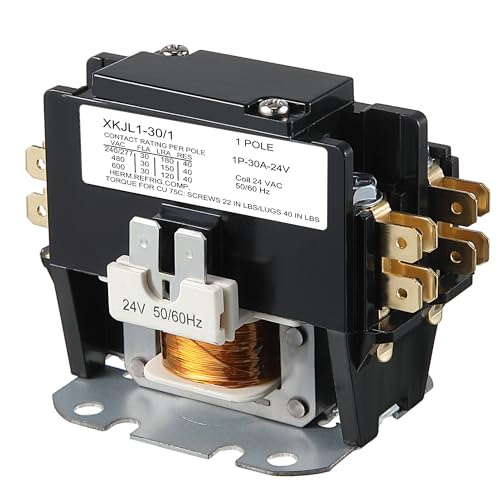
| BOJACK 1 Pole 30A | Proven drop-in replacement | 1 | 30 A | 24 VAC | Amazon |
| SUNLEE 2 Pole 40A | Premium 2-pole performance | 2 | 40 A | 24 VAC | Amazon |
| Goodman 2 Pole 30A | Universal 2-pole replacement | 2 | 30 A | 24 V | Amazon |
| PROTACTOR 1 Pole 40A | Heavy-duty 1-pole upgrade | 1 | 40 A | 24 V | Amazon |
| PROTACTOR 2 Pole 40A | Heavy-duty 2-pole upgrade | 2 | 40 A | 24 V | Amazon |
In‑Depth Reviews
1. Dreyoo 2 Pole 40A Contactor
Our pick — over 4.5★ from 900+ verified ratings; the strongest balance of quality and price.
Backed by over 900 buyers, this 40 A two-pole is the most common fix for a silent condenser.
This relay replaces both 30A and 40A residential parts, so you get room to spare on most home units. It is a true 2-pole contactor rated for 40 A full load, meaning it can safely switch both hot lines on a 240-volt circuit. The hermetically sealed coil (a coil fully encased to block moisture) shrugs off rain and rooftop humidity, and the silver oxide contacts keep voltage drop under 5mΩ, so the compressor gets clean, consistent power on every startup.
Buyers report “Worked like a charm and got my condenser back up and running without any problems” — and the pages back that up with the dominant praise being how well it functions. It is built to survive -40°F to +221°F, so it will handle a brutal attic in August as easily as a freezing January night. At 8.8 ounces it is noticeably meatier than lighter general-purpose relays, and that heft translates to a part that feels solid in hand when you torque down the lugs.
The trade-off is long-term durability, with a minority of owners reporting early failures. A slice of owners mention the part failing within 30 days, which is a real minority but worth knowing if you are installing it on a unit you cannot easily reach. It also lists compatibility with Mars 17421 and Cutler Hammer C25BNB240T, so check your old part’s stamp before you commit if you run one of those brands.
durable dual-pole workhorse
- 40 A rating covers most residential 2-pole needs
- Sealed coil resists moisture and debris
- Easy for confident DIYers to wire
heavier than rivals
- Occasional early failures reported within a month
- Heavier than a basic general-purpose relay
best overall: you need a dependable 2-pole, 40 A replacement for a standard residential condenser and want a part with a huge base of happy owners behind it.
overkill for small: you have seen this exact model fail before in your unit, or you want the extra thermal headroom of a premium coil.
2. Dreyoo 1 Pole 30A Contactor
A single-pole 30A fix that has saved hundreds of owners from paying a contractor.
If your system only switches one hot leg, this is the budget pick that keeps things simple. Rated for 30 A with a 24 V coil, it is a direct match for a huge share of residential single-pole contactors, and owners repeatedly note it dropped into place in about ten minutes. One buyer described replacing both the capacitor and this contactor in half an hour and dropping the upstairs temperature from 93 degrees to a comfortable 68 — a vivid reminder of how fast a failed relay makes a home unbearable.
There is a practical warning buried in the review pages that is worth heeding: one owner traced their problem back to a transformer that went bad inside the furnace, noting you may need to replace that too, along with the fuse on the furnace circuit board. That is the classic cascade failure — the relay burns out, and it takes the transformer with it. Before you install, check the transformer and fuse so you do not fry a brand-new relay on the first call for cooling.
At 8.32 ounces it is right in line with other single-pole parts, and the value argument is strong since it often costs a fraction of the OEM part from a brand like Carrier. The main caution is that a few owners found the build quality a notch below the original they replaced, so it is best suited to those who want an inexpensive, functional fix rather than a part that feels premium in the hand.
A cross-check against the 2-pole Dreyoo above shows the real difference between the two: this one is rated at 30 A versus the 40 A of its bigger sibling, so if your condenser needs the heavier duty, step up to the 2-pole version instead.
budget pick: you have a single-pole system and want the cheapest reliable path back to cold air without calling a pro.
not for heavy: you want a part that feels as sturdy as the OEM unit it is replacing.
3. Supco 90340 General Purpose Relay
At just 5.44 ounces, this DPDT relay is the lightest here and adapts to nearly any switching job an HVAC pro throws at it.
This is not a standard condenser contactor — it is a double-pole, double-throw (DPDT) relay, which means one coil can flip two separate switch circuits at once. That flexibility is why it shows up in HVAC/R systems, vending machines, and fan controls. At 5.44 ounces versus the Dreyoo 2-pole’s 8.8 ounces, it’s compact and easy to tuck into tight control panels.
It comes with UL recognition and CSA certification, so it carries real third-party safety validation rather than just a maker’s claim. The silver alloy contacts handle both normally closed and normally open wiring, which is the secret to its flexibility — one owner clarified that you can wire it as NO, NC, or both, making it a true one-part-fits-many solution. Owners have used it to bring a hurricane-flooded Heil condenser back to life, with one noting it “replaced the original perfectly and at a good price.”
The catch is that instructions are famously sparse. Buyers describe the documentation as lacking, so this is a part for someone who already understands relay wiring rather than a first-timer guessing from the box. If you know what you are doing, it is an excellent, dependable tool; if you are brand new to electrical work, pick a contactor with clearer guidance instead.
universal relay replacement: a UL-recognized DPDT workhorse that adapts to HVAC, vending, and fan-control duty — provided you already know how to wire it.
4. ClimaTek Condenser Contactor

This single-pole, 30 A contactor directly replaces four specific part numbers, so Carrier, Bryant, and Payne owners often need zero modification.
When the maker’s name is right on your old part, this is the replacement that makes life easy. ClimaTek built this single-pole, 30 A contactor to directly replace part numbers HN51KC024, HN51CB025, HN51KB024, and P282-0311, and it is designed for Carrier, Bryant, Payne, Day&Night, ICP, Heil, and more. The promise is an exact fit — no adapters, no wiring changes, no re-drilled holes — and most owners confirm that is exactly what they got.
One buyer dropped it into a 30-year-old Bryant system and reported it worked immediately, with only the mounting footprint requiring a small new screw hole. Another noted it “matched the bad part perfectly, it dropped right in,” and kept two screws from the old unit because their square caps held the wires better. The sealed contact design is a genuine upgrade over older open-style contacts, since it keeps insects and debris away from the switching surfaces.
Downsides include a brittle plastic housing and occasional contact burn under heavy use. It also has an audible click when it engages, which is normal for a contactor but noticeable if your unit sits right outside a bedroom window. None of this stops it from being a strong, cost-effective pick for the brand family it targets.
quick swap: you own a Carrier, Bryant, or Payne and want a same-spec swap without creative wiring.
rough handling: you prefer the confidence of a part with a cleaner durability record.
5. BOJACK 1 Pole 30A Contactor

A 1-pole, 30 A full-load part with a 600 VAC max withstand voltage, proven to cure stuck-contact condenser gremlins.
If your AC runs nonstop or fails to start, a pitted contactor is often the hidden cause — and this BOJACK is the part owners reach for when they crack that code. It is a 1-pole, 30 A full-load contactor with a 24 VAC coil and a 600 VAC max withstand voltage, giving it plenty of margin on a standard residential circuit. One owner described an old contactor that had become pitted and would stick in the on position, forcing them to cut power and tap the part to make it release — a new BOJACK fixed it instantly.
The review pages paint a clear picture of a part that fits where it should and performs without drama. It went into a Rheem without modification, replaced a stuck-contactor Goodman unit in about ten minutes, and one owner installed it alongside a new start capacitor during a 95-degree heatwave for roughly total. The recurring headline is the money saved — several owners quote contractor estimates of to that they avoided by doing the swap themselves.
Quality opinions split a few ways, with some calling it well-made and others noting a cheaper feel, and a handful of owners saw failure after about 45 days. It is a value-first part rather than a heirloom-grade one, so it suits DIYers who want cold air fast at a commodity price. For a single-pole system, it delivers the same function as pricier originals for a fraction of the cost.
entry level: you are a confident DIYer who wants a cheap, proven single-pole fix that fits common Rheem and Goodman units.
frequent cycling: you want a heavier-duty build that inspires confidence across many seasons.
6. SUNLEE 2 Pole 40A Contactor

A UL-certified 40 A two-pole with a Class F coil that runs cooler, safely covering both 30A and 40A systems.
SUNLEE rates it at 40 A full load and 50 A resistive load, so it is rated to replace both 30A and 40A contactors, and it carries UL recognition plus A2L compliance — a modern safety standard that matters as the industry shifts to mildly flammable refrigerants. The silver contacts resist the arcing and pitting that kills cheaper parts, and the Class F coil insulation (rated to 155°C) runs with more thermal headroom than the Class B (130°C) coils found on most competitors.
What owners notice first is how cleanly it engages — the coil pulls in immediately on 24 V with a quiet operation, and the rugged molded base shrugs off heat and vibration. One owner swapped it in as preventative maintenance and reported it still working great a year later, which is exactly the longevity story you want from a premium part. The universal mounting plate uses the standard HVAC footprint, so it fits most home condensers without modification.
The only real downside is the higher price than commodity contactors, plus a few buyers found their issue was elsewhere. If your diagnosis points at a 2-pole contactor, this is a confident choice that should outlast a budget part.
premium dual-pole upgrade: a UL-recognized, A2L-compliant 40A contactor whose cooler-running coil and rugged base make it the premium pick for serious DIYers and techs.
7. Goodman 2 Pole 30A Contactor

This sealed 2-pole, 30 A relay claims to replace virtually any residential brand’s condenser contactor.
Some contactors hide their secrets, but this one advertises its reach: it directly replaces all 2-pole, 25/30 amp, 24-volt coil contactors on AC and heat pump units across every major brand. That universal promise comes with a sealed coil and covered contacts, which keep bugs and yard debris from landing on the switching surfaces — a common killer of open-style contactors in outdoor units. One owner summed up the upgrade: “the relay had shorted and it just caused all kinds of havoc,” and this part was an exact replacement for a unit that had run for about 20 years.
Reliability is what owners praise most about this one, along with easy installation and straightforward value. It is a touch larger and heavier than the OEM part it replaces, which is a minor fit consideration if your panel is tight, and it works quietly in operation. The sealed design is the standout feature — it actively prevents the debris buildup that leads to pitted contacts and stuck relays in the first place.
The quirks are practical rather than fatal: there is no manual trip button, and the terminal design assumes you have a crimping kit for the lugs. One owner improvised with hooks when they lacked the right tool, so plan for standard HVAC connectors. For a universal, straightforward 2-pole replacement, this is a dependable stop that keeps your condenser clicking over cleanly.
brand match: you want a sealed, universal 2-pole contactor that keeps debris out and fits most residential units.
noisy setups: you need a manual trip lever or prefer a part with a smaller footprint.
8. PROTACTOR 1 Pole 40A Contactor

A UL-listed 40 A single-pole with a compact 2-5/16 by 1-15/16 inch base, built to replace nearly every residential 1-pole contactor made.
When your compressor has been welded shut by a stuck contactor, this is the heavy-duty cure. PROTACTOR rates it at 40 A full load with a 24-volt coil, and it is designed to replace most 1-pole contactors rated from 20 A all the way up to 40 A on both air conditioners and heat pumps. The enclosed contacts and encapsulated coil protect against the insects and debris that kill open designs, and the compact base measures 2-5/16 by 1-15/16 inches with multiple mounting holes for flexible placement.
Owners tell a consistent story of a fast, exact fit. One swapped out a 23-year-old Amana unit’s original 25 A contactor for this 40 A upgrade and reported a smoother, quieter compressor with less runtime — a real benefit of going up in rating within the same pole count. Another ordered it early in the morning, had it by the next morning, and finished the install in 15 minutes on a 100-degree day. The UL listing and 2-year replacement policy add genuine reassurance that a budget brand rarely offers.
The one recurring caveat is that some units lasted about a year before needing replacement, so longevity is not guaranteed at this tier. Terminal markings also differ slightly from some originals, so follow your old wiring rather than trusting the labels. For a heavily built 1-pole upgrade with a safety certification to back it, this is a strong, confident choice.
power pick: you want a UL-listed 40A single-pole with a 2-year replacement policy and universal brand coverage.
limited space: you expect a single part to run for many years without attention.
9. PROTACTOR 2 Pole 40A Contactor

A UL-listed 2-pole, 40 A contactor with the widest brand coverage in this list: Carrier, Goodman, Rheem, and Trane.
For a 2-pole system, this is the endgame replacement. It carries a 40 A rating with a 24-volt coil, and the compatibility list reads like a who’s who of residential HVAC: Carrier and Bryant P282-0421, Goodman and Amana CONT2P series, Rheem and Ruud 42- series, plus Trane and American Standard CTR models. The enclosed contacts and encapsulated coil keep environmental wear at bay, while heavy lug terminals and push-on connectors give you real flexibility when the old wiring does not match expectations.
Owners consistently describe it as easy to install and well-built. One found a burned L1 power connection left by an AC installer who had failed to tighten the terminal, and this contactor fit like it was built for the unit. Another simply reported “old one fried” and this one working great as a drop-in replacement. It is UL listed and comes with a 2-year replacement policy, which takes the sting out of the higher price point.
The durability record is mostly positive but carries a note of caution, as a few owners reported burnouts within seconds of use — usually a sign of an underlying wiring issue rather than a defective part. If you have confirmed your system’s wiring is sound, this is a heavy-duty, safety-certified 2-pole that should handle years of cycling. It pairs perfectly with the single-pole PROTACTOR above if you need both pole counts across two units.
heavy duty: you want a UL-listed, 2-pole 40A contactor with the widest possible brand coverage and a replacement warranty.
cramped panels: your wiring is unverified, since a fresh part can burn out fast when the real problem is upstream.
Understanding the Specs
Poles: Single vs. Double
This tells you how many hot electrical lines the relay switches at once. A single-pole contactor switches one line, while a double-pole switches both hots on a 240-volt circuit. Match the pole count to your old part exactly — going from 2-pole down to 1-pole is unsafe because it leaves one hot line unswitched. Count the terminals on your old contactor and order the same layout.
Current Rating and Coil Voltage
The amp rating (30 A vs 40 A) tells you how much current the silver contacts can safely switch. You can go up in rating for headroom, but never down. The coil voltage — almost always 24 V in residential systems — is what pulls the contacts closed. If your coil voltage does not match your control transformer, the relay will not engage at all. Check the stamp on your old part before ordering.
FAQ
How do I know if my AC relay switch is bad?
Will a 40A contactor replace a 30A one?
What is the difference between a contactor and a relay?
How do I match the correct relay for my Carrier or Bryant unit?
Why does my new contactor keep burning out?
Can I install an AC contactor myself?
Is a sealed contactor better than an open one?
What does double-pole double-throw (DPDT) mean?
How long should an AC contactor last?
Should I replace the capacitor at the same time as the relay?
Final Thoughts: The Verdict
For most buyers, the air conditioner relay switch winner is the Dreyoo 2 Pole 40A because it pairs a 40 A rating with a sealed, weather-resistant coil and a huge base of satisfied owners. If you run a single-pole system and want the cheapest reliable fix, the Dreyoo 1 Pole 30A is the value pick that has saved many owners from a contractor bill.