
Our readers keep the lights on and my morning glass full of iced black tea. As an Amazon Associate, I earn from qualifying purchases.
Specs are compiled from manufacturer listings and verified buyer reviews and can change over time — please confirm the key details on the product page before buying.
Picking a pair of bookshelf speakers in this price range is about deciding what kind of listener you are, not just what your budget is. You are choosing between warm and analytical, between a wide soundstage and a punchy front-row seat, between speakers that vanish into the room and ones that demand attention. This guide cuts through the spec-sheet noise to help you match the right pair to your room, your amplifier, and the music you actually play.
I’m Min — the founder and writer behind Gadgets Feed. This guide is built by comparing the manufacturers’ published specifications and the patterns across verified customer reviews, so you get each pick’s real strengths and trade-offs instead of marketing spin.
Here are the nine pairs that make the most sense to audition on your shortlist for the best bookshelf speakers under $2000, ranked by how well they perform for real listeners.
Our Picks at a Glance


How To Choose The Best Bookshelf Speakers Under $2000
Before you pick a pair, check the amplifier you already own or plan to buy. Every speaker here is passive, so it has no built-in amplifier and needs a separate receiver or amp to make sound. That match decides how good these will actually sound in your room.
Match the Impedance and Power
Speakers are rated in ohms (a measure of electrical resistance), and most run at 4, 6, or 8 ohms. An 8-ohm speaker is the easiest load for a typical AV receiver to drive comfortably. A 4-ohm speaker demands more current from the amplifier — if your amp is weak, the sound can get strained or the volume can collapse. Before you buy, check that your receiver is stable at the speaker’s impedance rating, and look at the recommended power range in watts so you don’t under-power or over-power the pair.
Match the Woofer to Your Room
The woofer size — typically 5.25 inches or 6.5 inches in this category — controls how much bass the speaker can produce on its own. A 6.5-inch driver moves more air, so it fills a medium or large room with fuller low-end without needing a subwoofer. A 5.25-inch driver is often tighter and faster, and it suits smaller rooms or desks where deep bass would just boom and muddy the sound. Think about your ceiling height and floor space, not just the width of the shelf.
Read the Tweeter Type
The tweeter handles everything from vocals to cymbals, and its material shapes the character of the sound. Metal dome tweeters (like titanium or aluminum) tend to be crisp, detailed, and revealing — great for picking apart complex mixes, but they can sound bright or harsh if the crossover is not well designed. Soft dome tweeters (like silk or fabric) are usually smoother and more forgiving, making them an easy choice for long listening sessions. Neither is inherently better; the right one depends on if you want analysis or relaxation.
Quick Comparison
| Model | Best For | Woofer Size | Impedance | Frequency Response | Amazon |
|---|---|---|---|---|---|
| Polk ES20★ Best Overall | Warm, full-range listening | 6.5 inches | 4/8 ohms | — | Amazon |
| Klipsch RP-500M IIVocal Clarity Pick | Clear vocals, small rooms | 5.25 inches | — | Down to 40Hz | Amazon |
| ELAC Debut 3.0 DB53Audiophile Value | Audiophile neutrality | 5.25 inches | — | 48Hz to 38KHz | Amazon |
| KEF Q1 Meta | Cohesive imaging, small spaces | 5.25 inches | — | — | Amazon |
| Klipsch RP-600M II | Punchy home theater | 6.5 inches | — | — | Amazon |
| HiVi-Swans D3.1 MKII | Engaging, musical scale | 6.5 inches | 8 ohms | — | Amazon |
| DALI KUPID | Compact rooms, wall mounting | 4.5 inches | 4 ohms | 63–25,000 Hz | Amazon |
| Polk Reserve R200 | Warm, high-end detail | 6.5 inches | — | — | Amazon |
| SVS Ultra Evolution Nano | Hi-fi detail, compact size | 5.25 inches | 6 ohms | — | Amazon |
In‑Depth Reviews
1. Polk Audio Signature Elite ES20 Bookshelf Speaker Pair
Our pick — over 4.5★ from 750+ verified ratings; the strongest balance of quality and price.
A warm, silky pair that fills a room with non-fatiguing highs.
The ES20 is a 6.5-inch woofer design with a 1-inch Terylene tweeter, and it is the pair that people keep comparing to speakers many times its price. Owners describe the sound as warm and silky, with clean highs that you can listen to for hours — the kind of presentation that works for acoustic, vocals, and movies alike. The secret is Polk’s patented Power Port Technology, which the maker claims delivers 3dB louder bass than conventional ported speakers by reducing turbulence and distortion in the low end.
That engineering shows up in daily use. The bass is deep and well-balanced enough that buyers report a subwoofer is optional, and the speakers are easy to drive from most amplifiers or AV receivers thanks to their 4- and 8-ohm compatibility, including Dolby Atmos and DTS:X setups. On the aesthetic side, the walnut finish and bold modern look earn steady compliments, though the faux wood is not convincing up close.
The honest trade-off is physical size. As owners mention, “They are kinda big for bookshelf speakers,” with a deep footprint that can clash with a slim modern TV stand. If you have a shallow shelf, measure before you commit — but if you have the room, the ES20 rewards you with a huge, enveloping sound. The components are well-built, perform beautifully with Marantz receivers, and the value is what drives its 4.8-star rating from over 700 owners.
What wins people over
- Silky, non-fatiguing highs that stay smooth at high volume
- Deep, well-balanced bass — a subwoofer feels optional
- Easy to drive from almost any receiver or amp
Consider this first
- Physically large with a deep footprint — measure your shelf
- Faux wood finish looks cheaper up close than photos suggest
Reach for the ES20 if: you want a warm, easy, room-filling sound from a pair that pairs beautifully with a Marantz or McIntosh amp.
Look elsewhere if: your shelf space is tight — this is a mini tower in bookshelf clothing.
2. Klipsch Reference Premiere RP-500M II Bookshelf Speakers
Compact speakers that deliver crisp, upfront vocal clarity.
The RP-500M II pairs a 5.25-inch Cerametallic woofer with a 1-inch titanium tweeter mounted in a larger 90° x 90° Tractrix horn, and the result is a sound defined by crisp, upfront clarity. Buyers who replaced muffled-sounding speakers describe the difference as night and day — vocals gain a natural weight and instrument separation improves, making movies feel open and real. The horn-loaded design also means these perform well at lower listening levels, which is a rare quality for passive speakers.
Frequency response runs down to 40Hz, which buyers call sufficient for most rooms, with the option to add a subwoofer for deeper lows. That 40Hz figure is exactly what makes this pair so flexible: it reaches deep enough for music and casual movies, yet stays compact enough for small-to-medium rooms or rear-surround duty. The build quality and furniture-grade walnut finish draw consistent praise, and the magnetically attached grille lets you switch from a powerful statement piece to a discreet performance piece in seconds.
As a passive design, it needs an external amplifier or receiver — there is no built-in power. Buyers have successfully paired it with a FOSI MC351 amp at 165W per channel and an S8 subwoofer for a full setup. The lighter footprint versus the bigger 6.5-inch Klipsch models makes these ideal if you want revealing treble without overwhelming a living room, and the 4.6-star average across 200+ ratings reflects strong overall satisfaction.
Standout traits
- Crisp, revealing highs that restore clarity to muffled recordings
- Excellent performance at low listening volumes
- Furniture-grade finishes look like a statement piece
Worth knowing
- Horn-loaded treble can be too bright for some tastes
- Requires a separate amplifier — no built-in power
Best for: listeners who prioritize vocal clarity and crisp detail in a compact footprint that suits small-to-medium rooms.
Think twice if: you prefer a warm, rolled-off high end — the revealing treble is the defining character here.
3. ELAC Debut 3.0 DB53 Bookshelf Speakers
A neutral, detailed pair that outperforms its price class.
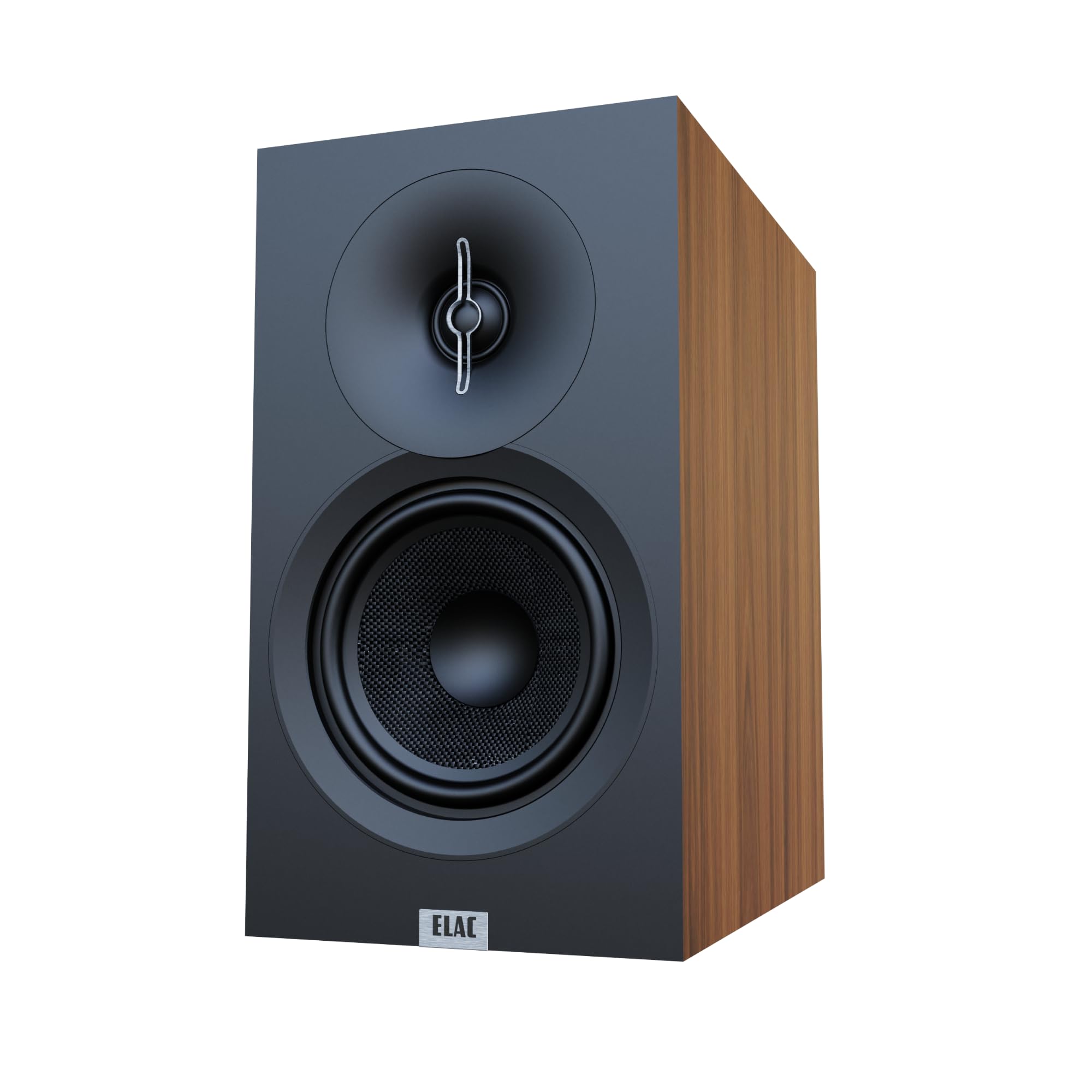
The DB53 takes a different approach to the budget audiophile formula: a 5.25-inch woven aramid-fiber woofer paired with a 1-inch aluminum dome tweeter, tuned for a balanced, even response from 48Hz to 38KHz. Where the Klipsch is bright and forward, the ELAC is smooth and neutral — buyers describe it as “very clean sounding from the high to the low,” with no boom and no breakup even at high volume. The aramid cone material offers stiffness and damping that outperforms polypropylene or paper, which is why the low end stays tight and melodic.
Internal bracing is the quiet hero here. By reducing unwanted cabinet vibrations, the sound comes primarily from the drivers rather than the box, which is why reviewers praise the wide soundstage and precise imaging. Buyers have compared this pair against KEF, Triangle, Q Acoustics, Polk, Dali, and Wharfedale models and still call it excellent value — one owner notes it beats speakers at two to three times the price. The magnetically attached grilles give it a clean, hardware-free look, and the walnut finish is described as beautiful.
The one honest caveat is power handling. While it handles a 100W amp fine, customers note it performs best with a quality amplifier or receiver — pair it with a Yamaha A-S301 and a Fluance RT85 turntable and the clarity is incredible. For EDM or hip-hop, a subwoofer is recommended because the tuning is more neutral than bass-heavy. With a 4.7-star average from 200+ ratings, this is the pair for listeners who want analysis and accuracy over excitement.
Why it stands out
- Neutral, even response — no boom, no harshness
- Wide soundstage reveals new details in familiar tracks
- Heavy, solid build with a beautiful walnut finish
Keep in mind
- Benefits strongly from a quality amp or receiver
- Bass is tight, not deep — EDM fans will want a sub
Choose this for: a neutral, analytical listening experience where accuracy matters more than bass punch.
Skip this if: you want a warm, forgiving speaker for casual background listening — this pair rewards attention.
4. KEF Q1 Meta Bookshelf Speakers

A compact pair with a single-point driver for an rich soundstage.
The Q1 Meta is built around KEF’s 12th Generation Uni-Q driver — a 5.25-inch design where the tweeter sits in the middle of the woofer, so all sound comes from a single point. The result is a cohesive, evenly dispersed soundstage that buyers describe as “stellar” with “great imaging and depth.” In a small apartment den or a desk setup, this coherence makes instruments lock into place in a way that traditional layouts cannot match. The distinguishing feature is KEF’s Meta material technology, which absorbs 99% of the unwanted noise from the rear of the driver for purer, more natural sound.
Buyers who compared this against Dali Oberon 3, Polk ES20, ELAC Debut, and B&W 606 S3 consistently picked the Q1 Meta for its clear mids and highs. It works well without a subwoofer for most music, though adding one makes the sound rich in rooms up to 20×20 feet. The satin walnut finish has a premium, subtle glow that blends into any interior, and the color-matched grilles keep the driver protected without hiding the design.
The trade-off is bass depth. While the bass is adequate alone, buyers recommend a subwoofer for deep low-end, and the speakers need a quality amplifier — a WiiM amp pairs excellently. At 5.25 inches, it is compact enough for a shelf or desk, though it is too big for cramped workstations. With a 4.7-star average, this is the pair for listeners who want precision and imaging above all else.
Highlights
- Single-point Uni-Q driver creates a wide, cohesive soundstage
- Meta material absorbs rear noise for purer sound
- Compact size fits desks and small rooms well
Watch out for
- Bass is okay alone, but a subwoofer adds real depth
- Needs a quality amplifier — doesn’t shine with weak receivers
Perfect if: you value pinpoint imaging and a cohesive soundstage in a small-to-medium room.
Not ideal if: you want chest-thumping bass without adding a separate subwoofer.
5. Klipsch Reference Premiere RP-600M II Bookshelf Speakers

A 6.5-inch woofer delivers punchy, room-filling sound for movies and music.
The RP-600M II is the bigger sibling to the RP-500M II, swapping the 5.25-inch woofer for a 6.5-inch Cerametallic driver that delivers richer bass and a more powerful overall presence. This is the pair buyers describe as “punchy, clear, and accurate,” with a rich midrange and crisp treble that works for both surround sound and primary stereo listening. The larger Tractrix horn and 1-inch titanium tweeter keep the signature Klipsch clarity, while the bigger woofer adds the low-end weight the smaller model lacks.
What sets this pair apart is the bi-wiring and bi-amping capability — dual input terminals that separate high and low-frequency current into different speaker cables, reducing distortion for a clearer midrange. For buyers building a home theater, these shine as surrounds or as mains, and one owner notes they are “perfect for mid-size theaters.” The dynamics are a frequent highlight: buyers describe sounds now coming from all around the room, a quality that makes action movies genuinely rich.
The physical heft is a real consideration — these are heavy and need sturdy stands, but that weight translates to a solid, non-resonant cabinet. Compared to the smaller RP-500M II, the 600M II offers more bass and power for a moderate step up in size, meaning a subwoofer may be skippable for many listeners. With a 4.8-star average from nearly 500 ratings, this is the pair that balances value and performance for home theater enthusiasts.
Why buyers love it
- Punchy, accurate sound with rich midrange and crisp treble
- Bi-amp capability reduces distortion for clearer midrange
- Big 6.5-inch woofer may eliminate the need for a subwoofer
Know before buying
- Heavy — requires sturdy stands, not flimsy shelves
- Wants quality amplification to sound its best
Pick this if: you are building a home theater and want a speaker that works brilliantly as mains or surrounds.
Pass on this if: you are tight on space — the physical size demands real estate.
6. HiVi-Swans D3.1 MKII Bookshelf Speakers
A heavy, powerful pair with massive scale and emotional musicality.
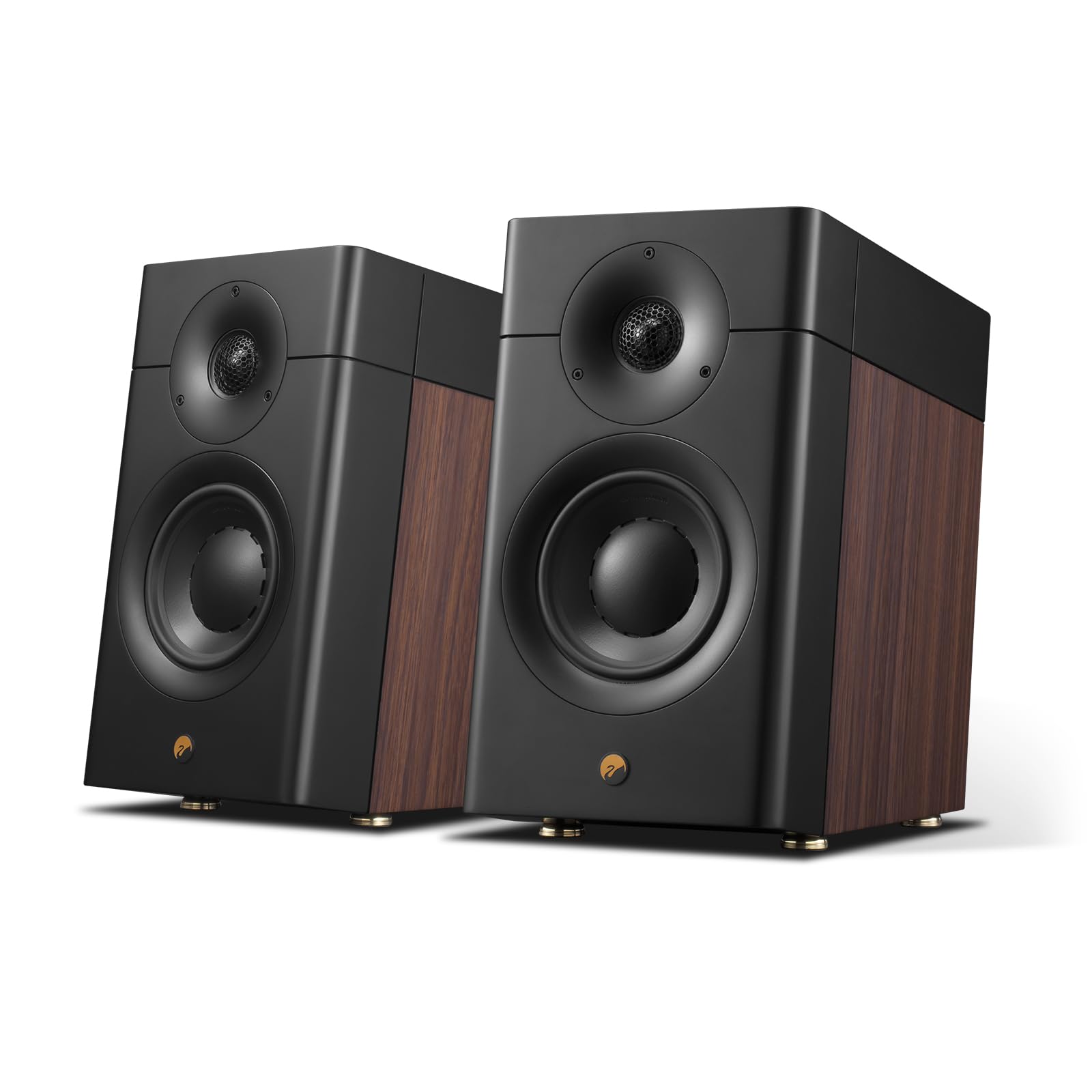
The D3.1 MKII is a 6.5-inch woofer design with a 28mm dome tweeter made from natural fiber braid, tuned for warm, natural treble with ultra-low distortion. Buyers are emphatic about its performance, with one describing it as “outperforming systems” and another calling it a “modern legend.” The sound is not flat or clinical — it is tuned for engagement, with massive scale, deep bass, and emotional musicality that makes music genuinely enjoyable rather than just accurate.
The classic acoustic tilt design is a clever touch: the detachable black front baffle angles upward so the sound axis points directly at your ear, which is ideal for mid and far-field listening. The cabinet is crafted from high-density wood with reinforced internal bracing to minimize resonance, and the genuine wood veneer shows natural grain patterns. At 48.5 pounds for the pair, this is serious, heavy gear that demands a sturdy stand — reviewers point out it performs best on lower stands.
There is a real caveat, though: this speaker benefits from power. Shoppers say it has low sensitivity and a forward presentation, so a quality amplifier is essential to get the best out of it. At 8 ohms, it is an easier load than many competitors. The honest drawback is that its revealing nature can be slightly unforgiving with poor recordings, showing sibilance on low-quality tracks. With a 4.6-star average from 43 ratings, this is a specialist’s pick for those who want an engaging, musical sound over clinical accuracy.
The appeal
- Massive scale and deep bass for the size
- Tuned for emotional engagement, not flat accuracy
- Genuine wood veneer with elegant craftsmanship
The catch
- Low sensitivity — needs a powerful amplifier to shine
- Forward sound can expose sibilance in poor recordings
Reach for this if: you want an engaging, musical pair that makes you feel the music rather than just hear it.
Look elsewhere if: your amplifier is on the weaker side — this speaker rewards power.
7. DALI KUPID Bookshelf Speakers
A tiny 4.5-inch pair that produces surprisingly deep bass.
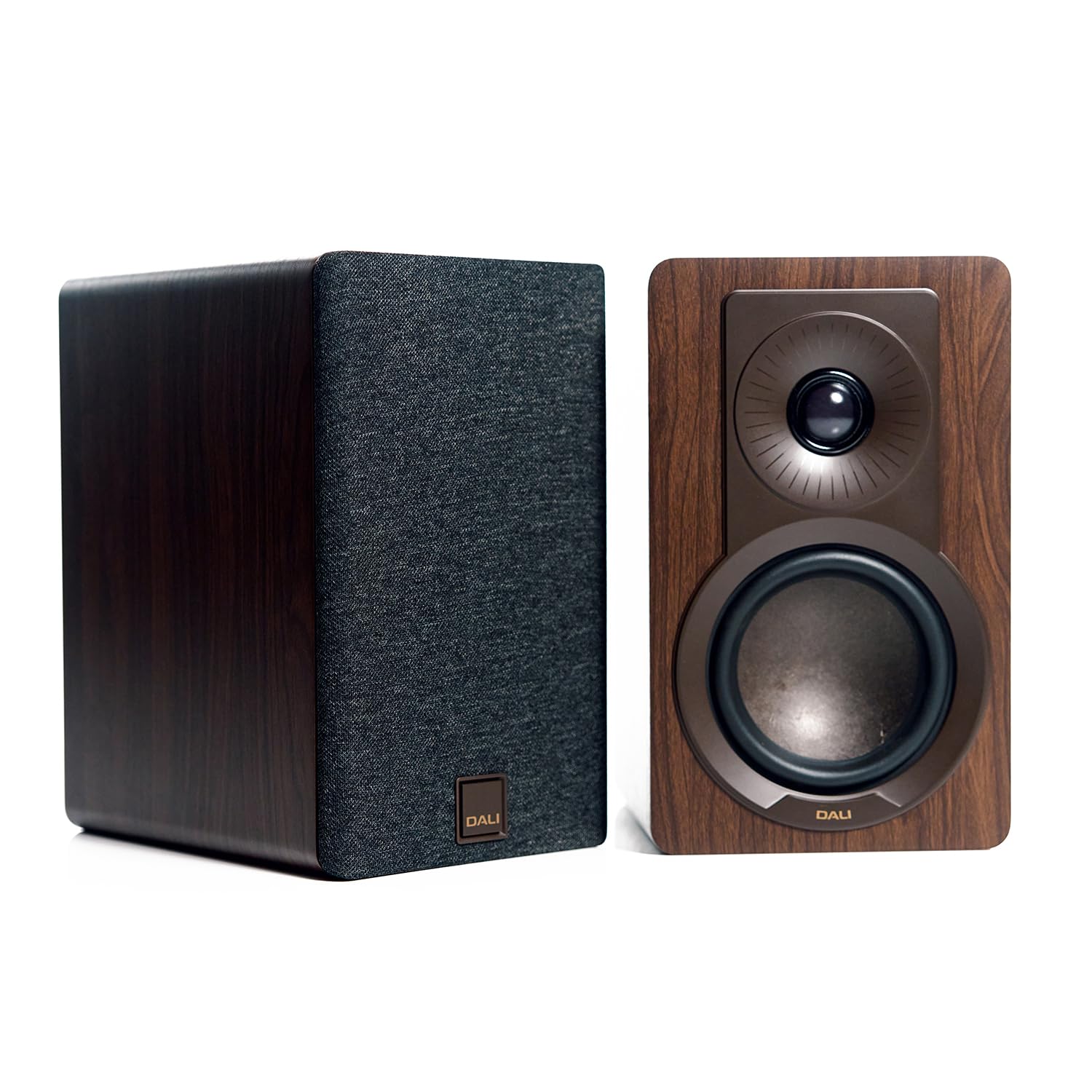
The KUPID is the smallest speaker here — a 4.5-inch low-loss bass/midrange driver paired with a 26mm soft dome tweeter — yet it is the one that surprises listeners the most. A 50-year industry veteran called it the “best thing since sliced bread,” replacing ELAC DB63s in an expensive music system. The soft dome tweeter delivers excellent detail and clarity that is never harsh, even at length, and the bass output is more than you would ever expect from a driver this small.
The frequency response spans 63–25,000 Hz, and buyers report it reaches below 80Hz easily, which is remarkable for the size. The compact form factor is the real selling point: it fits small rooms, offices, and tight entertainment centers where larger speakers simply will not go. It can even be placed horizontally without compromising sound, which is rare for passive speakers. The included wall brackets give you mounting freedom without extra cost.
This is a 4-ohm design rated for amplifiers from 40–120W, so make sure your amp can handle a 4-ohm load — a WiiM Amp Ultra drives them beautifully. DALI’s heritage of over 40 years of Danish loudspeaker design shows in the build quality and the wide dispersion that fills a 13×14-foot office with ease. With a 4.8-star average from 80 ratings, this is the pick for small-space listeners who refuse to compromise on sound quality.
What impresses
- Remarkable bass output from a 4.5-inch driver
- Soft dome tweeter is detailed but never harsh
- Wall brackets included — mounting freedom at no extra cost
Be aware
- 4-ohm load needs a compatible amplifier
- Small driver has limits in very large rooms
Choose this if: space is tight but you refuse to sacrifice sound quality — small rooms are this pair’s playground.
Skip this if: you have a large open-plan room that needs a bigger driver to fill it.
8. Polk Audio Reserve R200 Bookshelf Speakers

A warm, detailed pair that outperforms pricier rivals in side-by-side tests.
The Reserve R200 is Polk’s step-up line, featuring a 1-inch Pinnacle Ring Radiator Tweeter and a 6.5-inch Turbine Cone Woofer. Buyers who directly compared it against the KEF LS50 and ELAC UB52 found it came out on top — the R200 offers fuller, non-fatiguing sound with a wide soundstage and excellent off-axis imaging, while the KEF was too bright with less bass and the ELAC sounded thin. The warm tone and excellent low end for the size make it a favorite for small spaces.
The secret is the patented X-Port Technology with Eigentone Filter (ETF), which eliminates port noise for tight, distortion-free bass. The bass reflex cabinet with a rear-firing port is cross-braced to minimize interior resonances, and the acoustically inert magnetic grilles keep the modern aesthetic clean. This is a large, loud speaker that works as front, side, or rear surround for a multichannel system, with premium 5-way binding posts for a loss-less connection.
The honest requirement here is power. As buyers bluntly put it, the R200 “needs a 4-ohm receiver or amp to really shine” — with a basic 8-ohm receiver, it sounds underwhelming, but the difference is night and day with a quality amp like a 260W/4-ohm unit. Also note the narrow tweeter dispersion around 20 degrees, which means it is best for a single listening position rather than a wide multi-seat couch. With a 4.6-star average from 141 ratings, this is a warm, high-end choice for dedicated listeners.
Strengths
- Warm, non-fatiguing sound that beats KEF LS50 and ELAC UB52
- Excellent low end and wide soundstage for the size
- Top-notch build quality with premium 5-way binding posts
Requirements
- Demands a quality 4-ohm-capable amplifier to shine
- Narrow tweeter dispersion suits single-seat listening
Pick this if: you have a strong amplifier and want a warm, detailed sound that competes above its price class.
Pass if: you are driving a basic receiver — this pair needs power to reveal its magic.
9. SVS Ultra Evolution Nano Bookshelf Speakers

A compact hi-fi pair with astonishing detail and impressive bass from a small cabinet.
The Ultra Evolution Nano is the most technically ambitious speaker in this lineup. Its tweeter features a hyper-rigid diamond carbon coating on an aircraft-grade aluminum dome, delivering what the maker claims is top-tier fidelity and transient response. The 5.25-inch composite glass-fiber cone has an excellent stiffness-to-mass ratio for high sensitivity, and the chamfered front baffle with flush-mounted drivers improves both on-axis and off-axis response. The result is a speaker that owners mention sounds like one four times its size.
The high-frequency performance is the standout here. It excels at upper frequencies for rock and pop, with crisp, smooth highs that reveal detail in familiar tracks. The bass is astonishing for the size — one buyer in an apartment says a subwoofer is unnecessary, and another notes plenty of bass for the size. The FEA-tune cabinet construction and internal bracing eliminate resonances, and the premium piano gloss finish gives it a modern, high-tech look that draws compliments.
This is a 6-ohm speaker, and buyers warn that pairing both channels burdens the amplifier, so a quality receiver is important. The sound is forward and detailed, which is great for mid-heavy mixes, but one listener with sensitive ears found the high emphasis can cause fatigue without EQ. For rock and pop it is exceptional, though it may not be the first choice for jazz or classical. With a 4.9-star average from 15 ratings, this is a top-tier pick for detail-focused listeners in smaller spaces.
Why it stands out
- Astonishing high-frequency detail for rock and pop
- Impressive bass from a compact 5.25-inch driver
- Premium piano gloss finish looks high-end
Consider before buying
- Forward high end may cause fatigue for sensitive ears
- 6-ohm load demands a quality amplifier
Reach for this if: you want the last word in detail and build quality and listen mostly to rock or pop.
Look elsewhere if: you listen primarily to jazz and classical — the midrange is more subdued than rivals.
Understanding the Specs
Woofer Size and Bass
The woofer is the main driver that produces low frequencies, and its size in inches is the fastest way to predict bass output. A 6.5-inch woofer moves more air and fills a larger room with fuller bass without a subwoofer. A 5.25-inch driver is often tighter and faster, and it suits small rooms or desks where deep bass would just boom. Buyers should match woofer size to floor space, not just shelf width.
Impedance and Amplifier Matching
Impedance, measured in ohms, is the electrical load a speaker puts on your amplifier. An 8-ohm speaker is easy for most receivers to drive, while a 4-ohm or 6-ohm speaker demands more current. If your amp is weak, the sound can get strained or the volume can collapse at loud levels. Always check that your receiver is stable at the speaker’s rated impedance before committing.
Frequency Response
Frequency response, stated in hertz, shows the range of sound a speaker can produce, from deepest bass to highest treble. A speaker rated down to 40Hz can reproduce a lot of the low end on its own, while a higher number like 63Hz means you will likely want a subwoofer for deep bass. The upper number (like 25,000 Hz or 38KHz) exceeds human hearing, so lower is not necessarily better — it is about the overall balance.
Tweeter Materials
The tweeter produces high frequencies, and its material shapes the character of the sound. Metal dome tweeters like titanium or aluminum tend to be crisp and revealing, great for pulling apart complex mixes but potentially bright if poorly designed. Soft dome tweeters like silk or fabric are smoother and more forgiving, making them an easy choice for long listening sessions. Listen to both before you decide which character suits your ears.
FAQ
Do these speakers need a separate amplifier or receiver?
What does impedance mean and why does it matter for my receiver?
Will a 6.5-inch woofer sound better than a 5.25-inch one?
Can I use bookshelf speakers as rear or surround speakers?
Do I need a subwoofer with these speakers?
What is the difference between a ported and sealed speaker cabinet?
Will these speakers work with a turntable setup?
How much power do I need to drive these speakers well?
Can I bi-wire or bi-amp these speakers?
Are these speakers good for small rooms and apartments?
Final Thoughts: The Verdict
For the majority of shoppers, the bookshelf speakers under $2000 winner is the Polk Audio Signature Elite ES20 because it delivers the best blend of warm, silky sound, deep bass, and easy compatibility with most amplifiers — all at a price that feels like a steal. If you want crisp, revealing vocals in a compact footprint, grab the Klipsch RP-500M II. And for a room-filling home theater punch with bi-amp capability, the Klipsch RP-600M II is the one to reach for — its 4.8-star crowd rating across nearly 500 owners tells you this is a pair people genuinely love.
How We Picked
We do not accept paid placement. Every pick is matched to a real buyer and a real use-case; we do not hands-on test units.
Sources & Methodology
Specifications: manufacturer listings and product documentation. Review insights: verified customer reviews, as of August 2026. Pricing: not shown on this page (it changes often); check the current price via the retailer link.
As an Amazon Associate, Gadgets Feed earns from qualifying purchases. This does not affect which products we feature.