
Our readers keep the lights on and my morning glass full of iced black tea. As an Amazon Associate, I earn from qualifying purchases.
Specs are compiled from manufacturer listings and verified buyer reviews and can change over time — please confirm the key details on the product page before buying.
Wind generator listings love throwing around big watt numbers, but the real question is whether the blades will actually turn in your breeze. A 500W label means nothing if the unit needs a gale to spin, and tiny wiring can quietly cap output far below the promise. This guide sorts the honest performers from the paper tigers, focusing on 12V output so you can charge batteries directly.
I’m Min — the founder and writer behind Gadgets Feed. This guide is built by comparing the manufacturers’ published specifications and the patterns across verified customer reviews, so you get each pick’s real strengths and trade-offs instead of marketing spin.
Note that this list uses flexible matching, so a few picks are the nearest same-type size that serves the same 12V purpose. The 12v wind generator you choose should match your local wind speeds and battery bank size before anything else.
Quick Picks
- HEVIRGO 4500W Vertical Axis Wind Turbine — Budget Champion
- VEVOR 500W Wind Turbine Generator — Best Value
- VEVOR 800W Wind Turbine Generator — Top Performer
- Pikasola 400W 5-Blade Wind Generator Kit — Marine Pick
- Pikasola 400W Economy 3-Blade Windmill — Gust Tamer
- Pikasola 200W Vertical Axis Wind Turbine — Quiet Looker
How To Choose The Best 12V Wind Generator
Choosing a 12V wind generator means matching the machine to your site’s wind, not just the biggest number on the box. The three things that matter most are start-up speed, rotor size, and controller quality.
Start-Up Wind Speed
This is the breeze speed needed to get the blades moving. A unit that needs 2.5m/s (about 5.6 mph) will spin in light air, while others sit still until a real gust arrives. If your site has gentle winds, a low start-up speed is the difference between charging and watching.
Rotor Diameter and Blade Count
The rotor diameter is the circle the blades sweep, and a larger sweep captures more energy. More blades typically means smoother rotation and lower start-up speed, while fewer blades spin faster in strong wind. Bigger rotors also mean more weight and more mounting stress.
Controller Types
The charge controller converts wild AC output into safe DC for your batteries. MPPT (Maximum Power Point Tracking) controllers adjust continuously for peak output, while PWM (Pulse Width Modulation) controllers are simpler and cheaper but less efficient in changing wind.
Quick Comparison
| Model | Best For | Rated Power | Blades | Start-Up Speed | Amazon |
|---|---|---|---|---|---|
| HEVIRGO 4500W Vertical | Steady low-wind output | 4500W claimed | 5 | Not stated | Amazon |
| VEVOR 500W | Easy install + MPPT | 500W | 5 | 2.5m/s | Amazon |
| VEVOR 800W | Biggest rotor sweep | 800W | 3 | 2.5m/s | Amazon |
| Pikasola 400W 5-Blade | Marine / RV mounting | 410W | 5 | 2.5m/s | Amazon |
| Pikasola 400W 3-Blade | High-gust handling | 410W | 3 | 2.5m/s | Amazon |
| Pikasola 200W Vertical | Quiet visual appeal | 200W max 220W | 5 | Breeze start | Amazon |
In‑Depth Reviews
1. HEVIRGO 4500W Vertical Axis Wind Turbine
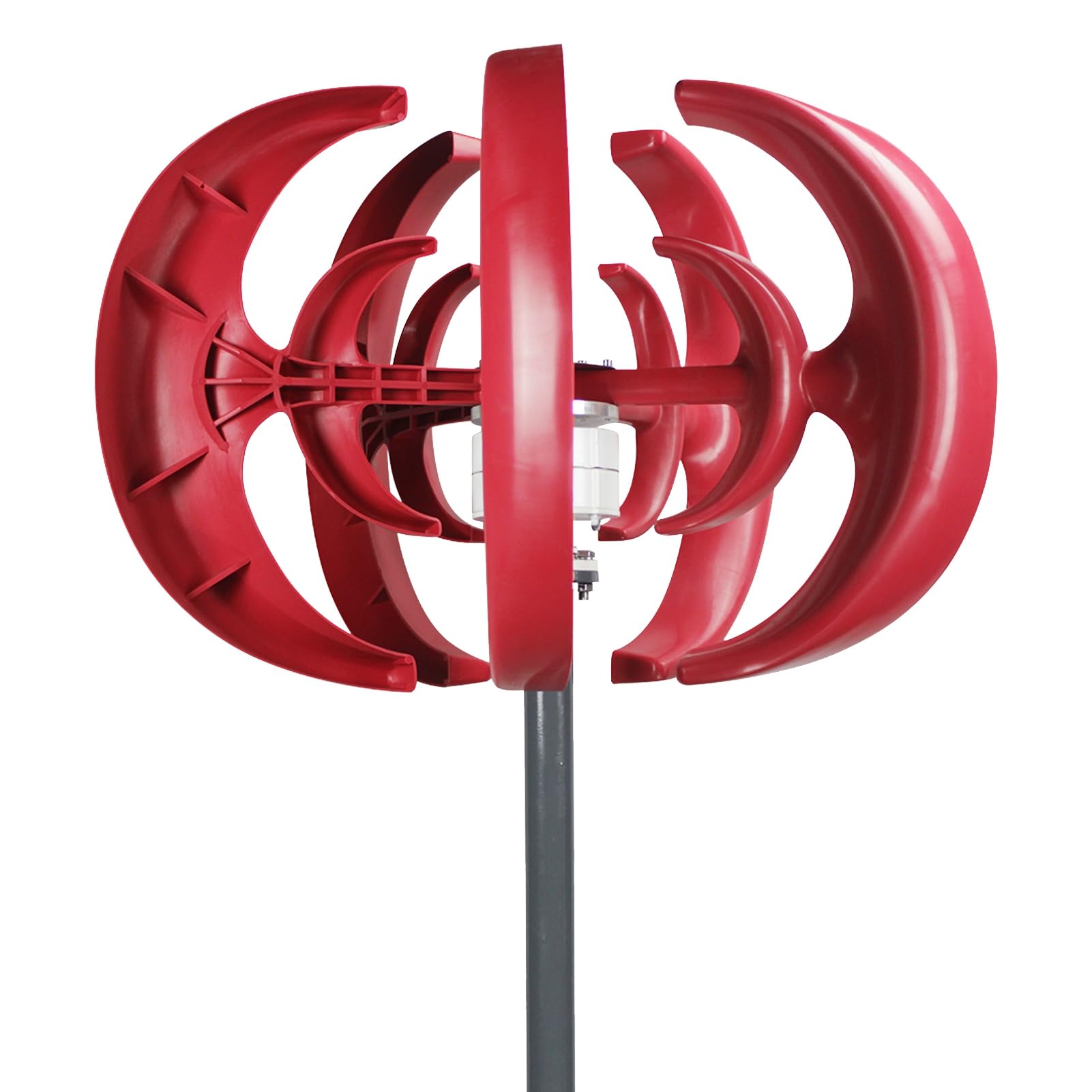
The vertical-axis oddball that promises huge output but carries the heaviest footprint on this list.
This is the only vertical-axis design here, and that shape buys you something real: it catches wind from any direction, so no yaw system is needed to keep it facing the breeze. The 5-blade setup uses double bearings to run with low vibration, and the die-cast aluminum shell is sprayed to resist UV and acid rain for outdoor life.
That weight signals solid construction, but it also means your mounting pole needs real strength. Owners who got a good unit report it “works good for steady power incoming,” and assembly draws praise for being easy and clean.
The 4500W rating is a fantasy for a unit this size, and a few reviews call the specs misleading. Treat it as a low-output supplementary charger, not a whole-home power source.
Who it fits: Off-grid setups that want omnidirectional wind capture without yaw tracking.
The honest caveat: The wattage claim oversells hard — expect a fraction in real breezes.
Reach for this if: you want a sturdy vertical unit for steady supplementary charging in variable wind.
Look elsewhere if: you need honest rated power and predictable output.
2. VEVOR 500W Wind Turbine Generator

The featherweight 5-blade that starts spinning in light air and hums along at just 55dB.
This is the lightest full kit here at 15.3 pounds, and that low weight makes mounting far easier than the beefier options. The 5-blade rotor spans 47 inches and starts spinning at 2.5m/s (about 5.6 mph), which means gentle breezes actually turn it. Blades are reinforced fiberglass nylon rated from -40°C to 80°C, so extreme climates won’t crack them.
What wins people over here is installation — the die-cast aluminum body goes together without drama, and the MPPT controller handles the AC-to-DC conversion intelligently. Buyers report it humming away in backyards, charging 12V battery banks for sheds, and holding up as a rugged hybrid companion to solar arrays.
The honest tension is output: some owners say it delivers well below the 500W claim, with one noting the internal wiring looks thin and suspecting real capacity sits near 50W. Pair it with a 12V battery bank as a supplement, not a primary source.
What owners love
- Simple, tool-friendly assembly
- Low start-up speed catches light wind
- Heavy metal body feels durable
The realistic limits
- Output often far below 500W rating
- Needs a tall, strong steel pole — not cheap
Best for: RV, shed, and cabin owners who want a light, quiet supplementary charger.
Not for: anyone expecting true 500W output in moderate wind.
3. VEVOR 800W Wind Turbine Generator

The big-sweep 3-blade that out-catches the 500W unit with a 59-inch rotor.
You get the highest power rating in this mid-range group, and the rotor is why: at 59 inches, the blade sweep covers 12 inches more than the VEVOR 500W’s 47 inches, so it catches far more wind in the same breeze. The 3-blade design (three blades for balanced spin) turns faster in strong gusts, per the spec sheet. It still starts generating at a gentle 2.5m/s (about 5.6 mph) and runs at a modest 58dB (about as loud as a normal conversation).
Owners mention real output: one owner bolted it to a vehicle for camping next to a solar panel and “never had to touch a thing the whole trip — worked day and night.” Another says it stands up to marine use, though he calls it “noisy but normal” for a turbine this size. The build quality draws comparisons to units costing much more, according to reviewers.
Here’s the catch: the stock controller is the weak link, with owners reporting it brakes output around 120W. Swapping to a quality MPPT controller open up the real potential, and the turbine needs a 1.25″ galvanized mast with guy wires — the tower is not included.
Why it leads
- Largest rotor sweep in this lineup
- Day-and-night output in real use
- Build quality rivals pricier kits
What holds it back
- Stock controller limits output until replaced
- Mast, guy wires, and wiring sold separately
Pick this if: you want maximum blade sweep and are willing to upgrade the controller.
skip it if: you want plug-and-play with no extra parts to source.
4. Pikasola 400W 5-Blade Wind Generator Kit

The lightweight Nylon-carbon 5-blade that sailors trust to keep battery banks topped up.
This kit is built for the water: the 23.8-inch blades use Nylon carbon fiber, which shrugs off water and corrosion while staying light, and the rotating aluminum body auto-adjusts to face the wind. The three-phase permanent magnet motor pairs with a yaw system that reads wind direction and pivots the rotor to capture maximum energy.
Sailboat owners are the ones who love it most — installs on stern rails with a welded base, and one reports it “maintains 200-300W draw in 10MPH+ winds” while charging a two-battery bank through a 3000W inverter. Assembly is straightforward, and the lightweight build means less strain on marine mounts.
The mixed reality shows up in output: while some owners see solid charging in sustained high wind, others report minimal generation even at 24 mph winds. It works best as a true supplementary source alongside solar, not your only charger.
Its strength: Marine-grade corrosion resistance and auto-yaw tracking in a light 6.2 kg package.
Its limit: Output is feast-or-famine depending on your local wind consistency.
Reach for this if: you’re equipping a boat or RV and want a corrosion-proof, self-orienting turbine.
Think twice if: your site has unreliable winds and you need guaranteed daily charging.
5. Pikasola 400W Economy 3-Blade Windmill

The no-frills 3-blade that charges batteries decisively in gusty, high-wind zones.
This horizontal-axis unit keeps things simple: a 60cm Nylon carbon fiber blade set, a three-phase permanent magnet motor, and an MPPT microprocessor that adjusts current and voltage to match your circuit. The integrated voltage regulator shuts down charging automatically when your battery is full, so you don’t have to watch it.
Owners in genuinely windy spots report real results. One trailer-based user confirmed immediate power the moment it spun, measured with a multimeter, and the unit handled 35-40 mph gusts without complaint. Another found it charges a battery bank steadily after swapping from a smaller model.
The trade-off is threshold behavior: it needs roughly 9-10 mph to start producing meaningfully, and one owner measured about 100W at a 20 mph gust. That’s still honest, usable output — just know the wattage builds with wind speed.
What makes it click
- Handles 35-40 mph gusts without drama
- Multimeter-confirmed charging output
- Auto-shutoff protects full batteries
Where it stumbles
- No mast included — you’ll engineer a mount
- Low-wind sites see minimal output
Best for: off-grid trailers and cabins in reliably windy locations.
Not for: light-air regions or anyone wanting a full mounting kit in the box.
6. Pikasola 200W Vertical Axis Wind Turbine

The Red-lantern 5-blade vertical that turns heads while topping up batteries in the breeze.
This is the style pick: the 5-leaf double-axis vertical design looks like a red lantern, and owners genuinely compliment the aesthetics. The vertical layout is inherently safer — blades are fixed inside by a flange, so there’s no risk of one flying off, and it captures 360° wind with no yaw system.
It starts turning in a light breeze thanks to double bearings and tune aero shape, and it runs silently — quieter than horizontal-axis units. Owners use it as a 24/7 float charger alongside solar, with one running it through 8 golf cart batteries on a 12V, 110V inverter setup for months.
The honest picture: this is a 200W unit (max 220W) and it shows. Output is modest, with one owner noting it “does not charge my batteries at all” in light conditions. It’s a supplement for cloudy-day top-ups, not a primary power source.
Its charm: Silent, safe, 360° capture, and genuinely good-looking for home use.
Its truth: Flea-power output — treat it as a maintenance charger.
Pick it if: you want near-silent supplementary charging with visual appeal.
Move on if: you need meaningful wattage from your wind investment.
Understanding the Specs
Start-Up vs Rated Wind Speed
Start-up wind speed is the breeze needed just to get blades rotating — lower numbers like 2.5m/s mean spinning in light air. Rated wind speed is where the unit hits its claimed output, often around 12m/s. Don’t confuse the two; a turbine that starts easily may still need strong wind to produce its rated watts.
MPPT vs Basic Charging Controllers
An MPPT (Maximum Power Point Tracking) controller constantly adjusts to pull the most power from variable wind. Basic controllers simply dump whatever comes in, often losing efficiency in changing conditions. If you have a decent battery bank, the MPPT upgrade is worth seeking out.
FAQ
How much wind do I need to start charging?
Will a 500W turbine actually deliver 500 watts?
Do I need a special pole or mast?
What’s the difference between 3-blade and 5-blade turbines?
Are vertical axis turbines better than horizontal ones?
Can I combine these with solar panels?
How noisy is a wind generator?
How long does a wind generator last?
Final Thoughts: The Verdict
For the majority of shoppers, the 12v wind generator winner is the VEVOR 500W because it nails the two things that matter: a low 2.5m/s start-up speed that catches light wind, and simple installation that owners praise again and again. If you want the biggest rotor sweep for gusty sites, grab the VEVOR 800W and plan a controller upgrade. And for marine or RV use where corrosion resistance is king, the Pikasola 400W 5-Blade is the one to reach for.
How We Picked
We do not accept paid placement. Every pick is matched to a real buyer and a real use-case; we do not hands-on test units.
Sources & Methodology
Specifications: manufacturer listings and product documentation. Review insights: verified customer reviews, as of August 2026. Pricing: not shown on this page (it changes often); check the current price via the retailer link.
As an Amazon Associate, Gadgets Feed earns from qualifying purchases. This does not affect which products we feature.