
Our readers keep the lights on and my morning glass full of iced black tea. As an Amazon Associate, I earn from qualifying purchases.
Specs are compiled from manufacturer listings and verified buyer reviews and can change over time — please confirm the key details on the product page before buying.
Moisture in your air lines can ruin a paint job, rust your tools from the inside, and make a plasma cutter spit out rough edges. An air compressor dryer sits between your tank and your tool to strip that water out, and the right one depends on how dry you truly need the air. You will see top systems compared by filtration stages, flow rate, and real owner feedback, so you can match a unit to your workshop tasks.
I’m Min — the founder and writer behind Gadgets Feed. This guide is built by comparing the manufacturers’ published specifications and the patterns across verified customer reviews, so you get each pick’s real strengths and trade-offs instead of marketing spin.
Whether you spray paint, run CNC tools, or cut with plasma, the right air compressor dryer keeps water out of your lines and protects your equipment’s performance and lifespan.
Our Picks at a Glance


How To Choose The Best Air Compressor Dryer
The right dryer for you depends entirely on what sits at the end of your hose. A nail gun tolerates a little moisture; a paint sprayer or plasma cutter demands bone-dry air. Match the unit’s filtration and flow to your most sensitive tool and you will never fight water again.
Count the filtration stages
Single-stage units trap basic water and debris. Two-stage systems add a coalescing filter to catch fine oil aerosols. Three-stage rigs finish with desiccant beads that absorb the last vapor — this is the setup serious painters and CNC operators rely on, because beads turn color when saturated so you always know their state.
Match port size and flow to your tools
A 1/4″ or 3/8″ port suits a basic hobby bench, but high-volume tools like spray guns and sandblasters need the wider 1/2″ or 3/4″ plumbing to avoid starving the tool of air. Check the unit’s CFM (cubic feet per minute) rating against your highest-consumption tool so the dryer never becomes the bottleneck in your line.
Quick Comparison
| Model | Best For | Port Size | Max Pressure | Filtration Stages | Amazon |
|---|---|---|---|---|---|
| PneumaticPlus SAU430-N04G-MEP★ Best Overall | Industrial clean-air shops | 1/2″ NPT | 250 PSI | 3-stage | Amazon |
| NANPU 3/4″ FRPD46-DHigh Flow Pick | High-volume HVLP spraying | 3/4″ NPT | 175 PSI | 3-stage | Amazon |
| NANPU 1/2″ FRPD44-D | Plasma and CNC work | 1/2″ NPT | 175 PSI | 3-stage | Amazon |
| THB EDGE 3-Stage Auto Drain | Heavy-duty painting jobs | 1/2″ NPT | 175 PSI | 3-stage | Amazon |
| Campbell Hausfeld PA208503AV | Dedicated paint and plasma | Standard | — | Oil filter + desiccant | Amazon |
| THB In-Line Desiccant Dryer | Compact single-tool setups | 3/8″ NPT | 215 PSI | Desiccant | Amazon |
| AIRZOE AC3110-03 | Budget garage filters | 3/8″ NPT | 145 PSI | Dual filter | Amazon |
In‑Depth Reviews
1. PneumaticPlus SAU430-N04G-MEP 3 Stage Compressed Air Filter Dryer System
Our pick — over 4.5★ from 100+ verified ratings; the strongest balance of quality and price.
The shop-grade three-stage system that big-pressure setups trust to keep lines bone dry.
This system suits a serious workshop. It uses a 10-micron particulate element (a filter that catches larger dirt particles) and a 0.1-micron coalescing element (a second stage that traps fine oil mist that ruins paint), so your spray gun gets clean, dry air. It flows a strong 37 SCFM at 90 PSI (cubic feet per minute at a standard pressure), meaning a high-demand spray gun never starves. The metal bowl with sight glass lets you check the collected water level without opening anything, and it handles a maximum supply pressure of 250 PSI — that is 16% more headroom than the 215 PSI on the simpler THB in-line unit, so it is safer for higher-pressure systems.
The 1/2″ NPT ports are noticeably wider than the 3/8″ fitting on the AIRZOE, a real advantage when you are feeding a plasma cutter or a long copper line. Owners running CNC mills report the system kept every single drop of water out of their lines, and it has proven itself in commercial paint shops where finish quality is the whole job. “It has done a good job stopping any oil or water from entering my air lines,” buyers report.
The manual drain is the one thing to plan around — you empty the bowl yourself rather than letting it auto-purge. That is a fair trade for a unit this solidly built, and one that threads in leak-free the first time.
rugged triple-stage
- Dual-stage filtration (10 and 0.1 micron) plus regulator in one unit
- 37 SCFM flow rate keeps high-volume tools fed
- Solid build quality that owners consistently praise
bulky footprint
- Manual drain requires you to empty the metal bowl yourself
- Ad copy can confuse buyers into thinking it is self-draining
top pick: a permanent shop installation feeding plasma cutters, CNC mills, or paint guns where dry-air consistency matters more than convenience.
space tight: you want zero-touch maintenance — this one needs a hand on the drain.
2. NANPU 3-Stage Air Compressor Filter Dryer Regulator (3/4″ NPT)
An industrial three-stage powerhouse with 3/4″ ports for the busiest spray booths.
This is the unit you reach for when a standard 1/2″ line cannot push enough air. Its 3/4″ NPT ports and 141 CFM (4000 L/min) flow make it the widest-throated pick here, which matters for HVLP spray guns and sandblasters that gulp air. The three stages work in sequence: a 5-micron element catches bulk water and rust, a 0.01-micron coalescing filter removes 99.998% of oil aerosols, and desiccant beads absorb the final vapor with no drain needed.
The kit is generous — it arrives with 2 spare 5-micron elements, 2 spare 0.01-micron elements, and 4 bags of 3.5oz (100g) desiccant beads, so you are stocked for a long while. The beads turn from blue to pink when spent, giving you a clear visual cue to refill or regenerate. Owners note the assembly regulates pressure dependably and accurately, with several reporting absolutely no leaks after installation.
The one recurring complaint in the review pages is overcut pipe threads that can make fittings tricky to seal — a little thread sealant solves it, as owners mention. Given the flow capacity and included spares, this is the premium choice for a demanding shop.
high flow capacity: 141 CFM through 3/4″ ports beats the 37 SCFM of the PneumaticPlus when you are running sandblasters or multiple tools at once.
thread care needed: some units arrive with overcut threads, so keep thread seal tape handy during install.
3. NANPU 3-Stage Air Compressor Filter Dryer Regulator (1/2″ NPT)
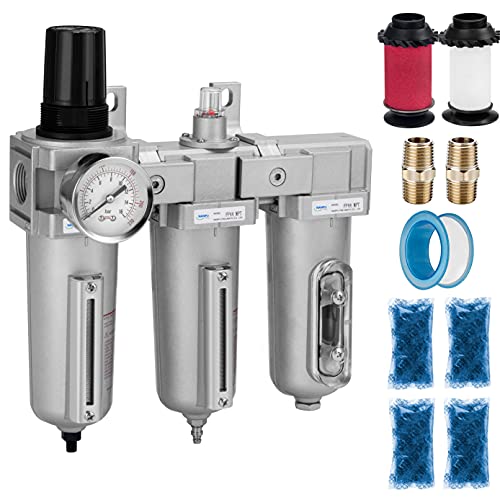
The same triple-stage precision in a 1/2″ body tuned for plasma and CNC setups.
This is the sibling of the 3/4″ NANPU, built with 1/2″ NPT ports for shops that want the full three-stage treatment without the wider plumbing. It still flows 141 CFM (4000 L/min), so it keeps pace with a plasma cutter or an 80-gallon compressor — one owner runs plasma torches and an air blower all day with no restriction of airflow. The 0.01-micron coalescing stage captures 99.998% of oil and sub-micron moisture, the exact contamination that causes pitted cuts and paint blemishes.
What wins people over here is the build quality and the clean install experience. The review pages describe a pressure test that held for a full day with no loss, and multiple owners confirm zero leaks at the seals. The kit mirrors its bigger brother: 2 spare 5-micron elements, 2 spare 0.01-micron elements, and 4 bags of desiccant beads included, so replacement parts are already on your shelf.
The only consistent gripe in owner feedback is that replacement filters are not easy to source afterward, and the included fittings are sometimes swapped out for proper pipe fittings. At this level of dryness consistency, that is a minor friction for a unit that protects expensive tools.
small fit: you run a plasma cutter or CNC machine and want the same 141 CFM performance as the 3/4″ model with standard 1/2″ plumbing.
high demand: you hate hunting for consumables — replacement elements take some effort to find.
4. THB EDGE 3-Stage Filter Regulator Desiccant Dryer System (1/2″ NPT, Auto Drain)

A three-stage auto-drain system that transforms paint quality at a mid-range price.
This is the unit hobbyists-turned-serious buy when they finally get tired of fisheyes in their paint. It runs the full gauntlet: a 5-micron water trap with regulator, a 0.01-micron coalescing filter with a red pop-up indicator, and a desiccant bowl whose beads shift from blue to pink when spent. The 5oz metal bowls with sight glass let you monitor every stage, and the internal float drain auto-purging the water means you genuinely set and forget the collection side.
Owners painting tractors and cars report a night-and-day difference in finish quality after switching to this unit. One review sums it up: the regulator issue they hit was resolved by a company that stands behind their product. The 175 PSI max input covers most home and pro compressors, and the 100 CFM flow is ample for single-tool painting and plasma work.
The honest downside in the review pages is leakage — several owners mention the need to tighten fittings carefully to avoid air escaping from the body. It also ships with thin documentation, though the support team answers questions quickly. At this price with auto drain, it is the best value route to genuinely dry air.
paint-grade dry air: three full stages including a 0.01-micron coalescing element and desiccant drying for a fraction of industrial-system cost.
setup labor: fittings need careful threading — a few customers note leak issues if rushed.
5. Campbell Hausfeld Air Cleaner/Air Dryer for Air Tools (PA208503AV)

A proven two-part classic that has kept painters and plasma users dry for years.
This is the straightforward, battle-tested option that has been on shelves since 2005 for a reason. It pairs an oil-removal filter that traps 99.9% of oil aerosols with a desiccant system that removes water vapor, and the desiccant changes color when it needs recharging so you are never guessing. It is built for a single dedicated purpose — owners use it specifically to keep a plasma cutter’s air clean or to eliminate water while painting cars.
The metal housing feels solid and mounts easily, and the review pages describe months of garage use with the original bead bag still holding up. It is a simpler design than the three-stage combos above: no regulator, no gauge, just focused oil and vapor removal for one critical tool. That simplicity is exactly why it keeps selling — it does the one job well.
The recurring gripes are the cheap plastic drain valve, which feels loosely held in place, and the fact that the supplied desiccant seems to turn pink quickly. You will need your own connectors since none ship in the box, and replacement beads are the ongoing cost. A few owners also note water vapor can get through in large volumes once the beads are spent, so keep an eye on the color indicator.
value pick: a dedicated single-tool setup where you want proven oil and vapor removal without the complexity of a regulator system.
heavy use: you need pressure regulation in the same unit — this one only filters and dries.
6. THB In-Line Desiccant AIR Dryer for Compressed AIR (3/8″ NPT)

A screw-in desiccant capsule that slips onto one tool and dries its air completely.
Sometimes you do not need a wall-mounted three-stage rack — you need dry air for one tool, right now. This in-line dryer threads directly into a 3/8″ NPT line with 88 CFM of flow and handles pressures up to 215 psi, which beats the 145 psi ceiling of the budget AIRZOE by a wide margin. The polycarbonate bowl shows you the desiccant beads at a glance, so you watch them shift color as they absorb moisture.
In high-humidity conditions, reviewers point out the beads turn pink after roughly an hour of intermittent spraying at 50-60% humidity, yet the air reaching the gun stays free of water vapor. A professional body shop owner calls it well-made and perfect for painting small projects. The trade-off is capacity: one fill lasts about an afternoon of spraying, and you will bake the beads back to blue (around 150°F) or swap in a fresh bag to keep going.
The kit ships with enough desiccant for two fills but no bracket or o-rings, so wall-mounting takes a separate purchase. It is the right tool for a compact, single-gun painting or nailing setup where simplicity beats a full filtration rack.
fast moisture removal: 215 psi rating and 88 CFM flow make it tougher than its compact size suggests.
frequent upkeep: beads go pink fast in humid air, so keep a spare bag or microwave ready.
7. AIRZOE 3/8″ NPT Air Dryer for Compressor AC3110-03
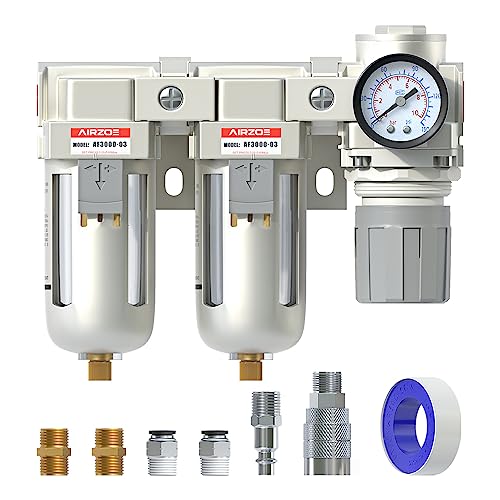
An entry-level dual-filter combo that proves budget dryers still catch real moisture.
This is the affordable gateway into dried air. The core filtration is a 5-micron brass element that catches most water and particles, wrapped in an aluminum alloy shell that resists corrosion, feeding a regulator that adjusts pressure from 0 to 145 psi. “This works great. I’m amazed by the amount of moisture it catches,” shoppers say — it genuinely pulls water out of the line and, in one test, dropped airgun noise from 110dB to 90dB.
It arrives with a useful accessory kit: a polycarbonate bowl, a 0-150 psi gauge, a bracket, a pair of metal air couplers, two 3/8″ NPT fittings, two push connectors, and thread sealing tape. That is everything you need to wire it into a garage wall station, which is exactly what many owners do — one mounted it 16″ from the compressor on a cinderblock wall.
The honest trade-offs are size and leak risk. The unit is smaller than the photos suggest, and while some buyers report no leaks after applying 3-4 wraps of Teflon tape, others hit air escaping from the main body or a valve that failed quickly. The regulator also drops about 15 PSI under full load. For a light-duty garage setup on a budget, it is a capable starter; for critical paint work, step up to a three-stage unit.
simple fix: you want an inexpensive way to dry air for a nail gun or basic shop tools and do not mind applying thread tape carefully.
big system: you need rock-solid leak-free reliability or are feeding a paint gun — the mixed leak reports and 145 psi ceiling argue against it.
Understanding the Specs
Micron Ratings
The micron number tells you how fine a particle the filter catches. A 5-micron element grabs bulk water and rust, while a 0.01-micron coalescing filter catches sub-micron oil aerosols — the contamination that causes paint blemishes. Lower is finer, and finer is what your spray gun needs.
Desiccant Beads
These color-changing beads absorb water vapor that liquid traps cannot catch. They start blue and turn pink as they saturate, giving you a visual reminder to recharge (bake them dry) or replace them. A desiccant stage is mandatory for truly dry air in painting and plasma work.
FAQ
What is the difference between a coalescing filter and a desiccant dryer?
Will a 3/8″ NPT dryer restrict airflow to my spray gun?
How often do desiccant beads need to be replaced?
Can I use an air compressor dryer with a plasma cutter?
What does a manual drain versus an auto drain mean for me?
Is a higher PSI rating always better in an air dryer?
Why does my air dryer leak and how do I stop it?
Can I add extra filters to my air compressor dryer system?
Final Thoughts: The Verdict
For most buyers, the air compressor dryer winner is the PneumaticPlus SAU430-N04G-MEP because it handles 250 PSI supply, uses a 10-micron and 0.1-micron dual-stage setup, and flows a strong 37 SCFM — so you get genuinely dry air for demanding tools. If you need maximum flow for HVLP spraying (high-volume, low-pressure painting), choose the NANPU 3/4″ model with its 141 CFM throughput. For a compact single-tool setup, the THB in-line dryer is the one to grab.
How We Picked
We do not accept paid placement. Every pick is matched to a real buyer and a real use-case; we do not hands-on test units.
Sources & Methodology
Specifications: manufacturer listings and product documentation. Review insights: verified customer reviews, as of August 2026. Pricing: not shown on this page (it changes often); check the current price via the retailer link.
As an Amazon Associate, Gadgets Feed earns from qualifying purchases. This does not affect which products we feature.