
Our readers keep the lights on and my morning glass full of iced black tea. As an Amazon Associate, I earn from qualifying purchases.
Specs are compiled from manufacturer listings and verified buyer reviews and can change over time — please confirm the key details on the product page before buying.
When you’re sizing a serious solar array, you care less about the sticker wattage and more about what the panels actually produce on a cloudy afternoon or during a summer peak. The real difference between a 3200W kit and a 3540W setup depends on real-world yield, mounting style, and how much roof space you’re willing to give up. Here are the powerhouse kits that meet (and exceed) the 2000-watt bar, with honest notes on output.
I’m Min — the founder and writer behind Gadgets Feed. This guide is built by comparing the manufacturers’ published specifications and the patterns across verified customer reviews, so you get each pick’s real strengths and trade-offs instead of marketing spin.
We’ve focused on complete panel bundles that clear the 2000-watt threshold, so you can compare a 2000 watt solar panel system’s true performance before you commit to a multi-year investment.
Our Picks at a Glance
How To Choose The Best 2000 Watt Solar Panel Kit
Buying a solar array this size means planning around your real energy needs, your available roof or ground space, and your charge controller’s voltage limits. The biggest mistake beginners make is assuming the panel’s rated wattage will appear at your batteries — real-world efficiency drops with heat, shade, and mounting angle.
System Voltage and Your Charge Controller
Your charge controller has a maximum input voltage it can handle. Panels rated for 24 volts are easier to wire for a 12V or 24V battery bank, while higher-voltage panels (like the 42.1-volt SUNGOLDPOWER) may need a controller rated for higher input. Check your controller’s spec before you wire panels in series, or you risk frying the unit.
Bifacial vs. Standard Panels
Bifacial panels (which capture light from both the front and back) can pull extra energy when mounted high enough for reflected light to reach the rear side. If you mount them flat on a roof, you lose most of that rear-side benefit — the gain disappears. Standard monofacial panels are simpler and cheaper, while bifacial models reward a thoughtful install.
Quick Comparison
| Model | Best For | Total Output | Panel Wattage | Max Voltage | Amazon |
|---|---|---|---|---|---|
| Renogy 3200W 10-Pack★ Best Overall | Versatile off-grid installs | 3200W | 320W each | 24V | Amazon |
| SUNGOLDPOWER 3360W 6-Pack | High-efficiency bifacial | 3360W | 560W each | 42.1V | Amazon |
| Renogy Bifacial 3540W 6-Pack | Heavy-duty durability | 3540W | 590W each | — | Amazon |
In‑Depth Reviews
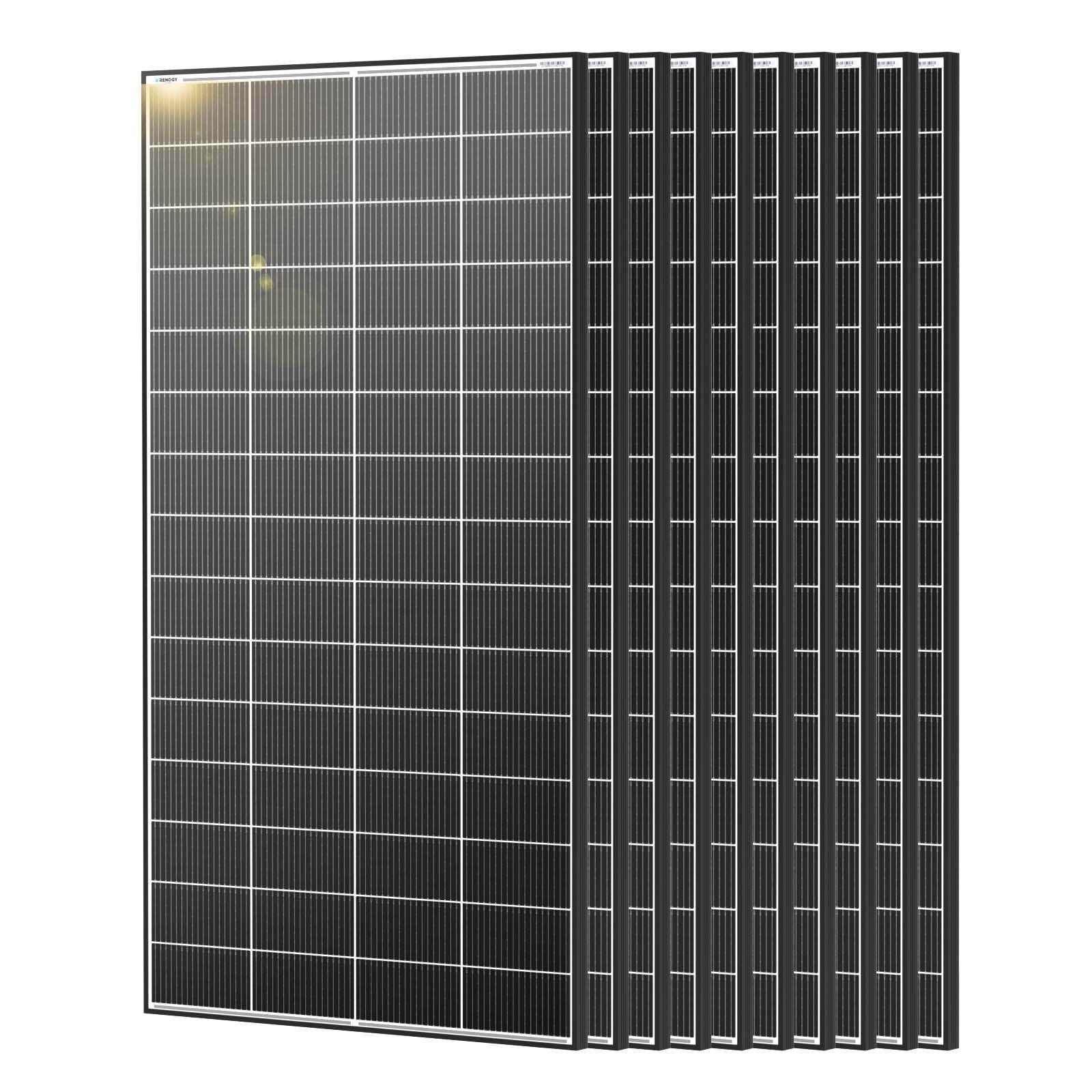
1. Renogy 3200W 10-Pack N-Type 18BB
Our pick — over 4★ from 100+ verified ratings; the strongest balance of quality and price.
A versatile 10-panel bundle with the flexibility to wire for almost any off-grid setup.
You get ten 320-watt panels for a total of 3200W, and the 24-volt rating makes it a natural fit for RVs, cabins, and home rooftops. The panels use N-Type 18 busbars (the thin metal grid lines on the cell surface), which reduce the “hot spot” effect when one cell gets shaded — meaning better performance in harsh weather and a longer lifespan at 25% cell efficiency.
Pre-drilled holes on the back panel align with Renogy ground mounts, Z brackets, corner brackets, pole mounts, and tilt mounts for straightforward installation. Buyers report that a 4S2P wiring configuration (four panels in series, two strings in parallel) at roughly 120V and 2560W delivered 1950W to batteries after a 200W load — and they expect 2400-2600W from the full 3200W setup.
Owners mention that a couple of panels have arrived shattered in shipping, though replacements came free. Durability gets mixed feedback, but the performance — even in overcast and rainy weather — is consistently praised, with one van build running nine days off-grid without ever lacking power.
Why It Wins
- 320W per panel, 3200W total gives real array flexibility
- 18 busbars fight hot spots in partial shade
- 24V output pairs cleanly with common charge controllers
Watch For
- Shipping sometimes arrives with cracked panels — check immediately
- Durability feedback is split between “well-built” and “shattered”
Reach for it if: you want a proven-biggest-array-value with flexible mounting and 24V simplicity for an RV, cabin, or rooftop project.
Think twice if: you need max durability in extreme wind — the mixed delivery-condition reports mean you should budget time to inspect every crate.
2. SUNGOLDPOWER 16BB 3360W Bifacial 6-Pack
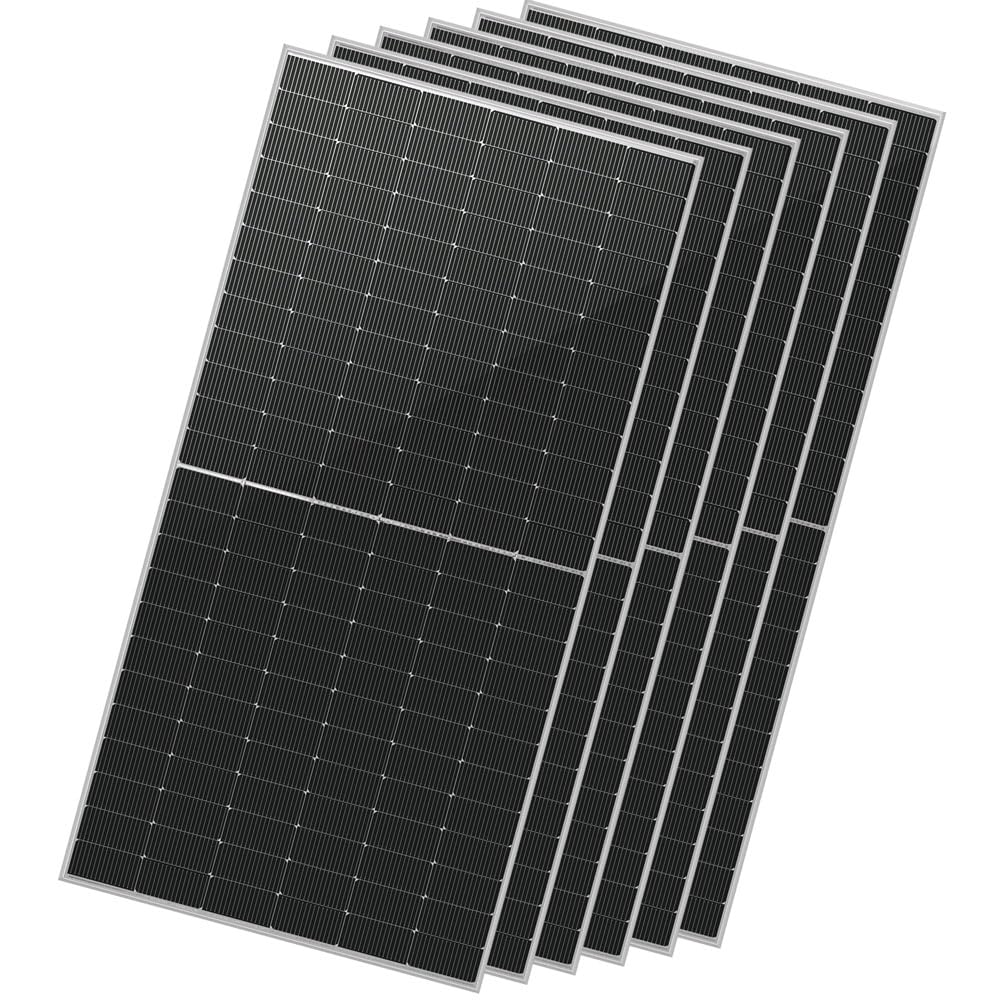
Six big 560W bifacial panels that keep producing past their rated number on bright days.
The panel dimensions are 89.8″L x 44.6″W x 1.4″H and weigh 67.9 pounds each — versus the Renogy Bifacial 590W setup at 350 pounds total, so this kit is dramatically easier to hoist onto a roof.
The 42.1-volt maximum pushes higher than the Renogy 3200W kit’s 24 volts — a 75% higher voltage ceiling — which means you can wire longer series strings with lower current loss, and the 13.3 amps keeps the wiring manageable. Customers note these work well with a 10,000W inverter on an off-grid house, and that fewer panels means less roof space used compared to lower-wattage options.
This premium-priced kit requires raised mounting to let reflected light reach the rear face and open up full bifacial benefit. One reviewer noted a damaged first shipment, but the reorder arrived in good shape — so the packaging is solid overall.
The Real Payoff: The bifacial design pulls in morning and evening light at an angle, giving you a longer effective charging window than a standard panel — and the high 42.1V ceiling means cleaner series wiring.
Best suited for: the homeowner or RV owner chasing maximum yield per square foot of roof, with a higher-voltage charge controller to match.
Who should pass: anyone mounting flat on a low roof — you’d lose the bifacial edge and overpay for it.
3. Renogy Bifacial 3540W 6-Pack 590W Panels
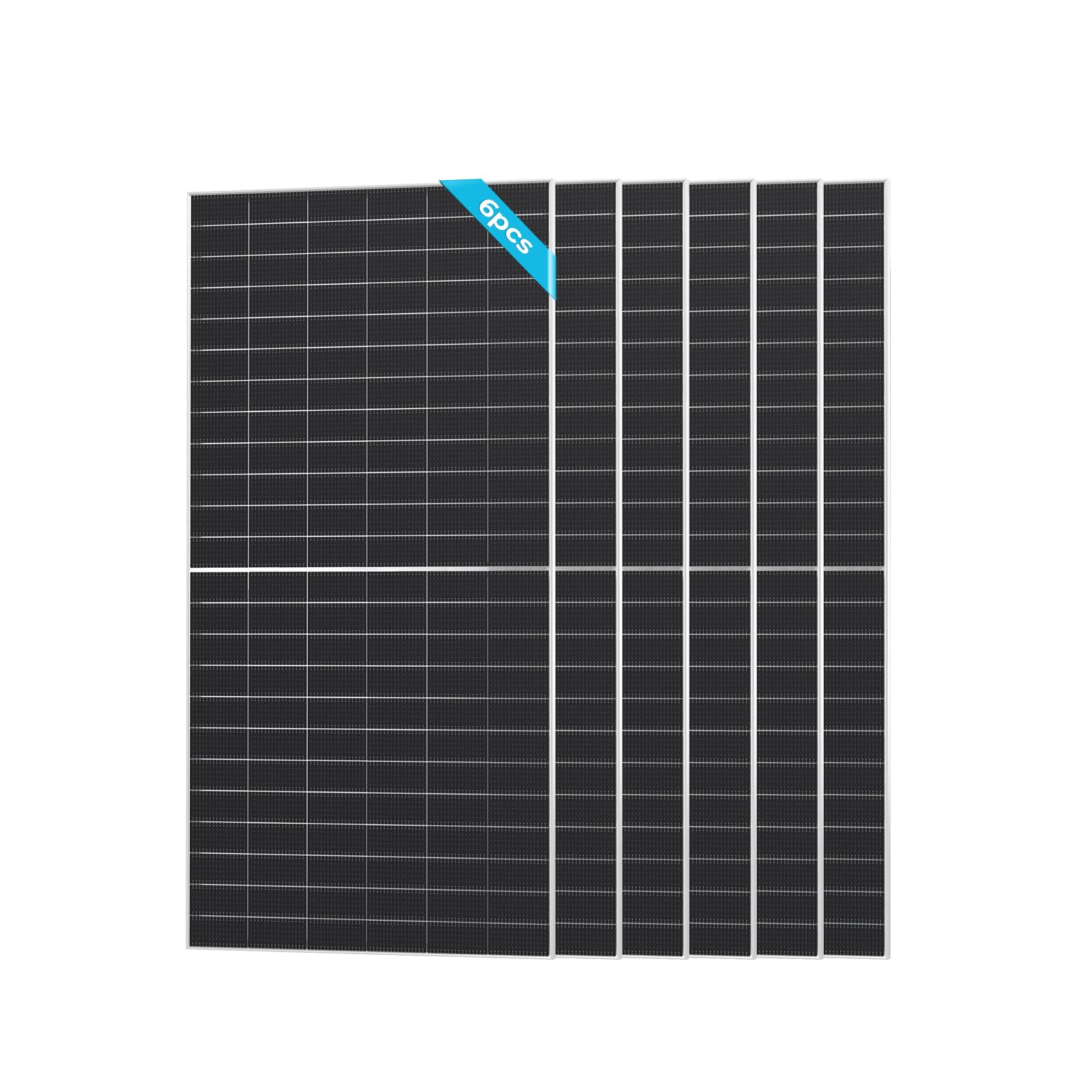
The bumper-tough bifacial brute built to shrug off serious wind and snow loads.
At 3540W total from six 590-watt panels, this is the highest-rated output in the lineup — and it leans on durability that the others can’t match. The black corrosion-resistant aluminum frame endures 2400Pa winds and 5400Pa snow loads (Pa, or pascals, are the units measuring pressure pushing on the panel face), with an IP68-rated waterproof junction box (meaning it’s sealed against dust and water immersion).
Reviewers point out the output holds up: one cabin owner with 12 panels sees close to 7kW at summer peak, and another measured very close to the full 590W per panel in late September without any backlighting. That said, this is the heaviest pick in the lineup at 350 pounds total, a 5.2x weight gap versus the SUNGOLDPOWER’s 67.9 pounds — so think carefully about roof load and two-person lifting.
The packaging is praised as some of the best in the category, with panels arriving intact even under rough handling. Even with rough handling, panels arrive intact with the 14.13A output and MC4 connectors ready to wire. At 44.6″L x 4.2″W x 89.7″H per the listing, these are large and heavy — a buyer noted they’re “huge and heavy” but perfectly packaged.
Built For
- 350-pound-grade durability with 5400Pa snow load rating
- IP68 waterproof junction box for outdoor confidence
- Bifacial + N-Type 16BB combos for 25% higher conversion efficiency
Consider First
- Heaviest bundle — 350 pounds total means serious mounting infrastructure
- Bifacial gain depends on raised mounting, not flat-roof installs
Grab this one if: your site faces heavy snow or high winds and you want a premium panel that shrugs those loads off while still producing.
Look elsewhere if: your roof can’t bear the weight — the 350-pound total will demand reinforced racking.
Understanding the Specs
N-Type Cells & Busbars
N-Type silicon cells (which use a phosphorus-doped design) resist a degradation effect called light-induced degradation — meaning they hold their output better over years than older PERC designs. The “16BB” or “18BB” refers to the number of busbars (the thin metal lines carrying current across the cell face). More busbars means current spreads more evenly, so a shaded corner creates less of a hot spot that can cook the panel.
Voltage & Charge Controllers
Maximum voltage (like 24V or 42.1V) tells you how much electric pressure a single panel pushes. Connect panels in series (plus to minus) and the voltages add up — so four 42.1V panels hit roughly 168V, which many charge controllers can’t handle. Always check your controller’s max input voltage before wiring a large array in series.
FAQ
Will a 2000 watt solar panel kit run a house?
What does bifacial mean in a solar panel?
How many panels do I need for 2000 watts?
Can I claim a tax credit on these panels?
Are N-Type panels better than PERC panels?
Will these panels work with my existing charge controller?
How much roof space does a 2000W+ array need?
How heavy are these solar panels?
Final Thoughts: The Verdict
For most buyers, the 2000 watt solar panel winner is the Renogy 3200W 10-Pack because it delivers the most flexible wattage-per-dollar with 24V simplicity and proven real-world output. If you want maximum yield per square foot of roof, grab the SUNGOLDPOWER 3360W for its bifacial bonus. And for the most punishing weather conditions, the Renogy Bifacial 3540W is the one to reach for.
How We Picked
We do not accept paid placement. Every pick is matched to a real buyer and a real use-case; we do not hands-on test units.
Sources & Methodology
Specifications: manufacturer listings and product documentation. Review insights: verified customer reviews, as of August 2026. Pricing: not shown on this page (it changes often); check the current price via the retailer link.
As an Amazon Associate, Gadgets Feed earns from qualifying purchases. This does not affect which products we feature.