
Our readers keep the lights on and my morning glass full of iced black tea. As an Amazon Associate, I earn from qualifying purchases.
Specs are compiled from manufacturer listings and verified buyer reviews and can change over time — please confirm the key details on the product page before buying.
When your car’s A/C blows warm, you face a choice: a four-figure shop bill or a can of sealant that plugs the leak for a fraction of the cost. The right stop-leak product depends on your refrigerant type, leak size, and leak location. This guide covers the best options for sealing evaporator leaks, condenser pinholes, and slow seeps.
I’m Min — the founder and writer behind Gadgets Feed. This guide is built by comparing the manufacturers’ published specifications and the patterns across verified customer reviews, so you get each pick’s real strengths and trade-offs instead of marketing spin.
From polymer-free formulas that won’t clog your expansion valve to UV-dye blends that reveal hidden leaks, here is the breakdown of the car air conditioner stop leak treatments that actually earn their place in your garage.
Our Picks at a Glance


How To Choose The Best Car Air Conditioner Stop Leak
Not every A/C leak is the same, and the sealant that saves one system can wreck another. Before you buy, you need to know your refrigerant type, the size of the leak, and whether the product is safe for the components in your specific car. Matching the sealant to your leak size and refrigerant separates a fix from a compressor replacement.
Match the Sealant to Your Refrigerant
Modern cars mostly use R134a or R1234yf, and these two are not interchangeable. A sealant made for R134a will not work in an R1234yf system, so check your owner’s manual or the sticker under your hood first. Some premium sealants ship with adapters for both, but many budget cans are locked to one type.
Understand the Leak Size Before You Pour
Most stop-leak products are designed for slow seeps — the kind where you lose your cold air over a month or two. If your system empties in a day or two, that is a major leak that likely needs a shop. A few products state this limit clearly: they can seal leaks where the complete charge is not lost within 7 days. Push a big leak into a small-leak product and you waste the can.
Know Your Components and Their Quirks
The expansion valve (the small part that controls refrigerant flow into the evaporator) is the most clog-prone piece in your system. Polymer-based sealants can harden and block it, while polymer-free formulas stay liquid and travel safely. If your car has a variable-displacement compressor or a sensitive pressure sensor, read the fine print on the can before you inject anything.
Quick Comparison
| Model | Best For | Formula Type | Refrigerant Compatibility | System Size | Amazon |
|---|---|---|---|---|---|
| Leak Saver Direct Inject Ultimate 3-in-1★ Best Overall | Professional-grade permanent sealing across car and home systems | Organosilane | R134a, R1234yf, R410A, R22, more | Up to 5 tons | Amazon |
| BlueDevil Red Angel 49496Best Value | Chemical-weld sealing on older R12/R134a cars | No solid particles | R12, R134a | Standard car systems | Amazon |
| Red Angel ProSeal22Top Performer | Slow leaks on R22 home and car systems | Liquid lubricant | R22, R134a | Standard systems | Amazon |
| ComStar AC Zero Leak | Instant sealing with fluorescent leak detection | Non-polymer, non-hardening | R134a, R12, R22 | Up to 5 tons | Amazon |
| Leak Saver Direct Inject Small System | Mini-splits, dehumidifiers, and small car leaks | Organosilane | R134a, R1234yf, R410A, R22 | Up to 1 ton | Amazon |
| Enviro-Safe ProSeal XL4 | Heat pumps and mini-splits with field-tested sealing | Concentrated insert | R22, R134a, R410A | Split and mini-split units | Amazon |
| Red Angel ProSeal12 | Older cars still running R12 or retrofitted R134a | Liquid lubricant | R12, R134a | Standard car systems | Amazon |
| Enviro-Safe R1234yf Stop Leak | Late-model cars with R1234yf refrigerant | Fluorocarbon | R1234yf only | Standard car systems | Amazon |
| Errecom Extreme Ultra | Preventative maintenance with refillable cartridges | Polymer-free gel | R134a, R1234yf | Standard car systems | Amazon |
In‑Depth Reviews
1. Leak Saver Direct Inject Ultimate 3-in-1
Our pick — over 4★ from 950+ verified ratings; the strongest balance of quality and price.
The professional-grade 3-in-1 that seals leaks, removes moisture, and adds UV dye in one shot.
This is the one that pairs a leak sealant with a moisture remover and a UV dye, so a single injection does three jobs at once. The formula is polymer-free organosilane, which means it won’t harden into the kind of gunk that clogs expansion valves and Schrader valves.
The sealing logic is simple: when it meets air and moisture at the leak site, it reacts to form a permanent seal. It handles everything from R134a and R1234yf in cars to R410A and R22 in home heat pumps, and the maker claims more than 4,000,000 units sold since 2015. Buyers report it sealing evaporator leaks where the system was losing 4 lbs of freon every 2 days — a fast leak that most sealants can’t touch — and two weeks later an electronic detector showed no leak at highest sensitivity. That result separates a real fix from a can of snake oil.
For automotive use, you will need a standard 134A to 1/4-inch charging adapter, since the can injects through a manifold gauge set rather than a hose. It is safe for TXVs, TEVs, capillary tubes, and all the tools you use to service the system. The catch: some owners found the injection tube’s Schrader valve finicky and needed to remove the valve core to get the sealant flowing — a 4-hour frustration for one person, but the leak still sealed afterward.
direct inject power
- UV dye built in for locating leaks later
- Polymer-free so it won’t clog expansion valves
- Seals permanent leaks when charge isn’t lost within 7 days
prep work needed
- Needs a charging adapter for car systems
- Injection tube valve can be tricky for DIY installs
top injector: you want a single can that handles sealing, moisture removal, and leak detection for both your car and your home heat pump.
needs skill: you are not comfortable with a manifold gauge setup and want a simple hose-in-can install.
2. BlueDevil Red Angel 49496 A/C Stop Leak
A 2-ounce chemical weld that seals leaks without any particles that could clog your system.
Red Angel’s whole pitch is that it forms a chemical weld rather than relying on solid particles, which means nothing in the formula can clog your A/C system or harm a recovery unit. That is a meaningful safety point — many sealants leave behind debris that technicians hate finding when they hook up their machines. It seals leaks in condensers, evaporators, hoses, gaskets, and O-rings across both R-12 and R-134a systems, and the maker stands behind it with a guarantee.
One owner’s car with a slow leak that took 1.5 months to go hot held fine for a month after proper evacuation and recharge. Another owner faced dealer quotes over for a core replacement and the product solved it. The durability shows up too — one system ran leak-free for 6 months through a Florida summer after a proper evacuation and injection.
What it can’t do is work miracles on major leaks. A pinhole evaporator leak losing about 0.5 lb per year held a 29-inch vacuum for 20 minutes before treatment, but a sniffer still caught a faint leak a year later. This is a product for slow seeps and reasonable leaks, not a blown compressor seal. The right move for anyone using it: evacuate the system first, then inject quickly before air can get in through the same leak.
quick fix: older cars with R-12 or R-134a that have slow evaporator or condenser seeps, especially when you want zero risk of clogging the system.
risky seal: your A/C loses its charge in a week or less — that leak is too large for any chemical weld.
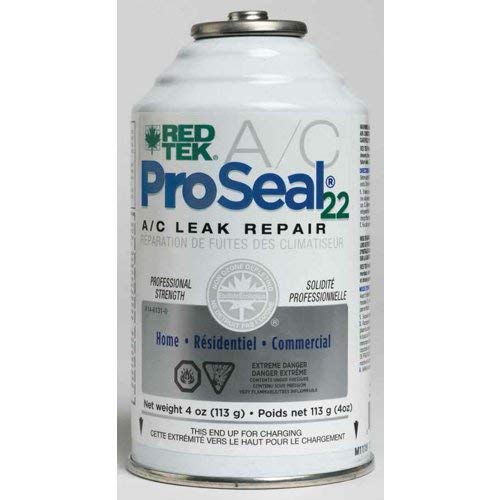
3. Red Angel ProSeal22 A/C Seal Treatment
A 4-ounce liquid sealant that stays in the system as a lubricant, ready to seal future leaks too.
ProSeal22 is the R22-focused sibling in the Red Angel lineup, and the design goal is exactly what a homeowner wants: install in minutes, then let the product remain in the system as a liquid lubricant that keeps sealing future leaks as they develop. It is compatible with R22 and R134a, plus metal components, seals, gaskets, hoses, compressors, and O-rings. The maker notes it is less toxic than seal treatments that use poisonous methanol, which matters when you are handling the can in your driveway.
Owners mention exceptional longevity, with one system running leak-free for 4 years. One owner put two cans into a 4-ton unit with a pinhole leak on the A-coil — a leak so small it takes a year to lose refrigerant — and it worked perfectly and easily. That same reviewer’s air conditioner was still running fine after 4 years. Another slow-leak story: a very slow leak in an HVAC system fixed with the sealant plus a small refrigerant top-up, still working great after 2 years.
The honest caveat is that this is a slow-leak specialist. A 28-year-old system with a leak that drops from -30 vacuum to -28 after a week held enough refrigerant for summer but emptied each winter — the owner used it twice over 3 years and eventually replaced the system. It is a bridge, not a forever fix, for systems that are already at the end of their life. Note: this is a non-refundable, non-returnable product due to hazardous material classification.
proseal22 versatile: slow, tiny leaks in R22 or R134a systems where you want a single can that keeps working as a preventive lubricant for years.
small leaks only: an old system losing a big charge each season will need a real repair eventually — this just buys you cold summers in between.
4. ComStar AC Zero Leak Fluorescent Yellow

A fluorescent-yellow sealer engineered for instant sealing that stays non-hardening and moisture-safe.
ComStar’s claim is speed — this formula targets minor leaks in evaporators, condensers, seals, and gaskets and delivers fast, reliable sealing without the risk of clogging. The non-polymer, non-hardening formula is what makes it system-friendly: it stays soft so it won’t create blockages inside the expansion valve or drier. One bottle treats up to 5-ton systems, and it works with POE, PAG, and mineral oil lubricants, which covers most modern car and home setups.
Customers note specific wins, like sealing an evaporator core leak that failed 3 other sealers. An evaporator core leak on a 2008 Trailblazer that had already failed 3 other sealers was fixed with 2 oz of this plus a vacuum/recharge kit costing under — avoiding a repair that would have run past. A 2009 Avalon at 200k miles got its A/C ice cold again after a 1-2 hour engine run to circulate the sealant. The fluorescent dye is the bonus here: it turns the leak detection job into a simple UV-light sweep if anything ever reopens.
It is not a universal fix. One owner with a leak too large for an evaporator coil still saw a slow loss after half a bottle, and noted that injecting through the Schrader valve was hard. The consensus is that this works beautifully for small leaks and struggles beyond that. Also, the engine-running circulation step is not optional — the product needs the compressor spinning to push it through the system.
fluorescent finder
- Sealed a leak that defeated 3 other sealers
- Fluorescent dye makes future leak checks easy
- Non-hardening formula protects expansion valves
leak detection only
- Only reliable on small leaks
- Needs a long engine run for circulation to work
leak hunter: you have already tried other sealers and want a fluorescent-tinted formula that handles small evaporator and condenser leaks with no clog risk.
not sealer: your leak is big enough to empty the system in a few weeks — that needs a shop.
5. Leak Saver Direct Inject Small System

The small-system specialist sized for mini-splits, dehumidifiers, and car leaks up to 1 ton.
This is the same organosilane chemistry as the Leak Saver Ultimate 3-in-1, but sized for systems up to 1 ton — which makes it the natural choice for dehumidifiers, mini-splits, and small car A/C loops. Like its bigger sibling, it seals permanently by reacting with air and moisture at the leak site, and it works across R134a, R1234yf, R410A, R22, and more. The 2.39-ounce can is easy to store and the injection needs a manifold gauge set or the Leak Shot kit.
The evidence is strongest for small appliances and mini-splits. An LG dehumidifier with an R410A evaporator leak that was losing charge weekly held for 10 days after treatment — versus leaking every week before. A DIY mini-split leak was sealed outright: “Great find; had a small leak in a DIY mini-split system. Goodbye leak.” The value story is real too — one owner reported the product saved them versus calling a technician.
On a car, the results split by leak size. One owner’s small car A/C leak extended the recharge interval from 2 months to longer — though the seal eventually let go after about 5 months when the car sat idle. That is the honest picture: this can buy real time on a small leak, but if your leak is severe it only slows the loss. A wine fridge with a 1.8 oz R134a charge lost temperature again in about 3 days after two applications — a reminder that the smallest systems are the hardest to seal.
compact use: your leak is in a mini-split, dehumidifier, or a small car system that loses charge over weeks, not days.
big leaks: you have a major leak that empties the charge quickly — the small-system dose is not built for that.
6. Enviro-Safe ProSeal XL4 Inject
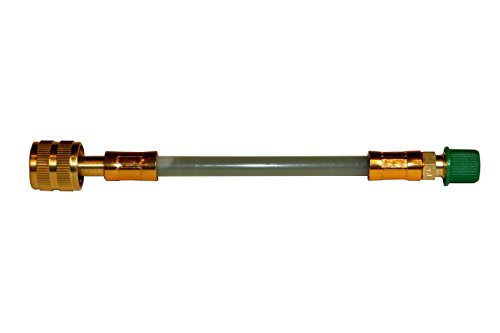
A brass injector with a concentrated formula that seals without hoses, caulk guns, or extra tools.
Enviro-Safe has spent 29+ years making sealants, and the ProSeal XL4 shows the result: a concentrated formula that travels with the gas for faster, more effective sealing than competitors. It seals small leaks in condensers, evaporators, fittings, Schrader valves, and line sets, forming a durable seal in metal, O-rings, gaskets, and solder joints. The one-time-use injector requires no hoses or extra tools, which keeps the install simple.
The field results are strong. A 26-year-old Lennox R22 system with a leak got 3 lbs of R22 added with the sealant and ran for 4 months, holding 68°F through a heat wave — and avoided a replacement. An RV with a 13,500 BTU Coleman evaporator leak was fixed properly with the right steps (piercing valve, nitrogen test, evacuate, refill) plus the sealant. Even the fit matters: the injector measures 6.875 inches with a slightly flexible plastic tube that bends about an inch, which one owner used to fit into a tight 6-inch clearance.
The trade-off is that this is an inject-only product, not a full service kit. You still need your own refrigerant and the proper procedure — vacuum pump, gauge manifold, and the like. One owner noted the injector is not reversible once attached to a manifold. If you are comfortable with basic A/C service tools, this concentrated formula gives you a lot of sealing power in a small package.
xl4 heavy duty: DIYers who already own a vacuum pump and manifold gauge and want a concentrated, tool-free injector for heat pumps, mini-splits, and packaged units.
pricey option: someone expecting a complete recharge kit — this is just the sealant injector.
7. Red Angel ProSeal12 A/C Seal Treatment
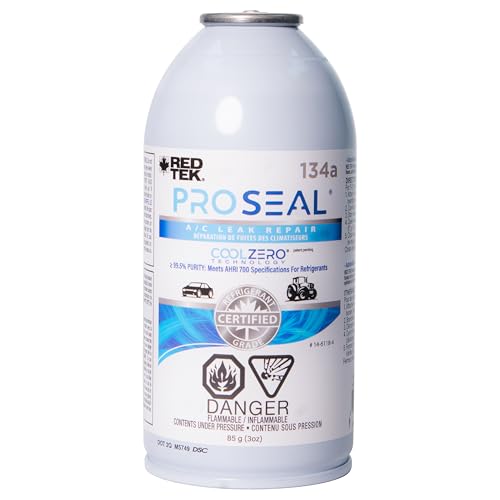
A 4-ounce can that understands older cars, sealing R12 and R134a systems in minutes.
ProSeal12 is the classic-car specialist. It works with R134a and R12, plus metal components, mineral and synthetic lubricants (Ester and PAG), seals, gaskets, hoses, compressors, and O-rings. For anyone with a 1990s or earlier vehicle still running R12, this is one of the few sealants that speaks its language. The product remains in the system as a liquid lubricant ready to seal future leaks, so it keeps doing its job long after installation.
The owner stories skew old and happy. A 30-year-old car had its leak sealed completely — “Worked great on 30 year old car, seal the leak completely.” A 21-year-old Dakota with a small evaporator leak got one can and was still blowing very cold 2 months later, saving hundreds in repair costs. On an R12 system with a new compressor and dryer, it blew cold with no leaks, and the owner noted it uses less gas than R134a or R12 refills.
The instructions are the weak point — one owner called them poor and conflicting, and had to pump down the system first with no tech support available. This is a product that assumes you know your way around an A/C system. And like the ProSeal22, it is non-refundable and non-returnable because it is classified as a hazardous material.
easy shot: you own an older car on R12 or a retrofitted R134a system and want a budget-friendly can that doubles as a future-leak lubricant.
one time: you need hand-holding through the process — the instructions won’t give it to you.
8. Enviro-Safe Stop Leak for R1234yf
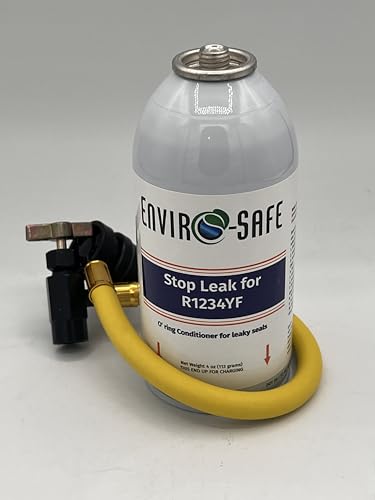
The dedicated R1234yf sealer for modern cars, with a single-use hose that pierces the can.
If your car is from the last several years, it almost certainly runs R1234yf — the newer refrigerant that older sealants don’t touch. This Enviro-Safe product is built specifically for those systems, using a fluorocarbon formula. The packaging spells out the limit clearly: this is for R-1234yf A/C systems only, not for R-134A systems. That specificity is exactly what late-model owners need.
The success stories cluster around late-model cars. A 2019 Nissan Kicks S that stopped blowing cold got refrigerant plus this stop leak and ran problem-free for 4 months. A 2016 Civic with a slow leak worked for a month after treatment, with the owner noting the dealer had quoted — DIY was far cheaper. A Honda SUV owner followed the instructions, refilled to 35-40 psi on the low-pressure port, and had no issues for 2 months.
The practical notes matter if you are doing this yourself. The can of R1234yf is one-time use, and the hose is only for use with this stop leak — it pierces the can and is not compatible with regular R1234yf cans. You must add refrigerant separately because this is stop leak only, not a recharge blend. Some Honda pressure sensors may need a jumper or bleeding to work around them, and a gauge hose is recommended so you hit the right pressure.
modern cars: you drive a modern car on R1234yf and want a sealer that matches your refrigerant exactly, with a simple pierce-and-inject hose.
older ac: your car runs R134a — this product will not work on it.
9. Errecom Extreme Ultra

A refillable, OEM-developed cartridge that favors prevention over big-leak repair.
Errecom brings an OEM pedigree — the formula comes from an in-house chemical laboratory trusted by HVAC technicians and OEMs since 2001 across over 130 countries, and it is 100% Made in Italy. The polymer-free formula does not react with moisture or oxygen, which prevents blockages or damage to expansion valves (TXVs, TEVs, capillary tubes) and Schrader valves. The reusable system is US patented (US 11002470): buy the cartridge once, then just purchase a refill cartridge next time instead of a whole new applicator.
The caution flag is real, and it is why this sits lower despite the pedigree. The manufacturer advises a 5-minute vacuum test first to confirm the leak is repairable — and some owners skipped that step or had leaks too big. A Toyota Camry with a thumbtack pinhole in the evaporator never sealed despite two tubes and needed a replacement. One owner also flagged the instructions as vague, with a QR code that did not help, and the syringe-style cartridge can be messy if handled wrong.
extreme ultra strong
- Includes both R1234yf and R134a adapters
- Reusable cartridge saves money on refills
- OEM-developed, made in Italy
hard to find
- Only reliable on small leaks — vacuum test first
- Instructions are vague; cartridge can spray if mishandled
max power: preventative maintenance on a healthy system or a confirmed small leak, especially if you want a refillable kit with both adapters included.
rare buy: you have a pinhole-size leak or larger — the tiny 6 mL dose is not designed for that.
Understanding the Specs
Polymer vs. Polymer-Free Formulas
The biggest decision you will make is which type of sealant to pour in. Polymer-based sealants harden into a solid plug at the leak site — effective, but they can also harden inside your expansion valve and clog the system. Polymer-free formulas, like the organosilane in Leak Saver or the chemical weld in Red Angel, stay liquid and only react at the leak itself. That makes them safer for modern systems with delicate valves and sensors, which is why they dominate the premium picks.
Refrigerant Compatibility and Adapters
Your car runs either R134a or R1234yf — and they are not interchangeable. Most sealants list which refrigerants they work with, and some ship with adapters for both. The Errecom includes green (R1234yf) and black (R134a) adapters, while the Enviro-Safe R1234yf product is locked to that one refrigerant. Check your hood sticker before you buy. Also watch what injection method you need: a manifold gauge set, a simple hose, or a piercing can.
The 7-Day Leak Rule
Many professional-grade sealants state they can permanently seal a leak only when the complete refrigerant charge is not lost within 7 days. That is a useful test for your own system: if your A/C goes warm in less than a week, you are looking at a leak too large for any can to fix permanently. If it takes a month or more to lose cold air, you have a slow seep that a good sealant can realistically plug.
UV Dye Built In
Some sealants, like the Leak Saver Ultimate and ComStar AC Zero Leak, include a UV dye alongside the sealing agent. That dye circulates through the system and glows under a UV light, so if a leak ever reopens, you can find the exact spot instead of guessing. It turns a mystery leak into a visual inspection — a small feature that can save you real diagnostic time later.
FAQ
Will a stop leak work on my car’s A/C if it already blew warm?
Can I use an R134a stop leak in my R1234yf car?
How long does a car A/C stop leak actually last?
Will stop leak clog my A/C system’s expansion valve?
Is a car A/C stop leak cheaper than a repair shop?
Do I need to evacuate the system before adding a stop leak?
How do I know which refrigerant my car uses?
Will a stop leak work on an evaporator leak specifically?
Can I use a car A/C stop leak on my home HVAC system?
What if the stop leak does not work?
Final Thoughts: The Verdict
For most people, the car air conditioner stop leak winner is the Leak Saver Direct Inject Ultimate 3-in-1 because it pairs a permanent polymer-free seal with UV dye and a moisture remover in a single injection that spans your car and home systems. If you want a no-particulate chemical weld on an older R-12 or R-134a car, grab the BlueDevil Red Angel. And for a modern car running R1234yf, the Enviro-Safe R1234yf is the one to reach for.
How We Picked
We do not accept paid placement. Every pick is matched to a real buyer and a real use-case; we do not hands-on test units.
Sources & Methodology
Specifications: manufacturer listings and product documentation. Review insights: verified customer reviews, as of August 2026. Pricing: not shown on this page (it changes often); check the current price via the retailer link.
As an Amazon Associate, Gadgets Feed earns from qualifying purchases. This does not affect which products we feature.