
Our readers keep the lights on and my morning glass full of iced black tea. As an Amazon Associate, I earn from qualifying purchases.
Specs are compiled from manufacturer listings and verified buyer reviews and can change over time — please confirm the key details on the product page before buying.
You want to capture the ride without fumbling for buttons or worrying if the mount will hold at highway speed. Decide first if you need cinematic vlog footage or a dependable witness cam for daily commutes. Here’s what to look for in sensors, stabilization, and mounting systems when the camera is strapped to your helmet.
I’m Min — the founder and writer behind Gadgets Feed. This guide is built by comparing the manufacturers’ published specifications and the patterns across verified customer reviews, so you get each pick’s real strengths and trade-offs instead of marketing spin.
Your choice narrows to how much wind noise, darkness, and vibration you ride through. The camera for motorcycle helmet you choose hinges on how much wind noise, darkness, and vibration you actually ride through.
Our Picks at a Glance

How To Choose The Best Camera For Motorcycle Helmet
Start by defining your goal: cinematic edits, evidence capture, or community sharing. Your riding style and typical roads dictate which spec deserves your budget.
Stabilization is the difference between watchable and nauseating
When the camera is on your head, every head turn and road bump translates to vibration. Electronic Image Stabilization (EIS) is the software that keeps the horizon level and the motion smooth. Look for a 6-axis stabilizer or a named system like HorizonSteady — it is the single feature that separates pro-looking footage from shaky clips.
Battery life vs. your ride length
A 240-minute camera sounds great until you factor in Wi-Fi, stabilization, and cold weather, which all drain power faster. If you do all-day touring, the ability to record while charging or swap batteries matters more than the headline number. Match the camera’s endurance to your longest realistic ride, not your average commute.
Quick Comparison
| Model | Best For | Stabilization | Battery Life | Still Resolution | Amazon |
|---|---|---|---|---|---|
| DJI Osmo Action 5 Pro★ Best Overall | Pro-grade footage | 360° HorizonSteady | 240 minutes | 40 MP | Amazon |
| Camlance 4K Mini Body CameraCompact Pick | Ultra-compact mounting | 6-Axis | 270 minutes | 20 MP | Amazon |
| Intepoll 4K Mini WiFiBest Value | Thumb-size value | None specified | 90 minutes | 4 MP | Amazon |
| Losfom Z10 | Simple one-click rides | None specified | — | 2.1 MP | Amazon |
| AKASO Brave 7 LE | All-weather starter | 6-Axis EIS 2.0 | — | 20 MP | Amazon |
| AKASO 360 | rich 360 video | 360-SuperSmooth | 2 hours | 48 MP | Amazon |
| Drift Ghost XL Pro | Long battery touring | Image Stabilization | 4.5 hours | 12 MP | Amazon |
| Insta360 Ace Pro 2 | Low-light mastery | FlowState Stabilization | — | — | Amazon |
| Sena 50C | Comms + camera combo | None specified | — | — | Amazon |
In‑Depth Reviews
1. DJI Osmo Action 5 Pro Essential Combo
Our pick — over 4.5★ from 1,500+ verified ratings; the strongest balance of quality and price.
The gold standard for broadcast-ready footage even at dusk
Rated 4.7 stars from 1,700+ owners, this action cam delivers the footage your rides deserve. At the heart of it sits a 1/1.3-inch sensor with 2.4 µm large pixels, which simply means it captures more light, so your evening lane-splitting clips stay clear instead of grainy. It shoots 4K at 120fps for silky slow motion, and its 40 MP still resolution doubles the output of the budget thumb-cams below.
Wind noise is the enemy of every rider, and DJI answers with dual OLED touchscreens and voice control that responds within one meter — you can shout a command over the wind without taking a glove off. The 360° HorizonSteady technology eliminates roll-axis shakes, keeping the horizon level even as you lean through a canyon. Battery life lands at 240 minutes, and buyers report the real-world figure is close to three hours, which is enough for a long day of filming short clips.
The Essential Combo is IP68 rated for 20 meters underwater, so a sudden downpour or a creek crossing on an ADV route is never a problem. Its compact build earned consistent praise as an outstanding everyday camera worth the price. The one honest note: the built-in audio is average, and serious moto-vloggers will want to pair it with an external mic via its direct DJI Mic 2 connection.
Why riders love it
- Crisp 4K at 120fps with fantastic color science
- 360° horizon lock keeps footage level in hard leans
- 47 GB built-in storage plus UHS-II support
- Voice control works hands-free for gloved riders
- Charges quickly via USB-C PD cable
The trade-offs
- Built-in audio is average; external mic recommended
- 4K footage eats storage fast, so carry cards
- Premium price reflects the pro-grade build
Reach for this if: you want the best possible image quality and don’t want to upgrade again next season.
Look elsewhere if: you simply need a cheap witness cam and care more about price than cinematic clarity.
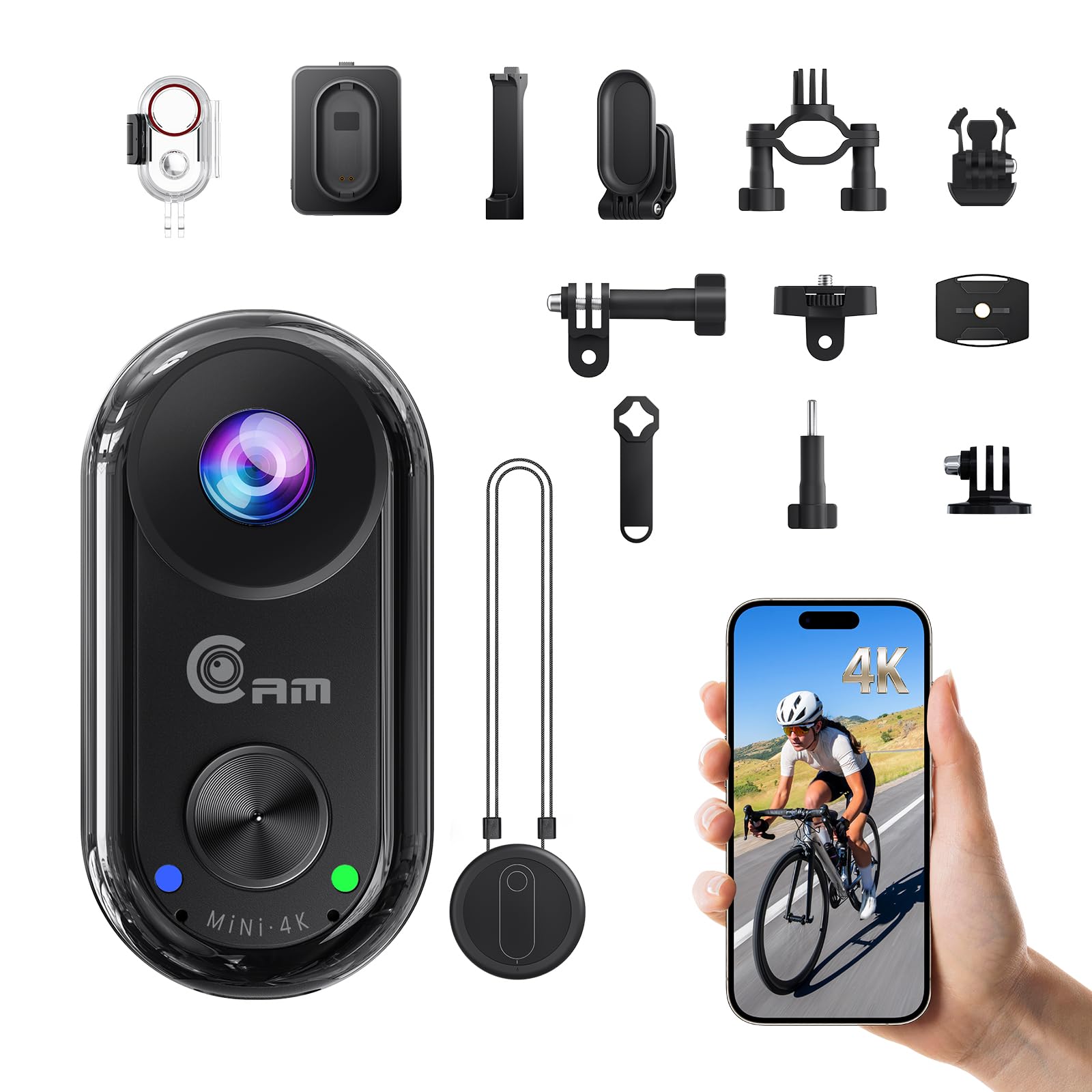
2. Camlance 4K Mini Body Camera
A featherweight 28.9-gram camera that hides on your helmet and forgets it’s there
If you hate the weight of a full action cam on your head, this thumb-cam is the lightest option here at just 1.01 oz (28.9 g) and 2.02 x 1.0 x 0.88 inches. The magnetic design with a rotatable clip lets you mount it on the visor, chin bar, or top vent — angles no other camera can match. It records 4K with a 6-axis stabilizer (a sensor that keeps the image level), so footage stays steady even on gravel roads.
Its standout feature is the detachable battery pack. The camera body records 90 minutes solo, but paired with the charging case it stretches past 270 minutes and supports recording while charging, which is a lifesaver for a full day of touring. It’s waterproof to 40 meters with the housing, and a single center button handles one-tap recording — press once to start, hold for 3 seconds to power off.
Owners mention using it for everything from dog walking to river hiking, with footage staying clear and the magnet holding strong. One owner summed up the practicality: “As a dog walker, it’s critical to have a camera on me in the case of an off leash dog or other dangerous situation.” It captures 20 MP stills, which beats the 4 MP of the similar thumb-cams below, yet it stays budget-friendly.
Built for stealth: if you want a camera so small you forget it’s recording, this is the one. The magnetic clip is the most flexible mounting system in this lineup, and the charging case doubles your ride time.
Who should pass: riders chasing cinematic color depth will find the 20 MP stills plenty, but serious vloggers will want the DJI’s dynamic range for night work.
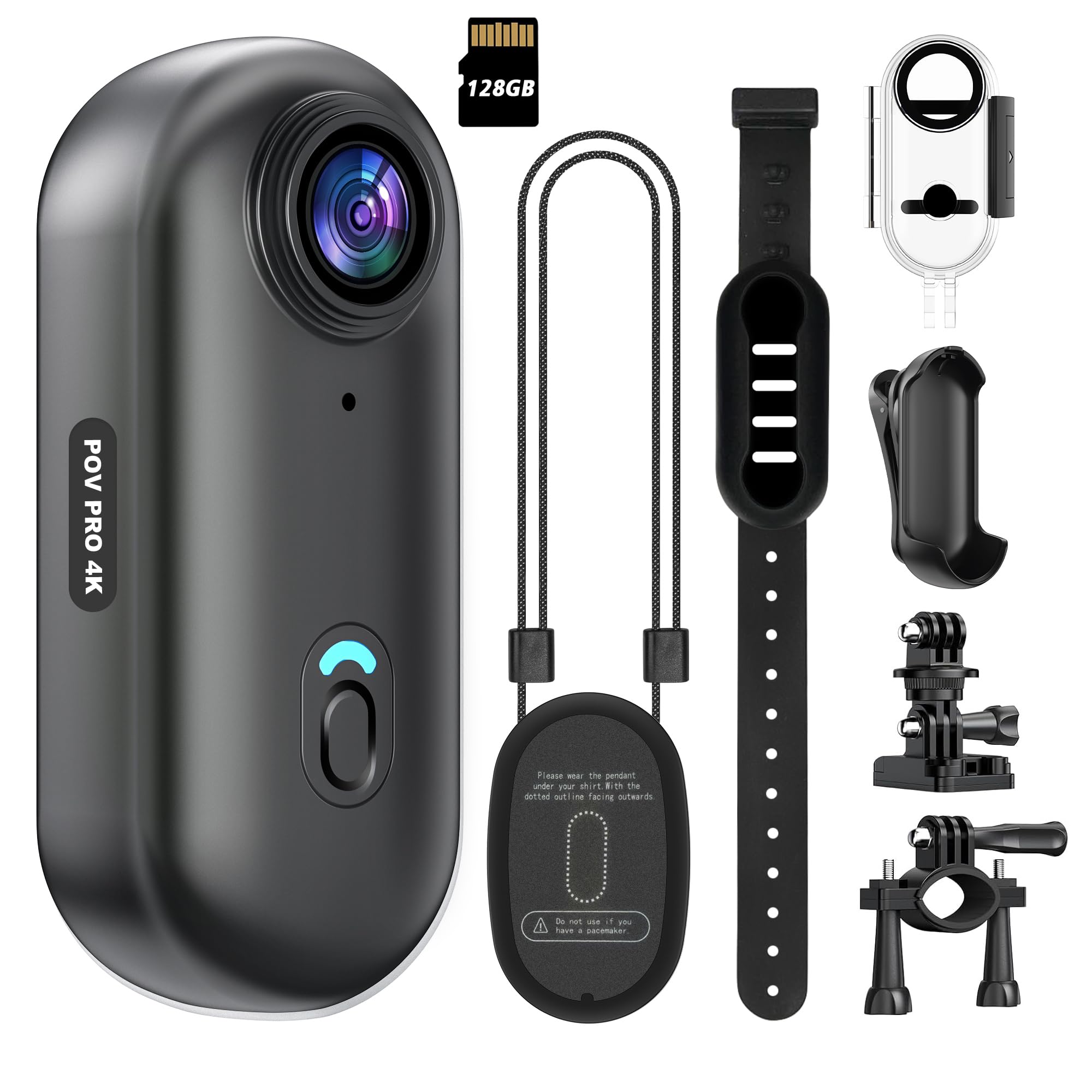
3. Intepoll 4K Mini WiFi Action Camera
A thumb-size camera that delivers smooth 4K without emptying your wallet
At just 1.1 x 0.7 x 2.5 inches and 1.27 oz, this Intepoll is nearly identical in size to the Camlance, but it cuts the price while keeping the essentials. It shoots 4K at 2160p/30fps and includes a 128GB memory card right in the box, so you can hit record the moment it arrives. The inclusive kit comes with a helmet bracket, magnetic pendant, back clip, and a waterproof case, making it a true grab-and-go package.
The defining feature is the runtime — up to 90 minutes of continuous recording at 4K with Wi-Fi off, which covers a solid commute or a spirited backroad run. The IPX7 waterproof rating (protection against immersion up to 1 meter) and the included case expand its use to rainy rides and pool days. Buyers consistently praise the sharp video quality and the compact size, noting it works smoothly for bike riding.
Honest caveat: battery life and phone connectivity get mixed feedback, with some owners finding the battery closer to 2 hours and app pairing occasionally fussy. Also, the 4 MP still resolution is the weakest in this lineup, so it’s not a photo camera. But as a pure value play for clean 4K video on a budget, it’s tough to top.
What you get
- 128GB card included, ready from the start
- Multiple mount styles for helmet, bike, and pocket
- 90-minute runtime at 4K with Wi-Fi off
- IPX7 waterproof build plus case
Keep in mind
- 4 MP still photos are basic at best
- Connectivity and battery draw mixed reviews
- Mount variety can confuse without instructions
Best for: a first-time rider who wants decent 4K without overspending.
Think twice if: you need long battery endurance or plan to shoot photos with it.
4. Losfom Z10 4K Action Camera

The one-button witness cam that starts recording before you’ve even thought about it
Weighing just 49 grams, the Z10 is built around a single large button that starts recording with a simple press — no menus, no app, no learning curve. The quick-mount bracket attaches to your helmet or handlebars, and the large button is easy to hit even with riding gloves on. It includes a 128GB microSD card and a full magnetic clip plus waterproof case kit.
Buyers were impressed by the complete kit, noting it includes many mounts and cable adapters, and that the footage quality is accurate with a wide field of view. One owner shot over 410 clips totaling 34 hours on the included card, describing the footage as having GoPro-like quality. The 2K resolution is honest about what it delivers — crisp and colorful, though not true 4K despite the name.
The honest downsides: there’s no Wi-Fi or Bluetooth, so transferring files requires a cable or card reader, and reliability gets mixed reviews with a few reporting the camera stops recording at random. Battery capacity is on the weaker side too. For a simple, cheap, always-ready witness cam it delivers, but riders wanting reliability for daily evidence capture should weigh the mixed reliability reports.
Clarity over control: this is the most user-friendly camera here — a single button for the entire recording process. The included 128GB card and waterproof case make it a true all-in-one.
The catch: if you need to review footage immediately on your phone or trust it for daily insurance evidence, the mixed reliability reports give reason to pause.
5. AKASO Brave 7 LE 4K Action Camera

The all-weather starter that brings dual screens and gimbal-like stability to the mid-range
AKASO’s Brave 7 LE is the smart pick for riders who want pro features without the pro price. Its headline feature is the dual color display — a rear 2-inch touchscreen plus a front screen — so you can frame yourself for a vlog or check your angle before you pull away. The 6-axis EIS 2.0 delivers gimbal-like stabilization that smooths out riding vibrations, and buyers confirm it works well as a starter motovlog camera.
It shoots hyper-quality 4K at 30fps and 20 MP photos, giving you a true hybrid camera for both ride footage and scenic shots. The IPX7 water resistance plus an included housing takes you down to 131 feet (40 meters), and the kit includes 2 rechargeable batteries, a remote, and a full mounting kit. Buyers consistently praise the battery, noting it powered roughly 10 short videos and photos over 6 hours.
The honest note: audio has a recurring white-noise issue after battery removal, and mounting adapters can be confusing with too many options. But the dual screens are the standout here — something the DJI has but at nearly double the price — making the Brave 7 LE the best value dual-screen option for solo riders.
The highlights
- Front and rear screens for perfect self-framing
- Waterproof to 40 meters with included housing
- 4x digital zoom for picking out road signs
- 2 batteries and remote included in the box
The drawbacks
- White-noise audio can return with battery swaps
- Battery drains fast with Wi-Fi and stabilization on
- Size gets mixed feedback from owners
Choose this for: a moto-vlogger starting out who wants dual screens and strong stabilization on a budget.
skip it if: pristine audio is non-negotiable on every single ride.
6. AKASO 360 Action Camera
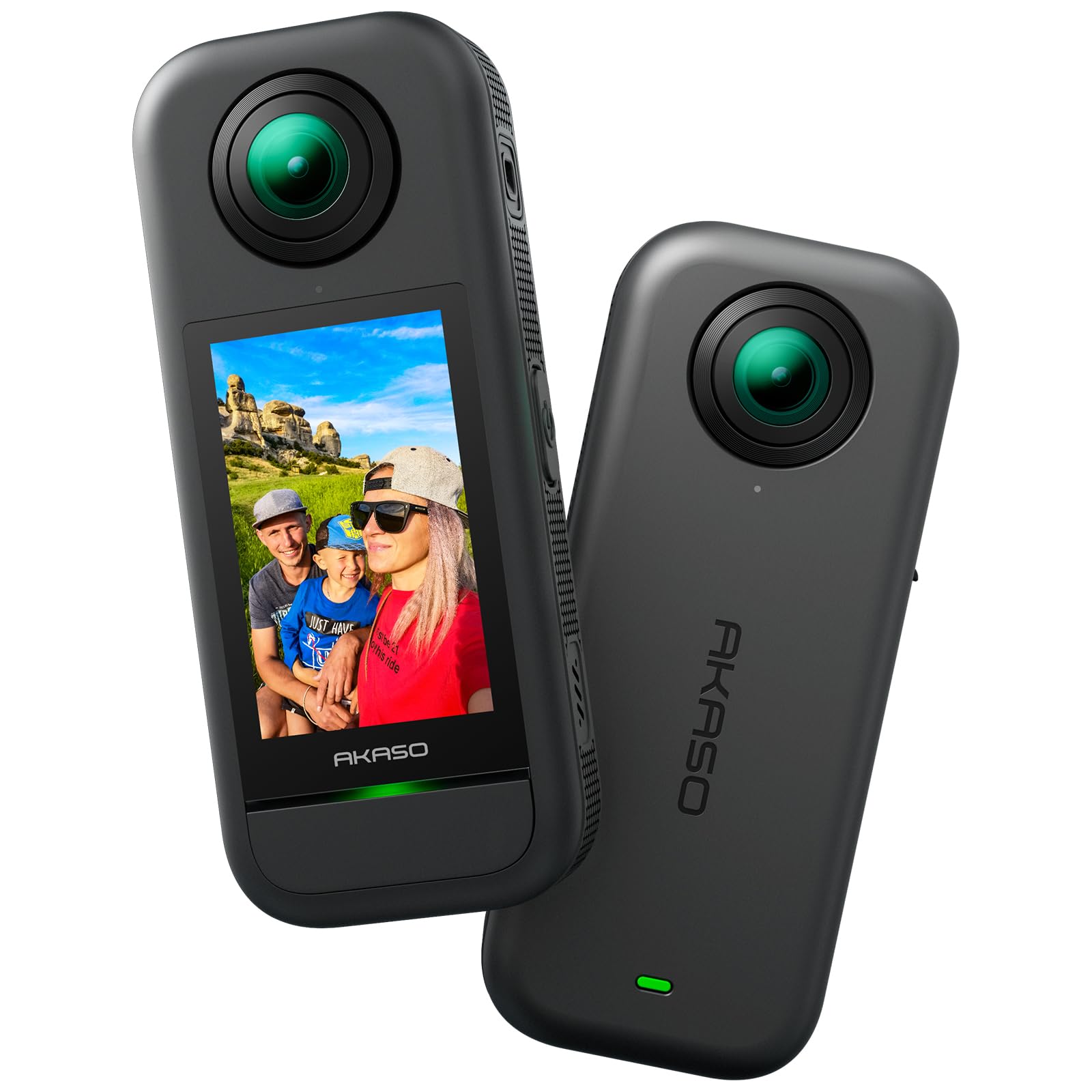
The 360-degree shooter that captures everything around you, even the pass you never saw
This is the wild card of the lineup. Instead of pointing a lens forward, the AKASO 360 captures a full sphere with dual 1/2-inch 48 MP sensors, recording rich 5.7K 360 video. For a motorcycle helmet, that means you catch the car passing on your left, the scenery on your right, and your own body language — all at once. The invisible selfie stick effect lets you create third-person shots of yourself riding, as if a camera drone were following you.
The 360-SuperSmooth stabilization and 360° Horizon Lock keep footage level no matter how you flip or spin, which is a genuine advantage over forward-only cameras when you’re leaned over in a corner. Buyers describe it as an excellent entry-level 360 camera for motorcycle trips, with stabilization that rivals cameras costing significantly more. It records up to 4K video and 72 MP 360 photos, and supports recording while charging for long rides.
The honest constraints: there’s no HDR and low-light performance is limited, so dusk rides will look noisy. It also has no waterproof case, so you’ll want a third-party housing for heavy rain, and it needs a high-end microSD (up to 512GB) for smooth recording. Battery life varies dramatically with settings — one owner measured just 54 minutes — so extra batteries or a charging stick are essential for touring.
What makes it special
- Invisible selfie stick for cinematic third-person shots
- 72 MP 360 photos for stunning detail
- Horizon Lock keeps footage level in any lean
- Records while charging for all-day rides
What holds it back
- No HDR and weak low-light performance
- No waterproof case included
- Battery life varies wildly by settings
Best for: the rider who wants to share the whole riding experience — not just the road ahead — and loves creative edits.
Not for: commuters who need simple evidence capture and long battery endurance.
7. Drift Ghost XL Pro 4K Action Camera
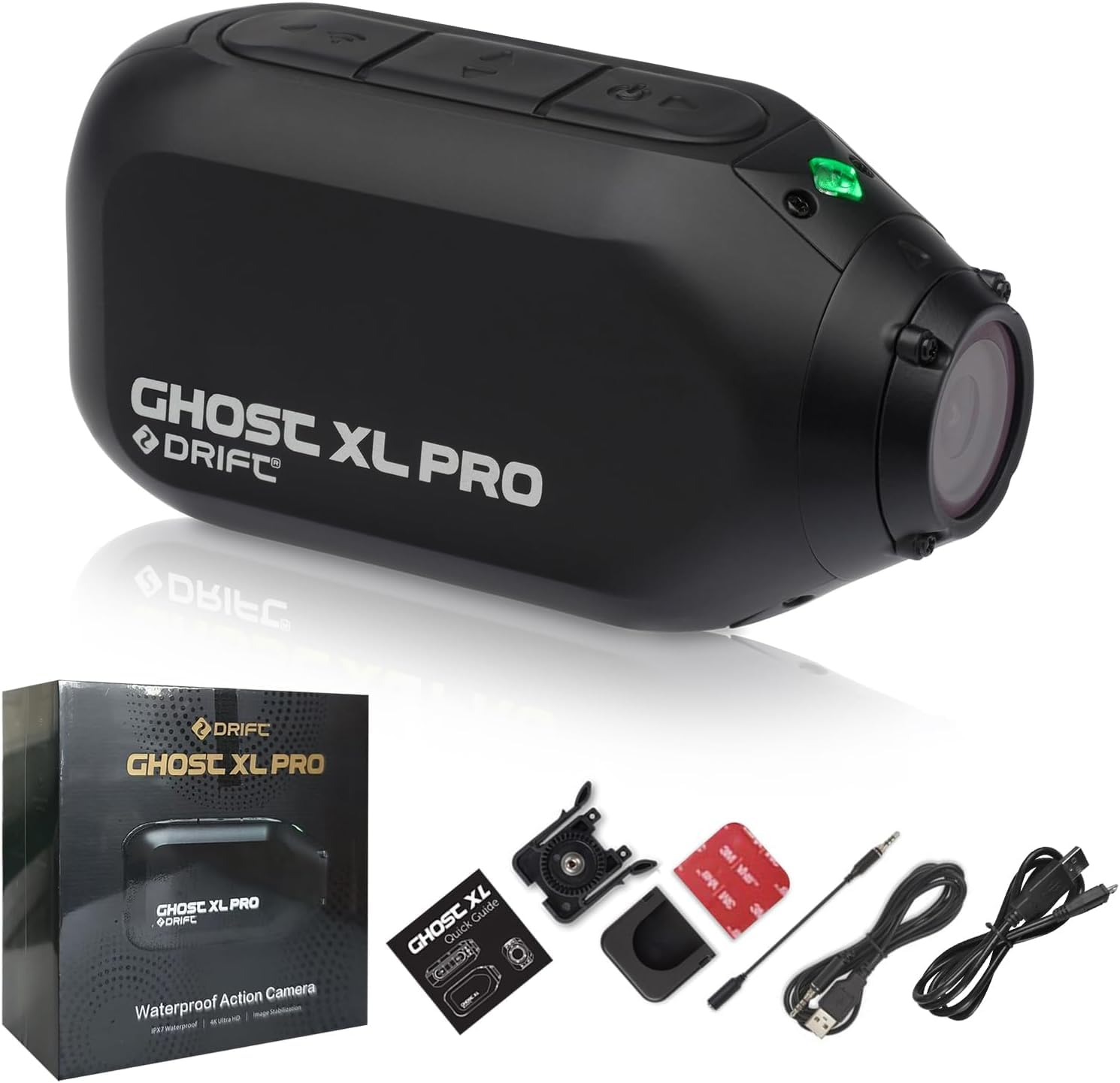
The marathon runner — a bullet-shaped camera that outlasts your whole fuel tank
The Drift Ghost XL Pro attacks the one spec every touring rider obsesses over: battery life, up to 7 hours at 1080P and 4.5 hours at 4K. That outlasts every other camera in this guide and means it’ll survive a full day of adventure riding without a charge. Its unique 300° rotating lens lets you mount it low on the helmet or crash bar while keeping the footage perfectly level — a huge advantage for aerodynamic mounting.
The Dash Cam Mode with loop recording is a genuine safety feature, continuously capturing for insurance claims and accident evidence. It’s IPX7 waterproof, so rain, mud, and wash-downs are all handled without an extra housing. Customers note the 4K quality is excellent in well-lit conditions and the large controls are easy to operate with gloves on.
The honest caveats are real, though. Reliability gets mixed feedback, with some reporting the unit shutting down instantly or failing over time, and battery life measured noticeably below the claim in one test (5.5 hours vs 7). There’s no viewfinder, no zoom, and the non-swappable battery means you can’t hot-swap on a long trip. It still earns its place for the rider who prioritizes all-day endurance above all else.
The endurance advantage
- Up to 7 hours at 1080P for full-day touring
- Loop recording protects you with evidence capture
- IPX7 means no housing needed for rain
- Rotating lens fits low-profile mounts perfectly
The risks
- Mixed reliability with some units failing early
- No viewfinder and no zoom
- Non-swappable battery limits ride-extension
Reach for this if: a multi-day tour and a single charge matter more than pixel-perfect color.
Think twice if: you need dependable evidence-capture every single ride — the mixed reliability reports argue for a proven action cam instead.
8. Insta360 Ace Pro 2 Dual Battery Bundle
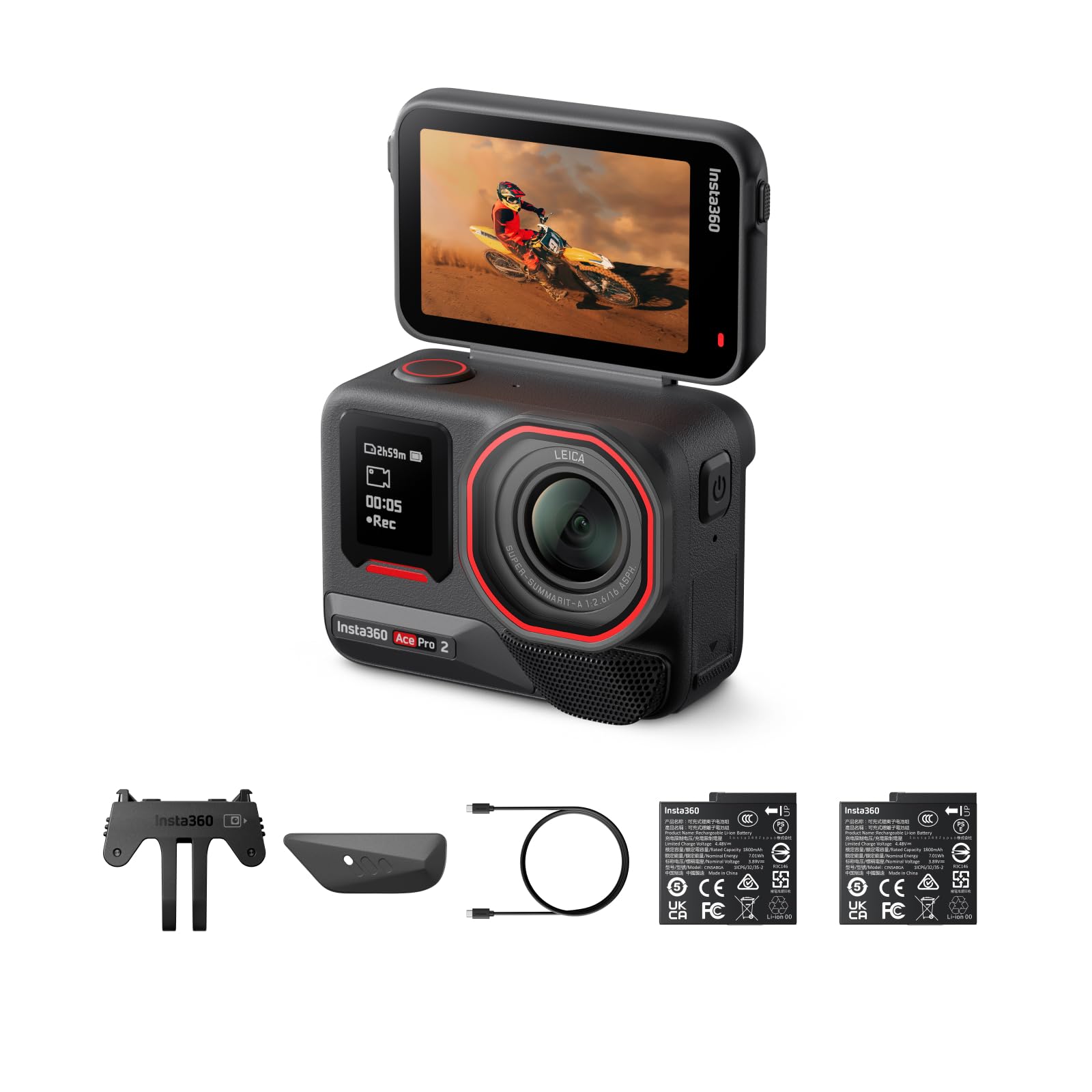
The low-light king, co-engineered with Leica, that makes night rides look like golden hour
The Ace Pro 2 is the most advanced camera here, combining a new 1/1.3-inch 8K sensor with a Leica Summarit lens and 13.5 stops of dynamic range — the engineering equivalent of seeing in the dark. It shoots 8K at 30fps or 4K at 60fps with Active HDR, and the dual AI chip delivers 100% more computing power than the previous model. The PureVideo Mode reduces noise and boosts brightness, so your evening ride footage stays crisp instead of murky.
The dedicated Wind Guard snaps over the mic to minimize wind noise at speed, a feature riders will immediately appreciate. FlowState Stabilization keeps shots rock-solid, and the 157° wide-angle lens with MegaView FOV captures everything around you. It’s waterproof to 39 feet (12 meters) and handles temperatures as cold as -4°F (-20°C), so it shrugs off both a downpour and a freeze. Buyers consistently report it delivers fantastic image quality, with several calling it better than GoPro and DJI in low light.
The honest trade-offs: reviewers point out it’s rugged and reliable at first, but a few note it dying after a month of use, and there’s no zoom due to its compact size. It also demands a fast V90 microSD card for the 8K bitrates. For the night rider or the serious content creator, though, this is the benchmark.
Why it leads
- 8K30fps video with Leica color science
- PureVideo Mode transforms low-light night rides
- Wind Guard cuts highway wind noise
- FlowState Stabilization is rock-solid
- Dual battery bundle keeps you recording
What you accept
- Mixed durability reports from a few owners
- No zoom, so framing is dictated by the lens
- Needs a fast V90 memory card for 8K
Best for: the night-riding enthusiast and serious creator who demands the best low-light image on the market.
Not for: the budget-conscious commuter who just needs a simple witness cam.
9. Sena 50C Motorcycle Communication & Camera System

The all-in-one helmet upgrade that pairs your riding crew and records the ride
The Sena 50C is the choice for riders who want one device instead of three. It combines a full motorcycle communication headset — with sound by Harman Kardon premium speakers and microphone — with an integrated 4K camera. That means you get rider-to-rider intercom, phone calls, GPS directions, and video recording from a single helmet-mounted unit, with no dangling cables or separate camera mounts. It supports Mesh & Bluetooth intercom for group rides and voice commands in 8 languages.
Buyers praise the audio clarity as a standout feature, noting it’s superior to older headsets and that the camera works well as a dashcam backup. The camera records up to 9-minute videos depending on SD card size, and the companion app makes downloading footage simple. Voice-activated assistant access via “Hey Google” or “Hey Siri” keeps your hands on the bars.
The honest trade-offs: connectivity gets mixed feedback, with several owners reporting issues syncing to laptops and Wi-Fi, and battery life receives negative feedback — shoppers say the camera drains the battery heavily, with the unit auto-off at 20% and a typical ride lasting about 2 hours. It’s the priciest option here, but it replaces a comms unit AND a camera in one clean installation.
One-and-done install: the cleanest way to get both communication and recording without a second mount. The Harman Kardon audio is the best-sounding speaker system in this guide.
The compromise: the camera battery life is short, and the connectivity setup is finicky — plan for daily charging and a patient first setup session.
Understanding the Specs
Stabilization (EIS vs Horizon Lock)
Electronic Image Stabilization (EIS) uses software to counteract shakiness. It’s essential for a helmet cam because your head moves constantly. Basic EIS smooths jitters; advanced systems like DJI’s HorizonSteady or AKASO’s Horizon Lock keep the horizon level even when you lean hard into a corner. For riders, this is the difference between a watchable clip and a seasick-inducing one.
Sensor Size and Low-Light Performance
Bigger sensors capture more light. A 1/1.3-inch sensor — found in the DJI and Insta360 — generally means better low-light footage than smaller sensors. This matters at dusk and dawn or when riding through tunnels, where cheaper cams turn grainy. If night riding is your routine, prioritize sensor size over sheer megapixel count.
FAQ
How do I mount a camera to my motorcycle helmet safely?
Is it legal to record while riding a motorcycle?
How long does the battery last on a helmet camera?
Can I use a 360 camera on my motorcycle helmet?
Is a dedicated action camera better than a comms unit with a camera?
Why does my helmet camera footage look shaky?
How do I reduce wind noise on my motorcycle camera?
What memory card speed do I need for 4K or 8K video?
Final Thoughts: The Verdict
For most riders, the top pick is the DJI Osmo Action 5 Pro because it delivers the best balance of stabilization, low-light quality, and battery life. If you want the absolute best night footage and don’t mind a premium price, grab the Insta360 Ace Pro 2. And for a clean single-device setup with excellent audio, the Sena 50C is the one to reach for.
How We Picked
We do not accept paid placement. Every pick is matched to a real buyer and a real use-case; we do not hands-on test units.
Sources & Methodology
Specifications: manufacturer listings and product documentation. Review insights: verified customer reviews, as of August 2026. Pricing: not shown on this page (it changes often); check the current price via the retailer link.
As an Amazon Associate, Gadgets Feed earns from qualifying purchases. This does not affect which products we feature.