
Our readers keep the lights on and my morning glass full of iced black tea. As an Amazon Associate, I earn from qualifying purchases.
Specs are compiled from manufacturer listings and verified buyer reviews and can change over time — please confirm the key details on the product page before buying.
You want restaurant-style deli slices at home without spending restaurant equipment money. The real question isn’t which slicer looks best on the counter — it’s which one actually cuts evenly, cleans up without a fight, and doesn’t stall mid-roast. This guide breaks down the budget tier by the specs that matter: blade size, motor wattage, and how thick you can actually dial it in.
I’m Min — the founder and writer behind Gadgets Feed. This guide is built by comparing the manufacturers’ published specifications and the patterns across verified customer reviews, so you get each pick’s real strengths and trade-offs instead of marketing spin.
We’ve matched six machines against the three specs that decide daily usability — blade reach, cutting power, and weight — and the crowd favorite holds a 4.4-star score across hundreds of owners: budget meat slicer.
Our Picks at a Glance
How To Choose The Best Budget Meat Slicer
Budget slicers all spin a round blade past a sliding carriage, but the differences in blade size and motor power change what you can actually feed it. Match the machine to the foods you slice most — a 6.7-inch blade handles a standard roast, while a 7.5-inch blade clears wider cuts without repositioning.
Blade length sets your ceiling
A longer blade means you can slice wider items in one pass — think a full loaf of sourdough or a wide brisket flat. The 6.7-inch blades on the OSTBA and VEVOR models handle most home roasts, but the 7.5-inch blades on the Valley Sportsman, Nutrichef, and FOHERE clear bigger food without you flipping it mid-cut.
Motor wattage predicts stamina
More watts generally means the blade keeps spinning when you push a dense, semi-frozen roast against it. The 150W motors are fine for deli meat and cheese, while the 180W and 200W units power through firmer cuts with less bogging. Watch for duty-cycle limits — several budget machines need a rest after a few minutes of continuous slicing.
Weight and footprint decide where it lives
A slicer you have to dig out of a cabinet gets used less. The foldable OSTBA collapses to a compact 12.99″L x 4.31″W footprint and weighs just 4 pounds, while the full stainless FOHERE sits at 9.2 pounds and 16.33″L — noticeably more stable but a permanent counter resident. Suction feet are the real stability story; they stop the machine from walking across the counter mid-slice.
Quick Comparison
| Model | Best For | Blade Reach | Cutting Power | Carry Weight | Amazon |
|---|---|---|---|---|---|
| OSTBA Foldable★ Best Overall | Small kitchens & hot pot | 6.7 inches | 150W | 4 lb | Amazon |
| VEVOR 6.7″Top Performer | Semi-frozen roasts | 6.7 inches | 180W | 4.1 lb | Amazon |
| Valley Sportsman | Deli-thin precision | 7.5 inches | 180W | 18″ cube | Amazon |
| OSTBA SL-517 | Dishwasher-safe parts | 6.7 inches | 150W | 6.3 lb | Amazon |
| Nutrichef 200W | Bread & charcuterie | 7.5 inches | 200W | 13.9″ depth | Amazon |
| FOHERE 200W | Raw & cooked separation | 7.5 inches | 200W | 9.2 lb | Amazon |
In-Depth Reviews
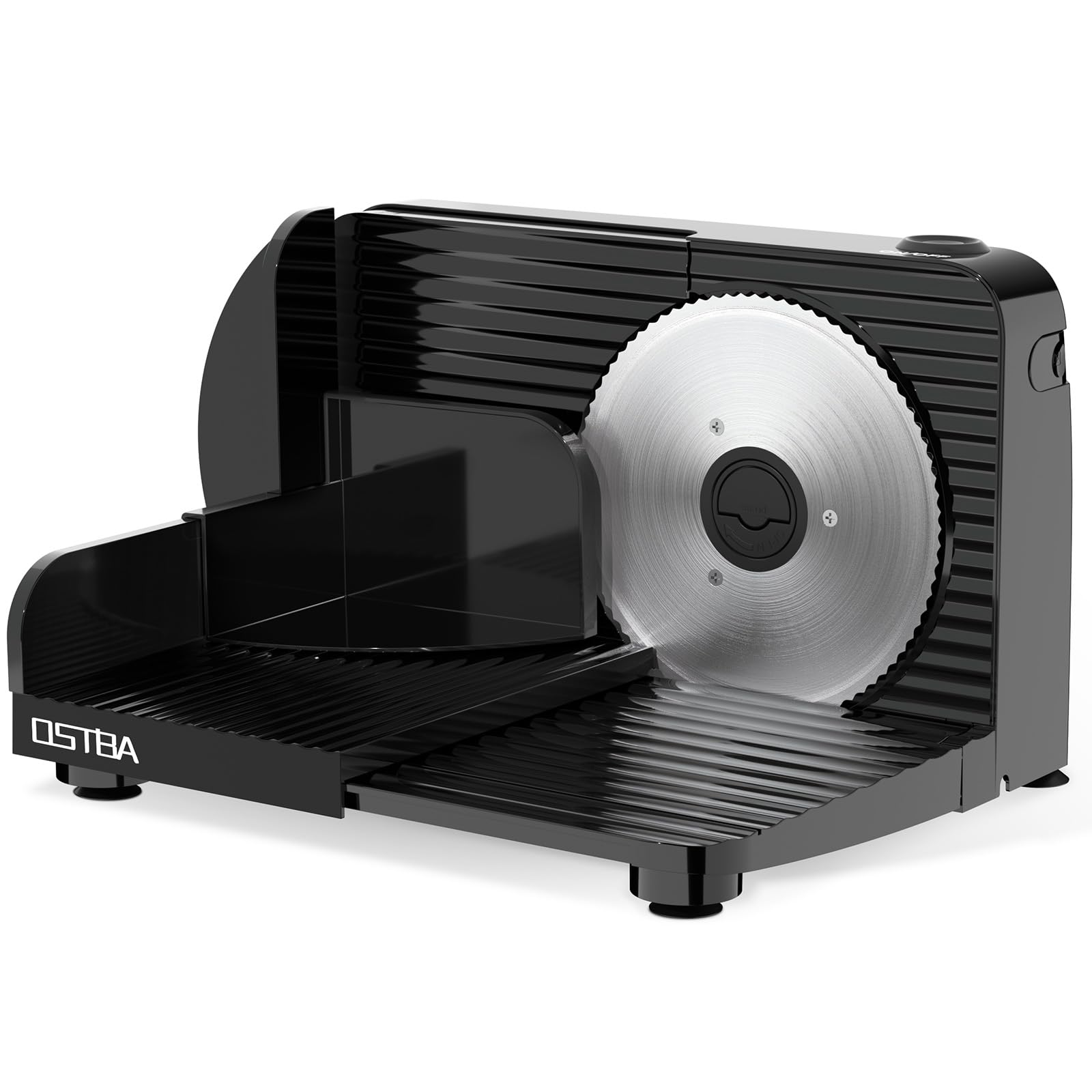
1. OSTBA Foldable Electric Food Slicer
Our pick — over 4★ from 50+ verified ratings; the strongest balance of quality and price.
The foldable wonder that disappears into a drawer yet still pulls restaurant-style hot pot slices.
This is the slicer for tight countertops and weekend hot pot sessions. It folds down to a compact 12.99″L x 4.31″W footprint, so it tucks into a cabinet or RV galley instead of owning the counter. Buyers report it makes “thin, restaurant-style slices from partially frozen beef or lamb with ease” — the exact texture hot pot demands.
The 150W motor runs quietly, which matters when you’re slicing a whole log of deli meat on a Sunday afternoon. The 6.7-inch serrated stainless blade handles meat, cheese, bread, and vegetables, and the thickness dial spans 0 to 15 mm. What wins people over is the foldable design — owners consistently single out how it collapses for storage.
Cleaning is genuinely simple: the blade, slicing platform, and food pusher all come off, and the stainless exterior wipes clean. The honest trade-off is that the body is lightweight plastic, and some owners note it feels fragile even while it cuts bread and unpeeled pineapple flawlessly. Durability gets mixed feedback, so treat it as a solid occasional-use machine, not a daily workhorse.
What wins people over
- Folds flat for storage in tiny kitchens
- Quiet 150W motor with even cuts
- Removable parts make cleanup quick
- Adjustable 0-15mm thickness dial
The honest trade-offs
- Light plastic body feels fragile
- Cleaning around the blade takes time
- Best for occasional, not daily, use
Reach for it if: you want a slicer that stores away flat and handles hot pot meats, bread, and cheese on demand.
Look elsewhere if: you plan to slice dense roasts every single day — the lightweight build isn’t built for that rhythm.
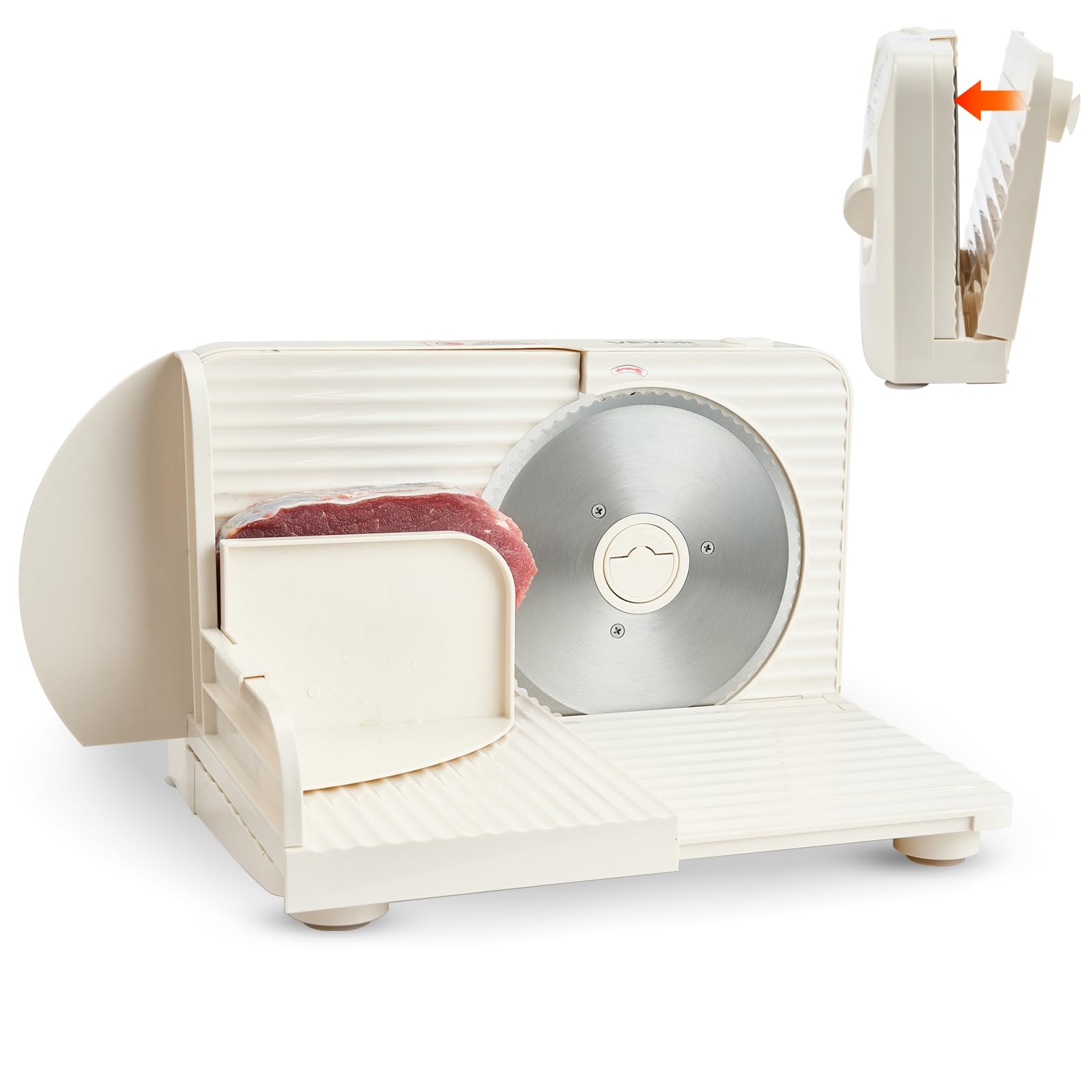
2. VEVOR 6.7″ Foldable Electric Cutter
The extra 30 watts that muscle through semi-frozen chuck roast without stalling.
Owners mention it “sliced semi frozen chuck roast and got fairly even slices,” the classic test that flattens weaker motors.
The 170mm (6.7-inch) stainless blade spins at 60-90 RPM, delivering smooth, even cuts without jamming. The thickness knob adjusts from 0 to 15mm (0.6 inches), so you can go from paper-thin deli work to thick steak cuts. It also folds flat or hangs for storage, with a security lock, rubber suction feet, and a full-guard food pusher for safe operation.
Here’s the honest rub: setup instructions are thin. Owners note you’ll need patience to figure out the folding side table and the slide mechanism. One buyer called it “kinda flimsy” and noted the motor bogs down on tougher slices, while another flagged that cleaning is genuinely difficult. The 4.1-pound build is light enough to store anywhere, but that lightness is also why it’s not a commercial-grade unit.
Power-per-dollar: the 180W motor outmuscles the 150W OSTBA for semi-frozen cuts at a sliver more weight — 4.1 lb vs 4 lb.
Know before buying: budget for a learning curve on assembly and a brush for the hard-to-reach crevices.
3. Valley Sportsman Deli Slicer 7.5″

The 7.5-inch blade that slices deli meat flawlessly — and the slice gauge is spot on.
If precision deli cuts are your goal, the extra reach matters. This machine’s 7.5-inch stainless serrated blade is 12% longer than the 6.7-inch blades on the OSTBA and VEVOR, so wider roasts and full loaves clear in a single pass. Customers note it “sliced deli meat flawlessly” with a gauge that’s “spot on” — and it handles bread just as well.
The 180W motor delivers fast, efficient slicing, and the wheel-and-rod slider design is a genuine upgrade over rod-only carriages that wobble. Owners who have owned multiple slicers over the years call this the best value on Amazon for the construction quality. Cleaning is straightforward — the blade, food carriage, and pusher all remove for a thorough wash, and rubberized feet keep it stable.
The catch is heat management. The review pages note it “heats up in about 10 minutes time and needs to be let rest” during heavy sessions, and blade durability gets mixed feedback. One owner skipped the machine entirely, but the consensus from most is that for home deli work, this is a sharp, accurate cutter that demands respect for its blade — it is extremely sharp.
Why it earns its spot
- Longest blade reach in this tier at 7.5 inches
- Stable wheel-and-rod slider design
- Removable parts for hygienic cleaning
- ETL, CE, GS & EMC certified safety
Watch for
- Needs a rest after ~10 minutes of continuous cutting
- Blade durability is a mixed note in reviews
- Treat the blade wheel with serious care
Pick this for: accurate deli-thin cuts on wide roasts and loaves, where blade reach beats motor brawn.
Think twice if: you routinely slice large batches — the 10-minute heat limit will pace you.
4. OSTBA SL-517 Electric Deli Slicer

The metal-bodied slicer whose blade and pusher actually survive the dishwasher rack.
Most budget slicers force you to hand-wash everything, but this OSTBA takes a different path: the blade and food pusher are dishwasher-safe. That single feature is why slice quality and value for money lead the owner feedback — you get clean, consistent cuts and don’t dread the aftermath.
The 150W motor drives a serrated 6.7-inch stainless blade, and the dial adjusts from 0 to 15mm for everything from cold cuts to bread and fruit. At 6.3 pounds, it’s noticeably heavier than the foldable OSTBA (4 lb) or the VEVOR (4.1 lb), which translates to a more solid feel while the non-slip suction feet hold it in place. The food pusher doubles as a blade guard, keeping fingers away from the spin.
Be realistic about the duty cycle: one owner sliced a 6-pound roast in two sessions because the machine “can only run for 5 minutes then needs 15 minute rest.” Ultra-thin slices are a struggle — the thickness dial has a mixed reputation here, with some unable to get reasonably thin slices. And despite the dishwasher-safe claim, food does creep into unreachable crevices, so a brush helps.
easy cleanup: blade and pusher ride the dishwasher rack — a rarity at this price, and the reason owners call it easy to maintain.
Pacing required: plan for 5-minute runs with rests between; this is batch-friendly, not marathon-friendly.
5. Nutrichef 200W Electric Meat Slicer

The 200W workhorse that turns a sourdough boule into perfect toast-ready slices.
This Nutrichef is the bread champion of the budget tier. Owners consistently praise it as a sourdough bread slicer, cutting crisp crusts without crushing the crumb — a task that wrecks weaker machines. The 200W motor and 7.5-inch tooth blade give it the speed and reach for charcuterie boards, deli meat, and vegetables alike.
The thickness dial spans 0 to 15mm, going from wafer-thin to thick steak cuts. The blade removes tool-free, and the detachable carriage simplifies cleaning. Strong suction feet hold it steady — though the review pages note you’ll still want a hand on it during heavy passes. The plastic body is lightweight, and one owner found it impressively sturdy despite the budget build.
Functionality is the most-praised aspect here, and value for money runs close behind. The realistic limits: the plastic pusher has durability concerns, the small platform handles salami and pepperoni more comfortably than huge roasts, and it needs a 30-minute cool-down per 10 minutes of use. Hand-wash only — don’t assume anything here is dishwasher-safe.
Where it shines
- 200W motor powers through crusty bread
- Tool-free blade removal for easy swaps
- 0-15mm dial from shaved to thick
- Lightweight and compact at 13.9″ depth
Realistic limits
- Plastic pusher can break under stress
- 30-min rest per 10-min slicing session
- Hand-wash only
Strongest for: bread lovers and charcuterie hosts who want consistent 200W power across many food types.
Not for: marathon slicing of whole roasts — the cool-down rule will stop you mid-project.
6. FOHERE 200W Meat Slicer

Two 304 stainless blades keep raw and cooked foods on separate cutting edges.
This FOHERE is the only slicer in the group that ships with two blades: a serrated 7.5-inch edge for cooked foods and a smooth 7.5-inch edge for raw. That separation is a real hygiene win — you avoid cross-contamination between a cooked ham and a raw chicken breast without washing the blade mid-task. The 200W motor powers both, and reviewers point out slicing frozen meat for smoked jerky “with no trouble.”
The body is die-cast aluminum — rust-proof and heavier at 9.2 pounds, which makes it the most stable unit in this lineup. The thickness knob adjusts 0-15mm, and the food pusher doubles as a blade guard while non-slip suction feet keep it planted. At 16.33″L, it’s the largest footprint here, so plan for counter space. Slice quality and functionality are the top praised aspects.
The trade-off is that this is a home-tuned machine, not a pro unit. Owners note the slider can feel clunky, the food press detaches when you flip the slide, and there’s a 0.5-inch gap before the blade that lets narrow items fall through. Cleaning is mixed — only the slide handle and blade are washable, and the low-power motor feel means it favors patience over speed. Blades run slower deliberately for better cut quality and longer machine life.
Food-safety first: dedicated serrated and smooth blades stop raw-cooked cross-contamination — a feature no other budget pick offers.
Counter commitment: at 9.2 lb and 16.33″L, this one earns permanent counter space, not cabinet storage.
Understanding the Specs
Blade length (inches)
The blade diameter sets the widest item you can slice in one pass. A 6.7-inch blade handles most home roasts and standard loaves, while a 7.5-inch blade clears wider cuts — like a full brisket flat or a big sourdough boule — without you turning the food mid-cut. Bigger blade also means more surface contact per slice, which can help evenness on dense meat.
Motor power (watts)
Wattage predicts how well the blade keeps spinning under pressure. A 150W motor is fine for deli meat, cheese, and soft bread. A 180W or 200W motor holds speed better on semi-frozen roasts and crusty loaves. Every budget model here has a duty cycle — a recommended rest period after a few minutes of continuous cutting — so plan for pauses on big batches.
FAQ
How do I get thin, deli-style slices instead of thick chunks?
Can a budget meat slicer handle semi-frozen meat?
Which parts can go in the dishwasher?
Why does my slicer stop or slow down mid-roast?
Is a foldable slicer less stable than a fixed one?
Can one slicer handle meat, bread, and cheese?
How do I clean a meat slicer safely without cutting myself?
What’s the real difference between 6.7-inch and 7.5-inch blades?
Final Thoughts: The Verdict
Across the board, the budget meat slicer winner is the OSTBA Foldable because it delivers the best blend of storage-friendly design, quiet 150W cutting, and easy cleanup at a value that’s tough to top. If you want the 7.5-inch reach for wide roasts and precision deli cuts, grab the Valley Sportsman. And for separating raw from cooked foods with two dedicated blades, the FOHERE is the one to reach for.
How We Picked
We do not accept paid placement. Every pick is matched to a real buyer and a real use-case; we do not hands-on test units.
Sources & Methodology
Specifications: manufacturer listings and product documentation. Review insights: verified customer reviews, as of August 2026. Pricing: not shown on this page (it changes often); check the current price via the retailer link.
As an Amazon Associate, Gadgets Feed earns from qualifying purchases. This does not affect which products we feature.