
Our readers keep the lights on and my morning glass full of iced black tea. As an Amazon Associate, I earn from qualifying purchases.
Specs are compiled from manufacturer listings and verified buyer reviews and can change over time — please confirm the key details on the product page before buying.
If you are shopping for a 120 lb cover cardstock, you have already learned the hard way that flimsy 65 lb paper makes a card base that flops over. At 120 lb cover, the paper is thick enough to stand upright on its own, hold a folded card’s shape, and survive a trip through the mail without bending. This guide compares two genuinely heavyweight 120 lb cover stocks so you can pick the one that matches your printer and your project.
I’m Min — the founder and writer behind Gadgets Feed. This guide is built by comparing the manufacturers’ published specifications and the patterns across verified customer reviews, so you get each pick’s real strengths and trade-offs instead of marketing spin.
Both picks here are real 120 lb cover stock, but the 120 lb cardstock that works for you depends on whether your printer can feed a sheet this thick in the first place.
Our Picks at a Glance
How To Choose The Best 120 Lb Cardstock
Choosing a 120 lb cover cardstock starts with one question: will your printer feed it? Both of these picks are authentically thick, and several buyers report that a standard inkjet simply cannot pull the sheet through. Check your printer’s stated maximum paper weight before you commit.
Understand the “cover” label
A 120 lb cover cardstock is not the same as a 120 lb text paper. The “cover” designation signals a much heavier, stiffer sheet that is built for card bases, postcards, and presentation fronts. At this weight, the paper holds its shape on its own and resists bending in the mail.
Match the size to the project
Letter-size 8.5″ x 11″ sheets give you maximum versatility for cutting and folding your own cards, signs, and covers. A smaller 5″ x 8″ sheet is an ideal blank for index cards, flash cards, and A7-style invitations without any cutting required. Think about what you will actually make before choosing a size.
Quick Comparison
In‑Depth Reviews
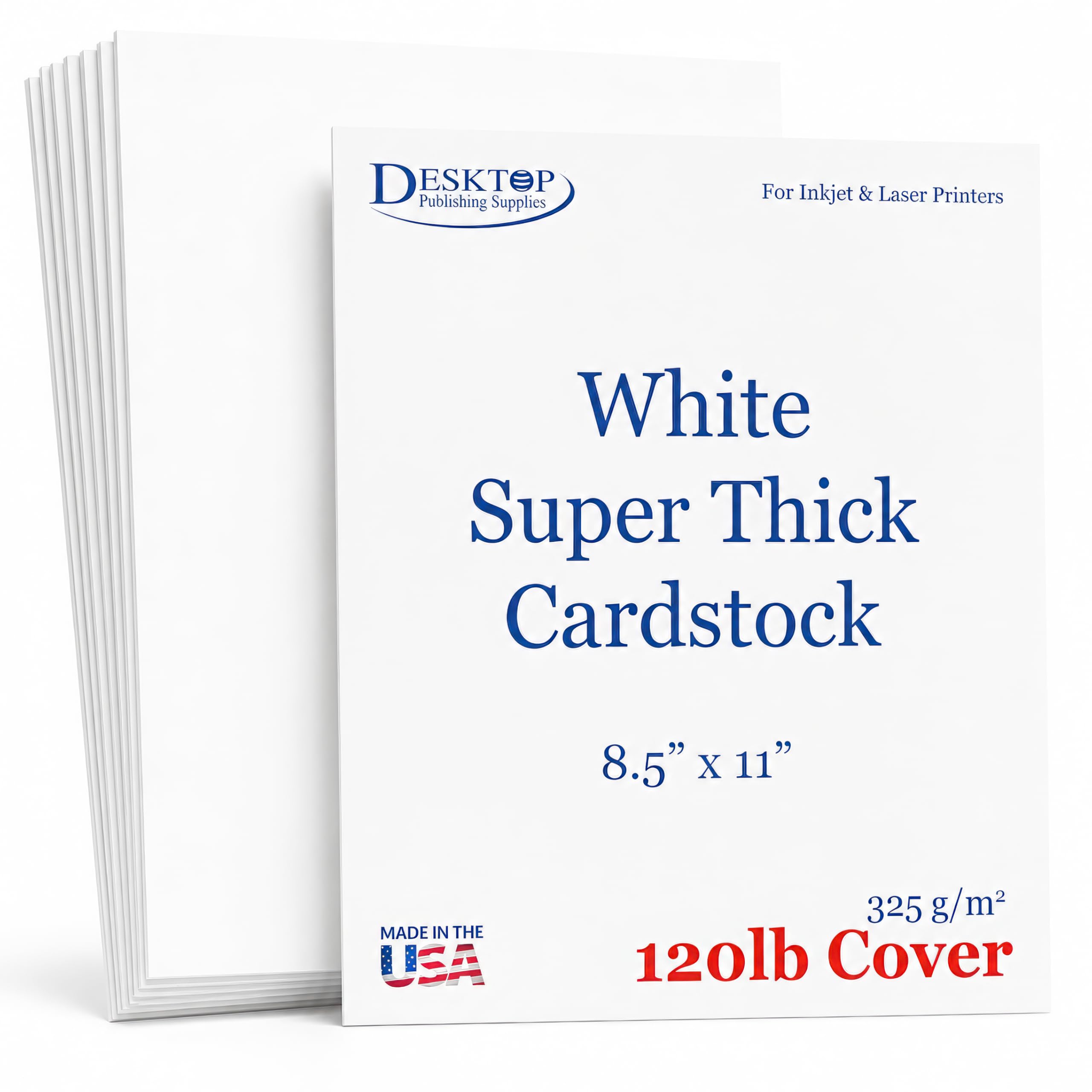
1. Desktop Publishing Supplies White Cardstock
The letter-size heavyweight that folds cleanly when you score it first
This 120 lb Cover (325 gsm) cardstock is the crowd favorite for a simple reason: its smooth matte finish takes ink beautifully, and owners say “ink blends well on it” for card bases. The bright white surface produces crisp text and vibrant graphics, which is exactly what you want for invitations, business cards, and presentation covers. At 325 gsm it is noticeably sturdier than the Hamilco’s 324 gsm, and that extra rigidity shows in a finished card that stands tall on its own.
The real strength here is versatility at letter size. At 8.5″ x 11″, you can cut, fold, and format this stock for nearly any project — certificates, signs, postcards, or layered paper crafts. Owners have used it for custom playing card prototypes, laser engraving, and even MTG-style proxy cards, gluing two layers together for a solid final result. The quality is the most-praised trait, with thickness close behind, and it holds up well to what owners call “artistic abuse.”
Before you buy, know the catch: the listing itself warns this ultra-thick stock “requires a printer that supports heavy media and may not work with many home printers.” One owner could not use it at all in an Epson inkjet, and another noted the thin cellophane packaging can leave a dented corner on the stack—a packaging quibble, not a paper flaw. Score your fold lines first and it creases cleanly without cracking.
What Owners Rave About
- Quality is the top-praised aspect — 46 owners call it out, with thickness a close second at 42.
- True bright white that folds well when you score first, per repeat buyers.
- Manufactured in the USA by a family-owned company with over 30 years in the business.
What To Know First
- Many home inkjets physically cannot feed a 325 gsm sheet this thick.
- Thin packaging means an occasional stack arrives with a dented corner.
Reach for these sheets if: you want one letter-size cardstock that handles invitations, signs, and craft projects all in a single 100-sheet ream.
Look elsewhere if: your printer’s max paper weight is below 120 lb cover — check that spec before you order.
2. Hamilco Blank Index Cards 5″ x 8″

Pre-cut 5″ x 8″ blanks built for flash cards and A7 invitations
This 120 lb Cover (324 gsm) stock skips the cutting entirely — every sheet arrives at a ready-to-use 5″ x 8″, the perfect blank for flash cards, index cards, and A7-style invitations. The acid-free cardstock carries a 96 brightness rating, which owners say makes prints look vibrant and professional. The heavy weight is the second most-praised trait here, and the texture draws its own share of compliments.
Instead of trimming down an 8.5″ x 11″ sheet and losing paper to the cut, you get a finished card size with zero waste. Owners have put these through spray stain, mica stain, heat embossing, and die-cut machines, and the sheet holds up through all of it. Marker and highlighter do not bleed through either, which makes this an outstanding choice for study flash cards and vision boards.
The warning label is blunt: “At 120lb, many inkjets do not have the capability.” So printer compatibility is the one genuine hurdle—reviews are mixed, with some machines handling it fine and others simply refusing. Another owner called it “a bit pricey” for what you get, though the sturdy cardboard box storage was repeatedly praised. That protective box is the difference-maker versus the Desktop Publishing Supplies pick, which ships in thin cellophane.
Print-quality edge: The 96 brightness rating makes colors pop more than the letter-size pick’s unrated surface, so this is the one to grab when vivid print color is the goal.
The one hurdle: Verify your printer’s max paper weight first — inkjet owners mention this sheet is simply too thick for many home machines.
Who this wins over: flash-card makers and A7 invitation senders who want a finished card size with no cutting and no bleed-through.
Who should skip it: anyone needing letter-size coverage — this pre-cut 5″ x 8″ blank cannot be widened.
Understanding the Specs
What 120 lb Cover Actually Means
The “cover” label tells you this is a stiff, board-like sheet, not a flimsy writing paper. In grams per square meter, it lands around 325 gsm — heavy enough to stand upright on its own and resist bending in the mail. A standard 120 lb text paper is far lighter and would flop over as a card base.
Printer Paper Weight Limits
Most home inkjets top out far below a 120 lb cover sheet, which is why customers note their printers refusing to pull the cardstock through. Before you buy, look up your printer’s maximum paper weight — if it cannot handle heavy media, you will need a laser printer, a professional print shop, or a lighter cardstock.
FAQ
Will 120 lb cardstock fit in my home printer?
What is the difference between 120 lb text and 120 lb cover?
Do I need to score 120 lb cardstock before folding?
Which size is better for A7 invitations?
Can I use 120 lb cardstock with a die-cut machine?
Is 120 lb cardstock acid free?
Will markers or highlighters bleed through 120 lb cardstock?
How is 120 lb cardstock usually packaged?
Final Thoughts: The Verdict
For the majority of shoppers, the right 120 lb cardstock depends on project size. Grab the Desktop Publishing Supplies 120lb Cover if you want one versatile letter-size ream for invitations, signs, and craft projects all at once. Reach for the Hamilco Blank Index Cards if you want ready-to-use 5″ x 8″ blanks for flash cards and A7 cards, with the stronger 96 brightness and sturdier packaging. Either way, verify your printer’s maximum paper weight first—both of these sheets are thick enough to reject an unprepared machine.
How We Picked
We do not accept paid placement. Every pick is matched to a real buyer and a real use-case; we do not hands-on test units.
Sources & Methodology
Specifications: manufacturer listings and product documentation. Review insights: verified customer reviews, as of August 2026. Pricing: not shown on this page (it changes often); check the current price via the retailer link.
As an Amazon Associate, Gadgets Feed earns from qualifying purchases. This does not affect which products we feature.