
Our readers keep the lights on and my morning glass full of iced black tea. As an Amazon Associate, I earn from qualifying purchases.
Specs are compiled from manufacturer listings and verified buyer reviews and can change over time — please confirm the key details on the product page before buying.
Boiling inside a parked van on a summer night is the fastest way to kill a road trip. A 12V DC air conditioner runs straight off your house battery bank, skipping the power-hungry inverter that makes most rooftop units impractical off-grid. This guide breaks down the best 12V units for vans, RVs, and trucks, weighing real cooling power, amp draw, and installation effort so you can sleep without listening to a generator.
I’m Min — the founder and writer behind Gadgets Feed. This guide is built by comparing the manufacturers’ published specifications and the patterns across verified customer reviews, so you get each pick’s real strengths and trade-offs instead of marketing spin.
Before we dive in, a quick note: this list uses flexible matching for 12V DC power source, so not every pick is the exact number searched; the nearest same-type size/watt serves the same purpose. The right ac unit for van depends on your battery capacity, roof space, and if you need heating, so we cover the standout options across every style.
Our Picks at a Glance


How To Choose The Best AC Unit For Van
Picking a van AC is a balance of three things: how much power it pulls from your batteries, how much space it needs to install, and how much heat it can actually conquer. A high-BTU unit is useless if it drains your battery bank in two hours, so match power draw to your battery capacity first.
Match BTU to your van’s size and insulation
BTU (British Thermal Units) measures cooling power. A 10,000 BTU unit handles a well-insulated van or small camper, while a 15,000 BTU unit is for larger trailers and less insulated builds. Insulation is key: a well-sealed van needs far less cooling power than a bare metal shell in direct sun.
Know your battery bank’s real capacity
12V DC units draw serious current — most pull between 30 and 60 amps at full blast. That means a 100Ah battery gives you roughly two hours of max cooling, but far longer in eco mode. Buyers report that a 400Ah battery bank is the balance for all-night use, while 280Ah gets you through most evenings if you’re conservative with settings.
Pick the right install style for your build
Rooftop units need a 14×14 inch cutout and are the classic RV choice. Under-dash mini-splits keep your roof clean but require mounting a compressor somewhere outside the cabin. Split systems with an indoor unit and separate outdoor compressor offer the most flexibility for weird builds like trucks and excavators.
Quick Comparison
| Model | Best For | Cooling Power | Style | Weight | Amazon |
|---|---|---|---|---|---|
| OutEquipPro 12V AC★ Best Overall | Off-Grid Van Life | 10,000 BTU | Rooftop | 43 lbs | Amazon |
| UAHKPA Split ACBudget Champion | Budget Truck Cooling | 9,000 BTU | Split-system | 23.6 kg | Amazon |
| Universal Under Dash KitBest Value | Cars & Small Trucks | 10,000 BTU | Portable | 20 kg | Amazon |
| Aspligo Under Dash Kit | Heat & Cool Combo | 10,000 BTU | Split System | 54 lbs | Amazon |
| Treeligo Mini Split | Rapid Airflow | 12,000 BTU | Mini Split | — | Amazon |
| Gidrox Rooftop AC | Energy Efficiency | 10,000 BTU | Rooftop | 59 lbs | Amazon |
| Dometic FreshJet 3 | Quiet RV Replacement | 13,500 BTU | Rooftop | 64 lbs | Amazon |
| OutEquipPro AC w/ Heater | Year-Round Comfort | 10,000 BTU | Rooftop | 43 lbs | Amazon |
| OutEquip Black Housing | Sleek Black Build | 10,000 BTU | Rooftop | 45 lbs | Amazon |
| Dometic FreshJet 15K | Big Trailer Cooling | 15,000 BTU | Rooftop | 64 lbs | Amazon |
| TOSOT GoCool | Heat Pump Power | 16,000 BTU | Rooftop | — | Amazon |
In‑Depth Reviews
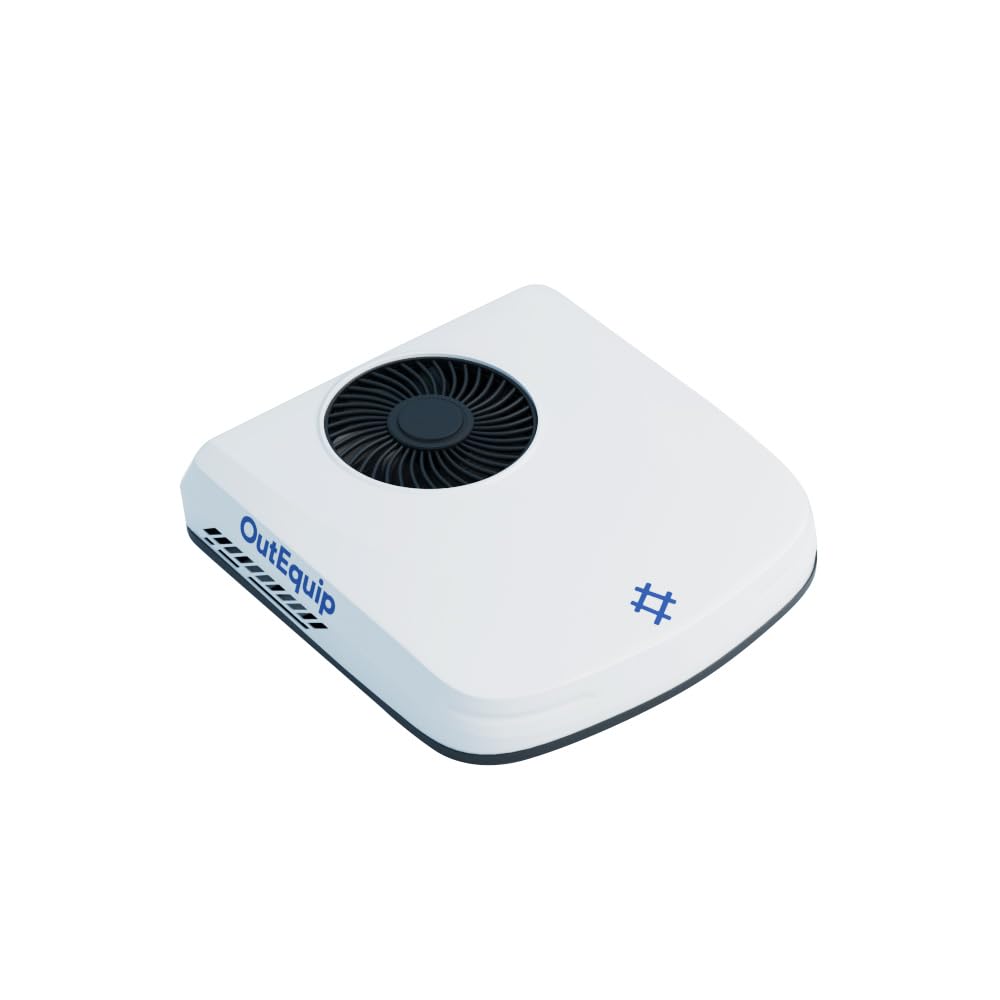
1. OutEquipPro 12V Rooftop AC
Our pick — over 4.5★ from 80+ verified ratings; the strongest balance of quality and price.
The off-grid powerhouse that cools a sweltering van in 15 minutes flat.
This rooftop unit delivers 10,000 BTU of cooling power that owners mention drops the interior to a comfortable 55 degrees even in brutal Texas heat. It’s designed to run directly off your 12V electrical system, giving you roughly 8 hours of cooling with a 480Ah power source and 10 hours with a 600Ah bank when parked. That means you can sleep through the night without shore power or a generator.
Its 43-lb build and quiet operation win buyers over. It’s light at 43 lbs, so a solo installer can manage it without a roof modification crew, and customers note a clean 2-day install. The brushless copper motor fans and spring-supported mounts keep things quiet, while the UV-stabilized ABS shell and EPDM foam gasket shrug off harsh weather. Reviewers point out it draws about 50 amps at startup, then settles to around 30 amps while maintaining temperature.
Smart controls come standard — a remote, temperature monitoring, and eco, sleep, and turbo modes let you dial in exactly how much power you burn. The one thing to know: shoppers say the fan is audible but quiet, and you’ll want to seal the condenser properly to prevent leaks. The 960-watt annual energy consumption here is 60% higher than the smaller under-dash kit, but that’s the trade-off for serious rooftop cooling power.
Why it sells itself
- Cools in 15 minutes with real 10,000 BTU punch
- 43 lbs is light enough for solo rooftop install
- Eco mode sips power — buyers praise the low draw
What to plan for
- Draws ~50A at startup, drops to ~30A maintaining
- Fix the 14×14 cutout and seal the condenser well
The call: Reach for this if you want proven off-grid cooling with a 400Ah+ battery bank and don’t mind a weekend install.
The honest limit: It’s a cooling-only unit, so winter campers will want the heater-equipped sibling.
2. UAHKPA 9000 BTU Split AC
A cheap 9,000 BTU split unit for tinkerers who love a project.
This split-system unit brings 9,000 BTU of cooling for a fraction of the price of premium options, making it an appealing entry point for budget builds. The design is flexible — it’s marketed for camping vehicles, trucks, excavators, and vans, so it fits weird spaces a rooftop unit can’t. The scroll compressor and R134a refrigerant (600g charge) deliver solid cold air, and the 5-gear wind speed gives you fine control over airflow.
The experience is the catch: high energy use and flaky build quality. Buyers report high energy use around 850W average, and the build quality draws the most negative feedback. One owner’s verdict is blunt: “It worked for one month only.” The Chinese-labeled controls and thin drain hose need work, and the power wires are undersized for the 75A starting current — you’ll want to run 2-gauge wire to be safe. The indoor temp sensor sits poorly placed, causing the compressor to cycle rapidly unless you extend it.
Set against the competition: it delivers 9,000 BTU versus the Universal kit’s 10,000 BTU — an 11% gap — while being heavier at 23.6 kg versus 20 kg. Buyers who got a good unit love the cold output and low noise, but it’s a gamble. A couple of verified owners had units that arrived dead or died within a month, and returns to the manufacturer are reportedly painful.
The honest read: This is a DIY project for someone who enjoys troubleshooting. The cooling is real when it works, but the reliability record and build quality keep it firmly in budget-tier territory.
Best for: Budget builders with mechanical confidence who can rewire and re-sensor a unit before trusting it.
skip it if: You want a plug-and-play experience — the reviews make clear this one demands patience.
3. Universal 12V Under Dash AC Kit
An under-dash kit that adds winter warmth to summer cooling.
This under-dash kit stands out because it offers both cooling and heating in one package. The 10,000 BTU cooling capacity handles summer, while the water heating system warms the tank by heating engine coolant — the blower pushes that warm air into the cabin. The seller’s fuel-savings claim is marketing, not a guarantee.
It sips power compared to rooftop units — rated power is 550-600W with a 40-60A draw, and the annual energy consumption is 600 watts. That’s a dramatic difference from the OutEquipPro’s 960 watts, which makes this kit far friendlier to smaller battery banks. The integrated receiver dryer and condenser design helps reduce leakage points, which is a genuine engineering improvement. It weighs 20 kg, making it 18% lighter than the UAHKPA split unit.
Installation is the downside: poorly written instructions and inconsistent QC. The instructions are poorly written — one buyer’s review is literally just “Can’t wire.” Another unit worked for an hour before the compressor stopped. The quality control is inconsistent: wrong hose fittings, incorrect wiring, and a broken evaporator temp regulator all appear in the reviews. Buyers who got a good unit report strong airflow and genuinely cold air, but it’s a lottery.
Mixed verdict: The heating-plus-cooling versatility and low 600W draw are real attractions, but the spotty QC and confusing install make this best for someone who can wire their own kit.
Choose this if: You have electrical expertise and want heat and cool from a single under-dash unit.
Look elsewhere if: You want reliability without a fight — the reviews show a wide quality gap between units.
4. Aspligo 10000 BTU Under Dash Kit
The novice-friendly under-dash kit with a smart battery-saving brain.
This under-dash split system uses a 20CC electric scroll compressor for faster, stronger cooling than standard rotary units. The 10,000 BTU output handles a car or small van cabin with room to spare, and the heating function (via engine coolant) keeps you warm in winter. It’s rated at 550-600W with a 40-60A draw, matching the Universal kit’s efficiency profile.
What sets this apart is the low voltage protection — it prevents excessive power consumption and stops the compressor from starting when the battery is too low. Buyers praise this for protecting their battery bank, and it allows the device to start smoothly without stressing the power source. The install is genuinely doable for a first-timer: owners mention a novice can complete it, with the main challenge being compressor and condenser mounting in a tight engine bay. The compressor comes pre-oiled with about 20 oz, saving you a messy step.
It weighs 54 lbs, so it’s not light, but the split-system design means the heavy parts live outside the cabin. The instructions are basic — buyers describe them as easy for experienced mechanics only — but the responsive customer service answers within 24 hours. One reviewer fit it in a 2005 Savana skoolie without drama, praising it as a bargain versus name-brand alternatives.
The case for it: The battery-protecting low voltage cutoff is a smart safety feature, and the pre-oiled compressor cuts install time. It’s a solid mid-range pick for heat-and-cool versatility.
Reach for this if: You’re a first-time installer who wants heat and cool with a safety net for your batteries.
Who it’s not for: Anyone without mechanical patience — the minimal instructions assume you can figure out mounting.
5. Treeligo 12000 BTU Mini Split
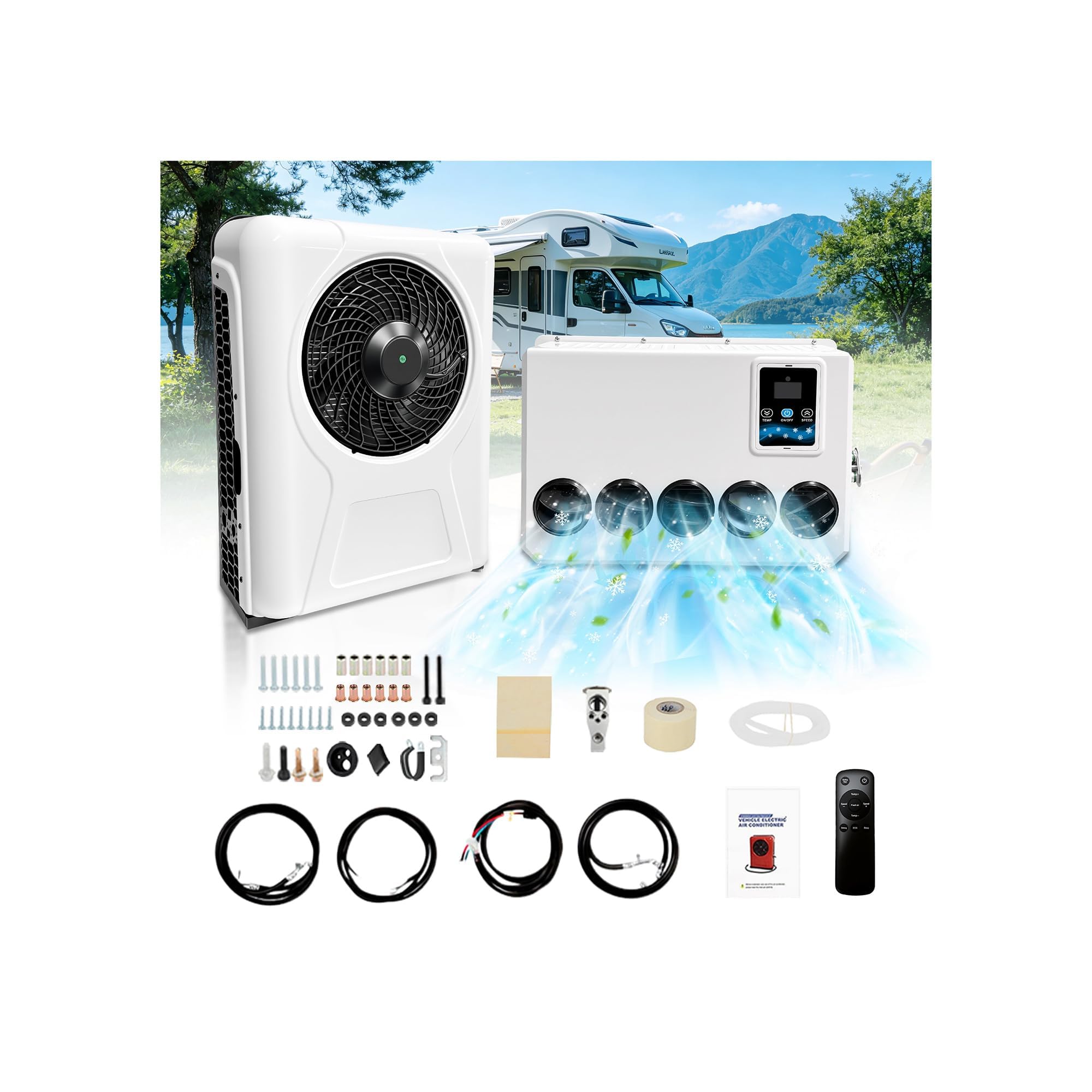
A 12,000 BTU mini split that blows out a truck cabin in minutes.
This mini split packs the biggest cooling punch in the mid-range tier at 12,000 BTU, with 350 CFM of airflow for rapid, uniform cooling. It’s tailored for 12V DC vehicle battery systems with a 960W rated power and steady 40-60A working current, so it runs long hours during parking without draining your bank. The split design keeps the cabin clean — the indoor unit measures just 17.95 x 6.22 x 12.6 inches — while the outdoor compressor lives outside.
Customers note it blows seriously cold, with one owner measuring 42-degree air off a simple deep-cycle battery. The 360° omnidirectional airflow design eliminates cooling dead corners, keeping the whole cabin balanced. The LCD control panel and smart remote give you dual control from anywhere in the vehicle, and the compressor is an inverter type, which helps with efficiency at partial load.
The trade-offs are quirks, not dealbreakers: right-side-only hoses and a Celsius-only display. The hoses exit on the right side only and are hard to reverse, so plan your mounting accordingly. The rubber grommet for the power wires is weak and needs reinforcing, and the display is Celsius-only. One reviewer noted an icing issue on the expansion valve in humid conditions. It’s stable, durable, and purpose-built for semi trucks, RVs, and vans alike.
The standout spec: 350 CFM of airflow is the highest in this lineup, meaning faster cooldown in big cabins. Owners call it “pretty amazing for a 12v AC unit” and say it runs you out of the truck with cold.
Best for: Semi truck and van owners who want maximum airflow and don’t mind a right-side-hose install.
The reminder: It runs on Celsius only and needs a reinforced power grommet — small jobs before you mount it.
6. Gidrox 10000 BTU Rooftop AC
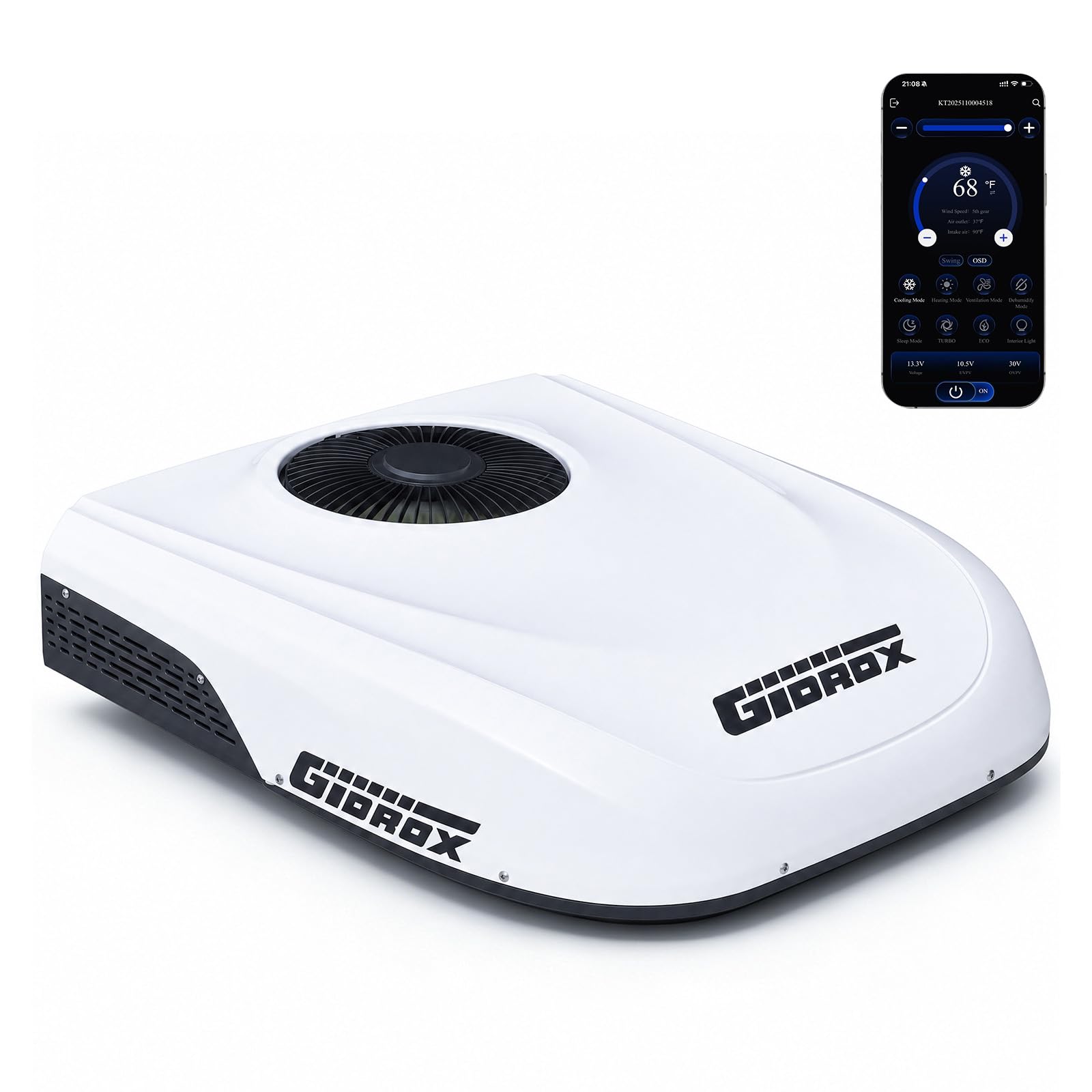
The rooftop unit that sips only 350W overnight in eco mode.
This rooftop unit uses inverter technology to cool your space rapidly within 3 minutes, then maintains a constant temperature with minimal power. The headline number is the tested average power consumption of about 350W during nighttime operation in 30°C ambient — roughly 60% less energy than traditional AC units. Paired with a 400Ah battery, reviewers point out it supports all-night use without stressing the bank.
It’s genuinely quiet, operating at a library-level 40dB in Sleep mode. The brushless fan and sound-insulation design make it disruptive to nothing. Three modes — Turbo, ECO, and Sleep — let you trade speed for silence or efficiency, and the three-way control (smartphone APP via Bluetooth, infrared remote, and physical buttons) is the most flexible in this lineup. You can set timers, switch between °C/°F, and let it auto-adjust power based on temperature difference.
The unit is 59 lbs and fits the standard 14×14 inch roof cutout, with a 19.7 ft power cable included. Shoppers say real-world draws of ~250W in dehumidifier mode, ~350W in eco, and 650-700W in turbo. The catch: eco mode is fixed at 79°F and there’s no battery cutoff voltage setting, so add a battery monitor. It’s a strong pick for vanlife where every amp counts.
The efficiency win: A measured ~350W night draw is the best energy story in this list — buyers running a 600Ah bank with solar report a full week of continuous use.
Choose this if: Energy efficiency is your top priority and you have a standard 14×14 roof cutout.
Plan for: The eco mode’s fixed temperature and wire routing through walls — an external cable trough is the fix owners recommend.
7. Dometic FreshJet 3 13.5K

Dometic’s lightest rooftop unit yet, built for fast airflow and easy swaps.
Dometic brings brand trust and a light 64 lbs weight to this 13,500 BTU rooftop unit. The FreshJet 3 Series delivers 13% higher cooling capacity and 15% more airflow than its predecessors, with a 4dB noise reduction for better sleep. The turbo airflow system moves an average of 350 cubic feet of cool air per minute, giving you faster cooldowns in hot weather.
The standout engineering is the e-coated evaporator coils — a flexible epoxy polymer coating that provides excellent corrosion resistance and durability. Dometic is the only RV industry brand using this design, and it protects the heat transfer coils from the elements. The unit is backwards compatible with existing non-ducted ADB control systems, so it’s a true plug-and-play replacement for older Dometic units. Buyers report swapping out a Brisk Air 2 in about 30-45 minutes.
It uses 28% less refrigerant than its predecessors — that’s the sustainable design working — and runs quieter than most OEM units. One buyer reports cooling an 80°F cabin to 64°F in 30-45 minutes. The big caveat is durability in shipping: owners mention units arriving damaged with cracked base plates, and the cooling performance gets mixed feedback depending on RV size. A couple of customers note the compressor wire burning out after a few months.
The name-brand pick: Dometic’s warranty and parts network give confidence the no-name units can’t match, and the 350 CFM airflow is class-leading. Just inspect the box carefully on arrival.
Reach for this if: You’re replacing an existing Dometic and want a lighter, quieter upgrade that keeps your old controls.
Who should think twice: Anyone on a strict budget — this is a premium-priced name, not a value play.
8. OutEquipPro 12V AC with Heater
The rooftop unit that cools in 15 minutes and adds a heater for shoulder seasons.
This is the same proven OutEquipPro platform as our top pick, but with a built-in 4,500 BTU PTC heater for supplementary warmth. The 10,000 BTU cooling still delivers quick, consistent comfort in 15 minutes, and the heater handles mild temperatures and small spaces. Just manage expectations: the maker notes it’s not suitable as a primary heat source in extreme cold or very large spaces.
The 43 lbs weight and 6-inch profile make it one of the lightest, shortest rooftop units available. Reviewers point out an install that takes about 4 hours with straightforward steps, and the included 15ft 6AWG wire and fuse are a thoughtful touch — one owner measured just a 0.03V drop. The inverter technology runs efficiently off battery and solar, and the Bluetooth app is genuinely useful, letting you monitor temperature and switch modes without walking outside.
At 40dB it’s whisper-quiet, and shoppers say no interior drips even in South Carolina heat and humidity. The 10-11k BTU cooling keeps a van comfortable, and the 4.5k BTU heating takes the chill off spring and fall mornings. The recurring install gripe is the lid screws, which are hard to remove, and the fragile connectors that can break with rough handling — patience and spare connectors are the fix.
The all-season answer: Cooling and heating in one 43 lbs package with an easy Bluetooth app — buyers consistently call it worth the price for van life.
Best for: Vanlifers who want a single unit that bridges summer heat and cool nights.
The fair caveat: The heater is supplementary, not a winter solution — plan a separate heat source for freezing weather.
9. OutEquip 10000 BTU Black Housing
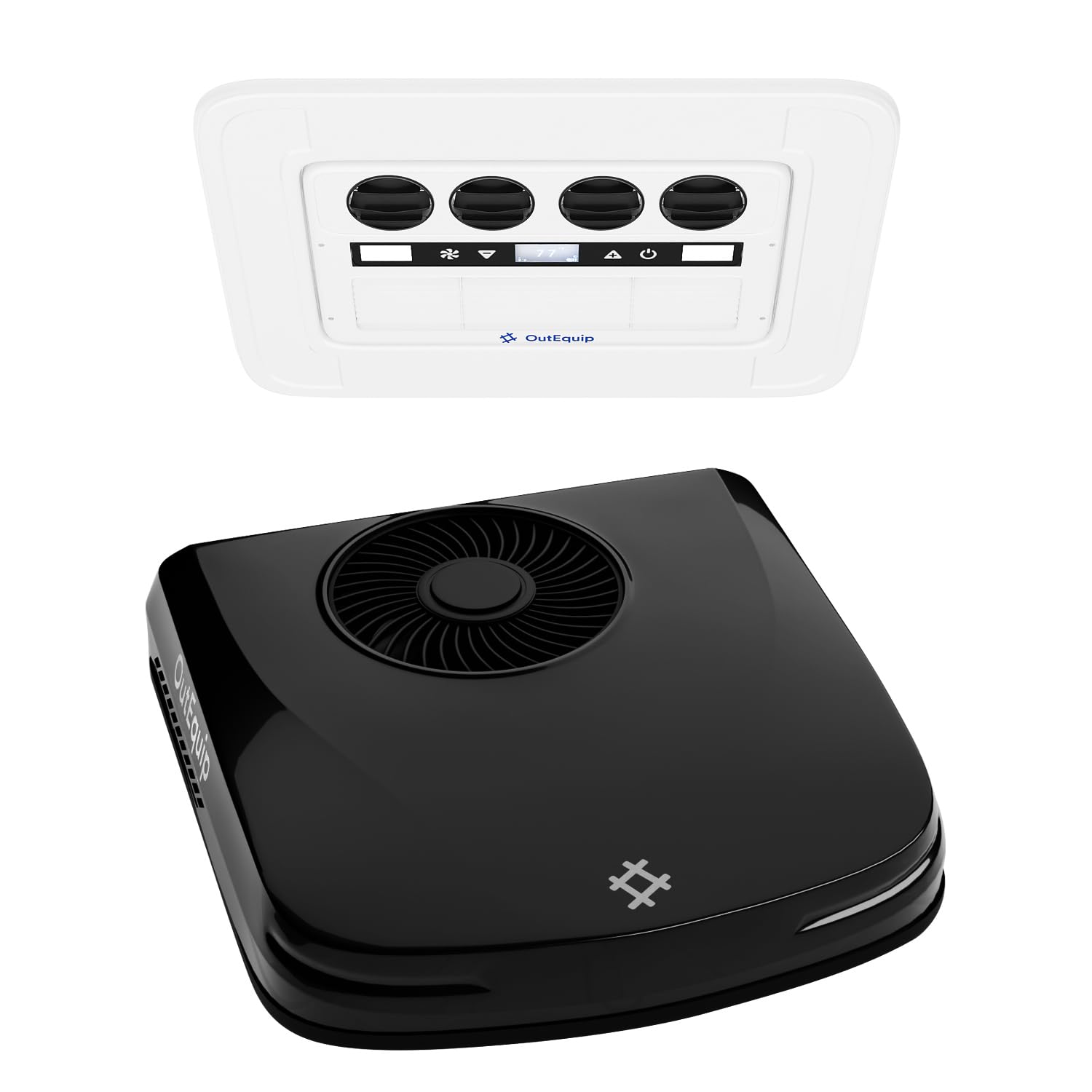
The blacked-out rooftop unit built to shrug off Arizona heat.
This OutEquip rooftop unit matches the brand’s proven 10,000 BTU performance but wraps it in a sleek black housing that looks sharper on dark van roofs. It’s engineered for the outdoors with UV-resistant ABS housing, a zinc-coated condenser, and an EPDM foam gasket for superior sealing. Buyers report it handles Arizona heat easily, pushing cold air within minutes of startup.
The dual brushless copper motor fans and anti-vibration mounting keep it stable and quiet, even while you sleep. Controls are easy — a remote, digital temperature display, and Eco, Sleep, and Turbo modes give you full command. The max draw is around 650W, dropping at lower settings, which is manageable for a 200Ah battery bank. One buyer runs it on a 24V 200Ah setup with solar and reports excellent efficiency.
Owners praise the build quality and the low profile — one measured just a 2-inch interior drop on a truck topper. The customer support is a recurring highlight, with responsive help for tricky installs. The main quibbles: the heater is noisy and not useful (this is primarily a cooling unit), the brackets run short, and there’s no Bluetooth for driving monitoring — some buyers wanted the app connectivity of the other OutEquip models.
The style pick that performs: Exceptionally quiet operation and a max draw near 650W make it a strong all-rounder, with build quality earning the highest praise from owners.
Choose this if: You want the proven OutEquip cooling in a black finish that matches a dark van build.
Know before buying: No Bluetooth means no phone control, and the heater is best ignored for real winter use.
10. Dometic FreshJet 3 15K BTU

Serious 15,000 BTU muscle for cooling a whole travel trailer.
When your van or trailer is too big for a 10K unit, this FreshJet 3 delivers 15,000 BTU of cooling power. It shares the same light 64 lbs construction and 13% higher cooling capacity as its 13.5K sibling, with 15% more airflow for faster cooldowns. The turbo blower moves 350 cubic feet per minute quietly, so even a 25-foot travel trailer drops to a comfortable temperature without a roar.
It’s a true plug-and-play replacement for existing Dometic units — owners mention swapping out old units in about 30 minutes using the included roof gasket. The e-coated evaporator coils resist corrosion, and the design uses 28% less refrigerant than earlier models. Owners describe it as quieter than the original, remarking they can take a phone call while it runs.
The versatility is the selling point: it works for both ducted and non-ducted setups, and it arrives with the gasket you need. The catch is reliability from the start — customers note units occasionally arriving with cracked plastic cases from poor shipping, and durability feedback is mixed. One buyer mentioned it runs a bit louder than the original unit, and it comes with no instructions in the box. But owners who got a clean unit report “plenty of cooling power” for a 25-foot trailer.
The heavy hitter: A true 15,000 BTU rooftop unit with Dometic’s reliability, best for anyone replacing an older unit on a larger trailer. Just document any shipping damage immediately.
Reach for this if: You need serious cooling for a 20-25 foot trailer and want a quick rooftop swap.
Who it’s not for: Small vans — this much cooling is overkill and wastes battery on a compact build.
11. TOSOT GoCool 16000 BTU

The all-weather beast with 16,000 BTU of cooling and a real heat pump.
This is the most powerful unit in our lineup, packing 16,000 BTU of cooling and a genuine 12,500 BTU heat pump for winter warmth. It’s rated for spaces up to 600 square feet, making it suitable for RVs from 16 to 24 feet long. The heat pump is the real deal — it’s not a supplementary PTC heater but a proper heat source that keeps a 20-foot trailer warm in cold weather.
It’s exceptionally quiet at 43dB even on high, and reviewers point out no vibration on a Sprinter 170 mid-roof install. The WiFi and remote control add modern convenience, and the unit comes with both the rooftop and ceiling ADB units included — so everything you need is in the box. One owner notes it cools a 40-foot 5th wheel alone, which is remarkable for a 12V system.
The power draw sits around 800W, which buyers pair successfully with 48V Victron systems. Installation is straightforward for a rooftop unit — pre-wired with both halves included — though it’s heavy enough to need a second pair of hands. The dehumidifier function is a bonus for humid climates. The quirks: no condensation drip kit from TOSOT (you’ll source your own), and one owner had a non-functional LED light. The vent may need a 1-inch move depending on your roof layout.
The all-season powerhouse: True heat pump heating plus 16,000 BTU cooling in a quiet, WiFi-controlled package — the definitive pick for serious year-round van or trailer living.
Best for: Full-time vanlifers in extreme climates who need genuine heating and cooling from one rooftop unit.
The honest trade-off: At this size and power, it’s the heaviest installation and needs a battery bank sturdy enough to feed 800W — a help with the roof lift is non-negotiable.
Understanding the Specs
BTU — The Cooling Muscle
BTU (British Thermal Units) tells you how much heat the unit can move per hour. A 10,000 BTU unit is the balance for most vans and small campers — it can drop a cabin from sweltering to comfortable in about 15 minutes. Bigger units like the TOSOT’s 16,000 BTU handle 600 square feet, but they draw more power and cost more. Match the BTU to your insulated square footage, not the raw volume of your van.
12V DC vs 110V AC — The Battery Question
A 12V DC unit runs directly off your house battery bank, skipping the inverter that wastes power converting DC to AC. This is the key to off-grid sleeping. But 12V DC cooling comes at a real current cost — most units pull 40-60A at full blast, which is 40-60 amps from your battery every hour. A 100Ah battery gives you less than two hours of max cooling; a 400Ah bank is what shoppers say as comfortable for all-night use.
Rooftop vs Under-Dash vs Mini-Split
Rooftop units are the classic RV choice — they need a 14×14 inch cutout and keep all the hardware out of your living space. Under-dash kits keep your roof clean and are better for vehicles without a flat roof, but they require mounting a compressor under the hood or chassis. Mini-splits split the indoor and outdoor units, offering the most flexible install for weird builds like trucks and excavators.
Sleep Mode and Decibels
Noise level is measured in decibels (dB). A unit running at 40dB is described as library-quiet — you can sleep next to it. The best units use brushless fans and anti-vibration mounts to cut noise while maintaining airflow. Sleep mode typically slows the fan and compressor to minimum output, trading a little cooling for silence and battery savings. It’s the difference between a restful night and lying awake listening to a jet engine.
FAQ
How big of a battery bank do I need for a 12V van AC?
Can a 12V AC unit run while I drive?
What is the difference between a heat pump and a PTC heater?
Will a 10,000 BTU unit cool my van in extreme heat?
Can I install a rooftop AC unit myself?
Under-dash AC vs rooftop AC, which is better for a van?
How much does a 12V AC unit cost to run in terms of battery drain?
Do these units come with heating or is it cooling only?
What is the quietest 12V AC unit for sleeping?
Can I run a 12V AC unit off solar power alone?
Final Thoughts: The Verdict
If you want one dependable pick, the best ac unit for van choice is the OutEquipPro 12V Rooftop AC because it balances proven 10,000 BTU cooling, a light 43 lbs weight for solo install, and a battery-friendly draw that buyers trust in real Texas heat. If you want a true heat pump for year-round living, grab the TOSOT GoCool 16000 BTU — its 12,500 BTU heating capacity is the only genuine winter solution here. And for the efficiency-obsessed vanlifer, the Gidrox Rooftop AC sips just ~350W overnight, making it the smartest pick for smaller battery banks with solar.
How We Picked
We do not accept paid placement. Every pick is matched to a real buyer and a real use-case; we do not hands-on test units.
Sources & Methodology
Specifications: manufacturer listings and product documentation. Review insights: verified customer reviews, as of August 2026. Pricing: not shown on this page (it changes often); check the current price via the retailer link.
As an Amazon Associate, Gadgets Feed earns from qualifying purchases. This does not affect which products we feature.