
Our readers keep the lights on and my morning glass full of iced black tea. As an Amazon Associate, I earn from qualifying purchases.
Specs are compiled from manufacturer listings and verified buyer reviews and can change over time — please confirm the key details on the product page before buying.
When the power cuts, your router, PC, and freezer all go dark at once. A battery backup system keeps them running — giving you minutes to save your work or hours to power essentials through a long outage. The right pick depends on one thing: what must stay alive?
I’m Min — the founder and writer behind Gadgets Feed. This guide is built by comparing the manufacturers’ published specifications and the patterns across verified customer reviews, so you get each pick’s real strengths and trade-offs instead of marketing spin.
From compact desktop UPS units to whole-home lithium power stations, here are the battery backup systems that actually hold up when the grid lets you down.
Our Picks at a Glance


How To Choose The Best Battery Backup Systems
Before you pick a system, you need to know what you’re protecting. A desktop PC with a monitor draws far less than a full-size refrigerator, and the battery capacity you need changes completely based on that load.
Understanding Your Power Needs
Start by adding up the wattage of everything you want to keep running. A 600VA unit (rated at 330W) is perfect for a router and a computer, while a 1500VA unit (900W) can handle a home office setup. For a refrigerator or medical equipment, you’ll want a larger system or a portable power station with a much bigger battery.
Battery Type: Lead-Acid vs. Lithium (LiFePO4)
Traditional UPS units use sealed lead-acid batteries. They’re affordable and reliable for short outages, but they wear out after a few years and need replacement. Lithium iron phosphate (LiFePO4) batteries cost more upfront but last far longer — often rated for 3,000 to 10,000 charge cycles — making them a better long-term investment if you plan to keep the system for years.
Output Waveform: Simulated vs. Pure Sine Wave
The power a UPS delivers comes in two forms. Simulated (or modified) sine wave is fine for most computers and routers. Pure sine wave is smoother and safer for sensitive electronics like gaming PCs with Active PFC power supplies, some medical devices, and variable-speed appliances. If the data for a unit mentions pure sine wave, it’s built for delicate gear.
Quick Comparison
| Model | Best For | Capacity (VA/Watts) | Battery Type | Runtime | Amazon |
|---|---|---|---|---|---|
| Anker SOLIX C1000★ Best Overall | Whole-home backup | 1056Wh / 1800W | LiFePO4 | 6+ hours | Amazon |
| APC 600VABest Value | Router & PC safety | 600VA / 330W | Lead Acid | 23 min | Amazon |
| CyberPower SL950USlim Pick | Gaming & home office | 950VA / 510W | Sealed Lead Acid | — | Amazon |
| CyberPower AVRG900LCD | Desktop & NAS setups | 900VA / 480W | Lead Acid | 18-20 min | Amazon |
| Amazon Basics 1500VA | Budget whole-desk | 1500VA / 900W | Lead Acid | 10 min | Amazon |
| APC BX1500M | Home office workhorse | 1500VA / 900W | Lead Acid | 68 min | Amazon |
| Eaton Tripp Lite SMART1000LCD | Dependable single-PC | 1000VA / 500W | Lead Acid | 10 min | Amazon |
| GOLDENMATE 1000VA Lithium | PC & modem longevity | 1000VA / 600W | LiFePO4 | — | Amazon |
| GOLDENMATE 1500VA Lithium | Gaming & NAS rigs | 1500VA / 1000W | LiFePO4 | — | Amazon |
| Anker SOLIX S2000 | Fridge & home essentials | 2010Wh / 1500W | LiFePO4 | 35 hours | Amazon |
| Jackery Explorer 2000 v2 | Heavy home backup | 2042Wh / 2200W | LiFePO4 | 21+ hours | Amazon |
In-Depth Reviews
1. Anker SOLIX C1000 Portable Power Station
Our pick — over 4.5★ from 1,500+ verified ratings; the strongest balance of quality and price.
The powerhouse that recharges in under an hour and keeps critical gear alive for hours
This is the system you reach for when a simple UPS isn’t enough. The Anker SOLIX C1000 packs a 1056Wh LiFePO4 battery and delivers 1800W of continuous power (2400W peak), which means it can handle heavy draws like a microwave or a Keurig, not just a modem and monitor.
What wins people over is the sheer reliability — One owner kept four medical devices running for six hours straight during a procedure.. The UltraFast recharging hits 80% in just 43 minutes, so you can top it up quickly between outages. It’s also 15% smaller than comparable 1kWh units, and Buyers run a 75-liter cooler without issue..
The honest trade-off: it won’t run a full-size fridge all day on its own — Pairing it with an extra battery pack extends a fridge to a full day and a TV to 10 hours.. Solar charging is also slow if you rely on panels. But against the APC 600VA’s 330W ceiling, this 1800W unit holds more than five times the continuous output, making it the clear choice for serious home backup.
Why It’s the Top Pick
- Rapid 43-minute recharge to 80% capacity
- 3,000 battery cycles with a 10-year lifespan
- 11 versatile ports power 99% of appliances
Who Should Skip
- Won’t power a fridge all day without an extra battery
- Solar recharging is slow (25-30 hours with 200W panels)
- Fan gets noisy at maximum load
The verdict: reach for the C1000 when you need true whole-home flexibility — it bridges the gap between a tiny UPS and a full generator.
The catch: plan for extra batteries if your goal is keeping a refrigerator cold through a multi-day outage.
2. APC UPS 600VA/330W Battery Backup
The dependable desk protector that keeps your router and PC safe through short outages
This is the classic entry point into battery backup. The APC 600VA delivers 23 minutes of runtime at a 100W load, and buyers confirm it keeps a router and modem up for 30-45 minutes during real outages. It’s a plug-and-play unit — no software setup required to get basic protection.
You get 7 outlets total: 5 with full battery backup and surge protection, plus 2 surge-only for less critical gear. There’s also a built-in 1.5A USB port so you can charge a phone even when the power’s out. The battery is user-replaceable (APCRBC154, sold separately), so when it ages out in a few years, you swap the battery instead of the whole unit.
The recurring gripe in reviews is the battery life — while many say it lasts a long time, others report it failing after about 4 months of use. It’s also a compact unit meant for graceful shutdowns, not extended runtime. If you need to power a full home office for an hour, the CyberPower SL950U above holds a 58% larger capacity (950VA/510W vs 600VA/330W).
Solid starter: this APC switches to battery instantly when the power drops, so your devices never blink — and it costs less than you might expect.
Size it right: get this for a single PC or your network gear, not for a gaming rig or refrigerator.
Best for: home offices and network setups where a few extra minutes to save work is all you need.
Think twice if: you’re looking for long runtime — this is a safety net, not a power source.
3. CyberPower SL950U Standby UPS
A slim, UL-certified unit that charges your phone via USB-C while shielding your console
CyberPower’s SL950U brings a 950VA/510W capacity in a slim profile that doesn’t eat up your desk space. It’s built for home office and entertainment setups — computers, gaming consoles, and broadband routers all get clean simulated sine wave power.
What stands out here are the 8 outlets and the modern charging options. You get 5 battery-backup outlets and 3 surge-only, with two outlets widely spaced for bulky transformer plugs. The two USB ports — one USB-A at 2.4 amps and one USB-C at 18W PD — can top up your tablet or phone while the grid is down.
This is a unit owners stick with for years. Buyers report it’s the third CyberPower they’ve owned over 12 years, using them for TV, stereo, router, and security equipment. The recurring comment is the annoying beep after an outage — you silence it by hitting the power button twice quickly. It’s also backed by a 3-year warranty including the battery.
Smart design: the slim footprint and USB-C port make this the most polished mid-range option here.
Known quirk: the alarm beep is persistent until you learn the two-press mute.
Reach for this if: you want a sleek, well-priced UPS that can also charge your phone and tablet.
Look elsewhere if: you need a display for real-time wattage readouts — this model keeps things simple.
4. CyberPower AVRG900LCD Intelligent LCD UPS
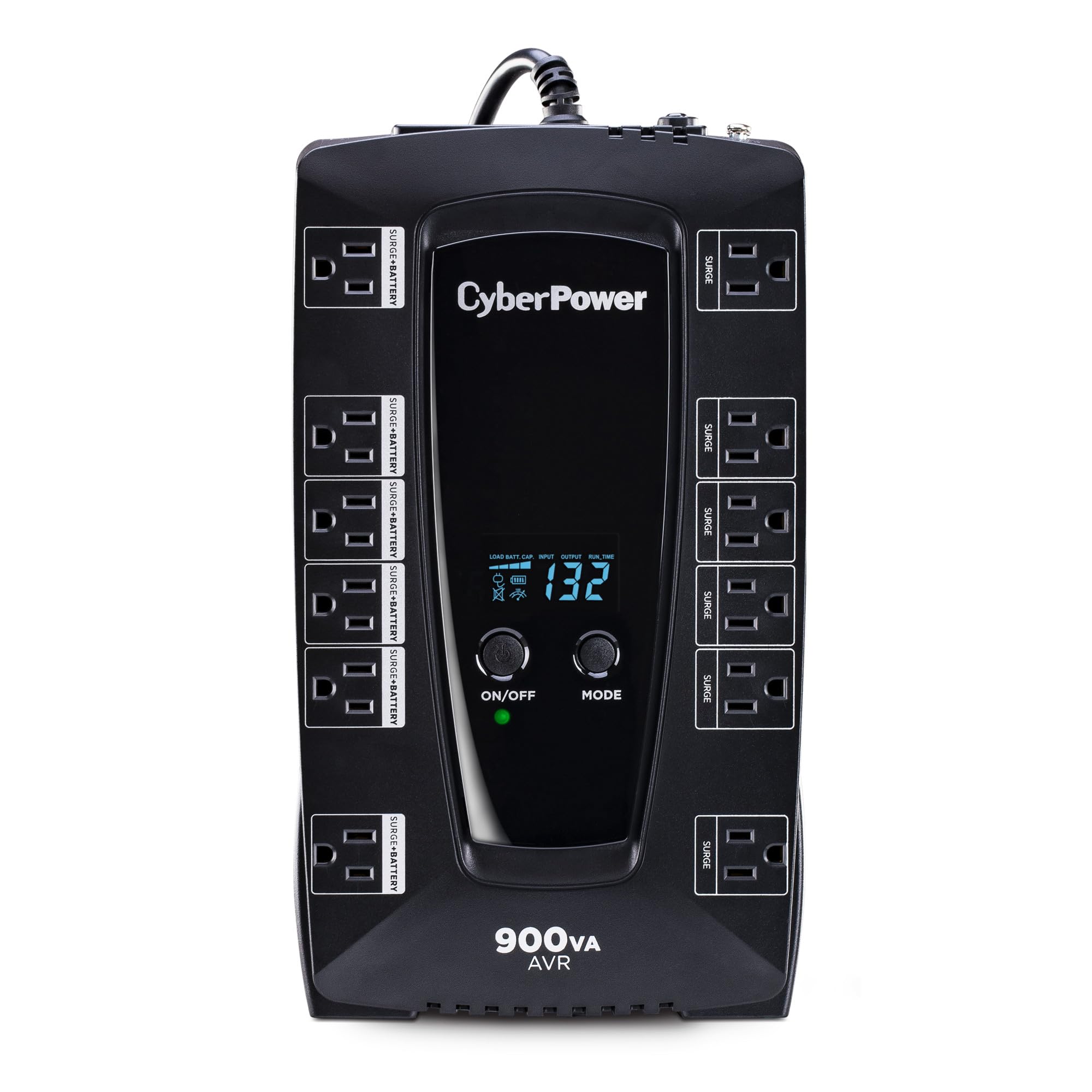
Twelve outlets and an LCD screen that show you exactly what your power is doing
If you have a lot of gear, the AVRG900LCD gives you room to breathe. This 900VA/480W unit offers 12 NEMA outlets — six with battery backup and surge protection, and six with surge-only. A built-in LCD keeps you informed about battery status and line conditions at a glance.
The key feature here is Automatic Voltage Regulation (AVR), which corrects minor power fluctuations without draining the battery. For island residents and people on unstable grids, this is a lifesaver — owners mention it handles frequent outages with “way more time than needed” to safely shut down a 100TB NAS without data loss. Real-world runtime lands around 18-20 minutes with a desktop and monitor pulling 175-200W.
The main complaints center on noise — there’s a relentless beeping that some owners find hard to silence — and mixed reliability. Some units work flawlessly for years while others won’t power on at all. Set it up with the free PowerPanel software and give it a full 8-hour initial charge to avoid early beeping issues.
Great capacity: 12 outlets and AVR make this ideal for multi-device desks and home servers.
Beep warning: the alarm can be relentless, and setup via the mode button is fiddly without the software.
Best for: anyone with a serious desktop setup or NAS who needs visible power status and AVR protection.
Not for: light users who just want to protect a single router — it’s more unit than you’ll use.
5. Amazon Basics UPS 1500VA/900W

A mini-tower that delivers 900W of power across 10 outlets — enough to keep your PC and router alive without breaking your budget.
Amazon Basics brings big capacity at a budget-friendly price. This 1500VA/900W line-interactive UPS provides about 10 minutes of backup at half load (450W), which is plenty to save your files and shut down safely. The mini-tower design with a 6-foot cord slips neatly under a desk or into an entertainment center.
You get 10 outlets total — 5 surge-protected and 5 with battery backup. Automatic Voltage Regulation (AVR) and simulated sinewave technology help correct minor fluctuations without switching to battery. Owners running 24/7 servers appreciate the three sensitivity modes, with the most sensitive setting handling thunderstorms without tripping.
Be realistic about expectations here. The bundled software is weak — some owners find it sketchy on Windows 11 and switch to third-party monitoring instead. Battery life gets mixed feedback, with some units delivering far less runtime than the software predicts. It’s a solid value, but reliability reports are mixed enough that this is best for less-critical setups.
Big value: you get serious 900W capacity and 10 outlets without the premium price tag.
Software letdown: the monitoring app is the weak link; plan to use third-party tools.
Reach for this if: budget is the priority and you need to protect a full desk of gear.
Look elsewhere if: you rely on deep battery runtime — this is for short, safe shutdowns, not extended outages.
6. APC UPS 1500VA/900W BX1500M
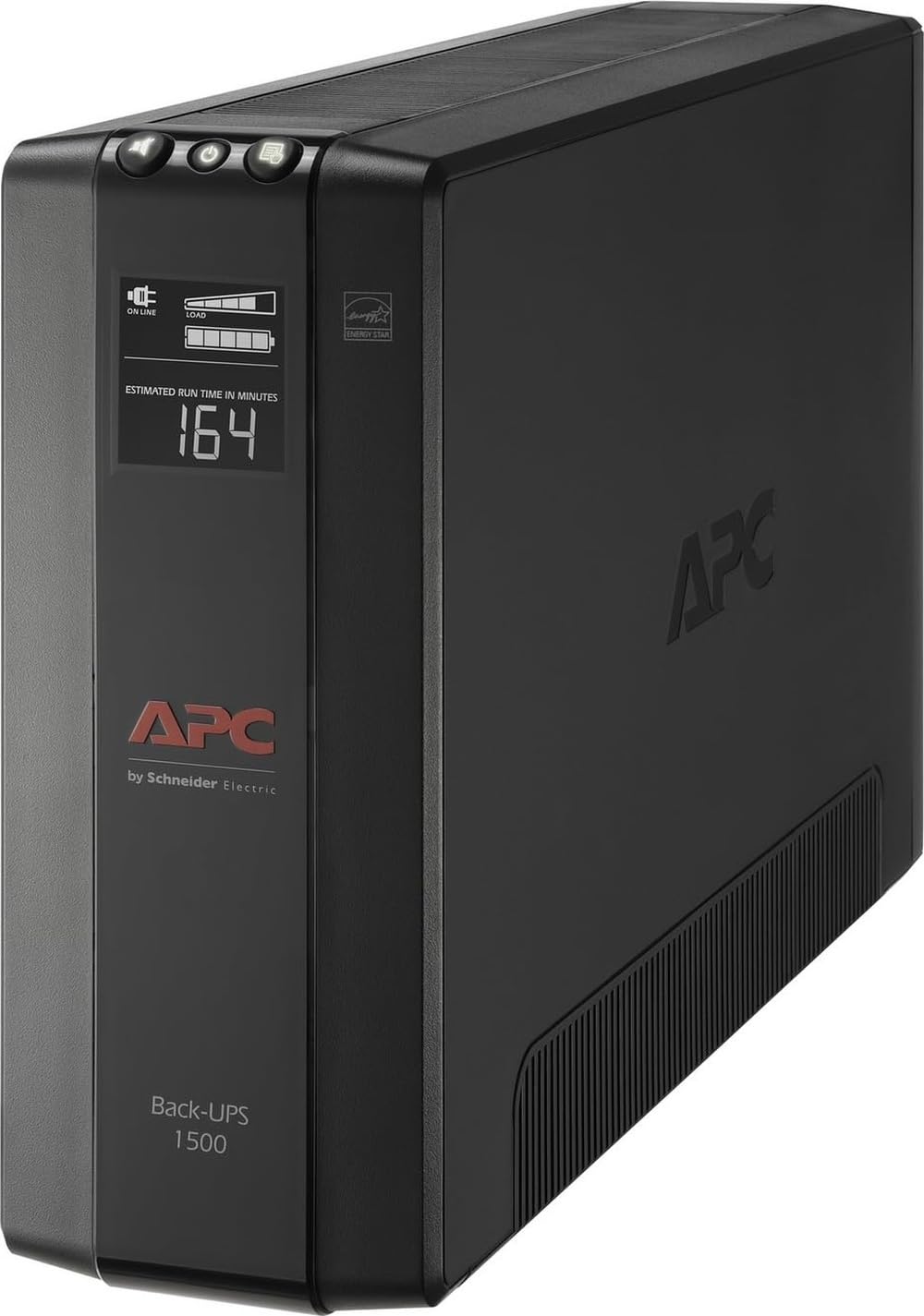
The UPS that bridges you through long outages with 68 minutes of runtime at light load
APC’s 1500VA/900W Back-UPS Pro is a home office workhorse. For a gaming PC with an Active PFC power supply, the AVR corrects voltage safely without draining the battery.
The 10 outlets split into 5 battery-backup and 5 surge-only, plus built-in coaxial and Ethernet surge protection for a fully protected desk. It’s ENERGY STAR certified for 92%+ efficiency, and the user-replaceable battery (APCRBC124) means you won’t throw the whole unit away when the battery ages.
Owners who’ve been through hurricanes report never losing a PC with APC gear. The known trade-off is a loud beeping and a high-pitched whine (2842 Hz) that some units emit every 4-5 seconds — though many customers note their units are completely silent. It’s heavy, but the reliability record is why it’s a crowd favorite.
Long runtime: 68 minutes at 100W is outstanding for keeping your network alive.
Noise lottery: beeping and whine get the most complaints, though mute options help.
The verdict: grab this for a serious home office where an hour of uptime during an outage actually matters.
Who should skip: anyone who can’t tolerate a beeping unit or only needs router protection.
7. Eaton Tripp Lite SMART1000LCD
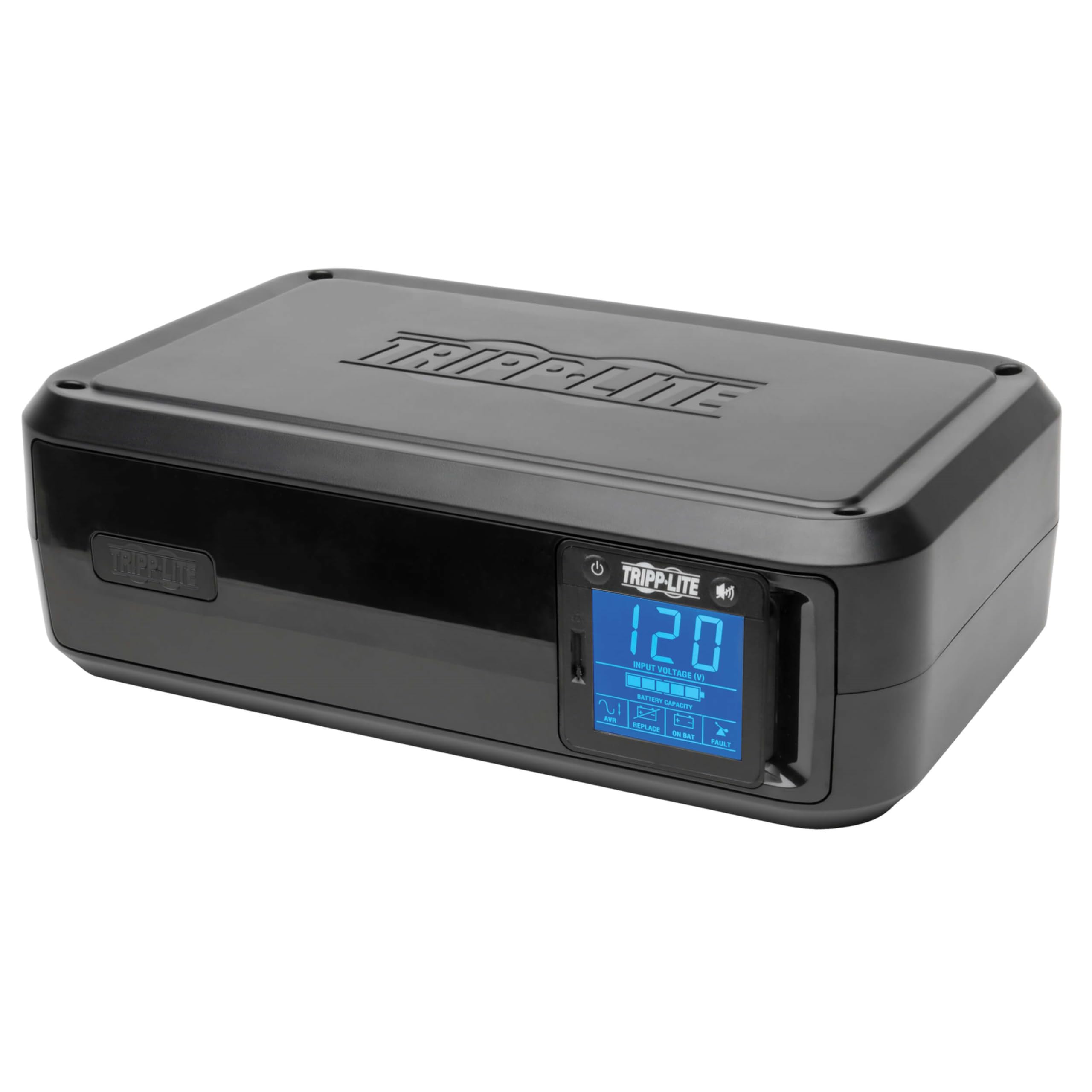
The rock-solid 1000VA unit with a rotating LCD and legendary support behind it
Eaton Tripp Lite builds this 1000VA/500W UPS for dependable single-PC protection. It offers 10 minutes of runtime for a 250W office PC and 3 minutes for a 500W gaming PC — enough to save work and shut down safely. The LCD screen rotates for vertical or horizontal placement and shows line voltage and battery status without needing a computer.
All 8 outlets provide 1038 joules of surge protection, with 4 delivering battery backup. AVR corrects undervoltages from 89V back to a safe 120V without touching battery power. The internal battery is user-replaceable and hot-swappable, extending the unit’s life significantly.
What sets this apart is the support. Reviewers point out exceptional customer service, with One owner got a free replacement after lightning damage; another after a crooked LCD.. The recurring note is that a monitoring app must be downloaded — it’s not bundled. Battery life is solid for brief outages, though some units die after about 3 years of light use.
Built to last: hot-swappable battery and a connected equipment guarantee show confidence.
Small trade-off: no included software, and the 3-year warranty is standard, not generous.
Best for: buyers who value support and a clear LCD over raw capacity and low price.
Not for: anyone running multiple high-draw devices — this is a single-workstation unit.
8. GOLDENMATE 1000VA/600W Lithium UPS

A quiet, pure sine wave UPS with a 10-year lithium battery that outlasts lead-acid rivals
GOLDENMATE is rethinking what a desktop UPS can be. This 1000VA/600W unit uses a LiFePO4 battery rated for over 10 years and 5,000+ charge cycles — dramatically longer than the lead-acid batteries in traditional UPS units. It delivers pure sine wave output, which is safer for sensitive electronics and Active PFC power supplies.
The unit is exceptionally quiet, with owners calling it “super quiet” and praising its clear color LCD display. It’s also a looker — a clean white design that’s a far cry from the black boxes you’re used to. The 8 outlets (with backup and surge protection) and a switch-button buzzer mute function round out a genuinely modern package.
Some owners note it can last up to 5 hours during outages, though others report a unit dying after 7 months — a reminder that even good gear has the occasional lemon. There’s no user manual in the box, which can be a stumbling block for non-techies. If you’re tired of replacing lead-acid batteries every two years, this is a compelling upgrade.
Long-term value: the maker claims over 40% lower total cost of ownership vs lead-acid batteries.
Learning curve: no manual included, and the mute function isn’t a simple hard toggle.
Reach for this if: you want a quiet, modern UPS with pure sine wave and a battery that could outlast your PC.
Look elsewhere if: you’re on a tight budget and only need a basic shutdown safety net.
9. GOLDENMATE 1500VA/1000W Lithium UPS

A metal-bodied, 1000W pure sine wave beast that runs a gaming rig without breaking a sweat
This is the biggest lithium UPS in the GOLDENMATE lineup, and it’s built for serious hardware. The 1500VA/1000W capacity handles gaming PCs, NAS systems, and home theater setups with ease. The LiFePO4 battery pack (51.2V, 5.8Ah) is rated for over 10 years and 3,000+ charge cycles — and the metal enclosure is a step up in build quality.
Owners running Alienware desktops with 1kW power supplies, dual monitors, and external drives report zero issues. The AVR continuously monitors voltage and corrects fluctuations without draining the battery. Front-panel USB ports — one Type-C and one Type-A — provide 10W of charging for your phone or tablet. A communication port with included USB cable enables automatic PC shutdown through Windows settings.
The honest catch: this unit is large and heavy (15 kg), and the power cord is short. UnRAID server owners note the software only reads battery level, not full APC-style protocols. Some shoppers say fan noise under full battery load. It’s also note this UPS is designed for standard utility power — generator-supplied power may not be recognized as valid input, keeping the unit in battery mode without recharging.
Serious muscle: 1000W continuous output with pure sine wave protects the most sensitive PSUs.
Physical footprint: it’s big and heavy, and the short cord limits placement options.
Best for: gamers and NAS owners who need clean power for high-draw equipment and years of battery life.
Not for: those with limited desk space or who run gear off a generator.
10. Anker SOLIX S2000 Portable Power Station
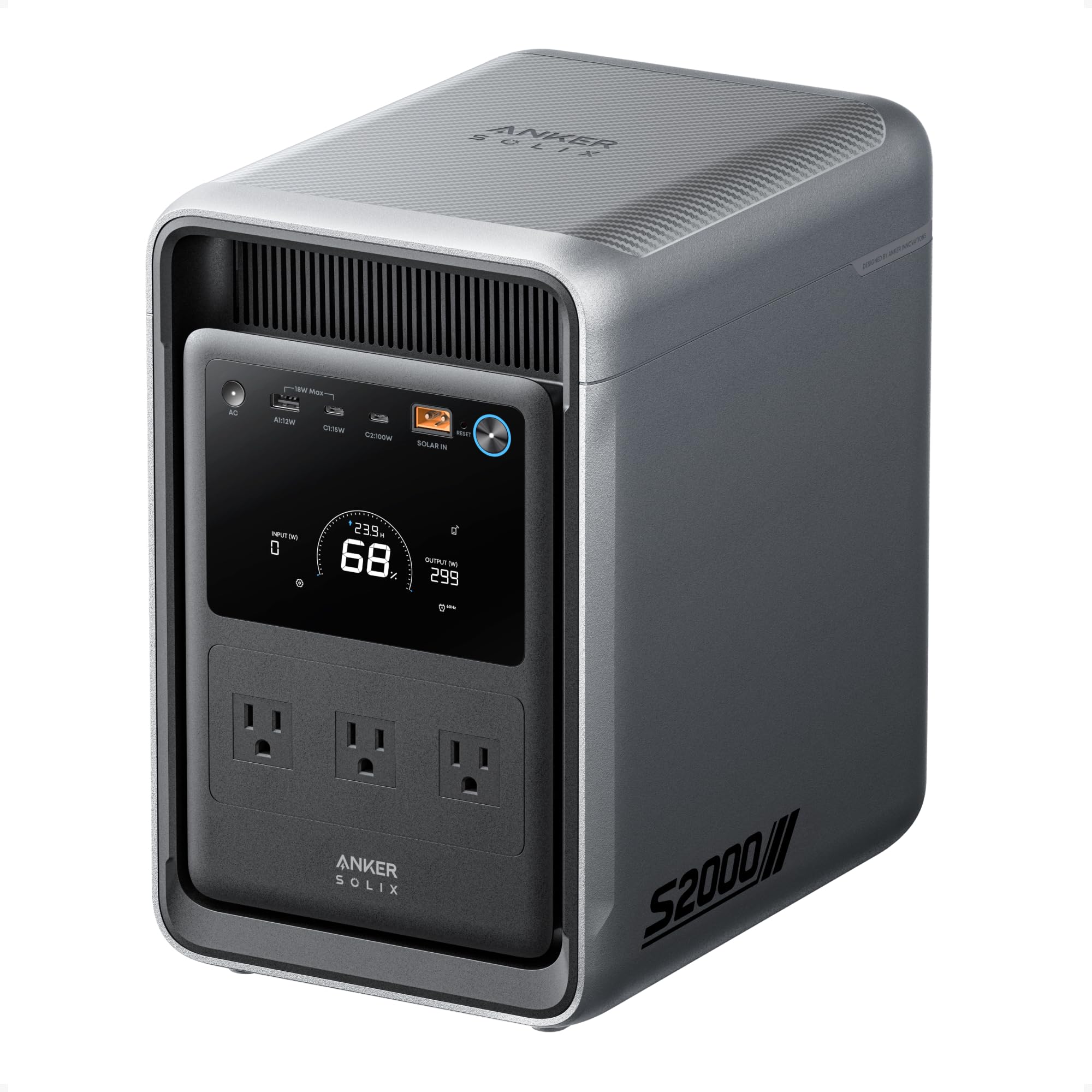
The lightest 2kWh power station that keeps a fridge cold for 35 hours straight
If your priority is keeping food cold and essentials running during a multi-day outage, the Anker SOLIX S2000 is built for exactly that. With 2,010Wh of capacity and a 6W idle draw, it runs a fridge for up to 35 hours — and owners confirm it delivers, with One owner survived a 30-hour outage without issue..
At just 35.7 lbs and measuring 8.2 × 11.1 × 12.7 inches, it’s 30% smaller and 25% lighter than the industry average for 2kWh units. The 1,500W continuous output (3,000W peak) powers 99% of home essentials, and the 10,000-cycle LFP battery promises a 15-year lifespan. The <10ms UPS switchover means your computer never blinks during a transfer.
Owners note the fan is quiet and the WiFi remote monitoring is a standout feature. You can adjust charging from 100-1200W and track energy usage from your phone. The trade-off: there’s no 12V DC port, and the shallow front/back ledges make carrying awkward if you move it often. It’s a heavy unit that’s best placed and left alone.
Efficiency king: 10% higher efficiency and a 6W idle draw stretch every watt further.
Portability limits: heavy at 35.7 lbs with shallow handholds — best for stationary backup, not daily travel.
Reach for this if: a refrigerator and essential home devices are your top priority during long outages.
Look elsewhere if: you need a 12V car port or plan to haul it around regularly.
11. Jackery Explorer 2000 v2

The 2200W titan that’s 41% lighter than typical 2kWh stations and charges in 66 minutes
Jackery’s Explorer 2000 v2 keeps the most appliances running at once — it delivers 2200W continuous output from its 2042Wh LiFePO4 battery (a lithium iron phosphate pack that lasts longer than standard lithium-ion). That’s enough to power a refrigerator, sump pump, or even a space heater; Owners run a 1500W heater at 1438W.. It’s UL1778 certified for UPS use (a safety standard for backup power), with a 20ms switchover so your devices never notice the outage.
Despite the massive capacity, it weighs just 39.5 lbs — 41% lighter and 34% smaller than typical 2kWh units, thanks to EV-grade Cell-to-Body technology. AC Fast Charging hits 80% in just 66 minutes, and the Silent Charging mode delivers a full charge in 5 hours at under 30dB, so it won’t disturb your sleep. The USB-C PD 100W port charges laptops at full speed.
Owners rave about the quick charging — One owner hit a full charge in under an hour without overheating., and Another owner ran a fridge for 21.3 hours.. The Bluetooth app connection gets some complaints for reliability, and the solar barrel ports feel weak. But for pure output and portability in one package, this is the benchmark.
Output champ: 2200W continuous is the highest here, beating the Anker S2000’s 1500W ceiling.
Minor quirks: the companion app sometimes drops connection, and the solar input ports feel less sturdy than the rest of the unit — so handle them with care if you plan to recharge off-grid.
Best for: anyone who needs serious wattage for appliances or power tools plus true portability.
Think twice if: you want the absolute lightest option — the Anker S2000 is 4 lbs lighter.
Understanding the Specs
VA vs. Watts
VA (volt-amps) is the traditional rating, but watts is what actually tells you how much power your devices can draw. A 1000VA unit might only deliver 500-600W. Always match the watt rating to the combined wattage of everything you plug in.
Runtime Ratings
Runtime figures like “23 minutes” are measured at a specific load — usually 100W or half-load. Your actual runtime depends on what you plug in. A router and modem might run for 45 minutes, while a gaming PC might only last 5. Check the load rating before assuming you’ll get the headline number.
FAQ
Will a battery backup keep my refrigerator running during an outage?
What’s the difference between a UPS and a portable power station?
How long does a UPS battery last before it needs replacing?
Can I plug a power strip into a UPS or power station?
What is pure sine wave and why does it matter?
How do I calculate what size UPS or power station I need?
Can I use a generator to recharge my power station?
Is a higher VA rating always better?
What is AVR and when do I need it?
Final Thoughts: The Verdict
Across the board, the battery backup systems winner is the Anker SOLIX C1000 because it combines rapid recharging, a decade-long lithium battery, and enough power for 99% of home appliances. If you want a simple, affordable safety net for your router and PC, grab the APC 600VA. And for keeping a fridge cold through a multi-day outage, the Anker SOLIX S2000 is the one to reach for.
How We Picked
We do not accept paid placement. Every pick is matched to a real buyer and a real use-case; we do not hands-on test units.
Sources & Methodology
Specifications: manufacturer listings and product documentation. Review insights: verified customer reviews, as of August 2026. Pricing: not shown on this page (it changes often); check the current price via the retailer link.
As an Amazon Associate, Gadgets Feed earns from qualifying purchases. This does not affect which products we feature.