
Our readers keep the lights on and my morning glass full of iced black tea. As an Amazon Associate, I earn from qualifying purchases.
Specs are compiled from manufacturer listings and verified buyer reviews and can change over time — please confirm the key details on the product page before buying.
When your dog’s back legs start to fail, everyday joy can feel out of reach. The right rear-support cart changes that by putting those paralyzed or weak hind legs onto wheels, so walks and playtime return. This guide breaks down the back leg dog wheelchair options by weight capacity, adjustability, and real-world owner feedback — the three things that decide whether a cart actually gets used.
I’m Min — the founder and writer behind Gadgets Feed. This guide is built by comparing the manufacturers’ published specifications and the patterns across verified customer reviews, so you get each pick’s real strengths and trade-offs instead of marketing spin.
Measuring your dog from floor to hip is the single most important step before any purchase. A well-fitted rear-support cart lets a disabled dog run again, and this back leg dog wheelchair guide shows you exactly which models deliver that freedom and which ones need careful measuring.
Our Picks at a Glance

How To Choose The Best Back Leg Dog Wheelchair
A rear-support wheelchair only works when it fits. The single most common reason carts get returned is an incorrect size — not a bad product. Before you buy anything, measure your dog while standing: the distance from the floor to the top of the back at the hindquarters is the number that determines whether the cart lifts the right part of the body.
Match the weight capacity to the dog, not the budget
Every cart lists a maximum dog weight, and these caps vary widely — from a 20-pound limit on compact frames up to 180 pounds on heavy-duty large models. A cart built for a 22-pound dog will strain under a 30-pound dog, and a frame rated for 180 pounds will simply be too bulky for a small breed. Pick the capacity that fits your dog’s real weight with a little room to spare.
Adjustability matters as the condition changes
Rear-leg weakness is rarely static. Dogs with degenerative conditions like IVDD can improve or worsen over months, so a cart with adjustable height, length, and width lets you adapt the fit instead of buying a new cart. Some models adjust with simple knobs or screw positions; others are more involved. If you expect the condition to change, prioritize adjustability.
Quick Comparison
| Model | Best For | Max Dog Weight | Frame Weight | Adjustability | Amazon |
|---|---|---|---|---|---|
| Walkin’ Wheels Large★ Best Overall | Large breed paralysis | 180 lbs | 21 lbs | Height, length, width | Amazon |
| Walkin’ Wheels Small PinkPremium Pick | Small breed all-terrain | 25 lbs | 10 lbs | Height, length, width | Amazon |
| Best Friend Mobility FML Elite | Medium/large active dogs | 45 kg | 13 lbs | Toolless width knobs | Amazon |
| Walkin’ Wheels XS | Mini/toy breeds | 10 lbs | 1.5 lbs | Height, length, width | Amazon |
| LetPetRun Cart | Small dogs, tight budget | 20 lbs | 2.8 lbs | Height, width, length | Amazon |
| Acesolid Medium | Small breeds with safety kit | 22 lbs | 2.2 lbs | Adjustable | Amazon |
| VEVOR X-Small | Pocket-size dogs on a budget | 22 lbs | 1.9 lbs | 5 lengths, 6 widths, 7 heights | Amazon |
In‑Depth Reviews
1. Walkin’ Wheels Dog Wheelchair (Large, 70-180 lbs)
Our pick — over 4★ from 600+ verified ratings; the strongest balance of quality and price.
That rare rear cart engineered to carry a 100-pound dog with 95% paralysis, not just steady it.
This is the heavy-lifter of rear-support carts, rated for dogs from 70 to 180 pounds. Its dense foam wheels with rubber treads won’t puncture, so a big dog can roam uneven ground without you worrying about a flat mid-walk. The 21-pound aluminum frame is the clear trade-off versus lighter carts — it’s a substantial piece of equipment, but owners say it holds up to the demands of a large, active animal.
One owner’s 80-lb German Shepherd with 95% paralysis used it daily for a year with no frame issues. The positive feedback leans heavily on regained mobility and solid build quality. A recurring success story: a dog that walked the day the cart arrived, and improved to a mile a day within a month. It’s a commitment to assemble, though; expect around two hours on first setup.
The honest caveat is fitting. A 120-pound German Shepherd missing a rear leg found it a poor fit, and the dog wouldn’t tolerate it. Measure your dog’s floor-to-hip height carefully against the 20-22 inch leg range. The patented adjustable design in height, length, and width gives you room to tweak the fit as your dog’s health changes.
Built to last: The 21-pound frame and puncture-proof foam wheels are exactly what a heavy dog needs for daily outdoor use.
Plan the setup: Assembly runs about two hours, and the wheels wear — budget for replacement treads down the line.
The right audience: Large-breed owners with a paralyzed or severely weakened dog who want a cart that adapts as the condition changes.
Think twice if: Your dog is outside the 70-180 pound range, or you need something you can lift with one hand.
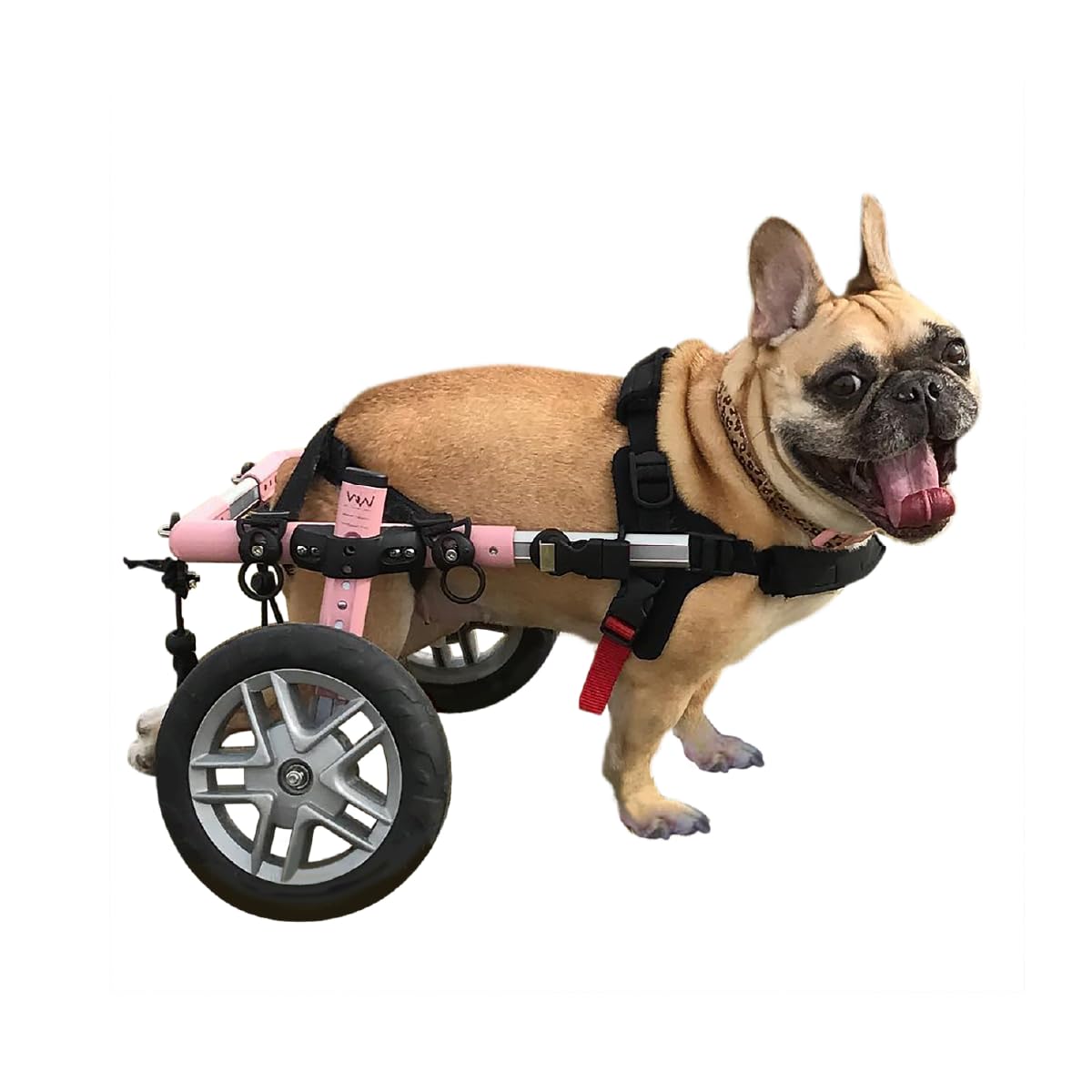
2. Walkin’ Wheels Small Dog Wheelchair (15-25 lbs, Pink)
The small-breed cart that owners say had their paralyzed pug walking on grass within a week.
For a small dog in the 15-25 pound range with a 6-8 inch leg height, this is the quality benchmark. The frame is made of lightweight extruded aluminum that’s chew-proof, and at 10 pounds total it’s manageable to carry when your dog needs a break. It collapses for storage, which makes car trips and small-space storage genuinely practical.
The owners’ consensus is strong: quality and effectiveness are the most-praised aspects, with one story of A dog with frozen back legs used the cart as a bed platform, enabling his first outdoor movement in months.. One small dog owner reported their pet regained normal bodily functions while using it.. The one caution sits on the assembly side — it’s the most-discussed topic, and it’s a mixed experience, so budget extra time on first setup.
There’s a trade-off with the vest. A few owners swapped in a padded harness for extra comfort, since the included setup can rub on sensitive skin. Leg height matters too — a dog with hind legs shorter than the 6-8 inch spec won’t fit right no matter how well the cart is built.
What wins owners over: The wheels glide on sidewalks, streets, and grass, and the cart enabled real rehabilitation — One paralyzed dog regained walking ability after two months of use..
The one disappointment: Assembly is fiddly for some, and you may want a softer harness for long wear.
Choose it for: A small breed with back-leg weakness that still wants to run and explore rough ground.
Leave it on the shelf if: Your dog’s leg height falls outside 6-8 inches, or you’d rather not deal with a complicated first build.
3. Best Friend Mobility Standard Rear Support FML Elite (Large)

A 13-pound aluminum frame with push handles that turns a 90-pound senior dog into a walker again.
If your large dog still has front-leg strength but drags its rear, this cart lifts the back end so it can walk again. The frame uses steel buckles and polymer mounts (a tough plastic that resists cracking), and you adjust the width with toolless knobs — no set screws to hunt for. At 13 pounds, it’s lighter than the 21-pound Walkin’ Wheels frame but sturdier than budget carts, and it supports dogs up to 45 kg.
The most-praised results are mobility gains — A 12-13 year old, 68-pound dog went from rear-leg issues to running three blocks again.. A 12-year-old, 90+ pound Akita/Pyrenees mix walked normally after two sessions.. The sling setup that works best for most owners is the sports sling with handles, though adding padding like pool noodles helps prevent rubbing and heat buildup.
Here’s the honest friction: assembly is the most-discussed topic, and the experience splits hard. Some owners found it easy after a learning curve; others describe pieces that don’t fit and instructions that miss a critical step. The stiffest criticism involves installing crossbars and tiny wheel-connector screws. If you’re not handy, budget patience — or have a friend help.
What gets the tail wagging
- Mobility returns fast — A 90+ lb dog walked normally after just two sessions.
- Push handles give you steering control on steps and gravel
- Toolless width adjustment makes fitting simpler than screw-based carts
Where it stumbles
- Assembly instructions miss steps, leaving some owners frustrated
- A few report flimsy plastic clips and O-connector clamps
- The size runs large — most owners set it to the smallest setting
Reach for it if: You have a large senior dog with rear weakness and you’re comfortable with a build-it-yourself project.
Look elsewhere if: You want a cart that works right from the start with zero fuss.
4. Walkin’ Wheels XS for Mini/Toy Breeds (2-10 lbs)

A 1.5-pound frame built for a 3-pound Yorkie to take its first run in five years.
This is the cart for the tiniest patients — mini and toy breeds from 2 to 10 pounds. It comes with a 2-point front harness with comfort sleeves and includes leg rings, stirrups, and an extra fastener set. The dense foam wheels with rubber treads follow the same design as the larger Walkin’ Wheels carts.
The standout owner story is a Yorkie with an old back injury who took his first run in five years the day the cart arrived. A Chihuahua with IVDD adapted quickly and started walking longer distances, with smooth rolling on sidewalks, streets, and grass. The wheels are only 2 inches in diameter, which keeps the cart compact but means it tips backward on hills and bumps — supervision is a must.
The heaviest criticism centers on stability, and it’s worth taking seriously for a dog with full rear paralysis. One owner found that as their elderly Chihuahua’s balance worsened, a 2-wheel cart wasn’t enough — they needed a 4-wheel setup. This is a cart for a dog with some core strength, not total collapse.
The payoff: Buyers report long walks returning for IVDD-affected Chihuahuas and old Yorkies, with a 20-minute assembly time.
The risk: A few owners found it hard to set up and not sturdy enough — and 2-wheel carts tip backward on uneven ground.
Made for: A toy-breed dog with rear weakness that still has balance and just needs the hind end supported.
Not for: A dog with severe instability that needs four points of support.
5. LetPetRun Dog Wheelchair for Back Legs

A featherweight 2.8-pound cart with a leash buckle that gets a small dog rolling with zero assembly drama.
For a small dog up to 20 pounds, this cart is the entry point that owners say is easy to assemble and adjust, with quality being the most-praised aspect. The aluminum frame weighs just 2.8 pounds, and the foldable design stores flat. It has a buckle to attach a leash, which keeps your dog from wandering off during walks — a practical safety touch.
Dachshund owners in particular report a great fit, with one noting the company sent a free smaller rear harness when the included one was too large. Another owner’s Chiweenie loved it immediately, and the back-paw holders keep dragging legs out of harm’s way. A key design detail: it works for dogs with impaired hind legs but healthy front legs — the cart should not be used for full-body or severe front-leg issues.
The size is the recurring mixed point. Several owners found the first size they ordered too long, and a Yorkie owner said it was too big even at the smallest setting. Measure your dog’s back height carefully against the 13.8-inch maximum height. One owner also flagged that screws can loosen over time, so plan to check them periodically.
Strengths that show up in use
- Easy, tool-light assembly that owners finish quickly
- Adjustable height, width, and length to fine-tune the fit
- Leash buckle prevents escapes on walks
Limits to know about
- Size runs large for some small breeds — measure twice
- Screws can loosen with use
- Best on flat ground; struggles in grass
Grab it when: You want an affordable first cart for a small dog with rear weakness and you’re careful with the size chart.
Pass if: Your dog needs serious off-road capability or full rear-leg support on rough terrain.
6. Acesolid Adjustable Dog Wheelchair (Medium)

A 2.2-pound cart that bundles a reflective vest and leash for low-light walks with a paralyzed small breed.
This one stands out for its safety kit. It pairs the cart with a reflective lime-green vest and a reflective leash, so evening walks keep your dog visible. The 5.5-inch EVA foam wheels handle a range of terrain, and at 2.2 pounds with a 22-pound dog capacity, it’s a genuinely light option for a small breed. There’s also a dog-pulling cart design — a shoulder strap lets you lift the cart over obstacles or stairs.
Owners mention it fits a small Shih Tzu, and one poodle owner says their paralyzed dog was walking within minutes of a 10-minute setup. Another reviewer notes it didn’t cause sores on their niece’s aging dog and was easy to carry. The 1-year warranty covers defects, which budget carts often skip.
The mixed reality is the fit and build. A poodle owner with a long body found even the medium size too big, with the adjuster not reaching high enough, and called the metal and wheels cheaply made. Another skinny, lengthy dog needed foam padding added to avoid hitting the frame. This cart suits a compact, average-proportioned small dog far better than a long-bodied one.
What’s genuinely useful: The reflective gear and shoulder-strap lift make this the easiest cart to carry over obstacles.
Where it falls short: Fit is hit-or-miss for long-bodied breeds, and the metal frame feels basic to some owners.
Best suited for: A compact small breed under 22 pounds that needs visibility and easy carrying on travel days.
Skip it for: A long-bodied, tall-hind-leg dog like a poodle that needs a deeper, taller frame.
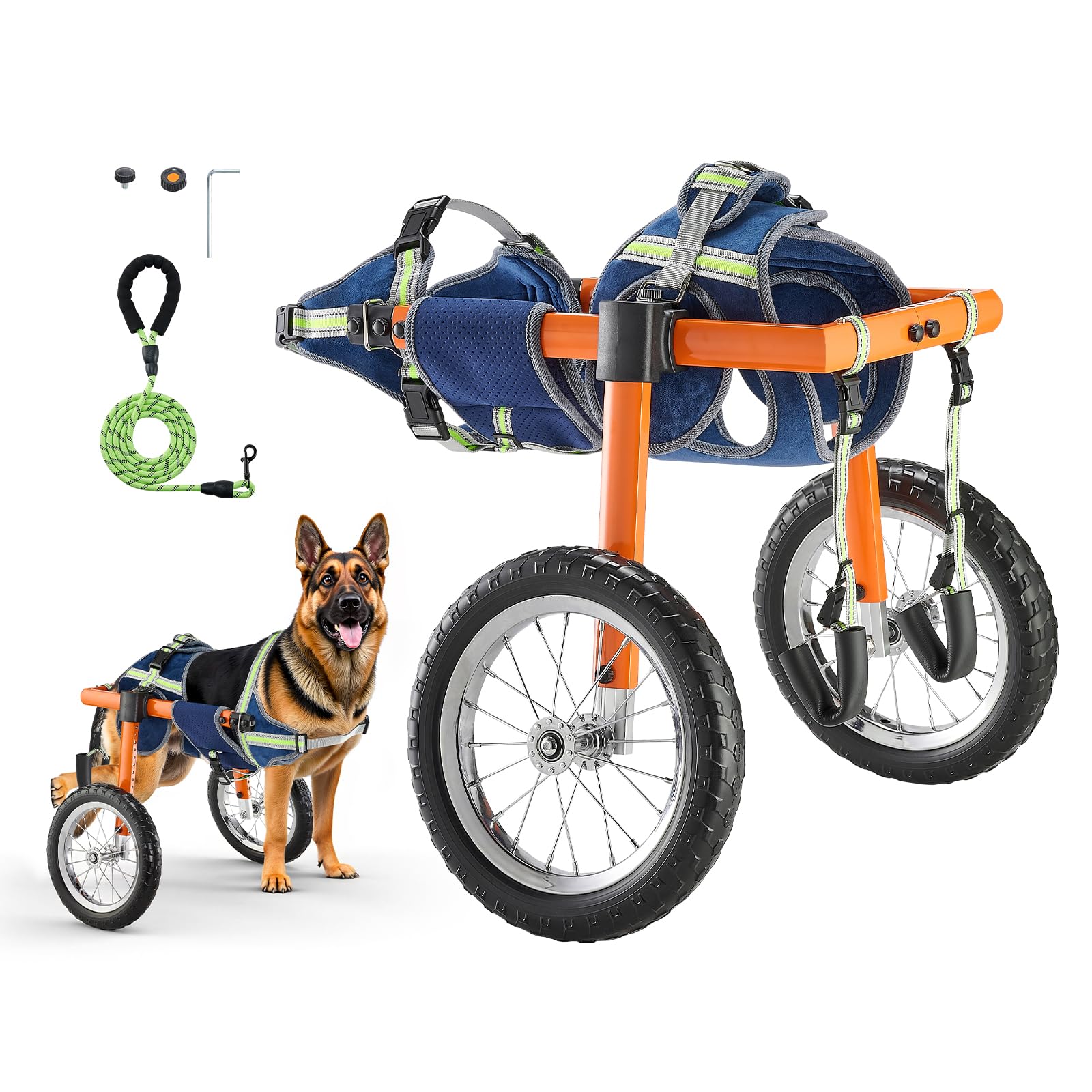
7. VEVOR Dog Wheelchair for Back Legs (X-Small)
A 1.9-pound X-small cart that gives a medium Aussie new hips-on-wheels for a fraction of the premium price.
If price is the deciding factor, this is the most budget-friendly rear cart on the list, rated for dogs up to 22 pounds. The aluminum frame weighs just 1.9 pounds, built from a reinforced 1.5 mm thickened tube — stronger than the standard 1 mm frames. The shock-absorbing silent wheels with EVA tires smooth out bumps, and the 5-point harness keeps the dog secure. It’s designed to assemble in minutes with spring buckles and simple screws.
Build quality and sturdiness get the most praise. One owner says a medium Australian Shepherd with weak hips was walking and trotting after adjustment, which helped the family avoid euthanasia. Another owner reports their dog with partial back-leg mobility works on grass, dirt, and wet packed sand. A D-ring (a metal loop) lets you clip a leash for secure outings.
Fit is the big mixed note here. One owner’s 12lb shih tzu found it too small — the seller kindly issued a full refund and suggested donating the unit to a vet’s office. The sling design also gets criticism: the front velcro wings can be too short to secure around some dogs’ necks at the narrowest setting. And for a fully paralyzed dog, the cart requires full disassembly for sitting, which gets frustrating. This is a support cart, not a full-paralysis solution.
The strongest point: Owners praise the sturdy build and sturdy wheels that roll over varied terrain better than other budget carts.
The honest catch: Fit varies — a 12-pound shih tzu found it too small — so measure, and don’t expect it to handle total paralysis.
The fit you want: A small-to-medium dog with partial rear weakness that needs affordable support for daily walks.
The fit to avoid: A fully paralyzed dog that needs to sit frequently, or a dog that’s even slightly outside the 22-pound limit.
Understanding the Specs
Floor-to-Hip Height
This is the measurement that determines whether a cart fits at all. You measure from the ground to the top of your dog’s back at the hindquarters while they stand. Every cart lists a leg-height range (like 6-8 inches or 20-22 inches), and if your dog falls outside it, the support sits in the wrong place and the cart won’t do its job. Get this number before you buy anything.
Weight Capacity vs. Frame Weight
The maximum dog weight tells you what the frame can carry safely — from 10 pounds on a toy-breed cart up to 180 pounds on a large-dog model. The frame weight tells you how much you’ll lift daily. A 21-pound frame is heavy but stable for a big dog; a 1.9-pound frame is easy to carry but only suits small breeds. Match both numbers to your dog, not your budget.
FAQ
How do I measure my dog for a back leg wheelchair?
Will a rear-support cart work for a fully paralyzed dog?
What is the difference between a 2-wheel and 4-wheel dog wheelchair?
How long does assembly take?
Can my dog use the wheelchair indoors and outdoors?
Will the cart hurt or rub my dog’s skin?
How do I know if my dog is too big or too small for a specific model?
Is a cheap dog wheelchair worth buying?
Final Thoughts: The Verdict
If you want one dependable pick, the back leg dog wheelchair winner is the Walkin’ Wheels Large because it’s the one that genuinely carries a heavy, paralyzed dog through a full year of daily use while adapting to a changing condition. If you want a small-breed cart that earns its price with durability and off-road wheels, grab the Walkin’ Wheels Small Pink. And for a tight budget with a small dog, the VEVOR X-Small delivers surprising sturdiness at the lowest entry cost.
How We Picked
We do not accept paid placement. Every pick is matched to a real buyer and a real use-case; we do not hands-on test units.
Sources & Methodology
Specifications: manufacturer listings and product documentation. Review insights: verified customer reviews, as of August 2026. Pricing: not shown on this page (it changes often); check the current price via the retailer link.
As an Amazon Associate, Gadgets Feed earns from qualifying purchases. This does not affect which products we feature.