
Our readers keep the lights on and my morning glass full of iced black tea. As an Amazon Associate, I earn from qualifying purchases.
Specs are compiled from manufacturer listings and verified buyer reviews and can change over time — please confirm the key details on the product page before buying.
Every carpenter square in this list will help you lay out rafters, mark square cuts, and scribe repeatable lines — but the real difference is in how clearly you can read the markings and how square the tool stays after a season on your belt. This guide ranks nine squares by marking clarity, durability, and layout precision.
I’m Min — the founder and writer behind Gadgets Feed. This guide is built by comparing the manufacturers’ published specifications and the patterns across verified customer reviews, so you get each pick’s real strengths and trade-offs instead of marketing spin.
The right carpenter square holds accuracy, survives drops, and keeps its markings readable for years of framing and woodworking.
Our Picks at a Glance


How To Choose The Best Carpenter Square
The first decision is the shape. A rafter square (the triangle) is for quick angle marking and saw guides; a framing square (the big L) is for full layout on wide boards; a try square is for checking 90-degree accuracy on joinery. Most serious shops own at least two of these.
What the scale graduations really give you
Squares come with different graduation ranges — the finest markings printed on the tool. A 1/8-inch scale is fine for rough framing lumber, but if you need to lay out a precise cut on trim or cabinetry, look for a 1/16-inch scale. A 1/16-inch scale doubles the marking fineness over 1/8-inch for precise trim and cabinetry work.
Why material and markings matter
Aluminum squares resist rust and stay light on a tool belt, but softer alloy can bend if dropped. Steel framing squares are heavier and sturdier, yet prone to corrosion if not oiled. Laser-etched or deep-stamped markings will not wear off, unlike printed stickers that fade after heavy use.
Quick Comparison
| Model | Best For | Type | Graduation | Material | Amazon |
|---|---|---|---|---|---|
| Beslands 12″ Rafter Square★ Best Overall | Large board marking | Rafter Square | 1/8 Inch | Aluminum Alloy | Amazon |
| Mr. Pen 7″ & 12″ SetBest Value | Two-tool versatility | Rafter & Combo | 0.03 Inch | Aluminum, Brass, Steel | Amazon |
| WORKPRO 8″ Try SquarePrecision Pick | Precision 90° checks | Try Square | 0-8 Inches | Stainless Steel | Amazon |
| Klein Tools 7″ Rafter Square | Jobsite durability | Rafter Square | 0-90 Degrees | Aluminum | Amazon |
| Crescent Lufkin EX6 | Wide materials on the go | Extendable Layout | Laser Etched | Aluminum | Amazon |
| Johnson CS9 Framing Square | Rough framing layout | Framing Square | 1/16 Inch | Alloy Steel | Amazon |
| Preciva 12″ Rafter Square | Accurate 1/16″ layout | Rafter Square | 1/16 Inch | Aluminum Alloy | Amazon |
| POWERTEC Framing Square | Straight-edge work | Framing Square | 1/16 Inch | Carbon Steel | Amazon |
| IRWIN Hi-Contrast Square | Sunlight readability | Framing Square | 1/16 Inch | Aluminum Blend | Amazon |
In‑Depth Reviews
1. Beslands Aluminum 12-inch Rafter Square
Our pick — over 4.5★ from 550+ verified ratings; the strongest balance of quality and price.
The big 12-inch triangle that reads clearly even when your eyes are tired.
Its 12-inch edge marks a full line across wide lumber in one pass. — the 12-inch edge (the surface measures 17″L x 12″W) lets you mark a full line across wide lumber in one pass, from 1/8-inch graduations that are laser-etched so they will not wear off. It is precision-machined from aluminum alloy, so it is corrosion-resistant and light enough to clip onto a tool belt without bending.
Buyers report it is “true/square out of box; easy-read markings, multiple measuring modes; works as saw guide; ridge locks securely; great build quality, proper angle.” The built-in lipped edge locks onto the edge of lumber, making it a safe, repeatable saw guide for framing and roofing work. As owners put it: the large lettering is a genuine help for aging sight, and the hefty feel signals durability that should last a lifetime.
One practical caveat: a few owners note the actual measuring edge comes in just shy of a full 12 inches — closer to 11.5 inches — so it is ideal for framing and larger boards, but less ideal for precision work on 1-foot materials. Compared to the Mr. Pen set below, this single tool trades versatility for sheer marking real estate, and it uses a coarser 1/8-inch scale rather than the finer 0.03-inch graduations.
What wins people over
- Large 12-inch edge marks wide boards fast
- Corrosion-resistant aluminum stays true
- Laser-etched markings stay readable
- Works as saw guide, protractor, and depth scriber
Where it comes up short
- Measures ~11.5 inches, not a full 12
- Coarse 1/8-inch scale for fine layout
Reach for this if: you frame, roof, or mark large boards all day and want one durable, easy-reading square on your belt.
Look elsewhere if: you need a fine 1/16-inch scale for precision cabinetry layout.
2. Mr. Pen Rafter Square & Combination Square Set
Two squares that cover marking, leveling, and depth checks from one pocket.
The package gives you a 12-inch combination square and a 7-inch rafter square — two tools in one order (a 2.0x gap in item count versus the single Beslands above). The combination square works as a level, depth gauge, and ruler, with a spring-loaded brass bolt and stainless steel blade marked in 1/16, 1/8, and 1/32 inch increments. The 7-inch triangle is die-cast billet aluminum with a non-glare matte finish.
This set wins people over on quality and value for money — the top two things owners mention. One measured the combination square for 90° accuracy and found it “less than 0.05° off. That’s more than good enough for my amateur woodworking needs.” The white gradations on the rafter square stay readable in any light, and both tools are sized to fit easily into a pocket.
The honest trade-off is accuracy and durability get mixed feedback: some report the square is quite accurate, others say it falls short, and a few mention the tool coming apart. One owner noted the line length for 1/4″ is the same as 1/8″ on the combination blade — a minor readability quirk you might notice after repeated use.
Two-tool versatility: you get a precise 12-inch combo square and a pocket-friendly 7-inch rafter square for roughly the price of one premium tool — the smart money pick for a first kit.
Mixed consistency: build quality varies unit to unit, so check the 90° accuracy when it arrives.
Pick this for: a beginner or hobbyist who wants both square types without buying two separate tools.
Think twice if: you are a pro who needs guaranteed repeatable precision straight from the box.
3. WORKPRO 8-Inch Try Square
The featherweight 90-degree checker that keeps elbows and wrists happy.
This is a try square, not a rafter square — its whole job is verifying right angles on joinery. It weighs just 9.9 ounces (the metric 280 g), so it is genuinely easy to carry, with an ergonomic aluminum handle designed to ease pressure on the elbows and wrists during long marking sessions. The blade is 0.08 inches thick and fixed with 3 pins, so it resists deforming.
Owners praise its accuracy and the durability of the etched markings — one noted it “passes flip test for accuracy,” and the squareness holds throughout the ruler length. It has centimeters on one side and inches on the other, plus a 45-degree measuring angle added at the handle, so it covers the two angles you actually check most. The 9.7″L x 1.5″W body makes it a compact 75% longer than a small pocket square but still sleeve-friendly.
The recurring gripe is that the metric scale sits on one side instead of inches on both sides — a minor annoyance if you never work metric. A more expensive square offers a rebate to keep it level on the work surface; this one lacks that, so it can rock slightly on uneven boards.
The strong points
- Ultra-light 9.9 oz for carry-all-day comfort
- Accurate 90° checks with etched markings
- 3-pin fixed blade resists deformation
- Inches and centimeters on opposite sides
Minor friction
- Metric side only — no dual inches
- No rebate to sit level on uneven work
Best for: woodworkers who need a light, accurate right-angle check for joinery and trim work.
Not for: framing layout on wide lumber — that needs a rafter or framing square instead.
4. Klein Tools 9357SSQ Rafter Square
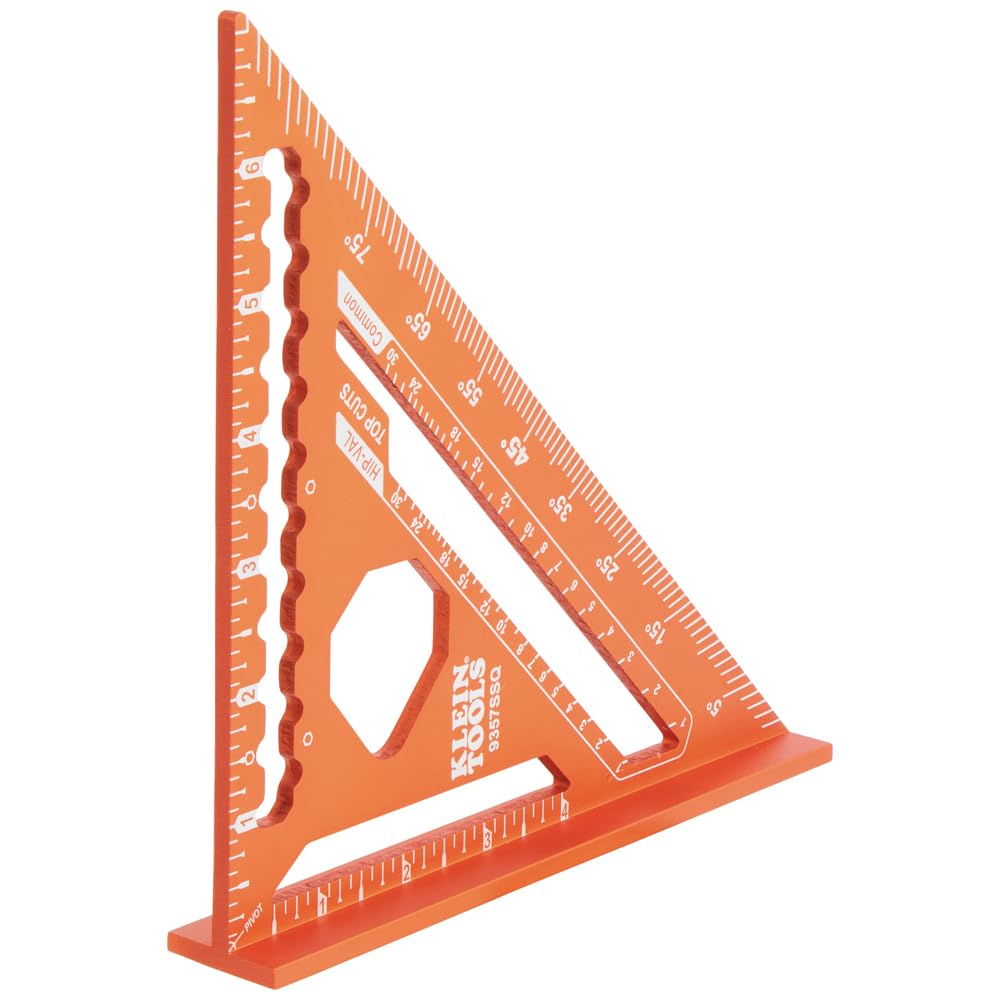
A bright orange 7-inch square that is hard to lose and easy to trust.
Klein built this 7-inch rafter square with double laser-etched markings on both faces, so the numbers stay visible for a long time even with heavy use. It has 0 to 90-degree markings etched directly on the tool for identifying angles, plus scribe notches that hold a carpenter pencil to create evenly spaced marks at 1/4-inch intervals. There is even a pipe prop to hold metal or plastic pipe steady for cutting.
Owners call it the best speed square they have owned, with the bright orange color making it easy to spot on a messy bench. The thick aluminum and sharp edges give precise marking, and the wide lip catches boards securely. One owner noted the anodization is more durable than a competing brand’s finish.
The mixed feedback centers on the marking feature: the pencil notches are rounded instead of a sharp V, and the 1/4-inch spacing alternates sides rather than offering 1/8-inch offset on both. It is still accurate and readable — just not the most versatile scribing tool in the category.
Built to last: thick aluminum, double-etched markings, and a wide lip make this a daily-driver square that survives jobsite abuse.
Marking limits: rounded notches and 1/4-inch-only spacing mean it is less flexible for fine scribing than some rivals.
Reach for this if: you want a tough, highly visible 7-inch square for everyday framing and roofing.
skip it if: you need fine 1/8-inch scribe spacing on both edges.
5. Crescent Lufkin EX6 2-in-1 Layout Tool

A 6-inch fold-out arm that replaces carrying two separate squares.
The clever trick here is the 6-inch fold-out extension arm: it flips out when you need to mark wide material, then locks back flush with a thumb lock. That means you do not need to carry both a 7-inch and a 12-inch square — this 11.68-ounce tool becomes both. The solid aluminum body carries a corrosion-resistant finish and laser-etched markings.
Owners call the precision remarkable, especially with the extension out, and the red extension arm makes the tool easy to find on a cluttered table. It squares off 2x10s cleanly, and the tight hinge mechanism keeps the fold-out stable during marking. The extension is the aspect owners mention most after overall quality.
The main friction is readability: the numbers and tick marks stand out on one side, but some owners find them hard to read on the opposite side. If you work mostly in one orientation it is a non-issue, but it is worth turning over before you buy.
Why it stands out
- 6-inch extension replaces a second square
- Corrosion-resistant aluminum body
- Laser-etched markings for durability
- Red arm is easy to spot
The catch
- Markings hard to read on one side
- Heavier than a basic 7-inch square
Grab this for: carpenters who mark wide boards and hate carrying a separate 12-inch square.
Pass if: you rarely work wider than a single 7-inch layout and want the lightest possible belt tool.
6. Johnson Level & Tool CS9 Framing Square

A 16 by 24-inch steel workhorse that shrugs off welding-shop abuse.
This full-size framing square is built from high-quality stainless steel to resist rust and corrosion, and it carries the EZ Read thermal-bonded graduations in 1/8, 1/10, 1/12, and 1/16-inch increments. It includes octagon scales, brace tables, rafter tables, and board foot tables — everything you need for framing, layout, rafter and stair work. At 1.4 pounds it has the heft to stay put while you mark.
Owners who build feedlot gates say it has held up great under extensive use in a welding shop, which tells you the steel body can take real punishment. The 1/16-inch markings beat the bargain-store squares that only offer 1/8-inch graduations, and the accuracy is called perfect for the job. Owners highlight its stainless steel body that survives welding-shop abuse.
The sticky point: the EZ Read sticker. Several owners mention the adhesive is problematic — the sticker will not come off at all, leaving a residue or a loosened label. It is a finish annoyance, not a function problem.
Rough-use ready: the stainless steel body survives welding-shop conditions and heavy framing without rusting.
Finish friction: the thermal-bonded sticker can be genuinely hard to remove cleanly.
Best for: builders who need a big, durable framing square on a budget and do not mind a sticker quirk.
Not for: anyone who wants a clean, printed-free aluminum surface straight from the start.
7. Preciva 12-inch Carpenter Square

A 12-inch triangle with the fine 1/16-inch scale most rafter squares skip.
This square is the same 12-inch size as the Beslands, but it steps up the measurement detail with a 1/16-inch scale instead of the standard 1/8-inch — so you get more accurate data and a wider range of applications for fine layout, drilling positioning, and locating table saw height. The aluminum alloy body carries laser-calibrated markings that are scratch-resistant to hold lasting accuracy.
Owners praise its exact accuracy and easy-to-read laser-calibrated markings., with the accuracy called exact and easy to read. A DIYer who built an entire deck this summer said these squares worked exceptionally well as an affordable alternative to the name brands — solid proof the 1/16-inch precision translates to real framing tasks. It handles parallel lines, vertical lines, and angle lines in one tool.
Pen set, which gives you both a combo square and a 7-inch rafter square. If you already own a combo square, this is the better upgrade; if you own nothing, the set may be smarter value.
Why it earns its place
- Fine 1/16-inch scale for precise layout
- Laser-calibrated, scratch-resistant markings
- Aluminum alloy resists corrosion
- Multi-use for parallel, vertical, and angle lines
Consider this
- Single tool — no combo square included
- Costs more than a basic 7-inch square
Pick this for: layout work where the extra precision of a 1/16-inch scale actually matters.
Choose the set instead if: you are building a first kit and need the combo square’s level and depth functions too.
8. POWERTEC Framing Square 16″ x 24″
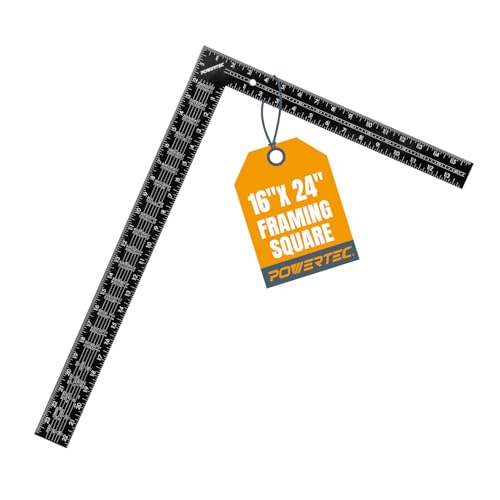
The flat, true 24-inch edge that doubles as a circular saw guide.
Two owners in the review trail bought this 16″ x 24″ framing square specifically to use as circular saw edge guides, and they work perfectly for it — the steel profile stays flat and straight, with a bit of weight to keep it planted. The front face carries imperial units with a rafter table, while the back shows metric units, all in graduated scales of 1/8, 1/10, 1/12, and 1/16-inch increments.
Owners praise its stout, straight edge that stays true after drops. — it is a stout straight edge that never bends, and it stays square even after a drop, according to owners. It measured 24 inches to the notch accurately end to end, and one owner used it to mix a cylinder head and got exactly the numbers the machine shop produced. Owners highlight its flat, true edge that never bends.
The catch is the markings: the printed sticker scale is easily scratched, and the thick edge offsets the marks from the paper, so it is not a great ruler for tight measurement — it is an excellent straight edge and layout tool instead. It also needs occasional oiling to resist corrosion.
Flat and true: carbon steel construction with a rail design makes this a precision straight edge that holds up to drops.
Marking limits: the printed sticker can scratch, so treat it as a layout guide rather than a fine ruler.
Reach for this if: you want a reliable straight edge for saw guides, layout, and checking flatness.
Pass if: you need a ruler-grade scale that survives heavy abrasion.
9. IRWIN Tools Hi-Contrast Framing Square
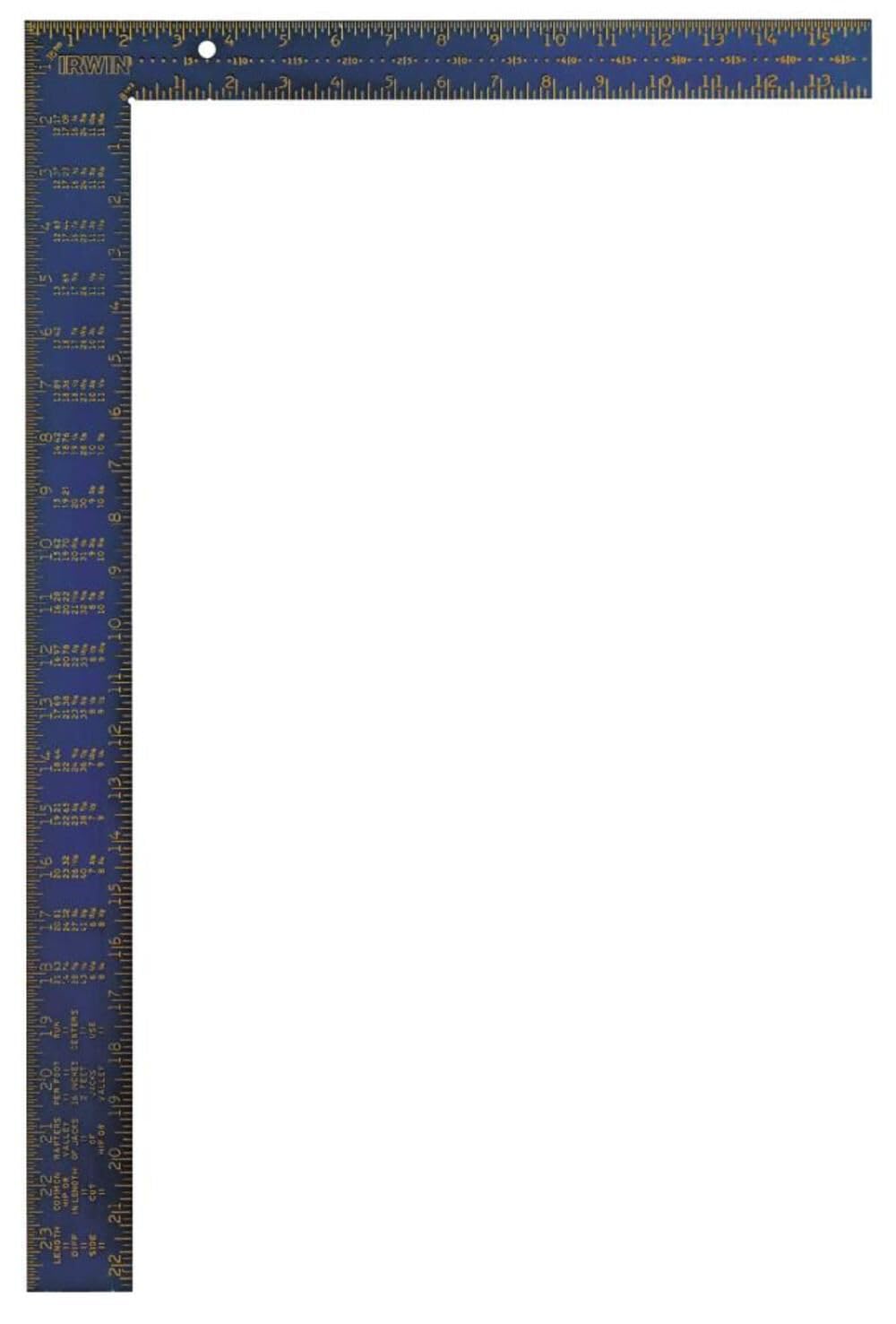
The 16 by 24-inch square with yellow markings that refuse to glare in the sun.
IRWIN’s signature move here is the yellow markings on a blue aluminum background — the highest-contrast combination in this lineup, and owners who work outdoors say it eliminates reflection so measurements stay easy to read in direct sunlight. It carries permanent deep stampings for durability, with multiple scales of 1/8, 1/10, 1/12, and 1/16-inch, plus rafter tables, brace and octagon scales, and essex board measure. At just 12.64 ounces it is far lighter than the steel framing squares.
Owners with failing eyesight praise the yellow-on-blue markings for easy reading. — one owner with failing eyesight swapped to this square because the numbers are finally easy to see. It is a favorite for amateur woodworkers who want a solid, easy-reading framing square without paying for a heavy steel tool.
The honest caveat: accuracy gets mixed feedback. One owner measured the 24-inch leg and found the angle acute by about 0.04 inches — likely fine for rough framing, but not a precision instrument. Another notes it is not perfectly square and the blue is not as high-contrast as claimed, though most agree it is good enough for carpentry.
The standout traits
- Yellow-on-blue markings are glare-free in sunlight
- Lightweight 12.64 oz aluminum body
- Permanent deep stampings resist wear
- Full rafter and brace tables included
Know the limits
- Not perfectly square at the long end
- Mixed feedback on true contrast level
Choose this for: outdoor framing where glare kills readability on dark or shiny squares.
pass on it if: you demand absolute perpendicular accuracy at the full 24-inch run.
Understanding the Specs
Graduation Range
This is the finest scale printed on the square — typically 1/8-inch or 1/16-inch. A 1/8-inch scale is fine for rough framing lumber, but a 1/16-inch scale (or the 0.03-inch on the Mr. Pen) gives you finer, more accurate markings for trim and cabinetry. If you see 0-90 degrees on a rafter square, that is the angle scale etched into the hypotenuse for reading roof pitches.
Material and Marking Method
Aluminum squares resist rust and stay light on a tool belt, but softer alloy can bend if dropped hard. Steel framing squares are heavier and sturdier, yet prone to corrosion without oiling. Laser-etched or deep-stamped markings survive years of use, whereas printed or thermal-bonded stickers can scratch off or refuse to peel away cleanly.
FAQ
What is the difference between a rafter square and a framing square?
Is a 7-inch rafter square big enough for framing work?
What does a 1/16-inch scale give me over a 1/8-inch scale?
Are laser-etched markings better than printed ones?
Can I use a carpenter square as a circular saw guide?
Is a try square different from a rafter square?
Will an aluminum square bend if I drop it?
Why does the Klein square have scribe notches?
Do carpenter squares stay accurate forever?
Final Thoughts: The Verdict
For most people, the carpenter square winner is the Beslands 12-inch Rafter Square because it pairs a large 12-inch marking edge with durable laser-etched aluminum at a mid-range price. If you want two tools in one order for a first kit, grab the Mr. Pen 7-inch and 12-inch set. And for wide-board layout plus saw-guide duty, the POWERTEC 16 x 24-inch framing square is the one to reach for.
How We Picked
We do not accept paid placement. Every pick is matched to a real buyer and a real use-case; we do not hands-on test units.
Sources & Methodology
Specifications: manufacturer listings and product documentation. Review insights: verified customer reviews, as of August 2026. Pricing: not shown on this page (it changes often); check the current price via the retailer link.
As an Amazon Associate, Gadgets Feed earns from qualifying purchases. This does not affect which products we feature.