
Our readers keep the lights on and my morning glass full of iced black tea. As an Amazon Associate, I earn from qualifying purchases.
Specs are compiled from manufacturer listings and verified buyer reviews and can change over time — please confirm the key details on the product page before buying.
An 18650 battery charger is one of those small tools that quietly decides whether your flashlight, vape mod, or headlamp lives a long life or dies young. The real difference between chargers isn’t the brand name — it’s whether the device pushes the right current, reads the cell correctly, and refuses to overheat. A good one protects your batteries; a sloppy one can shorten their lifespan or worse. When you’re juggling 18650s alongside 21700s, AAAs, and Ni-MH cells, you want one box that handles them all without babysitting.
I’m Min — the founder and writer behind Gadgets Feed. This guide is built by comparing the manufacturers’ published specifications and the patterns across verified customer reviews, so you get each pick’s real strengths and trade-offs instead of marketing spin.
You need a charger that won’t fry your cells or waste your time. This roundup covers everything from a simple two-bay unit to an eight-slot lab bench, so you can match the right charger to your battery drawer.
Our Picks at a Glance


How To Choose The Best 18650 Battery Charger
Your choice depends on your gear. Two flashlights? A dual-bay charger is enough. A fleet of vape batteries or solar-light cells? Go for four or eight bays, so nothing sits half-charged for days.
Match the Current to the Cell
Charging current is measured in amps (A), and it controls how fast a battery fills. A 1A charge is gentle and safe for most 18650s, while a 2A charge tops up faster but generates more heat. The smartest chargers let you switch between a slow 0.5A trickle and a fast 2A burst depending on the cell and your patience.
Size and Slot Count Matters More Than You Think
Long protected 21700 batteries need a deep slot, often around 75mm, or they won’t seat properly. Check the specs for “75mm” before you buy if you own those longer cells. Also count the bays — four-slot chargers almost always charge slower per slot than a dedicated dual-bay unit because the total power gets split.
Don’t Skip the Safety Net
Lithium-ion cells are energy-dense, so a charger should have built-in protection against over-current, over-voltage, reverse polarity, and short circuits. You also want automatic shutoff when the cell hits full — nobody should rely on remembering to unplug it at 4.2 volts.
Quick Comparison
| Model | Best For | Slots | Max Charge Current | Input Power | Amazon |
|---|---|---|---|---|---|
| EdisonBright Fenix are-A2★ Best Overall | Cool-running all-rounder | 2 | 1 A | 240 volts | Amazon |
| VCYWE 2-Slot ChargerBest Value | USB power-anywhere backup | 2 | 2 A | 5 volts | Amazon |
| XTAR VC4Top Performer | Versatile four-bay value | 4 | 1 A | 5 volts | Amazon |
| WISSBLUE LCD-4 | Adjustable charging speed | 4 | 2 A | 5 volts | Amazon |
| IMREN K4 | Fast single-cell flexibility | 4 | 2 A | 5 volts | Amazon |
| WANGDAJIEDIAN EL-4 | Independent bay control | 4 | 2 A | 5 volts DC | Amazon |
| Nitecore UMS2 | Sleek travel companion | 2 | 3 A | 5 volts | Amazon |
| XTAR VC8 | Eight-slot capacity grading | 8 | 3 A | 5 volts | Amazon |
| Nitecore UMS4 | Four-bay QC3.0 speed | 4 | 3 A | 12 volts | Amazon |
In-Depth Reviews
1. EdisonBright Fenix are-A2 Smart Battery Charger
Our pick — over 4.5★ from 750+ verified ratings; the strongest balance of quality and price.
A cool-running dual bay that owners trust with their priciest 18650s
The defining trait here is heat control — buyers report “This charger will not warm up 18650 batteries,” which is the single most reassuring sentence you can read about a lithium-ion charger. It draws 240 volts at the wall and outputs a gentle 1A per bay, which is exactly the kind of low-stress current that keeps cells cool to the touch during and after a charge.
Compatibility is the headline feature, with 34 owners calling it out as the top reason they bought it. It accepts 10440, 14500, 16340, 18650, 21700, 26650, plus Ni-MH/Ni-Cd AA, AAA, and C cells, so it covers nearly everything in a typical battery drawer. The big, easy-to-read LCD shows voltage, current, and a charge timer — and the whole bundle includes the EdisonBright BBX5 carry case for storing spare cells.
Charging speed earned the second-most praise, with several owners noting it finishes faster than their older Nitecore units. Safety is layered in with short-circuit, over-current, over-voltage, and reverse-polarity protections, plus UL and FCC certification. The only recurring gripe is the included battery case — it doesn’t fit rechargeable batteries quite right, so treat it as a bonus, not a feature.
What Wins People Over
- Stays cool through a full charge, protecting cell health
- Charges two different size batteries at the same time
- Detailed LCD shows voltage, current, and charge time
The Honest Trade-offs
- Included carry case is a poor fit for rechargeables
- Only 2 bays — big collections need a rotation
Reach for this if: you want a safe, cool, no-drama charger that handles 18650s and 21700s without warming them up.
Look elsewhere if: you routinely charge more than two cells at once and need a bigger bay count.
2. VCYWE 2-Slot USB Charger
A budget dual bay that doubles as an emergency phone power bank
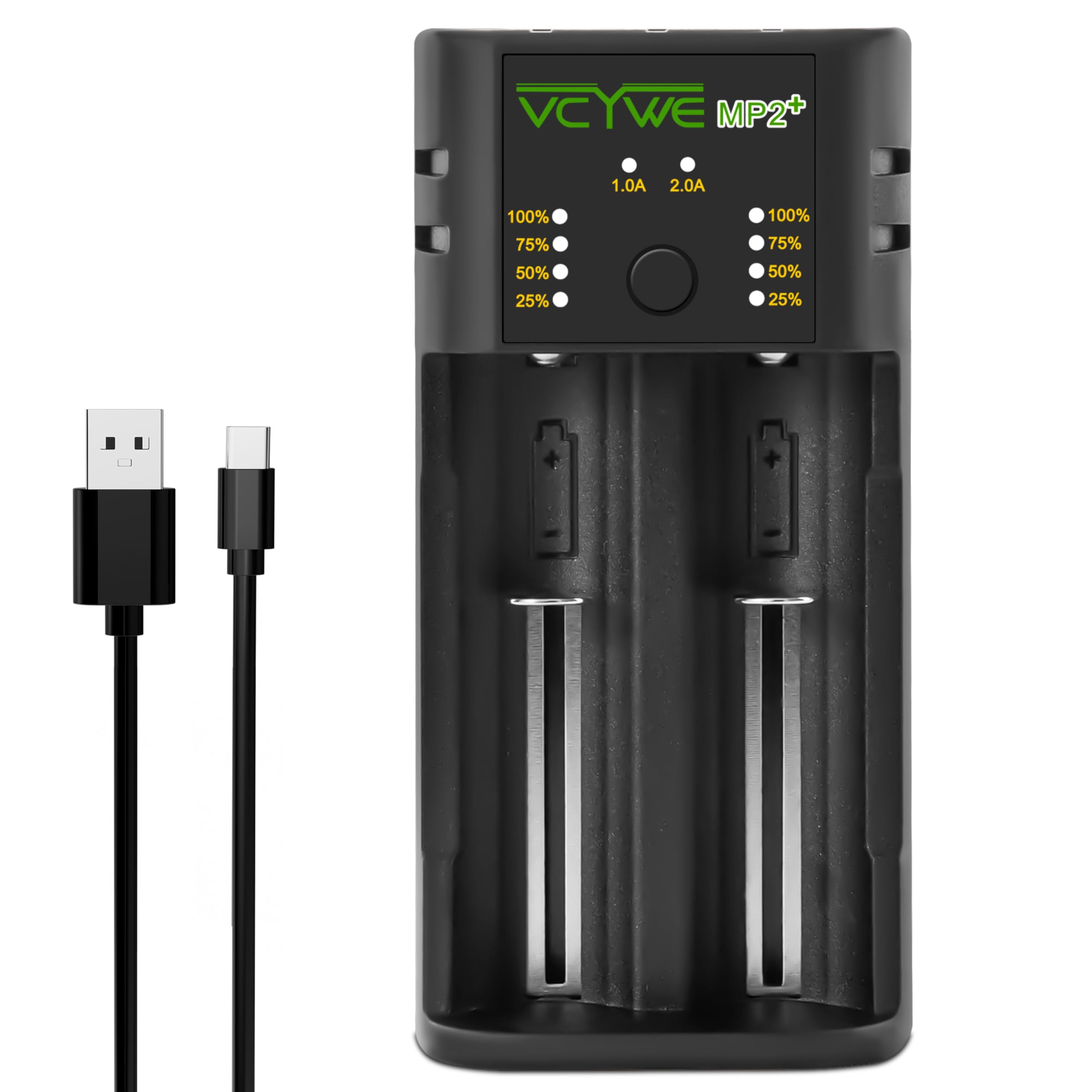
This one takes a different angle than the EdisonBright above — instead of a wall plug, it runs entirely off USB power at 5 volts, drawing a faster 2A. That means you can charge at home, in the car, or from any laptop, which is why owners mention “I needed a charger for 2/3 AAA batteries” and found it handled the odd sizes without complaint.
The clever a neat extra is the emergency output: pop an 18650 into the right slot and it can charge your phone or another USB device in a pinch. That’s a genuinely useful backup for camping trips or power outages. Battery compatibility is the most-praised aspect, covering 3.6/3.7V Li-ion cells like 10400, 14500, 16340, 18350, 18500, 18650, 20700, 21700, 22650, and 26650, plus 1.2V Ni-MH/Ni-Cd in AAAA, AAA, AA, A, SC, C, and F6.
The 4-level LED indicator (25%, 50%, 75%, 100%) is simple rather than fancy, and a one-year warranty backs it up. It weighs just 0.12 kg, making it the most travel-friendly pick here, and it comes with multiple built-in safety protections. Just remember — batteries are not included, which the listing states clearly.
Why It’s a Steal
- USB powered — works anywhere with a phone adapter or car charger
- Acts as an emergency power bank for your phone
- Ultra-light at 0.12 kg
Keep in Mind
- No LCD readout — just a 4-step LED
- Faster 2A current means more heat on sensitive cells
Grab it for: the traveler who wants one tiny charger that also rescues a dead phone.
Think twice if: you want per-cell voltage data — this one only shows rough progress.
3. XTAR VC4 Universal 4-Slot Charger
The four-bay workhorse famous for reviving cells other chargers reject
Charging performance is what wins people over here — 64 owners single it out, and the stories are remarkable. Customers note it “Revived 18650 battery Nitecore D4 rejected,” and another describes it bringing back batteries its expensive Powerex C9000 had declared defective. That’s a capability worth real money if you’ve got a drawer of “dead” cells.
It’s the biggest unit in the lineup at 7.36 ounces and 4.53″D x 5.87″W x 1.38″H — about 2.8 times the footprint of the compact EdisonBright. In exchange you get four independent bays that charge simultaneously, and the LCD shows each cell’s voltage, type, charging current, and charged capacity independently. You can choose a slow 500mA charge or bump it to 1000mA fast mode.
Battery compatibility is the second most-praised aspect, covering 10440, 14500, 16340, 18350, 18650, 25500, 32650, and Ni-MH AA, AAA, C, and D. The catch? Reviewers point out it cannot charge protected 20700 and 21700 batteries — for those, XTAR points you to its X4 or VC8. Also, it uses a barrel connector instead of USB-C, so if you lose that cable it’s a pain to replace.
Loved For
- Revives over-discharged cells other chargers reject
- 4 independent slots with per-cell LCD data
- Selectable 500mA slow / 1000mA fast charging
Fair Warning
- No 21700 support for protected cells
- Proprietary barrel cable, not USB-C
Best for: the hobbyist with a mix of odd cells who wants to resurrect old batteries instead of trashing them.
Not for: anyone whose main batteries are protected 21700s — this one won’t fit them.
4. WISSBLUE LCD-4 Universal Charger

Press one button to switch between a slow trickle and a 2A blast
Adjustability is the whole story here. The “a” button cycles through 0.5A, 1A, and 2A charging speeds, so you can gently top off a delicate 16340 or fast-charge a beefy 26650 in the same session. A separate “C” button flips the LCD between ports, showing charging time, capacity, voltage, progress percentage, and battery type on demand.
Compatibility is the most-praised aspect, with the charger auto-recognizing any 3.7V lithium cell or 1.2V Ni-MH/Ni-Cd AA battery between 29mm and 75mm long. The unique discharge function is a nice bonus — it can drain a cell slowly to reduce damage and help you spot weak batteries before they fail you in the field. Four bays charge independently, and the whole unit stays compact enough to earn “travel charger” status.
Honest caveat: charging performance gets mixed feedback in the review data. Shoppers say a pattern where one battery charges at 2A, two drop to 1A, and three or four drop again to 0.5A — so the headline 2A speed only applies when you’re charging a single cell. Also note the spring holders lack travel, making battery insertion a bit fiddly compared to smoother bays.
What Stands Out
- Manual 0.5A/1A/2A speed control per session
- Discharge function to test and protect weak cells
- Handles battery lengths from 29mm to 75mm
Watch For
- Full 2A speed only with a single battery installed
- Springs feel short-travel, so seating cells takes care
Choose it for: the tinkerer who wants manual control over charge speed and a discharge tester built in.
skip it if: you always charge four cells at once and don’t want the speed drop.
5. IMREN K4 4-Bay USB-C Charger

A 4-bay fast charger whose 75mm slots swallow even button-top 21700s
Charging speed is the crowd favorite here — 44 owners single it out as the reason they bought it. Hit the MODE button and the two default 1A slots jump to a 2000mA fast-charge mode, which buyers report can top up a pair of 18650s in about 30 minutes on a 12V source. That’s genuinely quick for this category.
The connectivity angle is modern too — it’s USB-C powered, so the included cable works with phone adapters, car chargers, laptops, or power banks. The 75mm long slot is the practical standout: it comfortably seats 21700, 20700, 26650, and button-top 18650s without cramming. Charging capacity earned praise because you can charge any number of batteries (1, 2, 3, or 4) without pairing them, and it auto-detects Li-ion versus Ni-MH cells.
Quality is the second most-praised aspect, with owners noting the built-in regulators won’t allow overcharge. The recurring operational tip from buyers: plug it in and let it boot up before loading batteries, or you risk damaging the unit or cells. It’s a plastic device, so treat it with care. The negative “battery life” mentions relate to cheap cells, not the charger itself.
The Highlights
- 2000mA fast mode charges a pair of 18650s in ~30 min
- USB-C input works with nearly any modern adapter
- 75mm slots fit long protected 21700s
The Catch
- No printed instructions included
- Must boot up before loading batteries to avoid damage
Pick it if: speed matters and you carry USB-C cables everywhere anyway.
Pass it by if: you’d rather not remember the boot-up sequence every time.
6. WANGDAJIEDIAN EL-4 4-Bay LCD Charger
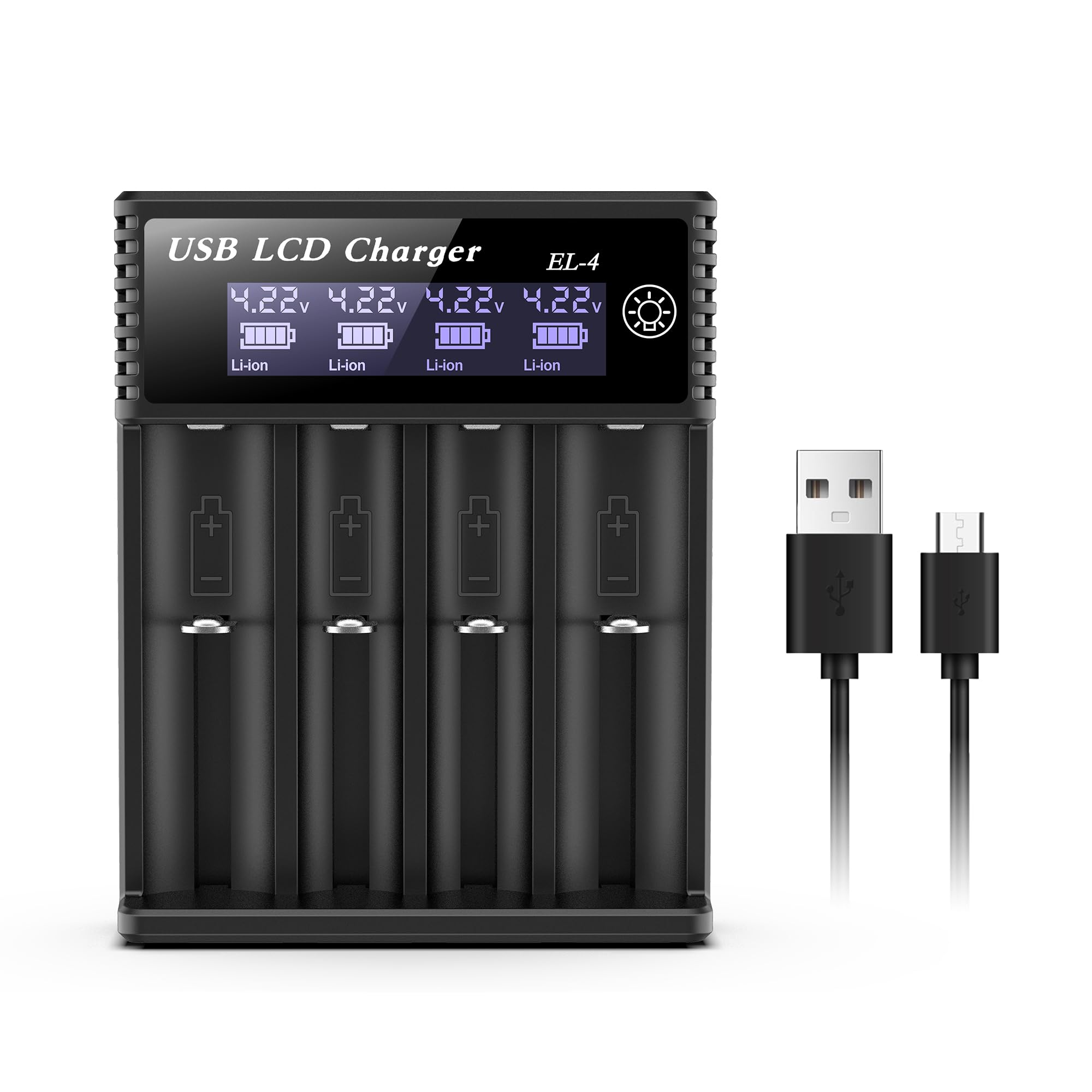
A budget four-bay with a brightness-adjusting LCD and flame-retardant shell
Quality is the most-praised aspect here, and the build backs it up — the body is made of flame-retardant PC material with a heat-dissipation-focused circuit design. The four bays charge independently without interfering with each other, and the LCD displays each slot’s voltage, current, charge, and battery type on its own screen. Touch the screen to adjust brightness, and it dims automatically after 30 seconds of inactivity.
The wide compatibility list is genuinely long: 18650, 21700, 21750, 18700, 10440, 14500, 16340, 17335, 17500, 17650, 18350, 18500, 26650, 25500, and AA, AAA, and C cells. Battery lengths from 29mm to 70mm fit the bays. For Li-ion cells it delivers up to 2A for a fast fill; for AA/AAA NiMH/NiCd it drops to 300mA, which is gentle on small cells.
Here’s the fit note: charging speed gets mixed feedback. Some owners say it works in the expected timeframe, while others report it doesn’t charge as quickly as advertised. One owner also flagged that 21700 batteries didn’t fit despite the claim. If you stick to 18650s and smaller, owners mention it holds batteries better than others and shows clear charge level and battery type on the indicators.
Build Quality Wins
- Flame-retardant shell with good heat dissipation
- Independent bays with per-slot LCD data
- Touch-to-adjust screen brightness
Be Aware
- Charging speed is slower than some rivals
- 21700 fit is questionable despite the claim
Ideal for: the budget buyer who wants a solid 4-bay 18650 charger with a clear display and won’t push 21700s into it.
Not for: users who mainly own long 21700 cells — measure before you trust the spec.
7. Nitecore UMS2 Dual-Slot USB-C Charger

The sleek 2-bay Nitecore that hits 3000mA per slot with a QC2.0 wall plug
Quality is the most-praised aspect here by a wide margin — 78 owners call it out, and the Nitecore reputation for reliability runs deep. It’s the compact travel hero of this list at 5.56 ounces, pairing a 2-bay charger with a matching battery organizer so you can carry cells and charger together.
Speed is the second most-praised trait, but it comes with a power-source caveat. With a standard 5V/2A USB source, each slot maxes at 1000mA. Pair it with a 9V QC2.0+ output adapter and a single slot jumps to 3000mA, or 2000mA per slot across both. That means the charger is only as fast as the wall plug you give it — worth knowing before you buy.
Compatibility covers IMR, Li-ion, LiFePO4, Ni-MH, and Ni-Cd across a huge size range including 18650, 16340, 14500, 20700, 21700, and rechargeable AA/AAA. The LCD reports battery health, charging status, and charging mode in real time. Fit note: reliability and USB connectivity draw mixed feedback — some units reportedly stop working or fail to power up, and one owner noted an irritating electrical squeal from the unit.
Loved For
- Slim, light, and pairs with a carry organizer
- Single-slot 3000mA burst with a QC2.0 adapter
- Auto-detects cell size, type, and voltage
Worth Knowing
- Speed depends on the wall adapter you supply
- Occasional units report power-up or squeal issues
Reach for it: on the go — it’s the smallest quality dual bay here and the organizer keeps cells tidy.
Look beyond it if: you want four slots or need guaranteed reliability from day one.
8. XTAR VC8 8-Slot Charger with QC3.0 Wall Plug

An eight-bay beast that tests your batteries’ true capacity instead of guessing
This is the biggest and most analytical charger here, juggling 8 slots at once. It comes with a QC3.0 wall charger (a quick-charge adapter) in the box. The headline feature is grading mode on the first four bays: the charger runs a “charging-discharging-charging” cycle to measure a cell’s real capacity, so you can finally catch overrated batteries. Customers note testing 3000mAh cells that measured a real 1230-1280mAh.
Value for money is the most-praised aspect, and it’s easy to see why. For the price of a couple of cheap dedicated chargers, you get an 18W unit with five selectable currents (3A, 2A, 1A, 0.5A, 0.25A), built-in temperature control, and XTAR’s patented “Three-Stage Lithium Battery Charging System.” The single-slot max of 3A kicks in only when battery resistance is low enough, so real-world charging is often slower — a full house of 8 cells drops to about 500mA each.
Honest fit note: charging performance and battery life draw mixed feedback, with some owners reporting units that stopped working after two months or lasted only about a year. Also, grading mode is slow — expect 8+ hours for a 2100mAh cell through the full test cycle. For the enthusiast who needs capacity truth, it’s worth it; for someone who just wants cells filled fast, it’s overkill.
The Big Deal
- Grading mode reveals true battery capacity
- 8 slots charge simultaneously
- Includes QC3.0 wall charger and USB-C cable
The Reality Check
- Grading an 8+ hour process per cell
- Some reviewers point out units failing within months
Worth it for: the flashlight collector or vape enthusiast who wants to test every cell’s real capacity, not just charge it.
Overkill for: anyone who just wants a quick top-up — the VC4 above does that more simply.
9. Nitecore UMS4 4-Slot Charger with QC3.0 Adapter

A premium four-bay Nitecore that ships with its own QC3.0 power adapter
Battery life and reliability are the twin most-praised aspects here, and it’s no coincidence — this charger comes with a LumenTac QC3.0 adapter (a quick-charge USB adapter) in the box, so the fast-charging promise is deliverable out of the gate. Connect that adapter and a single slot outputs up to 3000mA; with a plain 2A USB adapter, the total tops at 2000mA across all four slots. Shoppers say the included adapter means no guesswork about whether you’re getting full speed.
Versatility earns consistent praise. The LCD reports detailed per-bay data — voltage, milliamp-hours, and internal resistance in ohms — giving you a full health readout on every cell. Owners specifically note it can revive over-discharged 18650s and restore certain battery types that seemed dead, plus it charges lightsaber batteries of all types without worry about overcharging thanks to the built-in protections.
It’s the heaviest unit here at 9.01 ounces, with dimensions of 1.61″D x 4.21″W x 6.26″H, and it draws 12 volts at the input. The most-praised aspects anchor it as a trustworthy daily driver, but the fit note is charging speed — some buyers report it doesn’t always charge in a timely manner, so the 3000mA ceiling is a maximum, not a guarantee for every cell.
Premier Strengths
- QC3.0 adapter included, so fast charging works from the start
- LCD shows voltage, mAh, and internal resistance per bay
- Can revive over-discharged and dead Li-ion cells
Consider This
- Heaviest pick here at 9.01 ounces
- Speed varies — not every charge hits 3000mA
Splurge on it for: the serious user who wants a four-bay charger with a detailed health readout and fast charging that arrives ready to use.
Consider the VC4 instead if: you don’t need the included adapter and want a lighter, cheaper four-bay option.
Understanding the Specs
Charging Current (Amps)
This number tells you how fast a battery fills — a 0.5A trickle is gentle and safest for delicate cells, while a 2A or 3A current tops up quickly but generates more heat. The best chargers let you switch speeds manually so you can treat every cell according to its needs.
Input Voltage and Power Source
Wall-plug chargers often draw 240 volts or higher, while USB-powered units run on 5 volts from any phone adapter, car charger, or laptop. Some premium chargers include a quick-charge (QC) adapter so you don’t have to supply your own fast-charging brick.
FAQ
Will a 4-bay charger charge 18650 batteries faster than a 2-bay charger?
Can one charger handle both 18650 and 21700 batteries?
What does the LCD display actually show me?
Is a faster charging current always better?
Can a smart charger revive a dead 18650 battery?
What safety protections should I look for in a charger?
Can I charge Ni-MH AA batteries in the same charger as 18650s?
Is a USB-C powered charger as good as one that plugs into the wall?
Final Thoughts: The Verdict
For most buyers, the 18650 battery charger winner is the EdisonBright Fenix are-A2 because it combines cool-running safety with a clear LCD and wide battery compatibility in a compact 2-bay design. If you want four slots and the ability to revive old cells, grab the XTAR VC4. And if you need a fast-charging four-bay unit that arrives ready to go, the Nitecore UMS4 is the premium one to reach for.
How We Picked
We do not accept paid placement. Every pick is matched to a real buyer and a real use-case; we do not hands-on test units.
Sources & Methodology
Specifications: manufacturer listings and product documentation. Review insights: verified customer reviews, as of August 2026. Pricing: not shown on this page (it changes often); check the current price via the retailer link.
As an Amazon Associate, Gadgets Feed earns from qualifying purchases. This does not affect which products we feature.