
Our readers keep the lights on and my morning glass full of iced black tea. As an Amazon Associate, I earn from qualifying purchases.
Specs are compiled from manufacturer listings and verified buyer reviews and can change over time — please confirm the key details on the product page before buying.
Dragging an air compressor up two flights of stairs just to tack on a piece of baseboard is the kind of ritual that makes you wonder if there’s a better way. There is. A battery nail gun ends the hose, the hiss, and the oily smell — you pull the trigger and the 18-gauge brad sinks flush on its own. This guide sorts through the real trade-offs so you land on the right one.
I’m Min — the founder and writer behind Gadgets Feed. This guide is built by comparing the manufacturers’ published specifications and the patterns across verified customer reviews, so you get each pick’s real strengths and trade-offs instead of marketing spin.
You can ditch the compressor and its upkeep, and this guide to the battery nail gun category shows you which cordless models are worth your money and which to skip.
Our Picks at a Glance

How To Choose The Best Battery Nail Gun
Before you click buy, the single most important question to answer is which gauge you actually need. Gauge is the thickness of the nail wire. Thinner 18-gauge and 23-gauge brads leave tiny holes that are perfect for trim, while thicker 15-gauge and 16-gauge nails hold crown molding and flooring with authority.
Match the Nail Size to the Project
Every nailer is built around a nail length and thickness range. An 18-gauge brad nailer handles 5/8-inch up to 2-inch pins — ideal for baseboards, window casing, and cabinet trim. A 16-gauge finish nailer steps up to 2-1/2-inch nails for heavier jobs. If you are framing walls or decks, you need a dedicated framing nailer that drives 3-1/2-inch nails, but it weighs much more and costs more.
Count the Shots Per Charge
Shots per charge tells you how much work one battery will finish. A typical 18-gauge brad nailer gets 400 to 700 nails per charge, which handles a full room of trim. Higher-end tools push this to 2,000 shots per charge. The pattern is simple: bigger nails and harder woods drain the battery faster, so buy more shots than you think you need if you work slow.
Check Battery Platform First
Cordless nailers lock you into a battery family. If you already own a wall full of Ryobi 18V ONE+ or DeWalt 20V MAX tools, buying the bare tool version of the same brand means the nailer shares batteries with your drill and saw. That costs far less than a full kit with a new battery and charger.
Quick Comparison
| Model | Best For | Nail Size | Shots per Charge | Weight | Amazon |
|---|---|---|---|---|---|
| Metabo HPT NT1850DG★ Best Overall | All-around trim work | 5/8″ to 2″ | 700 | 5.5 lbs | Amazon |
| Milwaukee 2746-20Pro Grade | Pro-grade brad nailing | 18-gauge | — | 6.5 lbs | Amazon |
| DEWALT DCN660D1Finish Pro | Finish carpenters | 16-gauge | — | 6 lbs | Amazon |
| Ryobi P321 | ONE+ battery owners | 18-gauge | — | 6 lbs | Amazon |
| WEN 20512 | Budget-friendly kits | 3/4″ to 2″ | — | 7.84 lbs | Amazon |
| WORX WX842L | Rapid firing on panels | Up to 2″ | — | 7.06 lbs | Amazon |
| CRAFTSMAN CMCN618B | Craftsman V20 owners | 18-gauge | 420 | 6.9 lbs | Amazon |
| DEWALT DCN623B | Near-invisible pin holes | 5/8″ to 1-1/2″ | 2,000 | 4.45 lbs | Amazon |
| Makita XNB02Z | Heavy 16-gauge work | 1″ to 2-1/2″ | 1,000 | 8.12 lbs | Amazon |
| DEWALT DCN650B | 15-gauge crown molding | 15-gauge | — | — | Amazon |
| Metabo HPT NR1890DRS | Framing and punch-out | 2″ to 3-1/2″ | 400 | 10.1 lbs | Amazon |
In‑Depth Reviews
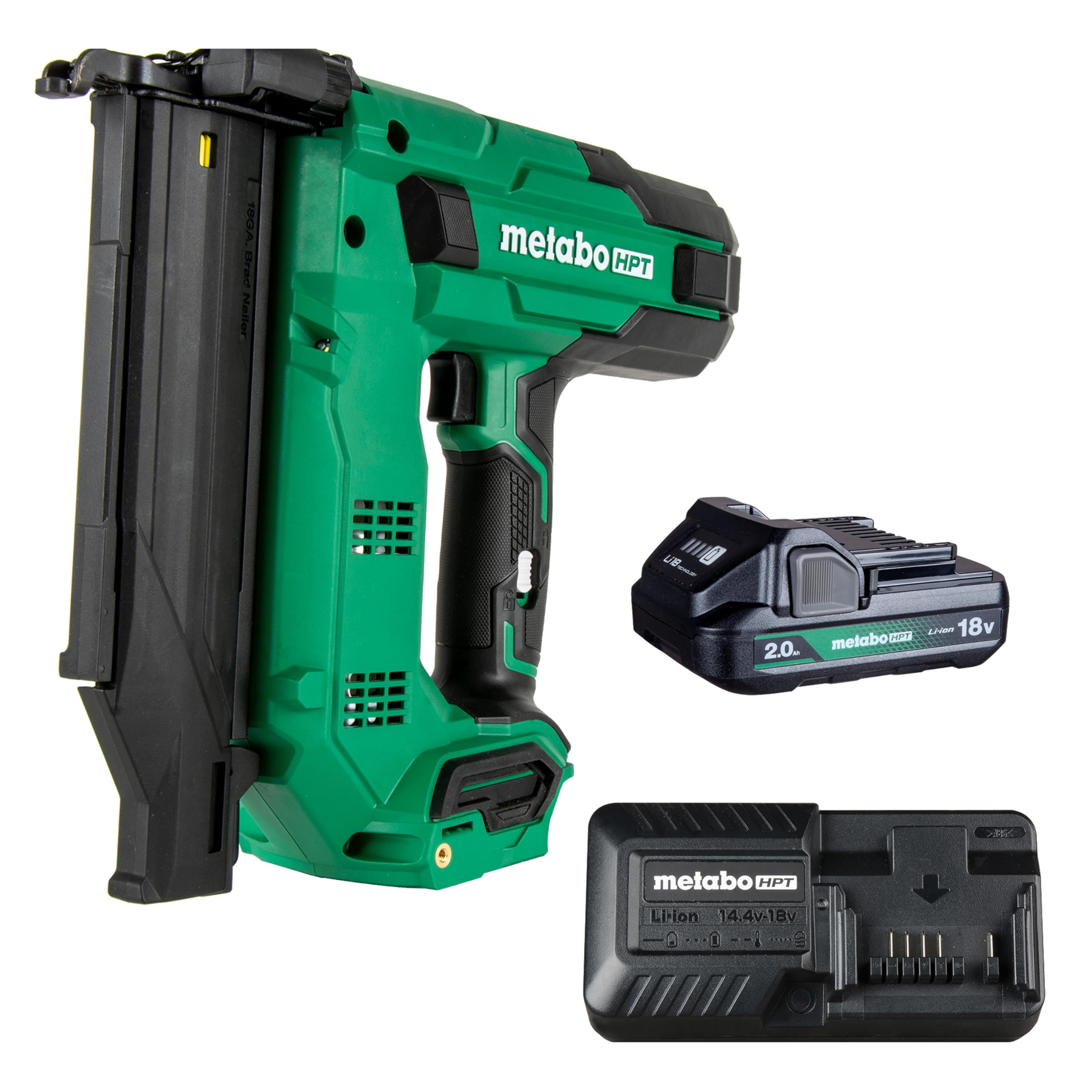
1. Metabo HPT NT1850DG 18V Brad Nailer
Our pick — over 4.5★ from 900+ verified ratings; the strongest balance of quality and price.
A 5.5-pound trim nailer that outshoots compressor models with no air tank.
You get consistent driving power from a mechanical spring that sinks up to 2-inch brads, and it fires 700 times on one charge from the included 2.0Ah 18V battery — enough for a full afternoon of baseboards without swapping cells. The battery pack has a fuel gauge, so you see the charge countdown before it dies.
Buyers report it worked cleanly with 1-inch to 2-inch nails, with battery life that charges fast and never misfired over a 500-nail run. The tool-less depth dial lets you tweak how deep each brad sinks without digging for an Allen key, and the bright LED lights up the work area right where the nose lands. It weighs 5.5 pounds, a full 2.34 pounds lighter than the WEN 20512 below, which you feel on the second hour of overhead crown work.
It is heavier than some rivals — a few owners call it manageable but not featherlight — and you may nudge the depth setting after switching nail lengths. For the money, buyers call it outstanding value, and the no-gas, no-hose, no-compressor design is the whole point.
Why It Leads the Field
- 700 nails per charge with the included 2.0Ah battery
- Fires instantly with no ramp-up time between nails
- Tool-less depth adjustment plus a bright LED work light
The Trade-offs
- Heavier than some competitors at 5.5 pounds
- Depth dial may need a touch-up after changing nail sizes
Reach for it if: you want one cordless brad nailer that does trim, casing, and small projects without drama.
Look elsewhere if: you need a framing-scale nailer — this tops out at 2-inch brads.
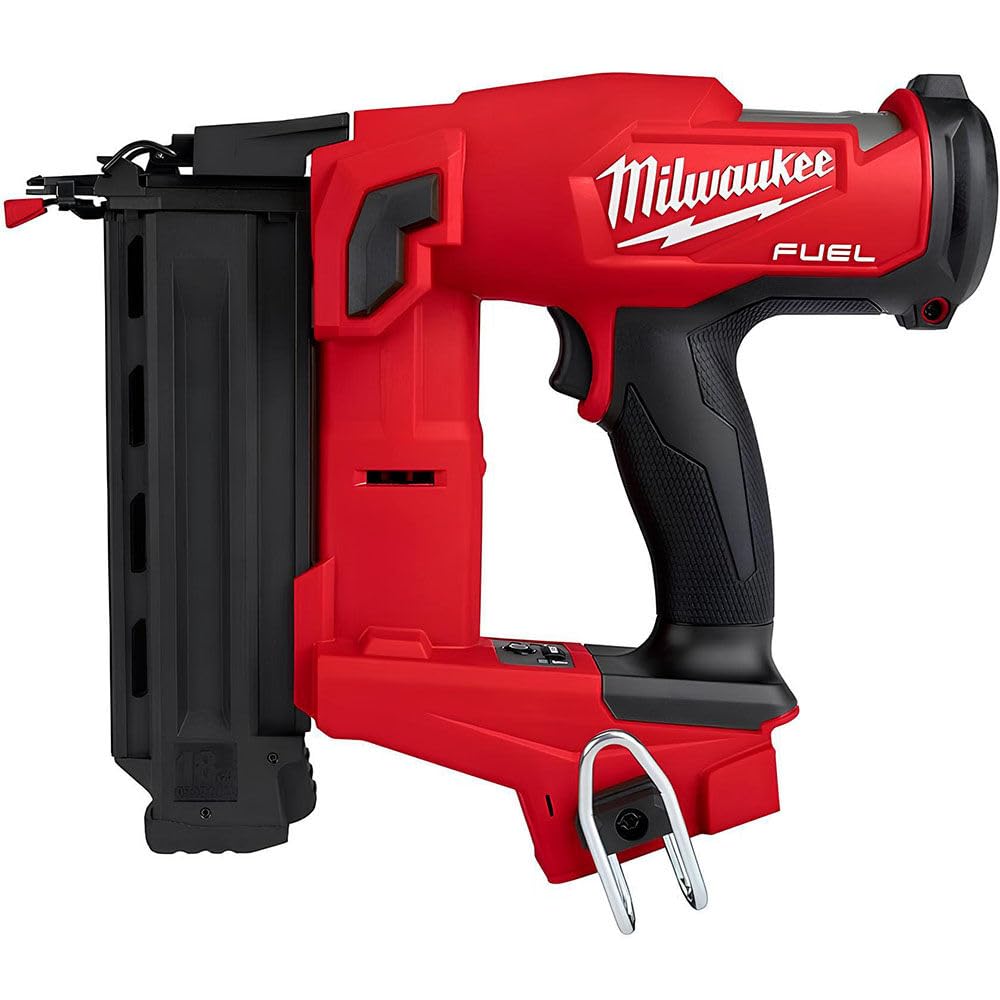
2. Milwaukee M18 Fuel 18-Gauge Brad Nailer
A nitrogen air-spring nailer that sinks brads flush with zero ramp-up, no gas, and no fuss.
Milwaukee’s answer to the compressor relies on a nitrogen air spring instead of a mechanical coil, and that changes how the tool feels. It sinks nails to the proper depth in hard and soft woods while leaving a clean hole that matches the head of the nail. The POWERSTATE brushless motor paired with REDLINK PLUS intelligence delivers a fire rate with zero ramp-up time — pull the trigger, the nail is in.
Owners mention 2-inch nails sink into concrete and studs with no misfires, and a full baseboard job barely drops the charge bar. A 20-year contractor approved it for daily use. It is tool-only, so you supply the M18 battery and charger, but a 2Ah pack lasts long enough that buyers call it near-endless runtime.
The 6.5-pound weight draws mixed feedback; it is fine on a belt but noticeable for overhead work. The LED light is included but weak, and it is genuinely overkill if you only hang a few frames a year.
Contractor-grade call: this is the one that keeps pace with an air nailer all day, runs quiet, and never misfires. If you live inside the M18 platform, it is the obvious top shelf.
Watch the weight: at 6.5 pounds with no battery, overhead trim will wear on your arm faster than lighter picks.
Best suited to: serious DIYers and pros who already own M18 batteries and want air-nailer pace without the tank.
Not for: occasional users on a budget — the bare-tool pricing assumes you have the battery platform.
3. DEWALT DCN660D1 16GA Angled Finish Nailer
A finish carpenter’s 13-year verdict: matches air nailers, no misfires, quiet, oil-free
A 13-year finish carpenter finds it matches his air nailers with no gap in performance. The 16-gauge angled finish nailer runs 100% on battery, so there is no gas cartridge, compressor, or hose in sight. The brushless motor boost runtime, and the kit arrives with a 2.0Ah battery and charger in a hard case, so it works the moment you open the box if you own DeWalt.
The inline magazine lets you work in multiple orientations and tight spaces, and a tool-free selectable trigger switches between sequential and contact actuation modes. Owners say it ran a 10-hour day on under half a charge, with no misfires or jams on DeWalt nails. It drives baseboard and shoe molding with authority, and the multi-functional LED lights illuminate the work area while doubling as a diagnostics readout.
The honest catches are the price and the angled-nail format, which offers a more limited nail selection than straight collation. It is also heavier than a pneumatic, and a few owners find the 1/4-round trim trick in tight corners.
Trade-up worthy: if you have hit the limits of an 18-gauge brad nailer on thick molding, this 16-gauge angled gun is the finishing upgrade.
Know the catch: angled nails mean fewer options at the hardware store, and the premium price reflects the pro build.
Grab it if: you trim houses regularly and want a cordless finish nailer that behaves like an air gun.
skip it if: baseboards are an occasional weekend thing — the price and nail format are more than casual work needs.
4. DEWALT DCN623B 23-Gauge Pin Nailer

The 4.45-pound pin nailer that drives 2,000 nails per charge for invisible holes
This ATOMIC Compact Series unit drives 23-gauge pin nails from 5/8-inch up to 1-1/2-inch, leaving holes so small they vanish in the wood grain. The brushless motor powers an average of 2,000 nails per charge — the best endurance on this list by a wide margin.
Owners describe near-invisible holes on trim and molding, flush-setting pins, and battery life that outlasts the person holding it. The low-nail lockout system uses an LED indicator to tell you the magazine is nearly empty, and both the jam release and depth adjust are tool-free. It uses DeWalt 20V batteries, so it slots straight into an existing toolbox.
The recurring gripe is jamming — it is the most-mixed trait in the review data — and loading pins takes a little practice. One owner called it heavy but effective, with a loud click when fired, though quieter than any pneumatic version. It is a specialty tool, not a generalist.
The Niche It Owns
- 2,000 shots per charge is class-leading endurance
- 23-gauge pins leave near-invisible holes for fine trim
- LED low-nail lockout warns before you run dry
Who Should Pass
- Jams happen most here of all the picks — clearable, but frequent
- 23-gauge pins hold far less than 18-gauge brads
Pick this for: picture frames, thin trim, and any spot where you cannot afford to fill a visible nail hole.
Look elsewhere if: you need real holding power for baseboards — 23-gauge is too delicate for that.
5. Makita XNB02Z 18V Straight Finish Nailer

The straight-collated 16-gauge workhorse that drives 1,000 finish nails per 5.0Ah charge
Makita’s answer to trim work keeps the straight nail format that hardware stores stock deepest, and its motor drives standard 16-gauge finish nails from 1-inch up to 2-1/2-inch. On a 5.0Ah 18V LXT battery — sold separately — it pushes up to 1,000 finish nails before you swap cells. The compact center height lets you see around the nose tip when fastening into tight spots.
The anti-dry fire mechanism stops the gun from driving blanks and damaging your work surface when the magazine is empty. A reversible belt clip keeps the tool close on the jobsite. Owners call it a great finish gun that works just like a Makita should, provided you feed it quality nails — generic brands produced blank shots and half-driven nails until the owner switched to a reputable brand.
The 8.12-pound weight is the main knock; it is the heaviest finish nailer here by a clear margin. One owner also reported jams and a broken part, though that sits against a strong quality reputation. This is a battery platform play for LXT loyalists.
Power-first pick: 1,000 nails per charge and 2-1/2-inch reach make this the ceiling of the cordless finish category.
Pay the weight tax: at 8.12 pounds, it will fatigue you faster than lighter 18-gauge guns on long trim days.
Choose it if: you need 16-gauge holding power with straight collation and you already own Makita LXT batteries.
Think twice if: you want a light everyday trim gun — the 8.12-pound heft is hard to ignore.
6. DEWALT DCN650B 15GA Angled Finish Nailer

The micro-nose 15-gauge that holds crown molding and trims out a 3,000-square-foot house
Some jobs need a nail thick enough to matter, and that is what a 15-gauge angled finish nailer is for. The brushless motor boost runtime and durability while the micro nose improves line of sight and accuracy compared to earlier DeWalt models. It runs 100% on battery — no compressor, hose, or gas cartridges at all.
One owner trimmed a 3,000-square-foot house, noting a split-second delay versus pneumatic but consistent firing after adjustment. Another owner who has used pneumatic and battery finish nailers for years says it lives up to the expectations for a trim nailer, driving nails and setting them repeatedly. The multi-functional LED lights provide both workspace illumination and tool diagnostics, while the tool-free jam release and stall release lever keep it running.
The standout complaint is weight — it is the third most-discussed trait and lands squarely negative. The inline magazine and adjustable belt hook help, but this is a hefty tool for a full shift. It is also a bare tool, so you need a DeWalt 20V battery and charger.
The heavy lifter: 15-gauge thickness plus a micro nose for accuracy makes this the crown-molding specialist of the lineup.
Honest caution: owners consistently flag the weight — expect arm fatigue on all-day trim work.
Reach for it when: crown molding, door casing, or hardwood flooring needs a nail that won’t give.
Pass it over if: you prefer a lighter gun — this one asks you to carry the 15-gauge price and heft.
7. Metabo HPT NR1890DRS Cordless Framing Nailer

The pneumati-like air-spring framing nailer that drives 3-1/2-inch nails without a tank
Framing is the heavyweight division, and this Metabo HPT brings a unique air spring drive system that delivers pneumatic-like performance from an 18-volt battery. It accepts round-head 21-degree plastic strip collated nails from 2 inches up to 3-1/2 inches. The kit includes a compact 3.0Ah lithium-ion battery, fast charger, contractor bag, and safety glasses.
Owners drove about 2,000 nails without misfires, including 3.5-inch ring-shank galvanized nails through treated lumber and white oak siding. There is zero ramp-up — no air tank to refill, so you pull the trigger and the nail fires. The brushless motor extends runtime per charge, and the tool-less depth adjustment dials in fastening depth across materials. It drives 400 nails per charge on the included battery.
The honest math here is reliability feedback runs mixed — while many say it works well enough, others report it failing to fire properly. Weight is the clearest negative at 10.1 pounds, though that is the price of framing power. It is fast, not production-line fast, but a contractor-grade option for punch-out work minus the hose.
Where It Excels
- Pneumatic-like air spring with zero ramp-up time
- Handles 3-1/2-inch nails through hard, treated lumber
- Kit includes battery, fast charger, and contractor bag
Where It Struggles
- 10.1 pounds is heavy for long framing days
- Reliability feedback is split — some report firing failures
Choose this for: jobsite punch-out and framing where carrying a compressor is the worst part.
pass on it if: you only frame occasionally — the 10.1-pound heft and premium price need regular use to earn out.
8. WORX WX842L 20V 18GA Brad Nailer

The Power Share nailer that fires 80 brads a minute through hardwood paneling
WORX built this around its NailForce Air Impact Technology, which secures brad nails up to 2 inches into hardwood. The headline number is speed — it fires up to 80 nails per minute, so a room of panel molding goes fast. The same Power Share battery that runs this nailer works across 140-plus tools and outdoor equipment from the Worx platform, which makes the battery investment stretch.
Owners found it strong enough to drive nails fully into 2x4s, with the anti-ejection design keeping nails from flying when you open the magazine. The tool-free jam release clears stuck nails in seconds, and customers note a jam only once, easy to clear. The depth adjustment sets nails flush so you skip the caulk, and battery life held up fine through a day of small projects.
The mixed reviews center on weight — at 7.06 pounds, some call it a bit heavy — and jamming appears for a minority of owners. One reviewer noted the max effective depth ran closer to 1.5 to 1.75 inches rather than the full 2 inches, which matters if you regularly sink into dense hardwood.
Speed-focused value: 80 nails per minute plus a huge battery platform makes this a strong mid-range pick for trim and molding.
The fit note: weight and occasional jams are the trade-offs, and deep hardwood drives may fall short of 2 inches.
Good for: fast trim work and panel molding where firing speed saves your afternoon.
Not ideal if: you drive a lot of 2-inch nails into very dense hardwoods.
9. CRAFTSMAN V20 CMCN618B 18GA Brad Nailer

The balanced 18-gauge that shares one battery fleet with your whole Craftsman shed
Everything about this Craftsman centers on the V20 ecosystem. If your drill and saw already run on Craftsman 20V batteries, this bare tool drops straight in — one battery powers the whole collection, and reviewers point out switching a drill battery in with zero downtime. The motor drives up to 420 nails per charge, enough for most trim and baseboard runs.
The tool-free jam and stall settings clear issues without searching for a hex wrench, and the belt hook keeps it within reach. Owners call it ideal for molding, board-and-batten walls, and small indoor projects, with nails driving flush on pine and poplar. One owner summed up the appeal: no more dragging out the air compressor and hoses for a quick trim job.
The 6.9-pound weight draws mixed opinions, with some noting it feels heavy for long sessions. It ships with no battery and no nails, so factor that into your total cost. The reviews are strong enough that owners consistently say it is a great tool at a great price point.
Ecosystem bargain: 420 nails per charge and full compatibility with existing Craftsman V20 batteries make this the smart buy for loyalists.
A small asterisk: bare-tool only means your total cost depends on batteries you may already own.
Reach for it if: you already own Craftsman V20 tools and want a trim nailer to match.
Look past it if: you’re starting from zero batteries — the bare-tool format assumes you have the platform.
10. Ryobi 18V ONE+ Airstrike P321 Brad Nailer

The Airstrike that earned five-star nods from a weeks-long home project in the reviews
Ryobi’s Airstrike line is the gateway for the huge ONE+ battery family, and this 18-gauge brad nailer rides that wave. The 18V tool runs on any ONE+ battery, which is the single most common battery platform in home garages. One owner summed up weeks of use: balances well in the hand, not too heavy, but sturdy enough to know it is built to last.
Shoppers say it works reliably for months of home projects, getting the nail where it needs to be with no feature problems. The battery life holds up long enough that owners call it fast and long-lasting. It is a tool-only purchase, so you supply the battery and charger, which keeps the upfront cost down if you are already in the ecosystem.
The mixed feedback centers on nail depth and jam-free operation — some report no jams at all while others deal with nails not going all the way in. Weight also splits opinions at 6 pounds. For ONE+ owners, this is the natural, budget-friendly fit.
Ecosystem-friendly: if you already run ONE+ batteries, this is the lowest-friction way to add a cordless brad nailer.
Expect variance: nail depth and jamming get mixed reviews — worth a test run on scrap before real trim.
Best fit: Ryobi ONE+ owners who want a simple, reliable trim nailer without buying into a new battery system.
Not the pick if: you need guaranteed flush drives on dense material — depth feedback is genuinely mixed.
11. WEN 20512 20V 18-Gauge Brad Nailer Kit

The 400-brad starter kit that gets baseboards done without a top-end price tag
WEN positions this as the value play that still behaves like a workhorse. It shoots 18-gauge brads from 3/4-inch to 2 inches, loads through an easy magazine with a 100-nail capacity, and lands on your bench with 400 brad nails included. The kit ships with the 20V battery and charger, so it works from the start — no platform required.
The smart LED indicator tracks battery status, magazine fill, and tool temperature, which is a thoughtful touch at this level. Owners call it great for baseboards and describe driving nails perfectly with long battery life and impressive quality for the money. One homeowner put it plainly: did not want to spend a lot on a top-end tool for light use, and this has been great.
The 7.84-pound weight is the most honest caveat — arm fatigue creeps in on long jobs, and some buyers report jams that require disassembly. Battery life also splits opinion, with a few units struggling to charge properly. It is the heaviest of the 18-gauge picks here, sitting 2.34 pounds above the Metabo HPT.
Why It’s the Budget King
- Complete kit with battery, charger, and 400 brads included
- 100-nail magazine keeps you working longer between loads
- Smart LED tracks battery, fill, and tool temperature
The Bottom-Line Trade-offs
- 7.84 pounds is the heaviest 18-gauge gun in this lineup
- Battery and jamming feedback is mixed across owners
Ideal for: first-time buyers who want a complete cordless setup with zero extra purchases.
Maybe not if: you have an all-day trim project ahead — the weight will wear on you.
Understanding the Specs
Shots Per Charge
This is the endurance number that tells you how much work one battery finishes. A brad nailer rated for 700 shots covers a full room of baseboards, while a framing nailer burning 400 shots per charge is expected — bigger nails drain harder. Tools with 2,000-shot ratings, like the DEWALT pin nailer, let you work all day on one cell.
Gauge and Nail Length
Gauge is nail thickness, and lower numbers mean thicker nails. 18-gauge brads handle trim and casing with small holes, 16-gauge finish nails hold crown molding and flooring, and 15-gauge adds more grip for heavy casing. The nail-length range printed on the box — like 5/8-inch to 2-inch — is the hard limit of what the magazine feeds.
FAQ
Will a battery nail gun replace my pneumatic nailer?
What gauge nail gun do I need for baseboards?
How many nails can you shoot on one battery charge?
Is an 18-gauge or 23-gauge nailer better for trim?
Do battery nail guns jam a lot?
Can I use any brand of nails in these guns?
What is the difference between a brad nailer and a finish nailer?
Is a heavier battery nail gun always more powerful?
Is a heavier battery nail gun always more powerful?
What does shots per charge actually mean for a full day of work?
Should I buy the kit version or the bare tool?
Final Thoughts: The Verdict
For the majority of shoppers, the battery nail gun winner is the Metabo HPT NT1850DG because it combines 700 shots per charge, a 5.5-pound frame, and rock-solid reliability that owners praise across hundreds of reviews. If you want the pro-grade power of a nitrogen air spring, grab the Milwaukee M18 Fuel. And for finish carpenters who need 16-gauge holding power, the DEWALT DCN660D1 is the one to reach for.
How We Picked
We do not accept paid placement. Every pick is matched to a real buyer and a real use-case; we do not hands-on test units.
Sources & Methodology
Specifications: manufacturer listings and product documentation. Review insights: verified customer reviews, as of August 2026. Pricing: not shown on this page (it changes often); check the current price via the retailer link.
As an Amazon Associate, Gadgets Feed earns from qualifying purchases. This does not affect which products we feature.