
You’re cruising down an empty stretch of interstate, and suddenly your podcast buffers, your GPS reroutes into limbo, and the call you needed to take goes silent. That sinking feeling—being unreachable in the middle of nowhere—is why a dedicated automotive signal amplifier belongs in every glove box. Unlike a pocket repeater, a proper vehicle-mounted booster uses a roof antenna and a tuned amplifier to grab distant tower signals and flood your cabin with usable bars, turning a dead zone into a working connection.
I’m Rikta — the co-founder and writer behind Gadgets Feed. I’ve spent years analyzing signal booster performance across frequency bands, antenna gain patterns, and real-world carrier compatibility so I can separate the amplifiers that genuinely extend your range from those that just look the part. (And Homer 🐱 supervised the whole deep dive from his sunlit dashboard perch, tail flicking at every dropped call sound effect.)
Whether you spend weekends exploring remote campsites or log long-haul miles for work, the right hardware makes the difference between shouting into the void and streaming a movie. This guide covers the best car cell phone booster options available, from budget-friendly kits to heavy-duty truck systems that laugh at mountain valleys.
How To Choose The Best Car Cell Phone Booster
The difference between a booster that works and one that collects dust comes down to matching the hardware to your specific driving environment, your phone’s frequency bands, and your tolerance for installation effort. Here is exactly what matters.
Carrier and Frequency Band Compatibility
Your phone talks to towers on specific frequency bands — Verizon leans on Band 13, AT&T and T-Mobile use Band 12/17 and Band 2/4/66. A booster that only covers Band 12/13/17 will leave you with zero improvement if your carrier runs primarily on Band 4 or 66. Before buying, check your phone’s field test mode (dial `*3001#12345#*` on iPhone) or use an app like CellMapper to confirm which bands are active in your area. The best kits support at least five bands (12/13/5/4/2) to cover all major U.S. carriers.
Antenna Type: Omni-Directional vs. Directional (Yagi)
An omni-directional antenna picks up signals from all directions, making it perfect for moving vehicles where the tower’s location changes constantly. A directional Yagi antenna offers higher gain and reaches towers farther away, but it must be physically aimed at the tower and is better suited for stationary use in RVs or cabins. For most drivers, a magnetic-mount omni antenna is the right balance of convenience and coverage.
Gain and Isolation Requirements
Gain, measured in dB, tells you how much the booster amplifies the signal. Car models typically offer 50 dB to 65 dB. More gain is better, but only if the inside and outside antennas are separated by enough distance (typically 20–30 feet, or at least through a metal roof) to prevent oscillation feedback. If the booster detects its own amplified signal, it shuts down — that’s the work of Automatic Gain Control (AGC). A kit with AGC and a clear installation guide saves you hours of troubleshooting.
Quick Comparison
On smaller screens, swipe sideways to see the full table.
| Model | Category | Best For | Key Spec | Amazon |
|---|---|---|---|---|
| weBoost Drive X | Premium | Multi-user family SUV | Band 12/13/5/4/2 support | Amazon |
| Atcall Truck Booster LCD | Premium | Semi-truck or van fleets | 50 dB gain, LCD monitor | Amazon |
| weBoost Drive 4G-X OTR | Premium | Extreme remote / semi truck | 17-inch weather-resistant antenna | Amazon |
| ZORIDA Ace 5S | Mid-Range | RVs and cabins | 72 dB max gain, 2000 sq ft | Amazon |
| PRACOA 65dB Booster | Mid-Range | Camping / travel trailer | 65 dB, 8-band (incl. 66) | Amazon |
| SignalBrick Booster | Mid-Range | Everyday commuter car | 30-min installation, 5 bands | Amazon |
| Phonetone C20 | Budget | Band 12/13/17 only users | Band 12/13/17 coverage only | Amazon |
In‑Depth Reviews
1. weBoost Drive X

The weBoost Drive X is the gold standard for vehicle boosters for a reason — it delivers 33 percent farther gain than the company’s single-user model while covering every major U.S. carrier band (12/17, 13, 5, 4, 2/25). That means everyone in the car gets faster data, clearer calls, and improved hotspot capability, even when you’re deep in rural stretches where towers are miles apart.
Setup is genuinely tool-free: the magnetic roof antenna clicks into place, the slim inside antenna mounts on a window or console, and the 6.25 x 1 x 4.5-inch booster unit tucks under a seat or in the center console. Real-world tests show it converting a single bar of weak LTE into a stable connection capable of Zoom calls and HD streaming, though it is not a miracle worker in absolute zero-signal zones.
The trade-off is that the Drive X is a premium investment, and it is still subject to the laws of physics — if your phone shows no bars at all outside the vehicle, no booster will create signal out of nothing. For anyone who regularly drives through marginal coverage areas with a car full of devices, this is the most reliable tool on the market.
Why it’s great
- Class-leading gain for multi-user vehicles
- Tool-free install with magnetic roof antenna
- Supports all major U.S. carriers on 5 frequency bands
Good to know
- Won’t create signal where none exists outside
- Premium price compared to entry-level options
2. Atcall Truck Booster with LCD Monitor
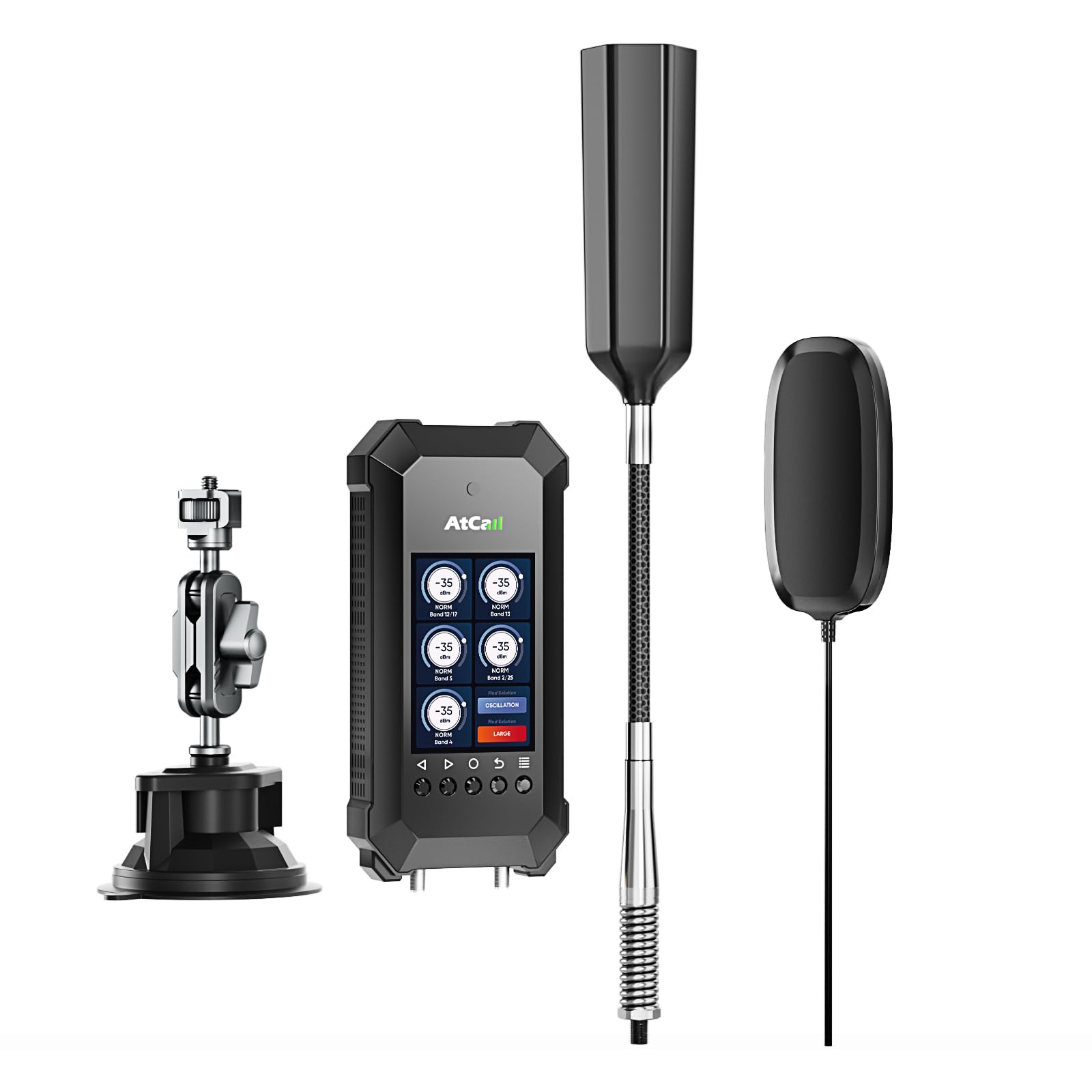
The Atcall SF-T is one of the few boosters purpose-built for the truck cabin with a real-time LCD monitor that displays signal strength changes and system status. That display alone saves you the headache of guessing whether the booster is working, especially during the installation phase when you are finding the sweet spot for antenna placement.
It delivers 50 dB of max gain across bands 12/17, 13, 5, 2/25, and 4, covering all U.S. carriers including Verizon, AT&T, and T-Mobile. The omni-directional outdoor antenna is ruggedized to be waterproof, shockproof, and rustproof — important when it is mounted to a semi mirror or roof rack. Two included mounting brackets let you secure the booster unit to the center console or under the dash.
Installation is DIY-friendly but not instantaneous; you will spend about an hour routing cables and securing the antennas. No app or subscription is required, and the FCC certification means it is compliant on cellular networks. If you drive a large rig or work truck and want visual confirmation that your gear is active, this is the smart choice.
Why it’s great
- HD LCD display for real-time signal monitoring
- Rugged, weather-resistant outdoor antenna
- Includes two mounting brackets for flexible placement
Good to know
- Setup takes about an hour for full installation
- Requires 20+ ft antenna separation to avoid oscillation
3. weBoost Drive 4G-X OTR

When you need a signal in places most people give up on cell service entirely, the weBoost Drive 4G-X OTR is the heavy artillery. Its 17-inch weather-resistant omni antenna is dramatically taller than the puck-style antennas on most car boosters, which translates into more gain and the ability to pull in weak signals that smaller units miss entirely.
Built for semi trucks but equally effective on RVs, the kit includes a 3-way CB antenna mount, mast extension, and side exit adapter for professional-grade installation. The booster supports bands 12/17, 13, 5, 4, and 2/25, so it works with all U.S. carriers. Users consistently report going from a phone showing zero bars to speeds that handle streaming and hotspot connectivity in remote mountain areas.
The system is not cheap, and the installation requires more work than a magnetic roof antenna. But if you spend time in BLM land, deep canyons, or the remote stretches of the American West, the OTR’s larger antenna and robust construction make it the highest-performing option for extreme dead zones. The 5-pound weight and bigger form factor mean it is a permanent install, not a toss-in-the-car accessory.
Why it’s great
- Massive 17-inch omni antenna for extreme range
- Professional-grade mounting hardware included
- Boosts signal in genuine zero-bar situations
Good to know
- Heavier and bulkier than compact car boosters
- Installation is more involved than magnetic-mount kits
4. ZORIDA ACE 5S

The ZORIDA ACE 5S punches well above its price tier with a 72 dB max gain — the highest raw amplification number in this roundup — and coverage up to 2,000 square feet. That makes it effective not just in a car or SUV, but also in a small RV cabin, garage, or workshop where you need to blanket a room with signal.
It supports bands 12/17, 13, 5, 4, and 2/25, covering all major U.S. carriers, and the included 49.2-foot cable gives you plenty of flexibility to place the outdoor directional antenna well above the vehicle or structure. The killer feature here is the companion app that provides 1-on-1 tech support, installation guidance, and before-and-after signal data — useful if you are not comfortable guessing antenna placement.
The directional Yagi antenna requires aiming at the nearest tower, which is fine for a stationary setup but less ideal if you are moving every day. Users report jumps from 1-2 bars to 4-5 solid bars on Verizon and AT&T, with HD streaming and gaming possible after installation. For the price, the combination of high gain, app support, and a 3-year warranty is tough to beat.
Why it’s great
- 72 dB gain — highest in class
- App-based 1-on-1 installation support
- Up to 2,000 sq ft coverage area
Good to know
- Directional antenna needs manual aiming at tower
- Better suited for stationary than constant vehicle use
5. PRACOA 65dB 8-Band Booster
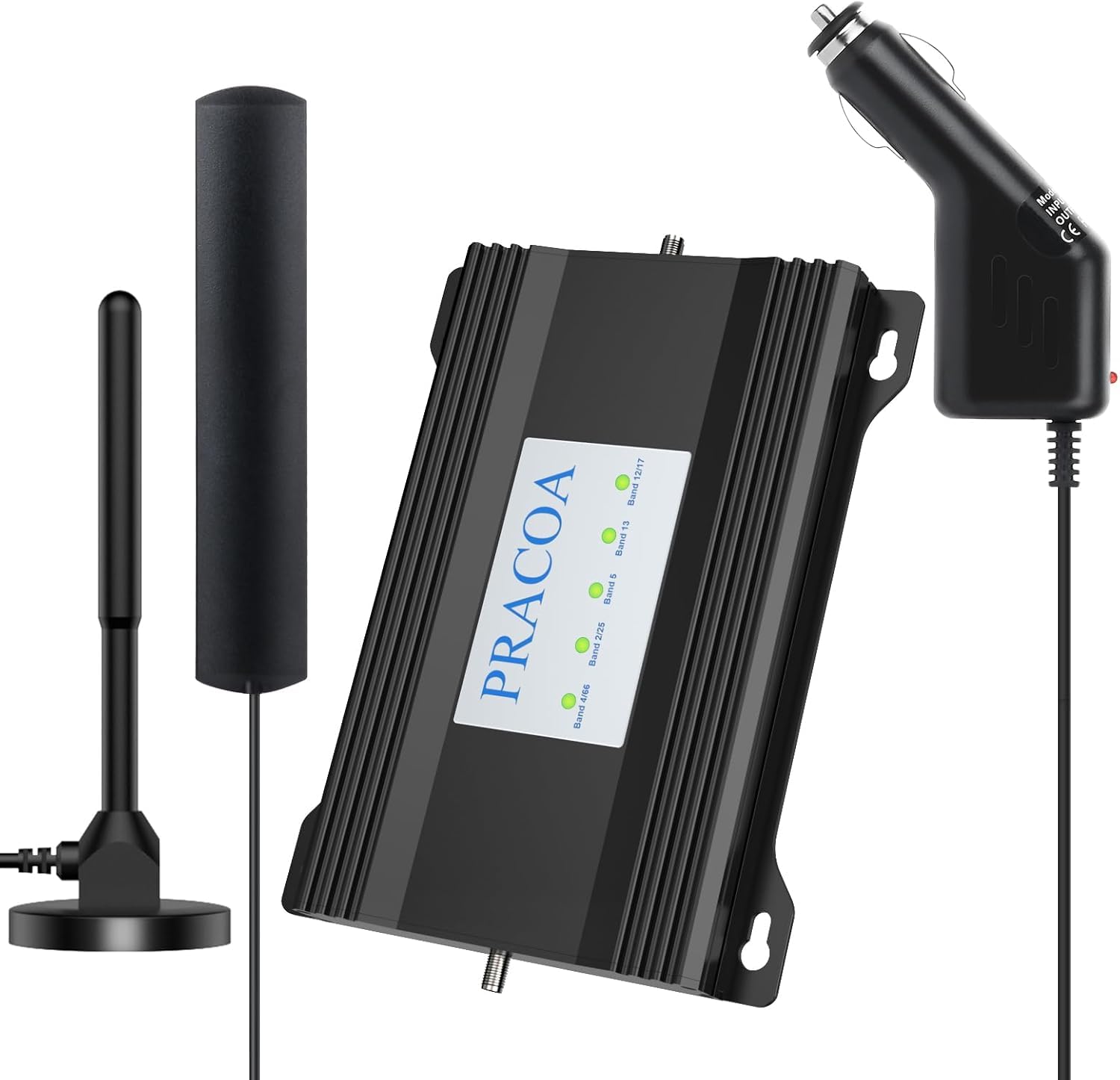
The PRACOA 65dB booster stands out for its broad 8-band frequency support, including the important Band 66 that many budget kits ignore. That wider coverage means it is compatible with more carriers and more modern 5G deployments, giving you a future-proofed solution whether you drive a sedan, truck, or travel trailer.
Maximum communication distance is rated at 5-8 miles under ideal conditions, and the Automatic Gain Control, Inactivity Mode, and Oscillation Elimination features let the unit self-adjust as signal conditions change on the road. The kit includes a 12V 3A power adapter, indoor patch antenna with 10-foot cable, and outdoor magnetic antenna with 16-foot cable.
Customer feedback is predominantly positive, with a seasoned RF engineer reporting an improvement from -112 dBm to -98 dBm RSRP and sustained 180 Mbps download speeds. The catch is that installation precision matters a lot — users who did not use a tower finder app or mount the outdoor antenna high enough saw minimal gains. For those willing to fine-tune, the PRACOA delivers mid-range performance with premium band coverage.
Why it’s great
- 8-band support including Band 66
- Automatic Gain Control and Oscillation Elimination
- Up to 8-mile range in optimal conditions
Good to know
- Performance highly dependent on antenna placement
- Some users report limited gains in heavily wooded areas
6. SignalBrick Vehicle Booster
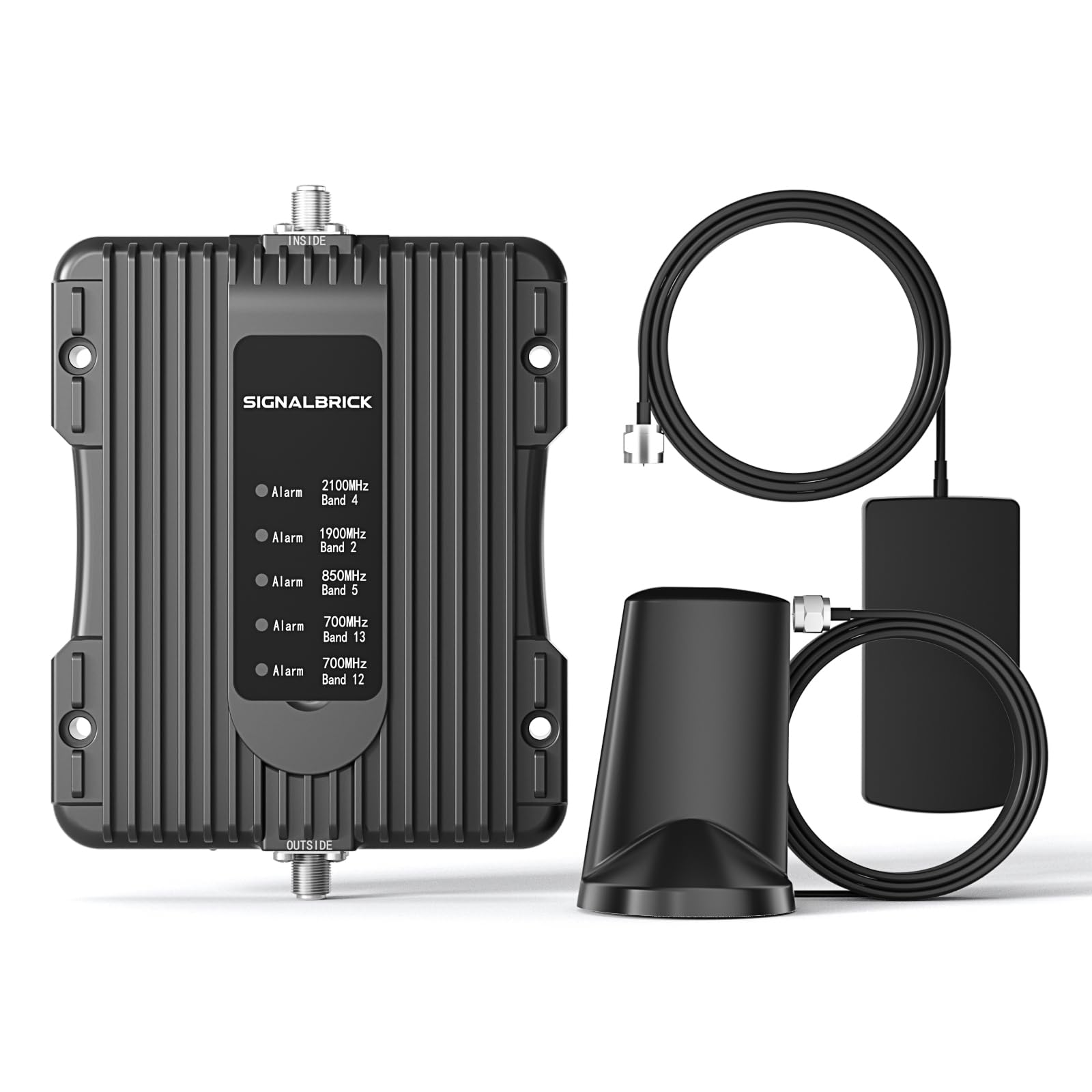
The SignalBrick booster is built for the driver who wants a no-drill, no-fuss experience without sacrificing multi-carrier support. The magnetic roof antenna and indoor patch antenna install in under 30 minutes, and the system covers bands 12/17, 13, 5, 2/25, and 4 — enough to handle Verizon, AT&T, T-Mobile, and all major Canadian carriers like Bell, Telus, and Rogers.
Advanced Automatic Gain Control adjusts the amplifier’s power in real-time, which reduces energy consumption and prevents the feedback loop that ruins signal quality. Users in remote northwestern Canada reported a jump from 1-2 bars to 4 bars on Bell LTE, with drop-free calls and reliable laptop hotspot connectivity on long-haul truck routes.
The main limitation is that the included power cord is relatively short, so the booster unit works best when mounted near a DC outlet in the back seat or cargo area. Also, while the SignalBrick works well in marginal signal conditions, it cannot create service in areas where there is genuinely zero usable signal outside the vehicle. For the price, it is one of the easiest boosters to live with day to day.
Why it’s great
- 30-minute no-drill magnetic installation
- Works with U.S. and Canadian carriers
- Automatic Gain Control for stable performance
Good to know
- Power cord length may limit mounting options
- Not for absolute zero-signal locations
7. Phonetone C20
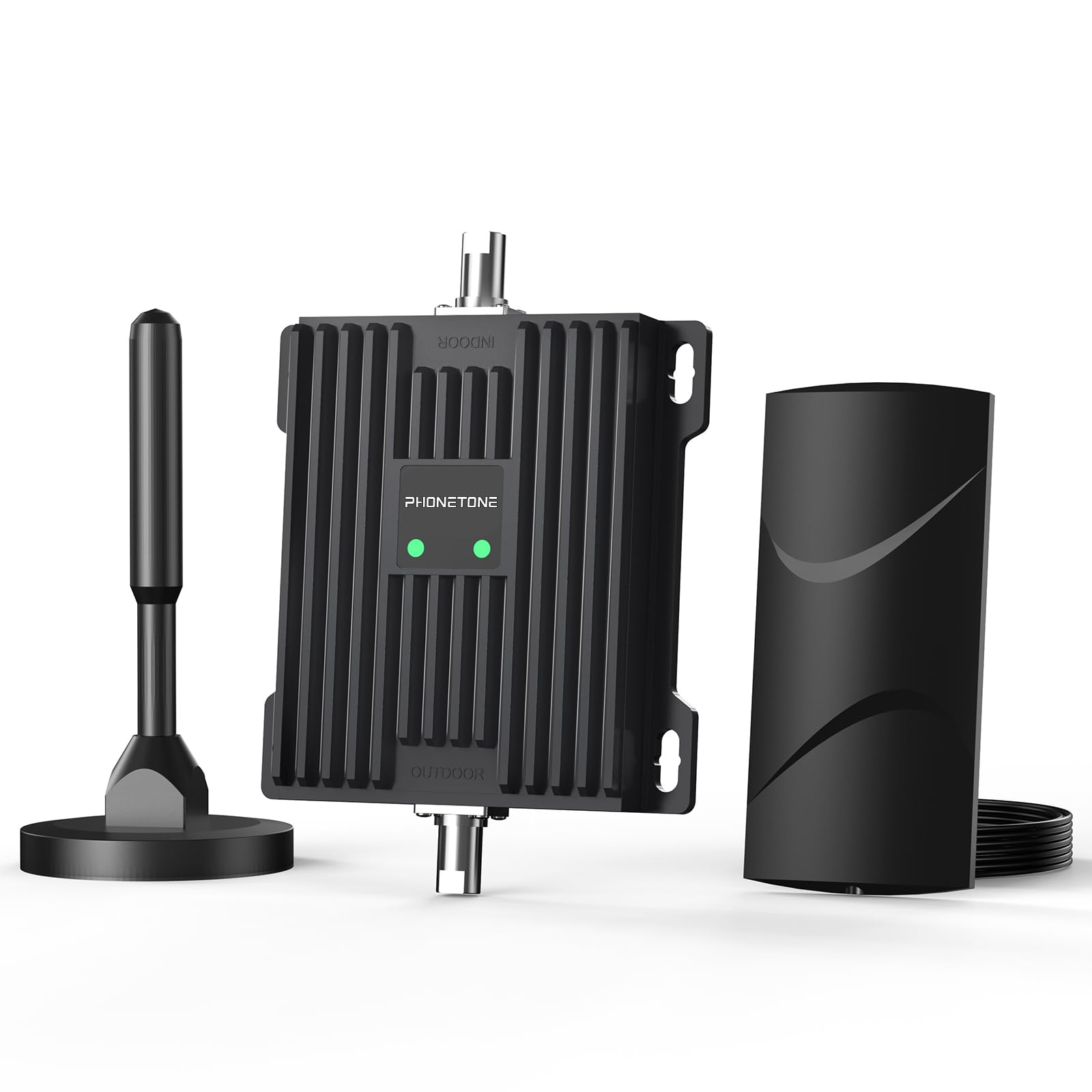
The Phonetone C20 is the most affordable entry point in this roundup, but it comes with a critical caveat: it only amplifies signals on bands 12, 13, and 17. If your carrier uses Band 4, 5, or 66 as its primary frequency, this booster will do nothing for you. That said, for Verizon and T-Mobile users whose local towers broadcast on these low-band frequencies, the C20 can transform a 1-bar struggle into a reliable 3-4 bar connection.
The kit includes an omni-directional magnetic roof antenna and an indoor patch antenna with a 2-year warranty. Installation is straightforward, and multiple verified buyers report eliminating dropped calls and achieving faster data speeds in areas where they previously had spotty coverage. One customer noted that the unit works with Rogers 4G and 5G in Canada, boosting from 1-2 bars to a consistent 3-4 bars.
The trade-off for the low price is limited compatibility — this is not a universal tool. Before buying, you must check that your phone’s frequency bands include 12, 13, or 17 and that you have at least 2 bars of signal outdoors. If those conditions are met, the C20 is a shockingly effective budget solution for highway driving and remote camping.
Why it’s great
- Very affordable entry into signal boosting
- Works well for Band 12/13/17 carriers
- 2-year warranty coverage
Good to know
- Only amplifies three frequency bands
- Requires 2 bars of outdoor signal to function
FAQ
Will a car cell booster work if there is zero signal outside my vehicle?
Do I need to register my booster with my carrier?
Final Thoughts: The Verdict
For most users, the car cell phone booster winner is the weBoost Drive X because it balances proven multi-carrier support, tool-free installation, and enough gain to keep everyone in the vehicle connected without requiring a PhD in RF engineering. If you want real-time monitoring and a rugged form factor for a work truck, grab the Atcall Truck Booster LCD. And for the highest possible range in truly remote terrain, nothing beats the weBoost Drive 4G-X OTR with its massive 17-inch antenna.