
Our readers keep the lights on and my morning glass full of iced black tea. As an Amazon Associate, I earn from qualifying purchases.
Specs are compiled from manufacturer listings and verified buyer reviews and can change over time — please confirm the key details on the product page before buying.
Finding an amplifier that sounds great at bedroom volume but can still hold its own at a gig is the eternal guitarist’s dilemma. The amps below crack that code with features like built-in power scaling, headphone outputs with cab simulation, and app-based tone modeling. We’ve focused on what actually matters when you’re spending real money: clean headroom, gain character, and how the controls respond to your playing.
I’m Min — the founder and writer behind Gadgets Feed. This guide is built by comparing the manufacturers’ published specifications and the patterns across verified customer reviews, so you get each pick’s real strengths and trade-offs instead of marketing spin.
You want great tone while staying affordable, and the best amp under $500 should fit your playing style—whether that’s quiet home practice, a small gig, or street performing. This guide breaks down top picks by their sound, features, and what actual owners say, so you can choose with confidence.
Our Picks at a Glance


How To Choose The Best Amp Under $500
Before you click buy, you need to match the machine to your room, your band, and your musical goals. A 100-watt head might be overkill for an apartment, but a 10-watt combo might leave you unheard next to a drummer.
Wattage vs. Real-World Volume
Wattage dictates clean headroom, not just sheer loudness. A 20-watt amp can get loud, but a 50-watt amp can stay clean at the same volume. For strict home practice, anything from 10 to 40 watts is plenty; for unmic’d gigs with a drummer, you’ll want 50 watts or more to hear yourself clearly.
Solid-State vs. Modeling vs. Tube
Solid-state amps are reliable, lightweight, and affordable, using transistors to produce tone. Modeling amps digitally recreate the sounds of classic tube amps and effects, giving you endless variety in one box. True tube amps deliver that organic, dynamic feel but are heavier, pricier, and need more maintenance — a trade-off many players accept for tone.
Quick Comparison
| Model | Best For | Wattage | Speaker | Channels | Amazon |
|---|---|---|---|---|---|
| Orange Crush 35RT★ Best Overall | Versatile gigging | 35W | — | 2 + Cab Sim | Amazon |
| Coolmusic BP80Portable Powerhouse | Battery-powered gigs | 100W | 8″ Woofer | 6 Inputs | Amazon |
| Orange Crush 20RTCompact Classic | Practice & portability | 20W | 8″ Voice | 2 | Amazon |
| Marshall MG30GFX | Classic Marshall tone | 30W | 10″ Custom | 4 | Amazon |
| Fender Acoustasonic 40 | Acoustic & vocals | 40W | Dual 6.5″ | 2 Inputs | Amazon |
| Positive Grid Spark 40 | App-driven practice | 40W | — | App Models | Amazon |
| BOSS Katana-50 Gen 3 | Tone flexibility | 50W | 12″ Custom | 5 Sections | Amazon |
| Yamaha THR10II | Desktop practice | 10W | Stereo | 15 Models | Amazon |
| Fender Mustang GTX100 | Stage-ready modeling | 100W | 12″ Celestion | 200 Presets | Amazon |
In‑Depth Reviews
1. Orange Crush 35RT
Our pick — over 4.5★ from 500+ verified ratings; the strongest balance of quality and price.
A 35-watt combo that delivers gig-ready British crunch with a cab-sim headphone out for quiet practice.
You get that classic British crunch—the gritty, mid-heavy tone Orange is famous for—through a simple analogue signal path (no digital modeling, just pure analog circuitry). At 35 watts, it gives you honest volume for practice and enough punch to hold your own in a small venue, so you can leave the half-stack at home.
What wins people over is the sound quality, hands down. Owners consistently praise the true Orange tone and the excellent built-in reverb, noting the dirty channel delivers a tube-like punch with smooth note decay at high gain. The 4-stage preamp and 3-band EQ give you real control over your voice.
Buyers report it’s “loud enough for small shows” but warn that “apartment volumes >5 annoy neighbors,” so it rewards responsible volume levels. For silent practice, the headphone output loaded with 4×12 cab simulation is genuinely impressive, letting you nail that full-stack sound without waking anyone.
Players’ Verdict
- Gig-worthy volume in a compact combo
- Footswitchable channels and effects loop
- Cab sim headphone out for quiet practice
Watch The Volume
- Gets neighborly past 5 on the dial
- Clean channel is warm but not the standout
Ideal for: guitarists wanting one amp that covers home jams and small shows without a pedalboard.
Note this: it’s heavy at 27.8 pounds, so it’s not a grab-and-go pedalboard mate.
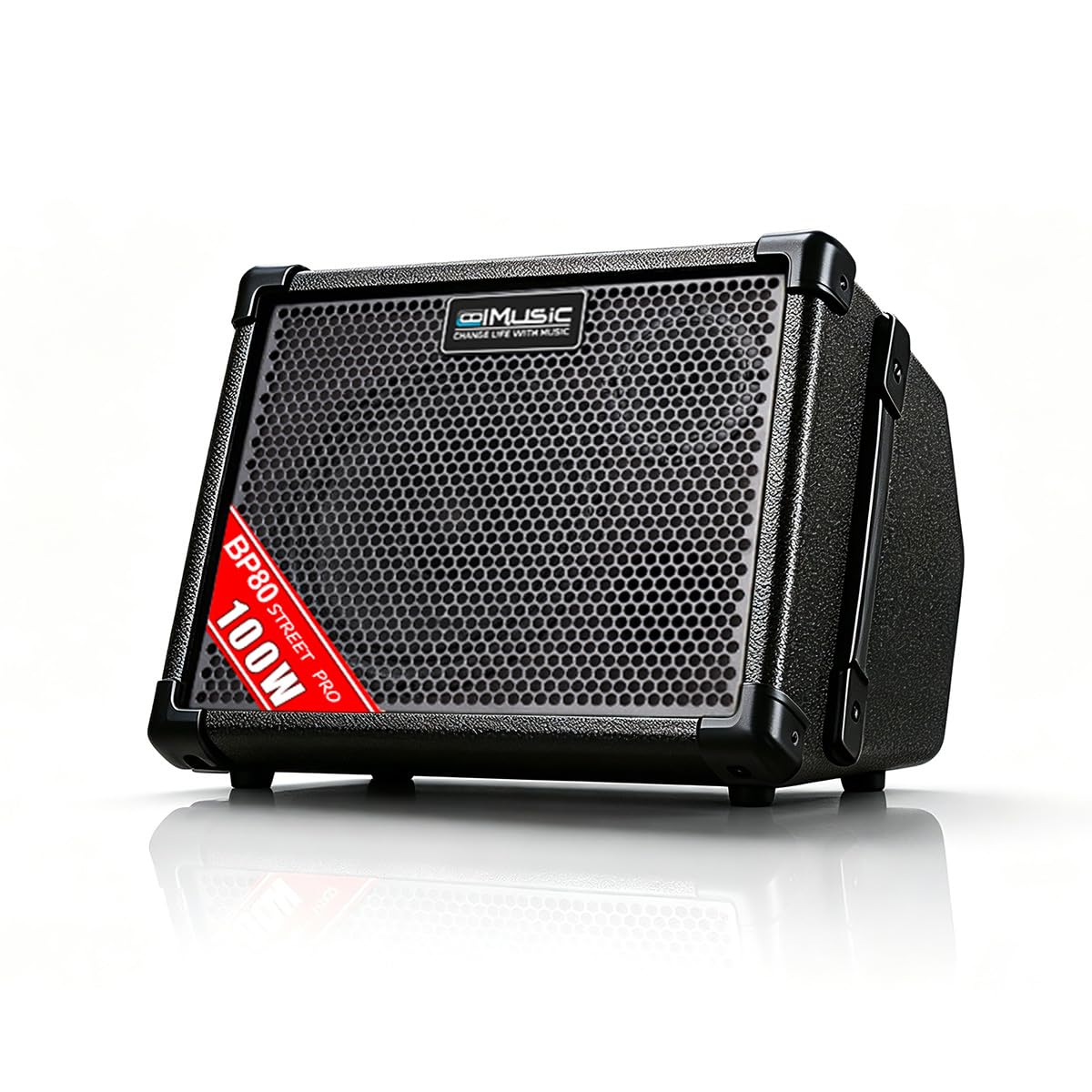
2. Coolmusic BP80
A 100-watt battery-powered amp with six inputs and phantom power for portable, cord-free gigs.
Imagine setting up for a gig with zero extension cords. The Coolmusic BP80 makes that a reality with a 100-watt punch from an 8-inch woofer and 3-inch tweeter, all powered by a rechargeable battery. Owners mention “battery lasts 3+ hrs at high volume,” making it a genuine tool for street performers and park jams.
Its 6 inputs are the real story here — you can run a guitar, a keyboard, two microphones, and two phones or computers all at once. The built-in 48V phantom power even lets you use a condenser mic, turning this single unit into a mini PA system for a solo act or small group.
With a 5.0x wattage gap over the Orange Crush 20RT, the BP80 sits in a different league for sheer output. It also has a 3-band EQ and master Bluetooth control, so you can stream backing tracks between songs. Just note the exterior build has been called subpar after rough outdoor use — treat it with care.
Gig Freedom
- True portability with 6-8 hour battery life
- 6 inputs handle a full small band
- 48V phantom power for condenser mics
Build Watch
- Exterior durability questioned under heavy use
- At 10 kg, not the lightest portable option
Best for: solo acoustic players or duos who gig anywhere without power.
Reach for it if: you need a full PA-in-a-box; skip it if you’re a bedroom-only player.
3. Orange Crush 20RT
A 20-watt practice amp with the brand’s signature crunch, built-in tuner, and reverb in a compact 15.9-pound package.
The Crush 20RT distills everything players love about the brand into a friendly 20-watt package. Its custom 8″ Voice of the World speaker delivers rich, responsive tones that are perfect for practice, and the 2-channel design lets you flip between pristine cleans and aggressive overdrive instantly.
What makes this amp special is the built-in chromatic tuner and reverb — two features that streamline your setup. Owners rave about the “big time bang for the buck,” noting it holds its own even next to vintage Fender amps in a studio. The clean channel breaks up nicely, and it handles acoustic-electric guitars surprisingly well.
The size is a huge talking point, and at 15.9 lbs with dimensions of 14.67 x 12.8 x 7.75″, it’s easy to carry anywhere. One owner was candid: “I dig the sound of the amp” but felt “the reverb leaves a lot to be desired” compared to dedicated pedals. An occasional report of the speaker failing after heavy use exists, but most players are thrilled.
Compact Charm
- True Orange crunch at bedroom-friendly volume
- Integrated tuner and reverb save pedalboard space
- Lightweight enough for any commute
Frontroom Focus
- Not built to out-volume a drummer
- Reverb depth is shallow
Reach for it if: you want a quality practice amp that travels well and sounds like the big Oranges.
Look elsewhere if: you need stage-level volume from a 20-watt speaker.
4. Marshall MG30GFX

A 30-watt combo with four channels and built-in digital effects for classic Marshall tone at manageable volumes.
Some players need that iconic British bark, and the MG30GFX delivers it through a custom 10″ speaker. With four channels — clean, crunch, OD1, and OD2 — you have a broad sonic range that moves from sparkling cleans to saturated lead tones without touching a pedal.
The built-in digital FX are the headline here, offering chorus, phaser, flanger, delay, and octave effects that are easy to tweak. A 3-band EQ gives you precise shaping control, and customers note the EQ is responsive and pronounced. For songwriters, the MP3/line-in lets you jam along with tracks through the same speaker.
At 23.8 pounds, it’s a solid practice and small-gig companion. The headphone output is great for silent recording, and the classic Marshall aesthetic is a winner. The consensus is that it’s the best Marshall tone at this tier — a huge upgrade from any beginner amp.
Signature Sound
- Four channels cover every genre
- Built-in digital effects expand your palette
- Classic Marshall roar at manageable volume
Band Reality
- May not be loud enough for unmic’d live gigs
- Some find it on the heavier side
Grab it for: the Marshall sound you grew up loving, packed with modern effects and a great footprint.
pass on it if: your priority is a featherlight grab-and-go amp.
5. Fender Acoustasonic 40
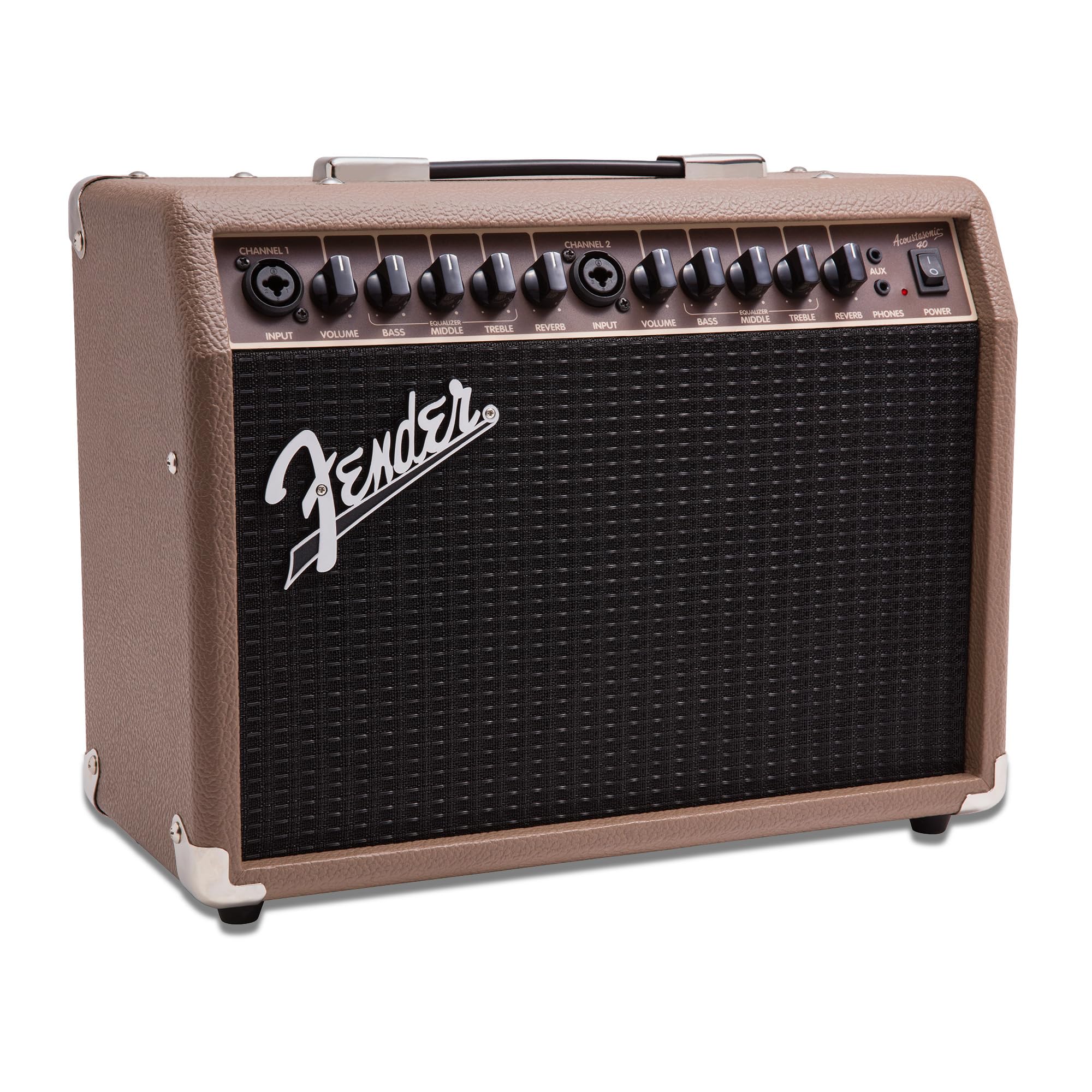
A 40-watt acoustic amp with dual 6.5-inch speakers and separate guitar and XLR mic inputs for solo performances.
If you play an acoustic-electric, this Fender is built to make it sound natural and full. Its dual 6.5-inch speakers project 40 watts of clean, lifelike tone, with a built-in reverb that adds sweet ambiance to your picking. Buyers love the clarity, calling the sound “crisp” even at restaurant-gig volumes.
The dual front-panel inputs are the killer feature: a standard 1/4″ jack for your guitar and an XLR input for a microphone. This turns the amp into a compact PA for singer-songwriters, letting you run both vocal and instrument through one lightweight box. It’s small enough to double as a stage monitor.
Weighing just 17 lbs, it’s noticeably lighter than comparable acoustic amps, making it a favorite for gigging musicians who hate heavy gear. The trade-off is a simple control set — you get tone and reverb, but not a deep EQ section. Some units have shown QC quirks like a hiss when on, so inspect yours carefully.
Gig Ready
- Handles guitar and mic simultaneously
- Great clarity for vocals and acoustic tone
- Compact enough for stage-monitor duty
Simple Controls
- Lacks deep tone-shaping options
- QC issues reported on some units
Ideal for: the solo acoustic performer who wants one unit for guitar and voice.
Think twice if: you need heavy distortion or complex effects — this is a clean-tone machine.
6. Positive Grid Spark 40

A 40-watt smart amp with 50,000+ presets and Smart Jam backing tracks, ideal for app-driven home practice.
The Spark 40 rewrites the practice amp rulebook. It’s a 40-watt combo that gives you access to 50,000+ amp-and-FX presets on ToneCloud, powered by Positive Grid’s BIAS virtual tube amp technology. You’re not just buying an amp; you’re buying a gateway to endless tones for electric, acoustic, or bass.
The genius is the Smart Jam feature, which learns your style and generates authentic bass and drums to accompany you. Connect your phone and stream music from Spotify or Apple Music, and the app auto-displays the guitar chords in real time — it’s like having a teacher and a band in your living room. Owners call it the “best amp for the price tag” and a huge upgrade from basic beginner amps.
At 15.2 pounds with dimensions of 7.48″D x 13.78″W x 7.09″H, it’s remarkably compact for the feature set. The main caveat: it’s not gig-loud, and some units have shown reliability quirks. But for the bedroom player who wants to improve fast, nothing here comes close.
Practice Superpower
- Infinite tones via the Spark app and ToneCloud
- Smart Jam generates backing band in real time
- Doubles as a Bluetooth speaker
Living Room Limit
- Not designed to compete with a drummer
- App features need an internet connection
Best for: beginners and intermediate players who want to explore tons of tones without buying pedals.
Choose this if: practice and learning are your goals over playing live venues.
7. BOSS Katana-50 Gen 3
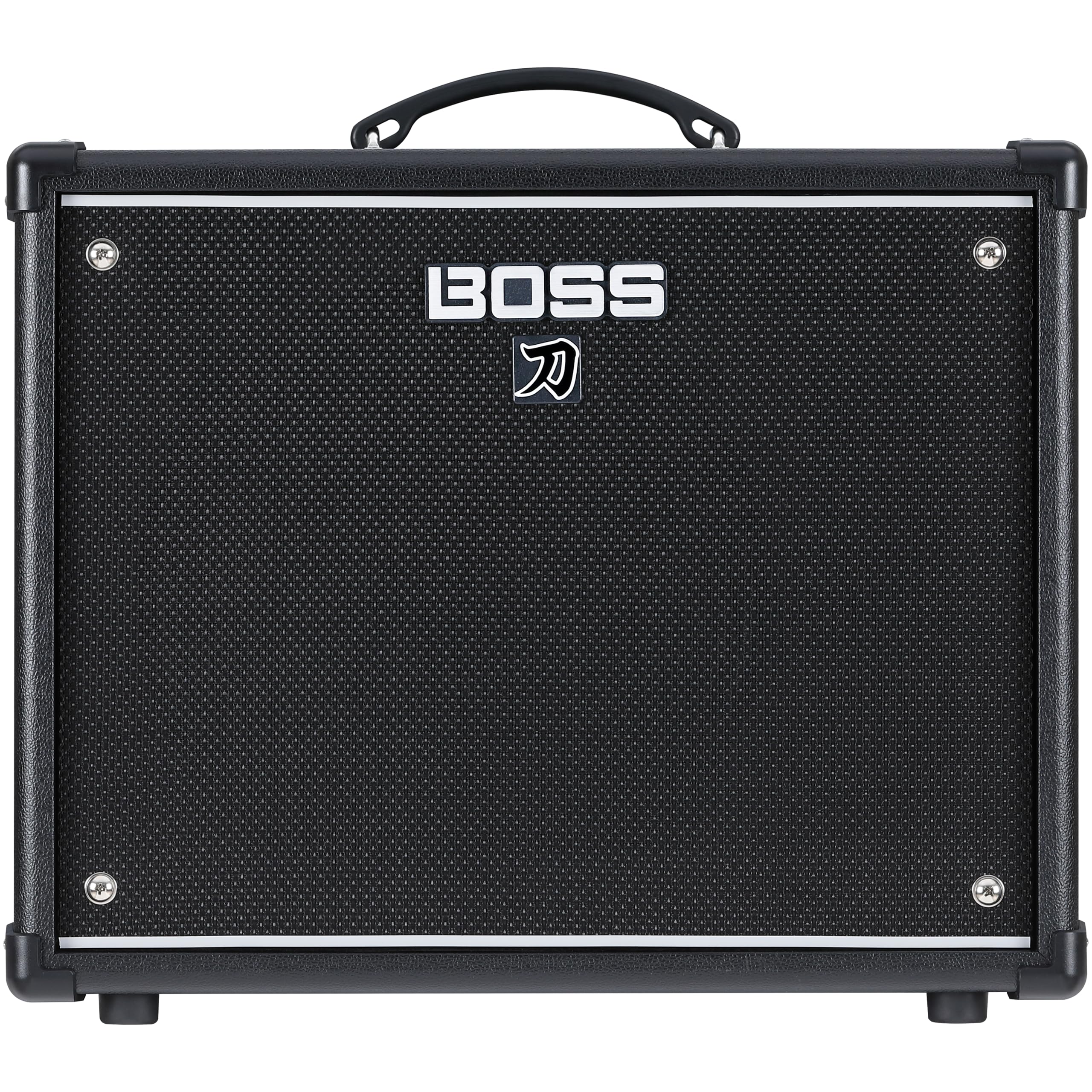
A 50-watt solid-state amp with Tube Logic, six amp characters, and five effects sections for stage-ready versatility.
The BOSS Katana series is the benchmark for hybrid practice-and-performance amps, and the Gen 3 takes it further. This 50-watt combo packs a custom 12-inch speaker and new Tube Logic enhancements that deliver a surprisingly authentic, “expressive” feel. Players with decades of experience call the tones “as close to a tube amp as I’ve found in a solid state amp.”
You get six amp characters — including the new Pushed type for edge-of-breakup fans — plus a selectable variation for each. Five independent effects sections (Booster, Mod, FX, Delay, Reverb) give you a full pedalboard under your fingertips. Sound quality is the most-praised feature by far, with customization a close second.
While it shines in small venues, connectivity gets mixed feedback — there’s no built-in Bluetooth. A 5.0x wattage difference puts it far above the Orange Crush 20RT for live use. At 25.6 pounds, it’s a solid gigging companion that feels premium without the premium price.
Tone Machine
- 12 amp characters with deep customization
- Five effects sections rival a pedalboard
- Tube-like feel from a solid-state design
Connectivity Quirk
- No Bluetooth for wireless streaming
- Distortion is good, but some prefer the Fender GTX for vintage tones
Grab it if: you want a stage-ready amp with deep tonal options and a classic feel.
it’s not for you if: Bluetooth streaming to your amp is a non-negotiable.
8. Yamaha THR10II
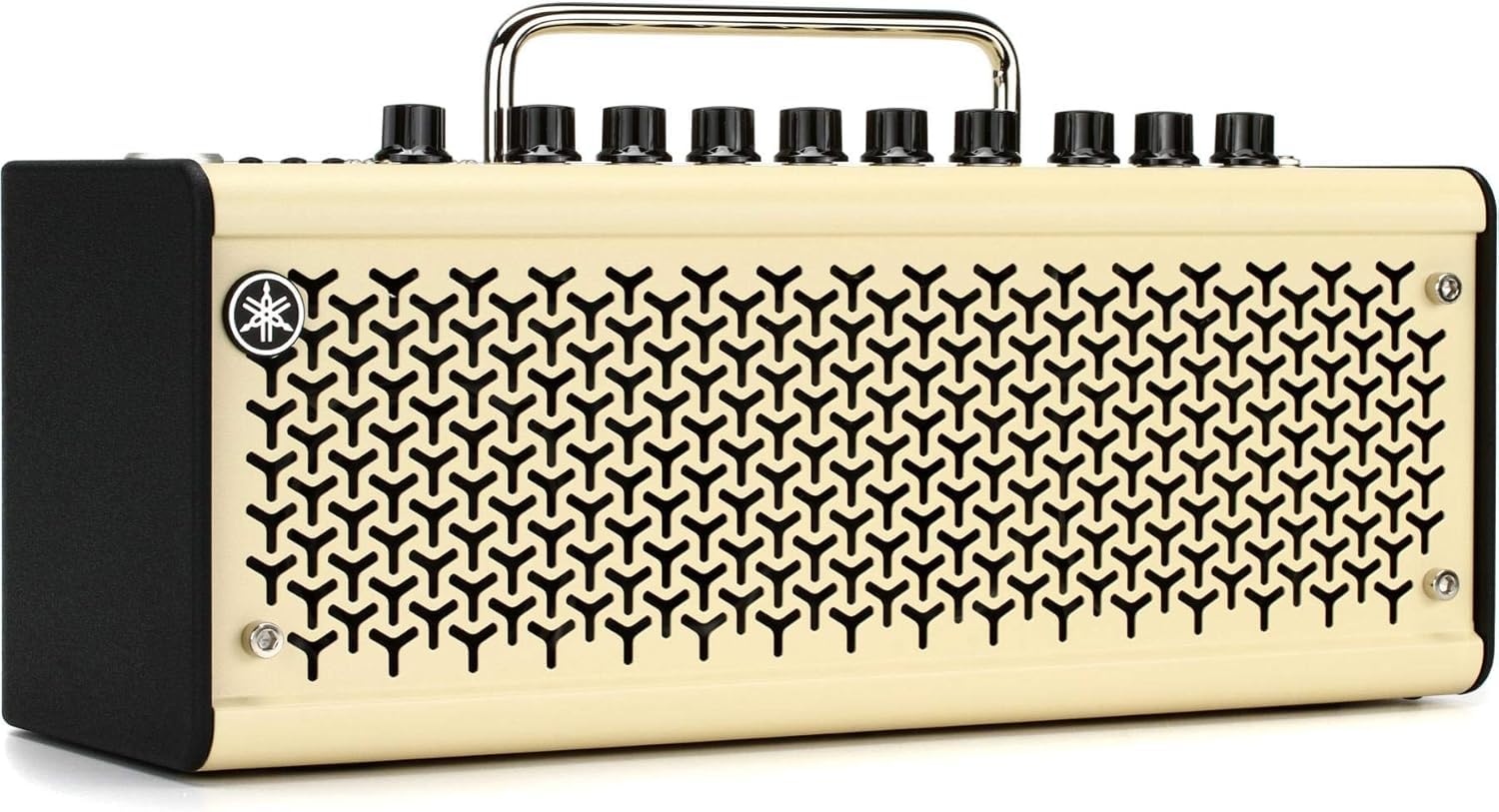
A 10-watt stereo desktop amp with 21 models and Bluetooth, delivering wide sound for apartment practice.
The Yamaha THR10II is the ultimate apartment and desktop amp. Despite its modest 10-watt output, it delivers a “wide stereo sound” and “rich clarity” that owners say makes it the best purchase for their playing in years. It’s small, light, and versatile enough for any style.
Digging into the controls reveals 15 guitar amps, 3 bass amps, and 3 mic models for acoustic-electrics. The built-in effects are easy to dial in with the clever dual-dial control, and Bluetooth support lets you stream audio from your phone or edit presets via the app. Owners love that it “doubles as a Bluetooth speaker” — a genuinely useful feature.
This amp is all about quality over volume. At just 3 kg, it’s exceptionally portable, showing picking articulation and dynamics that defy its solid-state design. The trade-off is clear: 10W is strictly for home practice, not jamming with a drummer. The USB connectivity is plug-and-play for recording, but some users report finicky laptop connections.
Apartment Hero
- Incredibly compact for wide stereo sound
- 21 amp models cover every genre
- Bluetooth speaker function adds daily value
Power Ceiling
- 10W is strictly for solo home use
- USB cable not included; app connection can be finicky
Perfect for: the player whose only stage is a desk, sofa, or bedroom.
Look to other picks if: you plan to jam with others or play live shows.
9. Fender Mustang GTX100
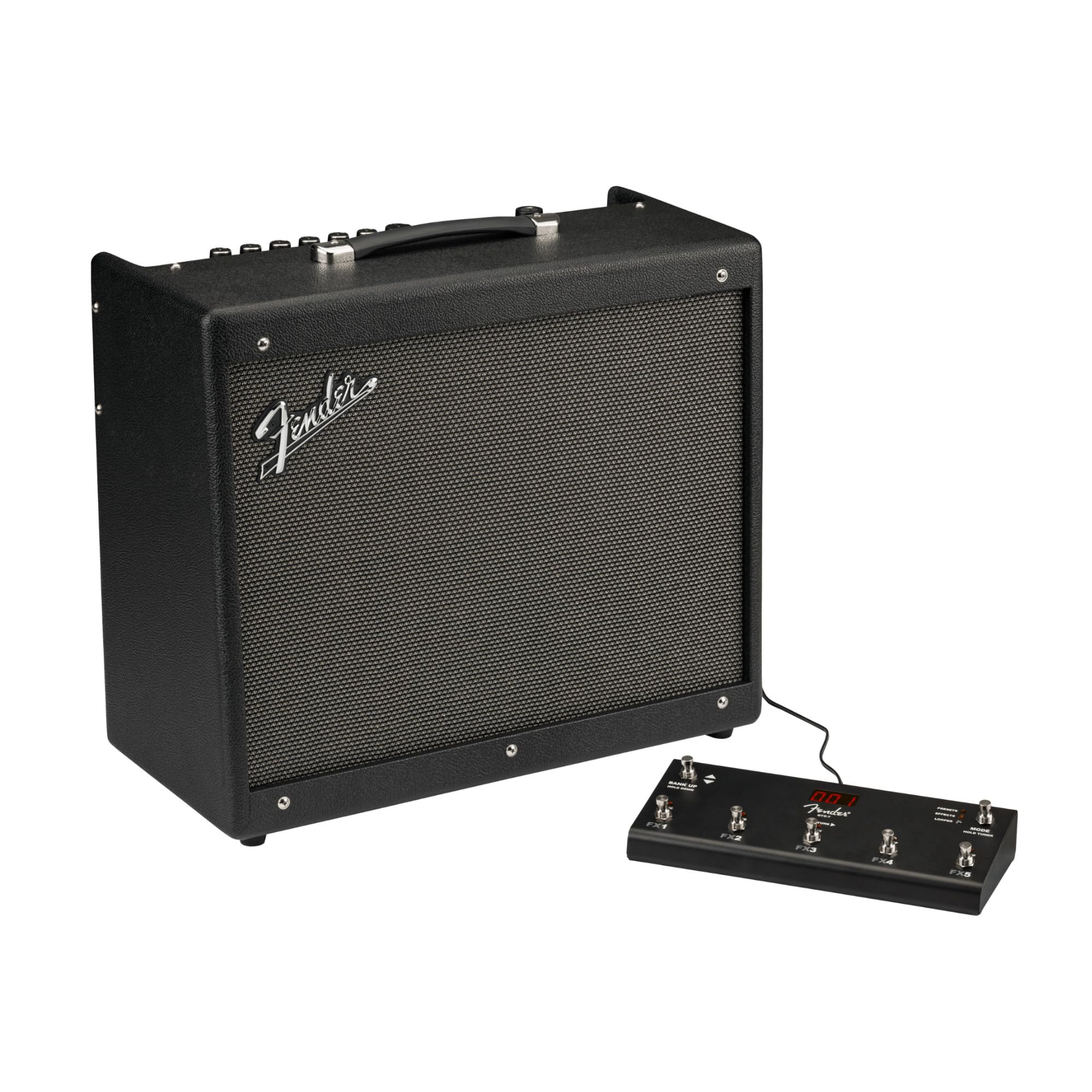
The do-everything modeling amp that dares to replace a full rig.
Think of the Fender Mustang GTX100 as a full pedalboard and amp collection in one portable unit. It holds 200 of your own presets, drives a specially-designed 12-inch Celestion speaker (a brand known for its clear, punchy guitar tone), and includes a 7-button footswitch with a 60-second looper—so you can build layers live. That means you can rehearse quietly at home, then step on stage and switch sounds instantly without hauling extra gear.
You get classic Fender models like Blues Jr and Vibro King, plus industry-leading amps like JC Clean and Silver Jubilee. The newly-modeled overdrive, fuzz, delay, and pitch shift effects are all editable on a crisp full-color screen. Owners call it “one of the best amps out there,” noting it’s more versatile than amps costing two to six times as much.
Bluetooth and WiFi connectivity open up the Fender TONE app for deep editing and community presets. The 1/4 volume setting is already loud for home use, and it honestly sounds incredible. The main gripe is connectivity — some reviewers point out the device intermittently shutting out and needing to reconnect. At 28.5 pounds, it’s the heaviest pick here, but that weight buys you a 100-watt powerhouse.
All-In-One Power
- 200 presets and ~40 amp/cab models onboard
- 7-button footswitch with 60-second looper included
- 100W with a 12″ Celestion fills any room
Digital Needs
- Connectivity issues can require reconnection
- Not an exact tube tone, despite the versatility
Choose this for: players who want every tone imaginable and are ready for small stages right now.
Note this: it’s a digital modeling amp, so purists chasing a single perfect tube overdrive should try it first.
Understanding the Specs
Wattage & Speaker Size
Wattage tells you how much clean power an amp can push before it distorts. For home practice, 10 to 20 watts is plenty. For small gigs, 40 to 50 watts with a 10″ or 12″ speaker will help you keep up with a drummer. A larger speaker moves more air, giving you a fuller low-end and a bigger overall sound.
Modeling vs. Solid-State
Solid-state amps use analog circuits to produce a fixed tone. Modeling amps use digital processors to recreate many amp and effect types in one unit. If you want variety in a single box, modeling is the way. If you prefer simple, reliable, hands-on control, a solid-state amp is often the more direct choice.
FAQ
Is 20 watts loud enough for a band practice?
Can I use a headphone jack with a cab simulation for quiet practice?
What is the difference between an effects loop and a line out?
Does a modeling amp sound as good as a tube amp?
Can a modeling amp be used for gigs?
How many inputs do I need for acoustic guitar and vocals?
Is it worth paying more for an amp with an app?
What is the best amp for apartment living?
Final Thoughts: The Verdict
For most buyers, the amp under $500 winner is the Orange Crush 35RT because it balances gig-ready volume, fantastic British tone, and practical features like cab sim headphones. If you want a practice tool that feels like a full band, grab the Positive Grid Spark 40. And for the gigging player who needs endless tones and stage power, the Fender Mustang GTX100 is the one to reach for.
How We Picked
We do not accept paid placement. Every pick is matched to a real buyer and a real use-case; we do not hands-on test units.
Sources & Methodology
Specifications: manufacturer listings and product documentation. Review insights: verified customer reviews, as of August 2026. Pricing: not shown on this page (it changes often); check the current price via the retailer link.
As an Amazon Associate, Gadgets Feed earns from qualifying purchases. This does not affect which products we feature.