
Our readers keep the lights on and my morning glass full of iced black tea. As an Amazon Associate, I earn from qualifying purchases.
Specs are compiled from manufacturer listings and verified buyer reviews and can change over time — please confirm the key details on the product page before buying.
You want deeper, richer sound in your car, but you don’t want to sacrifice your entire trunk to a giant wooden box and a separate amplifier. The solution is an all-in-one powered subwoofer — a sub and amp built into a single enclosure that tucks under a seat or behind a panel. This guide breaks down the models that deliver real bass without the installation headaches.
I’m Min — the founder and writer behind Gadgets Feed. This guide is built by comparing the manufacturers’ published specifications and the patterns across verified customer reviews, so you get each pick’s real strengths and trade-offs instead of marketing spin.
Match the sub’s driver size and RMS power to your vehicle’s available space and the bass depth you want.
Our Picks at a Glance


How To Choose The Best Auto Powered Subwoofer
If your factory stereo sounds thin and you want real bass without rewiring your car, an auto powered subwoofer is the simplest fix. It combines the subwoofer and amplifier into one box, so you avoid the complicated wiring of separate components. Your choice hinges on the available mounting space and the bass depth you want.
Match the Size to Your Space
Measure the mounting space before buying. A slim 8-inch sub fits under most front seats, while a 10-inch unit often goes behind the rear seat of a truck or in a trunk corner. The largest 12-inch powered enclosures are taller and usually live in the trunk, where they can be heard but take up noticeable room.
Understand the Power Numbers
Manufacturers advertise peak wattage that sounds impressive but only happens in brief bursts. RMS (continuous power) is the honest spec that tells you what the sub can sustain. A 300W RMS sub plays consistently loud, while a 125W RMS sub offers a cleaner but more modest bass boost.
Check Your Radio’s Connections
Factory stereos lack the RCA outputs found in aftermarket head units. Look for speaker-level (high-level) inputs that let you tap into your existing speaker wires without replacing the radio. Many powered subs also include auto turn-on, which senses the signal and powers up automatically.
Quick Comparison
| Model | Best For | Driver Size | RMS Power | Enclosure Type | Amazon |
|---|---|---|---|---|---|
| Rockford Fosgate P300-10T★ Best Overall | Truck Behind-Seat Fit | 10″ | 300W Internal | Sealed Slim | Amazon |
| Rockville RWS10CABest Value | Best Value Power | 10″ | 300W RMS | Sealed Slim | Amazon |
| MTX Audio RT8PTCompact Tube | Compact Tube Design | 8″ | 120W RMS | Vented Tube | Amazon |
| Pioneer TS-WX140DA | Electric Vehicles | 8″ | 170W Class-D | Sealed Compact | Amazon |
| JBL BassPro SL | Under-Seat Clean Bass | 8″ | 125W RMS | Sealed Compact | Amazon |
| Rockford Fosgate P300-8P | Tight Spaces, Punchy Bass | 8″ | 300W Internal | Ported Slim | Amazon |
| Pioneer TS-WX1210A | Deep 12″ Music Bass | 12″ | 300W Class-D | Sealed | Amazon |
| JBL SUBBP12AM | Loud 12″ Impact | 12″ | 150W RMS | Ported Slipstream | Amazon |
| KICKER 46HS10 | Slim Aluminum Build | 10″ | Built-In Amp | Sealed Aluminum | Amazon |
In‑Depth Reviews
1. Rockford Fosgate Punch P300-10T
Our pick — over 4.5★ from 650+ verified ratings; the strongest balance of quality and price.
The truck-cab favorite that adds tight, musical bass without swallowing your floorboard.
If you drive a pickup or SUV and want dependable, clean bass, this is the one to get. The 10-inch driver runs off a built-in 300-watt class-D amplifier (a compact, efficient amp that produces less heat), and the sealed slim enclosure measures 13.3″ x 21.7″ x 7.9″ x 4.8″ — thin enough to slide behind a truck seat. It hooks up to factory stereos via speaker-level inputs or to aftermarket units via line-level inputs, so it works with nearly any radio.
Owners consistently call out the sound quality above everything else, and the installation stories back it up. Buyers report it fits neatly behind the seat and is genuinely easy to set up and adjust. The bass is described as tight and musical rather than window-rattling — exactly what daily drivers want. As owners put it: “sounds good, pretty easy installation, would sound better if the box was ported but overall good sub for price point.”
The sealed design keeps the bass controlled and precise, which suits rock and pop more than hard-thumping hip-hop. The adjustable 12db/Octave low-pass crossover, a built-in bass boost EQ, and a 0°/180° phase switch give you real control to tune it. It’s a hefty unit, so it won’t fit under every rear seat — one common note is that it doesn’t slide under a Ram 1500’s rear seat, but it works well on the floorboard instead.
What Wins People Over
- Sound quality is the most-praised trait by a wide margin
- Easy install with factory or aftermarket radios
- Slim profile fits behind truck seats
- Rockford Fosgate build quality with a 1-year warranty
Fair Trade-Offs
- Sealed box is not built for extreme bass output
- Physical size can be a tight fit in smaller cabs
The daily-driver choice: if you want clean, musical bass and an easy install, this is the one to start with.
Not a flex machine: if you want chest-thumping volume for competitions, a ported box will serve you better.
2. Rockville RWS10CA
A surprisingly strong 10-inch punch that gives budget-conscious bass heads real output.
If you want maximum bass per dollar, this Rockville delivers hard. It pushes 1000W peak and 300W RMS through a 10-inch Kevlar-reinforced cone, and the built-in 300W amplifier means you don’t need a separate amp. The slim enclosure measures 24″ x 7″ x 15″, so it slips into trunks, under bench seats, or in the back of a Jeep without dominating the space.
Value is the story here — second only to sound quality in what buyers praise most. It’s a frequent pick for single cab trucks and small SUVs like the Jeep Renegade, and the smart turn-on circuitry makes wiring simple even for first-timers. There’s a remote bass control knob, an adjustable low-pass crossover, and a +12dB bass boost so you can dial it to your music. The 2-inch aluminum voice coil and 60oz magnet are built to handle the power.
The honest downside is heat. A recurring theme in reviews is the amp overheating and kicking on and off during heavy use, and reliability gets mixed feedback overall. If you drive it gently, it’s an incredible value; if you push it hard for long stretches, you may trip the thermal breaker.
Why It’s a Steal
- 1000W peak and 300W RMS for serious output
- Strong value reputation among buyers
- Compact slim box fits small vehicles
- Great for filling cargo vans and truck cabs
Where to Be Careful
- Amp overheating is the most common complaint
- Can overpower very small cabin spaces
Reach for this if: you’re on a budget and want the most bass for the least money.
Look elsewhere if: you plan to run it loud for hours — heat is its weak spot.
3. MTX Audio RT8PT
The round vented tube that adds punchy lows to tight spaces without a big footprint.
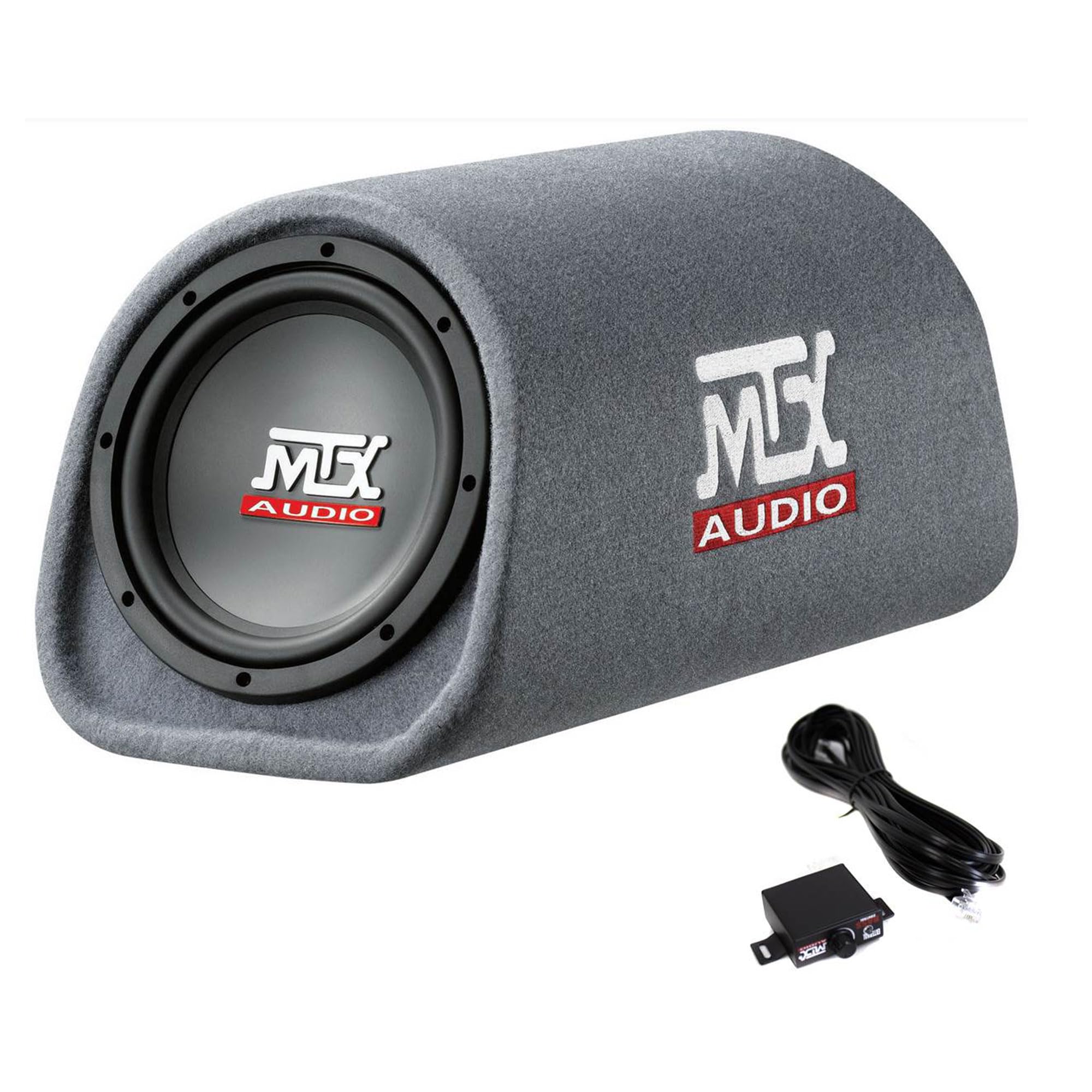
This one’s for smaller cars and trucks where a box just won’t fit. The 8-inch driver with a butyl rubber surround handles 240W max and 120W RMS, and the vented tube design boosts output beyond what a sealed box this size could manage. The dimensions — 21.25″L x 9.84″W x 9.84″H — let it sit under a bench seat or in a cargo corner.
Owners consistently praise the sound quality and value, and the installation stories back it up. A common thread is that it fills lower frequencies well for most music, staying punchy and accurate for country and rock. It fits neatly in a Tacoma double cab back seat and improves stock sound dramatically. The frequency response spans 35Hz to 250Hz, with a variable crossover from 50Hz to 200Hz at 12dB/Oct.
The catch is depth. It cannot hit below 35Hz, so the lowest synth and sub-bass in rap tracks take a hit, and output stays modest rather than thumping. It’s a steady, musical sub rather than a head-banger — perfect if you want to round out your system without rattling windows.
Best for steady bass: it adds clean, accurate lows to daily driving without demanding much space or wiring expertise.
The limitation: if your playlist is heavy on deep sub-bass, you’ll feel the 35Hz floor.
4. Pioneer TS-WX140DA

The under-seat sub built specifically so electric vehicle owners can add bass without killing range.
If you drive an EV, this Pioneer is engineered for you. Its built-in 170-watt Class-D amplifier draws a maximum of only 4.3 amps, so adding bass won’t noticeably lower your mileage. The compact driver is 20 centimeters (about 8 inches) and fits in tight spots — under seats, behind seats, or inside small storage compartments.
What makes it versatile is the three listening modes: Deep, Dynamic, and Natural, each with its own sensitivity rating. You get 95 dB in Deep, 100 dB in Dynamic, and 98 dB in Natural, which means it stays clear and loud even at lower power inputs. It works with most car radios through RCA or speaker-level inputs, and a wired digital bass control with a 16.25′ cable lets you tune from the driver’s seat.
Owners find the sound quality excellent, with some noting genuinely impressive bass for its size. The trade-offs are practical: the included manual is confusing, and RCA or speaker wire aren’t in the box, so you’ll need to supply your own wiring. It’s a clean bass booster, not a window-shaker, which suits luxury-car-style sound perfectly.
Why EV drivers love it: the low 4.3-amp draw keeps your range intact while adding a punchy low end.
Setup note: plan to buy wiring and watch a video — the manual won’t hold your hand.
5. JBL BassPro SL

The compact JBL that slides under a seat and rounds out weak factory systems cleanly.
This is the fix for factory stereos that lack bass. The 8-inch BassPro SL delivers 250W peak and 125W RMS through an efficient Class-D amplifier, and the slim enclosure is built to sit under a seat. It includes speaker-level inputs with Audio Sense Auto-on, so it wakes up automatically when your radio plays — no remote turn-on wire needed.
A common real-world story is using it to fix a wimpy factory system, like the Ford B&O setup, where owners mention it adds the missing low end and complements the stock speakers beautifully. It’s adjustable, compact, and easy to install, fitting behind rear seatbacks or under benches. The controls help manage road noise and let you tailor the output to your liking.
The main caveat is mounting. The unit doesn’t come anchored, and owners note that insulating it — say, with foam blocks — is essential to stop vibration noise. It also carries a mixed value reputation, with some feeling it’s priced high for 125W RMS.
Great for factory upgrades: it’s a straightforward way to add clean, controllable bass to a stock system.
Plan the install: budget for foam or brackets to tame vibration, and it shines.
6. Rockford Fosgate Punch P300-8P

A harder-hitting 8-inch cousin of the 10T, built for tight spaces with extra punch.
Don’t let the smaller driver fool you — this 8-inch ported sub hits harder than its size suggests. It’s powered by the same internal 300-watt class-D amplifier as the 10T above, but the ported enclosure (11.4″ x 17.6″ x 5.6″) gives it a more aggressive character. Owners describe it as slightly punchier and harder than the 10-inch, making it a favorite for trucks and small cars.
The ported design means it can move more air, and reviewers report it beats stock systems easily, coming close to 12-inch depth at moderate volume. It includes an adjustable 12db/Octave low-pass crossover, onboard bass boost EQ, and a phase switch, plus the remote Punch Level Control for bass. It connects to factory or aftermarket radios via speaker-level or line-level inputs.
Push it hard and you’ll hear port noise at high drive levels, and the port assembly feels a bit cheap to some. At moderate volumes, though, it’s crisp, clean, and fills the missing bass in most vehicles. One insightful note from owners: the gain knob becomes pointless beyond low settings, so subtle tuning is best.
What Makes It Great
- Ported design adds punch beyond its 8-inch size
- Easy install with helpful online guides
- Fits behind seats and in tight spots
- Strong build quality from Rockford Fosgate
Know Before You Buy
- Port noise appears at high volume
- Not built for competition-level pounding
Pick this for: a compact sub that still delivers an aggressive, punchy sound.
skip it if: you plan to crank it — it prefers moderate volume.
7. Pioneer TS-WX1210A

The 12-inch all-in-one that adds real depth and richness for music lovers, not just bass heads.
If you want the deepest bass without piecing together a separate amp, this Pioneer delivers. The 12-inch driver handles up to 1200W max, powered by a built-in 300-watt Class-D amplifier known for high efficiency and low heat. It’s a sealed enclosure that fits neatly in a trunk, and while it’s taller than slim rivals, it’s still a single self-contained unit.
Owners overwhelmingly praise the sound quality, noting it handles any music genre well. It delivers punchy kickdrums and a solid bass guitar tone, blending cleanly with your existing speakers. The sensitivity rating of 114 dB (how efficiently it converts power into sound) means it stays loud and clear even at moderate power, and the adjustable low-pass filter, phase control, and variable bass boost (0 to +12 dB, 40Hz to 100Hz) let you fine-tune the output to your taste.
The honest math: some owners note the real continuous output is closer to a few hundred watts than the headline 1200W max, so it’s not an SPL monster. It hits around 30Hz well and drops off below that. For casual listening in noisy vehicles, it’s a solid winner that beats many pricier options.
A music lover’s sub: it rounds out any genre with clean, adjustable bass that doesn’t distort.
Temper expectations: it’s loud and clean, not a competition ground-shaker.
8. JBL SUBBP12AM

A 12-inch JBL that hits hard and clean, with a port design that silences the usual whoosh.
This is for drivers who want serious output from an all-in-one. The polypropylene 12-inch woofer (305mm) is matched to a built-in amp delivering 150W RMS and 450W peak. The defining feature is the Slipstream port, which eliminates port noise and delivers distortion-free bass even at high volume — a real advantage over cheaper ported boxes.
Owners consistently praise the sound quality and value, describing it as loud enough for its wattage and capable of pulling bass out of songs you didn’t know had any. In a full-size car, it can shake the mirrors at half volume, and the included remote control plus sub level control make tuning simple. The frequency response spans 35Hz to 120Hz, giving you solid low extension.
The size gets mixed feedback — it’s pretty large, and some find it too tall for tight trunks. The exposed speaker cone also means you’ll likely want a protective grill for cargo-hauling days. It’s a clean, powerful performer that rewards a professional install.
The Highlights
- Slipstream port delivers distortion-free bass
- Hits hard for 150W RMS — shakes the car at half volume
- Easy install with a solid value reputation
- Remote sub level control included
Watch For
- Large footprint — measure your trunk first
- Exposed cone needs a grill for protection
Choose this if: you want big, clean 12-inch output and have the trunk space.
Think twice if: your storage area is tight — this one needs room to breathe.
9. KICKER 46HS10 Hideaway

The rugged aluminum Hideaway that hides behind seats and still delivers surprising impact.
This Kicker is built for stealth. The 10-inch driver lives in a tough all-aluminum frame that’s only two millimeters taller than its 8-inch sibling, yet delivers more power and bigger impact. It’s designed to fit behind seats and in inconspicuous spots, with a quick-connect Molex plug and harness that includes power, signal, and remote turn-on for a clean install.
Owners are consistently impressed with the sound quality for its compact size, calling it the right amount of punch. A memorable install story is a Mercedes SLK 250 where the sub transformed the sound stage with chest-hitting bass. The included remote control lets you adjust bass without touching the radio volume, and the adjustable low-pass crossover, variable +6dB bass boost, and phase switch give solid tuning options. It offers two auto turn-on modes: DC-offset or signal sensing.
The recurring advice is that settings matter — you must dial in the gain and crossover to get the best sound. Reliability gets mixed-to-negative feedback in some reviews, and value is debated, with some feeling it’s pricey for the output. It’s a premium, position-dependent unit that rewards careful setup.
Why It Stands Out
- Tough all-aluminum frame that barely takes up space
- Quick-connect harness simplifies wiring
- Surprising chest-level bass from a slim package
- Great for full-size truck cabs
Consider This
- Requires careful dialing-in for best sound
- Mixed reliability and value feedback
Best for: truck owners who want rugged, hidden bass behind the rear seat.
Not for: impatient installers — it demands tuning time to shine.
Understanding the Specs
Driver Size (8″, 10″, 12″)
The size of the subwoofer cone determines how deep it can dig. An 8-inch driver is compact and fits under seats, but it can’t reproduce the lowest sub-bass frequencies well. A 10-inch is the best balance for most cars, offering good depth in a slim box. A 12-inch moves the most air for the hardest-hitting, deepest bass, but needs a larger enclosure.
RMS vs Peak Power
Peak wattage is the brief maximum burst a sub can handle — it’s the big marketing number. RMS (continuous power) is what the sub actually delivers over time, and it’s the honest spec to compare. A sub rated 300W RMS will play consistently loud, while one rated 125W RMS offers a cleaner but more modest boost.
Sealed vs Ported Enclosures
A sealed box gives tight, accurate, musical bass that suits rock and pop. A ported (vented) box has a hole or tube that lets the driver move more air, boosting output and creating a punchier, louder sound — ideal if you want more impact from a smaller driver. Ported designs can hiss at high volume, which is what the Slipstream port on the JBL eliminates.
Class-D Amplifiers
Almost every modern powered sub uses a Class-D amplifier because it’s highly efficient. That means it produces more power with less heat and less drain on your car’s electrical system. It’s why compact subs like the Pioneer TS-WX140DA can run in an EV (drawing only 4.3 amps) without hurting range.
FAQ
Will a powered subwoofer work with my factory radio?
How do I know if a subwoofer will fit under my seat?
What is the difference between peak watts and RMS watts?
Can I install a powered subwoofer myself?
Does a powered subwoofer drain my car battery?
Why does my powered subwoofer keep turning off?
Can I use a powered subwoofer in an electric vehicle?
What does a bass boost knob do?
Final Thoughts: The Verdict
For most buyers, the auto powered subwoofer winner is the Rockford Fosgate Punch P300-10T because it balances clean sound, a slim behind-seat fit, and trusted build quality in one easy package. If you want maximum bass for your dollar, grab the Rockville RWS10CA and accept its heat sensitivity. And for EV drivers who want to add low end without sacrificing range, the Pioneer TS-WX140DA is the one to reach for.
How We Picked
We do not accept paid placement. Every pick is matched to a real buyer and a real use-case; we do not hands-on test units.
Sources & Methodology
Specifications: manufacturer listings and product documentation. Review insights: verified customer reviews, as of August 2026. Pricing: not shown on this page (it changes often); check the current price via the retailer link.
As an Amazon Associate, Gadgets Feed earns from qualifying purchases. This does not affect which products we feature.