
Let’s be honest — most affordable dashcams look the same on a product page, but they fail in dramatically different ways when you actually need the footage. One common pain point in this category is that cheap cameras either wash out license plates entirely under bright headlights, or the rear camera’s adhesive gives up after a week of summer heat. When an accident happens, the footage you didn’t get is the price you pay for picking the wrong unit.
I’m Rikta — the co-founder and writer behind Gadgets Feed. I’ve spent years analyzing the technical specification sheets and real-world performance data in this crowded sub- dashcam segment, separating cameras that promise 4K from those that actually deliver readable footage at night and in complex lighting. (And Homer 🐱 sat on the dashboard shaking his head at any model that claims night vision but can’t catch a feline whisker in dim garages).
I’ve gathered the current lineup of front, front-and-rear, and three-channel units available on the market — sorting through sensor specs, frame rates, Wi-Fi standards, parking-mode quirks, and real customer feedback — so you can find the affordable dashcam that actually fits your driving needs and budget.
How To Choose The Best Affordable Dashcam
Choosing the right dashcam for your budget means understanding which compromises you can live with and which will cost you evidence. Here are the key areas to evaluate before clicking buy.
Sensor Quality and Night Performance
The image sensor is the heart of any dashcam. In this price bracket, you will see standard sensors and STARVIS or STARVIS 2 sensors. A STARVIS sensor offers significantly better low-light sensitivity, keeping license plates readable even under direct headlight glare. A camera with a low-resolution sensor but a wide aperture (F1.6 or wider) often captures clearer night footage than a basic-sensor 4K camera with a mediocre lens. If you drive frequently after dark or park on unlit streets, prioritize sensor technology over raw resolution.
Parking Mode and Power Requirements
Most affordable dashcams advertise 24-hour parking monitoring, but that feature almost always requires an additional hardwire kit (sold separately) connected to your car’s fuse box. Without it, the camera relies on the cigarette lighter port, which loses power when the ignition is off. If you park on the street or in a busy lot, look for a model that explicitly supports time-lapse or motion-detection parking mode with a hardwire kit, and check whether the kit draws power safely (low-voltage protection is essential).
Storage and File Management
Loop recording is standard, but the included memory card size varies wildly. Some budget models ship without any card, while others include a 64GB or 128GB card rated for continuous overwrite. Maximum supported capacity matters, too — 256GB or 512GB allows longer retention before older clips are overwritten. Also look at how easily you can retrieve footage: a built-in Wi-Fi module (5GHz or 5.8GHz for faster transfers) and a well-reviewed companion app make a huge difference compared to physically removing a microSD card and searching through folders on a computer.
Quick Comparison
On smaller screens, swipe sideways to see the full table.
| Model | Category | Best For | Key Spec | Amazon |
|---|---|---|---|---|
| 70mai T800E | 3-Channel Premium | Rideshare & total coverage | STARVIS 2 + Wi-Fi 6 + 3CH | Amazon |
| REDTIGER F7N | Dual Channel Premium | Night plate capture | STARVIS 2 + 20MB/s WiFi | Amazon |
| TERUNSOUl 3CH | 3-Channel Mid-Range | Cabin & road in one unit | Triple cam + 128GB incl. | Amazon |
| COOLCRAZY N8 | 4K Dual Channel | Best value GPS tracking | STARVIS + 5GHz WiFi + GPS | Amazon |
| DDPAI Z60 | 4K Dual Channel | Dual-storage reliability | Built-in 32GB eMMC | Amazon |
| VIRROW X5 | 4K+2.5K Dual | Touchscreen usability | Touchscreen + free 64GB | Amazon |
| Vantrue E1 Lite | Front-Only Compact | Stealth front cam | 1080p 60fps + GPS | Amazon |
In‑Depth Reviews
1. 70mai 4K Dash Cam Front and Rear Inside T800E

The 70mai T800E earns its spot as the top overall pick because it solves the biggest challenge in this tier: delivering three-channel 4K front coverage alongside 1080p interior and rear feeds without the typical noise or frame-rate drops. Its Sony STARVIS 2 sensor is the same imaging backbone found in significantly pricier units, and the F1.55 aperture lets in enough light to keep plates readable even on poorly lit residential streets. The switchable IR for the interior camera is a smart touch for rideshare drivers who want cabin visibility at night without the giveaway red glow.
Where this dashcam separates from the pack is connectivity. Wi-Fi 6 transfers are up to five times faster than the Wi-Fi 4 standard most competitors still use, so pulling a 4K clip to your phone takes seconds instead of minutes. The built-in 5-mode GPS overlays speed and route data precisely, and the companion app (once you navigate the initial pairing) is intuitive for reviewing footage. The included 64GB card is an honest placeholder — the unit supports up to 512GB if you need longer retention. Super capacitor construction means it handles the 14°F to 140°F range without swelling or fire risk.
Some users have noted that the app connection can be finicky on the first few tries, and the rear camera cable is generous but requires thoughtful routing in smaller sedans. The parking mode requires a separate hardwire kit, which is standard for this feature set. If you need cabin monitoring or want the best low-light sensor in this budget bracket, the T800E is the complete package.
Why it’s great
- STARVIS 2 sensor for class-leading night clarity
- True three-channel recording (4K front, 1080p cabin, 1080p rear)
- Fast Wi-Fi 6 file transfers
- Switchable IR for discreet interior recording
Good to know
- App pairing can be tricky initially
- Parking mode requires a separate hardwire kit
- Cable management is fiddly in smaller cars
2. REDTIGER Dash Cam F7N
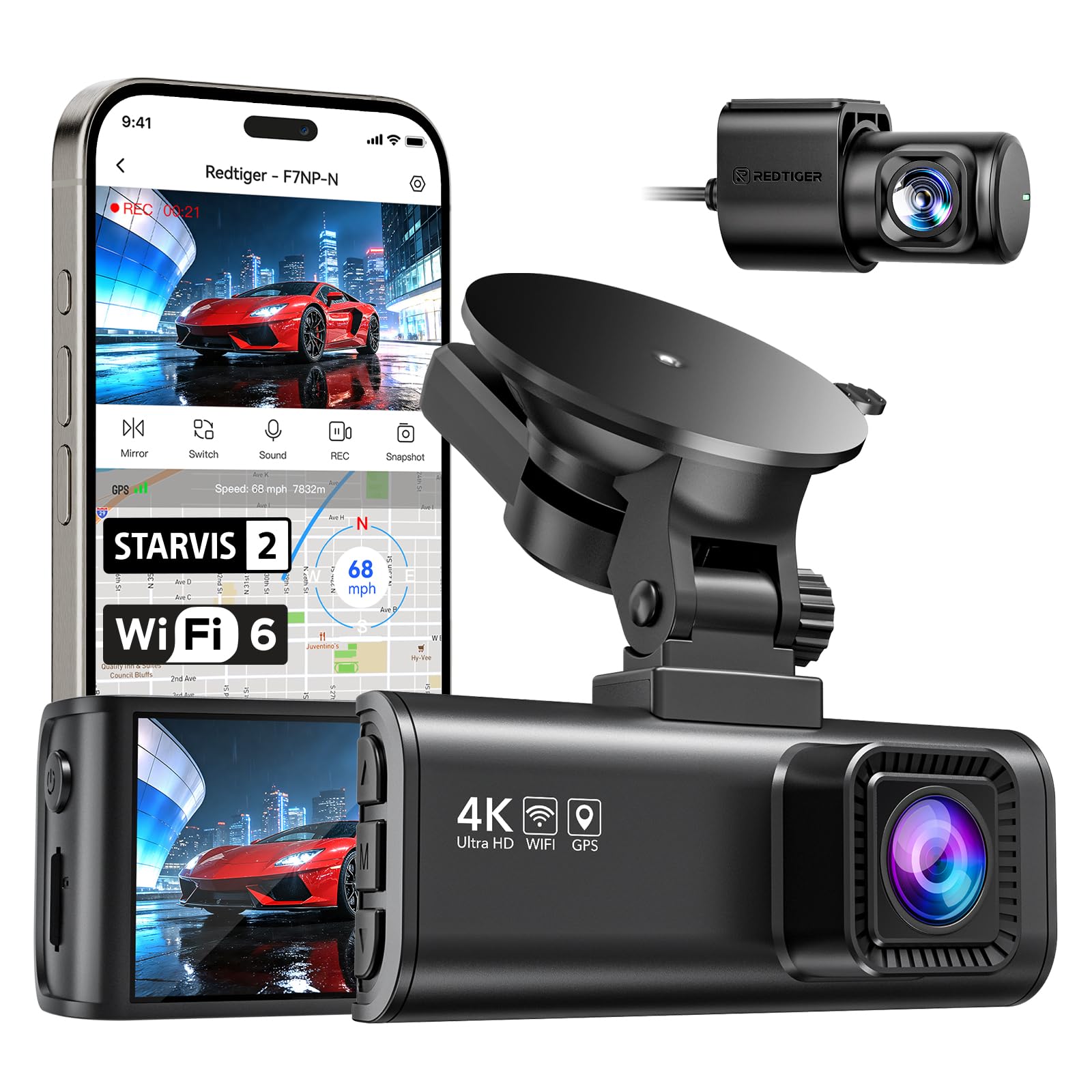
The REDTIGER F7N is built around the same STARVIS 2 sensor found in the 70mai, but it comes in a dual-channel format (4K front, 1080p rear) and focuses on delivering the fastest wireless transfer speeds in this tier at 20MB/s over 5.8GHz Wi-Fi. That speed matters when you are stopped on a shoulder and need to hand a clip to a police officer before leaving the scene. The F1.6 aperture combined with HDR and WDR technologies keeps exposure balanced across frame, preventing blown-out headlight halos that ruin plate readability.
The build quality stands out among competitors: the suction cup mount with built-in GPS unit locks securely and holds position even on rough pavement, and the supercapacitor power system survives extreme temperatures without degrading. The Redtiger Cam app is one of the more stable companion apps in the budget segment, with OTA firmware updates and quick playback controls. The 170° front lens covers three lanes of traffic easily, and the rear camera cable is a generous 21.3 feet, enough to route cleanly through an SUV or a minivan.
One recurring note from verified buyers: the parking mode documentation is insufficient, and users who installed the hardwire kit incorrectly reported that the unit never recorded while parked. Read the hardwire kit instructions carefully or check the support forums before wiring. Also note that no memory card is included — you will need to purchase a high-endurance microSD card separately. If stable day-to-night video and reliable app access are your priorities, this is the most refined dual-channel unit at the premium end of the budget bracket.
Why it’s great
- STARVIS 2 sensor delivers balanced day/night exposure
- Fastest Wi-Fi in its class at 20MB/s
- Solid build with GPS-integrated suction mount
- OTA firmware updates through the app
Good to know
- No memory card included in the box
- Parking mode setup is not well documented
- Android app can feel slower than iOS version
3. TERUNSOUl 4K 3 Channel Dash Cam
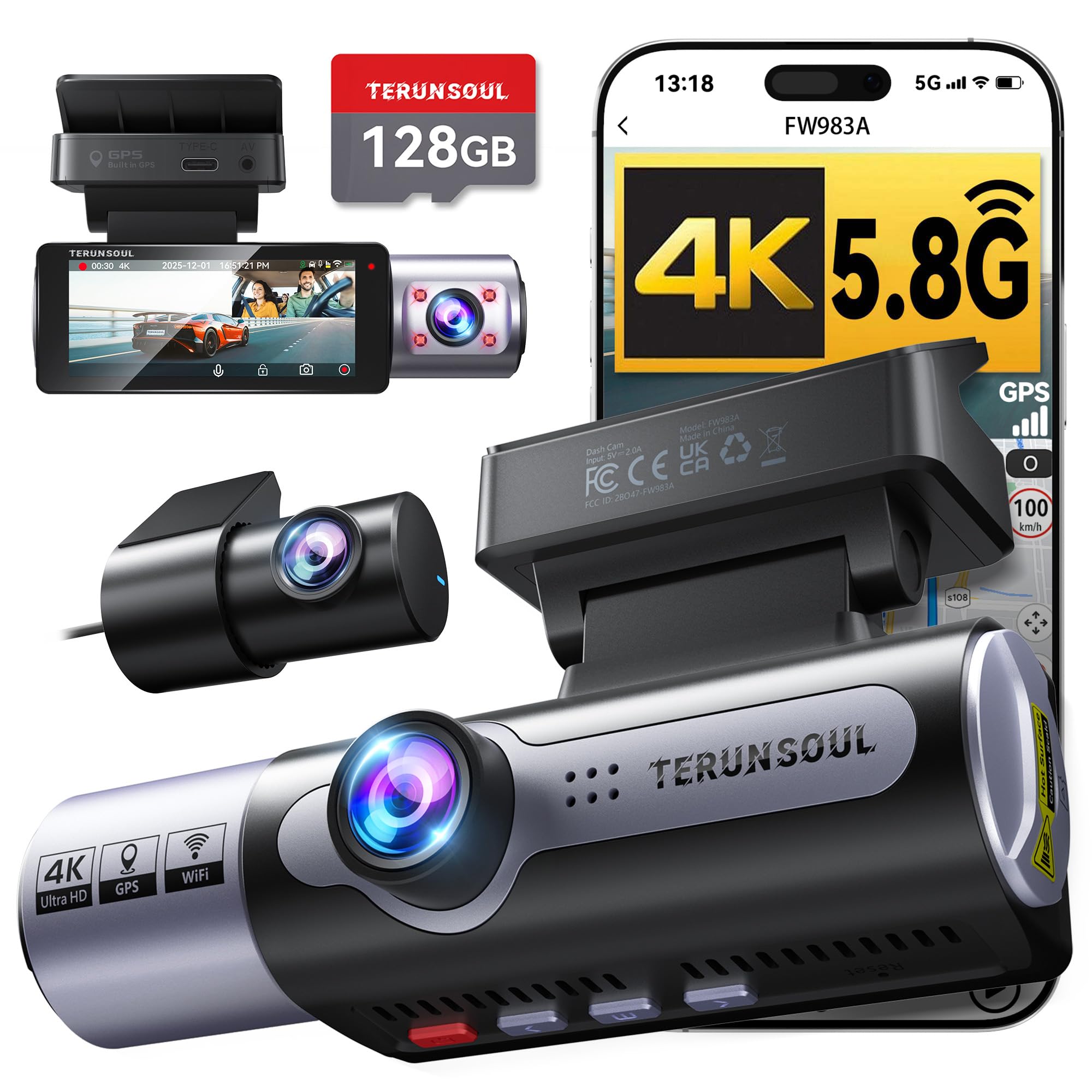
The TERUNSOUl targets a specific sweet spot: it offers three-channel recording (4K front, 1080p cabin, 1080p rear) with a pre-installed 128GB memory card, all at a price point where most competitors sell only dual-channel units. This is a compelling proposition for rideshare drivers or families who want to document both the road and the passenger compartment. The 170° front lens and 165° rear and cabin lenses provide near-360° coverage, and the starlight-grade F1.6 aperture with HDR processing pulls solid detail from dusk and dawn conditions.
The 3.16-inch IPS display is bright enough to review footage on the spot without needing the phone app, and the included GPS mount embeds route and speed data directly into the video file. The 5.8GHz Wi-Fi delivers file downloads up to 20MB/s, which is competitive with the REDTIGER. TERUNSOUl backs this unit with an 18-month warranty, and the packaging includes thoughtful extras like cable clips, electrostatic films, and a pry tool — reducing the friction of a first-time installation.
The trade-off comes in sensor quality. The front camera does not use a STARVIS sensor, so low-light performance is noticeably softer than the 70mai or REDTIGER when the sun is fully down. The rear and cabin cameras also use lower-resolution modules, so fine details on plates from the back are less reliable at night. If your driving is mostly daytime or well-lit urban streets, this is the most generous storage- and channel-value unit in the roundup.
Why it’s great
- Three-channel recording at a dual-channel price
- 128GB memory card included and ready to use
- Bright 3.16-inch IPS display for on-camera review
- Comprehensive accessory kit for installation
Good to know
- No STARVIS sensor — night plates are less reliable
- Printed manual is minimal; app guide is better
- Parking mode needs separate hardwire kit
4. COOLCRAZY N8 4K Dash Cam Front and Rear
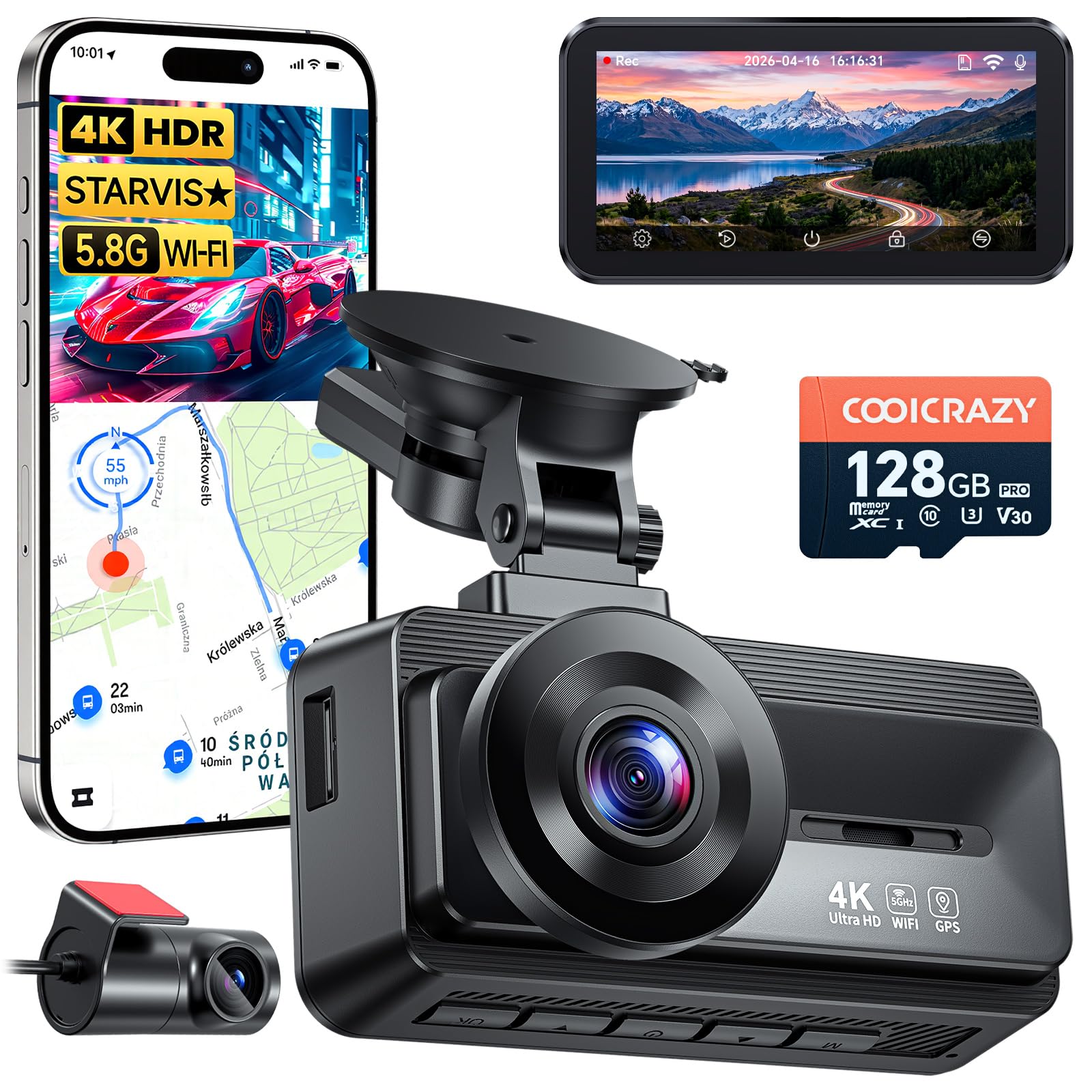
The COOLCRAZY N8 hits a remarkable balance for a mid-range unit: it packs a STARVIS sensor, 4K front resolution, 60fps front frame rate (smoother for fast-moving plate capture), GPS tracking, 5GHz Wi-Fi, and a 128GB memory card — all without crossing the premium price boundary. The 170° front lens combined with a 150° rear lens covers the standard blind-spot zones effectively, and the F1.8 aperture pairs with WDR technology to cut glare from oncoming headlights during night commutes.
GPS lock is noticeably fast — about 20 to 30 seconds after startup — and stamps speed and coordinates directly onto the video file, which insurance adjusters appreciate. The 60fps recording at 4K front is unusual at this price; most rivals cap at 30fps. This higher frame rate makes it easier to freeze a license plate frame from fast-moving highway traffic. The included 128GB card is a high-endurance model rated for continuous overwrite, and the unit supports up to 256GB if you want even longer archives.
Verified buyers consistently note two issues: the rear camera adhesive failed on some units, and the app connection requires manual reconnection after the camera powers off. The latter is common among many Wi-Fi dashcams, but it is worth planning for if you want seamless background sync. For drivers who prioritize GPS accuracy and the smoothest front footage, the N8 delivers specs that punch above its placement.
Why it’s great
- STARVIS sensor with 60fps 4K front recording
- Fast GPS lock with speed and coordinate overlay
- 128GB high-endurance card included
- WDR eliminates headlight glare effectively
Good to know
- Rear camera adhesive reported to fail on some units
- Wi-Fi requires manual reconnect each drive
- Smaller SD card capacity cap (256GB vs 512GB rivals)
5. DDPAI Z60 4K Dash Cam Front and Rear
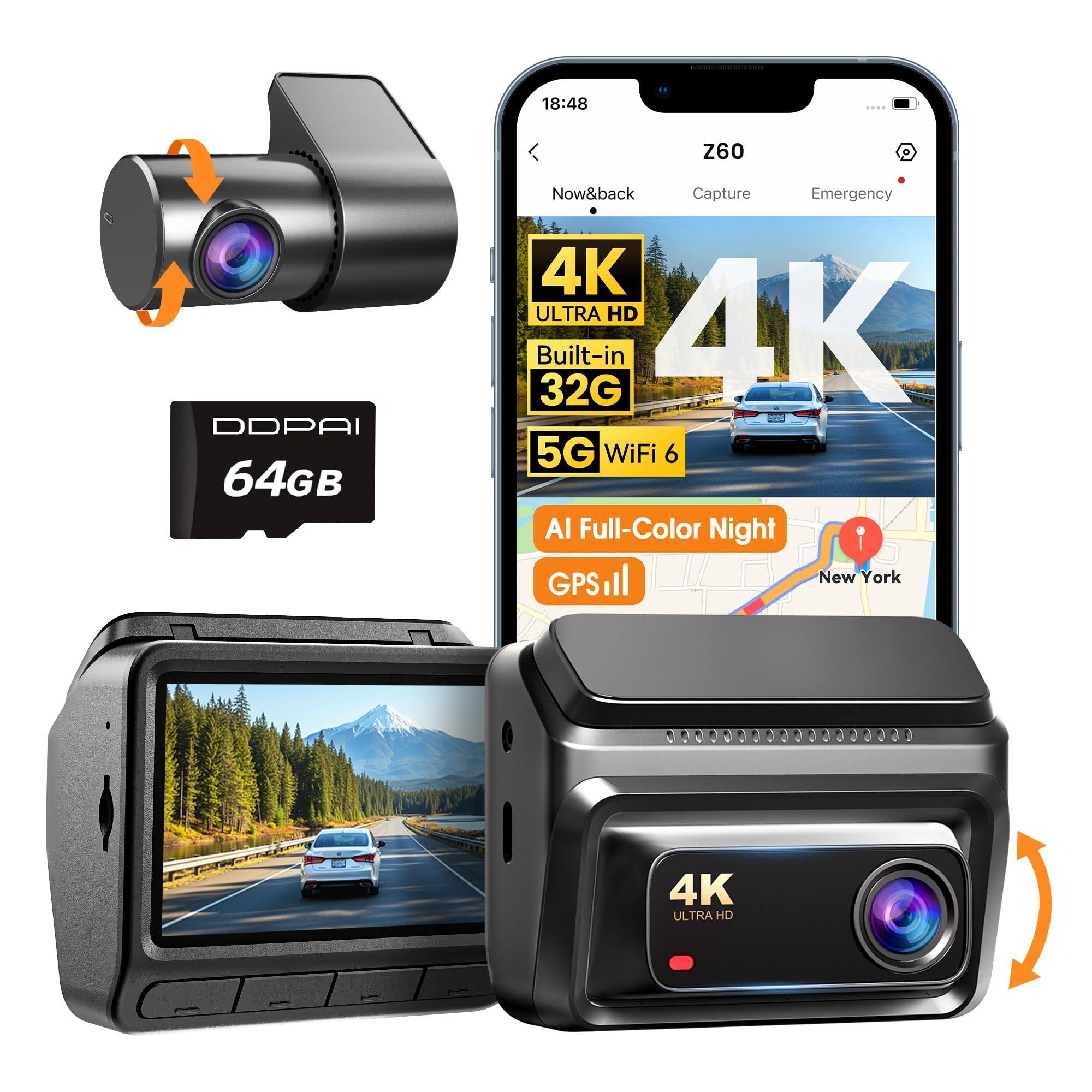
DDPAI’s Z60 differentiates itself through D²Save 2.0 technology, which integrates 32GB of eMMC internal storage alongside an external microSD card slot. This dual-storage architecture means that if your external card becomes corrupted, reaches its lifespan, or is physically removed, recordings switch automatically to the internal memory — no gap in evidence. This is a meaningful safety net considering how many dashcam owners discover a dead card only after an accident. The front camera captures 4K video, and the rear delivers 1080p footage with a 140° field of view.
The Z60 also features DDPAI’s AI ISP Night Vision 2.0 with Realcube technology, which enhances color accuracy and reduces noise in low-light scenes. The ADAS system provides front vehicle start alerts and fatigue driving reminders, and the 7-day AOV parking mode extends monitoring up to 20 days in sleep mode by using low-energy time-lapse frames. The super capacitor backup supplies 3–4 seconds of power after a sudden shutoff, ensuring the current file is saved cleanly during a collision.
The 140° front lens is narrower than most competitors, so you lose some peripheral lane coverage on multi-lane highways. Some users also note that the rear camera housing feels less sturdy than the front unit. The hardwire kit is not included. For drivers who prioritize data integrity above all else and want the peace of mind that comes with redundant storage, the Z60 justifies its placement through engineering thoughtfulness.
Why it’s great
- Built-in 32GB eMMC backup storage prevents evidence gaps
- AI ISP Night Vision 2.0 for accurate low-light color
- Extended 7-day AOV parking mode (up to 20 days in sleep)
- ADAS with voice reminders for safer driving
Good to know
- 140° front lens is narrower than competition
- Rear camera housing feels less robust
- Hardwire kit required for parking mode and not included
6. VIRROW X5 4K+2.5K Dash Cam Front and Rear
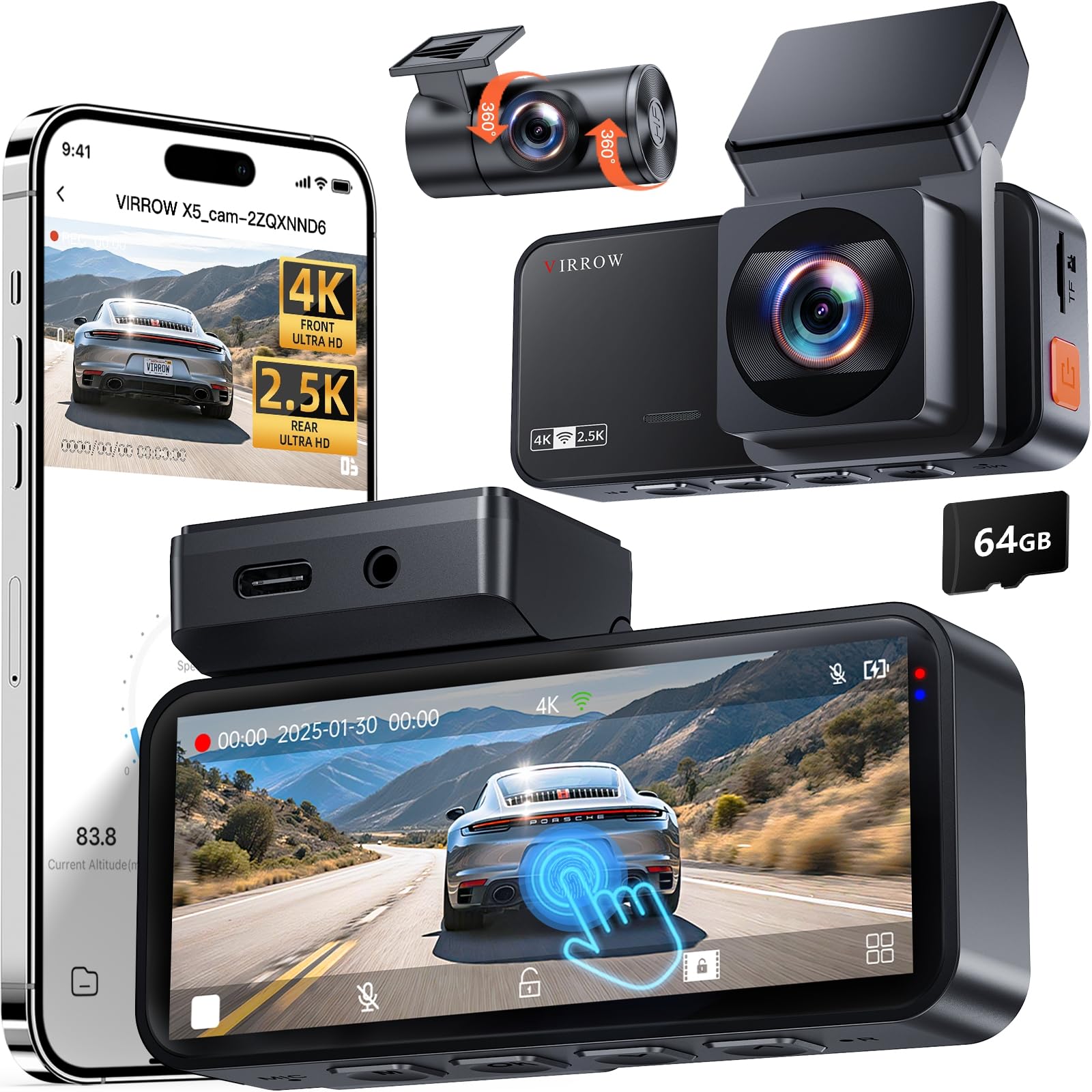
The VIRROW X5 distinguishes itself with a 3.39-inch touchscreen, which makes navigating menus, reviewing footage, and tweaking settings intuitive without reaching for a phone. The dual-camera setup records 4K from the front and 2.5K from the rear — a resolution combination that keeps more detail on rear plates than the standard 1080p second camera. The 170° front and 165° rear fields of view are among the widest in this segment, nearly eliminating the blind spot on the passenger side.
The included 64GB memory card is a welcome convenience for first-time buyers, and the maximum supported capacity of 256GB gives you room to grow. The F1.8 aperture paired with the SC2336 sensor and 6-layer lens system does a respectable job adapting to changing light conditions, though it does not match the STARVIS-class sensors for deep darkness. Loop recording with G-sensor collision lock is standard, and the parking monitor with time-lapse mode covers 24-hour surveillance (hardwire kit required).
Verified buyer reports mention that the mounting bracket can be fragile if bumped hard, and some units shipped with an adhesive tape that struggled to hold the camera in warmer climates. The Wi-Fi connection does not auto-reconnect reliably between drives, requiring a manual tap each time. If you prefer a self-contained device with a large, responsive screen and high rear resolution, the X5 is a mid-range contender with a unique interface advantage.
Why it’s great
- Large 3.39-inch touchscreen for easy on-camera control
- 2.5K rear camera offers superior rear detail
- 170° front and 165° rear very wide coverage
- Free 64GB memory card included
Good to know
- Mounting bracket reported fragile on impact
- Adhesive tape may lose grip in hot climates
- Wi-Fi does not auto-reconnect between drives
7. Vantrue E1 Lite 1080P Dash Cam

The Vantrue E1 Lite is the smallest and most discreet unit in this roundup, measuring roughly the size of two stacked matchboxes. It is a front-only camera, which keeps the installation time under 10 minutes and preserves a clean windshield look. Despite the small footprint, it packs a GPS module for speed and route logging, voice control in multiple languages, and a 160° ultra-wide lens that captures the full roadway without fisheye distortion. The 1080p resolution at 30fps produces manageable file sizes for older SD cards and slower computers.
The HDR plus F1.8 aperture does a credible job in mixed lighting, but the lack of a STARVIS sensor means deep-night plate readability is a stretch. Where this unit shines is reliability over time — verified users report the adhesive mount staying solid after 18 months in South Florida heat, and the supercapacitor construction removes the swelling risk of lithium batteries. The Vantrue app is straightforward for GPS log review and clip downloads, though the Wi-Fi connection can be temperamental during initial pairing. Voice commands for locking video or snapping a photo work well enough to keep your eyes on the road.
The trade-offs are obvious: no rear camera, lower resolution, and no 60fps option for high-speed plate capture. But for a driver who only needs a rock-solid front-facing recorder that disappears behind the rearview mirror, the E1 Lite delivers the highest reliability per dollar. Just note that USB-C power is loose on some units, and G-sensor sensitivity needs adjusting out of the box to avoid false locks on potholes.
Why it’s great
- Extremely compact and discreet design
- Built-in GPS with speed and route logging
- Voice control for hands-free operation
- Proven long-term heat endurance
Good to know
- Front-only recording — no rear or cabin cam
- 1080p footage struggles with night plates
- USB-C power connection can feel loose
- G-sensor needs sensitivity adjustment on arrival
FAQ
What’s the difference between loop recording and event lock?
Do I need a hardwire kit for parking mode?
Why do some dashcams include a memory card and others do not?
How important is a STARVIS sensor for daytime-only drivers?
Final Thoughts: The Verdict
For most users, the affordable dashcam winner is the 70mai T800E because it combines a STARVIS 2 sensor, true three-channel recording, Wi-Fi 6 speed, and reliable supercapacitor construction in one well-rounded package. If you need the sharpest night-time dual-channel footage with the fastest clip transfers, grab the REDTIGER F7N. And for a no-fuss front-only unit that disappears on your windshield and survives the heat with GPS and voice control, nothing beats the Vantrue E1 Lite.