
Our readers keep the lights on and my morning glass full of iced black tea. As an Amazon Associate, I earn from qualifying purchases.
Specs are compiled from manufacturer listings and verified buyer reviews and can change over time — please confirm the key details on the product page before buying.
You push through the trees, breathing hard, and suddenly the world turns milky white inside your goggles. That moment — when your vision blurs into a frosty haze and you have to stop cold to fix it — is the single most frustrating part of skiing or snowboarding. The right pair of anti-fog snow goggles prevents that mid-run stop, keeping your vision clear and your pace unbroken.
I’m Min — the founder and writer behind Gadgets Feed. This guide is built by comparing the manufacturers’ published specifications and the patterns across verified customer reviews, so you get each pick’s real strengths and trade-offs instead of marketing spin.
The anti-fog snow goggles that earn a spot on your face balance dual-layer lenses, smart ventilation, and a fit that seals out weather without squeezing your temples.
Our Picks at a Glance

How To Choose The Best Anti-Fog Snow Goggles
Fog happens when warm, moist air from your face hits a cold lens. Anti-fog snow goggles solve this with double-layer lenses that trap a pocket of insulating air, plus vents that let moisture escape. The real trick is finding a pair where both systems work together with your face shape and helmet.
Start with the lens construction
A single-layer lens fogs fast because there is no buffer between your breath and the cold glass. Dual-layer lenses — a thermal barrier design — keep the inner pane closer to your face temperature, so condensation has nowhere to form. Every pick here uses dual-layer construction as its anti-fog foundation.
Decide if you wear glasses under your goggles
If you wear prescription glasses, an OTG (over-the-glasses) design is non-negotiable. These goggles carve out extra room in the frame so your frames fit underneath without pinching, and that extra air volume does double duty by slowing fog. Measure the width of your frames against the goggle interior before you commit.
Match the lens to the light you ride in
Lens tint controls how much light reaches your eyes, measured as VLT (visible light transmission). A low VLT around 13% suits blazing sunny days, while a high VLT near 78% is built for overcast and night riding. If you chase every condition, a pair with swappable magnetic lenses is worth the upgrade.
Quick Comparison
| Model | Best For | Lens System | Prescription Fit | Field of View | Amazon |
|---|---|---|---|---|---|
| Wildhorn Pipeline★ Best Overall | All-mountain versatility | Magnetic swap | Yes (OTG) | Oversized | Amazon |
| SMITH SquadTop Performer | Optical clarity | Replaceable | No (standard) | Wide (XL) | Amazon |
| COPOZZ G1Best Value | Budget all-rounder | Quick-swap | Yes (OTG) | Standard | Amazon |
| OutdoorMaster PRO | Magnetic convenience | Magnetic frameless | Yes (OTG) | Wide | Amazon |
| ZIONOR X4 | Multi-condition riders | Magnetic, 4 lenses | Yes (OTG) | Panoramic | Amazon |
| Giro Cruz | Helmet-matched comfort | Fixed cylindrical | Yes (OTG) | Standard | Amazon |
| Innerking OTG | Everyday snow chores | Fixed dual-layer | Yes (OTG) | Wide | Amazon |
| findway OTG | Budget first-timers | Fixed dual-layer | Yes (OTG) | Panoramic | Amazon |
| GlaRid Ski Goggles | Entry-level clarity | Fixed dual-layer | Yes (OTG) | Standard | Amazon |
In‑Depth Reviews
1. Wildhorn Pipeline Ski Goggles
Our pick — over 4.5★ from 650+ verified ratings; the strongest balance of quality and price.
The oversized-vision workhorse that swaps lenses mid-lift without a single fumble
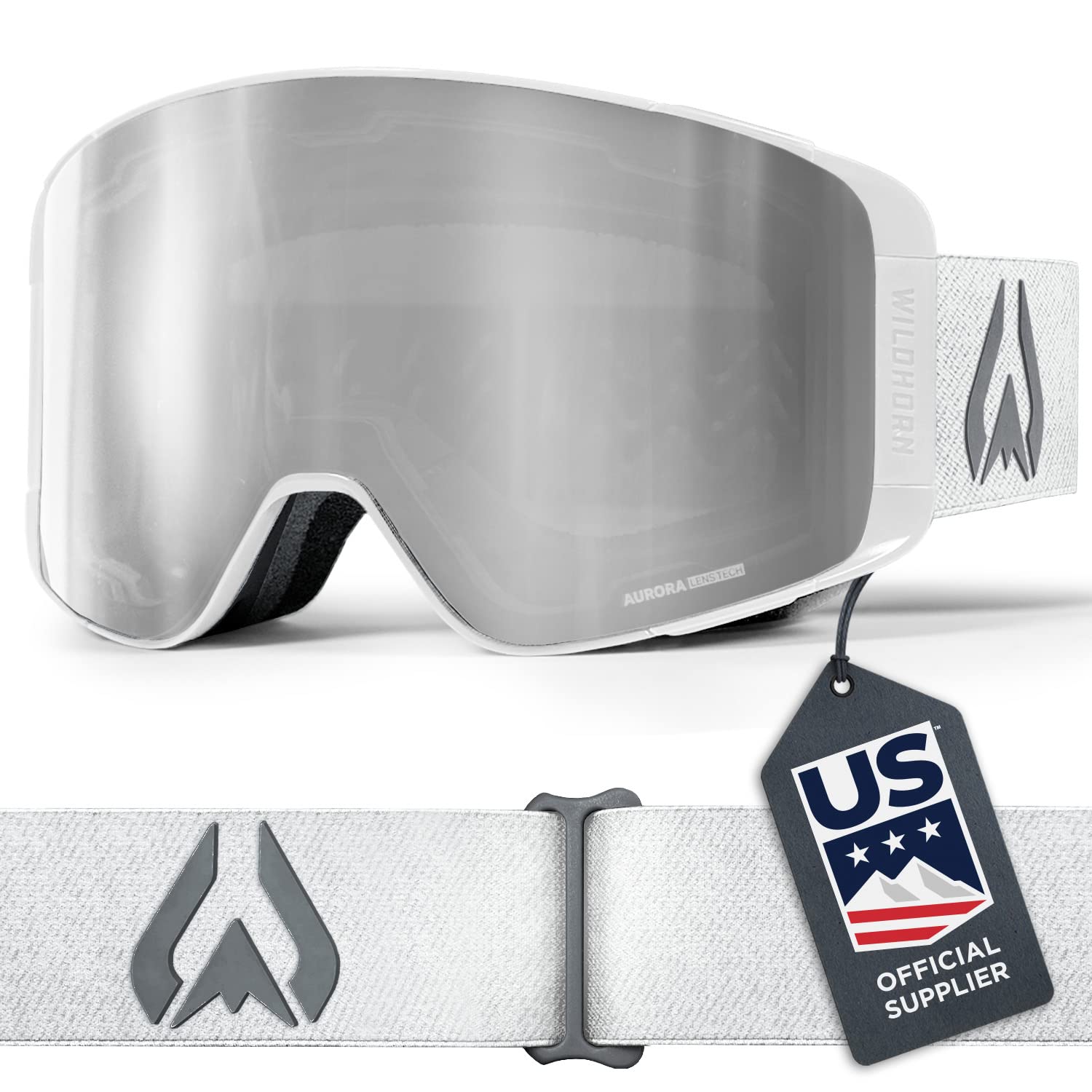
The Pipeline is built around a cylindrical lens with a fog-resistant coating and scratch-resistant polycarbonate, so your view stays sharp through the crud of a long day. What makes it special is the magnetic quick-change system with a nearly invisible clip lock — you can drop from a bright sunny lens to a cloudy one in seconds. Buyers report two full snowboard seasons of use with great visibility that rarely fogs, which is the endurance test that matters.
The frame uses a lightweight dual molded PC-ABS/TPU build with thinner foam for an ultra-close fit, giving you wall-to-wall vision without the peripheral blind spots of older designs. It rides comfortably over a helmet, and the oversized field of view is the thing owners rave about most. Its large-profile frame suits bigger heads, but average or smaller faces may find it loose.
The strap adjustment is the one recurring gripe — it is a bit unintuitive and fiddly to tighten while wearing gloves. That minor gripe is worth it for anti-fog performance owners rank above goggles costing several times more.
What wins people over
- Fast magnetic lens swap with strong magnets for changing light
- Wide, low-profile field of view with 100% UV400 protection
- Wears comfortably over helmets without pressure points
Who should pass
- Oversized fit that is a poor match for average or smaller faces
- Strap length is hard to adjust mid-run with gloves on
Reach for this if: you want one pair to cover every condition with a lens swap that takes seconds, and you have a larger head.
Look elsewhere if: you have an average-sized face and want a low-profile frame, since the generous fit will leave extra space.
2. SMITH Squad Goggles with ChromaPop Lens
The lens-quality king whose ChromaPop clarity reshapes how you read the snow
The Squad is the optical purist’s pick, built around a ChromaPop lens that boosts contrast so bumps and changes in the snow surface become obvious instead of blending into a white blur. Anti-fog coating and strong ventilation keep that clarity running, and owners mention zero fogging across sun and shade. The XL panoramic field of view is the feature people notice first — it is why this pair feels like wearing a windshield.
Two lenses ship in the box for high and low visibility, and the lens replacement system lets you swap them, though it demands real effort and some care to avoid scratching the J-hooks. The fit is secure over helmets and comfortable on a normal head, with a strap that tightens predictably. The recurring complaint is the sticky residue on some headbands that peels off onto gear — worth checking the strap before a full season.
Compared with the magnetic Wildhorn above, the Squad trades swap speed for optical precision; you get 100% UV protection and a smoked lens tint that owners describe as unique, neither amber nor blue. The soft case that ships with it is thin, so a separate hard case is wise for travel.
Optical edge: ChromaPop contrast plus a panoramic view make terrain reading easy, and the anti-fog system holds up in bright, cold, windy conditions.
The catch: lens changes are stiff and risk scratching, and some straps arrive with a sticky film you will want to check.
3. COPOZZ G1 OTG Snowboard Goggles
The friendly-price all-rounder that fits over glasses and blocks glare all day
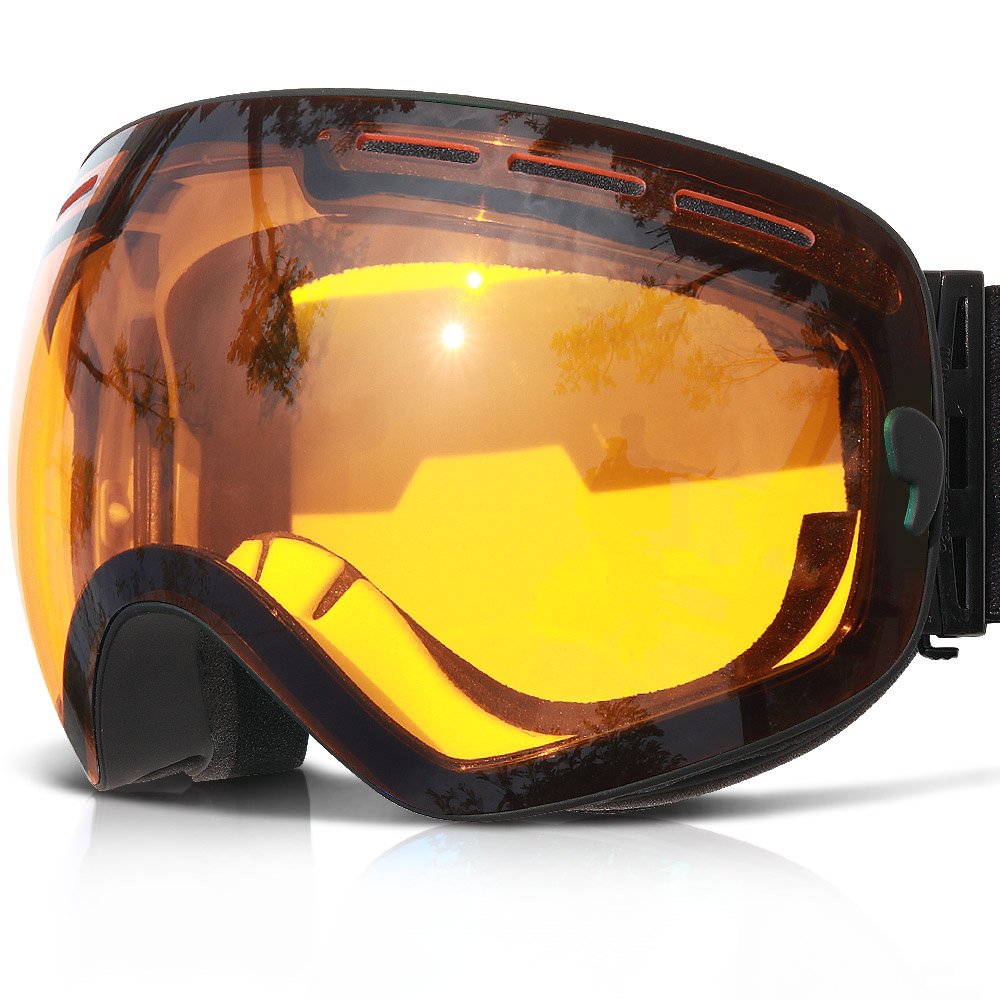
The G1 delivers the double-layer anti-fog and UV protection you need without demanding a premium budget. It has a comfortable thick foam seal and a strap that stayed tight through three straight days of six-to-eight-hour riding, according to owners. The yellow lens brightens early-morning light nicely, and the seal is good enough that fog never becomes a problem.
This is an OTG design, so prescription glasses fit underneath comfortably — a recurring point of praise from bespectacled riders. Owners also love that you can swap the lens in about two seconds, which is rare at this price tier. Durability is the limit: a few riders saw fog between lenses on a cold second day, so treat it as an occasional-use pair, not a full-season beater.
There is no hard case in the box, only a soft bag, so you will want to store it carefully between trips. For a first-time skier or a family member who rides a few weekends a year, the G1 is the sensible money move that still looks sharp on the mountain.
Best for: value-conscious riders and glasses wearers who want a comfortable, well-sealed pair for occasional trips.
Think twice if: you ride every weekend in harsh cold, since a small number of units fog between lenses on sustained storms.
4. OutdoorMaster Ski Goggles PRO
The frameless magnetic pair that clicked into place for two full seasons of hard riding
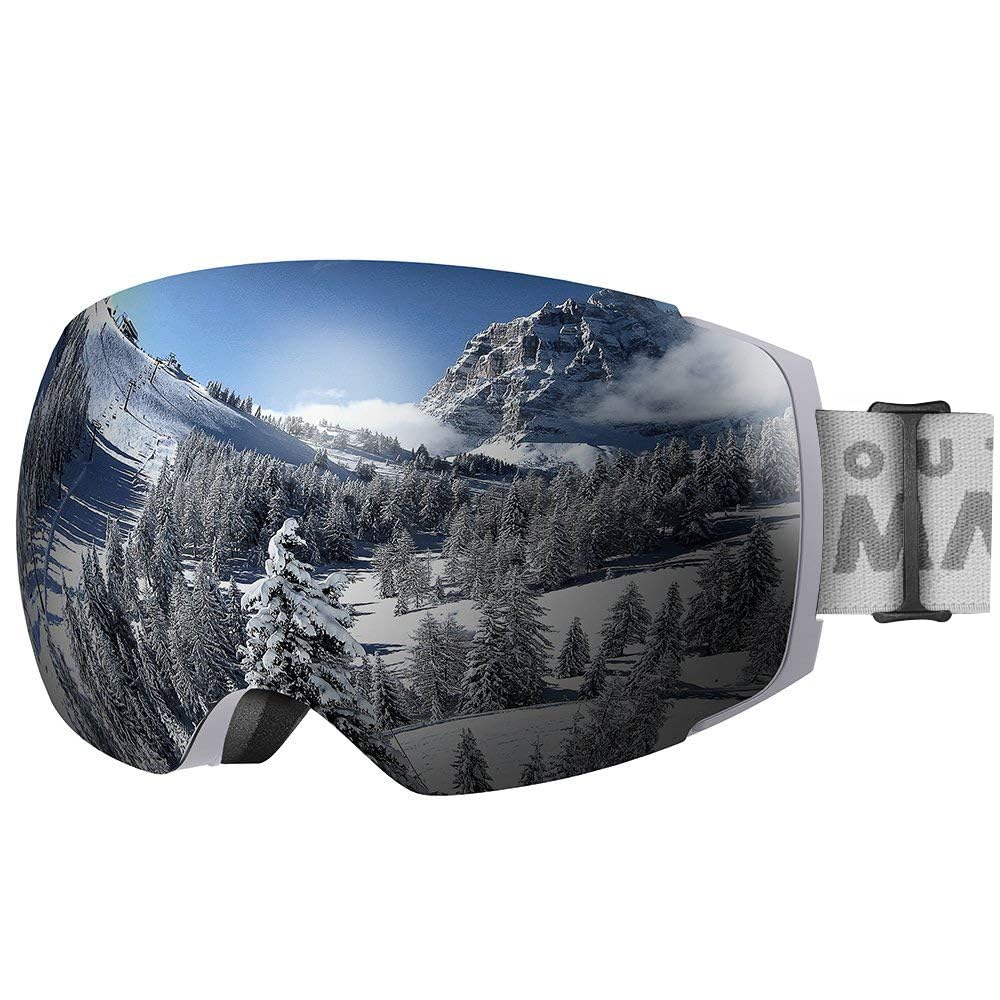
The OutdoorMaster PRO goes frameless with a quick-change magnetic lens system, and the magnets hold securely enough that one owner logged over 40 days across two seasons without a single lens pop. It is an OTG design that fits comfortably over glasses and helmets alike, and the anti-fog treatment kept vision clear even in aggressive terrain at 10,000+ feet in bright sun.
Owners rate it as exceptional value next to Oakley and Smith, with one rider noting it made them “feel like a million bucks on the ski hill” for a fraction of the usual cost. The case stores a spare lens, which is handy when conditions shift mid-day. Fit is the caveat: it suits small faces and low nose bridges, but some riders find it too small, so measure your face first.
There is a minor quirk where the inner lens can go briefly wet and take a minute or two to clear, but that is a rare event rather than a pattern. Pick up a clear low-light lens for cloudy or evening runs, and this pair covers everything.
Season proof: 40+ days over two seasons with a secure magnetic lens and no fogging is a standout endurance record at this price.
Who it misses: riders with wider faces, since the frame runs small and snug.
5. ZIONOR X4 Ski Goggles Magnetic Lens

The four-lens kit that covers sunny, cloudy, and night riding out of one box
The X4 is the Swiss Army knife of the group, shipping with four swappable magnetic lenses that carry VLT ratings from 13.67% for bright sun up to 78% for overcast and night. Each lens offers premium anti-fog with a dual-layer design, and the wider ventilation system routes moist air out before it can condense. Customers note no fogging in cold snow and magnetic lenses that snap on with eight magnets each.
The triple-layer foam padding seals comfortably and breathes, and the panoramic view keeps the whole slope in sight. Riders love the appearance, with a sharp look that draws compliments, and the value lands well below the big-name equivalents — one owner called it a solid knockoff of a popular goggle at 90% of the quality. The scratch-resistance is the weak spot: several owners found marks on the lens after just a couple of days, so the included protective bag needs to be standard practice.
With five lens options from sunny to clear green, this is the pick for riders who chase every weather window and want one pair to handle it all.
Why it covers everything
- Four included lenses span 13.67% to 78% VLT for all light
- Eight magnets per lens snap in place securely
- Wide ventilation and triple-layer foam keep it comfortable
The honest limits
- Lenses scratch easily, so the protective bag is essential
- Strap fit runs large and favors oversized helmets
6. Giro Cruz Ski Goggles

The Giro-built pair that locks onto helmets and handles freezing winds without complaint
If you already ride with a Giro helmet, the Cruz clicks straight onto it for a secure, low-maintenance fit—no fiddling with straps or gaps. Its cylindrical thermoformed lens (a curved, heat-shaped shield) has an anti-fog coating, so your view stays clear when you start sweating. The OTG interior (over-the-glasses design) adds extra volume, so your prescription frames fit comfortably while the air pocket fights condensation. Double-layer face foam with microfleece facing keeps the seal soft against your skin, so long descents don’t chafe.
Silicone inside the strap stops slippage over a helmet or beanie, and owners praise the fit around helmets as perfect and super comfy. The 40% VLT clear lens handles cloudy conditions well and cuts glare, making it a versatile choice for beginners and intermediate riders. One owner highlighted excellent protection in freezing temperatures and wind, and versatility for night skiing is a recurring theme in the feedback.
Compared with the magnetic-heavy field above, the Cruz is refreshingly simple — a single fixed lens, no swapping, no fuss. The trade-off is that you cannot change lenses for different light, so it suits riders who ride in consistent conditions rather than chasing every weather shift.
Built to match: smooth helmet integration and a plush microfleece-lined seal make this the comfort pick for helmet-first riders—if you don’t own a Giro helmet, you’ll miss the main benefit, so skip it and look for a universal-fit goggle instead.
Keep in mind: a fixed lens means bright-sun days and low-light days each demand the right single tint choice.
7. Innerking OTG Ski Goggles
The every-day snow goggles that shine just as hard on a tractor as on a ski run
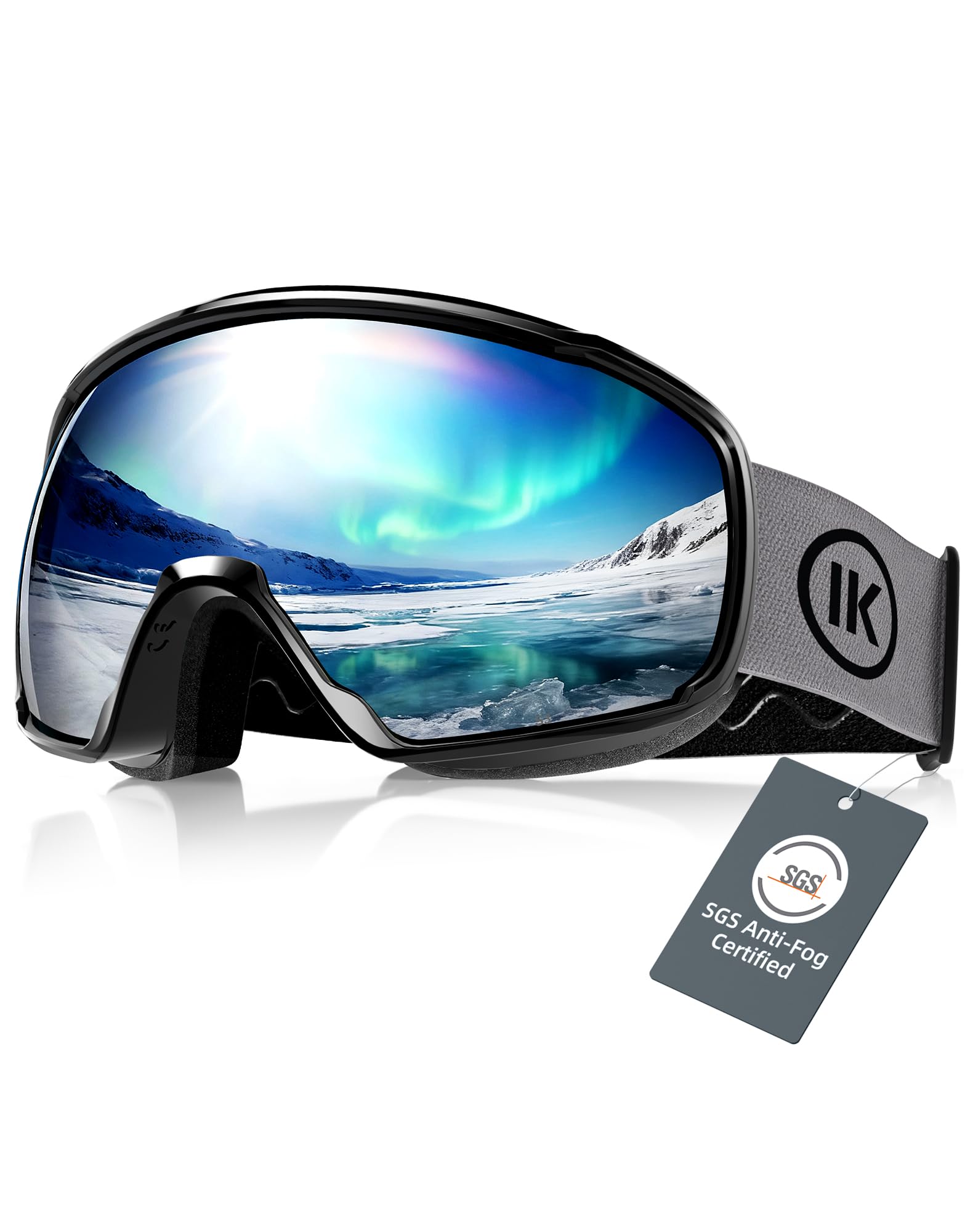
The Innerking uses VisionPlus lenses that the maker claims offer twice the clarity of standard lenses, backed by original Italian fog-proof lenses certified SGS and CE EN174. That translates to an anti-fog system with dual-layer lenses and sponge ventilation that owners found fog-free even through a 31-hour snowstorm while plowing driveways. The OTG design fits comfortably over prescription glasses, a frequent point of praise.
Three silicone anti-slip straps plus adjustable buckles keep the goggles locked to any helmet, and the TPU frame is lightweight and durable. Owners describe it as a pair that looks far more expensive than it is, surviving drops without scratching and blocking snow, wind, and sun. One buyer had a husband plowing 900-foot driveways in bright sun and it worked great on a tractor at a -1°F windchill.
With a VLT of 11%, this is tuned for bright, sunny days, which is exactly where the feedback sits — flat light and sunny skies are where owners say it performs best. Think of it as a high-value workhorse that earns its keep on the mountain and the driveway.
Everyday strengths
- Certified anti-fog lenses hold clear through long, cold storms
- Triple silicone straps lock onto any helmet
- Scratch-resistant and durable after repeated drops
Who should pass
- An 11% VLT lens means flat-light and cloudy days will look dark
- Tuned for sunny conditions, not low-light hunting
8. findway OTG Ski Goggles
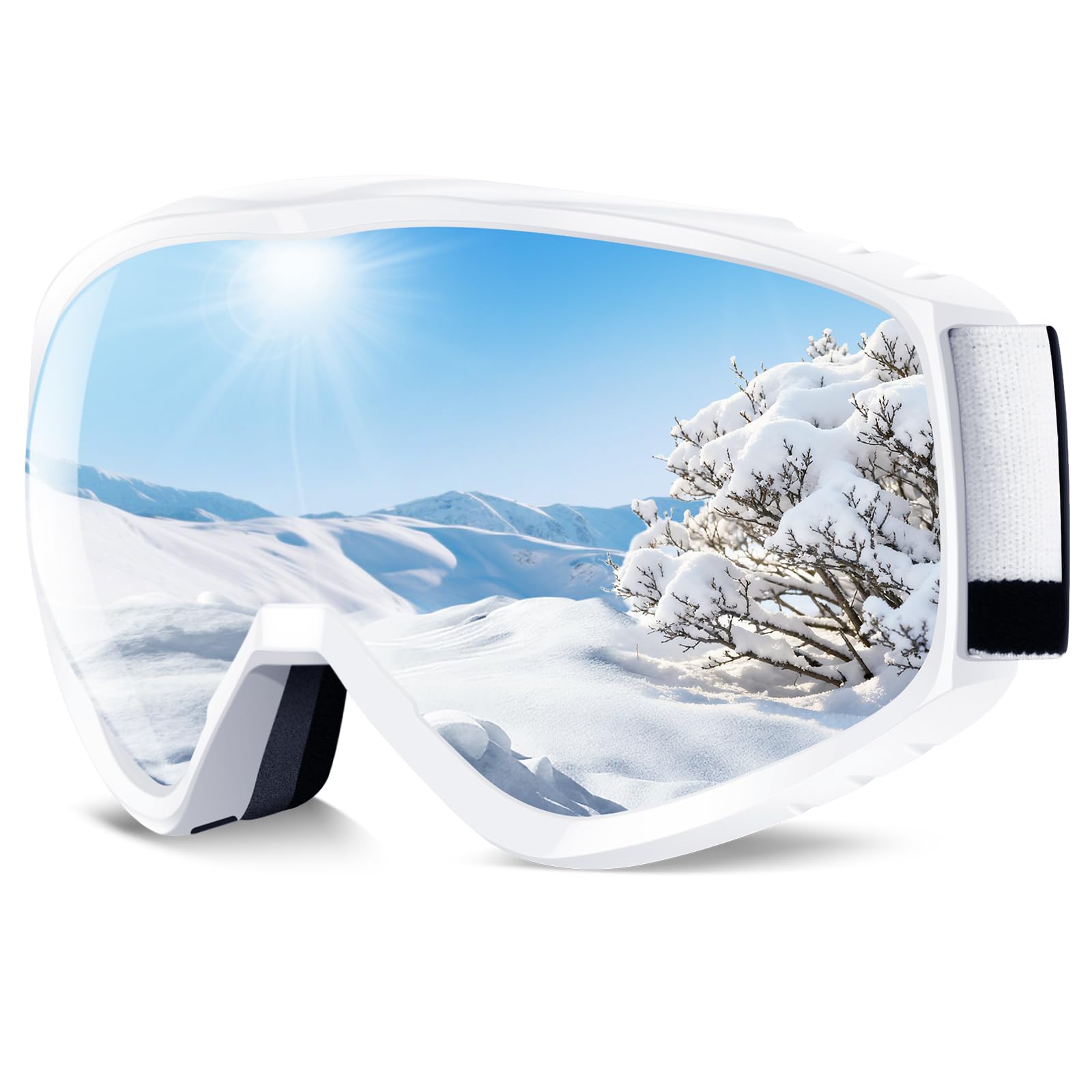
The genuinely cheap pair that rode a first-ever ski trip without a single fog moment
The findway is the budget entry that punches above its weight for first-timers. Dual-layer lenses with a thermal barrier make it more resistant to fogging, and reviewers point out minimal fogging in cold, vigorous use with excellent ventilation and snow-glare protection. The panoramic view keeps the whole run visible, and triple-layer foam padding delivers a snug, breathable seal.
It is an OTG design with an adjustable mirrored strap that fits most helmets, and the TPU frame is safe, reliable, and resilient. One first-time skier called it perfect for a trip where they were not ready to invest in expensive goggles — and it worked very well. The recurring tip from owners is to remove the inner plastic film, or you will mistake it for a scratch and blame the lens.
The main limit is sizing: it runs a touch large, and one owner found it pinched the nose when paired with a helmet, so do a trial fit before a full day. It ships with a pouch for storage, keeping the value story intact.
Best for: first-timers and families who want a genuinely affordable pair that stays fog-free and fits over glasses.
Think twice if: you have a smaller helmet or face, since the frame runs large and can pinch the nose.
9. GlaRid Ski Goggles OTG

The glasses-wearer’s rescue that solved snowblower fog at ten below zero
The GlaRid is the entry-level answer for anyone whose glasses fog the second they step outside in winter. It pairs a scratch-resistant coating with a dual-layer anti-fog lens and 100% UV protection, wrapped in a lightweight, flexible TPU frame. Owners wearing glasses found it “worked perfectly” for snowblower duty and hiking in near-zero cold, with one testing it down to -10°F and reporting no fog.
The OTG design fits oversized glasses and big heads comfortably, and the package includes a carrying case and cleaning cloth. It is a natural fit for winter chores — snowblowing, shoveling, and farm work — where the priority is clear vision in brutal cold rather than slope-side style. One owner bought it after cataract surgery so they could still work outside without worrying their eyes.
Lens versatility is the limit: it struggles in low light on cloudy days, so it is best for bright sun and cold weather. Anti-fog feedback is mixed—most see none, a few report heavy fogging—so treat it as a value bet, not a guarantee.
Cold-weather asset: breath-isolating OTG design that earned a test to -10°F without fogging from glasses-wearing owners.
The limit: low-light visibility is weak, and anti-fog results vary, so cloudy-day riders should look higher up the list.
Understanding the Specs
Dual-Layer and Thermal Barrier Lenses
An anti-fog lens uses a thermal barrier design where two layers of lens trap a pocket of air between them. That air pocket acts as insulation, keeping the inner lens closer to your face temperature so moisture from your breath cannot condense into fog. A single-layer lens lacks this buffer and fogs far more easily, which is why every pick here is built on dual-layer construction.
VLT and Lens Tint
VLT, or visible light transmission, tells you how much light the lens lets through. A low VLT around 11% to 13% is for bright, sunny days, while a high VLT near 70% to 78% suits overcast, flat light, and night riding. Choose a lens tuned to the conditions you ride in most, or pick a pair with magnetic swappable lenses to cover them all.
OTG (Over-the-Glasses) Design
An OTG goggle carves out extra interior volume so prescription glasses fit underneath without pinching your temples. That extra air space also serves an anti-fog purpose by giving warm, moist air more room to circulate before it hits the cold lens. If you wear glasses, an OTG fit is the difference between a clear run and a constant battle with condensation.
UV Protection
Snow reflects up to 80% of UV rays, meaning your eyes take a beating from both above and below. Anti-fog snow goggles with 100% UV400 protection block the full spectrum of UVA and UVB light, shielding your eyes during long days on bright snow. This is a baseline safety feature that every serious pair should carry.
FAQ
How do anti-fog snow goggles actually stop fog from forming?
Can I wear these goggles over my prescription glasses?
What is the difference between a low VLT and a high VLT lens?
How long does the anti-fog coating last before it wears off?
Are magnetic interchangeable lenses worth the extra cost?
Will these goggles fit my ski helmet?
Why do my goggles fog up even though they claim to be anti-fog?
What is the difference between OTG goggles and regular ski goggles?
Final Thoughts: The Verdict
For most people, the anti-fog snow goggles winner is the Wildhorn Pipeline because its magnetic lens swap, oversized field of view, and proven two-season anti-fog performance cover every condition a rider meets. If you want premium optical clarity with the ChromaPop twist, grab the SMITH Squad. And for the budget-conscious first-timer riding over glasses, the COPOZZ G1 is the one to reach for — it is the crowd favorite that balances price, fit, and fog-free riding for most weekend warriors.
How We Picked
We do not accept paid placement. Every pick is matched to a real buyer and a real use-case; we do not hands-on test units.
Sources & Methodology
Specifications: manufacturer listings and product documentation. Review insights: verified customer reviews, as of August 2026. Pricing: not shown on this page (it changes often); check the current price via the retailer link.
As an Amazon Associate, Gadgets Feed earns from qualifying purchases. This does not affect which products we feature.