
Our readers keep the lights on and my morning glass full of iced black tea. As an Amazon Associate, I earn from qualifying purchases.
Specs are compiled from manufacturer listings and verified buyer reviews and can change over time — please confirm the key details on the product page before buying.
An AC TIG welder is the difference between fighting with aluminum and making it flow like liquid silver. The right machine pairs a high-frequency arc start with AC balance controls to scrub away aluminum’s oxide layer for a clean, bright weld puddle. This guide breaks down the top machines by real-world performance, focusing on the specs that matter for clean aluminum and thin stainless.
I’m Min — the founder and writer behind Gadgets Feed. This guide is built by comparing the manufacturers’ published specifications and the patterns across verified customer reviews, so you get each pick’s real strengths and trade-offs instead of marketing spin.
Whether you’re restoring a classic car or building custom frames, the right ac tig welder turns tricky metalwork into a smooth, repeatable process you can rely on.
Our Picks at a Glance

How To Choose The Best AC TIG Welder
AC TIG welding open up aluminum and magnesium, but the machine you choose determines how easily you can weld them. Focus on amperage range, AC balance, frequency control, and duty cycle to avoid a frustrating purchase.
Amperage Range and Output
Your machine’s amperage range dictates the thickness of metal you can handle. A 200A output is the current balance, offering enough power for most fabrication, while the low-end amperage matters just as much for thin gauge work. The best units let you dial down to around 10-20 amps without the arc becoming unstable, allowing precise work on delicate sheet metal.
AC Balance and Frequency Control
This is the heart of aluminum welding. AC balance lets you adjust how much time the arc spends cleaning the oxide versus penetrating the base metal. AC frequency control (measured in Hz) widens or narrows the arc cone, allowing you to focus the heat for a tighter bead on thin material or a broader puddle on thicker stock.
Quick Comparison
| Model | Best For | Max Output | Input Power | Weight | Amazon |
|---|---|---|---|---|---|
| Weldpro 200A★ Best Overall | All-Around Shop Work | 200A | 110V/220V | 61.8 lbs | Amazon |
| HITBOX 200ABest Value | Budget-Friendly Entry | 200A | 220V | 26 lbs | Amazon |
| AHP AlphaTIG 203XiTop Performer | Value-Focused Fab | 200A | 110V/220V | 69 lbs | Amazon |
| LOTOS TIG200ACDC | DIY & Auto Repair | 200A | 110V/220V | 37 lbs | Amazon |
| ARCCAPTAIN 200A | Thin Aluminum Precision | 200A | 110V/220V | 42.7 lbs | Amazon |
| Everlast PowerTIG 185DV | Portable Flexibility | 185A | 110V/220V | 40 lbs | Amazon |
| Everlast PowerTIG 200DV | Home Hobbyist Upgrade | 200A | 120V/240V | 60 lbs | Amazon |
| Everlast PowerTIG 210EXT | Serious Hobbyist & Pro | 210A | 110V/220V | 60 lbs | Amazon |
| Lincoln Square Wave 205 | Brand-Trust & Portability | 205A | 120V/230V | 36 lbs | Amazon |
| Everlast PowerTIG 255EXT | Professional-Grade Power | 255A | 110V/220V | 85 lbs | Amazon |
| ESAB Rebel EMP 205ic | All-Process Versatility | 205A | 120V/230V | 49 lbs | Amazon |
In‑Depth Reviews
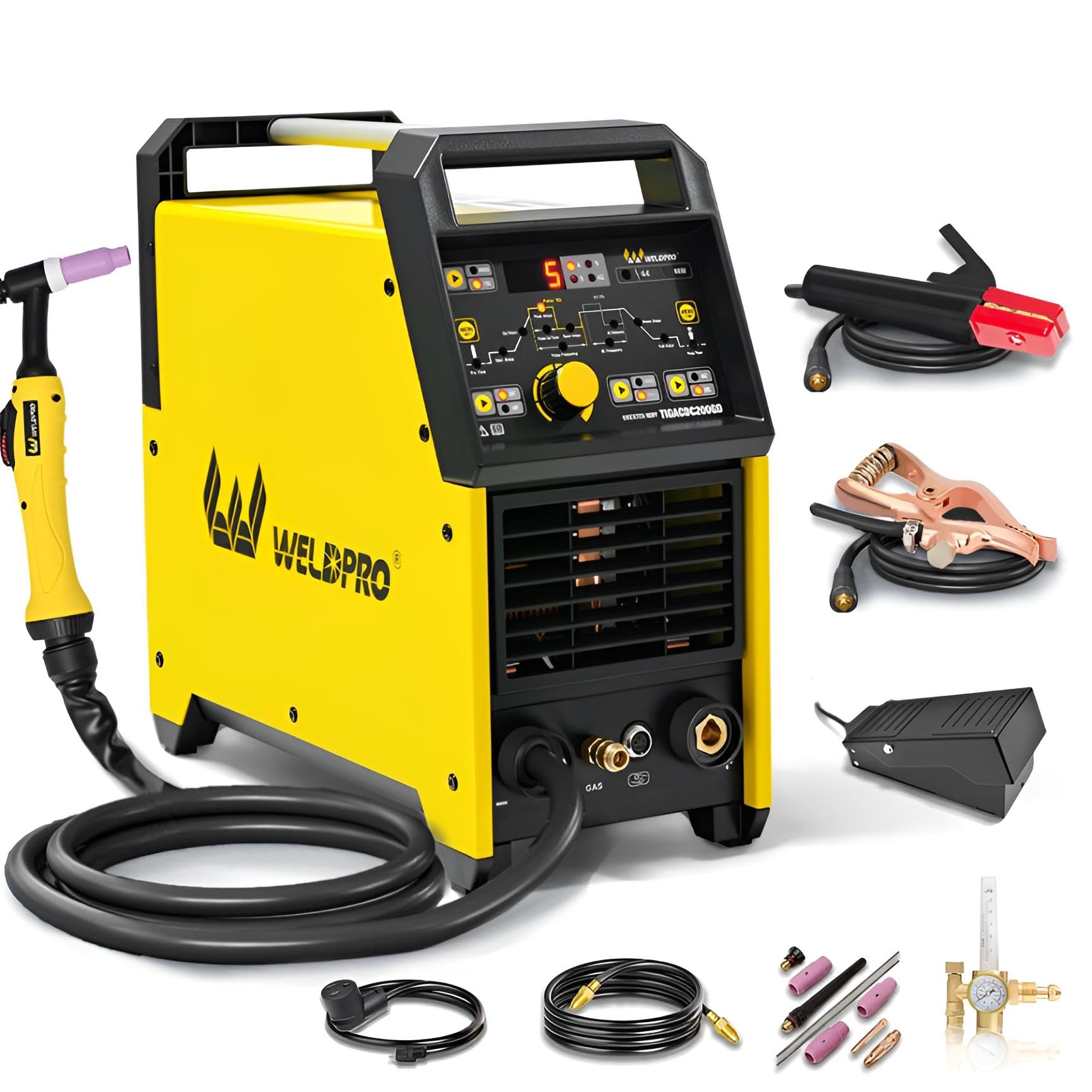
1. Weldpro 200A AC/DC TIG Welder
Our pick — over 4.5★ from 800+ verified ratings; the strongest balance of quality and price.
The shop workhorse that makes professional-grade aluminum welding accessible.
The Weldpro 200A delivers a complete package of power, versatility, and included accessories for serious fabrication work. The 200A output handles a huge range of work, and the 5-in-1 versatility means you get High-Frequency AC TIG, DC TIG, AC Pulse TIG, DC Pulse TIG, and Stick MMA all in one portable unit. It runs on both standard 110V household outlets and industrial 220V power, with automatic detection and switching so you can move between your garage and a job site without reconfiguring anything.
For aluminum specifically, this unit is engineered with fully adjustable AC balance, frequency, and pulse settings to manage thin and thick stock. The high-frequency non-contact arc start reduces tungsten wear, and the included heavy-duty rocker foot pedal gives you hands-free amperage control for long, continuous welds. The 40% duty cycle at full 200A output means you can keep working without the machine shutting down to cool, and the large HD LED display keeps all your parameters visible even in bright sunlight.
The build quality earns consistent praise, with owners noting it feels like a much more expensive unit, and the included accessory kit—TIG torch, ground clamp, gas hose, flow meter, tungsten, and nozzles—has you welding from the start. As buyers report, it handles fine-gauge stainless exhaust work beautifully, with easy starts and good control over upslope, amps, purge, and downslope. Its combination of performance and value makes it a crowd favorite.
What wins people over
- Dual voltage 110V/220V with auto-switching for worksite flexibility
- Complete kit includes foot pedal, torch, and flow meter
- 5-in-1 modes cover TIG, Pulse TIG, and Stick for any job
Who should think twice
- At 61.8 pounds, it’s a heavy unit to lug around constantly
- Lacks the advanced AC waveforms of higher-end machines
The all-rounder: If you want one machine that does it all—aluminum, steel, stainless, and stick—this is your best foundation.
Heads up: It’s not the lightest on this list, so plan a permanent home or a sturdy cart for it.
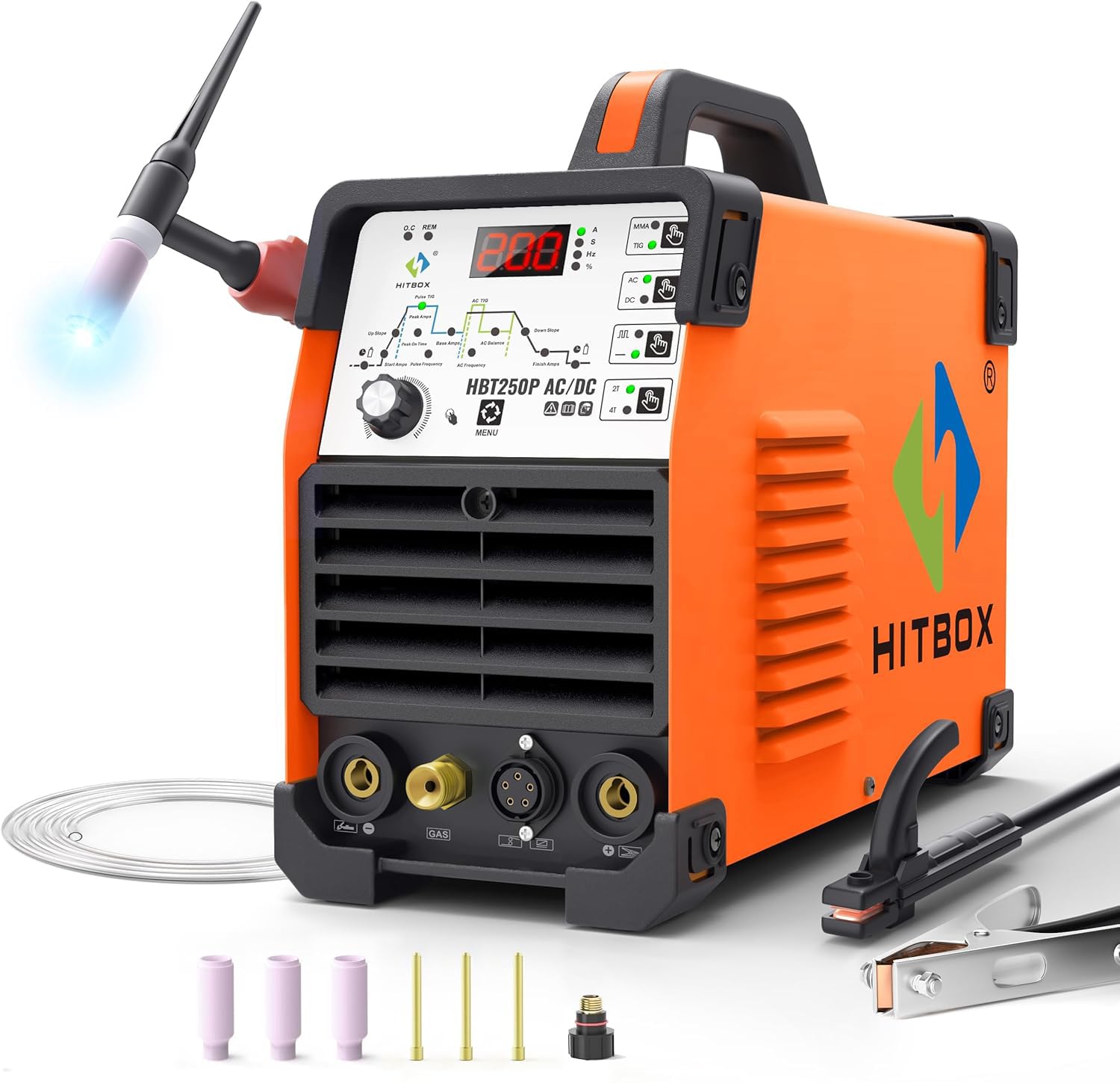
2. HITBOX 200A AC/DC TIG Welder 6-in-1
A featherweight 200A machine that punches far above its price tag.
At just 26 pounds and a budget-friendly price, the HITBOX is a revelation for portability and value. At just 26 pounds, it’s a fraction of the weight of most comparable 200A units, making it genuinely easy to move around a shop or load into a truck for mobile repairs. It’s a 6-in-1 multiprocess machine covering MMA, DC HF/Pulse TIG, AC HF/Pulse TIG, and AC Pulse TIG Square, so you’re not sacrificing capability for portability.
For aluminum, the AC frequency control (40–200Hz) and square wave technology work to stabilize the arc and remove oxide films, while the pulse frequency (0.5–200Hz) and base amps (5–95%) help prevent burn-through on thin material. The high-frequency start enables touch-free arc ignition, which is a huge comfort factor for beginners learning TIG. It supports tungsten diameters from 1.6–3.2 mm, covering common setups.
Owners mention it welds 1/4″ aluminum flawlessly with its HF start (a high-frequency spark that starts the arc without touching the metal) and pulse, making it an “Excellent value AC/DC TIG/stick welder.” The build quality is praised as sturdy with efficient dual cooling fans, keeping the unit stable during longer sessions. Some owners note the included foot pedal has a usability quirk where the display only shows 5A unless actively welding, and the gas hose needs an adapter for standard B-size tanks, so budget for those small extras.
Why it stands out
- Incredibly light at 26 lbs
- 6-in-1 modes including AC Pulse TIG Square for clean aluminum
- Ideal for home, hobby, and repair work straight from the start
The honest trade-offs
- Requires a 220V outlet—no 110V option for low-power sites
- Foot pedal control feedback is a bit vague during setup
- Consumables like tungsten and stick holder not included
Best for the budget builder: This is a killer first AC/DC TIG or a perfect travel companion for someone with 220V access.
Not for you if: You only have 110V outlets in your workspace, as this unit is 220V only.
3. AHP AlphaTIG 203Xi
The value king that delivers a 100% duty cycle and serious arc control.
The AHP AlphaTIG 203Xi is the smart money choice for experienced hobbyists, backed by a 100% duty cycle at 155 amps. The AlphaTIG 203Xi doesn’t just match big-name performance—it often exceeds it on paper. The standout spec is the 100% duty cycle at 155 amps, a figure that beats most machines in its class and lets you weld continuously without worrying about thermal shutdown, a key selling point for anyone doing longer fabrication runs.
It’s a 200A AC/DC unit with pulse, running on both 110V and 220V. The new HV Start (a solid-state simulated high-frequency start) means there’s no physical point gap to manage or maintain, providing reliable non-contact arc initiation. The digital interface, paired with the large high-visibility LCD screen, gives you precise amperage control and makes switching between stick and TIG modes simple. Owners praise it for having the smoothest stick arc of several major brands they’ve used.
The included package is generous: a Nova foot pedal with a 25-foot cord, a Nova Rotaflex 9/17 TIG torch, a 250A stick electrode holder, and a heavy-duty argon regulator. Customers note that achieving a “stack of dimes” on aluminum takes a few practice runs but is very achievable with the frequency, post-flow, and balance adjustments. The only recurring complaint is the included ground clamp, which some find cheap and replace immediately.
The performance edge
- 100% duty cycle at 155 amps for uninterrupted heavy work
- HV Start electronics eliminate point-gap maintenance
- Runs 6011, 6013, 7018, and 308L stick electrodes smoothly
Things to plan for
- On 120V mode, the digital and knob readouts can mismatch
- The stock ground clamp is a weak point for immediate replacement
The smart upgrade: This is the balance for a serious hobbyist moving up from a budget machine.
Watch the fine print: At 69 lbs, it’s a stationary shop tool, not a portable unit.
4. ARCCAPTAIN TIG Welder AC/DC 200A 7-in-1

A 7-in-1 chameleon that excels at delicate, thin-gauge aluminum work.
For welders tackling thin materials, the ARCCAPTAIN brings a unique tool to the table: a Triangular Waveform. This wave shape reduces heat input more effectively than standard square waves, meaning the weld forms rapidly with less distortion—a lifesaver on thin sheet metal. This machine offers an impressive 7-in-1 flexibility: DC TIG, DC Pulse TIG, AC TIG, AC Pulse TIG, AC Pulse TIG Square, AC Pulse TIG Triangular, and Stick, plus a dedicated Spot TIG mode.
The output range is tuned for finesse. It’s rated to weld 0.5MM to 5MM (0.02″–0.20″) aluminum and 0.5MM to 10MM (0.02″–0.39″) steel, making it exceptionally capable on fine materials where other machines would blow through. The MCU digital control system gives you precise, reliable adjustments across pre-flow, initial current, up-slope, peak current, pulse duty, AC frequency, and balance, all displayed on a large, clear LED screen.
Owners highlight how clean aluminum welds come out thanks to the frequency controls, with one noting it “honestly exceeded our expectations” for a machine in this price bracket. A professional fabricator was impressed with its DC stainless performance, calling it the best budget welder they’d tried. The main caveat is the proprietary XS12 pedal connector, which means you’re tied to their foot pedal, and the pedal itself is described as bulky.
Its unique strengths
- Triangular wave reduces heat input for distortion-free thin metal
- Spot TIG mode is rare at this price for precision tacking
- Full digital parameter control via MCU system
Know before you buy
- Foot pedal uses a proprietary connector, limiting replacement options
- An occasional unit has arrived with a nicked power cord from packaging
Made for precision: If your world is thin-wall tubing, custom exhausts, or artistic aluminum, this is your machine.
Not ideal for: Heavy structural work over 5mm aluminum, where a higher-amperage unit is a better fit.
5. Everlast PowerTIG 210EXT

A programmable powerhouse that brings pro-level waveform control to a 210A package.
The PowerTIG 210EXT offers advanced pulse AC and three selectable waveforms for welders who demand precise arc control. Its party piece is the Advanced Pulse feature for AC, specifically designed for welding thin material by increasing travel speed and reducing warping. This, combined with three selectable AC waveforms—Triangular, Advanced Square, and Soft Square—gives you an unusual level of control over how heat enters the weld.
The microprocessor control manages all parameters precisely, and the programmable memory allows you to save your favorite settings for up to 9 different programs. This is a massive time-saver if you regularly switch between material thicknesses or joint types, as you can recall a perfect setup instantly. It offers both HF (high-frequency) and Lift Arc start in AC or DC, plus programmable stick functions including hot start time, hot start intensity, and arc force control.
Owner feedback highlights its business-capable performance, with one professional noting it welds 1/4″ aluminum to 24-gauge stainless with ease. The consensus is that it performs like a machine costing double, easily matching the arc quality of more expensive units. The main drawbacks are physical: at 60 pounds it’s heavy for mobile use, and the stock rigid #26 torch is often swapped for a flexible neck version for better access.
The advanced toolkit
- Advanced Pulse AC reduces warping on thin materials
- 9 memory slots save your favorite weld recipes
- Triangular, Advanced Square, and Soft Square waveforms
Physical realities
- Large and heavy at 60 lbs; not built for frequent portability
- The included rigid torch benefits from a flex-neck upgrade
For the serious craftsman: This is a long-term shop investment that grows with your skill and handles paid work.
Consider this: If you don’t need program memory or advanced waveforms, you can save money with a simpler unit.
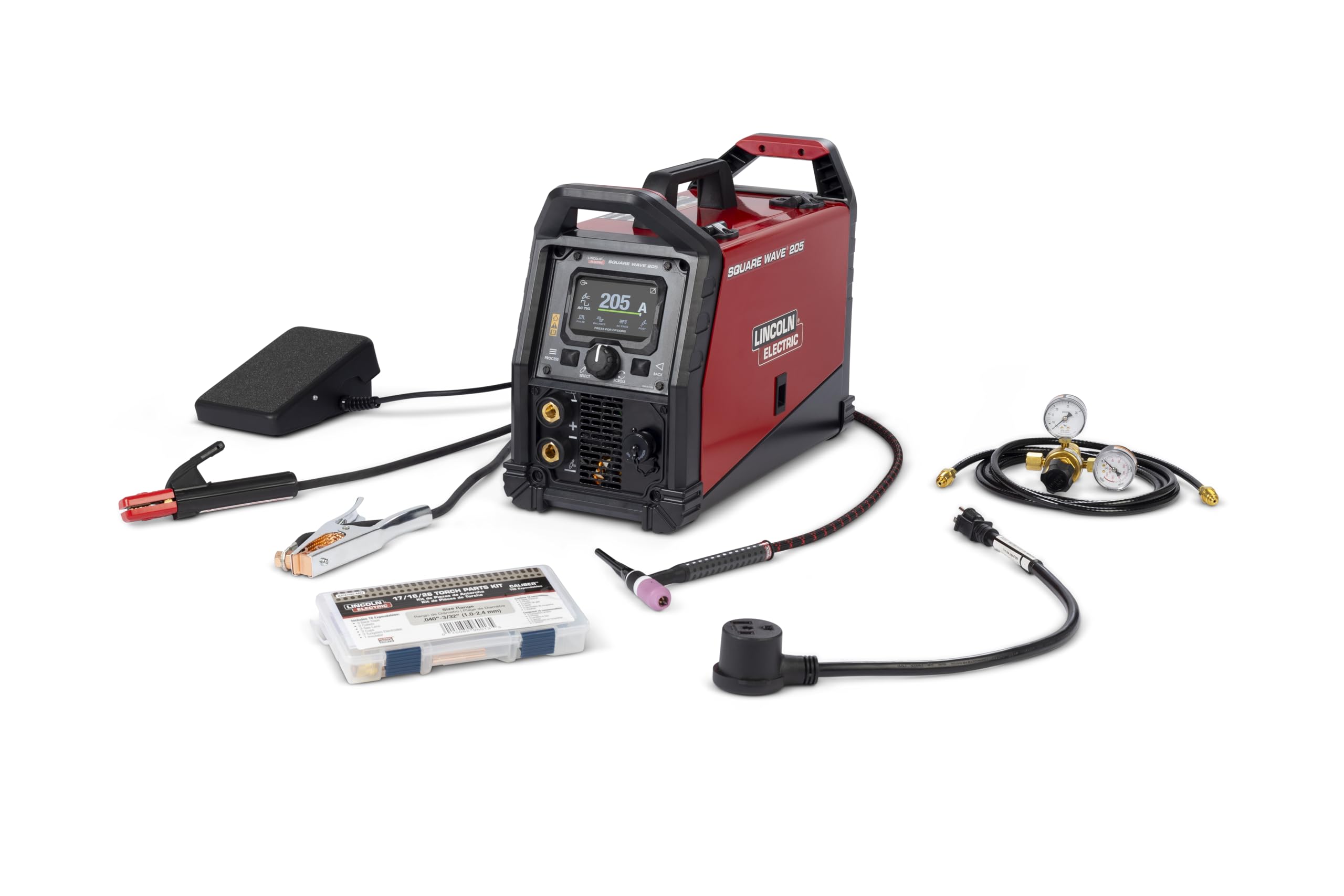
6. Lincoln Electric Square Wave 205
A brand-name machine that proves portability doesn’t mean compromising quality.
When you see Lincoln Electric on a machine, you expect a certain level of reliability, and the Square Wave 205 delivers. This unit breaks the mold of heavy, cumbersome TIG welders by weighing just 36 lbs (16 kg), making it genuinely easy to move around a shop or take to a job site. The built-in handles make portability a breeze, and it plugs into a standard 120V circuit or 230V for maximum output, so you’re covered wherever you land.
For aluminum, it offers the core controls that matter: AC Frequency Control to adjust the weld bead width from tight to wide, and adjustable AC Balance to shift between more cleaning action on dirty aluminum or maximizing penetration on thick material. It’s a multi-process unit, offering both TIG and Stick welding from one power source, which is ideal for outdoor work or thicker materials where a TIG torch isn’t the best choice.
New owners frequently mention the “easy high freq starts” and that the “auto settings are pretty close” without much fiddling, making it forgiving for those learning TIG. The fans are noted as slightly loud when running, but they quiet down when not in use. It arrives with a solid assortment of accessories and even includes a 30-amp to 110V adapter, which is a thoughtful touch for flexibility.
Why buyers pick Lincoln
- Only 36 lbs with great handles for true portability
- Dual 120V/230V input with a convenient adapter included
- Trusted brand with accurate, easy-to-use arc controls
A genuine trade-off
- Lacks the advanced pulse customization of some rivals
- Fans run audibly louder than inverter competitors
The trustworthy traveler: This is the pick for anyone who wants a reliable, lightweight machine from a heritage brand.
You’d be fine with it if: You prioritize a proven name and ease of use over maximum adjustability.
7. Everlast PowerTIG 200DV

A low-amperage specialist that starts arcs smoothly even at just 5 amps.
The PowerTIG 200DV excels at the delicate end of the spectrum, which is often where TIG welding gets tricky. Its stand-out feature is a low start amperage of just 5 amps in DC mode and 20 amps in AC mode, allowing for incredibly gentle arc initiation on thin, heat-sensitive material. This makes it a fantastic choice for precision work like thin-gauge stainless or fine aluminum sheet, where a hot start would instantly warp the metal.
It’s a dual-voltage machine running on 120V or 240V, providing flexibility for home garages with standard outlets or shops with higher power. The built-in Lift Start function is perfect for environments where high-frequency start is undesirable, offering smooth arc starts without electrical interference. Pre and post-flow gas control is standard, and it includes Arc Force control (DIG) to improve Stick welding performance and reduce spatter.
The “Fan-on-Demand” feature is a small quality-of-life win that owners specifically call out, as it doesn’t run continuously and keeps the shop quiet. Buyers upgrading from entry-level machines consistently note the improvement in arc smoothness and build quality. It’s frequently described as “perfect for any hobbyist” and an ideal choice for racecar fabrication and shop repairs.
Precision strengths
- 5A low-start amperage for ultra-thin DC work
- Quiet Fan-on-Demand cooling system
- Lift start option for clean, HF-free ignition
Things to expect
- TIG welding has a steep learning curve, so plan for practice
- Setup errors with polarity are easy to make unknowingly when learning
For the detail-oriented hobbyist: If thin metals are your primary focus, this machine’s low-end control is exceptional.
Reach elsewhere if: You need heavy-duty, continuous production welding at high amperage.
8. Everlast PowerTIG 255EXT

Serious firepower with 4 AC waveforms for welders who need professional-grade results.
This is the machine you step up to when your skills and projects outgrow a 200A unit. The PowerTIG 255EXT delivers a substantial 255A of output, giving you the headroom to weld thicker aluminum and steel with confidence. It operates down to incredibly low amperages—3 amps in DC and 5 amps in AC—for delicate work, while offering an advanced pulse up to 500Hz in DC and 250Hz in AC for exceptional arc control.
The advanced digital microprocessor control is the brain here, offering 4 distinct AC waveforms: Sine, Triangular, Soft Square, and Advanced Square Wave. Each shape changes how the arc behaves, letting you tune for maximum penetration, minimal warping, or a softer, more forgiving puddle. A 10Hz pulse mode specifically enhances penetration on thicker material. It also includes a VRD function for shock reduction in stick welding environments, plus arc force and hot start controls.
Owners are emphatic about its quality, with comments like it “runs as good as my Miller Dynasty” and “green is just as good as blue or red.” It’s a dual-voltage 110V/220V unit and includes both air and water-cooled torch options, though a separate water cooler is needed for the 20-series torch. The main cautions are its physical footprint—at 85 lbs, it needs a dedicated cart—and a gas hose placement that benefits from a minor 90° fitting adjustment.
The pro advantage
- 4 AC waveforms offer class-leading arc tuning flexibility
- Runs 6010 cellulose stick electrodes that smaller units cannot
- High-frequency start with ultra-low 3A DC operation
Considerations
- At 85 lbs, it’s a heavy, stationary piece of equipment
- Water-cooled torch setup requires an additional cooler purchase
The definitive upgrade: For the advanced welder ready to leave mid-range limits behind, this is a final-destination machine.
Hold off if: You’re a beginner—this much power and capability could overwhelm a developing skill set.
9. ESAB Rebel EMP 205ic AC/DC

The ultimate multi-process toolbox with an arc that adapts to your technique.
The ESAB Rebel is the complete fabrication suite in a single, portable box. It’s a true all-process machine, excelling at MIG, Flux-Cored, STICK (including 6010 electrodes), DC TIG, and AC TIG. The headline feature is the exclusive sMIG (“smart MIG”) technology, which continuously learns and adapts to your welding technique, providing a stable arc and repeatable welds. This reduces training time for novices and increases productivity for experienced welders.
For TIG use, it includes professional features like High Frequency start in both DC and AC modes, balance adjustment, and frequency adjustment, plus Pulse DC for better control on thin materials. The rugged design includes a 5-handle roll cage for easy transport, and at just 49 lbs (22 kg), it’s remarkably portable for its capability. The TFT multilingual display offers 4 programmable memory locations per process, giving you extensive fine-tuning control.
Owner feedback is strikingly positive, with one saying it “stick welds 7018 better than any I’ve used” and another declaring “Miller has met its match.” Buyers appreciate that it’s a complete fab shop kit, including a MIG gun, stinger, electrodes, and a mid-tier TIG torch. The only noted issue is that the pin connection for the pedal and gun feels a bit loose, which some fear may eventually need attention.
What makes it special
- True all-process capability from MIG to AC TIG in one unit
- sMIG technology adapts in real-time to your welding style
- Roll cage design and 49 lbs weight offer serious portability
Honest caveats
- Premium price point places it firmly in professional territory
- Pin connectors for the pedal are a known weak point
For the do-it-all fabricator: If you want one machine to handle an entire shop’s workload, this is the ultimate choice.
Overkill for you if: You only plan to TIG weld occasionally and don’t need MIG or advanced Stick capabilities.
10. LOTOS TIG200ACDC

The dual-voltage beginner’s ally that fuses 3/8″ steel down to thin sheet with ease.
For the hobbyist working on cars, exhausts, or general DIY fabrication, the LOTOS TIG200ACDC hits a very balance of price and performance. This 200A AC/DC square-wave inverter provides a clean, stable arc for aluminum, stainless, and mild steel. Its dual-voltage (110V/220V) capability means you can run it off a standard household outlet or a dryer-style 220V plug, a huge convenience for home use.
It offers a 10-200Amp AC/DC TIG current output and a 15-200Amp DC Stick/MMA output, covering a wide range of metal thicknesses—from 3/8″ steel down to thin sheet metal. The high-frequency start hand torch and precise foot pedal control give you the finesse needed for quality TIG work. It comes as a comprehensive package, including the power supply, TIG torch, MMA stick clamp, foot pedal, and an argon regulator, so you’re not nickel-and-dimed on essentials.
The customer support backing is a strong plus, with a 30-day money-back guarantee, a 1-year replacement warranty, and a total 3-year limited warranty. Buyers find it a “quality hobby-level welding unit” that handles multi-pass aluminum work well. The recurring advice is that beginners should be patient with the AC TIG learning curve, and some note the amp dial isn’t perfectly accurate, requiring occasional fine-tuning based on the weld pool.
The value points
- True dual voltage 110V/220V for home flexibility
- Argon regulator and foot pedal included in the box
- Backed by a 3-year warranty and responsive support
Beginner’s notes
- Foot pedal gets mixed feedback on long-term durability
- Amp dial calibration isn’t perfectly precise
Great starting point: This is a forgiving, well-priced machine for learning AC TIG on cars and small fab projects.
Move up when: You outgrow its 200A limit and need advanced waveform control.
11. Everlast PowerTIG 185DV

An analog-friendly dual voltage unit that’s ideal for on-the-go repair work.
The PowerTIG 185DV is the welder for those who prefer straightforward, tactile controls over complex digital menus. It offers dual voltage capability (110V or 220V), providing flexibility to work anywhere a power outlet is available, whether that’s a home garage or a remote job site. The easy-to-read analog-style settings allow for quick, intuitive adjustments, making it user-friendly for both shop projects and on-the-go jobs.
The digitally controlled IGBT inverter delivers a smooth, steady arc for high-quality welds, and its performance is often compared favorably to top industry brands. It includes AC/DC TIG pulse function with 2 pre-programmed settings (1 or 50 pulses per second) and Stick welding capability, offering good versatility. Owners who upgraded from entry-level machines find it a significant step up in arc stability and control, specifically noting it welds 18-10 gauge aluminum cleanly.
It’s a “bang for the buck” favorite, with buyers noting its sturdy build quality and excellent value. A key point of praise is Everlast’s warranty support, which one reviewer noted as “awesome” after a mainboard failure was quickly covered with fast support and a detailed DIY repair guide. As with many units in this class, the included accessories are described as mid-tier, and some recommend an upgraded torch whip for maximum performance.
Its dependable nature
- Simple analog-style controls for quick, intuitive setup
- Dual voltage flexibility for shop and remote work
- Excellent manufacturer warranty support from owners’ experience
What to know
- Pulse function lacks a variable dial, offering only 2 fixed rates
- Minimum amperage sits above 20A, limiting ultra-thin work
Ideal for the mobile hobbyist: Its portability and simple controls make it a great grab-and-go shop tool.
Not for precision micro-work: If you frequently weld under 20 amps, you’ll want a machine with lower minimum output.
Understanding the Specs
AC Balance
When welding aluminum with AC, the current alternates between cleaning the oxide off the surface and penetrating the base metal. AC balance lets you control this ratio. More cleaning action helps on dirty material but reduces penetration; more penetration means less cleaning but a deeper weld. This control is critical for dialing in the perfect weld pool.
Duty Cycle
This is the percentage of time a welder can operate at a given amperage within a 10-minute period before overheating. A 40% duty cycle at 200A means you can weld for 4 minutes straight, then need a 6-minute rest. A 100% duty cycle means you can weld continuously, which is vital for professional or production work.
High-Frequency (HF) Start
This technology uses a high-voltage, high-frequency spark to ionize the gas between the tungsten and the workpiece, starting the arc without touching the metal. This prevents tungsten contamination and creates a clean, consistent start every time, which is a huge advantage over older scratch-start methods.
Pulse TIG
Pulse TIG alternates between a high ‘peak’ current and a low ‘base’ current at a set frequency. This reduces overall heat input into the workpiece, preventing burn-through on thin material and reducing distortion. It also promotes a consistent ‘stack of dof dimes’ weld appearance, which is why it’s so prized for aluminum work.
FAQ
What is the difference between AC and DC TIG welding?
Do I need a 220V outlet for an AC TIG welder?
What does a foot pedal do on a TIG welder?
How thick of aluminum can a 200A AC TIG welder weld?
What are the benefits of a square wave vs a triangular wave in AC TIG?
Why do I need a gas lens on my TIG torch?
What is pulse frequency measured in and why does it matter?
Is it worth buying a premium welder like the ESAB Rebel for home use?
Final Thoughts: The Verdict
For most buyers, the ac tig welder winner is the Weldpro 200A because it delivers the most complete package of power, versatility, and included accessories for its price, making it a machine you won’t outgrow quickly. If you want a lightweight, budget-friendly unit for home projects, grab the HITBOX 200A. And for the welder who needs professional-grade waveform control and program memory, the Everlast PowerTIG 210EXT is the one to reach for.
How We Picked
We do not accept paid placement. Every pick is matched to a real buyer and a real use-case; we do not hands-on test units.
Sources & Methodology
Specifications: manufacturer listings and product documentation. Review insights: verified customer reviews, as of August 2026. Pricing: not shown on this page (it changes often); check the current price via the retailer link.
As an Amazon Associate, Gadgets Feed earns from qualifying purchases. This does not affect which products we feature.