
Our readers keep the lights on and my morning glass full of iced black tea. As an Amazon Associate, I earn from qualifying purchases.
Specs are compiled from manufacturer listings and verified buyer reviews and can change over time — please confirm the key details on the product page before buying.
The biggest frustration with a corded sander isn’t the sanding—it’s the constant drag of the cord, the hunt for an extension lead, and the dust that goes everywhere. A battery powered orbital sander cuts all of that out, letting you work on a vertical surface, a car door, or a ladder without fighting the cable.
I’m Min — the founder and writer behind Gadgets Feed. This guide is built by comparing the manufacturers’ published specifications and the patterns across verified customer reviews, so you get each pick’s real strengths and trade-offs instead of marketing spin.
You want a tool that keeps up with your projects without dying mid-pass, and these cordless models deliver that balance of runtime and cutoff. battery powered orbital sander picks like these are your ticket to a cleaner, freer finishing experience.
Our Picks at a Glance

How To Choose The Best Battery Powered Orbital Sander
Match the tool to the workload. A quick touch-up on a table leg needs far less muscle than stripping an entire deck, and the cordless sander you pick should reflect that difference.
Think About Which Battery Ecosystem You Already Own
If you already have a set of 20V or 18V power tools, staying in that brand’s family means you can share batteries and chargers. That saves you money and lets you grab a spare battery when it counts. If you are starting fresh, look at what each kit includes, since some ship with a battery and charger while others are bare tools.
Balance Speed, Runtime, and Weight
The orbital speed, measured in RPM, tells you how much material the sander can chew. A higher top speed like 12,000 RPM works better for fast stock removal, while a lower speed range of around 6,000 RPM is for finishing. Remember that a bigger battery adds runtime but also adds weight, so find a balance that won’t tire your arm out.
Quick Comparison
| Model | Best For | Max Speed | Voltage | Weight | Amazon |
|---|---|---|---|---|---|
| Makita DBO180Z★ Best Overall | Balanced Performance | 11,000 rpm | 18V | 1.3 kg | Amazon |
| SKIL SR7603B-10Pro-Grade Power | Pro-grade Power | 22,000 rpm | 20V | — | Amazon |
| DEKOPRO 20VFull Kit Value | Full Kit Value | 13,000 rpm | 20V | 2.8 lbs | Amazon |
| WORKPRO W125228 | Lightweight Versatility | 12,000 rpm | 20V | 3.1 lbs | Amazon |
| Metabo HPT SV1813DAQ4 | Pro Finish Work | 11,000 rpm | 18V | 2.6 lbs | Amazon |
| SKIL SR660302 | Fast Charging | 11,000 rpm | 20V | 5.3 lbs | Amazon |
| FLEX FX3411-Z | Aggressive Removal | 13,000 rpm | 24V | 3 lbs | Amazon |
| BOSCH GEX18V-5N | Comfort & Control | 10,000 rpm | 18V | 2.4 lbs | Amazon |
| DEWALT DCW210P1 | Precise Variable Control | 12,000 rpm | 20V | — | Amazon |
In-Depth Reviews
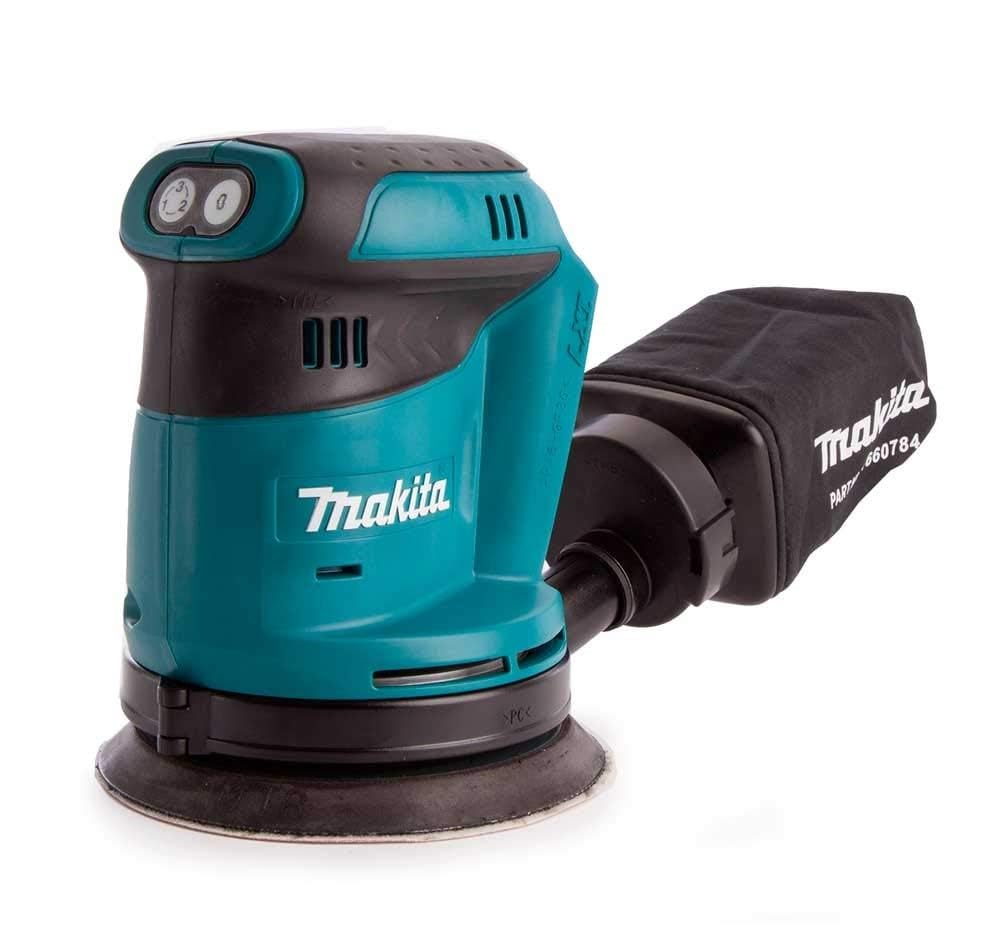
1. Makita DBO180Z
Our pick — over 4.5★ from 9,000+ verified ratings; the strongest balance of quality and price.
The featherweight that feels glued to your palm while it hums along steadily.
Owners consistently talk about the balance first. The Makita DBO180Z has “excellent balance” and “very little vibration,” which translates directly into less hand fatigue during a long finishing session. It is a bare tool, meaning you supply your own 18V battery, but that also means it slips right into an existing Makita ecosystem without paying for a charger you already own.
Its 11,000 rpm top speed is modest next to some rivals, but the draw here is the polish and control, not raw aggression. The hook-and-loop pad makes paper swaps quick, and there’s a pad brake to stop the disc spinning when you release the trigger. Reviewers describe it as their “go to sander” precisely because “not having to deal with the cord” changes how they work.
The trade-off is the 18V voltage. Its 18V platform delivers slightly less peak power than 20V rivals like the WORKPRO., which can matter if you’re constantly pushing into dense hardwood. Yet the verdict from the workshop floor is loud: this is the sander people reach for first when they need a clean, smooth result without the tangle of a cord.
Balanced performer: A great blend of comfort, low vibration, and dependable battery life that makes it the default pick for most hobbyists.
Know the limit: As a body-only tool, you need a Makita 18V battery and charger to run it.
Reach for this if: you value comfort and control over sheer speed, and you’re already in the Makita 18V battery family.
Look elsewhere if: you need a complete kit with battery and charger included in the box.
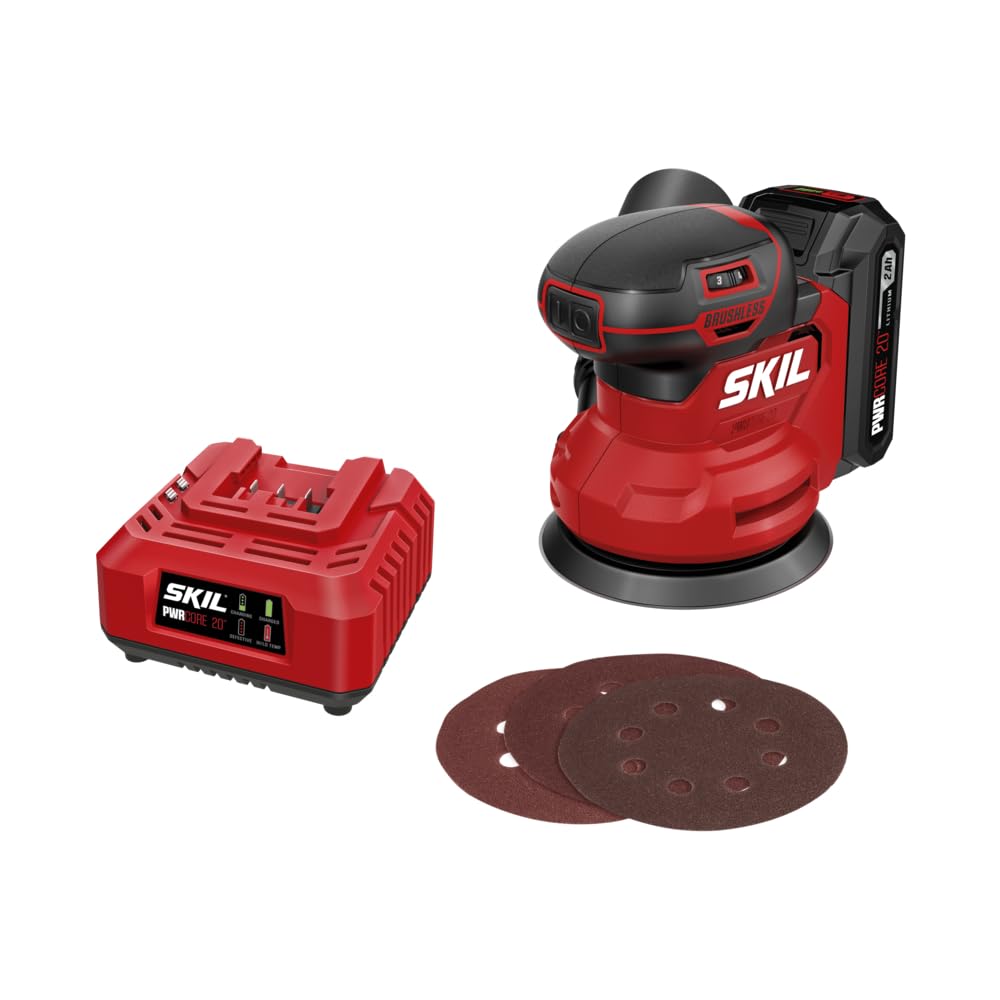
2. SKIL PWR CORE 20V (SR7603B-10)
A tiny palm sander that punches with a speed figure of 22,000 rpm versus the Makita’s 11,000 rpm.
The headline spec here is the 22,000 rpm maximum speed—double the Makita’s 11,000 rpm top speed.. That kind of orbital speed means fast, aggressive material removal when you’re flattening a panel or stripping old paint. And because it’s a brushless motor (a motor that replaces carbon brushes with electronic control), it runs cooler and lasts longer than a brushed equivalent.
The kit bundles a 20V 2.0Ah battery, charger, dust bag, and three sandpapers, so it’s ready to work from the start. A 1-1/4-inch dust port lets you hook it to a shop vac or the included bag. A variable speed dial means you can dial it down for fine finishing, and the low-profile grip with soft overmold helps keep your hand comfortable.
The seasoned pros who picked this up had strong words. One with decades of woodworking experience called it “the best sander I have used” and “the best little sander I ever used”—high praise from someone who knows a good tool. The recurring gripe is the battery removal, which some find stiff, so treat the release mechanism gently rather than forcing it.
What Wins People Over
- Class-leading 22,000 rpm for fast stock removal
- Complete kit with battery, charger, and dust bag
- Variable speed dial for finishing control
The Sticking Point
- Battery can be stubborn to pull out of the tool
- Charger release is also stiff for some hands
Who it beats: anyone who wants corded-level aggression without the cord, especially for heavy stripping work.
Who it doesn’t: those with arthritis or weak grip strength who need a tool where battery swaps are easy.
3. DEKOPRO 20V Random Orbit Sander
An everything-included bundle that still manages to sand a whole car.
The DEKOPRO brings the most complete box in this roundup: the sander, two 2000 mAh batteries, a charger, dust bag, vacuum hose adapter, and 16 sanding discs spanning 60 to 1000 grit. Having two batteries means you can keep one on the charger while the other runs, which softens the blow of its biggest weakness—runtime. One owner measured about 45 minutes of continuous sanding per full charge..
Its 13,000 rpm top speed is genuinely quick for the price tier, and seven variable speeds give you fine control between rough and finish. The hook-and-loop pad keeps paper changes fast, and an ergonomic rubber grip plus balanced counterweight design keeps vibration down. For light craft work or a one-off project, it delivers far more than its entry-level price suggests.
The catch is durability and battery life, which draw mixed feedback from owners. While the performance and quality get consistent praise—one buyer sanded an entire car on two charges—some report the battery doesn’t work for more than 15 minutes. It’s a honest fit note: this is a budget-friendly starter, not a daily professional workhorse.
Best for: DIYers and crafters who want a full kit for small projects and don’t need all-day runtime.
Think twice if: you have large jobs where 15-minute battery life would stop you mid-pass.
4. WORKPRO 5-Inch Brushless

A nimble 3.1-pound palm sander that’s easy on smaller hands and tight budgets.
If you have a smaller hand, the WORKPRO is built for you—owners specifically call out that it’s “perfect for a smaller hand,” and at 3.1 pounds it sits on the lighter side of this list. The soft rubber palm area keeps your grip comfortable, and the 6 variable speeds from 6,000 to 12,000 RPM let you slow down for a delicate finish or speed up for faster passes. Its 20V brushless motor (a motor type that uses electronic controls instead of brushes, so it runs quieter and without sparks) is a real upgrade over a brushed motor.
The kit includes the sander, a 20V 2.0Ah 2000mAh battery, charger, dust collector, tool bag, and 15 sanding discs in five grits. The dust collection has a split personality—some owners find it “good” and effective, while others say it clogs and blows dust everywhere, so wearing a mask is a wise move either way. The speed switch sits where you can adjust it mid-work, which is handy.
You’ll want an extra battery and more sandpaper, as owners readily admit. But the price-to-value read is strongly positive: it’s an affordable, capable entry into cordless sanding that shares 20V batteries with other WORKPRO tools if you expand your kit later.
A lighter touch: Great ergonomics and adjustable speeds make it ideal for smaller hands, detailed work, and finishing passes.
The honest flaw: Dust collection is inconsistent—sometimes great, sometimes clogging.
Pick it if: you want a lightweight, budget-friendly sander that’s gentle to hold and shares WORKPRO 20V batteries.
skip it if: you need industrial-grade dust containment for a dust-free workshop.
5. Metabo HPT SV1813DAQ4

A lightweight finish specialist that sips battery and grabs every contour.
Weighing just 2.6 lbs, the Metabo HPT is built for extended finishing work without arm fatigue. It runs 7,000 to 11,000 OPM across 6 speed settings, and an electric brake stops the pad quickly when you release the trigger—a productivity boost when you’re checking your work repeatedly. The one-handed dust bag stays on well and collects effectively, which surprised even skeptical owners.
This sander is part of the MultiVolt Metabo HPT battery system, meaning you can run it on lighter 18V packs or supercharge runtime with up to an 8.0Ah MultiVolt battery. Owners note it “sips battery” and finds it a worthy replacement for a corded DeWalt that died after a year. The included kit has two sanding pads, a dust bag, a 1-3/8-inch dust port, and two collection adapters.
The honest fit note: it’s a bare tool with no battery included, and it’s noticeably heavier when you slot in a large 8Ah pack, tilting toward the battery side. But the grip options—top or side—help you manage that weight. For remodelers and finish carpenters, the smooth surface it leaves is the whole point.
Why Pros Like It
- Ultra-light 2.6 lbs body reduces fatigue
- Electric brake stops the pad fast
- Sips battery with long runtime per charge
Weight Trade-off
- Gets heavy with large 8.0Ah batteries attached
- Battery and charger sold separately
Best for: finish carpenters and remodelers who want a smooth surface and long runtime in an 18V MultiVolt ecosystem.
Not for: anyone who wants a ready-to-run kit with a battery in the box.
6. SKIL PWRCore 20 (SR660302)

A brushless scorer that recharges in five minutes flat via its PWRJump charger.
The defining trick of this SKIL kit is its PWRJump charger, which delivers a 5-minute quick charge and a full charge in 30 minutes.. That changes the runtime math completely—short bursts of work become painless when the battery tops up between passes. Buyers report the battery runs up to 90 minutes at speed 1 and about 60 minutes at speed 6, recharging fully in roughly an hour..
Its brushless motor pushes up to 22,000 RPM with variable speed control, and the microfiltration dust canister keeps the air cleaner while the dust-sealed switch extends tool life. The hook-and-loop pad makes paper swaps quick. The included battery even has a USB port for charging your phone on the go—a thoughtful extra.
The recurring concern is the hook-and-loop pad itself, with one owner reporting the Velcro sheet detached after heavy use due to vibration. It’s worth treating the pad gently and checking it occasionally. Overall, the battery life is the thing everyone raves about, with buyers noting it “outperforms even plug-in units” they’ve used before.
Reach for this if: you hate waiting on charges—the 5-minute PWRJump top-up minimizes downtime between passes..
Keep an eye on: the hook-and-loop pad, which some owners found detaches after extended vibration.
7. FLEX FX3411-Z

A 24V bruiser with a turbo mode that melts material away at 13,000 OPM.
If raw removal speed is your priority, the FLEX FX3411-Z leads the pack. Its turbo mode hits a class-leading 13,000 OPM, and the 24V lithium platform delivers 20% more power than lower-voltage rivals. Owners consistently call it “the best sander on the market,” noting it feels powerful, fast, and lightweight in the hand with zero vibration.
This is a tool-only purchase—battery and charger are sold separately—so it’s aimed at someone already invested in the FLEX 24V ecosystem. The low-profile design, pad brake with 5X more endurance, and dust and water-resistant switch all point to a pro-grade build. The sensor-free brushless motor eliminates friction for higher efficiency.
The trade-off is runtime, which gets mixed feedback. At speed 3, you can expect up to 30 minutes on a 3.5Ah stacked battery, and some owners say it doesn’t last very long under heavy use. But the recharging is incredibly fast, and the smoothness and comfort are so good that some buyers purchased two more just to keep different grits loaded.
Aggressive and smooth: Class-leading 13,000 OPM for fast material removal, wrapped in a comfortable, low-vibration body.
The catch: Runtime is the weak link, so budget for extra FLEX 24V batteries.
Best for: pros who own FLEX 24V tools and need maximum material removal in a comfortable package.
Not for: newcomers without an existing FLEX battery system—you’ll pay extra for power.
8. BOSCH GEX18V-5N

The 2.4-pound ergonomic marvel that lefties and righties both love to hold.
The Bosch GEX18V-5N is the comfort specialist of this lineup. Weighing just 2.4 lbs with a compact palm-grip design, it’s the lightest sander here, and owners rave about its ergonomics and balance—one even notes it’s superb for left-handed users. The vibration-dampening element and soft-start technology (which eases the motor in gently) keep fatigue low during long sessions.
Its 10,000 rpm top speed is on the gentler side, but the constant-speed electronics keep the pad spinning reliably under load. The mobile dust collection lets you choose between a dust bag or a vacuum hose via a vac interface, and owners mention near-zero residue when hooked to an extractor. A 4Ah battery provides about an hour of full-speed sanding, enough for a 4×8 plywood sheet per charge..
The chief complaint is battery placement—centered on the disc rather than in the handle, you have to pull up slightly to keep the disc level, which speeds up fatigue. It’s a compromises worth making for the comfort.
Comfort First
- Ultra-light 2.4 lbs with superb ergonomics
- Quiet, low-vibration operation
- Excellent dust collection with a vacuum
Ergonomic Quirk
- Battery placement requires pull-up effort to keep level
- Less stock removal power than a corded unit
Reach for this if: comfort and low fatigue matter more than raw speed, especially for detailed finishing work.
Look elsewhere if: you need aggressive material removal and don’t mind a heavier tool.
9. DEWALT DCW210P1
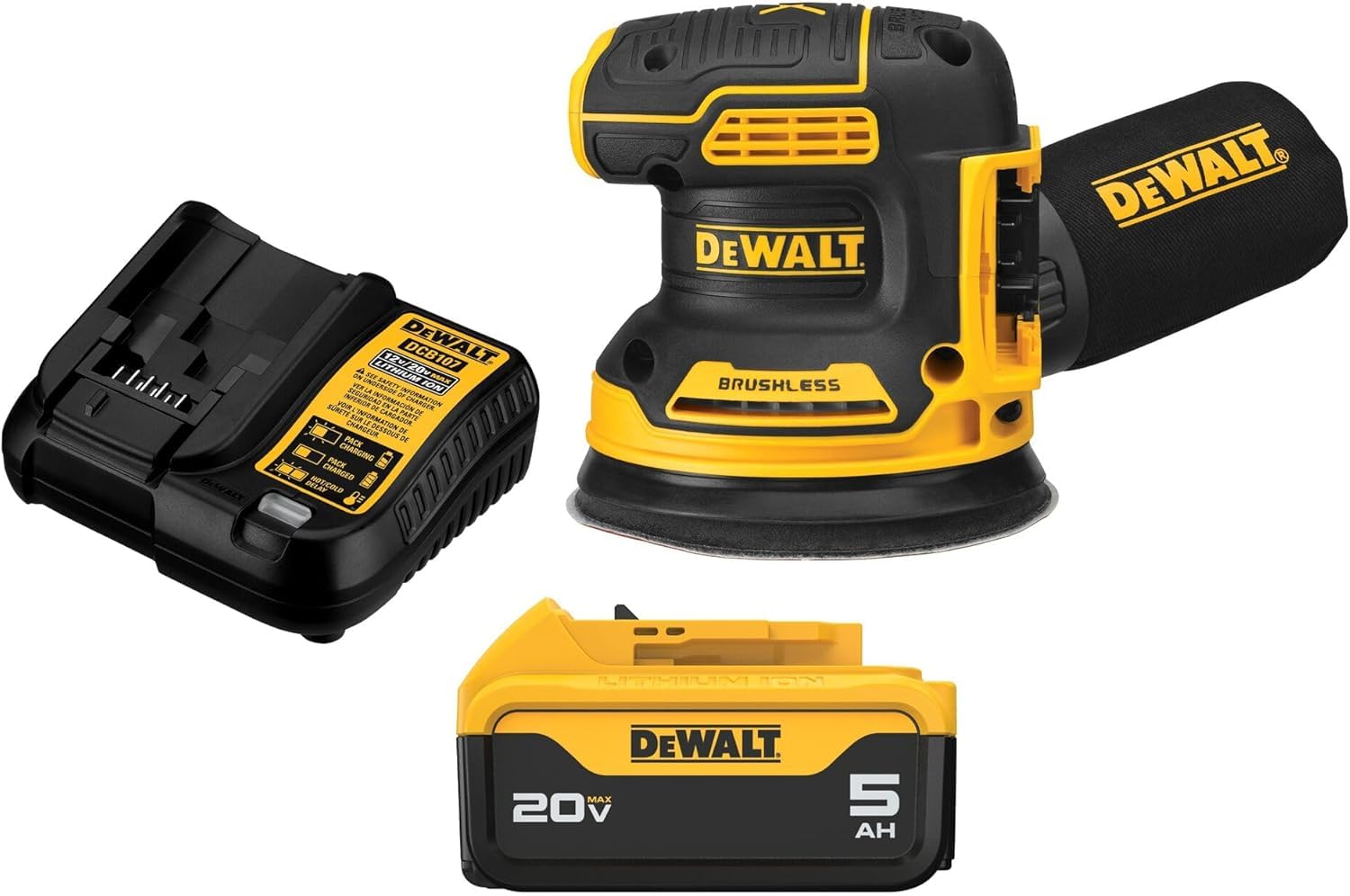
A workshop favorite with instant-stop braking and a 12,000 OPM ceiling.
For precise sanding, the DEWALT DCW210P1 hits a balance between power and control. Its brushless motor delivers variable speed from 8,000 to 12,000 OPM (orbits per minute—how many times the pad moves in a circle each minute), and the low-profile height lets you get close to the work surface for accurate work. Owners specifically love the instant stop on power-off—versus the 10-15 second run-on of some rivals, like the WORKPRO—which speeds up your workflow noticeably.
The kit includes the sander, a 20V MAX 5.0Ah battery, and charger, giving you solid runtime right in the box. The replaceable 8-hole hook-and-loop pad (DWE64233) makes paper changes quick, and the texturized rubber overmold grip stays comfortable. The one-handed locking dust bag is genuinely handy, and the dust-sealed switch protects against grit ingestion.
The recurring complaint is battery life, with some customers note only about two hours of runtime before recharging.. The battery and canister also protrude, which can limit access in tight corners. For a “sander that saved hours of hand sanding” and feels “joy to use,” these are fair trade-offs for a tool that performs “better than corded models” according to some owners.
Precise and powerful: Instant-stop braking plus a wide 8,000-12,000 OPM range gives you fine control across applications.
The honest limit: Battery life is mixed—some owners get about two hours, so a spare pack helps.
Best for: DEWALT 20V owners who want a versatile, precise sander with a full kit in the box.
Not for: tight-corner work where the protruding battery and canister get in the way.
Understanding the Specs
Orbital Speed (RPM/OPM)
This tells you how fast the pad spins in a circular orbit, measured in revolutions per minute (RPM) or orbits per minute (OPM). A higher number like 13,000 RPM removes material faster, while a lower speed around 6,000 RPM gives you a finer finish. Variable speed dials let you switch between the two without changing tools.
Brushless Motor
A brushless motor uses electronic control instead of carbon brushes that wear out over time. It runs cooler, lasts longer, and delivers more power per battery charge than a brushed motor. This is why nearly every premium cordless sander on the market has gone brushless—it’s the difference between a tool that lasts years and one that dies young.
Battery Voltage and Capacity
The voltage (18V vs 20V vs 24V) roughly indicates the power ceiling, while the capacity in Amp-hours (Ah) determines how long it runs. A 2.0Ah battery might give you 45 minutes of sanding, while a 5.0Ah pack can stretch to two hours. Since voltage across brands isn’t directly comparable, focus on the ecosystem you already own and the runtime you actually need.
Dust Collection
Orbital sanders create a lot of fine dust. Built-in dust canisters or ports that attach to a shop vacuum keep the air cleaner and your work surface visible. Microfiltration canisters trap more particles, while vacuum-ported models give near-zero residue when connected to an extractor.
FAQ
Will a battery powered sander have enough power for hardwood?
How long does a cordless sander battery last?
What is the difference between orbital and random orbital sanders?
Is it worth buying a kit with a battery and charger included?
What grit sandpaper should I start with?
Are brushless sanders worth the extra cost?
Can I use a cordless sander with a shop vacuum?
Do heavier batteries make the sander harder to use?
Final Thoughts: The Verdict
For most buyers, the battery powered orbital sander winner is the Makita DBO180Z because it blends comfort, low vibration, and dependable balance into a tool owners genuinely reach for first. If you want class-leading speed and aggressive removal, grab the SKIL SR7603B-10 with its 22,000 rpm. And for a complete budget-friendly kit that works from the start, the DEKOPRO is the one to reach for.
How We Picked
We do not accept paid placement. Every pick is matched to a real buyer and a real use-case; we do not hands-on test units.
Sources & Methodology
Specifications: manufacturer listings and product documentation. Review insights: verified customer reviews, as of August 2026. Pricing: not shown on this page (it changes often); check the current price via the retailer link.
As an Amazon Associate, Gadgets Feed earns from qualifying purchases. This does not affect which products we feature.